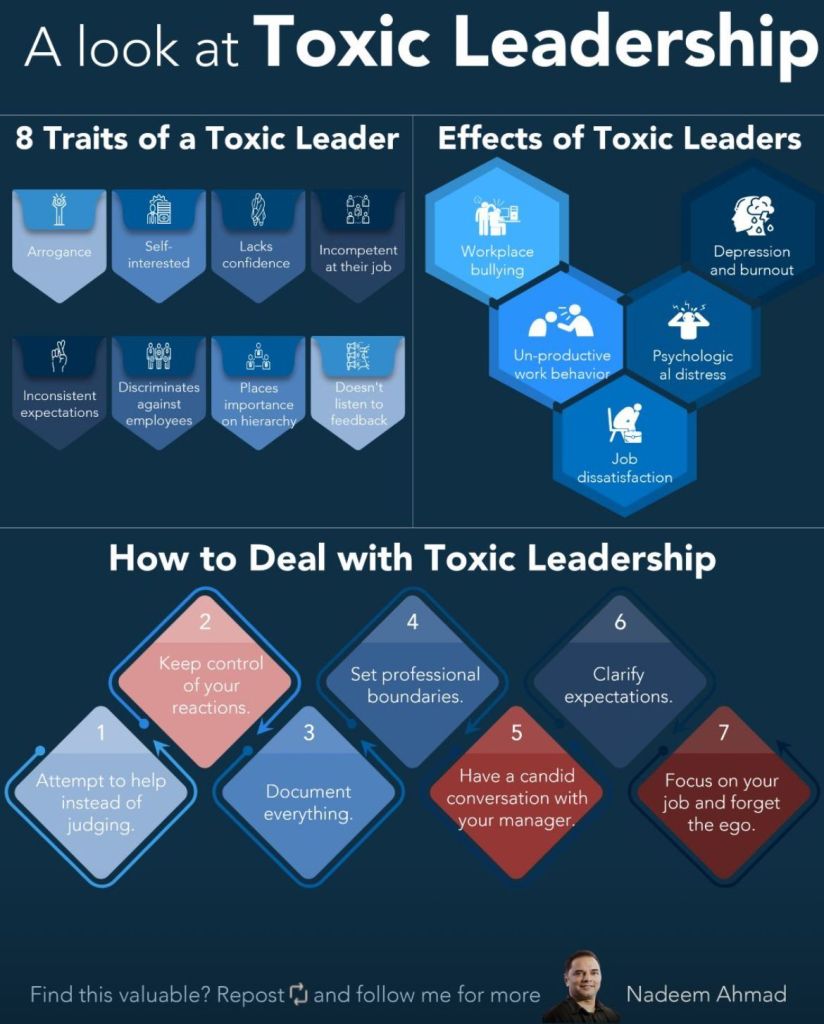
PhD Top Tips on Managing Your Supervisors: Love em or hate em, there’s no completion without them

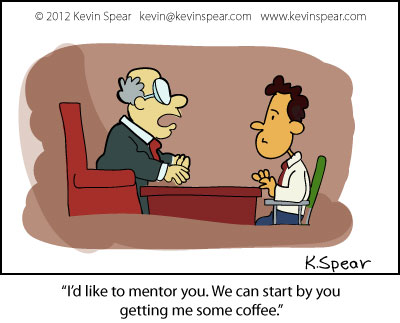
I posted a couple of weeks ago about application tips when applying for a PhD. In that post, I talked a bit about researching the supervisors in order to be able to talk about their work and department. In all honesty, though, there is a much stronger reason to start early on understanding your supervisor. They can make or break your experience during your PhD.

It’s no secret that I did not have the best supervisory experience during my own PhD, and there are plenty of reasons for that, but one of the main ones was that I didn’t start off understanding enough that there is a requirement to curate and nurture the supervisor – student relationship. I didn’t know what questions to ask, what clarity to seek, or frankly even what was normal. The relationship therefore broke down, and I retrospectively had to unpick why. Having learnt the hard way, and now having sat on both sides of the table, I thought I would share some thoughts about how to get the most out of your relationship with any academic/educational supervisor, PhD or not.

Do your research

As I’ve said, doing your research should probably start before you even have the post. It’s worth reaching out and speaking to previous and current students so you can to get an idea of what their experience has been. If you are already in post, it’s still worth speaking to people to find out as much as you can about what kind of supervision style they’ve experienced. Every supervisor is different, just like every leader is different. The more you know, the better placed you are to understand what the dynamics of your relationship might look like, and importantly whether there are any possible pitfalls which you could then address early, preventing then becoming something more. In this one, knowledge really is power. So get as much knowledge as you can as early as you can.

Expectations matter

We all enter relationships and situations with expectations, but too often, these are internalised and therefore opaque to both ourselves and others. Not getting these into the open where they can be discussed and expectations clarified can be a key reason for relationship breakdown, at least it was for mine. One of the reasons I think this happens is because, as students, we are often entering a completely new arena, and so we just don’t know the unwritten rules. I’d like to think that most supervisors know this and will therefore spend time at the starting point of the relationship to talk through what their expectations are. I’ve previously written about the use of learning agreements to help this process. Sadly, I’m all too aware that this is often not the case, and supervisors, who live in this different world, often forget that others don’t come with all the information they may need to deliver what is expected.

Get to know their work and working patterns

My inbox is the place where emails go to die, and my diary is a horror show. These are facts. No matter how much I try to keep up, I get hundreds of emails every day, and to be honest, I can’t. If you only send me a single email, it will get lost. If you try to get a same day meeting with me, you will fail. I therefore ask that, if it is important, you email me three times and make it high priority. This vastly increases the chance that I will see it. If you want to see me every 2 weeks, then let’s get a regular slot in, which will move, but at least it’s there. All of this is not because I don’t care, it’s just the only way I can manage multiple competing priorities. Everyone is different. You will have your own way of working, as will your supervisor. There is no point in being passive in the process and miserable about the outcome. If you have needs, you have to actively work to find the best way that they can be met.

Be aware that you are the one driving your work

One of the largest changes when you start a PhD is that it is YOUR PhD. You are in the driving seat. A PhD is effectively a job, and the switch up to the responsibility sitting with you can be a challenging shift. No one is policing deadlines, and in fact, you are the one that should be setting them. No one is prioritising your workload. You need to work out, with support, what needs to come first at any given time. The lesson about not being passive is important across all aspects of your PhD. You are no longer in a taught process. A PhD is effectively an apprenticeship in research, and like in any job, there are expectations placed on the employee in terms of delivery and performance. The earlier you can come to terms with this the easier your pathway will be.

Identify peer support

All of this change can make the start of any PhD stressful, and you will need to find sources of support outside of your supervisor.  Even if you have a great relationship with your supervisor, even if everything is going well, there will be times when you dislike them or part of your PhD. In these circumstances, you need to have safe spaces to vent and seek support alongside benchmarking from others. It’s important to invest some time early on to build wider relationships with your peers and, if in a small lab, potentially seek out groups or networks. These will stand you in good stead during your PhD, but also in your future career, as learning to build networks is a key skill to be invested in.

Know your benchmarks

Everyone enters a PhD at a different place. The same is also true for PhD projects, some are more developed on day one than others. It can be hard therefore to work out how you are doing, especially if you haven’t established supervisor expectations. There are some useful tools out there to help. Every University should have some form of pathway which lays out the dates and timelines that PhD students need to deliver on, from reporting and upgrade to final submission. These are invaluable in making sure that you are on track and on target for your work. Projects will often have individual timelines, if they are grant funded, that you need to maintain. Grant funded projects will usually have milestones, reporting, and dissemination deadlines, which need to be kept to. It is worth noting that some of these things mean that it is not always so meaningful to benchmark against your peers. I would always advocate using them as a source of support rather than self judgement, as you may not be comparing like with like.

Manage your relationship

All relationships require work. All relationships, especially ones that last years, will go through peaks and troughs. Your relationship with your supervisor is no different, and because of this, communication is key. This sounds easy enough, but sadly, it is often not. Finding the balance between being that student who needs supervisor input into ever thought/decision, meaning you don’t find independence, and being that student who never speaks up and therefore ostriches on issues, meaning that issues don’t get addressed, is not an easy one. It requires the pair of you to build trust, and that is a gradual process. A lot of this is helped by laying the groundwork and having open discussions about expectations. Being open to supportive feedback, asking questions, and owning your work by doing things like reading and coming prepared to meetings goes a long way towards making these relationships flourish. Also, being transparent about challenges and identifying issues early can mean that both sides are facilitated in addressing issues. Your supervisor can’t help if they don’t know.

Friendly is not the same as friends

I’m going to say this here, being friendly is not the same as being friends. We all hear great tales of supervisors and students being best friends. I’m sure that happens after the PhD is over, but I’ve never known it happen during. I’d like to say I get on really well with most of students. I’m invested in them. I care about them. I will happily buy them a beer in the pub. We are however not friends. My wellbeing is not on them. It is not an even relationship. I am there to support them, but I am also their boss. In a friendship, if we went to the pub, my friends and I would take turns buying in rounds and discussing our problems.  I’m pretty open about my work based challenges, but I don’t expect my students to take them onboard. I don’t ever expect them to buy me a drink. I personally don’t think that’s how these things should work. When they are done being my students, when I no longer have responsibility for them, then the relationship can become more bi-directional. Until then I have a duty of care which means I should put them first.

Know the rules

These next few ones are for if, like mine, your relationship takes on a less healthy trajectory. The first thing I learnt was that I really needed to understand the rules. That’s both the formal written rules and the informal social academic rules. It’s only by knowing these that you can judge whether the breakdown is precipitated by a valid breach. If you don’t know the rules, how can you tell if you’ve broken them? If you have broken them, then we all need to act like adults, hold up our hands, and seek forgiveness whilst taking corrective action. The other reason to know the rules is that you may need the information.  My primary supervisor refused to sign off on allowing me to submit my thesis. As I’d done my research, I knew that I didn’t need supervisor sign off, it just meant I couldn’t sue the University if I failed. Hopefully, you will never get to a similar point, but knowing your parameters will never do you any harm. This one is back to knowledge is power, and so gain as much of it as you can.

Keep up your end of the bargain

It takes two to tango, and knowing the rules won’t help if you don’t keep up your end of the bargain. Grant deadlines, if you are externally funded, are often immovable, and so if you are required to get data or reports out by a certain date it can hold ramifications, not just for you, if you don’t deliver. Even if you are not grant funded, you need to deliver on the agreed timelines you made with your supervisor. This may all sound really simple, but you would be shocked at the number of students who don’t seem to grasp this fairly straightforward concept. PhDs are not like undergraduate work where you can ask for an extension on every piece of work or merely have an assignment capped. This is your first job in research,  and like any job, if you keep missing deadlines, then eventually you will get fired. I had one PhD student who kept missing all deadlines because they believed no one would ever be allowed to fail a PhD or would be removed from the course. I had to explain to them that this was not true and show the mechanisms that existed to do just those things. After which we got on much better and they re-focussed on the task in hand. It’s obviously better if things don’t reach that point before being addressed, and so it is key both sides bear in mind the social contract they have made.

Have a plan B

If academic life has taught me anything, it’s that you should always have a plan B, and I think it’s a sensible approach no matter what stage you’re at. Hopefully, you will never need it, but strategic thinking is a good skill to develop regardless. You should always have more than one supervisor, even if the others have variable involvement. If you can, it’s always worth trying to include them and investing in developing relationships with them as well. They can provide a counterpoint view on your work, and they can help with benchmarking your relationship and expectations with your primary. Your secondary supervisor is also likely to be involved at times, such as your upgrade viva, and so understanding their expectations can be really helpful. In the unlikely event that your relationship with your primary is not great, they can also take on a mediation role to help both sides gain clarity and hopefully move forward. If you hope for the best and plan for the worst, you should have all sides covered and hopefully have the most fulfilling experience possible during you PhD.

Finally, it’s worth remembering that supervisors are people too. They have good days and bad days. They have personal stuff going on that can impact their mood and decision-making. They will make mistakes and hopefully apologise for them. They will aim for perfection and always fall short. What I hope more than anything is that you will find a supervisor who wants and drives for you to reach your potential and who always has your best interests at heart. Sometimes, that means that there will be hard conversations, and sometimes that means they will push you, as they have faith in your ability to improve. I want all of my students to grow to be better than I am. I want them to know that I have faith in them even when they feel lost and can’t find faith in themselves. So do your research and find a supervisor who works for you and the way you work. Find that supervisor who will make you better than you could be on your own.

All opinions on this blog are my own

If you would like more tips and advice linked to your PhD journey then the first every Girlymicrobiologist book is here to help!

This book goes beyond the typical academic handbook, acknowledging the unique challenges and triumphs faced by PhD students and offering relatable, real-world advice to help you:

  • Master the art of effective research and time management to stay organized and on track.
  • Build a supportive network of peers, mentors, and supervisors to overcome challenges and foster collaboration.
  • Maintain a healthy work-life balance by prioritizing self-care and avoiding burnout.
  • Embrace the unexpected and view setbacks as opportunities for growth and innovation.
  • Navigate the complexities of academia with confidence and build a strong professional network

This book starts at the very beginning, with why you might want to do a PhD, how you might decide what route to PhD is right for you, and what a successful application might look like.

It then takes you through your PhD journey, year by year, with tips about how to approach and succeed during significant moments, such as attending your first conference, or writing your first academic paper.

Finally, you will discover what other skills you need to develop during your PhD to give you the best route to success after your viva. All of this supported by links to activities on The Girlymicrobiologist blog, to help you with practical exercises in order to apply what you have learned.

Take a look on Amazon to find out more

Healthcare Science Education 2024: Embracing Your Authenticity

Today is a bit different, today is about celebrating all of who we are and what we bring to everything we do. Friday was also the day for Healthcare Science Education 2024 (#HCSEd24) which was conveniently titled ‘Embracing your authenticity’. As I know that not everyone could make it I thought it might be useful to share what the sessions contained. To do this, the organising team have come together to each blog about their key take aways from each session. So grab yourself a cup of tea and have a read, and hopefully you will finish reading this post as inspired and as happy as the day made me.

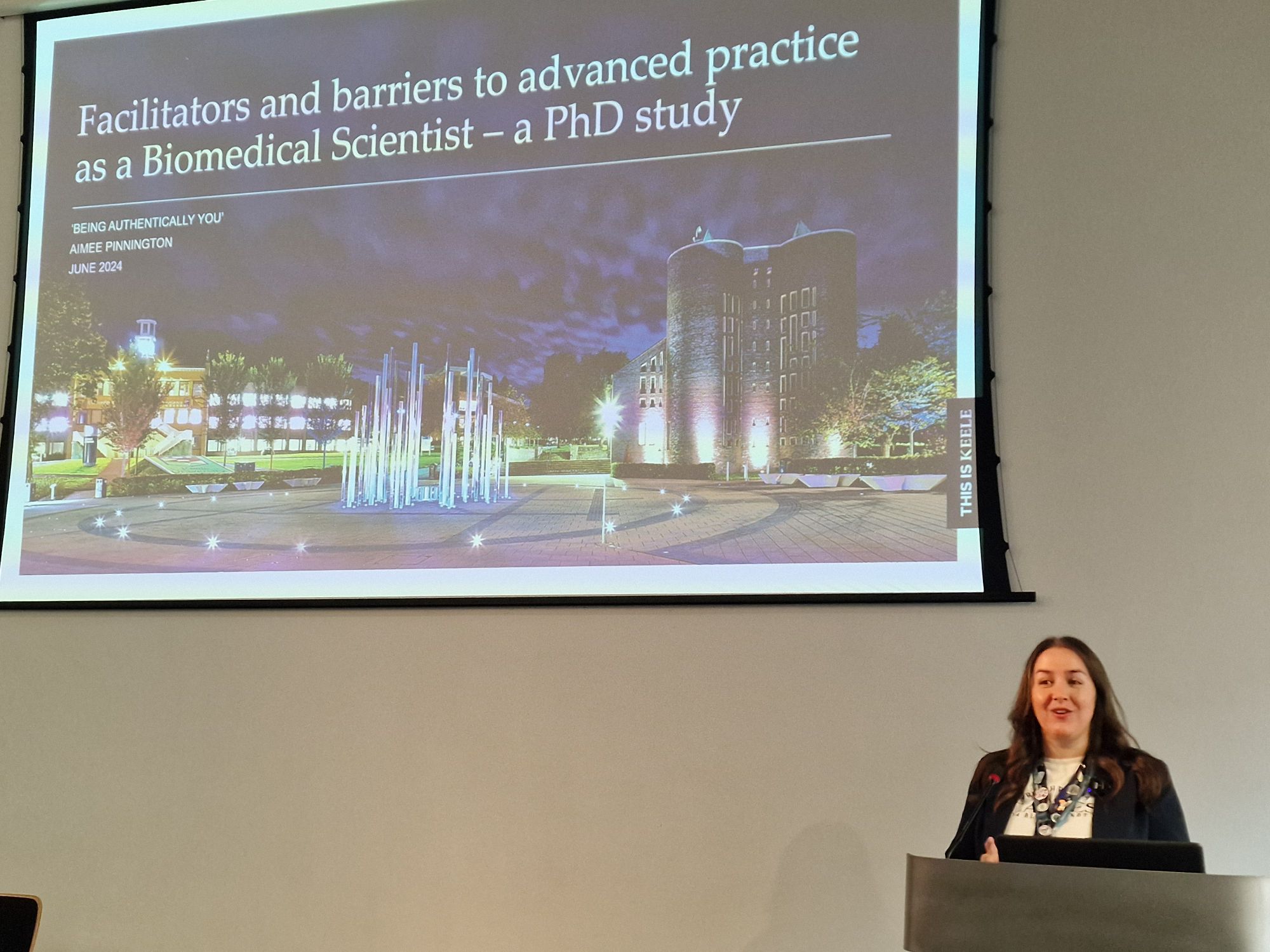
Barriers and facilitators in Healthcare Science careers – Aimee Pinnington (Keele University)

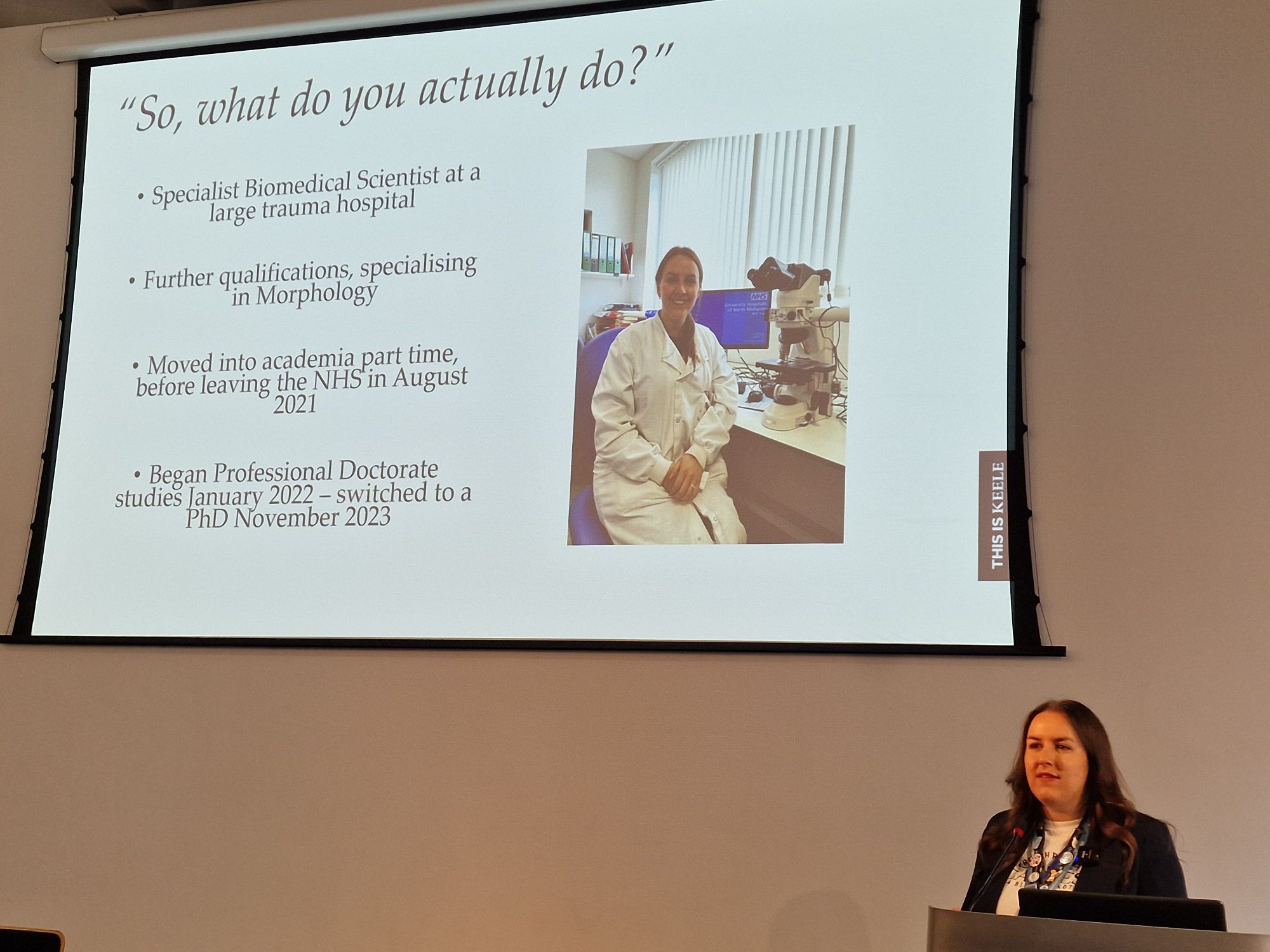
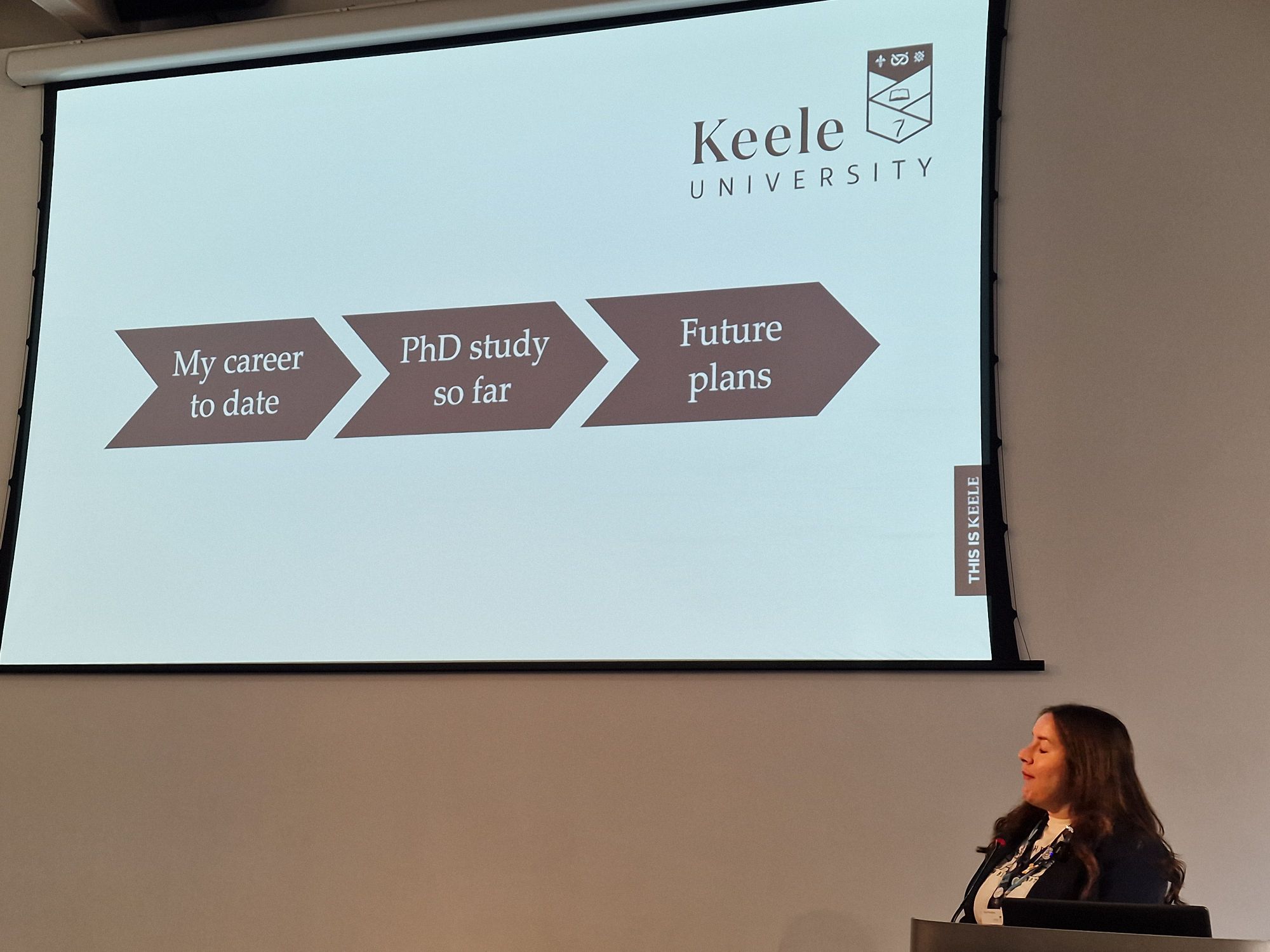
Aimee gave a superb talk covering her diverse career pathway, from her experience as a Biomedical Scientist to transferring to a professional doctorate. Despite a long list of achievements, unfortunately there was a lack of support from the department, building in barriers. After a move to a teaching fellowship, this lack of support continued, with additional barriers becoming apparent. This prompted a further move to a full time lectureship, Aimee began her PhD looking at how to improve biomedical science as a profession and empower the workforce.

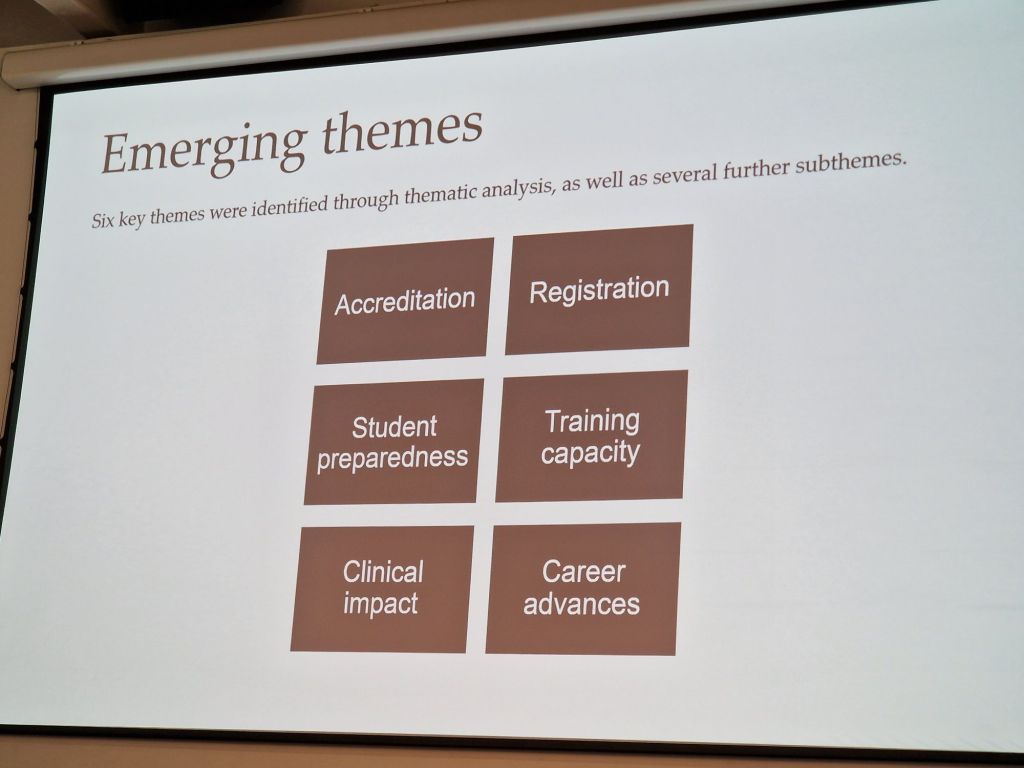
Her PhD research focuses on the impact Biomedical Scientists have on the patient, with there being a lack of direct evidence on the quantifiable impact on diagnostic pathways on patient outcomes. Furthermore, a lack of training posts and placement opportunities can hamper progression. There is further ambiguity of how to progress through the Biomedical Scientist profession to advanced roles. Her research has so far highlighted accreditation, registration, student preparedness, training capacity, clinical impact and career advances as key area of importance to the profession as part of focus groups.

Her research has focused on career advances in the biomedical science profession, which when done well and encouraged, can benefit all areas of the profession and support students entering clinical laboratories. To address this, the project is looking deeper into investigating behavioural traits that impact career progression. Are the opportunities clearly available? Do staff members feel empowered within their departments to take on opportunities for progression? It is also important to consider how barriers to progression change as someone moves through the profession, looking at how a trainee may feel compared to a more senior staff member.

Getting the room actively engaged in the session, a poll identified management support as a key barrier when done poorly, and excellent facilitator for progression when done well. One comment stated how there can be an expectation from managers for staff to progress, without actively facilitating this progression.

Blogged by Sam Watkin

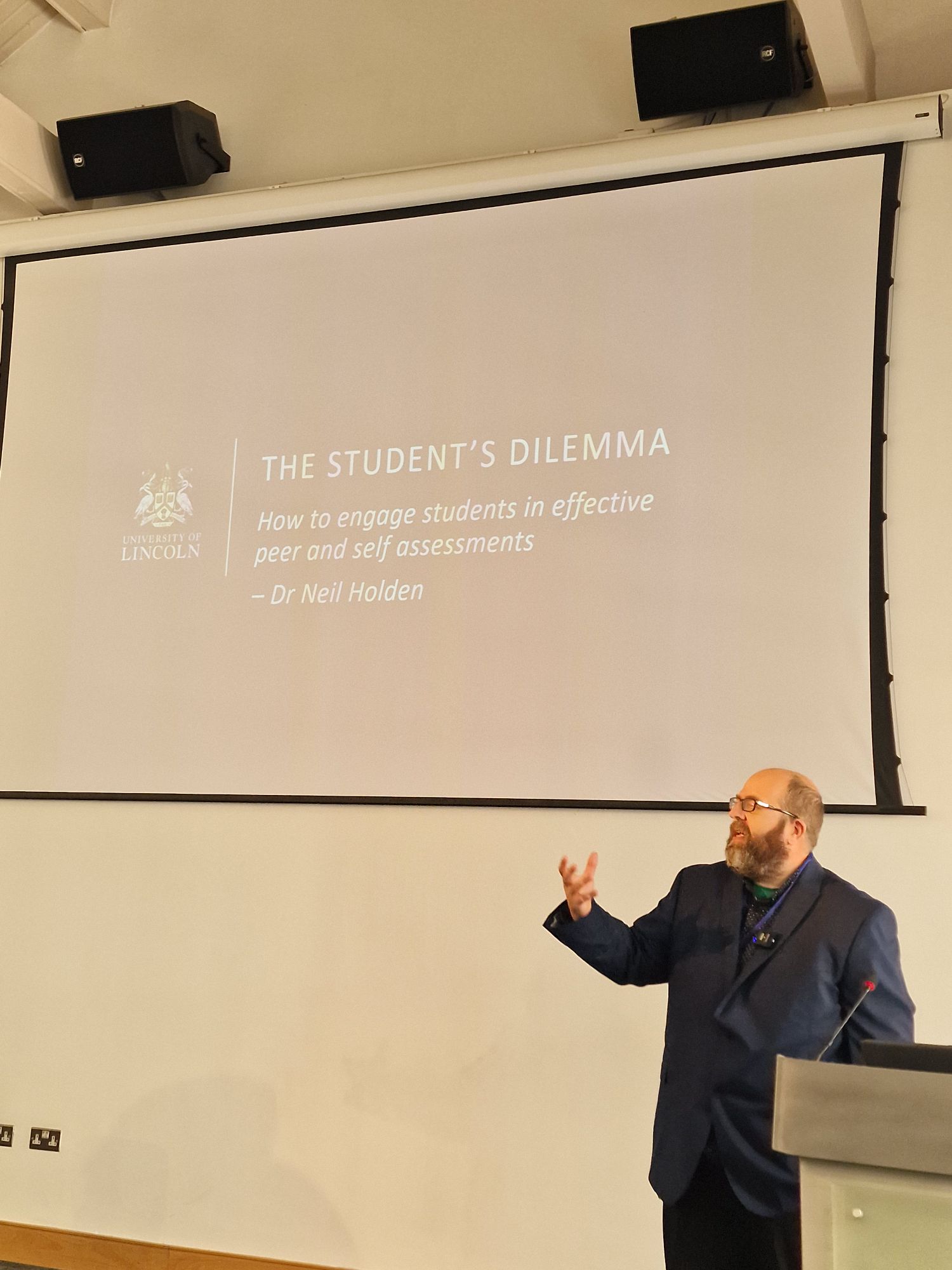
The students dilemma: how to reduce bias in student peer and self-assessments – Dr Neil Holden (University of Lincoln)

Neil brings a fresh perspective to the conference with a background of academia and international pharmaceutical industry experience. He’s passionate about what placements can bring to the academic journey. A key theme developing through our talks this morning is finding our barriers and how we can overcome them. Neil has been asked to talk today about authentic assessment and how to engage our students in this work. How we might bring them into the fold of University culture. We need to acknowledge how education is changing and how we can keep up. Neil feels an essential part of this is bringing the students into the process, and learning how they might assess themselves. The view inwards is becoming more important in this modern AI generated world.

Neil has instigated a peer review assessment in his popular Pharmacology and Toxicology module. Peer review is hugely beneficial – it has enhanced performance, and it massively helps with social skills and ownership. It can have greater impacts than even the lecturers feedback, when it is done well. But how can we ensure that it is done well? How do we identify and overcome bias to create an authentic assessment?

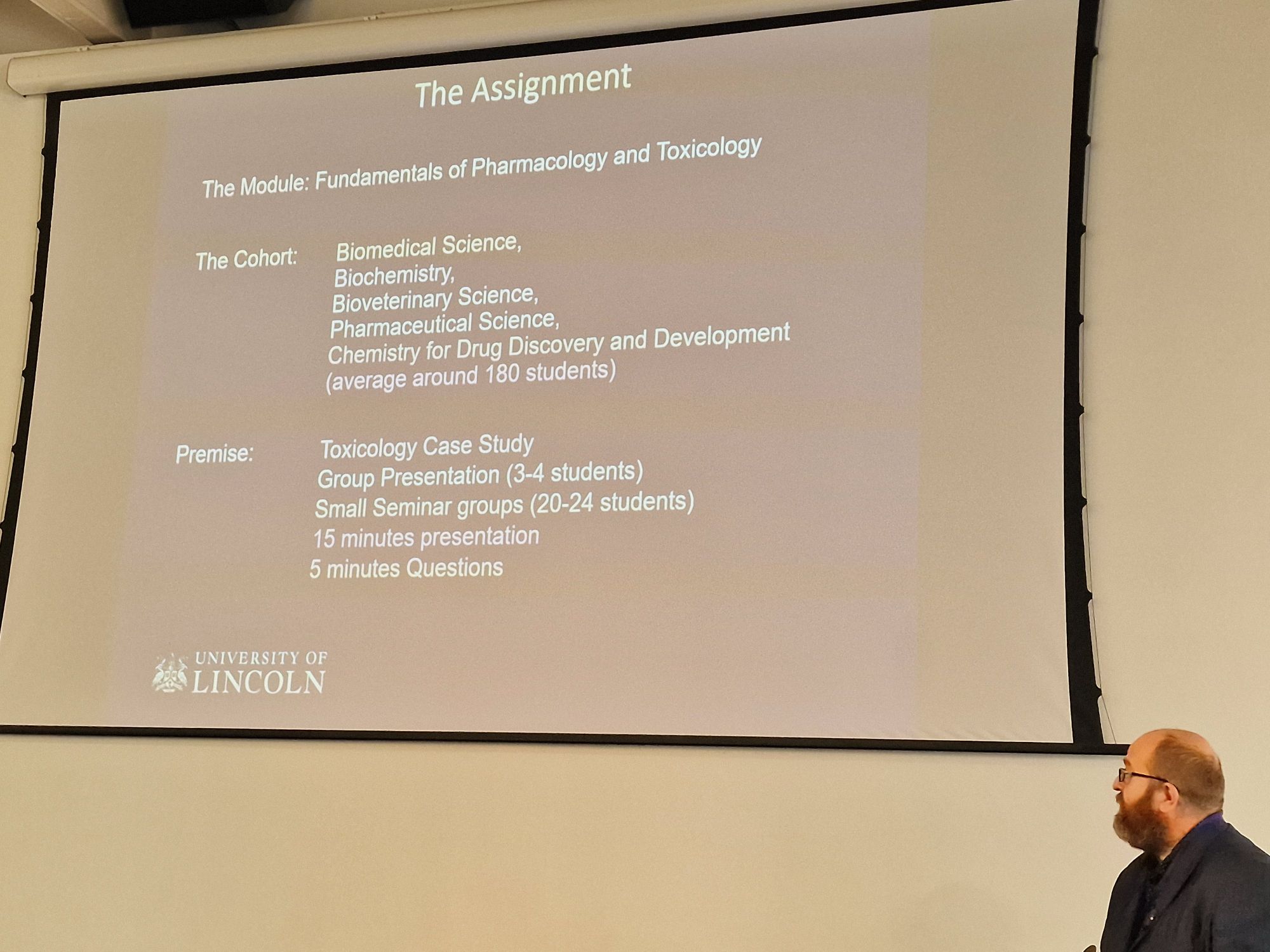
Neil’s approach to this covers around 180 students per year from a really wide range of disciplines – Bioveterinary through to Chemistry students. He makes use of real-world toxicology case studies and asks students to work on a group presentation in small seminar groups. Neil walks us through an arsenic poisoning case as an example of the materials the students engage with – it’s surprising just how funny the odd case of poisoning can be (!)

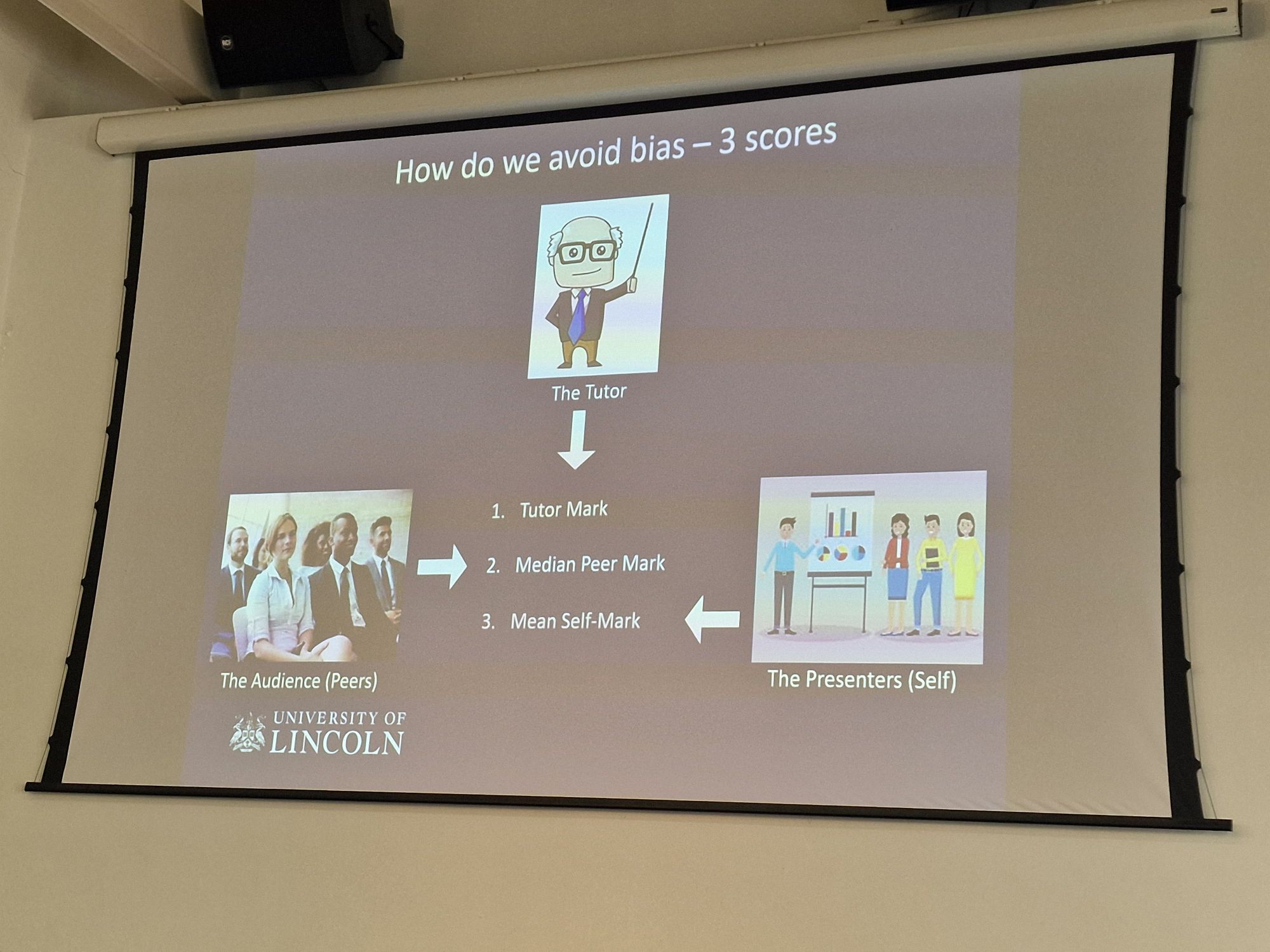
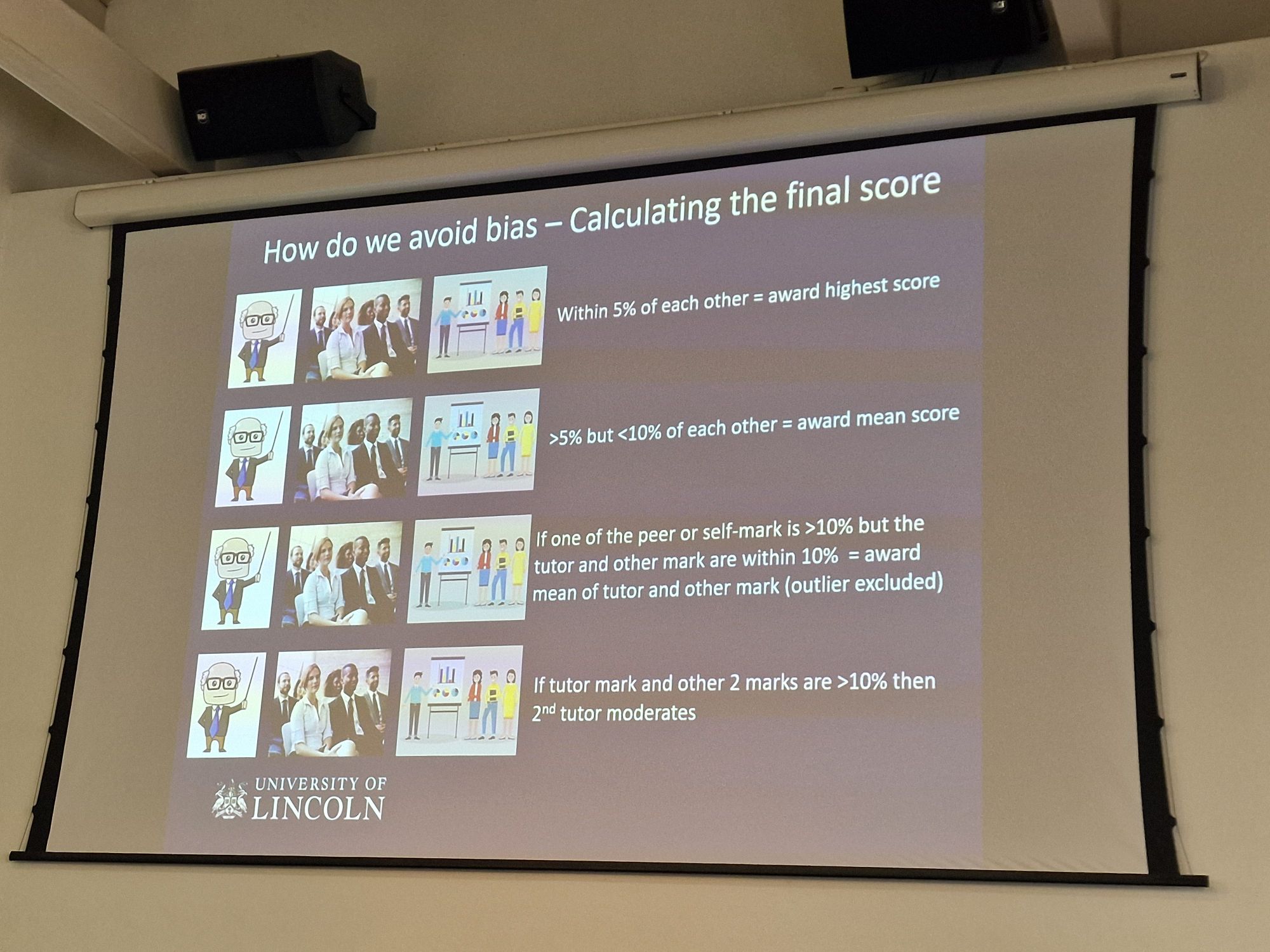
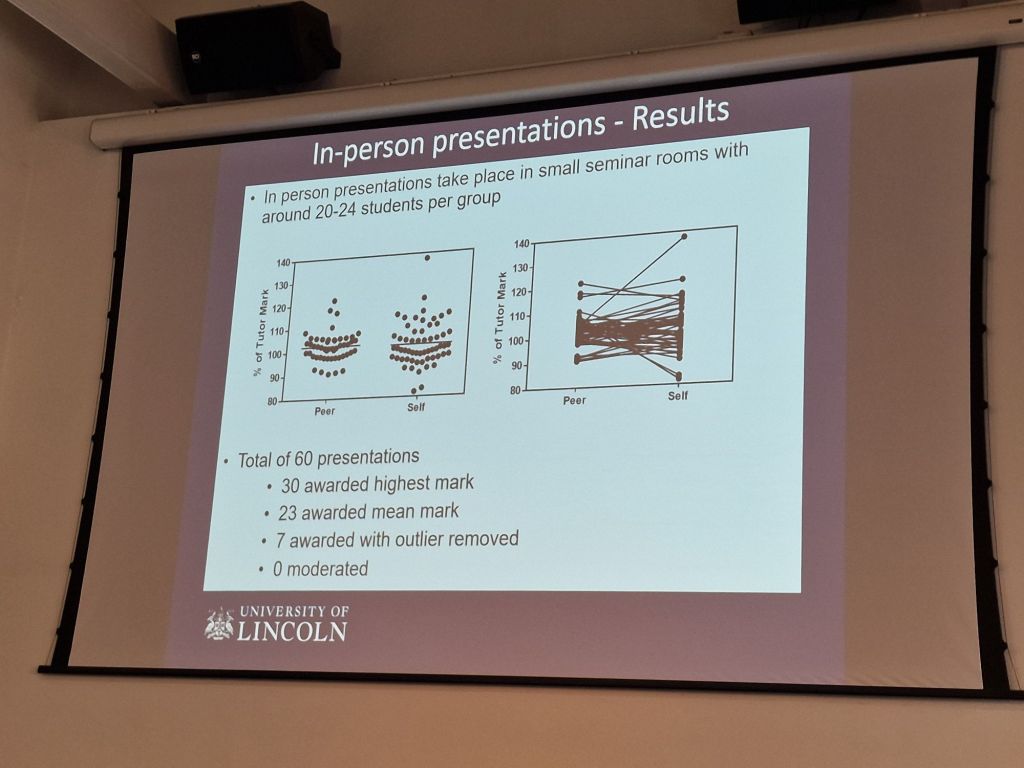
In this approach three different assessors are used; the tutor, their peers and self assessment. They all mark on a number of criteria, with the opportunity to add in constructive peer comments to justify their responses. To avoid bias in the marks the tutor mark, the median peer mark and the student’s self mark are all recorded. Calculation of the final mark is a fairly complex process! If all three marks are within 5% of each other, they get the highest of the three marks. But if they are >5% but lower than 10% they get the average of the three marks. Furthermore, if the self mark is >10% but the tutor and peer marker are within 10%, the mean of the tutor and the peer is awarded. This inventive process really encourages self reflection, and an understanding of the students skills in the difficult area of group presentation. and it works! Last year half the students were within 5% of Neil’s mark, whilst only 7 were awarded with the outlier removed. It’s amazing to see how rarely students are inclined to massively over or under estimate themselves.

Student feedback – they feel engaged, and just about all of them come out of it with a net positive experience. This is a second year module which really helps develop the students skill prior to their third year work. What a nice note to end the final session of the morning on! Authentic assessment leading to such positive benefits to our next generation of pathologists.

Blogged by Dr Claire Walker

Navigating educational comfort zones for impactful teaching – Dr Claire Walker (University of Lincoln)

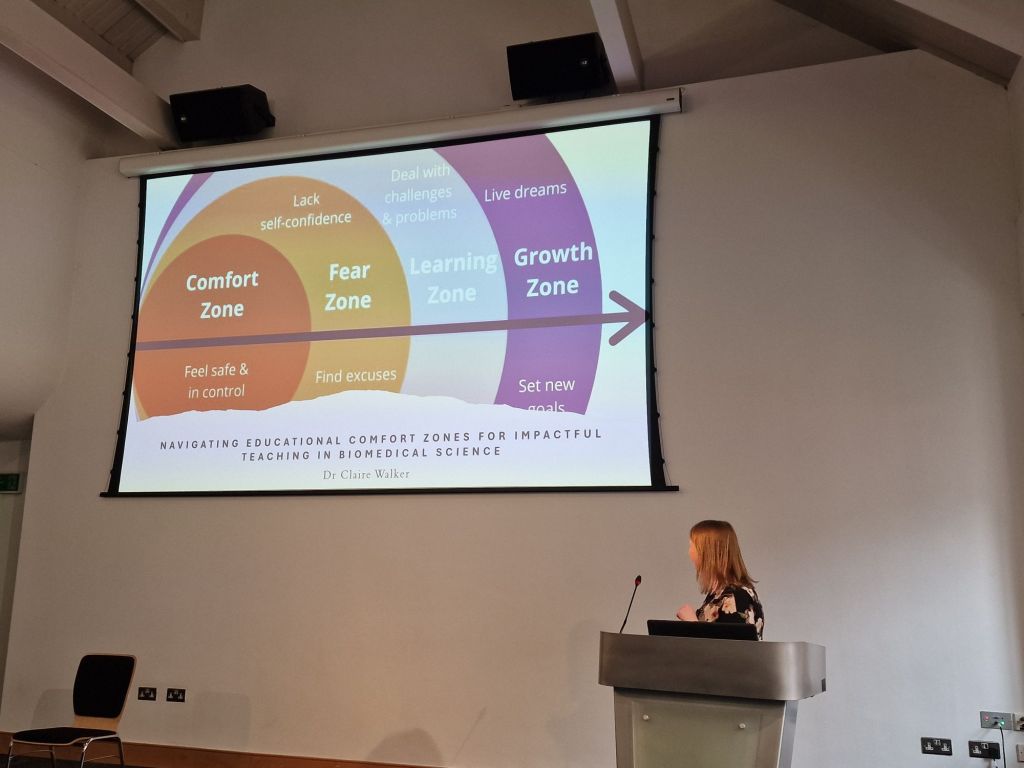
We are all being asked to do more with less, but that means we may need to acknowledge that this will require us to step out of our comfort zone. Comfort zones are about delivery teaching in areas where we feel relaxed and at ease – either linked to topic or style. Many of us who are of a Healthcare Science background feel comfortable delivering 1:1 training or teaching within the lab, this is less possible however if you end up teaching tens or hundreds of students. Claire is a paediatric immunologist, but acknowledges that in her current lecturing role she will only get to give teaching on that topic once a year, all of the rest requires her to become comfortable with stepping out of her preferred teaching area.

Although stepping out of your comfort zone has many benefits, as it expands and supports your learning, that doesn’t stop it being challenging. So how do you create an authentic learning experience? How does this relate to the education and learning that most of us experienced during our training, where most of us learnt from a didactic teaching i.e. standard lecture style, but that often doesn’t work for the topics or students of the day. Claire’s comfort zone is narrative style teaching where she uses stories to communicate, weird wonderful and gross stories, although memorable however it could still be considered didactic. Students love it, but sometimes they find it difficult to tie the stories they remember to the facts that they will need to be able to answer assessments and therefore apply it in practice.

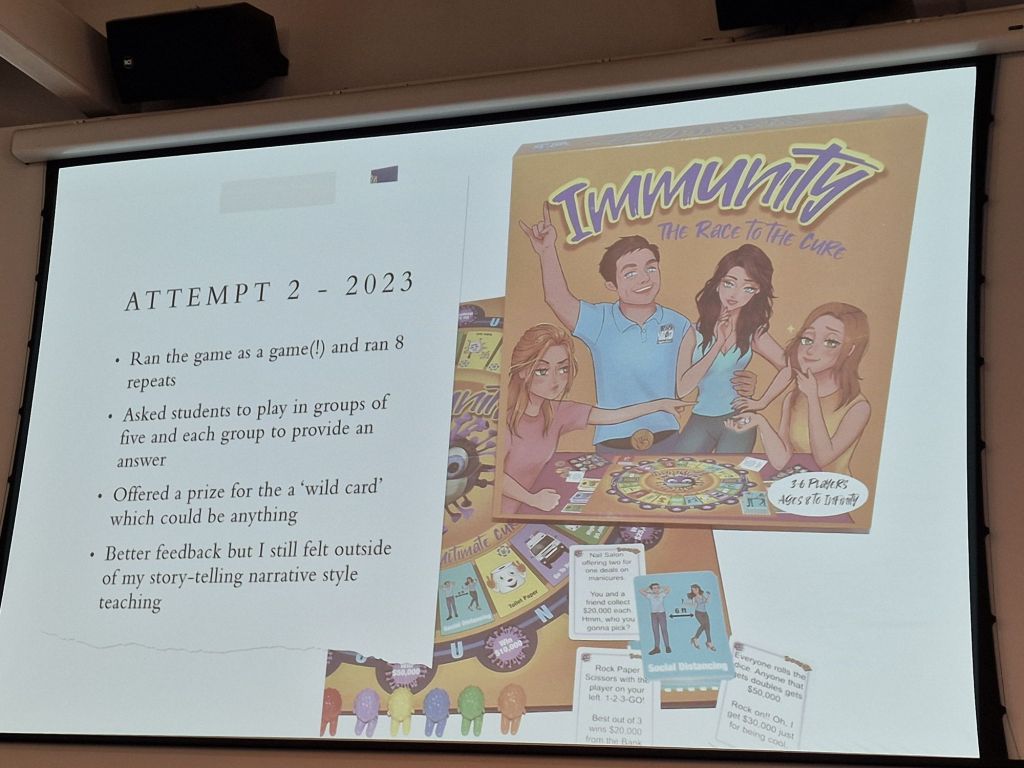
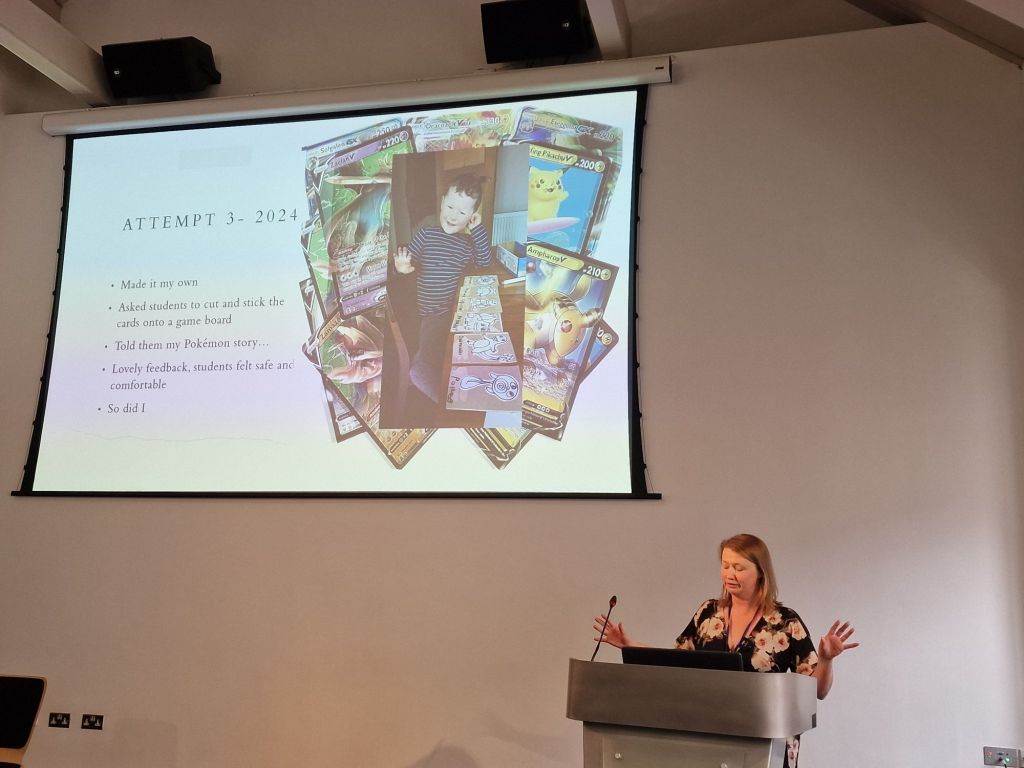
It was suggested by Neil (previous speaker) that it might be worth using an interactive learning approach based on a top trumps style gaming method. It was so out of her comfort zone that when it was first run she ran the game as effectively a lecture, that sat within her comfort zone, delivering for eight hours with limited engagement. It made her reflect that her comfort was actually impacting on what students’ experience of the session actually was. Some of the student feedback was positive, but some of it included that watching someone passively playing a game was not engaging, or that they felt uncomfortable interacting in big groups, which limited their participation. So, for the same session the next year she acknowledged that it did need to truly change. Therefore Immunity: the race to the cure was born. She made it really clear to students that this was an experiment and tried again. Students fed back that they really like the engagement but also gave extra feedback about how it could improve.

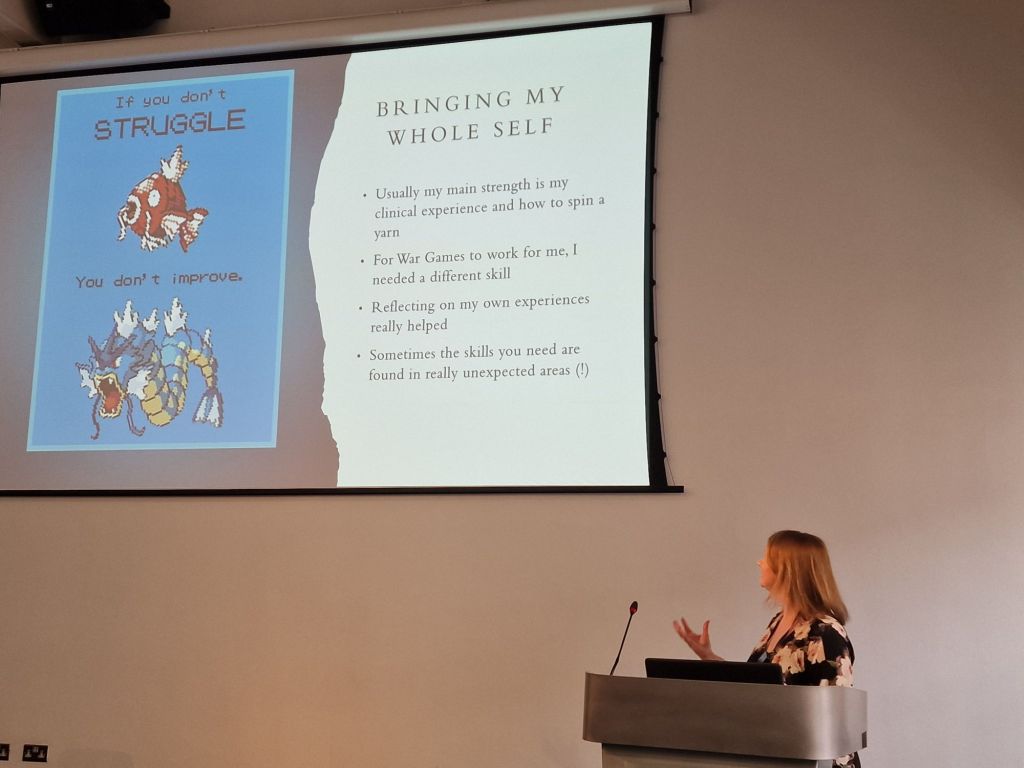
Version 3, Claire changed the way the session was constructed again, and put students much more in control of the session and the game. It vastly improved the student feedback, it improved their comfort and feeling of safety. The students now play the game in order to revise in small groups where they full interact with each other. Although, it still feels out of her comfort zone, the feedback makes it worth it. There is also a shared understanding that this is an iterative process where both Claire and her students need to reflect on the session and improving it, with Claire also focusing on why it felt so uncomfortable in the first place. It’s about expanding your comfort zone, but also about understanding yourself. As part of this process it’s really important to take on the feedback. Growing with that feedback, even if it’s bad, and even if it isn’t pleasant to hear. It is an essential part of any process. Learning to take on what serves you and using it to develop is the best possible approach for both yourself and for those you teach/train.

Blogged by Girlymicro

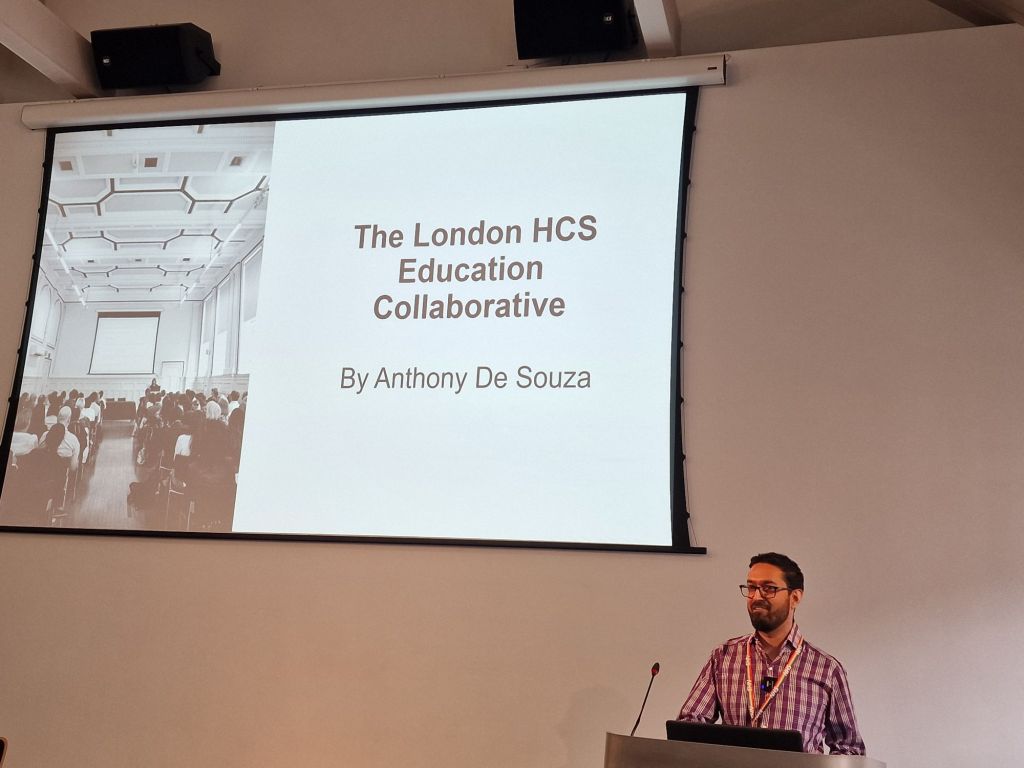
The London Healthcare Science (HCS) collaborative project – Ant De Souza (Great Ormond Street Hospital)

Anthony De Sousa (Lead Educator for HCS at GOSH) gave a wonderful presentation updating us around the work of London Healthcare Science Education Collaborative Project. This is a consortium of HCS at various London NHS Trusts who have secured funding to provide opportunities for HCS workforce education across NHS sites, with a focus on bringing people together to develop networks and to actively form collaborations. Ant illustrated the impact and reach this approach has had for London HCS.

Ant told us that the collaborative formed in 2018 as a result of a Healthcare Science Education event. Post pandemic it is has provided opportunity to re-engage with each other. He showed how, when viewed through the lends of authenticity, there were four key pillars of authenticity: Self Awareness, Unbiased processing, behaviour, rational orientation.

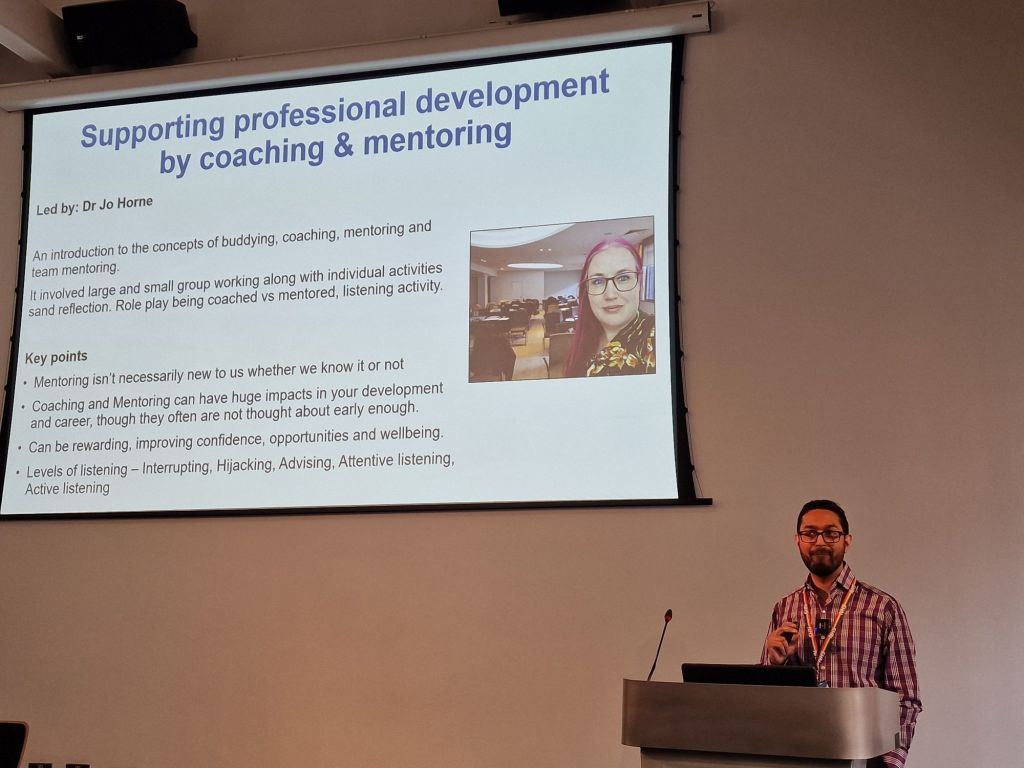
The first event was led by Dr Jo Horne where the concepts of buddying, coaching and mentoring (team mentoring) were introduced. There was small and large group working, alongside individual activities and reflection and listening activities. Ant showed that the learners feedback was overwhelmingly positive. He also discussed how many HCS have never been exposed to mentoring or coaching.

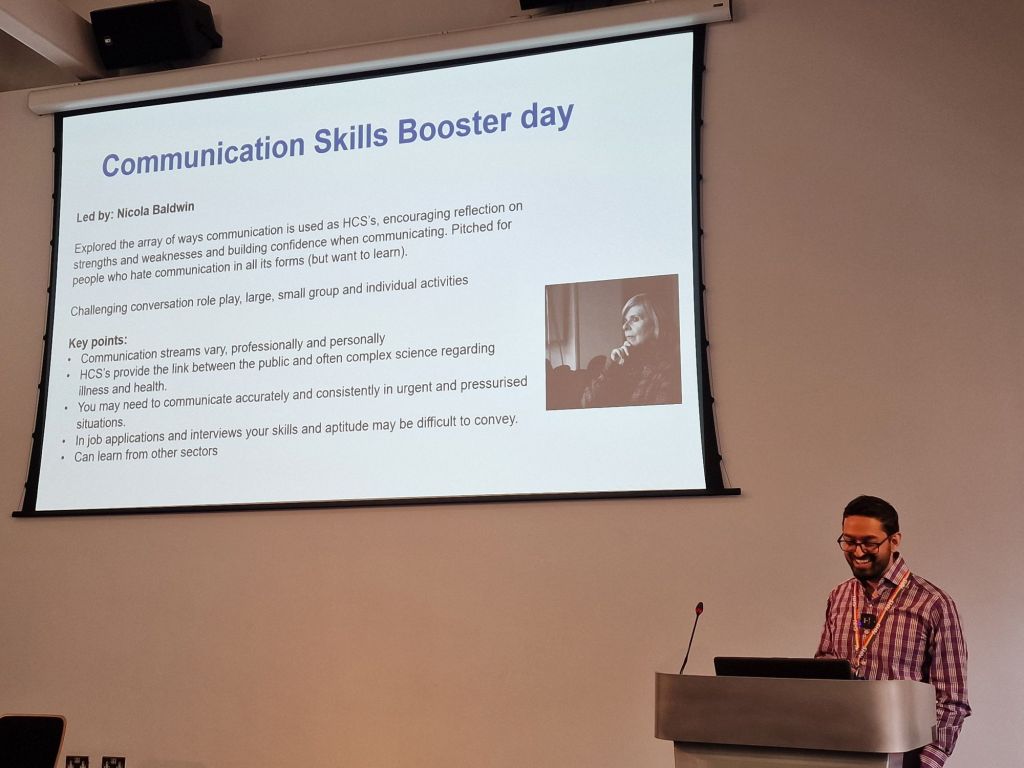
Event two was led by a playwrite called Nicola Baldwin. Nicola explored ways of communicating, encouraging reflection on strengths and weaknesses, and building confidence when communicating in all its forms. Challenging role play was utilised alongside small/large group and individual activities. The key points from learner feedback was that HCS already communicate in different ways in different situations but had never reflected on this and understanding how those decisions were made. Overwhelmingly, learners felt reassured that others were in similar situations with in difficult communicative arenas.

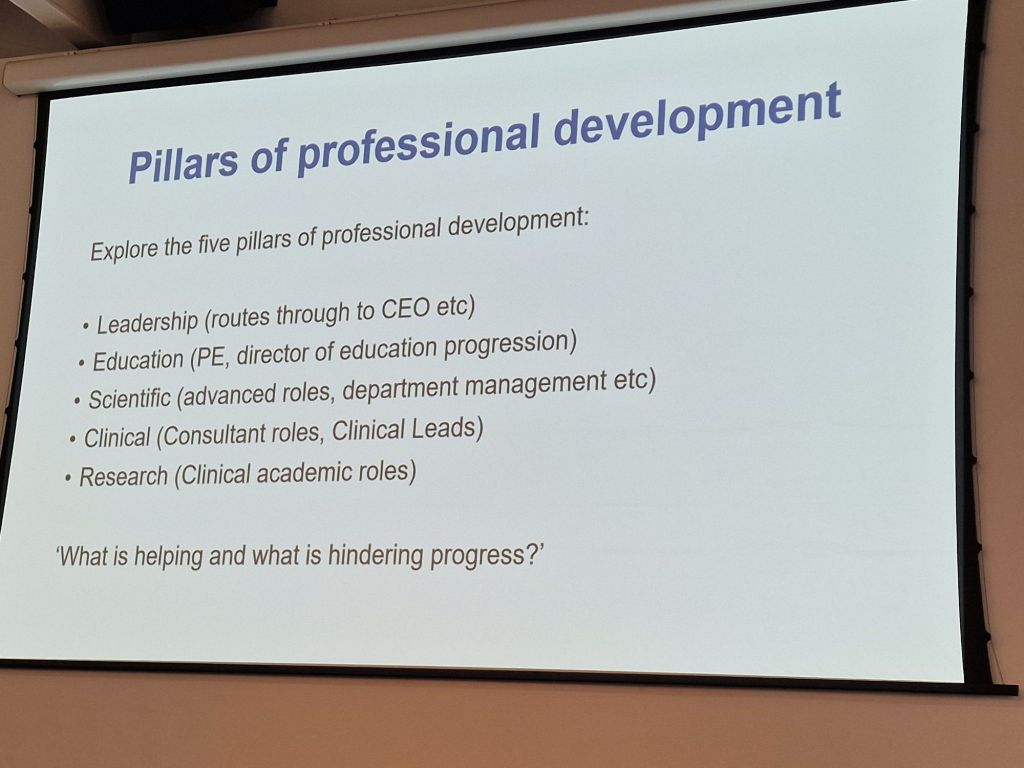
Event three focused on the pillars of professional development:

  • Leadership
  • Education
  • Scientific
  • Clinical
  • Research

Key points included:

  • Senior staff wanted more strategic leadership, educational development and inter-professional education
  • Juniors wanted sessions on career pathway progression, technical and digital skills, resulting and analytical skills

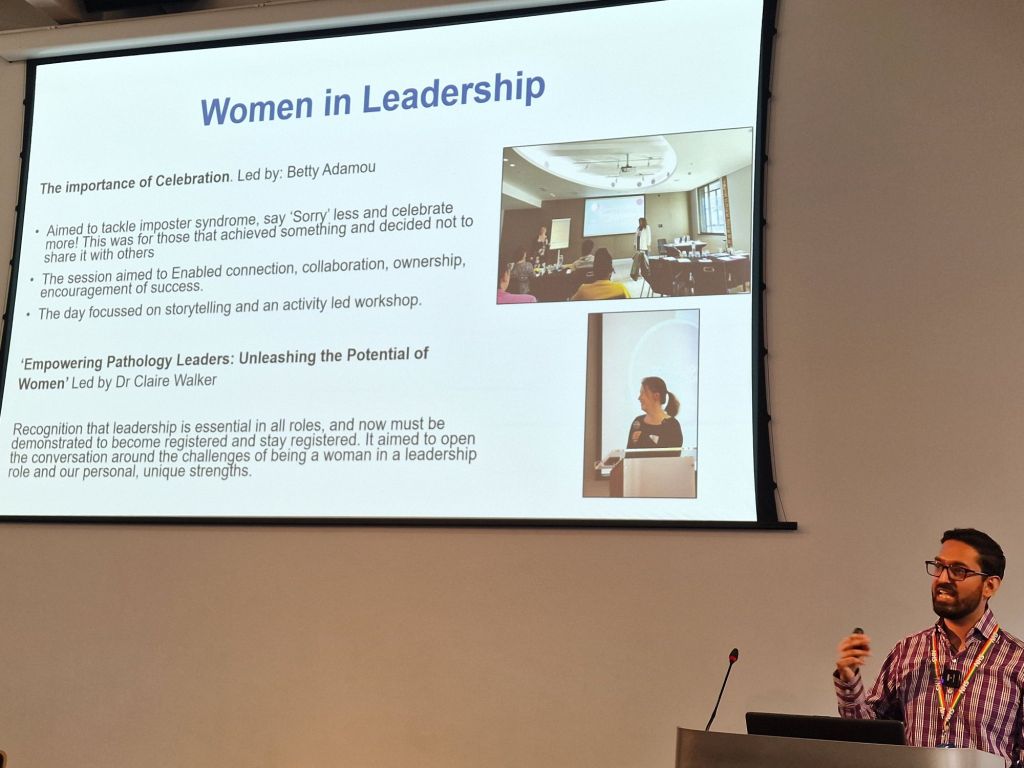
Event 4 on women in leadership was led by Betty Adamou and Dr Claire Walker. This session aimed to tackle impostor syndrome, encouraging women to say sorry less and to celebrate more. Sessions aimed to enable connection, collaboration, ownership, and encouragement of success. Ant shared that learners at this event felt empowered and had never encountered a celebratory event like this before.

Ant summarised the benefits felt by HCS learners who attended all the events:

  • Self-awareness – learners worked out how they react, what their values are, and how not to work against themselves (Johari Window)
  • Unbiased processing – learners were able to objectively self-assess without blame or denial. He showed how attendees learned to hold themselves to accountability and to not to get in their own way and filter out noise
  • Behaviour – Learners explored their values and if they were crossed how they would react. They learned how to be aware of the way they are reacting
  • Rational Orientation – attendees learned how to develop close relationships & have difficult conversations.

Ant summarised that learner feedback during these sessions indicated that they:

  • Wanted to feel seen and heard
  • Valued a sense of belonging
  • Were seeking connections
  • Valued time for self reflection
  • Thrived in a supportive space.

Blogged by Dr Stuart Adams

Being authentically us – Dr Jane Freeman and Dr Kerrie Davies (Leeds University)

To close the day we had the incredibly inspiring duo of Jane and Kerrie talking about how we are more than the sum of the professional hats we wear, and why it’s important to acknowledge who we are as people, not just professionals. They also emphasised the importance of giving yourself time and the use of tools to reflect on who you are, both as individuals and leaders. Not just because this is important in allowing you to find your place, but also in order to understand how it might impact how we interact with others. It’s also important to appreciate how much strength there is in diversity and bringing all sorts of different approaches together for the best possible outcomes.

This was such a brilliant way to end the day and to encourage us to think more, strive more and be more. Thank you to everyone who contributed to the day, but also to those who guest blogged today. You guys are the best! We hope you can join us next year for #HCSEd25!

All opinions in this blog are my own

Don’t Hang on Too Tightly: Having enough faith in yourself to know there will always be another idea

Someone said to me a few weeks ago that the story of my career is to ‘have good ideas and then to have them taken’. This was an interesting comment made spontaneously, and to be honest, I’ve never really thought about it in that way. So I’ve taken a few days to reflect on it as it obviously resonated enough with me to stick in my mind, and this is what I’ve landed on. We don’t own anything, at least when it comes to concepts and innovations at work, and I’d rather see any transition as a gifting than anything negative.

There will always be competing circles, hierarchies, or priorities, which means that things you developed sitting within one may be better placed or coveted by somewhere else. Workplaces are dynamic, and there is always flux. Denying that will just result in additional stress and tension. Sometimes, you just have to have a little faith. Faith that handing something off is the right thing to do, and faith in yourself that you will always have another idea or innovation, nothing is ending, this is an opportunity for new beginnings. Despite having come to terms with it now I found this very challenging early on in my career and so I thought it was worth exploring more, in case the journey I’ve been on is helpful to others in developing their own coping mechanisms for dealing with this reality.

The academic challenge

Academia is a strange and unusual world and, although I love it, it can be baffling and difficult to understand how it works, especially when you first join. When working clinically, you are generally in a scenario where you are responsible, and therefore in some way ‘own’, the results you are working with, even if you are not the one giving actionable advice. The same is often not true in an academic context. When you are starting out, your Primary Investigator (PI) has a lot of control over the work, and owns both the risk linked to any given project and the data. As a result, I think many of us have experienced a scenario where a PI has taken either our data or our ideas and utilised them without our inclusion or consent. I once found a paper that had a bunch of my data in it, interpreted incorrectly, that had been published by a Professor in my department without my knowledge. I’ve also popped in whilst I was on leave to find a different Professor going through my lab books to see my data when they were nothing to do with me.

These are extreme examples of not great behaviour, but the principle is still present. You don’t own what you produce in academia until you get to the point where you are the one who is bringing in the money that pays for the production, and even then your funder could be considered the owner. There are lots of ways to improve this, and there are plenty of people who behave better despite this scenario. It is important to understand the dynamics and drivers in order to be able to come to terms with some of the unwritten rules however. Once you have understanding, you are in a position where you can learn to navigate the challenges.

It’s less about seniority than you’d think

I used to think that the more senior I became the more I would have the freedom to own my initiatives. That I would no longer set things up to have them taken once the majority of the work had been done or the risk managed. This is true in some ways but not in quite a lot more. The last 20 years have shown me that the difference is less about seniority and more about advocacy. If you have people in the room who will challenge and speak up for you that is more important than status alone. For instance, if a project is being discussed then the meeting will hand designated responsibility for it to someone in the room. If you are not in that room, you need someone who is to go ‘Elaine has been doing a great job on this, I’ll feedback on how it’s going right now and make sure I continue support. Elaine will have more details so how about we invite her to the next meeting in order to give us an update?’. One of the problems with working between worlds (in my case scientific, clinical and academic) is that you have fewer people invested in this kind of exchange, as you don’t sit with any particular group in a way that feels like you are a full member. You therefore have less people who are prepared to take those steps to advocate for you and your work without significant prior campaigning. I now sit in a lot more meetings, and have a much closer team, and that advocacy pathway is easier, so seniority plays in, but is not always the main driver.

Be prepared to have hard conversations with yourself

It can be tempting to play the victim. It can be tempting to see the world as unfair and that things should be different. I hate to break it to you, and I am often forced to remind myself, it’s not about you. Very few things that happen in a professional context are truly personal. We work within systems, and those systems have rules, some of which are obvious and some of which are less so. If something works, if an idea is good, and it serves the system, sometimes people will just take it. If the idea is to benefit patients, or to serve a change, then maybe we can’t ‘own’ anything, as it belongs to the system we are working within. It can feel really tough whilst you’re in it. It can feel pretty dreadful to have something you’re invested in taken away.

Sadly, ideas are not toys, and we are not in nursery, rarely is someone going to sweep in and return things to us. So you need to be able to take a reflective step back and decide how important this particular moment is. When I sit in meetings, and yet again someone is claiming ownership of a research idea, or I feel pushed out, I consciously ask myself will this matter? Will this matter tomorrow? Will this matter next week? Will this matter in six months? Will this matter next year? I do it in precisely this order, almost as a mantra, and I often find that the answer is no to at least one of these questions. This calms me in the moment and enables me to react in a logical mind set rather than an emotional one. You need to find a way to get into the right mind set to serve you, not be the servant of an emotion in that moment. Otherwise you won’t get the outcome that you are striving for.

Battles inhibit creativity

One of the reasons I try to get myself to a space where I can rationalise and move on is because it helps me. I’m not doing it for anyone else. If you are spending time fighting every battle, I find, that it means I have less band width for creativity, for new ideas, to be inspired. Frankly, I’m not interested in giving other people enough space in my head to mean that I can’t be the best version of me. There are definitely times that you need to suit up and go into battle, but most of the time it isn’t worth the impact. Keeping yourself focused on why it is that you decided to do what you are doing, and making sure you can do it in the best way possible is the best version of success. You have to let go of the fear and the protectionism in order to enable you to succeed in the long term, rather than always having a short term focus.

Assess whether you are still the right person

One of the other reasons to move to a rational space is to enable you to make balanced assessments. One of these assessments is to evaluate whether you are clinging to things for the right reasons. Sometimes we have invested so much of ourselves, of our energy, into a project that it is hard to let it go. That doesn’t mean that we are always the right person to continue. There are plenty of times when the right decision for the work is for it to pass to someone else or another group. You may have too many other projects to give it the focus it needs, or you may have upcoming work which means it will have less investment in the future. It may be that the project now needs to be advocated for at a different level, and therefore expansion requires it to be taken over by a senior leader. A really common one is that you don’t have the CV or track record to be able to be PI on the grant that is needed to take it to the next level, and therefore you need to hand over primary responsibility in order for it to succeed. Not all handing over is linked with loss, sometimes you have to let go of control of an idea or piece of work to enable it to flourish. In these moments it’s important to recognise that the handing over is something to be celebrated, rather than mourned, and seen as a sign of how far it’s come.

Know what matters to you

If, when you ask yourself the does this matter questions, you answer yes, then you need to decide if the potential costs are worth it. There are definitely times that you will recognise that something does truly matter, and when that happens you need to be able to come up with a logical plan of response. Who can you speak to? Where can you build support? How much impact can you have and will that be enough? I’m very lucky to have a great team around me who will not only advocate when I’m not in the room, but will also offer peer support. If you are not in the place to influence and you decide that it matters, you have to maneuver yourself into a position where you can. This takes time, it takes investment, it requires the expansion of social and other capital. You can’t do this for everything and so you have to be selective. The other thing that you may learn, is that during the early stages of a project that is significant to you, you can take proactive steps in order to determine the future pathway and therefore reduce any challenges before they become insurmountable.

Keep the faith

Not matter how bad it can feel in the moment, know this. You will have a new idea. You will find a new challenge. You will be inspired again. This is not the end, this is a window to a different beginning. Be honest with yourself about your personal drivers, why is this so important? Take these moments and challenges as learning opportunities. I have found people that I am over the moon to collaborate and work with long term, but they can be counted on the fingers of one hand. I have collaborated and worked with vastly more, where I have completed the work, taken the learning, but know that I would prefer not to repeat the experience. All of that is OK. Building trust takes time. Sometimes you need to work with people that have different values and drivers to you, and often once you understand those you can deliver, but every now and again it doesn’t work. You have to have the courage to keep going, the courage to keep trying, and the courage to let go of failures and difficult experiences. You have what it takes to come out of this particular crucible so much stronger. So keep the faith in yourself and you will climb mountains!

All opinions in this blog are my own

If you would like more tips and advice linked to your PhD journey then the first every Girlymicrobiologist book is here to help!

This book goes beyond the typical academic handbook, acknowledging the unique challenges and triumphs faced by PhD students and offering relatable, real-world advice to help you:

  • Master the art of effective research and time management to stay organized and on track.
  • Build a supportive network of peers, mentors, and supervisors to overcome challenges and foster collaboration.
  • Maintain a healthy work-life balance by prioritizing self-care and avoiding burnout.
  • Embrace the unexpected and view setbacks as opportunities for growth and innovation.
  • Navigate the complexities of academia with confidence and build a strong professional network

This book starts at the very beginning, with why you might want to do a PhD, how you might decide what route to PhD is right for you, and what a successful application might look like.

It then takes you through your PhD journey, year by year, with tips about how to approach and succeed during significant moments, such as attending your first conference, or writing your first academic paper.

Finally, you will discover what other skills you need to develop during your PhD to give you the best route to success after your viva. All of this supported by links to activities on The Girlymicrobiologist blog, to help you with practical exercises in order to apply what you have learned.

Take a look on Amazon to find out more

PhD Top Tips: What do you need to think about when applying for a PhD?

Spring has sprung and that means academic application time has also begun. I’ve already had a number of queries about what it is that I look for when I receive PhD applications. Selfishly, I therefore thought I might write this post so that I can refer people here to read it. Don’t worry if you’re not applying for a PhD though. I’ve just interviewed for a senior role and had to go through a LOT of applications when shortlisting. It’s probably obvious, but worth stating, that a lot of these tips are also relevant to when you are pulling together any personal statement or piece where you need to sell yourself. So, good luck, and I hope these help.

Understand what’s being asked of you

The first thing is to really understand what is being asked of you. A PhD application, although in many ways a job application, is also much more than that. It’s less about where you are at right now and more about where you could be at the end. There’s a lot more in the assessment about being able to demonstrate the way you think, your aspirations, and your passion, therefore, than the box ticking against a job spec that is often required for other posts. Your cover letter is therefore critical in order to help you stand out from the crowd and a generic letter that you’ve sent to 20+ options just won’t cut it, if like me you’re are getting tens to hundreds of applications to shortlist. Your generic version just won’t pass the skim test. Below are the kinds of things I want to see if I’m glancing over your application in order to put it in the consider pile.

Be specific, details matter

Having looked at a LOT of applications over the years for PhDs and other roles, my first big tip is that details matter. Making statements like ‘I have good communication skills’ won’t tick any of my boxes.  I need to have it followed up by a concrete example such as ‘this was shown by me winning X poster prize at X conference’ or ‘me being asked to lead our group presentation on X, where received a distinction’. Your examples don’t have to be revolutionary, but you do need to back up your statement with something concrete. You are applying for a science post after all, so evidence matters.

Show what got you here

It’s easy to think you have to be exceptional to succeed, but the truth is most of us aren’t exceptional. We just have a passion, interest, or tenacity that gets us somewhere. My father recently referred to me as ‘an academic late bloomer’, and I’ve written before that we are all more than the sum of our grades. Because of this, when I’m looking at applications, I’m most interested in the person behind the grades and the details. Some people will be exceptional undergraduates but will hit a ceiling when it comes to postgraduate study. Some of us dealt less well with the thought constrictions at that level and only really grew into our potential when the safety wheels were removed. I’m looking for your application to show me what makes you tick, how you think and approach challenges, and how you ended up sitting in front of a computer writing this application.

Be clear about where you want to go

I’ve talked in previous posts about the need for you to show me your why when discussing undertaking a PhD. There are lots of reasons why you might decide that a PhD is the right next move for you, and it doesn’t just have to be that you want a future career in academia. In some ways, the reason doesn’t matter as long as it’s thought out. What does matter is that you’ve taken the time to do that thinking and have the skills to be able to communicate it. PhDs are not a walk in the park. There will be hard days and challenging periods where you question whether this was the right move. Your motivation, whatever it is, has to be strong enough to get you through those dark days. It’s also important, that if you get the role, I understand how to support you in your future goals, and I can’t do that if you don’t know what they are.

Why this PhD

There are PhDs advertised all the time. One of the top things I want to have jump out of your letter is why you think this particular PhD is the one you want to do. What is it about the topic that interests you? How does this fit in as a logical next step from what you’ve been doing so far? Where is your passion or interest in this particular topic? PhDs with me will always have a clinical aspect, so what is it about this rather than primary science PhD that speaks to you. I want to know that you have considered, in my case, what it will be like to do research in healthcare and the benefits and challenges of the setting. I also want to know how it fits in with your goals as described above. This needs to be done in enough detail that I know you have thought about it and that it’s specific to the PhD I have advertised. Anything generic is a real turn-off at this point.

Why this supervisor

Supervisors make or break your PhD. It’s the honest truth. Demonstrating you have awareness of how important this relationship is to your PhD goes a long way to show that you understand the challenge you are choosing to take on. I would always recommend reaching out to the primary supervisor ahead of applying therefore. You can then make an informed choice about whether this person will be the right support for you. Every supervisor has different styles and you as a learner have different needs. Understanding whether those 2 things will mesh is so important.  You can then address why the supervisory team on offer is the right choice for you in your application.

Why this university

The other thing that is worth including is why the university you’re applying for is the right choice for you. Each university has a slightly different ethos or feel, and so why does the one you are applying to match your requirements? Is is because it has an associated medical school or strong pre-existing links to local hospitals? Is it because you really like the structure of the PhD programme? Is that they have a doctoral school or other funding that links into a research council you are particularly interested in working with? It’s always worth looking up what the PhD structure is actually like, some will require you to submit regular essays, others will just have an ongoing log, each is likely to have different upgrade windows and structures. State why this university works for you and your learning style. This not only makes it clear that you’ve done additional reading to understand the programme, but that you’ve also done the reflective thinking to see how you would fit into what is being offered.

What skills do you have

Let me be clear, no one expects you to have all the skills to do a PhD when you apply, otherwise you wouldn’t be doing a PhD you’d be doing a post doc. That said, on the advert there will be some skill requirements that you will be expected to meet or be on the pathway to meeting. It’s key that you cover these off in your application, either in the covering letter or CV. One of the key errors I find people make when putting together their applications is that they think all of the skills and experience listed have to come from their scientific or academic backgrounds. This really isn’t true, especially for an early career post. Leadership skills can be demonstrated from volunteer or other work experience, such as helping out at Scouts, Guides or Duke of Edinburgh. Conflict resolution skills can include things like bar work on a Saturday night. Time management could include how you helped your parents manage your 6 younger siblings when it came to after school activities. As part of you bringing your entire self to the post you should feel free to include all of the skills developed as part of the route that brought you to making the application.

What experience do you have

It can be challenging to split out skills from experience, but if you have any, experiences can go a big way to demonstrating your commitment to the career you are hoping to embark upon. Have you attended seminars or other voluntary activities as part of your time at university? Have you arranged to shadow or undertake placements within a laboratory to gain extra experience? Did you engage in weekend or other field trips? These help demonstrate interest, but they can also help to round out some of the short listers’ understanding of what you may be bringing in terms of scientific experience, and how that might benefit the initial phases of your PhD. I also always appreciate the way that applicants introduce items like these into the application, as it also helps me start to get a feel for how they think and approach challenges, which is one of the things I’m looking for to help an application stand out from the rest.

Ensure you use the literature

Another way you can show what you thought process is and how you might develop as a scientist is by making sure you use the scientific literature in developing your application. I want applicants to reference a couple of key pieces of literature when they talk about why this PhD interests them. It also makes the application stand out if you reference published literature from the group or supervisors when you talk about why you are interested in working with them. Finally, if the PhD is funded by a particular funder, or through a particularly funded centre then I would also expect the application to reference what the funders remit is and what they aim to achieve. Demonstrating that you’ve taken the time to understand the context in which your research will be undertaken shows, to me, that you have the beginnings of the strategic awareness you will need to develop future funding applications during an academic career.

Demonstrate your added extra

I hate it sounding like I’m saying that everyone has to go above and beyond, because that’s not really what I’m saying. What I think you need to do is embed something that makes your application stand out. That can be by including a lot of reading and referencing in your application, if that’s the kind of thing you enjoy. It can also be about sharing a story about why you have always wanted to work in this kind of research. One application I recently reviewed, focussed on the applicant talking about how much they wanted to engage with dementia research as their grandmother had been in a care home linked to dementia, and they they had spent a lot of time therefore getting to know individuals with dementia and had personally witnessed the impacts on their families. They then followed it up with information linked to dementia UK, showing they had both the drive and ability to find information. There are many different ways to make an impression. Your application is a blank slate but making sure that it has enough detail to show that you have thought through what might help you stand out is key. How you do that is completely up to you. Think of it as getting a head start on developing your scientific elevator pitch!

Follow the rules

Having said that PhDs are different, in terms of not being so tightly tied to a person specification, there were still be boxes you need to tick that are listed on the advert details. Please please therefore make sure that you do maintain enough focus to be certain to cover off the stated requirements. You want to weave in the other aspects that will make you stand out linked into what is being asked for. One thing it is always worth asking, is for someone else to read your application against the requirements, preferably a none expert, to get a neutral assessment of whether you have clearly covered off everything that is needed.

I do have one personal plea linked to this though. Please do not send a 90 page attachment with all of the certificates you have ever achieved and every paper you have ever written in full. It is possible to go too far the other way and send too much. I will tell you honestly, if your combined letter and CV for a starting level post is more than 5 pages I will start to become less and less engaged with the application. If you send me more than 10 pages, I will not consider it for shortlisting. A key skill as a scientist is being able to engage with a question, shift information to identify what is relevant, and build an evidence based response. If you send more than 10 pages it signals, to me, that you are unable to manage at least one of these steps in an efficient manner, and therefore cannot meet the person specification.

Have a little faith in yourself

My final tip is this, have some faith in who you are and your ability to succeed. If you write your application from a position of confidence rather than imposter syndrome, you will use words like ‘will’ and ‘can’, rather than using works ‘like’ and ‘attempt’. It seems a small change but there is a subconscious difference that is detected by the reader when someone writes in a definitive style that inspires confidence. It will not be the only thing that gets you across the finishing line, but it can definitely help. You have achieved so much to get you to the point where you are qualified to apply for a PhD. You deserve to give yourself the same self belief and encouragement that you would offer friends and family if they were in same situation. Remember. You are braver than you know, and so much stronger and more able than you believe, so take that leap and fly.

All opinions in this blog are my own

If you would like more tips and advice linked to your PhD journey then the first every Girlymicrobiologist book is here to help!

This book goes beyond the typical academic handbook, acknowledging the unique challenges and triumphs faced by PhD students and offering relatable, real-world advice to help you:

  • Master the art of effective research and time management to stay organized and on track.
  • Build a supportive network of peers, mentors, and supervisors to overcome challenges and foster collaboration.
  • Maintain a healthy work-life balance by prioritizing self-care and avoiding burnout.
  • Embrace the unexpected and view setbacks as opportunities for growth and innovation.
  • Navigate the complexities of academia with confidence and build a strong professional network

This book starts at the very beginning, with why you might want to do a PhD, how you might decide what route to PhD is right for you, and what a successful application might look like.

It then takes you through your PhD journey, year by year, with tips about how to approach and succeed during significant moments, such as attending your first conference, or writing your first academic paper.

Finally, you will discover what other skills you need to develop during your PhD to give you the best route to success after your viva. All of this supported by links to activities on The Girlymicrobiologist blog, to help you with practical exercises in order to apply what you have learned.

Take a look on Amazon to find out more

We Lift by Raising Others: Why we should all get our nomination heads on

I’ve been fortunate enough to win a few awards in my time, but I count myself even more fortunate to have seen the great work and inspirational people in my science and Infection Prevention and Control (IPC) communities get recognised. Seeing the joy and the difference it has made to individuals and projects has really made me an awards convert.

I haven’t always been so supportive of them, as it some times feels like the same people, or groups, get recognised all the time. Now, having been on judging panels, I realise the reason for this is that they are the ones who are actively involved in nominating each other. So it’s less awards bias, more nomination limitations. So, for this weeks post, I wanted to try and persuade you all to remove some of that limitation by talking through both why and how you should nominate others, not only to show your appreciation but to enhance our communities.

Raises awareness

There are really three components to this one, linked to individuals, work, and the community. I think we often think of the person or project when people win awards and the benefit it provides to them. I think this misses out on what may be a cumulative, even larger, benefit. That is raising awareness of the community in which they sit. One example of this that I’ve experienced personally was last year when I was the first woman and scientist to be awarded the HIS Early Career Award. I was given a platform to be able to talk about my work at a national conference. As part of that session, I spent time talking about career paths in Healthcare Science. I got so many messages afterwards where people talked about how much that meant to them. It helped them feel seen and raised the profile of what scientists can bring to the world of microbiology and IPC. I’ve felt the same way when I’ve seen other IPC professionals win at mixed discipline awards. Any time a Healthcare Scientist or IPC professional is up for anything, no matter how well I know them, I will always be screaming at the top of my lungs if they even get nominated. Their visibility increases all of ours, and so by working together and supporting each other, we all flourish.

Acknowledges good work

Everyone works hard, I get that, so why should some people get awards for it and others not? Well, actually, in my ideal world, we would all get nominating for lots of different things and that hard work would be recognised more widely. It’s not just hard work that we are acknowledging in awards categories though. There are awards for those people who are not just great scientists but are also great leaders/educators/advocates/engagers/mentors, or even for bloggers. Sometimes, it’s an opportunity for us to express gratitude for that person who always throws themselves in to help or who we recognise is always there to support their peers. There are limited ways we can do this is a way that is visible or concrete in the NHS. Yes, we should always acknowledge and thank on a 1:1 basis, but sometimes it’s nice to go above and beyond as part of recognising others, just like the people we are celebrating.

Provides encouragement

I’m writing this as someone who weekly writes blogs and throws them out into the world and hopes that they make the tiniest bit of difference to a single person, acknowledgement is the most amazing encouragement to keep doing what you are doing. When I’m so tired or stressed out that I don’t have the energy to pull this weeks blog out of my brain, seeing previous comments/DMs/emails can be the thing that helps me get it done.

It’s the same with my projects, science related or not. Every project will go through challenging times, with trouble shooting, funding, or one of another 100 issues. If that project has been recognised, especially if recognised for the science or making a difference to patients, then that can be the pick me up required in order to persevere and take it to the next level, where that impact could be even greater. So if you see a project you admire, instead of saying, ‘I wish I’d thought of that’ say ‘I WISH I HAD THOUGHT OF THAT!!!’, and celebrate that joy by nominating it so others can have the same reaction.

Aids prospects

There is no getting away from it, money and positions can be difficult to find. Project funding especially is not as easy to come by, not matter how great the idea. Everyone says the average grant success rate is only 20% after all. Combine that with the fact that very few business cases are approved on a pure quality basis these days, and the landscape is pretty rough. Projects often need a something extra to stand out from the pack, especially when reviewers are often looking at a pile of papers and skim reading for initial comparison.  Winning a national award can make the project, or those involved with it, stand out from the others. So nomination doesn’t just recognise current work, but can really help to ensure projects can get taken to the next level.

Supports individuals so they are seen

The principle of standing out works not just for projects but for people too. There’s a lot about who you know and your connections in health. It shouldn’t be the case, but it definitely is. Networks mean you hear about opportunities, can reach out for coaching and mentorship, or have your name recognised when it’s mentioned by others in the room. All of these things are really helpful when developing careers. One of the things that winning any award gives people is visibility.  Those who win are often asked back to be judges, which enables you to spend one on one time with others. It may also mean your Trust decides to celebrate the win. At a minimum, it can be a talking point on your CV and helps open doors you didn’t even know existed. These are things that should be open to everyone, but unless we get our nomination heads on, it will continue to be the realm of the few.

Enables continuation

This may sound a little odd, but without nominees awards just doesn’t exist. I’ve held roles in numerous societies and sometimes it has been so hard to get any nominations submitted for some awards. Everyone thinks they are not good enough or that it will be too competitive, and frankly talk themselves out of nominating. What doesn’t seem to be so well understood is that awards have to be seen to add value by Trustees and other members of governance committees, and if no one is being nominated they will invest that resource elsewhere. This is even more true for awards, such as the AHAwards, which are not linked to charitable societies. There aren’t that many awards that recognise the small worlds I inhabit as a Healthcare Scientist in IPC. If I don’t nominate, there will be even fewer opportunities to raise the profile of both of these professions.  I suspect the same will be true for many of the people reading this blog and your specialisms. If we don’t nominate, these opportunities will decrease, so if we want to continue to have the option, we have to seize the day no matter how competitive we believe it might be.

Practice makes perfect

I always worry when I nominate someone that I won’t do them justice and that my lack of skill at writing the piece will be the reason they don’t get recognised.  I’ve written some top tips at the bottom of this blog, which I hope will help, but the bottom line is that practice makes perfect. Like everything in this life, you get better by doing, and the best way to learn is to start. From a purely selfish point of view, getting good at writing nominations will also have other benefits for your general working life. It will mean that you get better at the art of pitching, which helps with business cases and influencing skills in general. So really it’s a win win that we should all embrace.

Don’t be scared to self nominate

There are some awards that you have to self nominate for, and others that actively encourage it. There are also some that don’t permit self nomination. It is, in many ways, perfectly acceptable to nominate yourself. That said, I tend to find it a pretty uncomfortable process as it’s hard to shout about yourself the same way you’d shout about others. For this reason it certainly doesn’t give me the same pleasure as when I’m doing it for someone else. In contrast I’m happy to provide extra info about myself, if asked, as this is almost always necessary for someone else to be able to write in sufficient detail to do the nomination justice.

One of the main reasons why being able to self nominate is important is that we are not always networked enough, or in the lucky position where people think of us to nominate, or to even have people around us who know about the wide variety of awards out there to consider. It is sometimes the most sensible option, and I don’t think there is any shame in that. I would however always suggest a rule, and that is you always nominate others more than you nominate yourself. See it as a deliberate act of giving back to your community and building those networks that were lacking and meant you needed to self nominate in the first place.

If you get nominated, pay it forward

One of the more unanticipated consequences of being nominated for an award is that you are often then able to glimpse behind the curtain, as it were, to gain a greater insight into how that award works. If you have to attend an award interview, you gain insight into what kinds of questions they ask, which can in turn help you understand what they are looking for. If you are fortunate enough to win, you may get an even greater insight by being invited to become a judge, or have the opportunities to speak to the judges afterwards about what struck them about your nomination. All of these moments can really help increase your chances of success. This is your time to seize the moment and make sure that you capitalise on those insights to support others and make your own nominations. Someone nominated you after all, time to pay it forward.

Bring a little more joy into the world

Finally, I’d just like to be clear that this is not about the winning, it’s about finding joy in process of supporting and recognising others. Just being considered by someone else as worthy of nomination should make the nominees day a little bit brighter. If they get shortlisted, that is amazing! Winning is great, but all of the other parts are probably more important, winning is just the cherry on top of a pretty amazing cake. I also have one note of caution here, if you nominate and that person does well, feel good for them, enjoy the joy you have helped bring about, but try and not make their success about you. I have been to a few ceremonies where the nominators acted like they themselves had won the award. I think being able to write a good nomination is a skill, and I don’t want to take anything away from that. The nominee however usually did a lot of work to be worthy enough of being nominated, shortlisted and then possibly winning the award. Let’s make sure that we keep the focus on the brilliant nominee and keep the moment about raising them into the spotlight and recognising all they have done.

Here are some good examples of annual awards that you might want to consider (they’ll update links annually, and not all will be open right now, but these should sign post you in the right direction):

Please link to any others you know in the comments

Top tips for completing award nominations

  • Read the guidance – it will usually tell you how they are scoring
  • Check eligibility – both for you nominating and the nominee, sometimes you need membership
  • Take the time to choose the best category – there’s little point nominating a Clinical Scientist for an award sponsored by the IBMS for instance, or a scientist for the Nursing Times awards, even if they were in theory eligible it’s probably not the best choice
  • Don’t be worried about asking the nominee for more details – you’ll probably need more detail than you have to write something that does them justice
  • Be prepared – always look up the sections needed ahead of time and the word counts required
  • Spread the love – see if you can find some nomination buddies
  • Do you research – if you can look up previous winners, the details may help you focus the details of your nomination

So please please do me a tiny favour. Pick one award, any one, and ensure that some time this year you support someone or a great project by throwing their name into the pot! It won’t take long and you won’t regret it.

All opinions in this blog are my own

Beware the Lure of the Anxiety Rabbit Hole: Having the self-awareness to recognise when your thinking lacks clarity

April is always an interesting time for me and my mental health and well being. I’ve written a couple of posts as to why, but the main thing to know is that due to bereavement, I am probably not the most resilient version of myself at this time of year. In addition to this, I have a tendency to be pretty self-critical, which probably doesn’t help.

I’ve written before about shame spirals and how these play out for me. Shame spirals, for me, tend to be discreet events linked to a stimuli. In contrast, anxiety rabbit holes tend to be protracted. They build over time and tend to come to a bit of climax. They are driven internally by my state of being, although external stimuli can often pile onto what is already a pretty hard time. If I get into full-on ‘rabbit hole’ mode, it’s not pretty, not for me, but also for those around me. My husband refers to  these periods as me ‘developing bunny ears’, and it’s a pretty accurate description. I’m like a rabbit in the headlights, and every action, or lack of it, makes the anxiety worse. I’ve never really talked about this outside my family, but in the hope that others find it yourself I thought I should talk about what it looks like, for me, and how I’m learning to manage it better.

Know what your rabbit hole looks like

Everyone’s anxiety response looks different, feels different, and impacts differently. Mine hits with a massive decrease in confidence accompanied by an unhealthy dose of paranoia about how I’m perceived by others. Do I work hard enough? Am I committed enough? Am I good enough?

These particular drivers mean that I start to try to manage them by working harder, agreeing to more to justify my existence and holding myself to an even higher level of account. Sounds like it’s not a problem, right?  The problem is that the more I do the less I’m managing the cause, which is usually linked to tiredness or physical symptoms in my case. Pushing harder, driving harder, makes these symptoms worse until before I know it, I haven’t had an evening or weekend off for weeks and I’m on the verge of both physical and emotional collapse, as I still feel bad at my job and I have nothing else to give and yet I can no longer ‘push through’. At this point it really is a no win situation. The very thought of not working creates panic attack levels of response, but I also can’t work any harder or anymore. Just stepping away may mean I can be found crying over a laptop. It’s not pretty.

Become familiar with your warning signs

The ideal is obviously to recognise early in the process that the descent into the rabbit hole has begun. Sometimes, this is easier than others. Sometimes, the descent is slow and steady with a fair amount of warning signs.  Sometimes, it happens so rapidly that I’m at the bottom of the pit before I’ve even recognised I was falling. Some of that variability is linked to triggers and things that put me in a more vulnerable position, either physically or mentally. I sometimes find it hard to work out why the pattern of longer days and weekends occurs, whether it is the lack of rest that drives the anxiety, or the anxiety is what comes first, either way I need to recognise it’s happening. I think the other big sign for me is that I start to lose the ability to have a good nights sleep due to waking up and being faced by waves of anxiety linked to lists of things that I haven’t done, or reflections on conversations. None of which can be dealt with at 3am, and are therefore an unproductive use of time and emotional capital. Exhaustion then becomes a state of being, and any form of clarity or rational thought process becomes increasingly difficult to achieve and performing an intervention becomes required.

Identify your triggers

I’ve said that some things can get me into the hole faster than normal, knowing what those triggers are, for me, has been key to managing my approach. Specific triggers for me can be linked to:

  • Anything bad going on with my family, as this a direct short cut back to unresolved trauma linked to my sister
  • Health spirals, sometimes the auto immune responses I experience make sleeping harder and can generally make life uncomfortable
  • Mistakes or anything that makes me come up against my perfectionist tendencies
  • Attacking critiques, we’ve all been there, sometimes criticism is constructive, sometimes less so

All of these things can make it more likely that I’m going to respond in a less robust way to the general pressures of life than I would normally hope to. I therefore find being aware of these triggers a useful way of being self-aware linked to my anxiety levels and my responses. Everyone will have their own, I suspect there are some similarities, but these are mine.

Beware of poking the bear or rabbit in this case

There are always people out there who can help or hinder. I am super aware that when I’m in an anxious place there are definitely people who can accelerate my descent. Those people who take some joy in pointing out your flaws, who talk about how they don’t have ‘these issues’, or who take advantage of your anxiety driven need to agree to stuff to give you as much work as they possibly can. There are also those who will try to help by encouraging you to talk through what’s going on, but whilst doing so just draw focus onto the thing that is the source of your anxiety, whether it’s actionable or not. I personally need to step away from these high risk encounters when it’s not going well in order to have a little self preservation.

Be aware of how your behaviour impacts others

Having said that others can make the scenario worse, it’s also important to own the way that your behaviour may also impact others. I can get pretty short with people not responding in, what I have determined to be, a timely manner – as I can feel that everything is time critical even if it’s not. I can struggle to disengage and let others own their tasks, or properly delegate, which can muddy the waters or lead others to believe that I don’t have faith in them, which is definitely not the case. I can also make things worse for my colleagues by setting an example, or standard, of being constantly available, which is neither good nor sustainable. It can then appear that I expect others to do the same, and worse than that, it can mean that when I return to a more normal rhythm or routine, they get expected by others to pick up the slack. None of these things are intentional, but they are true none the less, and so being aware of how our responses impact others is key.

Have mechanisms to help you cope

So, having talked about how I end up in the anxiety rabbit hole and the less pretty consequences of it, how do I cope and manage myself? The first thing is, I have a couple of solid go to members of friends and family, and I have a very low bar for asking for help. This may mean that I need a bench marking phone call with the amazing Captain Claire about whether my responses are appropriate. I also have a wonderful team who I will sometimes message and ask for a second opinion on how an interaction went that I am replaying. I will also go to Mr Girlymicro and confess that I need a weekend completely off with no work and ask him to support me in being able to do so. To check in with me when he sees me opening my work laptop, or opening a blog post to write, to help me in stepping away. I also have a world of bad reality TV lined up which is sufficiently distracting but doesn’t require me to actively care, that enables some of the more challenging parts of my mind to be occupied doing something else.

Try to set yourself some rules

The hard bit comes when I’m in such a bad place that I have to set rules. Rules like, I will log off at 5pm, or that I won’t work at all over the weekend, that I will book leave and step away entirely. Sounds easy right? When I’m in the depths of the hole it’s anything but. If I could just get to the end of the inbox I would feel better. If I could just complete this task the anxiety would go away. It’s false, it doesn’t actually work that way. It just leads to the next thing and then the next thing, as it’s actually making the situation worse. It’s like when I have a skin flare, the scratching helps for the period I’m scratching, but the situation once I stop is oh so much worse. The only solution is to stop scratching and let it heal. The same is true for using work to manage my anxiety, it doesn’t fix it, only dealing with the root cause does that.

Understand that it will be uncomfortable

The long and short is that the crawling out of the hole is just incredibly hard and uncomfortable. A couple of week ago, as 5pm on a Friday, I knew I was in such a bad place that I had to stop as I was exhausted and needed some proper rest to be in a better place. At the same point closing that laptop screen was an act of willpower. The anxiety spike caused by walking away, when your brain says that everyone will be let down because you are failing to be on top of things when you do, is so hard. Even when the rational part of your brain knows that a) none of the way you are seeing the world is currently real, b) that everyone else is logging off and there is actually nothing to be accomplished by persisting and c) by working every weekend you are setting yourself up to never be able to have a weekend off as everyone will assume you are always around. It is uncomfortable to step away. It feels like you are making it worse, not better, but it is the only way out of the hole and the only way is through.

Know that you will get through it

The one thing that always helps me more than anything else is that I know that I have been here before and I know that I have come out the other side. It is not fun, it is not something that I like about how my brain works, but it is the reality of living with the mind I have. I have the best family, friends and colleagues who are supportive and understand that I am not always a bunch of roses to work/live with. I think they all know however that I strive to be better. Part of that striving is reflecting and building self awareness so that you are better able to cope in your own skin. Learning to love ourselves for the reality of who we are, warts and all, is a key part of life and happiness, and the sooner we accept the need to be as kind to ourselves as we are to others, the better our lives will be. So make sure you have a sign above the entrance to your rabbit hole so you know where it is, build in a ladder to help you climb out when you fall in, and importantly, if you find yourself there, more than anything else be kind.

Image credit Kate Rennie

All opinions in this blog are my own

Reputation is Everything: Why reputation matters & how reputational attacks can create shock waves

It’s not something that comes up in conversation on this blog very often, but I’m a bit of a swifty. Watching the Taylor Swift in the Reputation concert video is a happy place for me, I often watch it on my commute when I’ve had a challenging day, and the music forms a staple of my ‘get psyched’ mixes, along with a fair share of rock and big band music.

Now, for those of you who have yet to discover this particular joy, there is a speech she makes linked to why we worry about how we are perceived and the impact of having a ‘bad’ reputation that really lands with me:

“For example, having a bad reputation in our mind could get in the way of finding real friendship, real love, real acceptance, people you really fit in with because you think what if they have heard something about me that isn’t true, what if they’ve got these preconceived notions about me that they heard from gossip and then they never want to meet me and then we’ll never know what could’ve happened,” she continued. “And I think that’s why some of us…meaning if not most or all of us are sort of afraid of having a bad reputation because we’re so scared of something fake, like gossip, or a rumor about you or a name you got called getting in the way of you finding something real.  And so, when it comes down to that fear and that anxiety, it’s just all really delicate,”

Taylor Swift – Reputation Tour 2018

There are many forms of reputation:

  • Personal
  • Professional
  • Organisational

I think there are a couple of reasons why anything that impacts reputation is so powerful. The first one is that both trust and reputations take a long time to build and can be destroyed in the blink of an eye, depending on the scenario. Another is that, I believe, at the core of our being most of us want to be liked, and having someone affecting how we are perceived can directly impact on that. Finally, it is difficult to know how to respond to situations that influence our reputations.  We say ‘stick and stones may break my bones, but words shall never hurt me’, implying we should rise above it, but we also say ‘no smoke without fire’, implying there is a burden of proof upon us to correct what is being said.

I think, depending on who you are and the circumstances, the impacts on different types of reputation may not feel equal. Now, I went to a girls school, and one of the reasons I’m glad to no longer be a teen or in my twenties is because I’ve learnt and grown so that personal reputational attacks in general have a lesser impact on me. I would love for everyone to like me, but I know the reality is that this will never be the case. Although often highly impactful, personal reputation attacks can often be dealt with by removing the individual from your social circle. You often have the choice to interact or not, and the other members of your circle often know you well enough to not listen too closely.

What I have found more challenging are circumstances that impact my professional reputation. For a self declared people pleaser, like me, the thought that someone could lead you to be a scenario where you were perceived to be difficult, mean, or destructive, is particularly stressful. This is doubly so when you have a very particular set of values, about being collaborative, supporting others, opening doors, and being patient focused, and the commentary indicates you are anything but.

There’s a movie I love called Gossip, most people have never heard of it. It starts with a group of college students running an experiment where they create some untrue gossip and then track how far it spreads, how it evolves, and the impact. Needless to say,  it doesn’t end well. Now, I’m as guilty of gossip as the next person. We all want to feel in the know and to almost feel special by knowing something others do not. There’s a bunch of research about why this is. Gossip in real life, just as in fiction, isn’t harmless however.

Although gossip is bad enough, I feel there is also a significant difference between gossip and the escalation to deliberate character assassination or attempts to damage the reputation of another person. The weaponisation of reputational attacks, or even the threat of them to gain leverage, can be one of the most stressful things I’ve encountered in my professional career. Partly because they tend to come as a complete surprise to those targeted, but also because it’s difficult to know how to respond whilst in the midst of it. I’ve seen this happen to others and been a (somewhat) minor victim myself. Having hopefully come out the other side, I wanted to capture my thoughts for anyone caught in a similar situation in the future.

You may not escape the fallout

The first thing to say is that I am always a fan of taking the high ground and not engaging. Engagement can just end up adding energy to the situation rather than letting it burn out. It is important to note that taking this sensible higher ground approach may not mean you escape reputational damage, however, at least in the short term. You need to be aware of the fact that a time may come when you do have to address what is happening, and you may need to have a plan for how you will do so. Hopefully, it will never get to that point, but like with many things in life, preparation is key.

You have to remember the long game

One of the reasons to start out with a policy of none engagement is that most of the time, this will just turn out to be a blip and nothing more. Something you will look back on in a few years, possibly sigh, but see as a learning experience and nothing more. Professional careers span decades. Sometimes, it’s very easy to be caught up in the now rather than seeing it in that context. No matter how bad it feels in the moment, you need to ask yourself: how will this feel in 6 weeks, 6 months or 6 years? Very often, with the distance of time, it won’t feel anywhere near as bad, and that is the context you need to hang onto.

You have to faith in those that know you

It can be pretty shocking when you first hear reports of things being said that could impact how you are seen by others. It can be easy to feel like you should rush in and respond, but as I’ve said, for many reasons that is unlikely to be the best option. During what can be an unsettling time, it is important to remember that nothing really has changed. You have had professional relationships with many people ahead of this moment, relationships built on mutual trust and respect. These relationships haven’t changed, and you have to have faith in those people who know you and know the value you hold. Never let a single moment devalue everything you have already built.

You have to believe in the system

We work within systems, systems that provide individuals with routes for escalation and complaint. It’s incredibly important that everyone has the opportunity to feel heard. Everyone has their own perception that is unique to them, and those perceptions are real, even if they don’t match our own. This can be hard to accept when that variance in perception means that we feel attacked, or worse than that, if it feels that there are other drivers behind the responses that mean they are less genuine. The harsh truth is that it doesn’t matter. The system is set up, crucially, so that individuals can pursue making complaints, and this is an essential part of parity and fairness. If actions are taken that are erroneous, you have to believe that the requirement for evidence and facts count. That truth will out. Even if it takes a little time.

You have to try and not get sucked into the whirlpool

Whilst rumours/gossip/complaints are swirling it can be easy to get sucked into the drama and the emotions of it. It can be easy for those voices to be the voices that you carry with you and for you to only hear them in your head, not the ones of those that support you. To focus on the negative, the stress and the fear that comes from a lack of control. It’s hard, but none of this is useful to you. If you can’t find a way to put it in a box and distance yourself from it, it will be all you see and experience. This can really start to impact how your interact with the rest of your working life, or even how you feel outside of work. You need to make a deliberate effort to not engage with the whirlpool and to maintain your sense of self.

You have to control your own responses

Part of not engaging is making sure you retain what control of the situation you can. In the end, the only thing we can ever truly control is how we respond. You have no control over how others perceive you, you have no control over their actions, or what they say. You can absolutely decide how you react to that stimuli. It is all too easy to let the fear associated with being unsettled lead to responses that are seated within that fear, or to appear angry and let that drive our interactions. Those kinds of responses aren’t helpful however, in fact they just add fuel to the fire. You have to be aware, that if not careful, you can end up with a self fulfilling prophecy if you lose control, becoming what you are accused of.

You have to keep being authentic

For me, some of the worst reputational attacks, are those that attack us around those values that we use to define ourselves. Calling us self interested, when our focus is on parity and fairness, calling us unsupportive, when we believe in lifting others. These may not seem so significant in the scheme of things, but when those things you prioritise and use to define yourself, are the things that are under attack, it can feel incredibly personal. From what I’ve seen, responses to this tend to go one of two ways. First, people stop undertaking some of the associated activities, as they fear further attacks or putting their head above the parapet. Or, second, they change the way they do it, through anxiety or fear. Now, I’m not saying changing is bad, but I think it needs to be based on genuine reflection, rather than in response to negative emotions. I think stopping, in some circumstances as a temporary measure, is a wise choice, but it shouldn’t be the long term solution. It’s important to not allow circumstances to change who you are and your values.

You have to find your support systems

All of these aspects can be highly challenging, and to be honest you are not going to be able to navigate this on your own. You will need support, you will need help to undertake reflection, you will need an external view point to aid you to sense check and evaluate responses. Feeling personally attacked can really throw off your sense of inner balance, and you will need other people to help you find and retain the sense of self that you need to traverse what is happening. I think you need to find people from your professional context, as well as your personal, so that you have people who know you, all of you, as well as people who know the players and the landscape in which this is all playing out. It can be easy to want to ostrich, whereas, in reality, what you need to do is use those connections and networks you have to be able to understand what is really going on. Word of warning here, I am not suggesting you go out and start talking to everyone about what is happening, or the person who is doing the talking, that would be as bad as the initial reputational attack. I’m talking about having a few key supports where you can safely and openly talk about how you feel and what’s going on.

You have to make the sensible choices

I’ve said to not engage, but I’m not saying to be foolish and ignore what it happening. I’ve already talked about the fact that you function within a system, with processes and requirements. The first thing you should do is really learn about what those processes look like. What are the requirements upon you, what kind of evidence may be required. Have you encouraged reporting/escalation? Have you referred to occupational health? Have you offered alternative lines of reporting/management? Have you spoken to your line management or HR to confidentially gain advice? You may not need to do anything complex, it could be as simple as recording meeting content in emails, or not meeting 1:1. Seeking advice however is key, as these scenarios can also be complex, dependent on whether the person is in your organisation, a direct report, a peer, all of which impacts the information you need. You need to know enough to make sure you are making sensible choices to protect yourself and that you are acting proportionately and appropriately.

You have to check what is perception and what is reality

It can be easy, when you feel like the rug has been pulled from under you, to lose your sense of what is real. The resulting self doubt can make you question every interaction you have. Paranoia can set in and it can colour the way that you see the world. It can also colour your perceptions of your interactions with those associated with the commentary that is currently ongoing. You can’t let this happen. You need to find strategies to manage this, otherwise you will read negativity into everything. This is another reason why being sensible and not having 1:1s, or having email confirmation of any discussions, can be helpful. You can get a neutral opinion that gives context to interactions, and written communication can be helpful to ensuring shared understanding. As the emotions can spill over into other spaces, you also have to check yourself more widely. If you are like me, you can be sent into a spiral of being hyper critical about yourself, and this can colour your perceptions. Awareness is part of the challenge, and if you can become aware of how you are responding, and how that might impact on the lens through which you are seeing your interactions, you can start making proactive steps to adjust appropriately.

When it is over you have to let it go

You will get through this situation, you will come out the other side. No matter what the outcome, this isn’t forever. It can leave you with a certain amount of trauma, or a changed view of the world, or level of trust. That’s understandable, I get it, depending on what has happened the personal cost can be significant, even in just emotional impact. The thing is, despite recognising this, you have to let it go. You need to take the learning, and grow, without letting it fundamentally change who you are. You can’t become less trusting, or have less faith in people, there wasn’t enough of both of those to start off with and the world can’t afford for us to have less. You have to move on, wiser, but fundamentally unchanged. So deep breaths, take one day, one hour, or if needed one minute at a time. Keep the faith, and the world will turn out OK.

All opinions in this blog are my own

Greetings from the Laziest Girl on the Internet: Living with a mind that won’t stop in a body that doesn’t want to begin

I woke up at 5 this morning, the alarm wasn’t set to go off until 6:15. I am desperately tired and in need of more sleep. Instead of allowing me this simple luxury my brain decided to a) run through an experimental protocol, b) draft a paper I need to write, and c) plan a conference presentation. Sadly, my body wasn’t in alignment with this and so none of it has been written down or recorded anywhere. I am therefore exhausted still and have no concrete outputs to balance it out. I’d like to state this was a one off, but it is in fact my life and daily existence.

People often ask me how I manage to ‘do’ so much. The sad fact is that I really don’t think I manage to ‘do’ very much at all. I’m always a chapter behind on my ‘to do’ list. That combined with the fact that I only manage to get as much done as I do because Mr Girlymicro keeps our lives together by making everything happen at home, means that I thought I’d write something that talks openly about what the reality of having a mind that just doesn’t stop looks like.

I only have 2 speeds

I think those people who think I achieve a lot only see me in ‘doing’ phase. Running around spinning multiple plates at the same time and being totally ‘eyes on the prize’ focused. The other side to this is that when this Duracell bunny phase is over, I become the sloth girl who inhabits the sofa and doesn’t contribute to house work or the want to leave the house. The challenge is that work generally gets the Duracell bunny which means there is very little left over for real life. Hence Mr Girlymicro deserving the husband of the year award 15 years running, and the fact that I need to find a way to split my energy better.

My mind can’t switch off

One of the reasons for the enormous to do list, is that although my body switches off, my mind really doesn’t. I would really love it if it did. Today is Easter Monday, it’s before 9am, and I would really love to be able to sit and chill out. Instead I’m writing this blog as my mind is so full of stuff that this is my equivalent of relaxing as it enables me to focus, and thus relax a little. I don’t know if this is how everyone lives? I really don’t. I have so many thoughts, I remember so many things I should have done, things I should be doing. My mind can make my life a less than relaxing existence. Lovely Mr Girlymicro has brought me some Lego for later though so that I can use it to help, as the process of doing something whilst watching a movie or listening to an audio book, is basically my relaxed happy place. It’s important to have a strategy when my head is spinning out of control.

I find it very uncomfortable to only do 1 thing at a time

This leads me onto another thing. I need to be doing at least 2 things at once to feel comfortable. I’m writing this blog whilst watching CSI on Netflix, later I’ll be putting together Lego whilst enjoying a movie, I even need an audio book to sleep. One of the reasons I’m so happy to have my little bathroom office is that I find it really challenging to work in silence and so it means I can have music or a book running as background audio. I really find it helps me focus. The advantage to this way of living life is that does it enable me to plan talks in my head whilst doing other things, or to plan a text book or blog outline whilst writing a policy. This adds to my ‘to do’ list but also helps keep my head above water when I’ve made too many commitments.

I’m physically lazy and don’t pull my weight

For all that my mind is active I am physically lazy. I always joke that I was born to lounge on a chaise lounge with a book in my hand surrounded by my library with someone to bring me Darjeeling on request. I know that I must be challenging to live with. I get so focused on things, that without adult supervision, I have a tendency to forget to eat or drink, one reason that I am much healthier when I work from home. When I work on-site I tend to come home in a ball of flames, exhausted by my working life and physically broken, and therefore contribute negligibly to doing any form of physical chores. I’m working on it, but saying that, whilst Mr Girlymicro is working upstairs here I am writing this blog instead of tidying the kitchen. I did say he deserves awards, and I am a work in progress.

My mind doesn’t let me rest

One of the other factors that contributes to my physical laziness is that I am so tired all the time. I rarely get a decent nights sleep. If I wake up between one and three to go to the bathroom, my brain kicks in as I’ve had just enough sleep. It’s then fully engaged, whilst my body remains sleepy, with things I should be doing or random thoughts. The same is true even if I get back to sleep, I rarely if ever manage to sleep to the alarm. I do all the tips that everyone talks about, I keep a notebook by the side of my bed, I make notes into this blog so get things out of my mind, but I find switching off really hard. Some of this is because I should probably just take some painkillers/antihistamines, to manage other things, but some of it is definitely the fact that my brain just doesn’t want to play normal.

I am a starter not a finisher

Another side effect of having a mind that is constantly full of ideas, is that it can be challenging to bring any of them to completion. I am very much a starter not a finisher. Finishing anything requires a lot of active effort, otherwise I have a tendency to get distracted by the next good idea that comes along. I think it’s one of the reasons that over the years I’ve become slightly obsessed about keeping my promises and deadlines if I’m given them, even if it means I work weekends and evenings, as I’m hyper aware of my natural tendency to drift. If I make a commitment I can be pretty over the top and harsh with myself about delivering on time. As a people pleaser, this has gotten me into trouble in the past due to over committing to too many things. There have been a lot of very late nights and lost weekends. These days I’m trying to not over commit, whilst using this particular fear of failure to ensure that I still finish things on occasion.

I find focusing on being in the moment incredibly challenging

I am aware that some people are able to really ‘be’ in the moment. When they achieve something, when they have successes, they are able to really be fully present in the moment and enjoy the depth of emotions that that presence achieves. Don’t get me wrong, I enjoy the moment, but my brain is always onto the next thing. I’m always planning and looking forward. In many ways this is a really useful trait, but it means that I’m pretty rubbish at stopping and smelling the roses. I think this is another contributor to why I find it so hard to relax, as even when I’m having a lovely time I’m planning for the next thing. When I’m on holiday, I find it hard not to be planning for how I need to address work when I get back. When I’m at work, it’s always about how to keep us moving forward, and what needs to happen next. I need to make more run for tea 🙂

I spend my day being reactive when I would love to be visionary

My tendency to plan is one of the reasons that I find the current state of the NHS and my role within it so stressful. I want to be planning how to make us better, but because we are still recovering from the pandemic, even if the outside world has moved on, I spend a lot of my time still in reaction mode. It’s one of the reasons that research is so very important to me. In that aspect of my role, as well as in education, I feel like I can be focused on how to make things better and move things forward, whereas that can be more challenging clinically. It is why I love and value the different aspects of my role, education, research and clinical, as they balance each other off for the different needs that I have personality wise. It’s why my role is perfect for me and I’m so grateful that I have been able to develop it the way I have.

I feel I should be doing so so much more

All of this leaves me with a continuous general underlying feeling that I should be doing so much more, that there is so much more to do, and that I need to be better. There’s a lot about this which is good, especially when I was training and it could be channeled into ticking off the necessary boxes. Frankly, it was also easier to work full force and recover when I was in my 20’s and 30’s. I don’t think I had the self awareness, or self reflection skills I have now to understand my drivers in the same way back then. I also don’t think I had the self forgiveness to handle my lack of perfection and therefore be open to change. Now, although looking in the mirror and seeing my flaws can be challenging, it also inspires me to be better and I try to treat myself with the kindness I would offer to others. All traits have a light side and a dark side. My brain means that I am more physically broken and can make the lives of those around me harder by not contributing as much as I should. It also enables me to create change and make the lives of others better. It has been the enabler and the driver to allow me to reach where I am today, and to do things like start this blog. Although peculiar, it is of more benefit than it is harm, and after 44 years in each others company, we have finally reached an en tant cordial, where we still strive for improvement but also live in acceptance of the reality of what the day to day looks like. So my advice, learn to love yourself for who you, whilst striving to be better.

All opinions in this blog are my own

Book Review: Bad Blood by John Carreyrou – talking science and the Theranos scandal

It’s the Easter weekend and I haven’t posted a book review in forever, so I thought I would post a review of something that not only I think all scientists should read, as a tale of when science goes wrong, but also because it’s been dramatised and so you could also spend some of your weekend enjoying it in multiple media forms.

I didn’t really know much about the Theranos company before I read this book. I had seen a couple of news articles and video clips of Elizabeth Holmes, but I don’t think it made quite the same coverage in the UK as in the states. I do remember a video of her talking about being able to do several hundred tests from a drop of blood and rolling my eyes and being dismissive as it struck me as scientific nonsense. I didn’t realise this was a system that had been rolled out for actual patient testing and as the basis for clinical decision-making, which to me is incomprehensible. I’m getting ahead of myself however, here is what the book is about.

Bad blood is written by the journalist John Carreyrou, who broke the story at the Wall Street Journal. It is a chronological re-telling of the rise and eventual fall of the Theranos company and its founder, Elizabeth Holmes. It is based on interviews and fact finding that were collected for the articles and runs up until the start of criminal prosecutions.

Elizabeth Holmes is a self-proclaimed Stanford dropout who left university to pursue a bio tech start-up. She claimed to be terrified of needles, so established a company that would enable the avoidance of venopuncture blood draws by using point of care testing using a finger prick to provide the same level of diagnostic information. The end vision sold to investors was that this could all be done by a small microwave sized machine that could, eventually, be sold for home use as a form of self monitoring. The platform was rolled out into patient use at Walgreens chemists, as the first step in a national roll out. Testing patient samples and providing clinical results in Phoenix, Arizona. Interestingly, to me, as this was a private biotech company, there appears to have been little to no oversight of this diagnostic roll out, despite producing a medical device.

The book covers how investment was attracted and rapid growth attained because of the strength of this vision and the charisma of the woman selling it. It also covers how, despite scientists not being able to deliver this vision, it continued to be sold and how the very negative company culture allowed this to happen. All company employees were made to sign non-disclosure agreements, they were prevented from talking outside their teams, their emails were monitored, and threats of legal action appear to have been common. This meant that many of those working on development were unaware of the significant flaws with what was being sold, and those that were and considered or tried to whistle blow were taken down legal routes, where Theranos had considerable more financial capability  to attain a positive outcome.

This was all compounded by a lack of oversight and, as there were no regulatory affairs staff employed, allowed governance processes to be manipulated. The company had two laboratories, one to develop their new technology known as Normandy, and one which was disclosed and Clinical Laboratory Improvement Amendments (CLIA) accredited which containing more standard technology platforms known as Jurassic Park.

Eventually, after the death by suicide of one of the employees and increasing press coverage seen by external scientists who questioned how this was possible, as well as clinical alarm bells, enough momentum was gained to put together a story that shone the light on why this approach was disastrous for the patients who were relying on it.

The story is already available in many different forms, including a TV series that is currently available BBC iPlayer and Disney+

Listening to the audio book of this book whilst I write this blog post it makes me think that are a lot of points that shock me as a English scientist working in such a highly regulated environment, both for NHS services but also for me as a state registered individual.  It has also made me reflect on how crucial support for escalation and whistle blowing is to ensure that scenarios also get flagged when those services are not providing the quality of service required.  I’ve briefly outlined some of my reflections below:

Governance

I spend a lot of time in governance meetings, both local and national. I even sit on a number of grant, research and ethics panels. I don’t think I’ve ever encountered the kind of lack of governance and accountability described in this book. That said, I’ve never worked in private industry or a start up. Just going through this book has made me have a new recognition for how important it is that boards and other oversight structures, ask the difficult questions and undertake constructive challenge in order to identify problems early and reduce risk.

Responding to No

At every stage in this re-telling smart people tried to raise concerns. When concerns were raised those people raising them were either isolated or asked to leave. Those who played the game and did not rock the boat were promoted, ending up in a scenario where the entire of the senior leadership were either the ones who didn’t want to hear or were people that didn’t want to challenge. In other words Elizabeth deliberately surrounded herself with yes men and thus created her own echo chamber. You can see, to an extent, how this can happen in other settings and where unacknowledged risk could therefore be introduced, and so ensuring that challenge is encouraged and not victimised is key to success.

Female leadership

Being a female leader is challenging, being a female leader in the technology and science sectors is both challenging and unusual. I can’t help thinking when reading this book how much of a back lash will occur and impact other female innovators. Elizabeth was heralded as unique and special for being a female in this area, I feel it’s likely that her actions have significantly set back other women in this space trying to make room for themselves. In addition to the patient harm caused, this is one of the things that upsets me the most.

Authentic leadership

To succeed, Elizabeth crafted a new image of herself. She changed the way she dressed to look more like Steve Jobs, whom she admired. She even changed her voice to use a lower octave, as she felt it made her more unique, memorable and aided success. I’m rather struck by the fact that she changed the way she dressed to look and even sound more like her male compatriots. If she changed these external factors, I can’t help but think what else she changed, and how much she went against all the principles of authentic leadership. She shared little of the real her, and I wonder how much that facade enabled her to distance herself from the reality of what she was doing. For me, it’s a reminder of why authentic leadership is so important, to put yourself out there and also to be held to account, rather than introducing a facade which distances you from your actions.

Quality assurance

Quality assurance, ensuring you get the right result on the right patient in the right time frame, seems to have features little if at all in the Theranos story. They utilised out of date reagents, the way they undertook validation testing is like nothing I’ve ever encountered, and they topped it off by actually lying about how and where results were produced. It’s easy to think that we would never act in the same way, and I doubt any of us would to the same extent, but there are aspects of laboratory life which I think would be open to monitoring challenges. The expansion and use of home testing, and even point of care testing (POCT) presents a lot of quality control and assurance challenges. These tests are conducted outside of standard laboratory settings, often by individuals with less knowledge about the processes. How do we increase access whilst maintaining quality in these circumstances? I think it’s something many of us are wrestling with.

Research and innovation

Innovation has risk associated with it, research wouldn’t be research if there were not unknowns. The patient impacts of this work however have given me a chance to reflect on how import ethics and governance reviews are to controlling these risks. As the testing was not rolled out during a trial, there was no consenting of patients to those risks. The people who ran the institutions in which they were rolled out were also not informed that they were effectively partaking in a research experiment. This means that all those involved are less likely to engage in research based processes in the future, as trust has been broken, even if it were to happen with different more established individuals. Thus the behaviour of a few impacts us all, and therefore as scientists we have a responsibility to flag this bad behaviour as and when we see it.

Listening to the scientist in the room

The scientists in the room were not heard. The company was led by people who lacked technical skill. Rather than understanding their limitations, they actively denied any lack of knowledge. They therefore didn’t listen when those best placed tried to flag issues. There was also no route for whistle blowing, either to the board, or to external organisations, partly due to the NDAs and threats of litigation. As a leader, this has made me reflect on both how important it is to listen to those skilled individuals you have working for you, but also how much there needs to be processes in place that bypass me in the case of a need for escalation. No one is perfect, and it is so important that concerns are heard and acted upon.

Silos limit productivity and communication

One reason that Theranos not only manage to hide its failings, but also probably failed in the first place, was that everyone was kept in silos and isolated from each other. There were no multi-disciplinary collaborations, sharing was actively forbidden, and there were no cross department routes of communication. Everything was linear, up and down. This can easily be seen as a failing in other large institutions, not because of an active plan, but because we don’t encourage enough cross organisational working. Collaboration is key to innovation, trouble shooting, but also to fault finding and improvement. It takes effort to do well, but is worth investing the time and energy into for improved results.

Vision alone is not enough

Vision without follow through is always going to fail. Vision without working pragmatically on turning it into reality will not succeed. Once you move from vision into implementation or delivery, it cannot be enough that you alone own the vision. It has to be shared, it can no longer be owned by an individual. By sharing it, you also have to take onboard the input of those others, and if you cling to the original too tightly then you are setting it up to be a disappointment.

People are the ones who suffer

People were actively hurt by this poor use of science and innovation. The scientists themselves suffered when they tried to raise the alarm, emotionally and through litigation. Most of all though, the patients who placed their faith in a diagnostic that could never deliver suffered, either through over or under treatment. Because this tale occurred in the states, those failings also came with a financial burden, as well as a physical one. This book makes me so grateful for the NHS and our regulatory structure for the governance and protection it provides. Nothing is perfect, but an imperfect something is so so much better than the alternatives. I hope you find the book as eye opening as I did.

All opinions in this blog are my own

Stepping Into Leadership: What becoming a senior leader actually means

I’ve had some interesting experiences over the last few years as Lead Healthcare Scientist, and inevitably, some of these experiences were things that went well, and some went not so well. As spring arrives, it makes me reflect on these and what they’ve taught me about leadership.

When I mentor, I often get asked about the difference that happens when you step into more senior leadership roles and how you know when you are ready for that next step. I’ve sometimes found it hard to articulate. In light of my reflections, though, I think I’ve made a list of what I believe are probably the biggest shifts. I’m sure there are others, but these are my big hitters.

It’s no longer about you

There is a freedom that I don’t think I recognised or appreciated in just being responsible for yourself. You can choose who to build relationships with. You can make decisions on what is best for you. You have a certain amount of license to be selfish, as you didn’t sign up to be otherwise. The more senior you become however, the less that this is either true or acceptable.

I’ve experienced what it’s like to be in a leadership space with individuals who are still behaving like they have the independence of being more junior leaders, and the impacts can be pretty catastrophic.  They have failed to recognise that they no longer have the freedom to choose not to work with people or to not engage in projects because of personal feelings about who they are being asked to work with, leading to a failure in delivering the collective vision.

When you step up, you no longer have the freedom to judge based on relationships or let that judgement impact the decisions that are being made for the greater whole. You don’t have that kind of freedom anymore as you have moved into a space where the word We, rather than I, should dominate.

You have to get out of your box

We can have pretty small worlds at work, consisting of one department or cluster of departments. This can feel pretty comfortable as you know the people, you understand the rules, and communication is much more straightforward. The thing is, when you step up, that world shifts, and to succeed, that world needs to become a whole lot bigger. At a minimum, you are likely to be working across the Trust, across professional disciplines, and with much larger numbers of people. In reality, your world is likely to be even larger and require you to engage with and understand systems you are less comfortable with in order to maximise your impact.

The expectation will be that you actively engage and independently work to develop the necessary relationships to build your leadership in this area. You will probably get introduced to people, but the follow-up steps need to be owned by you. Now, sometimes, this isn’t a comfortable process. Not everyone is an extrovert after all, but it is necessary for success, and so it is worth investing development time in these relationship building skills.

You need to have and be able to sell a vision

Many of us, as individuals, know where we are going. When stepping into leadership, however, that is no longer enough. You can’t just have a vision for yourself anymore. In fact, the vision that you create is no longer even owned by you. You have to switch mindset. You need a strong, clear vision, but it’s no longer about you and your path. It’s about your team, your workforce, your service, and your patients. You need to develop the vision enough to be able to communicate it, and then you have to share it. Sharing also needs to be bi-directional. Your vision now includes others, and so taking on their input is key so it becomes a co-produced direction of travel that can really land and embed to become a reality.

You will never be ‘in control’

Often, people think that as they step into leadership you have both more control and more freedom. This is both true and false. You have more autonomy, but in some ways less choice about how to use it.  I’m sure some people in leadership positions do feel in control, possibly because they enjoy a more micro management style of leadership than I do, but the honest truth is that I never feel in control. Now, to be clear, this doesn’t mean that I feel like I have lost control either. It’s just I have accepted that leadership is unpredictable.  You can plan all you like but there will be things that come up that mean you have to maintain a flexible approach and the ability to pivot and think on your feet.

I also want to have trust and not control of the staff I lead. I trust them to escalate as needed, I trust them to know their skills and boundaries and where I need to support them in gaining clarity when needed. This is obviously flexible, dependent on level and experience, but for me, development requires supported freedom to make decisions and learn from the process. I always say to my students that I want them to learn all they can so that one day they will become my boss, and I really mean it. It is not my job to be so in control that I clip the wings of those around me. It’s my job to support others to fly.

You can’t play favourites

This one should be obvious, but it is sometimes not as simple as it seems. It takes active effort at every stage to try to ensure that opportunities are openly shared and that individuals feel like they are open to them. One of the reasons for this is that when you advertise or offer up these opportunities you’d be shocked by the number of times no one steps forward. There are lots of reasons for this, personal circumstances, lack of individual confidence, issues with how it was disseminated, and it just not being the right moment. This can lead to you actively needing to identify and encourage individuals who you think might be a good fit. That inevitability introduces bias however, as they are likely to be individuals you are more familiar with. I’m not perfect with this but I am conscious of it and therefore am a work in progress.

I’ve also known some senior leaders who liked to pick and choose who they worked with based on comfort and existing relationships.  I’m not sure that this is the right way, for the reasons I’ve said, so if you only find yourself working with individuals you find comfortable, I think it’s worth reflecting on why, and if that is the fairest and best approach. You are probably doing yourself, your colleagues and your service a disservice without even realising it.

You will have to make the tough calls

The reason this blog post is on a Monday rather than the normal Friday is that last week was tough. It was a week of tough days and tough calls. One of the things I don’t think I’d truly been able to understand, before I was in the position to make them, is quite how hard making some of those calls is. Whether clinical, scientific or leadership, you are likely to either have a) never encountered the situation before or b) not have all the information. The truth of the matter is you make the best decision you can with the amount with the knowledge you have. You have to make that decision confidently and you have to own it. People are looking at you for direction and guidance. You should always feel able to canvas opinion, seek knowledge and input, but at the end of the day the decision, and therefore the consequences, lie with you. It is not possible, nor is it acceptable, to be a leader who cannot make decisions when needed. Vacillating leads those around you to lose confidence in the decision made. It is also not fair to pass that decision making down the chain, so that those who are more junior are made to own the consequences instead. If you make the step up you have to own all of it, the good and the bad, boldly and in a way that enables others to have the confidence needed to do what they need to do. You need to spend every day striving for gumption.

You will need to own your choices, no matter how they turn out

Having said that you need to be confident in your choices, not all of them will turn out the way you hoped. I had a scenario a few years ago where I had to say no. In fact, I have them all the time, but this one sticks with me. I had to say no because otherwise, I was setting the person up to fail in a way that wasn’t wise. There are often times when, as a leader, you have to allow people to fail and grow as it’s a key part of learning.  There are circumstances, however, where the scenario is either too high stakes or risks reputational damage where a no is required. Frankly, this experience did not end well for either of us as it resulted in resentment.  That’s on me as I obviously failed to communicate the rationale in a way that aided processing. I offered, as is key in these circumstances, other options, other routes to attain the same end, but they didn’t lead to resolution. The thing is, I stand by the action, and I own the outcome, as well as the learning. As I said above, you can’t be liked by everyone, you can only try to be consistent and fair.

If you are going to be the person who says no, or make the big calls, you have to own the consequences of that decision. The same is true for when you say yes. If you are a decision maker, you need to understand that you are in a position to make decisions that impact people and patients and that those decisions should not be made lightly. You also can’t absolve yourself of any subsequent events linked to those decisions. You can only challenge yourself to make them for the right reasons and course correct and learn to be better if you get it wrong.

Sometimes, you just have to take it

Last week. again, was a great example of this one. Things went wrong. They were not under my control. I was, however, the face of the corrective actions required. Stress levels were high as well as emotions, and no matter how unpleasant, individuals needed to be able to express some of those emotions. It is much much better that those individuals expressed how the situation made them feel at me than carry them into their next encounter with a patient or different staff member. I understood the context and driver for the response in a way that the next person might not. It was, therefore, better for me to  be the conduit for that emotion. To stand there and hear the concerns and emotions in order to support processing and let them feel heard. Was it pleasant? No. Did it require tea and possibly a quick weep in my office? Yes. Was it the right thing to do? Also, yes. Sometimes, leadership is about allowing others to express unpleasant emotions so they can move past them to a space where they can take the actions needed. I’m not talking about allowing bullying or unacceptable behaviour, but about working with those impacted to move forward in what can be high stakes and very stressful situations. Sometimes being a leader is about doing what is needed to help everyone move forward, both emotionally and in action, so we can all start a new chapter together.

You have to be able to see the jigsaw, not just the pieces

One of the things that can really help with making the hard calls or dealing with the stressful moments is being able to see the whole picture and what that new chapter might look like. This is why having a vision and understanding the wider networks and landscape you are working within is key. You need to be able to take a step back and see the whole jigsaw and know whether the decisions you are making are right across the different levels of context.  That can mean making harder choices, but if you can return back to those wider drivers to sense check, it can make life easier.

One minor example of this is the choice I made to always refer to myself when possible as a Healthcare Scientist, not a Clinical Scientist.  It’s not that I’m not proud of my professional title. On a national and strategic platform, however, using a single name and description gives bigger numbers and a single voice.  It doesn’t require the person trying to navigate that landscape to understand all of the nuances that we experience if we work in the area. So I pivot based on context how I even describe myself, not for my personal benefit but to benefit the profession as a whole. It helps support a single identity and advancement for everyone, rather than any profiling raising I do benefiting just to me as an individual. I strongly advise taking this kind of active reflection across all we do, you never know when a simple change will maximise impact.

You can never be ‘just a passenger’

The final thing, and this can sometimes be hardest for me, is you no longer have the right to disengage. It’s no secret that 2024 has already been quite a challenging year, and I’d be lying if I said that I was in a great head space. My innate reaction to feeling the way I am feeling right now in to hide, to ostrich, to try to protect myself by creating distance. I can not do that. As a leader in challenging times you have to be even more present, even more engaged and involved than you would be otherwise. When circumstances and change are making everyone be unsettled the last thing you can do is become absent or disinterested. You have to step up, you have to be seen, you have to (try to be) the calm at the center of the storm. Personally I can come home and hide in my castle with the safety of Mr Girlymicro for recovery. Once I am out there professionally I need to put all that to one side and throw myself in 100%. You owe too much to your team/s and to your patients to do anything else.

I should say, this posts focuses on the things that can be challenging and the things that may be less obvious from the outside. Being a senior leader though brings so so much joy that all the challenge is more than worth it. Seeing those around you succeed, seeing things become better or change that you envisioned comes to pass, is massively rewarding. There are tough moments but if you are in the right place, with the right people, even the dark times lead to illumination. So take the next step and see what change you can make!

All opinions in this blog are my own

Guest Blog from Dr Claire Walker: Simulating Success – Enhancing Biomedical Science Education through Clinical Simulation

I’m off for some much needed leave enjoying being a Disney adult this week, it’s really needed as between COVID and a broken foot the start of 2024 has not been kind. I’ve called upon a great friend therefore to help me out and write this weeks blog post, so I can focus on drinking cocktails and braving the Tower of Terror. I hope you enjoy reading it as much as I did.

Dr Walker is a paid up member of the Dream Team since 2013, token immunologist and occasional defector from the Immunology Mafia. Registered Clinical Scientist in Immunology with a background in genetics (PhD), microbiology and immunology (MSc), biological sciences (mBiolSci), education (PgCert) and indecisiveness (everything else). Now a Senior Lecturer in Immunology at University of Lincoln. She has previously written many great guest blogs for The Girlymicrobiologist, including one on turning criticism into a catalyst for change.

I’ve written before on this blog about how inspired I was by the work of Professor Ian Davies and Aimee Pinnington on the introduction of clinical simulation to biomedical science education. Clinical simulation is used widely across medical training but to date, has largely been overlooked in biomedical science education. I signed off my last post on this subject with the intentions to build this into my own immunology module on the iBMS accredited course at the University of Lincoln. We are fortunate to have many Health and Care Professional Council registered members of staff across a wide range of disciplines teaching on our course, as well as a very active iBMS liaison committee with links to local laboratories. So I had many wonderful people to pester endlessly with my ideas for how to integrate more clinical simulation across our course. We already do a brilliant job of incorporating our own experiences as healthcare professions into our teaching through both use of case studies and work with simulated patients. My feeling is that enhancing this work with additional clinical simulation practical sessions can only further benefit our students here. 

Immunology, in particular, as a discipline lends itself beautifully to clinical simulation as a learning technique. Students often view immunology as challenging due to its complex and multi-faceted nature. It can be seen as dry because we ask them to develop an understanding of abstract concepts and use a diverse array of terminology which often are difficult to pronounce and even harder to remember. I often remind students that though immunologists are quite brilliant, but we probably shouldn’t have been allowed to name our own findings – especially given how frequently we tend to rename molecules. Furthermore, immunology is a notoriously difficult discipline to find placement opportunities in, thus it is essential for students to have authentic learning experiences in this field whilst at university. As such, using clinical simulation to create realistic scenarios which foster active learning and emotional engagement can only help students with this dry, dusty old subject.

I might love Immunology so much I own the teacup, but it isn’t for everyone. Perhaps Clinical Simulation can change this.

One of the most significant barriers to the introduction of clinical simulation to immunology is the frankly exorbitant cost of the commercial reagents to laboratory practicals. Fortunately, my students here at the University of Lincoln have a dry, dusty old teacher (me!) who remembers the days when we made, rather than bought, all of our kit in the clinical laboratory. To that end, with the help of my favourite histologist Dr Issam Hussain and my delightful mBio student, we have been making ANCA slides and using antibodies to manufacture patient samples for clinical simulation. For those of you who haven’t come across ANCA testing before, this is the preparation of ethanol-fixed neutrophil slides which we use in the clinical laboratory to run immunofluorescence staining to help diagnose patients with autoimmune vasculitis. This is a particularly serious condition which often presents as a clinical emergency and is probably the most urgent test run in the immunology laboratory. The results can be highly subjective and difficult to interpret, with extensive follow-on testing required. The clinical decision is often made based solely on the patient presentation and this single immunology test. Thus, the reporting of these urgent results can be nerve wracking for the most experienced of healthcare scientists. The opportunity to practice this skill in a risk-free environment with a range of clinical scenarios offers the ideal space for students to make mistakes and learn from them without putting a patient at risk. Simulation of this work can help to build confidence and competence, and introduces our students to the concepts of clinical judgment and decision-making.

Figure depicting the production of ANCA slides, their staining and visualisation with a immunofluorescence microscope.

Before and after the simulation lab session we ran anonymous surveys to evaluate what our students thought of the learning experience. I was delighted to see in our preliminary review of the data that more than 95% of the students felt the simulation improved their understanding of both the techniques and the diagnostic process, and 98% felt that clinical simulation was a good learning experience. With a really significant number of responses, and so few negative comments, I feel my view point on simulation has been reaffirmed. Watch this space. I am now fully committed to the idea that we can really enhance the training of our future workforce of biomedical scientists through this powerful teaching strategy. And thank goodness the students enjoy it too.

An example of weak ANCA staining seen down the microscope during for a simulated patient. Students are asked to identify the staining pattern, and with some additional clinical information, make a decision about whether to report urgently or wait for further tests.

All opinions in this blog are my own

Handling Criticism with Grace: Top tips for responding to reviewers’ comments

One of my brilliant PhD students had his first experience of responding to reviewers comments last week, and as we sat and talked it through I thought that it might actually be a useful topic to write a blog about. Now, Sam was responding to reviewers comments on a review, but I think a lot of the principles stand no matter the response is linked to. I feel the same way about responding to comments and reviews on any piece of work I’ve poured my heart and soul into, be that manuscripts, grants, a piece of guidance, a policy or a business case, or my current horror – book submission. It might be that I need to remind myself of this advice as much as I wanted to share it with you 🤣.

Getting the opportunity to respond to reviewers is a success in itself

No matter how rough it feels in the moment when you first open the email/attachment and read all those comments where the reviewers have blatantly failed to read your carefully crafted wording in the way it was intended remember this. Being able to respond to reviewers is itself worthy of celebration. It means you haven’t got a full on NO. It means that the people see there is value in what you have done, even if they believe that it could be improved with some tweaking. Anything that isn’t a rejection is worthy of allowing yourself a mini celebration, chocolate bar, glass of wine, cup of tea, before you tackle the trauma of starting to make the changes.

Put on your positive specs

Whilst I drink my celebratory cup of tea I always take a moment to remind myself that this is actually an opportunity, an opportunity to make something I care about better than it would be without this process, that it’s an opportunity for improvement, and that this opportunity is something to be seized and embraced. Who doesn’t want to deliver the best thing they possibly can?

Always be polite

Now, it can also be said that sometimes recognising that opportunity for improvement can be challenging. Sometimes, those responding can have missed something that you clearly stated in both paragraphs X and Y. The thing is, they won’t have spent hours and hours reading your writing, and they are unlikely to have come to know it in the exquisite detail that you do. I tell you this as the person who blocks out only an hour to review your precious creation as that is all my diary allows. The thing is, most reviewers are doing it for the good of the community/trust/committee. They are, in essence, doing us all a favour. Therefore, when responding to what they have said its important to recognise that, and always always be polite in your response that you write. You are a professional after all.

The moral high ground gives combat bonuses

I have, on occasion, seen reviewers’ comments that shouldn’t have gotten by the editor or panel. Comments that could be considered racist or sexist, or to be honest, blatantly are. I’ve also seen responses where editors return those comments and just added a comment of their own to say ignore them and don’t respond in the review. This later one is interesting to me, I feel editors shouldn’t return these comments and should really respond to the submitter to say they are not acceptable.  When responding to these, I think it’s even more important to respond with grace. I separate out the science and deliberately respond to these with my science head. I then flag and escalate the rest of it, as if it’s a completely separate incident.

Don’t respond immediately

This is my top tip, my one thing if you only take one thing from this blog post. Never ever respond immediately. Open the email, read it once, maybe twice, to really ascertain what’s been said and see the response deadline, then close it and walk away. Nothing good ever comes from responding in the moment. I personally have a 48 hour rule. I will leave that email closed for at least 48 hours before I open it again, during which time I will drink that celebratory cup of tea and try not to dwell. After 48 hours, I’m allowed to re-open and read it again. If at that point I can read it without an overt emotional response I’m ready to respond. If not, I will give it another 48 hours. Almost always, after 48 hours, I open it and it’s nowhere near as bad as I had originally perceived with my emotional goggles on and I can just get on with a response.

Bite the bullet and get on with it

I know, I know. I just told you you need space to switch from emotional to logical response and to read what’s there in an analytical way, but you also can’t wait too long to respond. This is for a number of reasons. One, there will be a deadline for you to accept or reject what you’ve been asked to do, and you have already invested a LOT of time to get to this point. Two, you want to draft your response when the original submission is still relatively fresh in your mind as it helps with rebuttals and references. Finally, if you need more than two 48 hour breaks to get your head in the right space it’s likely that this is feeding into something bigger and you probably need to find a coping mechanism and to start processing what that is, and responding is a good way to start unpicking and reflecting on what’s driving how you feel.

Decide on the structure of your response

You’ve finally got to the point where you are going to sit down and start drafting your response.  There are lots of ways that you can do this, everyone is different, but in case you haven’t had the opportunity before, I thought I’d share how I do it in case it helps.

There are two main pieces that I would work on in parallel, the response to reviewers document and the in-text changes.

Response to reviewers:

  • I do this in Word and always have my paper title as the header.
  • I open with a paragraph where I thank my reviewers for their helpful comments (whether you truly feel it or not, this goes back to always being polite, but in all honesty there’s usually a lot of good to be thankful for)
  • I then break my responses down by reviewer, so I will have a section headed reviewer 1, another headed reviewer 2 etc, also a general one for the editors comments if there are any
  • Within each section for each reviewer, I will copy and paste over the comments I have received. I then break down these comments. Some reviewers give you a lovely bullet pointed list, sometimes with line numbers, and so this is easy. Some will give you paragraphs of text where you then have to extract each point and effectively make a bullet pointed list out of it.
    • At this stage, I tend to remove commentary, things where they is no change requested. This gives me a working list to work from, and I will colour code this text so it stands out from my responses, which I will write under each bullet point. I tend to make the reviewers comments red, I don’t know why I just do. Then, when I start writing my responses, I do these in black.
    • You can also, at this point, identify whether several reviewers have given similar comments, and then you can cluster those changes.

It’s only really at this point that I can see the wood for the trees, and generally, it’s much less bad than I had initially thought.

In-text changes:

This one is pretty straight forward. You may not have this if you are responding to a business case or grant review as they will want all the information contained in the response document. This additional document is mainly for manuscripts and contains the changes that you make in response to the review in your original paper. I tend to highlight changes to the text in yellow and then make sure I cross reference back in my response to reviewers with line numbers, as well as any commentary, so they are easy to find. The main thing to remember here is, once you’ve completed your response, save off a ‘clean’ copy without the highlights as well as the highlighted version as some places will want you to upload both.

Read what is there not what you think is there

So, the above information is about how you prepare to respond, but how do you actually respond? The first thing, and I think this is key, is to read what they have actually said, not what you think they have said. This is where I find splitting the points to be addressed up really helps, as it enables you to read them in a different way.

Common features that reviewers want added/addressed include:

  • addition of references
  • spelling mistakes
  • improvements in unclear sentence structure
  • other nuance changes

For all of these the action is fairly straight forward, you just make the changes within the original document and write a comment in your response to reviewers stating ‘changed in text – line XX and YY’. If you get similar comments from more than one reviewer, I would address them in the order in which they occur. So reviewer 1 has a similar comment to reviewer 3, I’d respond in the reviewer 1 section and in the reviewer 3 section state, for instance, ‘already addressed under reviewer 1 in line XX’.

Decide where you line is

It’s actually quite lovely if you just get quick responses as described above, sometimes however the comments require a little more. Sometimes the reviewers will want new points addressed, or occasionally fresh data included. At this point you need to decide how much the paper in it’s current format is important to you to maintain. This has happened to me a few times. Normally the additional points made actually really strengthen the paper and I am more than happy to spend the few extra hours to add in, especially as they tend to be points I already had in drafts but was forced to lose due to word count. There have however been occasions where I disagreed with the reviewer on either the fact that certain points should be included or the way they had suggested that they be done. On these occasions you are entitled, and I have done, to include commentary under the reviewers’ comment where you state why you don’t feel that it would be a suitable edit. You will need to be polite and clear, and ideally evidence, why you don’t agree. The decision will then lie with the editor as to whether they agree or not.

Get a second opinion

Once you’ve completed your response, or earlier if you are deciding to rebut points, it’s valuable to get a second opinion. You should send your response documents to your other authors for sign off, but if you are a sole author you should still find someone to sense check. This process is important, both to help ensure that you have actually addressed all the points raised, but also to help ensure that your arguments are robust where needed. I have been on papers where the first author has returned the response to reviewers without showing it to the other authors, and on reading it I have seen the response hasn’t fully addressed the reviewers which has then led to another round delaying paper submission. Some papers have loads of authors and you, with their support, may not need all of them to comment, but they should have sight prior to submission and at least the 1st and senior authors should have fully reviewed.

Learn lessons for when you are reviewing in the future

My final point is that this is a great learning opportunity, not just on the subject matter, but on what and what not to do when you are reviewing papers, grants etc. I always try to review and write comments in a way that is clear and actionable for those receiving the comments, in a way that I would like to receive them if the submission was mine. I also think it is so important to consider what should and should not be included in your review. Most journals, for instance, want to know whether the level of writing is good enough for publication but I would never cross the line into making comments about the English skills of the authors, I personally don’t feel that’s appropriate, for me, I’m there to comment on the science. It’s crucial to consider what it constructive and what is not as part of this process. When writing a review it is so important to think ‘is it helpful?’ ‘is it kind?’.

I hope all of this helps you when you are thinking about the best way to take onboard comments as they come in. I would also plea that you aim to see them as an opportunity to improve and learn rather than something that puts you into a spiral and causes you distress. Just getting the opportunity to respond is a success after all!

All opinions in this blog are my own

If you would like more tips and advice linked to your PhD journey then the first every Girlymicrobiologist book is here to help!

This book goes beyond the typical academic handbook, acknowledging the unique challenges and triumphs faced by PhD students and offering relatable, real-world advice to help you:

  • Master the art of effective research and time management to stay organized and on track.
  • Build a supportive network of peers, mentors, and supervisors to overcome challenges and foster collaboration.
  • Maintain a healthy work-life balance by prioritizing self-care and avoiding burnout.
  • Embrace the unexpected and view setbacks as opportunities for growth and innovation.
  • Navigate the complexities of academia with confidence and build a strong professional network

This book starts at the very beginning, with why you might want to do a PhD, how you might decide what route to PhD is right for you, and what a successful application might look like.

It then takes you through your PhD journey, year by year, with tips about how to approach and succeed during significant moments, such as attending your first conference, or writing your first academic paper.

Finally, you will discover what other skills you need to develop during your PhD to give you the best route to success after your viva. All of this supported by links to activities on The Girlymicrobiologist blog, to help you with practical exercises in order to apply what you have learned.

Take a look on Amazon to find out more

One Year On: What has making professor actually meant for my day to day

It’s been just over a year since it was confirmed that I’d been made an Honourary Professor at UCL. It’s such an odd and yet brilliant thing to achieve the thing you never really believed would happen. Also, because I had dreamed but never thought it would be a reality, I don’t think I’d ever thought about what difference, if any, it would actually make. I thought I would, therefore, write this blog post to help all the dreamers, like me, who might benefit from some details about what it feels like after you’ve finally crossed the finish line.

Everything and nothing

I suppose the first thing to say is both that everything has changed, but in many ways nothing has. My job for all intents and purposes is exactly the same as it was, do clinical work and try to embed research along the way.

The biggest change is probably the level of respect you get from some people based on title alone. This happened to me when I made Consultant as well. You still get dismissed, or challenged (which isn’t a bad thing), but it happens less and somehow is generally done in a nicer way. This isn’t universally true of course, but the majority of interactions are smoother. In some ways this fascinates me, as I’m the same person. The social interplay linked to this hierarchy is something I’d love to go into more at some, but as much as it’s nice I’m not sure it’s how we should work.

The other thing has made my heart full on multiple occasions. I’ve had a number of people come up and tell me spontaneously how happy they are for me, which is lovely, but they’ve followed up with ‘you making professor makes me think it’s something that I can aspire for’, which is even better! I’ve had other people say I can’t be a professor because of my age, background, or gender, but not in a bad way, in a way where their eyes were opened as I didn’t fit the image they had in their mind. Frankly, I think this in itself is brilliant, being able to hold this space whilst being who I am and changing expectations is one of the reasons I fought so hard to get here. So thank you, thank you for helping me get here. In case you are fighting your own fight, and in case it helps, whatever happens next, the fight was worth it.

A world of unexpected opportunities

There are a few key ways that change has happened that I thought it would be worth talking about. Most of these are internal, but this first one is not. I do feel like I get offered more opportunities now. Now, I don’t know for definite that this is a consequence of me making professor, but the timing feels coincidental.

Within weeks of it being official, I received my first requests for commissioned articles from journals. I’ve never had these before, and it was so exciting I accepted the first three without realising that this wasn’t a one-off and that they’d all result in a heap of extra work. I’m glad I did. It’s been nice to spread the opportunity by picking awesome co-authors who haven’t had paper writing opportunities previously or where it benefits most, like my PhD students. The ones I’ve done have been brilliant learning and fun, but to be honest, are too much on top of an already full-on job. Writing them on top of this blog has been fairly challenging as I don’t get a lot of time at home as it is.

I also get a lot of invites to attend events and sit on committees, etc. These have always happened, but they happen much more frequently now. The same is also true with paper and grant reviews for organisations. The irony of some of this is that many of these opportunities are probably much more needed for those who are working to get established or still ticking the essential boxes rather than being wasted on me. I’m honoured, and I still get a lot out of them and feel I can contribute, but I’m not sure we should focus so much on defaulting to including the already embedded, maybe we should be opening those doors wider? That said, I’m frequently the only woman or scientist in those rooms, and so maybe these invites are just that? Still, I will try to pay it forward and spread the inclusion if I can by sending others and stepping back.

A certain kind of freedom

Most of the changes, as I said above, have been in how I feel and see myself. There is a freedom in feeling you’ve achieved something that felt out of reach. It validates the dream, and the sheer act of achieving one means that it inspires you to dream more and dream bigger. It also provides a level of freedom in terms of academic thought and process. I feel there is less justifying my research interests, removing some of the early hurdles you have to get over when starting any project.

There is also freedom to have a voice and express your opinions. Now, I’ve never been exactly meek about this. You read this blog after all. Being called a disrupter and boat rocker in the past is one of the reasons I didn’t think making professor would happen. Now I’m on the other side of the line, I feel even more empowered to stand tall as it would have been easier to not give it to me than it is to take it away. I think secretly everyone loves a little bit of disruption to the status quo.

A need to change my automatic yes

One of the things I still need to get better at and embrace more is the art of saying no. Interestingly, becoming a professor has really helped with this. All of the reasons why are touched on in the following sections, but this sits as an aspect within all of them. It’s changed my thinking about saying no as a negative thing, which I need to justify and flagelate myself over. Saying no to things I’ve come to realise can be an incredibly positive choice, both for myself and others. I’m embracing the power of no, and I would encourage you to do the same.

A need to change my mindset

One of the things that I wrote about in the original post when I made professor was about the fact that you have to demonstrate that you have achieved and ticked a fairly large number of boxes, from publications and grant funding to teaching and public engagement. In all honesty, some of these boxes will appeal to each person more than others. Many of them I love, and some of them are just key parts of the job. There are others however that I can now be more selective about.

I’ve always struggled with feeling like I have to cover all bases, as I didn’t have certainty about where I would end up. Career pathways in Healthcare Science were not very obvious when I started, and so you had to maintain and develop all aspects in case that’s where the job or opportunity would be. There is so much joy in knowing where that path has led, but also in having certainty about the fact that I have the power to now make informed choices about my next steps, as I know where I’ve ended up. Nothing in life is guaranteed, but being the master of your own destiny gives you the ability to choose steps that serve your purpose rather than trying to be everything to everyone. It provides freedom from the constant striving to please.

A redefinition of identity

Something that has been a challenge for me over the last few years has been linked to whether I’m still a scientist. This may sound odd, as of course, I still do a lot of scientific activities: writing papers, reviewing grants, sorting protocols etc, but I don’t DO science any more. I’m not in the lab wearing a lab coat processing specimens, I’m also not often there undertaking experiments. It’s taken me a while to come to terms with the fact that all of the activities that don’t take place in a lab are still part of what makes me a scientist. I find this one fascinating, as it took me ages to ‘feel’ like I was a scientist, and I went through a complete panic at the thought of no longer being considered one. The process of redefining my identity to include these new aspects has been been important, but not always straight forward.

A stronger sense of self

Titles shouldn’t change how you feel about yourself, they shouldn’t, your sense of self should not be dependent on labels. The thing is though, those labels sometimes make life easier. I’m still the same person I was before I became a consultant or a professor. I’ve not morphed overnight into someone different. It does however remove some of that constant need I have to prove myself and show to others I’m good enough, whatever that means. When I’m questioned and challenged, which of course does and should happen, it enables me to have slightly less self doubt. I’m not saying that questioning yourself is not a useful reflective tool, everything is good in moderation, but sometimes I can lean too far into that questioning. I feel like having gone through the external review process, by people who have never met me, and been assessed as reaching this level of knowledge and experience does give me a baseline level of confidence that I didn’t have before. This confidence translates itself into an improved sense of self assurance which is really helpful across my professional practice.

An increased sense of responsibility

Now, I’m not old and dead yet, but crossing this milestone has really made me think about what I want next, and what the next phase looks like. Over the last year I’ve come to realise that the crucial thing for me is about opening doors for others. I want others to be able to progress in a more defined way than I did, and to find some of the doors already ajar. They will face different obstacles, but I feel like that is how we move forward. I really feel that increased sense of responsibility to help those who will come after to me, and to pay forward the support that I have had along the way to others. Having ticked my boxes it’s time to help others tick theirs.

A new sense of direction

All of this has given me a sense of direction, one that involves not being afraid to be seen, and of embracing sticking my head above the parapet for the sake of change and for the sake of others. For the first time in my career I have a stable permanent post which means that I can afford to take risks in a way that I couldn’t have really contemplated before. I have privilege, that I recognise, own, and want to harness for the benefit of others.

I want to be in this position and still be me. I want to wave my geek flag, hold my head high as an obstinate head strong girl, and show that you don’t have to fit the mould in order to be successful. It’s one reason that this blog continues to be important to me. I want to show you can have self doubt and still progress. That you can make mistakes and learn from them, and that that’s OK. I want to stand tall and embrace being ‘Too Much’ to show you don’t have to compromise who you are to make things happen. That you can aspire and achieve more than you dreamed possible by being entirely, authentically you. I want to use the platform I’ve been given and hope that you will all join me along the way,

All opinions in this blog are my own
If you would like more tips and advice linked to your PhD journey then the first every Girlymicrobiologist book is here to help!

This book goes beyond the typical academic handbook, acknowledging the unique challenges and triumphs faced by PhD students and offering relatable, real-world advice to help you:

  • Master the art of effective research and time management to stay organized and on track.
  • Build a supportive network of peers, mentors, and supervisors to overcome challenges and foster collaboration.
  • Maintain a healthy work-life balance by prioritizing self-care and avoiding burnout.
  • Embrace the unexpected and view setbacks as opportunities for growth and innovation.
  • Navigate the complexities of academia with confidence and build a strong professional network

This book starts at the very beginning, with why you might want to do a PhD, how you might decide what route to PhD is right for you, and what a successful application might look like.

It then takes you through your PhD journey, year by year, with tips about how to approach and succeed during significant moments, such as attending your first conference, or writing your first academic paper.

Finally, you will discover what other skills you need to develop during your PhD to give you the best route to success after your viva. All of this supported by links to activities on The Girlymicrobiologist blog, to help you with practical exercises in order to apply what you have learned.

Take a look on Amazon to find out more

How Do You Become a Scientist and Other Career Day Questions: Some info to help in your scientific career journey

Last week I was part of a careers day for Queen Mary University of London, where I did my second Masters degree and where I currently act as an external examiner for the same Masters 15+ years later. I used to do these kinds of events all the time pre-pandemic but it’s been the first one I’ve done for some time. I know that many of the people who read this blog are already working scientists, but there are definitely some of you who are just starting out on your journey and so I thought I would share some thoughts in relation to some of the questions I was asked.

What is a day in the life of Clinical Scientist like?

I’ve blogged before about what a Clinical Scientist job is like as a Clinical Microbiologist. I think the main defining characterisation of Clinical Scientist jobs is that they are all quite different from each other. If you look at the NHS website it gives the following fairly generic description:

Clinical scientists research and develop techniques and equipment to help prevent, diagnose and treat illness.

Clinical scientists are healthcare and medical experts who support clinical staff in their work with patients. Their work is very wide ranging and can include laboratory work and testing, basic and applied research, management and teaching.

https://nshcs.hee.nhs.uk/healthcare-science/careers-in-healthcare-science/roles/clinical-scientist/

There are 4 main areas of Healthcare Science, each of which will have sub disciplines:

The day is a life for each is therefore pretty different. I work as a Consultant Clinical Scientist, and my training was within Microbiology. My Consultant post is even more specialised however, as my main area of practice is within Infection Prevention and Control. I love this as it means that I still maintain my practice within virology, mycology and bacteriology, whereas otherwise I would have had to choose a specific route.

These days I don’t get to spend so much time in the lab. My day to day involves supporting clinical decision making, managing outbreaks and infection risks, as well as supporting PhD students and research activity. I basically act as a hospital detective, trying to work out what is going on and solving cases of infection. I also sit on a number of national and international committees to try and translate some of the learning I experience and research into clinical practice. One of the things I love is that I run something called the Environment Network, that came out of my PhD.

What was my pathway into Healthcare Science?

My pathway into Healthcare Science was probably not that similar to most of you applying today, mostly because it wasn’t really something that was discussed when I was at uni and there were really quite restricted ways into the profession – things like T-Levels and apprenticeships just didn’t exist back then. My undergraduate degree was in Zoology, and although I loved it there were no real jobs in it. When I was an undergraduate I knew I didn’t really want to be your typical academic, where I thought you would spend your whole career looking at a single pathway in a lab, and that it wouldn’t really impact on the ‘real world’. I always knew I wanted to do something that changed things, that made life better for people, I just didn’t know how to do it.

When I graduated doing a master wasn’t really an option. I wasn’t in a position to pay for ongoing education – I needed to work. I then lucked out and was approached because the uni where I did my degree was looking for biologists to start on a new trial MRes that was focused on developing an interdisciplinary approach. They were developing a course called the Physics of Biological Interactions at Surfaces, and they wanted biologists to take it in conjunction with physicists, not only that but they were paying £10,000 tax free to anyone who would do it. I jumped at the chance, who wouldn’t.

During this MRes I discovered clinical research, research that was aimed at change and at making life better for patients. All of a sudden a new world opened up to me, I knew this was the kind of science I wanted to do. My best friend, who was a microbiologist, handed me an advert for a trainee Clinical Scientist job in London in Microbiology. Now, my project had included micro during my MRes, and I’d done one module of micro during my undergrad, but I was far from being a microbiologist. Despite that I took a leap of faith and applied for the job. There 240 applicants and 4 posts. I cried when I left the interview as I really wanted the job and I felt the interview was a disaster. Next day they called and offered me the job. I was shocked, so shocked I asked them why. The interview had been a bunch of scenarios, they replied that that they could teach me facts but they couldn’t teach someone how to think, and they liked the way my mind worked. That has stuck with me, and I bear it in mind as I interview to this day. The rest, as they say, is history.

What are the common routes available to people trying to enter into Healthcare Science today?

There are multiple points into Healthcare Science careers, which is great because no matter what stage of your career you discover them there is a route that will be appropriate for you!

College level entry

Discovering Healthcare Science careers early is great as it maximises your ability to choose your path forward and the amount of time that you can spend developing in this particular careers path. The main way to enter at this point is via T-Levels (I’ve written a separate blog post on these), as they enable you to build a good base and explore the different specialisms to help you make an informed choice.

Degree level entry

Degree level entry can look different depending on whether you are looking at going down the physiological sciences or life sciences route. For physiological science there are accredited degrees that enable you to access the Practitioner Training Programme, or PTP. This enables you to get work experience and training during your degree. There are also two different types of programme that in life sciences will support entry into the field as a Biomedical Scientist (BMS). Both of these include selecting Institute of Biomedical Science (IBMS) accredited degrees, but one includes choosing a degree that has a placement year so that you come out ready for registration, whereas the other will require you to do a registration year as part of work when you graduate (see post graduate entry).

Post graduate level entry

Once you have a life science (or other acceptable degree depending on specialism) the there are multiple routes into Healthcare Science:

Direct entry training posts – these include trainee BMS posts for those who have undertaken an accredited degree but still need the year in post to complete their portfolio.

Centrally recruited training post – these posts are traditionally either Scientific Training posts (STP), or Higher Specialist Scientific Training posts (HSST). STP posts involve training over three years to be a Clinical Scientists, and HSST posts involve training for 5 years (once already registered as a Clinical Scientist) to become a Consultant Clinical Scientist. STP posts involve further academic training to get an MSc, whereas HSST posts require working towards clinical exams and a taught doctorate.

In-post development and training, there are frequently opportunities to develop via informal routes when you are in post. If you have taken an accredited degree some posts will support you in completing your portfolio to get state registration whilst working as an associate practitioner (AP), or if your degree was not accredited, your employer may support you in taking top up modules that would then enable you to move onto the next stage of portfolio completion.

Finally, there are routes in via something known as equivalence or route 2 registration, especially for Clinical and Biomedical Science routes. These routes mean that you might do something like apply for a post when you have gained an appropriate PhD and over a period of years gain enough clinical experience to be able to complete a portfolio that demonstrates a similar level of knowledge and experience to someone whose gone through a formal training route. This is what I need for my HSST registration, as I already had a PhD and several years of clinical and academic experience.

Apprenticeships

I’ve put apprenticeships separately here as these are applicable to every level, although the Clinical Scientist one is not yet formalised. This means there are routes where you can be training and earning qualifications that support your career progress, as well as gaining valuable experience. These change periodically and different Trusts will support different ones, so I’m not going to list them in detail but I would encourage you to look at the .Gov website I’ve listed below so you can find the latest information and entry requirements:

  1. Healthcare science assistant (level 2) Carrying out routine technical and scientific procedures and support within hospitals, doctor surgeries and other healthcare settings for a wide range of people. Apprenticeship category: Health and science
  2. Healthcare science associate (level 4) Working in hospitals, primary care and other healthcare settings, carrying out routine technical and scientific procedures. Supporting healthcare science (HCS) practitioners and clinical scientists. Apprenticeship category: Health and science
  3. Healthcare science practitioner (integrated degree) (level 6) Supporting the prevention, diagnosis and treatment of medical conditions. Apprenticeship category: Health and science

What other types of science careers are there?

Healthcare Science is obviously not the only way to become as a scientist as a career, there are a world of different types of way to work in science. Starting in one does not mean that you cannot transfer to another, and different career options may be appropriate at different stages of your life. What I’m really saying is don’t worry too much about feeling like you are committing to a certain pathway if you get offered an entry level job in one area when your idea may be in another. Gain learning and experience and don’t be afraid to move between if that’s the decision that is right for you. Here are a few I can think of off the top of my head:

  • Industry – pharmaceutical, manufacturing, medical writing and so so many others
  • Academia – university based, but there are plenty of different pathways within, including specialising in teaching or research
  • Public sector – this can include jobs such as Healthcare Science, but could also include other routes such as public health, food science, environmental science, and options such as science policy
  • Clinical – there are other routes that enable you to work with a clinical aspect to your role, such as clinical trails, without entering into Healthcare Science
  • Charity sector – there are numerous charities, such as cancer research, Wellcome etc, that employ scientists and really value scientific input, whether that’s in their grant structure, policy development or science governance
  • Communication – science communication and public engagement is a really important area, from writing for news papers to developing content for employers such as the BBC, there are a lot of options in this area

What are my top tips for science applications?

I’ve previously written about this is more detail in 2 blog posts, application tips and interview tips, which I hope will be useful. Below are some more general tips that might help:

  • Don’t be afraid to use non-science examples. Have you worked in retail and dealt with money or conflicts? Have you been a guide or a school council member, both of which show leadership potential? You don’t have to have spent a year in a lab to be able to complete the form
  • Be prepared to talk about your why? Why science? Why this job? Why this place?
  • Know how to complete the application form. If you are applying for an NHS job you will need to explicitly state how you match each point with examples. Do avoid recruitment bias it’s all done on a point based system. You can’t get points if you aren’t writing against the JD, so don’t waste word count on items that are unlinked
  • Make sure you tailor your application to the job. Generic CVs won’t get you very far and a generic NHS application form will not get you the points you need. It takes time but it will pay dividends
  • If you get an interview make sure you visit before hand. It will give you pointers as to what they are looking for and ensure that it also feels like the kind of place you want to work
  • Practice common interview question answers ahead of time
  • If you are interested in them supporting further development, like supporting portfolio completion, use your opportunity at the end of the interview to raise it. An interview is as much you interviewing them as them interviewing you. If something is important to you make sure that you raise it, then you can make a fully informed decision about whether the role is right for you

What are my top tips for career planning?

I’ve blogged before about the fact that I’ve not had the smoothest academic pathway and that I really believe that academic success does not have to define who you are. I really believe there are so many many ways to end up in a place and a career that is right for you. There is not one way to do something, but here are some principles that I hope might help:

  • Don’t think you have to have it all figured out – follow what inspires you and supports your passions and everything will work out
  • You don’t have to be the smartest person in the room – being tenacious gets you far further than being talented alone, just keep going
  • Do your research – if you want something invest the time to learn about it, if there is a specific job reach out and speak to the people advertising it to get to know them, the workplace and more about the job
  • It’s OK to try a number of different ways to get into the field, don’t focus too much on it being on the ‘right’ pathway, as long as it enables you to be gaining experience, and in an ideal world training, you are still moving forward even if you need to move horizontally later
  • Keep an open mind about training routes in, don’t rule out apprenticeships and vocational routes, even if you consider yourself to be more academic, they will let you gain experience at the same time as earning money and studying
  • Be open to the fact that you are likely to have to invest your own time. Working in science has enormous opportunities, but if you sign up to a Healthcare Science pathway you are also signing up to continuous professional development, some of which will likely need to happen in your own time if you want the best possible outcomes
  • Maintain a growth mindset – no matter what the stage of your career be open to still developing, be open to opportunities and next steps, and be prepared to keep driving yourself to be better
  • Take a chance on yourself – sometimes we are our own biggest barriers and the most important thing is to get out of our own way. Don’t talk yourself out of taking chances, don’t tell yourself you can’t or that things won’t work out so you won’t try. Be brave, take your chances and leap!

How can I get work experience?

Work experience in Healthcare Science can be difficult to acquire, don’t be disheartened though there are still plenty of ways forward:

  • See if you can gain experience within industry or academia as these both tend to have specific work experience programmes that you can tap into
  • Some professional bodies, such as Applied Microbiology International, Microbiology Society and the Royal Society of Biology all have studentship and placement grants. I’m sure there are many others. Consider becoming a student member if you can afford it, or reach out to someone you would like to have a placement with and see whether they could apply or support you to do so. These mean that you can have some living allowance, if like me you couldn’t do it without, and bring some money with you to do a short project. They also look good on your CV as demonstrate both commitment and application/grant writing skills
  • Ask one of your current lecturers if they have any project opportunities with them
  • Gain an entry level post and use that to gain the experience you need to support your next steps
  • Consider apprenticeships to gain some exposure alongside your qualifications
  • Consider volunteering in adjacent roles, most hospitals and care facilities have volunteer programmes where you can gain experience, but also give back

Remember, you don’t need extensive experience to support your application for an entry level role, even a cup of tea with someone who does the job will enable you have a better understanding of the role. A couple of days to a couple of weeks is an advantage but not essential.

Useful places to find more information

Below are some links that might be helpful in getting some further information and reading up about possible next steps. These are great jumping off points, but you should also reach out to mentors and people doing the different types of jobs you are interested in to get deeper information not listed on the websites. There will be an option that works for you, but not every option works for everyone, so the more research you do the better fit you are likely to find.

Apprenticeships

NHS Healthcare Science careers

Equivalence

Institute of Biomedical Science for Biomedical Science careers

Association of Laboratory Medicine for life science Clinical Scientist careers

STP information

HSST information

PTP information

Healthcare Science T-Levels

International and PhD routes to registration via Association of Clinical Scientists

PhD finder

All opinions in this blog are my own

It’s All in the Preparation: My top ten tips to help prepare for your conference presentation

I was presenting at my first conference of the year last week, which is a sign that conference season is soon to well and truly kick off. I know that this often puts many of us in a state of anxiety. We know that conference presentations are important for both getting our work out there and also for personal and career development. Presenting however, can feel like quite a high stakes manoeuvre, especially if you are not comfortable with public speaking. With this in mind I thought it might be useful to share some tips that I have learnt, in the hopes that it might help with your next upcoming session.

1 – Know your audience

The first thing to realise is that we often make presentations about us, when actually they aren’t really about us at all, they are about the audience and what we are trying to achieve on their behalf. We are often given a fairly generic topic to speak on, or have submitted an abstract of what we wish to present. That’s great but actually probably doesn’t have enough clarity to start putting together the session. My first step whenever I’m asked to speak is to think about the learning objectives for the session. What might benefit the audience most? What are they expecting? Learning objectives act as a guidepost, and I will usually include them with the blurb I’m asked to write for the agenda. This means that people selecting their sessions will be able to make an informed decision about whether your session will work for them. Are you pitching an introduction level session or an update on the latest research that assumes pre-existing knowledge? You want to match your pitch to the audience that you are expecting.

It is also worth thinking about what kind of atmosphere is likely to be present? Is it a fairly informal setting where the session will be more discursive or is it a formal conference session where you may need to prepare for possible confrontational questions? Prepare for questions and queries whilst you’re preparing your session, try to think about the rabbit holes that the audience might want to go down and for any potential pitfalls where you will need to have a pre-prepared strategic response. If you’ve been clear about what the session covers and audience pitch this should be less of an issue, but it’s always worth being prepared.

2 – Be prepared to bring your authentic self

One of the things I’ve come to truly believe is that, no matter how formal the session, you should bring your whole self to it. I’ve written previously about how we should feel free to wear clothes that empower us, and conference sessions are no different. This can be something as simple as wearing your favourite colour, but whatever it is, delivering talks is easier when you feel good and empowered so do whatever you need to feel that way. My top tip is that whatever you decide to wear, ensure that it’s comfortable. I used to wear heels to speak but now I always wear flats, as I’ve decided that the pain isn’t worth it for me, especially when you consider how long you will be networking after your session.

The other place were I try to ensure that I also include something that is a little bit me, is within the presentation itself. Again, this can be levelled dependent on setting, sometimes I just choose a colour scheme or icon that speaks to me. Other things you can include are quotes or images that are meaningful to you. Again, it doesn’t have to be something big or in the face of your audience, but something that centres you and makes you feel more like you own the space you are presenting in. Sometimes however going big is the way forward, sometimes making something memorable is the right approach, it all depends on your confidence level and the setting.

3 – Judge your session

I’ve talked up above about thinking about how informal/formal the setting you are presenting in and how this can impact on your content. There are however other things that are beneficial to think about in terms of expectations for your setting. The type of session will dictate a number of things, as will time slot and room allocation. If you know the venue you are going to you may be able to predict numbers of attendees for instance, if you are allocated a room you may be able to find out whether its for 15 people versus 1500. High numbers of attendees will limit your options for interactions, as will being given a 15 minute time slot.

Common types of sessions include:

  • Debates
  • Research presentations
  • Topic presentations
  • Workshop
  • Plenary or keynote
  • Speed presenting
  • Poster presentation
  • Careers presentations
  • Panel sessions

There are obviously others but these are the main ones that spring to mind. Just from looking at the list you’ll be able to see how different ones will attract people with different levels of pre-existing knowledge or interest. There are some key questions that are worth asking to help you support judging your session when the email comes in. First, always confirm length of session and whether or not this will include time for questions. Second, ask about number and types of attendees both for your session and the target audience for the conference/meeting itself. Finally, as this will impact your options for engagement with large audiences, will there be free Wi-Fi available for attendees so they can access voting apps? Don’t feel like this information should confine your creativity and what you want to undertake but build any limitations into your thinking in order find solutions ahead of time. Finally, please please please never be the person that delivers a 40+ minute talk despite being given a 30 minute slot.

4 – Use the agenda to guide you

Once the agenda is released and you’ve starting to build the content of your session you can also use it to help in your preparation. Your timing and position on the agenda can influence the build of your talk. If you are directly after lunch, you might want to think harder about the engagement side to wake everyone up and get them back into the flow. If you are just pre lunch, you might want to stack some of your more exciting parts towards the end and build towards them to ensure you keep the audiences attention. If you are going first or last you probably need to start and finish with a bang. 

The other area where the agenda can really help you is to see what others are covering, especially if they’ve listed any focuses or learning objectives in their descriptions. This may mean you can get valuable slides back if someone is talking on a similar topic ahead of you, and will therefore have given a lot of similar introductory slides, thus giving you more time to build on the subject in your slot. It can also give you ideas of areas to avoid, so that you don’t give too much overlap. One of the things to not do is be intimidated by anyone else on the agenda. If you are speaking/presenting you have earned the right to do so, it doesn’t matter if the person before you is Dame X or Professor Y, acknowledge what that might do to the atmosphere in the room (i.e. may mean you have a larger audience) and then plan as if they were any other speaker.

5 – Have a plan on how to engage attendees

Engagement can start before the event even begins. If you have a poster session for instance, you might want to share a picture of your poster and it’s location on social media. Sometimes I also find running polls can help with working out pitching your session, and also in building engagement so that you are more likely to get an audience. This can be especially important if your session is at an event where there are multiple sessions running at the same time and therefore you almost need to sell why someone should comes to yours when there is so much choice available. Taking some time to raise awareness via social media using the event # can be really beneficial under these circumstances.

Depending on the availability of Wi-Fi and session details you may also want to consider using tools or apps to support interaction with the audience during your session. You can use tools such as Mentimeter and Slido to build voting or other forms of interaction into your session. This approach is especially important if you are asked to do a workshop session. It’s also worth asking additional questions during the prep phase, such as the type of seating, to see whether it would support group discussions.

Even if you are giving a standard presentation without interactive tools you still need to think about how to engage your audience. There obviously many different ways of doing this, starting from basics like pitching correctly so you bring your audience with you. If you can bringing yourself to your session by using framing such as story telling it can really help, alongside the use of humour. You can even think if there are props that would be appropriate to support what you’re talking about, although you also don’t want to make it gimmicky. Whatever tool you feel comfortable with, practice using it as it will make sure your session is more memorable.

6 – Make sure you have a plan B

Things go wrong, they do, despite your very best endeavours. Having a plan B in your pocket never hurts. This can be as simple as having a USB with your slides on it with you in case they haven’t managed to load it before you arrive. If I’ve included videos or anything else ‘fancy’ in my presentation I will always have a plan B and C. Plan B is an extra copy of my talk without the ‘fancy’ bit in it in case it doesn’t work when I test with the AV tech ahead of my talk. Plan C is a script in my head that I can use to describe the video in case it worked on test and suddenly fails during the real thing. If I’m doing a smaller session, I will also sometimes arrive with print outs of my slides so that I can approach it old school if needed.

Having a plan B is especially important if you are using voting or something tech related. If your entire session is going to be based on audience participation you need to have a plan if no one there can get signal or access to Wi-Fi. It’s worth building this flexibility in when you are developing the session so you will not need to entirely wing it if the unexpected happens to you.

7 – Be prepared to push yourself

I’m just throwing this out there. You should be prepared to push yourself into a space where you feel uncomfortable. Growing your skills is a never ending task, even if you feel like you are a pretty good public speaker, there are always things to learn, improve and do better. Sometimes the very act of speaking is a sufficient push because it’s not an area in which you feel comfortable. If you are comfortable talking ‘science’ maybe also stretch yourself by bringing more of yourself into the session. Embrace the creative possibilities and strive to have more impact, build better engagement, be more memorable. Read and research on the topic of how to present better in the same way that you would read and research your content and find inspiration about the next thing you could try.

8 – Facilitate a relaxed state of mind

Having just encouraged you to step out of your comfort zone by planning your presentation I also now want to encourage you to remove the stress that can be present outside of the speaking component itself. I speak from experience. I once agreed to speak at 2 conferences on the same day, on different topics and in different cities. This was beyond foolish. There simply wasn’t enough time to get from point A to point B and I arrived to land on stage for the second session with 1 minute to spare. I’ve also learnt that travelling up on the day of a session doesn’t work for me, it just makes me too stressed. I now will always travel up the night before, even if I arrive really late, because then I can go to sleep knowing that I’m where I need to be rather than lying awake all night stressing about whether an act of god will stop me making it to my session.

I also comfort myself by reading up on the areas that I have identified during my gap analysis that I might get questions linked to, or to reassure myself – even if it’s a topic I know really well – that I have up to date information and references. Feeling like you are walking up to a podium prepared is the best way I have to remove any of my stress linked to presenting.

9 – Plan to do your own timing

This is one I have learnt the hard way. I don’t like clocks present in the corner of a screen when I’m presenting as I want to be looking out at the audience and connecting when I’m speaking not constantly looking down at a monitor, probably slightly influenced by the fact that I don’t use notes as it enables me to feel more organic. I know some of you will feel differently. I’ve learnt to manage this by having a phone with a big clock (on silent) with me when I present so I can see it as I move around. I know that there will often be Chairs or speakers who will signal when you have 5 minutes left. I personally find that I need to pace my session throughout, as otherwise at 5 minutes I could be left with waaaay too much to cover, and so I like to time check myself. The final reason I do this is that I have been caught out. I’ve turned up and started a presentation and realised there was no clock or timing device visible anywhere. The panic, for me, at that point is real people, it’s a real stressor for me. You may have a different thing that triggers you, but once you identify what it is, do your best to have a plan to redress it so it doesn’t distract you from the moment you are in.

10 – Use the opportunity to build your networks

This last one I think is really important, if you are given the opportunity to have a platform use it! No matter how nerve racking it is, no matter how much you may not like presenting. In fact, if this is not your naturally comfort zone all the better, go out and seek opportunities that enable you to do it more. With practice comes familiarity and skill development. Don’t feel alone in your discomfort, but do know that there will be something in you that can inspire and give confidence to others. The world needs to see more people like you, whomever you are, especially if you have the courage to bring some of yourself to the podium. There is not enough diversity present on agendas and that is something that needs to change, and we need to have the courage to do that together as a collective.

The other thing to bear in mind is that so much within health and science is dependent on who you know. It’s probably not fair but it is true. Connections and networks are where you gain invites and opportunities, and presenting and meeting people is a big way to build these relationships. Whether you do this by following the hashtags for the event on social media, by speaking to those presenting or partaking in networking and social events at the meeting, networking is key. For those of you, who like me, find networking challenging I’ve previously written a post which I hope might help, but presenting is often an easy way to do it as people will come to you and you already have a shared interest through the topic. Whatever your level of networking comfort it’s worth putting in some time ahead of the event to think what your strategy might be, and who you might want to catch up with.

I really hope that this post will help support you, no matter how many presentations you’ve done, to bring a little bit more of who you are to the room you are presenting in and to be a little bit braver in some of the choices you make when developing sessions. I also hope that by sharing some of the learning I’ve gained by making mistakes, or making life harder for myself, that you won’t make the same ones. If you have any other top tips that you’ve gained to support presentation preparation then please do add them in the comments. See you at the podium!

All opinions in this blog are my own

If you would like more tips and advice linked to your PhD journey then the first every Girlymicrobiologist book is here to help!

This book goes beyond the typical academic handbook, acknowledging the unique challenges and triumphs faced by PhD students and offering relatable, real-world advice to help you:

  • Master the art of effective research and time management to stay organized and on track.
  • Build a supportive network of peers, mentors, and supervisors to overcome challenges and foster collaboration.
  • Maintain a healthy work-life balance by prioritizing self-care and avoiding burnout.
  • Embrace the unexpected and view setbacks as opportunities for growth and innovation.
  • Navigate the complexities of academia with confidence and build a strong professional network

This book starts at the very beginning, with why you might want to do a PhD, how you might decide what route to PhD is right for you, and what a successful application might look like.

It then takes you through your PhD journey, year by year, with tips about how to approach and succeed during significant moments, such as attending your first conference, or writing your first academic paper.

Finally, you will discover what other skills you need to develop during your PhD to give you the best route to success after your viva. All of this supported by links to activities on The Girlymicrobiologist blog, to help you with practical exercises in order to apply what you have learned.

Take a look on Amazon to find out more

Me and My Bathroom: Being an adult scientist has way more to do with bathrooms than I’d expected

Last week, I was lucky enough to be the Lord Mayor’s Colloquies (an academic conference or seminar) on water and sanitation, where the wonderful Dr Susanne Surman-Lee was speaking. It was an event sponsored by the Lord Mayor and supported by the Worshipful Company of Plumbers.

What has this got to do with bathrooms I hear you ask? Is it because it was on water and sanitation? Is it because these things impact healthcare design? Or are linked with infectious diseases? Is it because of the LAKANA Mali study? You’d like to think, but actually the trigger for this post was none of these things. It was triggered because I have a habit of hiding in bathrooms.

Hiding in bathrooms

I have posted before about networking, and that I’m not a natural in this regard. I have over time developed tools and approaches to aid me, but I still don’t love it. Now for a confession, and to be honest I genuinely don’t know if this is just a me thing as I haven’t really talked about it. Sometimes when I just can’t face networking, I hide in the bathroom of wherever the event is taking place so I don’t have to be in the room until just before the event start so I don’t even have to try. I’ve hidden in some pretty Class A bathrooms in my time, at the Houses of Parliament, at fancy hotels and most recently at Mansion House.

Some days, I just can’t face the sea of people and trying to come up with something interesting that I can bring to the conversation. It is especially bad when entering rooms when I just don’t know anyone or at least anyone well. Occasionally, my game face just fails me and so I find myself locked in a toilet cubicle negotiating with myself about what point I will leave in order to still look like I’m arriving in a timely fashion and with a window to grab some tea.

The negotiation is also about convincing myself to not a) hide at the back of the room, b) just call it quits and go home, and c) look confident and like I haven’t been hiding in a bathroom when I enter the room.

The negotiating doesn’t end here. Many years ago I made a deal with myself. I am allowed to hide in the bathroom, but only pre-event. Once I make it to the room I am not allowed to leave without speaking to at least one person I don’t know. It doesn’t have to be extensive, but it has to be a deliberate act of networking. One of the reasons I find this bit easier is because post event, at least, the one thing I have in common with the other attendees is that we’ve just engaged in the same activity. So that’s the rule, one person, one conversation before I’m allowed to leave. I don’t know if I’m the only one that has these types of rules, but now you all know if you see me hiding out in a bathroom, there is a reason why.

Developing a more than normal interest in bathrooms and water

You won’t just find me in bathrooms at events, however. Working in IPC has waaaaay more to do with bathrooms than I could ever have imagined before I came into post. From overflowing toilets to drain flies, we deal with it all. We often joke that we don’t know which members of the team are Mario and which are Luigi, as even when it isn’t an IPC issue, we still get all the plumbing calls.

As time has progressed, I’ve developed strong opinions on a wealth of topics that I never thought would hold meaning for me, from sink design to tap choice. I’ve also learnt a lot more about IPS panels (the panels at the back of your sink) and TMVs (thermostatic mixer valves) and how both can impact on other areas, such as my need to revalidate my specialist mechanically ventilated rooms.

One of the key things I’ve learnt, as well as being open to continuously learning, is that relationships in this area are key. This is an area where you need to be able to ‘phone a friend’. Friends aren’t just other people in IPC. You need to build relationships with engineers and designers, as well as those people in the lab who can talk you through your water-based results. You simply can’t do this one alone. There are too many factors. Collaboration is key, and the sooner we recognise we can’t do it alone, the more impactful we will be.

Promoted to a bathroom

I don’t know if there’s any meaning behind it, or whether it is just an amusing coincidence, but when I finally got to a point in my career where I was allowed my own office it turned out it was a converted toilet cubicle. My office still says on-call bathroom on the door, alongside one of my favourite things the team have ever given me, my Dame Elaine sign (they always joke it will happen one day). It is a rather compact space, but I love it, and at least they remembered to take the actual toilet out.

The irony of a blog post that starts with how much I hide in bathroom cubicles then discussing how my office is now one is not lost on me. Quite a lot of people don’t like it as a space, as it has no natural light or any ventilation. I don’t know if it’s because I’ve been hiding in bathrooms for way longer than I had a bathroom office, but I find it a really comforting space. I like the lack of distractions. I like being able to spin my chair and reach for anything I need. I like being able to listen to peppy music whilst I work, as I hate working in silence, and not having to worry about bothering others. To me, it’s sanctuary.

Being considered a bathroom expert

One of the things I didn’t realise when I started out as a Healthcare Scientist is how organically interests grow and end up turning into something more. I started involving myself in all things built environment and IPC, because I wanted to understand it better. I wanted to learn more. As time went on that wanting to learn led me to develop more and more questions, as I found gaps in the literature and questions I couldn’t find the answers to. Maybe because I am a scientist, those questions led me to create studies and collaborate with others to gain knowledge that not only solved some things but also created more questions. I’ve also had the painful experience of making bad decisions based on a lack of evidence to enable me to make better ones. Therefore, I think this area (water and water safety) is one that is often overlooked and yet is critical to all healthcare and healthcare environments.

One of the reasons it’s so easy to make less than ideal judgements and decisions in this area is that IPC teams get so little training on this. Most will know something about Legionella pneumophila and Pseudomonas aeruginosa, but very few will know much about other key organisms, such as atypical mycobacteria or Elizabethkingae. What can feel like fairly low consequence decisions based on aesthetic appeal, such as which tap you prefer, can have significant consequences down the line which might not be seen for years. This can make it hard to tie up cause and effect in order to lead to improved learning without external support.

I never aspired to, or meant to be considered an expert in this area, but somehow I have accrued some level of knowledge by being in a Trust that is always building, and having stayed in one place for 20 years to see the cause and effect in real time. For the same reasons, I’ve also published a few papers linked to ways to improve water hygiene, although only a handful.

The main thing I’ve done is establish the Environment Network as a way to share learning and talk through challenges, and more recently, a course that sits alongside it to help support those who are interested and don’t want to make the same trial and error mistakes that I did. I am far from an expert in reality. There’s too much to learn, and the landscape alters too quickly. What I am is intellectually curious and determined to try to learn enough that every decision I make it better than the last one.

Bathroom based recognition

I started this post talking about a Worshipful Company of Plumbers sponsored event at Mansion House and my bathroom based adventures. I thought I should finish it by telling you why I was there and how this transpired in case any of you would be interested in joining me at future versions.

As I said, there don’t seem to be that many people who work clinically who are interested in water safety, although I’m pleased to say the number is increasing. There are, however, amazing women working in this area from the microbiology perspective, women like Dr Susanne Surman-Lee and Elise Maynard. The brilliant thing about these women is that they are truly interested in engaging with others and also raising up other women. I first met Susanne 17 years ago as a trainee when she was working at UKHSA, she won’t remember the event but she made a definite impression on me, and I’ve known Elise for over a decade. They are my ‘phone a friends’ when I need expert advice. They also lead on a bunch of different guideline writing groups in relation to water, and over the years have been kind enough to include me so that these groups, which are usually fairly heavily engineering led, include a clinical perspective.

Over the years, we have written a few BSI guidelines together, and the one that I think is most useful to those of you out there in IPC is this one, BS 8580-2:2022 Water quality. Risk assessments for Pseudomonas aeruginosa and other waterborne pathogens. It has a wonderful table at the back from Elise that contains all of the kinds of organisms you are aiming to control and if there are any specific areas to be considered, such as Klebsiella pneumoniae and sinks. We’re currently writing a new one to help people make sampling based decisions, and one on atypical mycobacteria should hopefully start later in the year. Susanne also organises the Royal Society of Public Health water webinar series, and I’ve been fortunate enough to deliver a couple.

All of which ended up with me being here:

Worshipful Company of Plumbers Livery Ceremony May 2023

In 2022, I was asked if I’d consider becoming a Liveryman for the Worshipful Company of Plumbers, linked to my work on water and women in leadership. It’s been a fascinating process, and at some point I might do a blog post on it. Needless to say, I agreed and in May 2023 I was clothed in the Livery. One of the great things about joining has been to meet so many people who are also really interested in how we manage water better and differently. There are also so many different perspectives. At the Mansion House event, my one conversion ended up being the leader of a sustainability nonprofit who was interested in using STEAM (science, technology, engineering, arts and mathematics) approaches to change how people think about water. This strikes a bell with me, as some of the challenges in the healthcare setting are around people thinking of sink areas being ‘clean’, whereas they are frequently highly loaded with bacteria and therefore potential risk.

Members of my team now jokingly refer to me as Her Plumbship, and all plumbing queries are light heartedly directed my way. The thing is, in this area, none of us can do it alone. I’m not a plumber (despite what my CV says). Nor am I an engineer, an environmental microbiologist or sustainability expert. If we are to make things better, make thing safer and deliver on key goals like those listed by the UN, we have to come together. We have to embrace the fact that there is no such thing as a stupid question, be prepared to stick our heads above the parapet and be uncomfortable in our lack of knowledge in order to work towards a better shared understanding.

All opinions in this blog are my own

My (possible) Mid-Life Crisis and Me 2023 Edition: Entering 2024 has left me questioning….have I peaked at 44?

Heading into 2024 is a slightly odd event for me. Let me tell me why. 2023 ticked boxes for me I had never imagined existed, let alone had on my list. I attended the King’s Coronation. I got to fulfil a lifelong dream and go to Eurovision. I even managed to tick off the last remaining thing on my professional wish list and made professor.

Coming hard on the back of 2022 and 2021, I just don’t really have words for how privileged I feel to have had the experiences I’ve had. This is all amazing and mind-blowing. When you take a moment to breathe and reflect on all of this, however, it leaves me with one over whelming thought. What next?

I’m 44 years old. This year will be my 20th as a Healthcare Scientist, my 20th year working in the NHS. I have at least another 10 years of service in me. But what does that look like? I could never imagine where I am now, so how do I envision what’s to come? How do I therefore make it happen? I, like many others, have always kind of joked about people having a mid-life crisis, but for the first time ever, I can see how people get there. I’m super fortunate that I love my job, and I don’t want a change. At the same point, I also don’t want to stagnate. I want to keep on pushing. I want to keep getting better as a person and moving things forward for others.

Recently, though I have to admit, I am recognising how much I also need to get some rest and recognise how far I’ve come. I went from finishing my PhD to making professor in 8 years. Things have happened at pace. Part of my brain screams its time to sit back and smell the roses for a while and mentally catch up with all thats happened. The other part is saying that I need a plan to climb the next mountain, whatever that might be. I enter 2024 therefore in somewhat of a no man’s land, trying to work out who I want to be as I turn 45 and enter the next phase of my career. I don’t have much of this figured out yet, but I thought I would start by talking about the few things I do know.

It’s about giving back

For me, tunnel vision was very much a thing during the early stages of my career. I knew where I was going and what I wanted to achieve. In the last year or so I’ve very much had a change of perspective. I’m lucky enough to be offered a lot of opportunities, previously when I would have said yes or thrown my hat into the ring I’ve had a change of heart. When these opportunities come up, quite a lot of the time, I actively decide to not take them up, or to pass them on. It’s hard to gain experience and make connections when you are early in your career. I never really had that person in my career who would push me into the limelight, or pass things my way. I am aware, from seeing this happen with medical colleagues, quite what a difference it can make to someone’s career progression. I want to be the person who makes conscious decisions to do that now, and to pay things forward. I also want to still be open to mentorship and coaching opportunities where I can support others to take these steps. I feel like it’s not about me anymore, it’s about growing the people who will replace me, and do the job I’m doing even better, who will grow the change even further.

It’s about inspiring others

It’s so much harder to become something if you don’t know it exists. How do you follow a road map to a destination that you don’t have a location for. Everyone has their own pathway, but it’s so much harder if you can’t make informed choices about what your options could be. I struggled with this so much for a very long time. I was lucky, in that I could picture what I wanted, but as there was no one I could find in that space I just didn’t know how to get there. It must be even harder if you dont have that strong sense of where you want to be. Now, I don’t know that I’m particularly inspirational, but what I can be is visible and work to be even more so. Visible enough so that people feel they can reach out and ask questions, visible enough that I can show possibility for those thinking about future destinations.

I still remember the scientist who came into my primary school classroom. I have so much love for all the people, like Ruth Thomsen and others, who are living embodiments of the possibilities that are available for scientific careers. I want to continue to ring fence time so that I can live up to those examples. Although I took a while to realise it, I think that visibility is another reason why this blog is so important to me and why I hope that it will continue to grow and be useful to others. So, every day I want to consciously be trying to do better and inspire more.

It’s about opening doors

I have been blessed to have a career that both challenges me and fulfils me. I have also been fairly successful and managed to tick my personal tick boxes, becoming a Consultant Clinical Scientist, maintaining a clinical academic career, and making Professor. That’s great for me, but I think that if I don’t make it so that others can achieve those things or make the pathway easier, I will actually have fundamentally failed in my goals. Now I’ve finally managed to get over the line I’ve realised that the goal was never just about me. It was about making sure that anyone who had those aspirations had a pathway that they could follow, rather than wandering in the darkness and making it up as they went alone, like I did. So that’s the job, sharing my mistakes and learning so others don’t have to repeat them and can start a bit further along the pathway. 

It’s also my job to put a wedge in the door so that others don’t have to push anywhere near as hard to get it open as I did, and by using what level of influence and privilege I have to serve those who will follow. I am fortunate enough to have access to some resources that mean I can make practical contributions to this, not just work as a mentor or from an individual standpoint. I sit on national groups and run national meetings, which I really hope means that we can build networks and change things together. We are always stronger as a group. This is something that is really important to me, and a priority I want to continue to pursue.

It’s about trying new things

Now, when I say I’m passing on opportunities, it’s not that I don’t want to be challenged or to stagnate. I still want to take on new challenges, develop skills and take on new things. I’m just aware that there are experiences I’ve already had that could benefit others more. Some of the things I want to do are work adjacent, rather than purely work based skills. I’d like to get better at doing things like this, writing my blog, structuring it into something new, but also other things like science communication. I’d also like to be a better leader and communicator in general. I think, for me, it’s about moving from pure knowledge acquisition to pass exams etc, to skill/tool acquisition and application to help me implement change. I’m still passionate about my job and excited for the scope it gives me, I just want to gain the skills to do it better in the broadest possible sense.

It’s about knowing myself

All of this change has come from feeling like I’m growing into my own skin and learning to be unapologetically me. That doesn’t mean I’m a saint, I have so so many flaws, but it’s a growing acceptance that I’m a work in progress and that that is OK. Being open to that knowledge and that improvement is something I want to embrace. The more I get to know me, flaws and all, the more I can understand my drivers and responses. The more I do that the more I can reduce the noise, the more clarity I can have to embrace where I want to move towards. In my 20s and 30s I think I was scared to look and really see myself as I was clinging to ideas of perfection. Now in my 40s I just want to be the best authentic version of myself, and that’s the journey I’m on now.

It’s about finding time and balance

Part of that knowing myself is acknowledging that I use work as a way of feeling worthy and marking progression. There is so much more to me, and my sense of self worth cannot rely on numbers of papers published, or my professional reputation. Finding value in myself through work drives a fairly unhealthy relationship, where it’s difficult to step away and leads to working an excessive amount of hours. At one point prior to the pandemic I didn’t have a weekend off for 3 years, Weirdly I was OK with this, but now I have staff and students, I’m aware of how toxic an example this is to set. Also, as my health gets more challenging, I just can’t maintain it. I need rest and relaxation. I need to have periods where I completely step away, for both my physical and mental health. I want to learn to read books for fun again and take long bubble baths. To move away from my work being quite so core to my identity for the good of everybody, especially Mr Girlymicro.

It’s about allowing time for celebration and joy

The other part of allowing space to relax and enjoy life is finding time to celebrate. I’ve been very much ‘onto the next thing’ for so long that I’ve forgotten what it’s like to really sit back and smell the roses. I’ve always been the same. I never managed to celebrate GCSE results, degree results etc. By the time I finished the exam I was so burnt out and broken all I could do was crawl into my bed to recover. Having posted last year about the importance of celebration, I want to try to learn a new healthier habit where I do celebrate things, both large and small.

Again, this is something having students and teams has taught me. I want them to embrace their successes and take time to really recognise what they have achieved. It’s not therefore just about taking time to recognise my own progress but really ensure I put a focus on celebrating the progress of others. It’s so easy to put it off and say we will do it another time, then nothing ever happens, it’s time to prioritise joy.

It’s about staying brave

Finally, I want to make sure that I stay open to failure. I don’t want to avoid trying things or embracing experiences just because I fear I will fail or what others will think of me. I want to stay brave, I want to be fierce. Being fortunate enough to have reached a position of some privilege I want to also ensure I own that position and continue to speak my truth, even if that comes with risk or discomfort, for the benefit of others. I want, when needed, to know that I will always stick my head above the parapet, be seen, be part of the conversation, and use what voice I have for the benefit of people other than myself.

I may not know where this next phase will lead me, but there is joy in the not knowing as well as fear. I genuinely think that as long as I keep to the list of the things that I do know as a cornerstone of my decision making, it will all work out. I want to strive to be kind, I want to know myself better, and I want to leave this world a better place than I found it. I hope whatever part of the journey you are on you are able to find your own signposts to the life you want to lead. Welcome to the mid-life, it’s not so scary as it seemed!

All opinions in this blog are my own

An Uninvited Guest: Food Poisoning and Foodborne outbreaks, who are the villains of the piece?

This month is the start of a painful re-entry into normal life. Normal life in terms of work demands, normal life in terms of commuting and normal life in terms of getting back to not eating party food and leftovers for at least 50% of our meals. Now, mummy Girlymicro, Mr Girlymicro, and I have done our fair share of celebrating over the last few weeks, including eating out at large catered events and throwing our own parties for friends. Clinically, norovirus is now giving us its cyclical peak, and there was also a lot of food related outbreak news over the holidays. I thought, therefore, that I would start this years IPC related posts with one on foodborne outbreaks and the kinds of organisms involved.

Food related sickness and outbreaks can be caused by a number of different microorganisms and through a few different routes. The two main routes are infection and intoxication, and these are related to the organisms that tend to be the causative agents. The foods that are linked to these routes are also different, and if investigating can give you an idea of what you might be looking for, especially when combined with presentation, both in terms of clinical symptoms and speed.

Infection vs intoxication

Intoxication based food poisoning is usually linked to rapid onset symptoms following the ingestion of the food i.e. a matter of hours. This is because the symptoms aren’t related to an infection based process, where symptoms are linked to the invasion and replication process of the organism. There are two main types of toxins, heat stable and heat labile toxins. Heat stable toxins can be problematic, as once present in food these cannot be removed purely by re-heating to an appropriate temperature. Heat stable toxins, such as those produced by Bacillus cereus, are produced when the bacteria are present, hitting the right temperatures then kills the bacteria but the toxins remain. This process can be exacerbated when foods are not rapidly chilled or are left at a temperature where the bacteria could grown, there is therefore a prolonged period when toxins could be produced. Toxin related food poisoning (intoxication) can be caused by both bacteria and fungi.

Infection based food poisoning is linked to the ingestion of the organism itself, and presentations are therefore usually delayed as the organism needs to infect the gut mucosa. Many organisms that produce toxins can also cause infection related symptoms if present in high enough loads, and if suitable temperatures for bacterial kill are not met. Infection based food poisoning can be due to viruses, such as norovirus, parasites, such as E. histolytica, as well as bacteria, and the risks are often related to food hygiene efficiency as well as production factors.

Patient management

Most food related illness self resolves and management is mainly focussed on maintaining hydration and electrolyte balance. There is usually a requirement to undertake a minimum isolation period of 48 hours post symptoms in order to prevent any ongoing risk of person to person transmission, even if the original acquisition is thought to be via a food related source. Isolation may need to be prolonged in relation to certain groups because of the risk of ongoing to spread to others, either through personal hygiene awareness or through work based activity.

Recommendations for the Public Health Management of Gastrointestinal Infections 2019: Principles and Practice has a lot more detail on the main organisms associated with foodborne illnesses and some of these requirements for isolation. I’ve attached a copy below, but the link is also here in case it’s useful.

If symptoms continue for period of a week or are especially severe it may be necessary to take samples in order to identify a causative organism in order to support patient management. When taking a patient history it’s important to capture any patient specific risk factors (see below section on risk groups), travel history, recent event attendance history and details of hobbies (such as preserving) that may impact of food ingestion patterns. Additional individual management options can include antimicrobials (antiparasitic or antibacterial) and for non-bloody diarrhoea without fever antidiarrheal agents.

How do these organisms get into food?

Organisms can get into food from numerous sources. They can be present in the environment in which the food comes from, such as manure that is used to fertilise salad plants can contain organisms, like E. coli, even more so if human waste is used. Food, such as oysters, can be contaminated as part of their life cycle as filter feeders if they are growing in an environment where they are exposed to animal or human waste, and so can harbour organisms like norovirus and become highly loaded. Food can also become contaminated as part of the production or manufacturing process, contaminated from other items that are produced in the same facility, contaminated from the processes, such as the water or preservatives utilised, or from failures in the preservation process that would normally have removed organisms that are naturally present linked to food.

Organisms can also come from the humans involved in the process. Those manufacturing or handling the food may be carrying or infected with organisms, whether symptomatic or not. A Staphylococcus aureus colonised person making sandwiches may contaminated the food they are making. An asymptomatic norovirus infected canteen worker could expose those being served food by unwittingly contaminating food and/or serving implements. In the case of bacteria, low level contamination from those producing the food may then be able to grow up to levels where ingestion results in symptoms if the processes are not well enough controlled.

Food processing and manufacturing

Most food preserving techniques aim to ensure that if contamination occurs during production or manufacturing it is not able to replicate to the point where the organism would cause symptoms in those who ingest them. Many preserving techniques aim to control organism survival or replication/loading via either temperature, cell lysis/resource availability or both. There are two main groups of techniques, either physical or chemical. 

Some of these processes are more prone to risk of failure than others, both depending on the process and where is it being undertaken. When undertaken in food manufacturing, these techniques are usually undertaken under highly controlled conditions using the HACCP process in order to manage some of this risk variance:

Food preparation in the home

Obviously, none of us are following HACCP processes when we are preparing food at home, that doesn’t mean that there isn’t any risk to home cooking. One of the hazards linked to cooking at home can be the home environment itself. I’m still aware of people who wash out chicken or turkey cavities in their kitchen sink, unaware of the droplets that are produced and how they can then deposit on other surfaces, which are now contaminated whilst appearing visibly clean. Other hazards can link to the fact that most of us don’t have access to rapid (blast) cooling, and therefore when cooking big batches of food and putting in the fridge, the cooling process may not be fast enough to prevent bacterial growth. Also, in terms of equipment, I work in IPC and I’m a bit of a control freak so I possess things like meat thermometers, in order to ensure that meat has reached appropriate safe temperatures. I am aware that not everyone lives in this particular world, and so may not have some of these pieces of kit lying around. 

Most of the time if you end up preparing food less well at home the consequences are non-ideal but not massively serious, however, if you have an ‘at risk’ member of your household or visiting then it becomes more important to focus on controlling these risk, both through the food that is brought and how it is prepared.

Food preparation (catering)

We’ve already talked a little about the HACCP processes that are put in place to control risk in formal settings. Catering can be a tricky area of risk, even if undertaken by professionals. It is one thing to undertake catering in your restaurant or a space you work in all the time. Catering however, is often undertaken in sites that are not the ‘home’ of either the professional or the average person. Catering equipment can be hired to serve food in church halls, for weddings or other special events. It can also be undertaken on beaches, in forests and other remote locations with variable levels of power to support refrigeration. This can mean that control processes, such temperature control, are undertaken in atypical ways, such as temperature control using ice packs, which will have variable efficiency depending on external factors, such as ambient temperature.

Home catering for parties also brings risks. I love to throw an afternoon tea party for charity, but that means that I am suddenly trying to put waaaaaay more in the fridge than I normally would. Food may be out on a table for a number of hours. Some of the food may also be high risk, such as cheese or smoked fish, and it will be next to less high risk foods. Also, if you are not used to prepping food for large groups, you may inadvertently increase risks by the order in which food it prepped. That is without the risk of people bringing food to contribute to yours which you don’t know the origins of, or people picking up food with fingers and therefore increasing risk of spread if they have anything onboard.

Food storage

Once all of that catering is done, you are then left with a decision, what do you do with all the food that is left? Do you then try and shove it all in your fridge or freezer? Do you give it people to take home in Tupperware pots? How much have you taken into account the length of time that food has been non-temperature controlled? What does that do to the use by? Is everyone aware of any re-heating requirements or the dangers irrespective of re-heating of intoxication?

Issues with food storage are true not just for party catering, but also for batch cooking, something a lot of us are doing more and more of now the weather is colder and because food it more expensive. Foods like stews and rice dishes, which are high risk for intoxication, are also the kinds of foods that fulfil a lot of batch cooking requirements. It is really important to bear these risks in mind, ensuring rapid cooling and that temperature is monitored appropriately.

This also extends to ensuring that even dry goods are stored appropriately. We’ve all been there when we’ve found the pack of spice that 15 years old. Spices, canned goods and other preserved food have been identified as the source of outbreaks, and even when originally in good condition can become a risk if not well maintained, such as dented cans or if moisture has gotten into packets.

What kind of incidences are we talking about?

Over the Christmas period there have been two well publicised food related outbreaks, one linked to E. coli in cheese and one linked Cronobacter sakazakii (previously Enterobacter sakazakii) in infant formula.

BBC News – One dead after E. coli outbreak linked to cheese

This outbreak was linked to the presence of STEC toxin producing strain of E. coli. This leads to an intoxication that can impact of kidney function. Although not stated, elsewhere it was reported that the cheese may have been made from unpasteurised milk, removing one of the stages used to control organism risk in food production.

Advice for individuals from UKHSA included:

“Washing your hands with soap and warm water and using bleach-based products to clean surfaces will help stop infections from spreading. Don’t prepare food for others if you have symptoms or for 48 hours after symptoms stop.

“Do not return to work or school once term restarts until 48 hours after your symptoms have stopped.”

https://www.bbc.co.uk/news/health-67840758

The other recent recall was linked to possible contamination of infant formula detected at manufacturing. Formula feed outbreaks linked to Cronobacter sakazakii have been noted in the past, with a large outbreak in France being the last large scale event. Infection does not just lead to GI symptoms but is associated in some patients with presentations such as blood stream infection and/or meningitis.

The formula included in this recall is mostly used in healthcare or is prescribed to individuals. This makes it critical as it is likely to have been given to an ‘at risk’ population. Milk related contamination is particularly challenging as heating impacts the nutritional content of the milk and so use of thermal risk reduction is not straight forward. Some hospitals, such as the one where I work, undertake an additional step, pasteurisation, for any formula feeds due to be given to high risk infants because of this well acknowledged risk in order to support infection risk reduction.

BBC News – Baby formula recalled over bacteria contamination fears

Current and Future Perspectives on the Role of Probiotics, Prebiotics, and Synbiotics in Controlling Pathogenic Cronobacter Spp. in Infants
October 2021 Frontiers in Microbiology 12

There are obviously multiple examples every year of foodborne risks linked to contamination at source or HACCP failure, but these are the ones that have been most recently featured in the national press.

Are any groups at higher risk?

Although food related infection or intoxication can impact anyone, certain groups are more at risk of significant symptoms requiring treatment or are more at risk linked to certain organisms in terms of presentation. These groups are your very young, very old, the immunosuppressed and pregnant women. The very young and very old are more likely to need support linked to dehydration, and all 4 groups are likely to be less able to mount immune responses to invasive infection. The immunosuppressed and pregnant women have specific guidance linked to avoiding high-risk food groups because of severity of impact if infection occurs.

One particular organism linked with significant infection risk for pregnant women and the immunosuppressed is Listeria monocytogenes.

Microorganisms 2022, 10(8), 1522

Listeria crosses the gut wall at locations known as Peyer’s patches, and from there invades lymph nodes and blood. Once in the bloodstream, it can progress to cause meningitis/encephalitis by infecting the brain. In pregnant women it can also cross over into the placenta, where it can cause infection in the foetus/unborn child. Foodborne listeria outbreaks have been associated with a wide variety of foods, but are often linked to preserved foods and cheese.

https://www.gov.uk/government/publications/listeria-monocytogenes-surveillance-reports/listeriosis-in-england-and-wales-summary-for-2021

How do we investigate foodborne outbreaks?

There are a number of stages to investigating foodborne outbreaks. Initially, there will need to be some sort of flag to suggest an outbreak event. This is usually a number of people attending GPs or A&E linked to a single event, an uptick in samples positive for a specific organisms that is noted through lab reporting, or any cases of specific reportable organisms which will then get followed up.

Depending on the circumstances, a combination of the following steps will be undertaken:

  • Patient questionnaire (case)
  • Questionnaire of those who attended the same event but did not get sick (control)
  • Sampling and microbiological testing of possible implicated food, if still available
  • Sampling of the production environment, such as factories or restaurant kitchens

Investigation needs to be undertaken to identify the target food or batch as most production facilities will make more than one kind of food and will have multiple batches. If the outbreak is linked to a specific event, multiple types of party or other food is likely to have been available. Getting more information about what those who got sick ate vs the others enables you to narrow down what the culprit might be.

Once you have your questionnaires, it’s time for a little bit of stats. This enables you to calculate something called the relative risk for the cohort. The cohort being all those people who were at the same event, ate at the same restaurant, brought food from the same factory etc. This will include those who became unwell and those who did not. For each type of food or batch you can calculate a ratio of the risk of disease (infection/intoxication) in people who have been exposed (ate that food) compared to those unexposed (decided that food was not for them).

You then get a list of risks for different food types eaten. So if the following food was available at our event you can then undertake the calculation:

  • pigs in blankets
  • mini fish and chips
  • turkey and stuffing roulade
  • mini pavlova (with cream)
  • cheese pinwheels

If the number if >1 then it indicates and increased risk, if RR = 1 then it doesn’t impact on risk, and if RR <1 then there is a risk reduction. So in the case of our party food:

  • pigs in blankets RR = 1
  • mini fish and chips = 0.98
  • turkey and stuffing roulade = 1.73
  • mini pavlova (with cream) = 1.1
  • cheese pinwheels = 0.99

In conclusion………the turkey probably did it!

I hope that’s helpful, I know there’s loads more that could be covered, and if you are interested in anything in particular drop me a comment and I’ll see if I can post a follow up. The main take away is that there are multiple organisms that can cause foodborne infection/intoxication, and whether it’s home or out and about we can all be impacted. For most of us, it’s an unpleasant but low consequence event, but there are are people and populations where the outcomes can be much more severe. So, if you’re ever asked to complete a questionnaire please do so, and don’t ignore those news articles that tell you to throw an item away as it’s not a risk worth taking.

All opinions in this blog are my own

Taking the End of Year Hype with a Pinch of Salt: Understanding the social media declarations of successes probably come with undeclared context

I’m not a massive New Year person. I talk a lot about how much I love Christmas, but when it comes to New Year’s Eve, I kind of find putting so much pressure on a single night a bit much for me. That said, I do understand the benefits of using it as a moment to reflect, celebrate, and recognise the progress we’ve made. We all know that I’m a fan of ring fencing some time for reflection, I think the benefit and challenge of New Year is that it feels like the whole world is doing it simultaneously and occasionally the messaging that comes with that can be hard to digest and process.

I think it can be especially challenging if perhaps the year hasn’t gone so well or if you are going through something hard just as the year turns. The plethora of messaging out there, whilst laudable, can easily send individuals into a spiral that adds to what they were already dealing with. So, this year, instead of adding to that burden by merely posting my highs, I thought I would post a blog that I hope will remind anyone struggling to read those posts for what they truly are, nice words with limited context. I thought I would also throw in a few thoughts on how I work to process them when the world overwhelms me. Happy New Year, and welcome to 2024!

New Year is an arbitrary marker

The first thing I want to be clear about is that New Year is actually a completely arbitrary marker. There is nothing that states that this is the best time for you, as an individual, to reflect. January is cold and dark, and depending on how you feel about Christmas, it can come after a time that has already been emotionally challenging. It may not, therefore, be sensible to think you have the bandwidth to undertake some true reflection at this time. I see the world differently when the days are longer and when I have access to sunlight. I feel differently about the world when spring hits, and my challenges don’t seem as overwhelming. I thought I would start by saying, therefore, that there is no rule that you should do your reflection piece now. Choose a time that works for you. Be as individual as you choose and empowered to just opt out if you so wish.

Celebration and supporting others is important but…….

I’ve posted about how important I think it is to celebrate and support others. I think lifting each other up is key and an important way to give back. The way you do this doesn’t have to result in you damaging your own mental health and wellbeing however. You can choose to like posts as you scroll down them rather than fully engage and comment if you are having a difficult time. You can choose to have a social media break and know that at this time of the year, there will be plenty of others prepared to carry that particular load on your behalf. Sometimes, noting and filing away, so your congratulations or support comes later and individually, can actually be the more meaningful way to respond. My point I suppose is this, if you are in a difficult place there is nothing wrong with periodically prioritising your wellbeing.  This is different from choosing not to engage and celebrate others, and it’s OK, not that you need my permission or anything.

Not everything is as shiny as people say

One of the reasons I don’t fully engage with the hype at New Year is that I’m aware that people feel like they have to put something out there. Many people feel like they have to find something to shout about. I can, in many ways, see why this is helpful, as even if you’ve not had a great time, it encourages you to find the good. I actually feel this is a positive way to process if you are in the right space for it. If you are not, however, it can add undue pressure and make things worse. If you are in a place where you can’t do that processing, it’s worth noting 2 things. First, you will get to that place at some point. You just don’t need to get there in time for an arbitrary date that may or may not work for you. Second, a percentage of what you’re seeing posted won’t be from a place of true reflection and joy. It will come from the social pressure to post something.  There are a heap of people out there desperately trying to find something to say, and even more who are not posting anything as they are in the same space as you, they are just not visible in their absence. On this one, I would be aware of the absence of things as well as the presence of others and use it to help contextualise how your feeling.

Benchmarking against others is not always helpful

Betty, from the Tales of Female Badassery podcast, reminded me of a phrase today ‘comparison is the thief of joy’. It really struck me, today of all days, how true that can be. Benchmarking is a useful tool. It can inspire you, show us the possible, and help us plan the paths to our dreams. If you try to do it without full context or all the information, however, it can lead to negativity and self-recrimination. So, if you are tempted to fall down this particular rabbit hole, ask yourself……is this helpful? If the answer is no then it’s time to crawl your way back out into the sunlight and park it for later, you are probably either using the wrong sources or are not in the right head space for the undertaking. Your journey is yours, and benchmarking is a tool, not an outcome.

Life is multifactorial

You’ll see a lot of posts about professional success at this time of year. I wanted to take a moment to remind us all, however, that life is not just about work. When you are considering successes it needs to include not just work financial components but what happened in other aspects of your life. Did you take that drawing class you’ve wanted to? Did you finally manage to finish writing a poem? Did you get the kids to school in one piece this term? We are more than one thing, and our reflections should encompass all of who we are, not just a box that society deems we should tick off. It’s OK to bring all of you to whatever it is you’re doing, and that includes reflection and celebration. No one gets to tell you what matters and what is significant but you.

People are often not sharing the bits that didn’t go well

I have had an objectively amazing year. I got to go to eurovision, to the Kings Coronation, I got papers out, and won awards. All of which are brilliant.  The other side of that coin is that I’ve pretty much broken myself physically and mentally at points, to the extent that even writing this blog, which means so much to me, had to be paused for a month. Now, because of what this blog is, I’ve shared some of those challenges as well as the highs. You often don’t get to see both sides of the coin, however. Success often comes at a cost, and that is a conversation we often seem to avoid having. There is nothing wrong with deciding that it’s a cost that you are not currently prepared to pay. Even straightforward things, like exams, come with a financial and time penalties, and depending on where you are in life, you may say not now, or not ever. People are also always shocked when I talk about failure, as so many people don’t, but failure is a part of life, and it’s OK both that it happens and that we talk about it. You’ll see some people sharing their CVs of failure and this time of year, as well as their successes, and I think that that is brilliant and brave act, and something we should do more of.

You are on your own journey

Fundamentally,  we are all on our own path. No one will be on the same path as you. You have your own values, your own goals, your own history, all of which will be personal to you and impact on your decision-making. Celebrating rather than crushing that individuality under the weight of expectation and comparison is something I’ve found is key to my own happiness.
It actually, from my experience, takes a fair amount of courage to own this individuality and way of approaching the world. So what I’m wishing for us all in 2024 is the bravery to walk and own our paths, and to use that ownership to be a little less impacted by the distraction of the paths of others. You do you! Leave others to be themselves in turn.
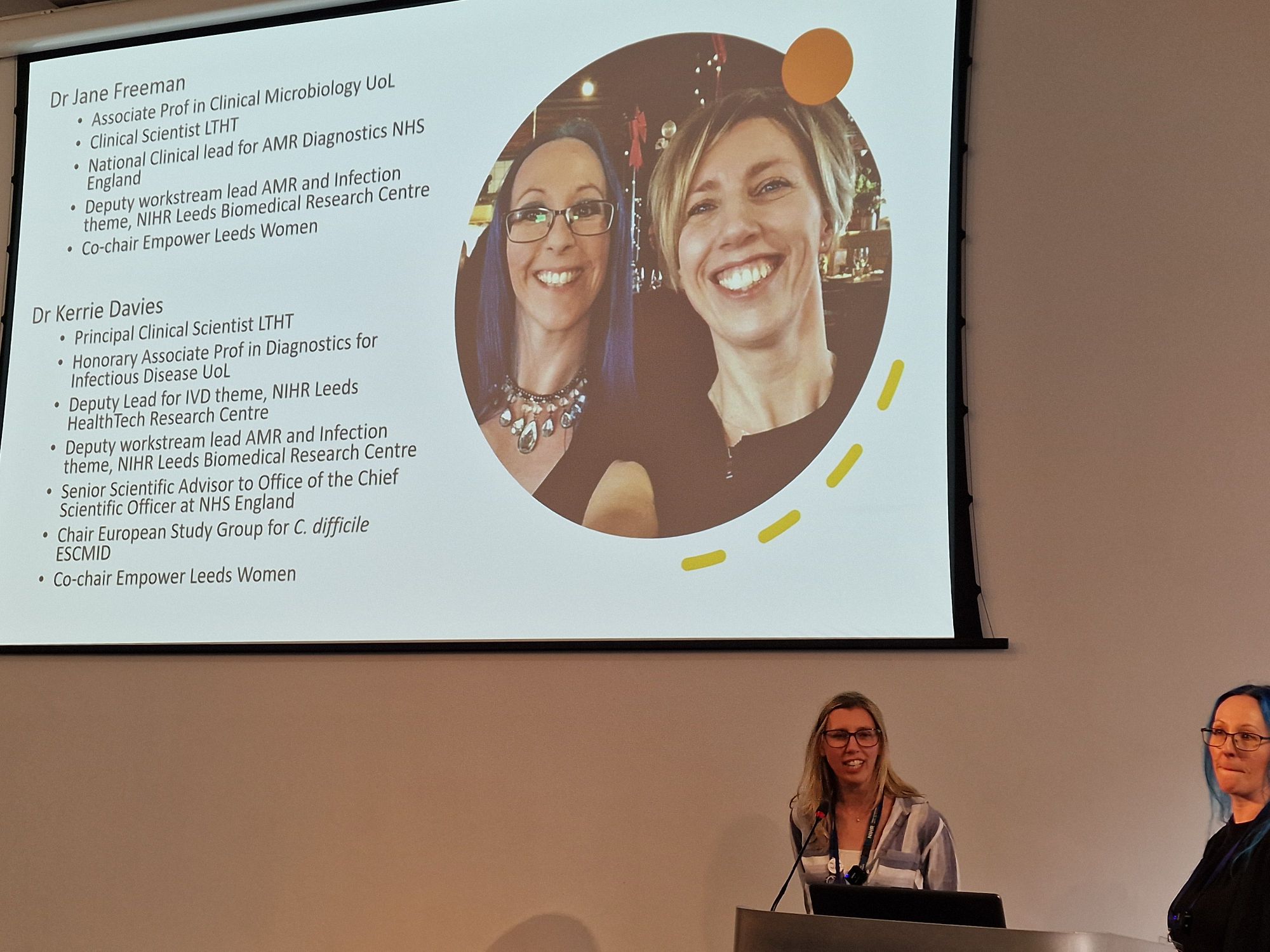
Goals should support aspiration, not self-recrimination

Goals and even New Year’s resolutions should be tools that help us on this journey. They should not be a weight around your neck to suffocate you if you do not achieve them. Goals need to be flexible enough to change as the landscape changes, and we need to be able to respond and throw them off if there are no longer relevant. I think we should all bear this is mind, least of all me, even with what should be simple things. Sometimes, when I say I will post on a specific day and I don’t manage it, I will go into a flight of self recrimination that baffles Mr Girlymicro who points out that the world has neither ended nor has someone been harmed by my lack of delivery. Perspective is needed. What are the consequences of achieving a goal or not? They should be map markers to aid you. If they become more than this, they probably need to be reviewed and further understood as to why they matter so much. Understanding your drivers is key to understanding yourself after all.

Sometimes, getting off the hamster wheel is more important than staying on it

One of the things I can’t work out if I learnt due to the pandemic or would have learnt in my 40s anyway is that sometimes the goal itself may be to become OK with not having a goal. Sometimes, the important thing is not to tick another box, add another level, or achieve more. Sometimes, the important thing is to do the opposite, to do less, take on less, to feel freed. In a world about consumption and visible gain it can be hard to feel legitimately able to make decisions that go against the tide and decide it’s time for a break. It’s often not even talked about as an option. It is however one. It’s OK to step away. It’s OK to table something for later. It’s OK to pause and re-evaluate. The rat race isn’t going anywhere. It will be there waiting for you when you are ready to re-join it. So go ahead and breath, everything will be fine.

Here’s to celebrating the little things in 2024

My 2024 will not therefore be filled with grand declarations. I’m hoping that it will still be filled with success, but the success that I want is about the little things. It’s about finding time to make and drink tea out of the pot instead of always rushing and having it from a tea bag in a cup. It’s about finding time to write this blog and be creative in a way that is joyful, not squeezed into existence. It’s about balancing my life and work, finding time to deal with my emails during working hours, and even on occasion seeing the bottom of my inbox. It’s about finding more moments with friends and family by achieving that balance. It’s about all those little moments every day that, for me, make life worthwhile. I hope that in 2024, you get whatever it is that you wish for and know, whatever you decide that is, that it is practically perfect in every way. Happy New Year.

All opinions in this blog are my own