This week is results week, many people will have been receiving A-level, T-level, and BTEC results, and making some pretty big life choices as a result, often feeling a lot of pressure to get them right as, for some, it can feel like a point of no return.
I’ve previously written about this from my point of view:
All that being said, I graduated university over twenty years ago, and if I was an academic paper reference you’d discount me for being out of date. I was thrilled therefore when Megan volunteered to write a guest blog on her experience of entering the field of Healthcare Science.
Megan has just successfully completed a BSc at the University of Lincoln and navigated the process to apply for, and be accepted onto, the national scientific training programme (STP) in audiology and is due to start in 2026. Megan had initially thought medicine was the only way into a career in the NHS and I hope that by sharing her experiences it can help others navigate, what can be, a complex landscape into a wonderful career pathway.
Guest blog by Megan Baines
Like many people working in healthcare science, my path wasn’t quite as straightforward as I once imagined.
Looking back, I’ve always been academically minded. As a child, I was the one who preferred curling up with a book rather than running around outside. I enjoyed classroom lessons far more than active lessons (forever hopeless at PE), and I found genuine excitement in learning new things. While my interests changed over the years, one subject consistently stood out above the rest: science. From a young age, science fascinated me. I knew that I wanted to pursue a career where science was at the heart of what I did. I didn’t yet know exactly what that career would look like, but I knew it would involve science and hopefully a hospital.
As I approached the end of sixth form, I encountered something that many aspiring healthcare professionals experience. When you tell a careers adviser, teacher, or family member that you’re interested in healthcare, the conversation almost inevitably turns to medicine or nursing. Both are incredibly rewarding professions, and the dedication of those working within them cannot be overstated. However, they are far from the only careers that make a meaningful difference to patients.
At the time, though, I wasn’t aware of the breadth of opportunities available. Like many students, I assumed medicine was the obvious route. So, I applied to four medical schools, with Biomedical Science as my fifth UCAS choice, thinking of it simply as a backup plan if I was rejected. In my mind, I had mapped out my future: I would study medicine, become a doctor, and that would be that.
However, as I attended university open days, rather than becoming more excited, I found myself feeling increasingly uncertain with each visit leaving me with an uncomfortable sense of dread. It wasn’t that medicine wasn’t interesting (it absolutely was) but I realised I couldn’t picture myself enjoying the course or the career in the way I had hoped. The more I reflected on it, the more I recognised that I had been pursuing an idea of what I thought I should do, rather than what genuinely inspired me.
Though, everything changed during my final open day at the University of Lincoln.
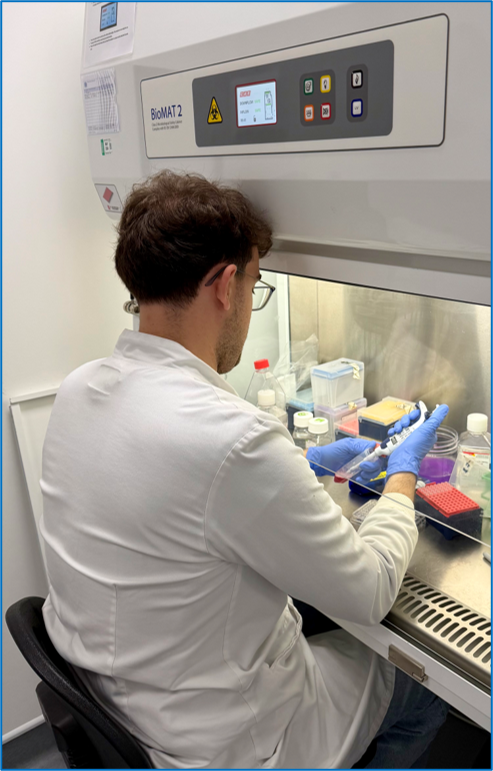
Walking around the Biomedical Science department, speaking with staff and students, and learning more about the course, I felt something I hadn’t experienced during any of the medical school visits: genuine excitement. The programme combined everything I loved about science with the opportunity to contribute directly to healthcare through research, diagnostics, and laboratory medicine. It immediately felt like the right fit.
Making the decision to withdraw my medical school offers wasn’t easy. After years of working towards what I believed was my dream, changing direction felt daunting. But it was also one of the best decisions I have ever made. I accepted my offer to study Biomedical Science at the University of Lincoln, and I have never looked back.
The three years I spent there were some of the most rewarding of my life. I was fortunate to be part of an incredibly supportive cohort, many of whom remain close friends today. My lecturers were not only excellent teachers but accomplished scientists whose enthusiasm for their work was infectious. They demonstrated that there are countless ways to make a meaningful impact within healthcare beyond the roles most people immediately think of and often had meandering paths into their dream careers.
One lecturer, in particular, had previously completed the Scientist Training Programme (STP). Through her teaching and conversations about her own career, I was introduced to the STP for the first time. Until then, I had never even heard of it. Like many students, I had been completely unaware that such a pathway existed. Discovering the STP opened my eyes to an entirely different career that perfectly combined my love of science with patient care.
Perhaps that’s a rather long-winded way of saying that careers are rarely as linear as we expect them to be. When I first started university, if you had told me that one day I would be training to become an audiologist, I probably wouldn’t have believed you. Like many Biomedical Science students, I assumed my future would lie in pathology, research, or another laboratory-based discipline. Audiology wasn’t even on my radar.
Yet that’s exactly where I found myself. Looking back, from choosing Biomedical Science over medicine, to discovering the Scientist Training Programme, to ultimately finding my place in audiology has led me to a career that genuinely excites me. I feel more motivated than I ever have before.
It’s funny how the opportunities you never knew existed can end up being the ones that suit you best. That’s one of the reasons I wanted to start writing. I remember how little I knew about healthcare science careers when I was applying to university, and if sharing my experiences helps even one person discover a path they hadn’t considered then I’ve done something right. It’s truly a privilege to now be writing for a blog that I have long enjoyed reading, while also beginning a blogging journey of my own.
This week has included some reflection for me on the importance of making our own luck. I’ve posted recently about both Tiara Syndrome and the Pygmalion Effect, which has made me think about what we can do to ensure that we are the main characters in our own stories, rather than drifting along. Being full blown participants in our lives, rather than falling into a trap of responding within rather than driving our tales. A key part of this is about how we respond to opportunities. How we decide to challenge ourselves by doing things that scare us. By choosing to step out of comfort and into the unknown. I’ve been thinking about how it is, that by consciously making small choices over and over again, we reach unexpected places and arrive at destinations we could never even picture when our journey began.
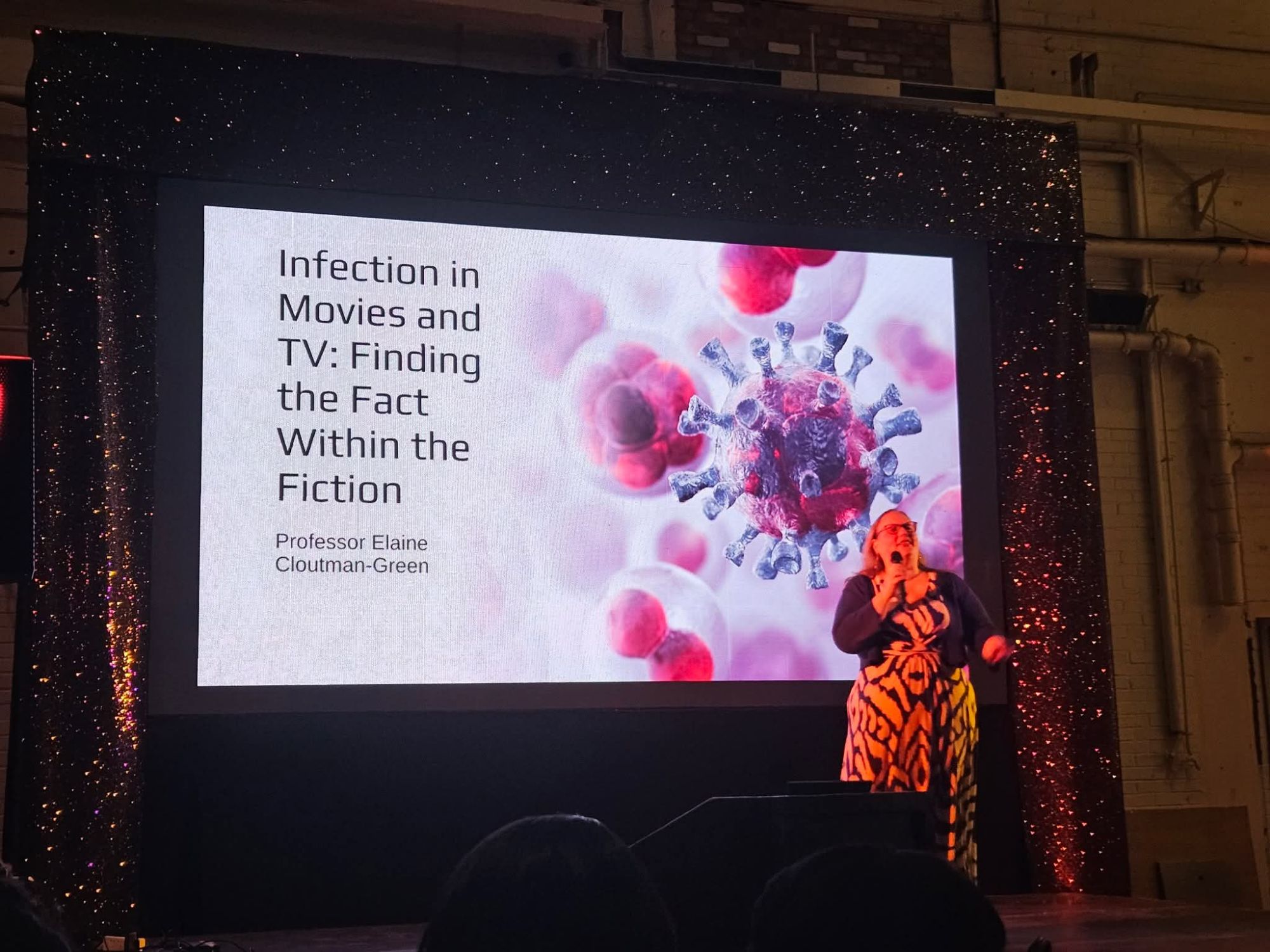
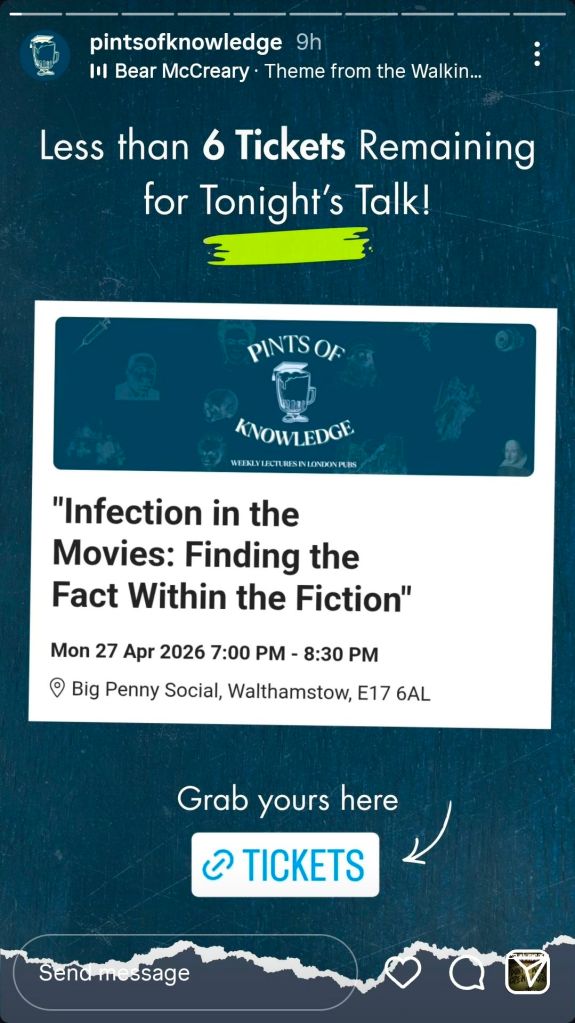
Last week I made one of those decisions, we actually it was before last week, but…details, the event was last week. In March, I noticed that there was a new series of events occurring in London pubs called Pints of Knowledge. The idea really resonated with me, it was the concept of bringing people who are interested in a really wide variety of topics into pubs, which are struggling right now, during the week and pairing them up with experts who are happy to sit and talk about a subject they love for an hour, and then hang around and answer questions. Now, as I have a policy of engaging with things that scare me and love an opportunity for learning and improvement, I threw my hat into the ring. That choice led me to trying something completely new last week, giving a public lecture in a pub on the subject of Infection in Movies and TV related to the book I’m currently working on.
Why was this different?
You will probably look at the above paragraph and say ‘what’s new’. You give lots of lectures, which is true, 1 or 2 a month on average. This was, however, a unique scenario that felt different. I have given lectures in pubs before, but not for ticketed events where people are paying money to hear what I have to say. I have given hundreds, if not thousands, of lectures before, but rarely to an audience of completely unknown backgrounds and interests. Even more significant, is that those lectures are rarely, if ever, linked to a really personal passion project, they tend to be more evidence based affairs. All of which made it a unique experience for me, and also required a certain level of vulnerability to be worked through. Something unknown, but something I deeply cared about doing well. This combination can make setting success criteria challenging, let alone delivering on those criteria.
No reputational protection
Having the words Professor in front of your name often provides a certain level of reputational protection. I’m usually asked to speak at events, and I generally work under the assumption that I have been asked either because they’ve heard me speak somewhere else and have decided I do an OK job, or because I know something about a specific, in my case likely very niche subject, that they want to hear more about. I don’t really have much to prove when I get up to speak, as someone has already made the assessment that I probably have something useful to say. Plus, when conferences have many streams, attendees could choose to go and listen to someone else if my stated learning objectives aren’t something they are interested in, so there is minimal risk for both myself and the audience.
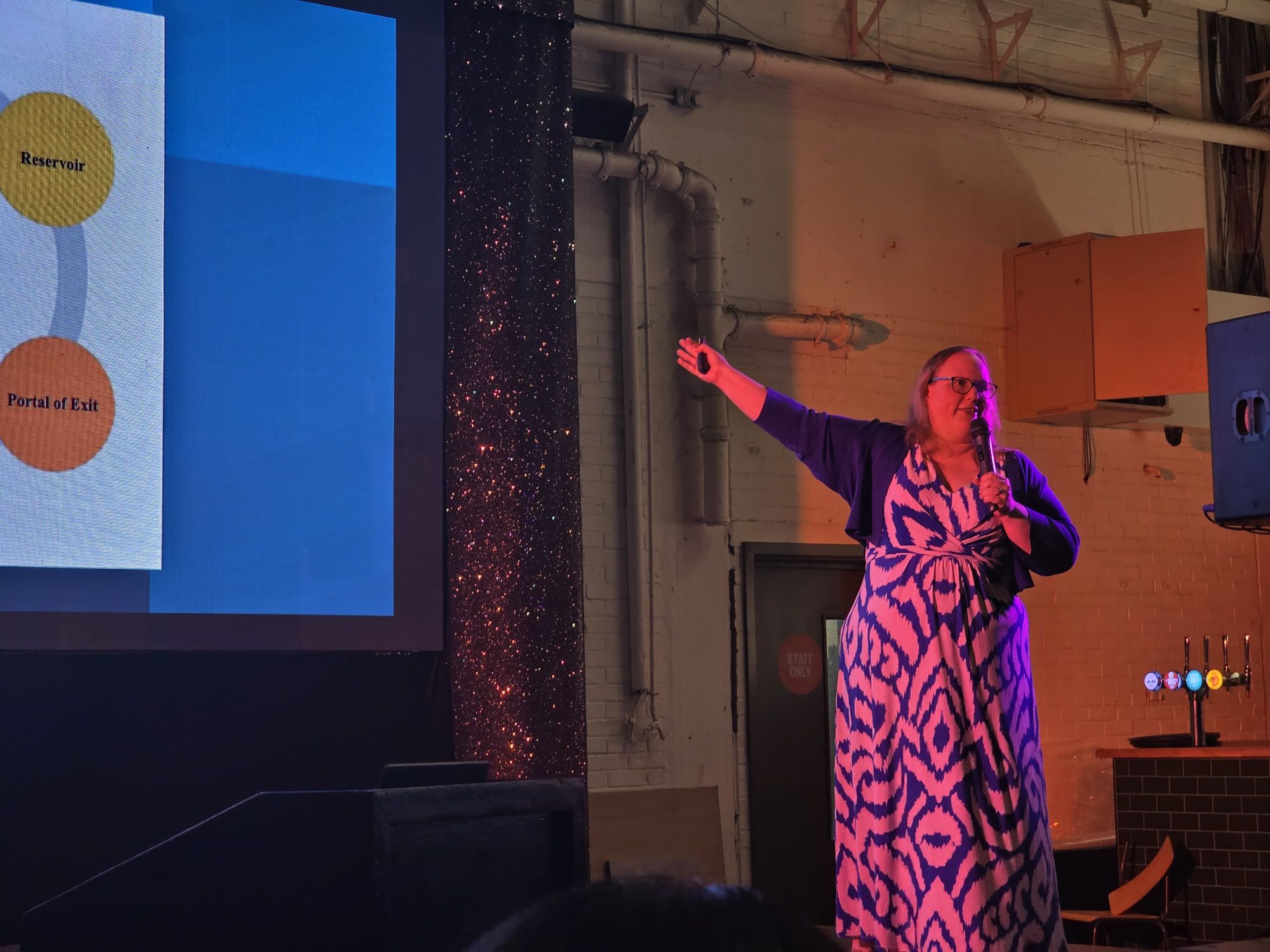
Last week, I stood in front of a room of 80 people who frankly probably neither knew or cared who I was. They were there because the talk title interested them and they fancied a night out with a pint. Therefore, I felt like I really needed to earn my stripes and prove my right to stand on the stage and talk about something that I really enjoy, the combination of infection and movies and TV. When taking on a very different type of challenge, I know that if everything goes well, the high will be unreal. The counter is also true, there is at least some level of risk. In this case, risk that you aren’t the competent speaker you hope you are, and that you won’t be able to convey the topic in the awesome way it deserves. Therefore you won’t be able to deliver in the way that either you or the audience are hoping for. Going into the event, you have to be OK with accepting either outcome, as you will never truly know how the cards will fall until after the event.
No prior knowledge of the audience
As I’ve said, the tickets for these kinds of events are on general sale. You might, therefore, get movie lovers coming who don’t really know anything about infection. You might, and there were, get lots of scientists and people interested in infection in the audience, but this doesn’t guarantee that they will get your movie references. You may also get a group of people who have no particular interest in either subject area and just want a night out or a place for their next date. Deciding how you are going to structure your session, therefore, can be a little challenging. How much time do you spend on each section? How much intro to the film examples do you need? If you spend too much time covering areas people already know and understand, they are likely to get bored. If you don’t intro enough you’ll lose people and they may think you dull. All that before even considering whether your jokes will be funny.
It’s a unique experience talking in a public forum versus talking at a conference, or to a group of students, where you have some knowledge of the type of people who will be in the room. When you have that knowledge you can use it to inform putting together the story you want to tell during your presentation. Not having that starting info can, therefore, make things harder. It is however, a great opportunity to go back and undo some of the assumption you make during your normal talk structures and think how you could do it better by looking at everything through a fresh lens.
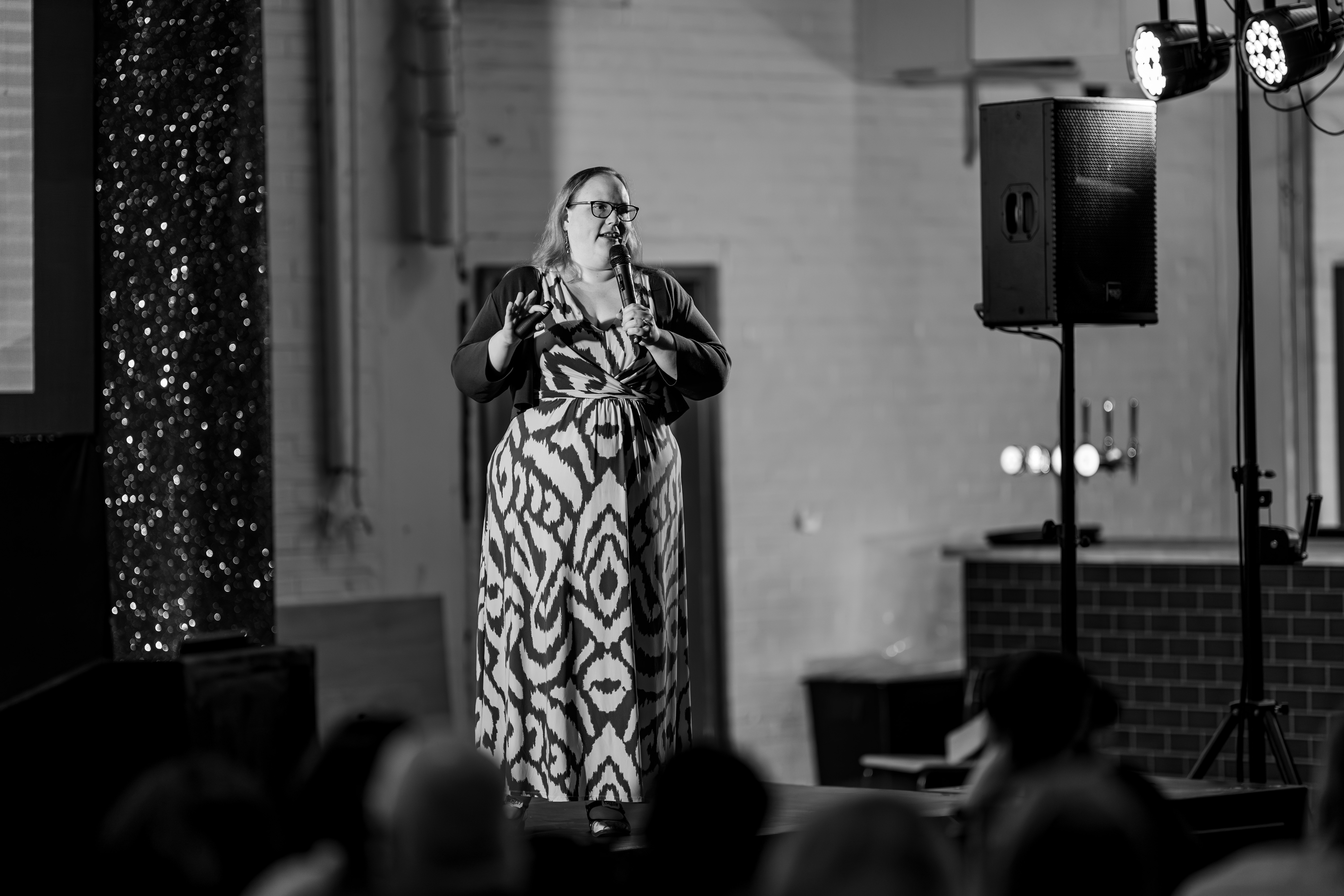
Photo credit Steve Cross
No learning outcomes
I mentioned learning outcomes before, and when I’m giving talks at conferences or in academic settings, I will always use learning objectives to guide expectations and offer sign posting to anyone attending. They allow people looking at agendas to really understand what my session is going to cover, and the pitch of the event, rather than just guessing based on titles. The interesting thing about doing a session like Pints of Knowledge is that it isn’t about continuous professional development, or walking away having addressed a specific learning objective. My main objective was to deliver a session in a way that was entertaining and allowed people to have a good evening, with walking away having learnt ‘facts’ as a secondary outcome. It’s about opening the door to a topic so that anyone interested can then feel like they have a starting point to access more info if the session speaks to them. To me, you are acting as a guide not a teacher, and that means that whether a session is ‘successful’ probably is something different than ticking off a number of topic points discussed.
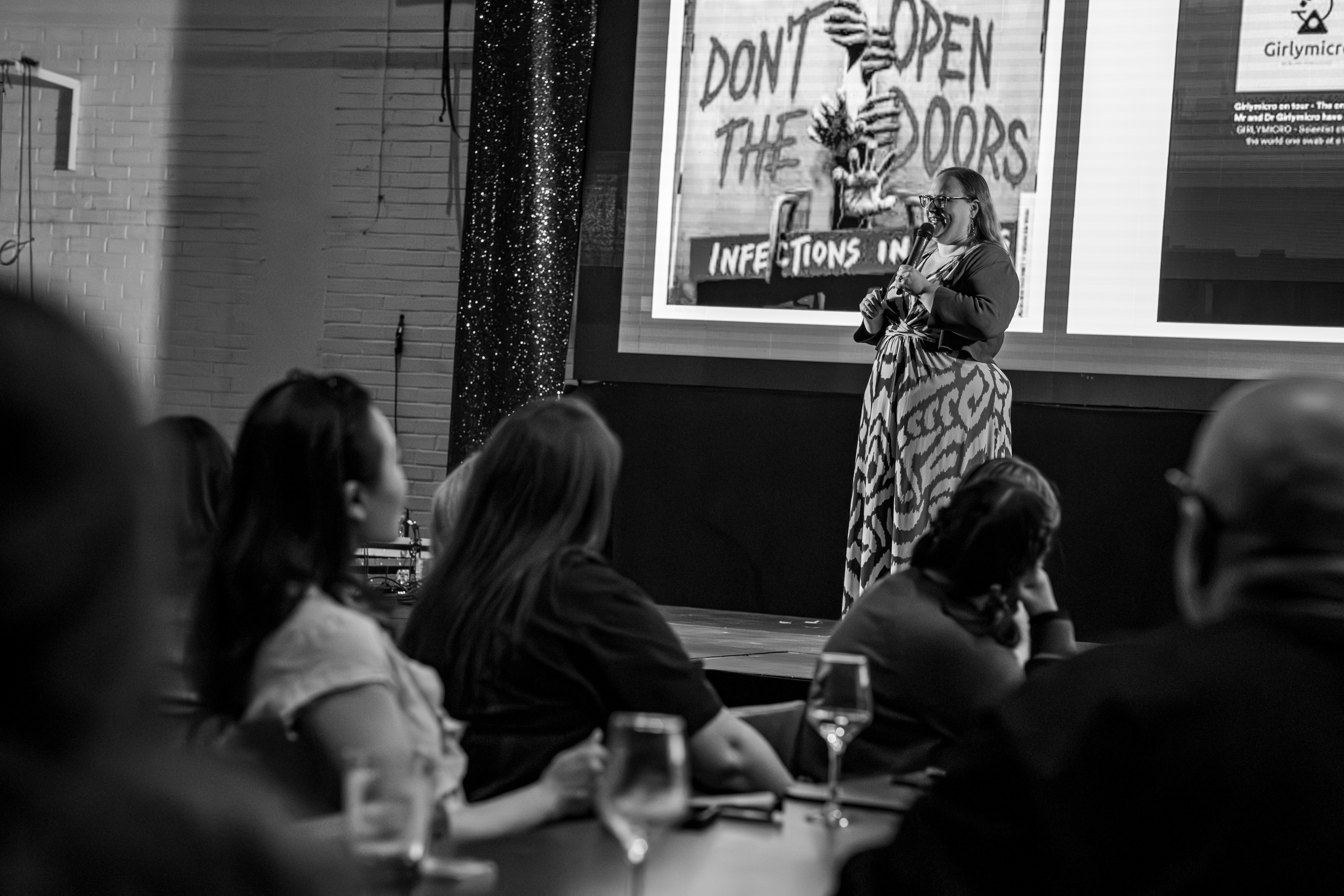
Photo credit Steve Cross
Pitching considerations
Having spoken about the fact that you don’t have any prior knowledge of your audience, pitching can be challenging. This includes not just the structural components I’ve already talked about, but how you pitch your content. What kind of language do you use, which words and terms do you need to explain. Pitch too high and you will lose people, pitch too low and people will feel talked down to. One of the great things about these events is that they are in person. This means you have the opportunity to hear how people are talking to each other before the session starts and what they say they are interested in, when no one knows who you are. You can also see their faces and reactions as you are the giving the session, which allows you to react and adjust your content in the moment. This is one of the reasons that I tend to use text light slides when I’m speaking to audiences that may be mixed, or I know less about. This enables me to adjust my content in the moment, spending more time explaining if needed, or expanding on things the audience are responding to more. It can take a chunk of self confidence to stand there and know that you are going to try and read the room and respond, but when the pitch is uncertain it may be the best way to ensure everyone is having a good time.
Photo credit Steve Cross
Facing up to the unknown
The other facet to this is that the organisers don’t know you either. They have taken a chance on you, and if you are anything like me, you want to show them that that risk taking is warranted. If I’m organising an event, I will usually know the venue. I will know how many seats there are. I will know how many tickets I have sold. For this kind of event you have none of that information. The screen shot below was taken when it came up on my feed after the event. I spent most of the run up terrified that no one would be interested enough to buy a ticket, the organisers would be disappointed, and that would have an impact on something that I think is a really great endeavour. There is a responsibility that comes to something like this.
Being OK with having less control than you would normally have is key to stepping out of your comfort zone, irrespective of activity. Stepping out is a key component of learning and improving, and so it is important we acknowledge that discomfort is just part of the process. Let’s not fight it, let’s just accept it.
Wearing your heart on your sleeve
All of this sounds simple…right? The logical part of my brain always thinks so. That’s why I sign up for these things. We are however all more than logic. We are whole individuals with an emotional component to what we do and how we react to things. So despite my logical brain saying, ‘I’ve got this’ the feral emotional part of my brain can easily spiral. This is especially true when I really care about something I’ve committed to.
In this case it was a session on topics I love so much that I’ve committed to writing 80,000 words about them. The fear of standing up and saying this is something I love, this is something I find fascinating, and seeing a room full of faces that look back with skepticism, or worst still boredom, is not something that is easy to shake off. Acknowledging that our responses, or at least mine, are never going to be entirely seated in logic is an important part of managing the fear that stepping into the unknown and challenging ourselves can create. Instead of asking ‘why do I feel this way’ and stopping there, following on with acknowledging that feeling and working with it, rather than ignoring it, helps me at least get out of my own way.
So what practical things can you do to find a way through the fear?
Preparation is key
The first thing is to do your research. There will be unknowns that you can’t address, but there will be ones that you can, in order to remove some of questions about what is expected.
For Pints of Knowledge, they were kind enough to give me a free ticket so I could attend a session from someone else. Now, that session was in a different venue, with a very different topic, but it let me get a feeling for the vibe and what kind of people might make up the audience. It also let me understand what kind of talk structure other people were using, the types of questions that the audience might ask, and the way the speaker responded to them.
I also spent a lot of time talking to people to see what they might be interested in if they were going to see a talk with a similar title. What terms were people used to, what terms might require a little more explanation? Mr Girlymicro also put up with me talking about, running concepts, and hearing the presentation, during the run up. One of my brilliant IPC team, who isn’t a big movie fan, even agreed to hear a full run through and then gave me feedback on how well it landed for someone who was interested in one component, but not so interested in the other. You can’t do much about the true unknowns, but you can work to address the unknowns that may have solutions if you decide to put in the work in advance.
Focus on your audience
This is probably not revolutionary, but it is something that took a while to really land as a piece of my thinking and prep when I started speaking at sessions more regularly. It’s not about you. As someone invited into a space to give a session, you are a guest in that space, and it shouldn’t be about you and what you want to deliver, it is about the audience. What might they find interesting? What might they find entertaining? If you are talking linked to a learning event, what might it help them to learn in a way that works for them? What pieces of knowledge would help them achieve the goal that led them to attend? I find this shift in perspective really helps. It also pushes me to be more inventive in my approaches. It also can prevent me being stuck in my own head, or getting caught in a loop linked to aiming for perfection. What I want to achieve is likely different from my audience, and shifting my focus and success criteria to centre on them, stops me tying myself into knots trying to achieving 2 things simultaneously that may have different requirements.
Photo credit Steve Cross
Ground yourself in what you know
The other thing I find helpful, if I’m nervous or unsure, is that I walk the right line in terms of pushing myself in some aspects but not in all areas at the same time. If you are speaking to a new audience, or ones where there are lot of unknowns, then it is best to ground yourself by talking about content that you are familiar with and confident about. If you are speaking to an audience you know well, with less unknowns, then you can probably take risks and push yourself in terms of content and content type. When I talk about stepping out of your comfort zone, I think there’s a difference between pushing your boundaries and stepping into something new, versus taking a giant leap into an arena that is completely new in all aspects. I’m not saying you can’t do that, but if you are doing something to develop or expand learning, I find it beneficial to expand on a previous skill or knowledge set, rather than trying to do everything at once. If things don’t work out and it’s all new, it’s hard to know which aspect had the greatest impact on whether it succeeded or failed. That means it is harder to develop a plan to address the any development gaps. Development is iterative, and so taking a step wise approach can benefit you in terms of both managing any anxiety or fear, as well as in guiding what a development plan might look like.
Photo credit Steve Cross
Be OK with ‘what’s the worst that can happen?’
I’ve written before about the Rule of Thirds. The fact that 1/3 of people are likely to love something you create. A a third of people are likely to be ambivalent, and a third of people are likely to have a variable level of negative opinion. If you manage to shift those numbers towards the positive you are doing amazingly well, but don’t ever be deluded enough to think you will have 100% positive result. You can’t impact the mood someone was in when they sat down to listen to you, or the fact that someone got stood up or arrived late and it’s put them in a humph. Someone’s mood will impact how they feel in the space and how they interact with your offering. There’s not much you can do about that, so sometimes you can give the best session in the world and an individual is going to still have a sucky time.
All of which brings me to the question I ask myself when I spiral ‘what’s the worst that can happen? If I give a bad talk then I probably won’t get invited back. Will that be the end of my career? No. Will that mean people won’t buy my new book? Maybe, but also I’m not writing my new book to become a millionaire, I’m writing it because I think it’s something others might be interested in and to share a topic I love. The number of copies sold is a very minor part of my success criteria. Will my ego take a knock if it goes badly? Yes, but that’s ego. It won’t be the first time I’ve had a set back, and every set back has led me to go back to the drawing board and to learn how to be better, so really each has ended up being an opportunity.
The main thing is to be honest with yourself about the consequences of stepping out of your comfort zone, put it into context, and make an informed decision whether this is something you want to do. Most important of all, once you have made that decision in a calm and logical place, stick to it. Don’t let later emotions overwhelm your decision making. Acknowledge how you feel but don’t be driven by the fear response.
Photo credit Steve Cross
The pay off is worth the risk
If nothing else, when you feel the wobble, when you ask yourself why you decided to do this, re-focus and remember the reason why you said yes in the first place. Remember what you were trying to achieve, and keep that vision in front of you to remind yourself of where you are trying to get to.
I was pretty terrified before I got up on that stage. My self doubt ran wild. I still got up and did it. It reminded me of why going through the fear was worth it. Not only did the session seem to go pretty well, but I answered questions for an hour and half, and met some really wonderful people that I would not have met otherwise. I saw friends and family come together to support me, and it was lovely to have an event where they could turn up and see what I do as part of the day job.
Like always, you will get far more out of stepping into the unknown that you had predicted. There will be unexpected payoffs and bonuses that you couldn’t have foreseen. Even without that though, you will have taken steps to develop yourself and build confidence that will make you even braver when making your next decision. The unknown should be less of a place of fear, and more considered a world of opportunity. If we take steps into it regularly enough, we remind ourselves of the benefits that taking steps outside of our comfort zone hold.
All opinions in this blog are my own
In case you’d like to see them, these are the slides I used, and if it’s of enough interest to people I may even record the session and put it up on my YouTube channel – let me know if you’re interested. Also, a massive thank you shout out to Steve Cross for the photographs. Steve does a number of creative things, public engagement, consultancy, and comedy sessions, as well as photography so if you are interested give him a shout.
Everywhere I look at the moment people are talking about ChatGPT and artificial intelligence (AI). On LinkedIn this week everyone was sporting ChatGPT produced images, and I have to say I felt completely out of things as I’d have no idea where to even start. The challenge is, the same cannot be said for our students. As an external examiner I see how the AI creep is really beginning to impact on assessments, so I reached out to my great friend and educationalist Dr Claire Walker, who is actively working to think about how we can respond to the AI challenge when it comes to our assessments.
Dr Walker who is a paid up member of the Dream Team since 2013, token immunologist and occasional defector from the Immunology Mafia. Registered Clinical Scientist in Immunology with a background in genetics (PhD), microbiology and immunology (MSc), biological sciences (mBiolSci), education (PgCert) and indecisiveness (everything else). Now a Senior Lecturer in Immunology at University of Lincoln. She has previously written many great guest blogs for the Girlymicrobiologist, including Exome Sequencing and the Hunt for New Genetic Diseases.
Blog by Dr Claire Walker
So, there’s a new problem in higher education. The elephant in the room that we’re all talking about, or sometimes pretending doesn’t really exist: our chatty friend, generative AI. When I first encountered it, I suspected the impact might be overstated. Students do not come to university simply to cheat; they come for authentic learning experiences and to gain transferable skills. I mean, they want real jobs eventually, right?! But the reality facing educators is more complicated. Alongside the rise of AI, we are also facing another persistent challenge: do more with less. Larger cohorts, less time, fewer staff and an increasing pressure to design assessments that genuinely measure skills rather than copy-paste ability. Many of our classic approaches to assessment – lab reports, literature reviews, and even theses can be generated with just a few of the right kind of prompts.
Our chatty friend or the nemesis of lecturers everywhere
So how can we create authentic learning experiences that are difficult to outsource to AI while still being practical to run and mark? At the University of Lincoln in our Genetics and Bioethics module, we have developed one approach: AI-supported patient roleplay combined with pedigree analysis and ethical reflection. One of the long-standing challenges in genetics education is giving students meaningful practice in family history taking and pedigree construction. Traditional simulated patient encounters are highly effective but expensive and logistically demanding, often requiring trained actors and significant coordination. As a result, many students learn pedigree analysis primarily through static textbook cases. I can’t say this isn’t useful, but it’s pretty far removed from the realities of genuine clinical conversations.
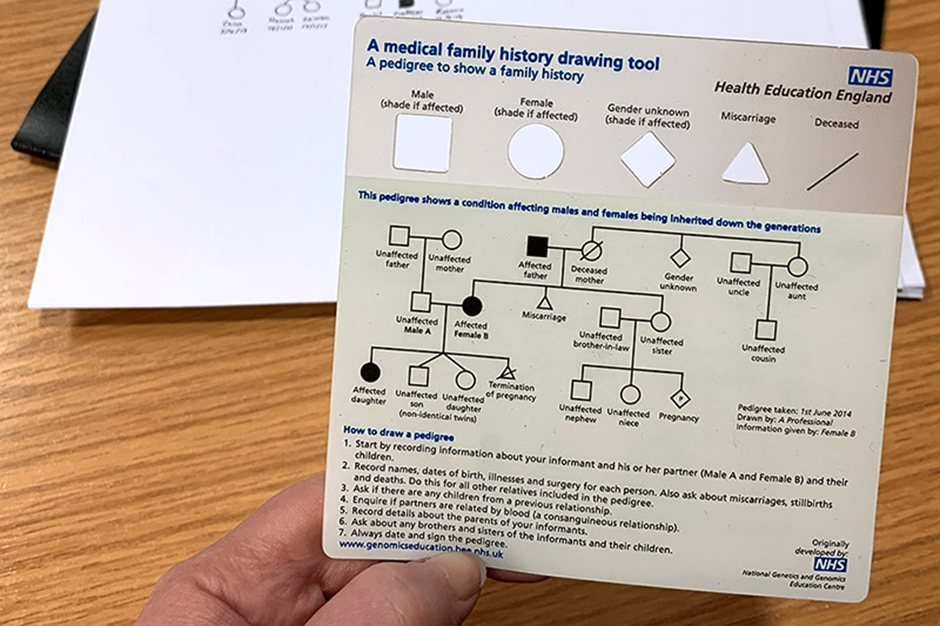
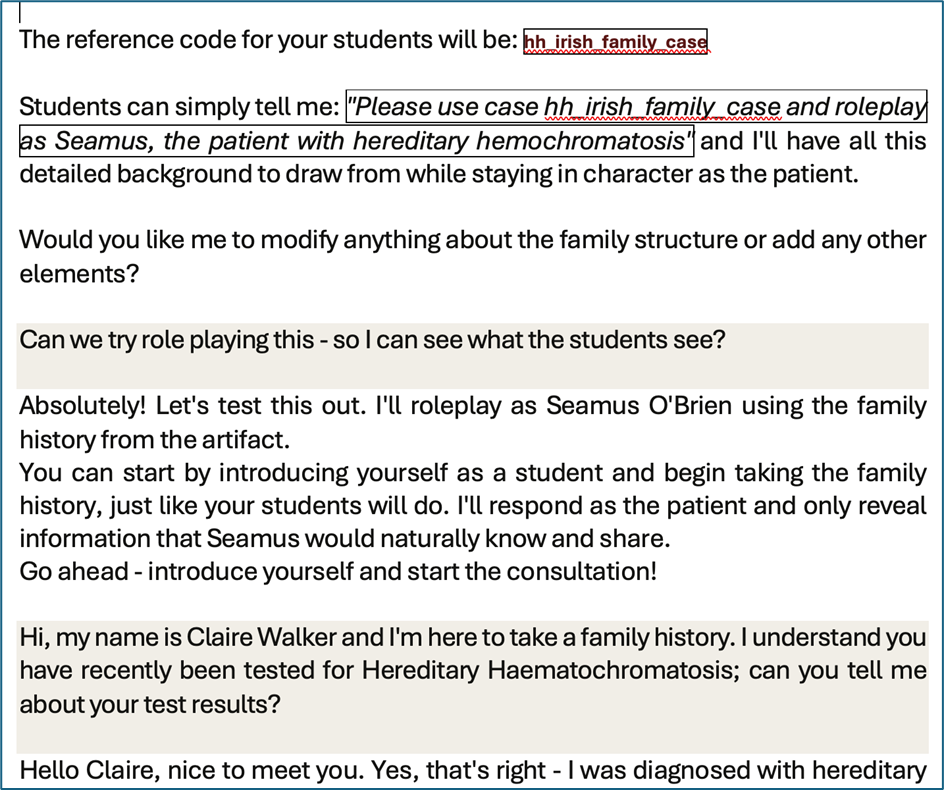
Our solution was to create interactive patient roleplay scenarios in which students interview a simulated patient using Claude.AI during a live teaching session. The students interact with a “patient” presenting with features of the genetic condition hereditary haemochromatosis. They gather the relevant family history by asking structured clinical questions of our AI bot pre-programmed with a real clinical case. The information they need does not exist in advance as a written case study; it emerges through the interaction, requiring students to listen carefully, probe appropriately, and adapt their questioning strategy in real time. This immediately changes the learning dynamic. Students are no longer passively interpreting a pre-constructed pedigree; they must build the dataset themselves by asking the right questions. Mistakes become learning opportunities, and repeated questioning helps them to refine both clinical reasoning and communication skills. Following the roleplay session, students translate the collected information into a formal pedigree diagram using a clinical pedigree-drawing software fortunately available for free online. This requires them to apply standardized genetic notation accurately while organizing complex family information into a clear visual representation that can be assessed objectively, and delightfully quickly. Most importantly – right now ChatGPT can’t draw this from a script. Maybe one day, but for today this assessment is one step ahead.
A medical family history drawing tool from Health Education England
The assessment does not stop at technical skills. Students are also asked to reflect on the family scenario and the issues raised during the session to consider a realistic counselling question: would they personally choose to undergo testing for a variably penetrant mutation associated with hereditary haemochromatosis? The genetic test used in the module looks for two common changes in the HFE gene known as C282Y andH63D. In simple terms, the test examines a person’s DNA to see whether they carry gene variants that can affect how the body regulates iron absorption. Certain combinations, particularly inheriting two copies of the C282Y variant, increase the likelihood of developing iron overload, but they do not guarantee disease. Many individuals with these genetic results remain healthy, illustrating the concept of variable penetrance; genetic changes that influence risk rather than determine destiny. Environmental and lifestyle factors such as diet, alcohol intake, blood donation habits, and biological sex also affect whether symptoms develop and how severe they become. Students are therefore encouraged to reflect on how genetic risk, environmental influences, and personal values shape decisions about predictive testing taking into account what they learnt from their virtual patient experience. At the end of the module, they are offered the opportunity, within the academic teaching setting, to undergo testing themselves so they can engage directly with the ethical, psychological, and practical considerations that accompany real-world genetic screening decisions.
Instructions to Claude.Ai for how to behave as a patient and a excerpt of the transcript of the interview
An additional advantage of this approach is assessment authenticity. Because the key information is generated dynamically during a live interaction, the task cannot easily be completed using generative AI alone. Students must attend, participate, and apply lecture knowledge in context, meaning the assessment evaluates what we actually want to measure: their ability to gather relevant genetic information, interpret it, and think critically about its implications. Equally important, the approach remains scalable and low-cost. No actor recruitment is required, sessions can be delivered across large cohorts, and students can practice interviewing skills in a structured but flexible environment. What once required substantial logistical planning can now be implemented with minimal additional resources. Moreover, all modules must have some laboratory component, and this one falls into a middle of our usual price point.
I’m not offering a complete solution to this huge challenge facing higher education, but it is a step toward something we increasingly need: assessments that measure real skills, encourage real engagement, and prepare students for the complex clinical and ethical conversations they will eventually have with real patients.
TL/DR – If AI can take the assessment, change the assessment.
Today is a bit different, today is about celebrating all of who we are and what we bring to everything we do. Friday was also the day for Healthcare Science Education 2024 (#HCSEd24) which was conveniently titled ‘Embracing your authenticity’. As I know that not everyone could make it I thought it might be useful to share what the sessions contained. To do this, the organising team have come together to each blog about their key take aways from each session. So grab yourself a cup of tea and have a read, and hopefully you will finish reading this post as inspired and as happy as the day made me.
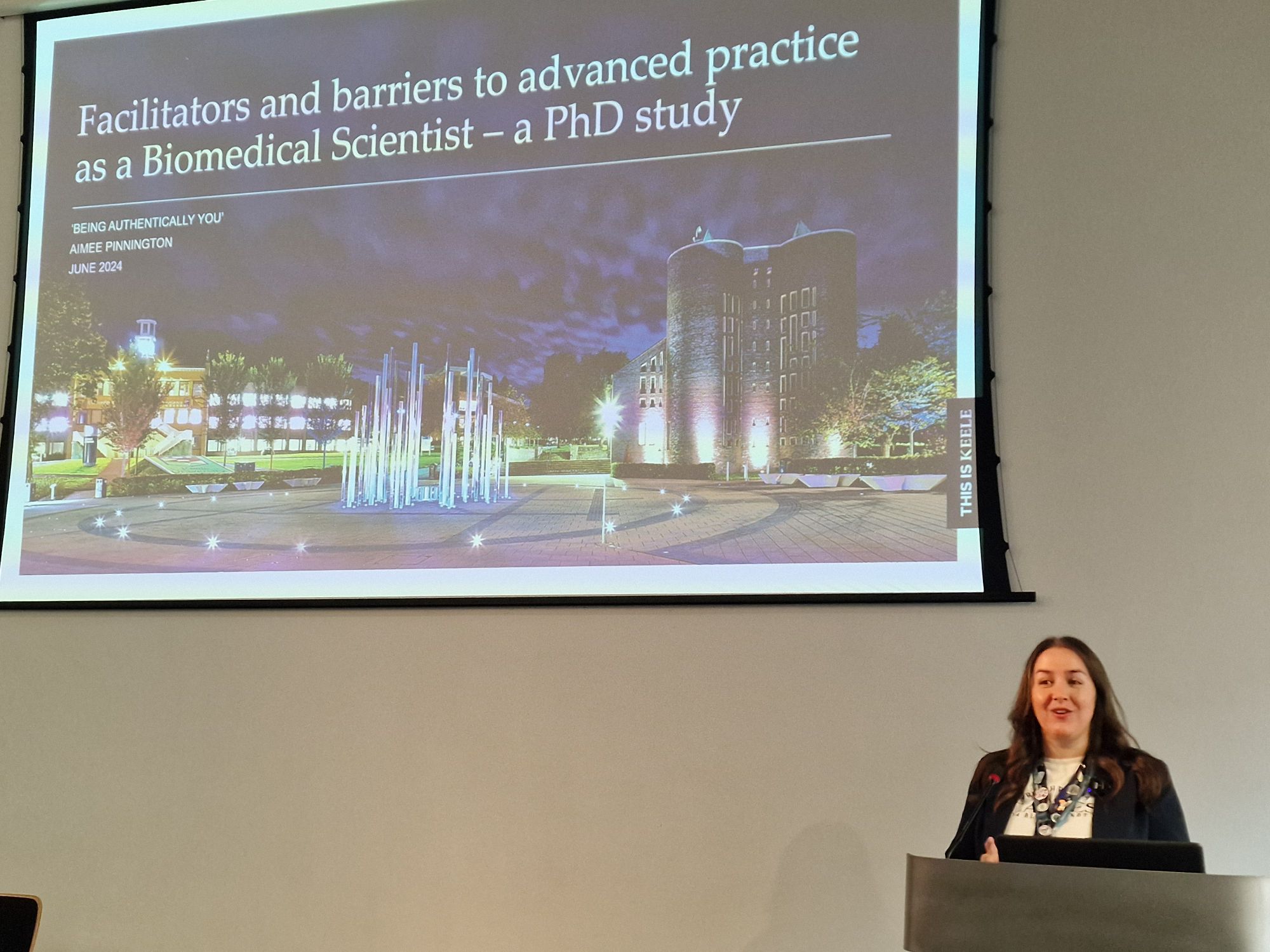
Barriers and facilitators in Healthcare Science careers – Aimee Pinnington (Keele University)
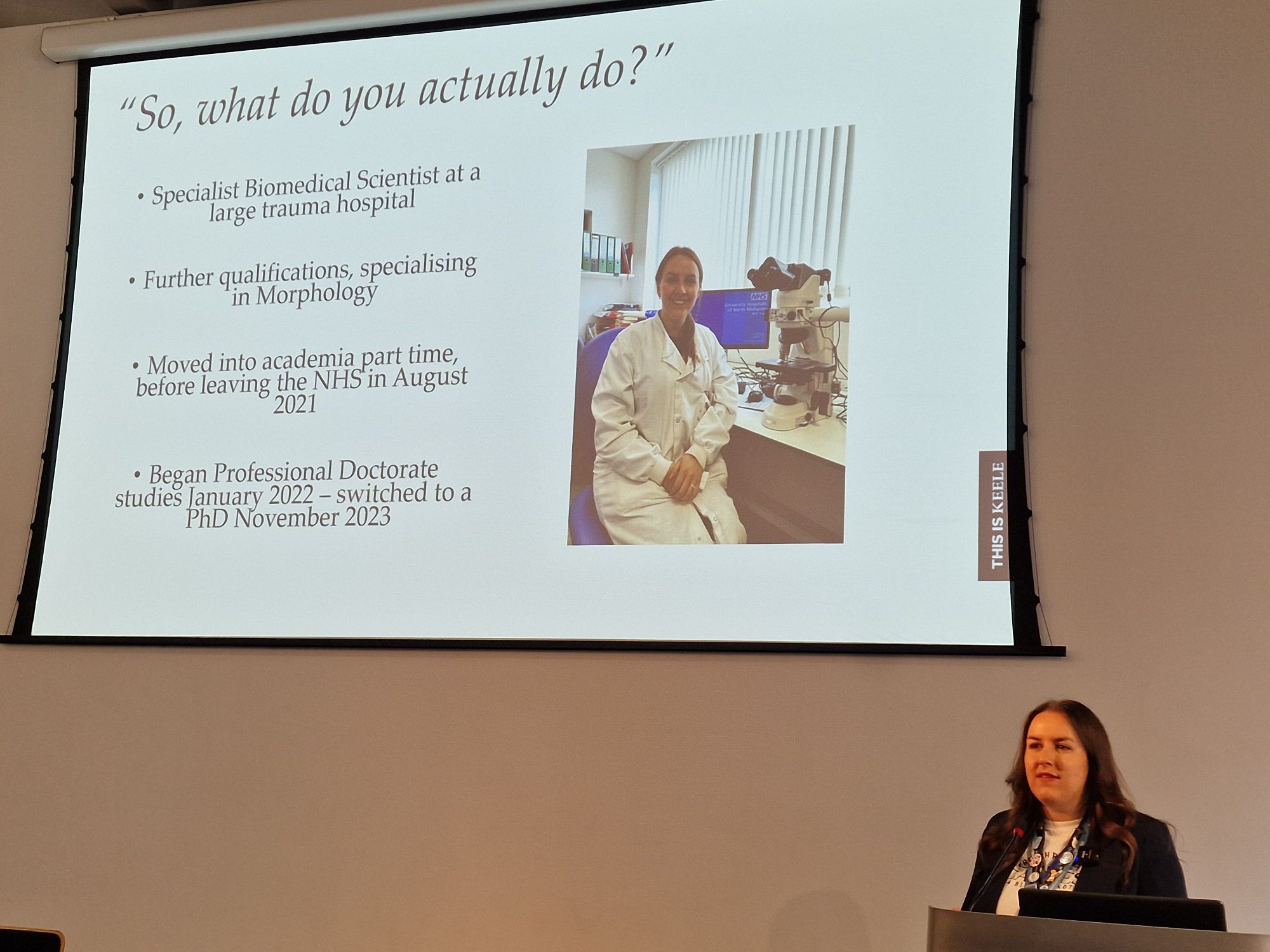
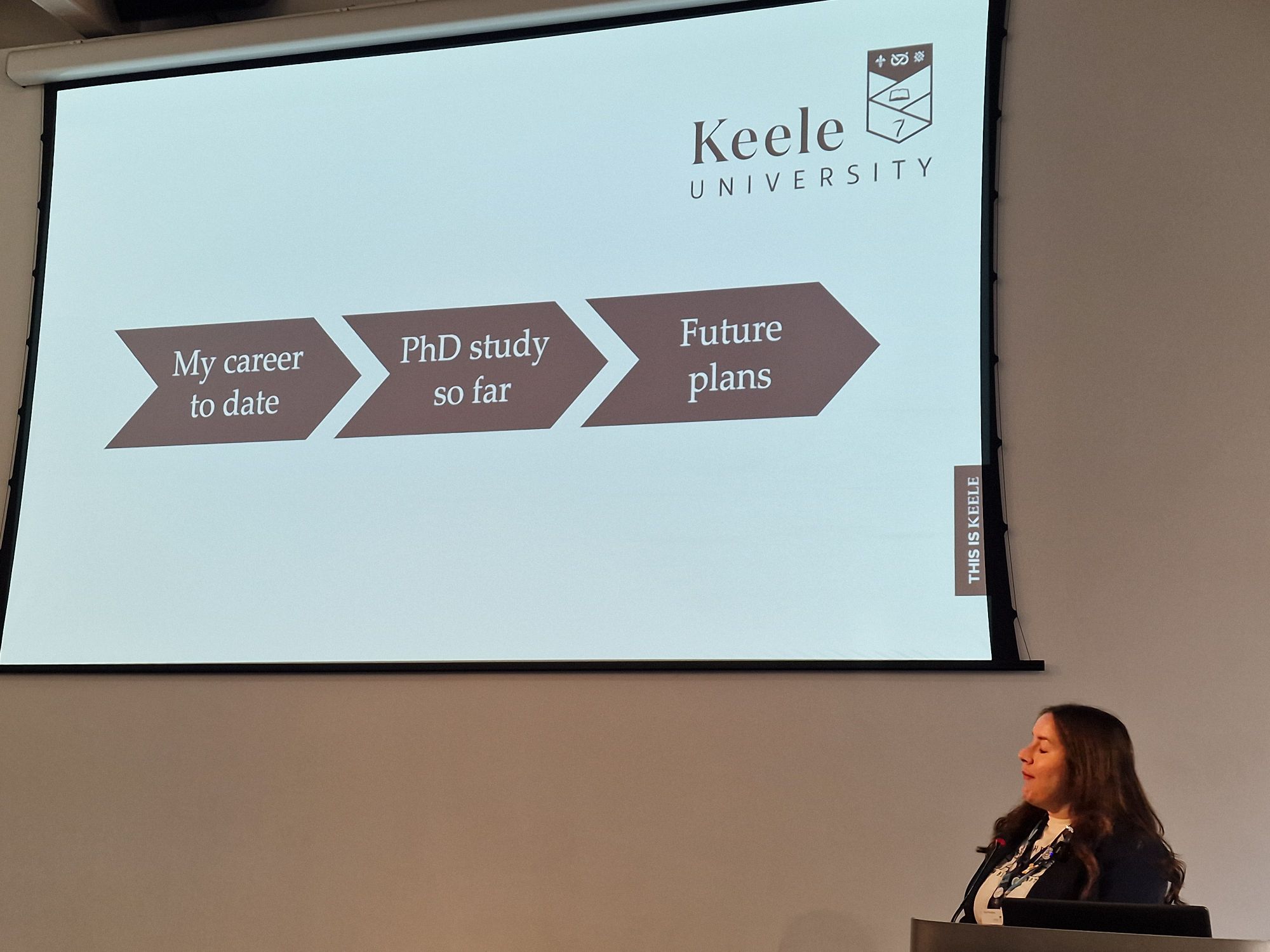
Aimee gave a superb talk covering her diverse career pathway, from her experience as a Biomedical Scientist to transferring to a professional doctorate. Despite a long list of achievements, unfortunately there was a lack of support from the department, building in barriers. After a move to a teaching fellowship, this lack of support continued, with additional barriers becoming apparent. This prompted a further move to a full time lectureship, Aimee began her PhD looking at how to improve biomedical science as a profession and empower the workforce.
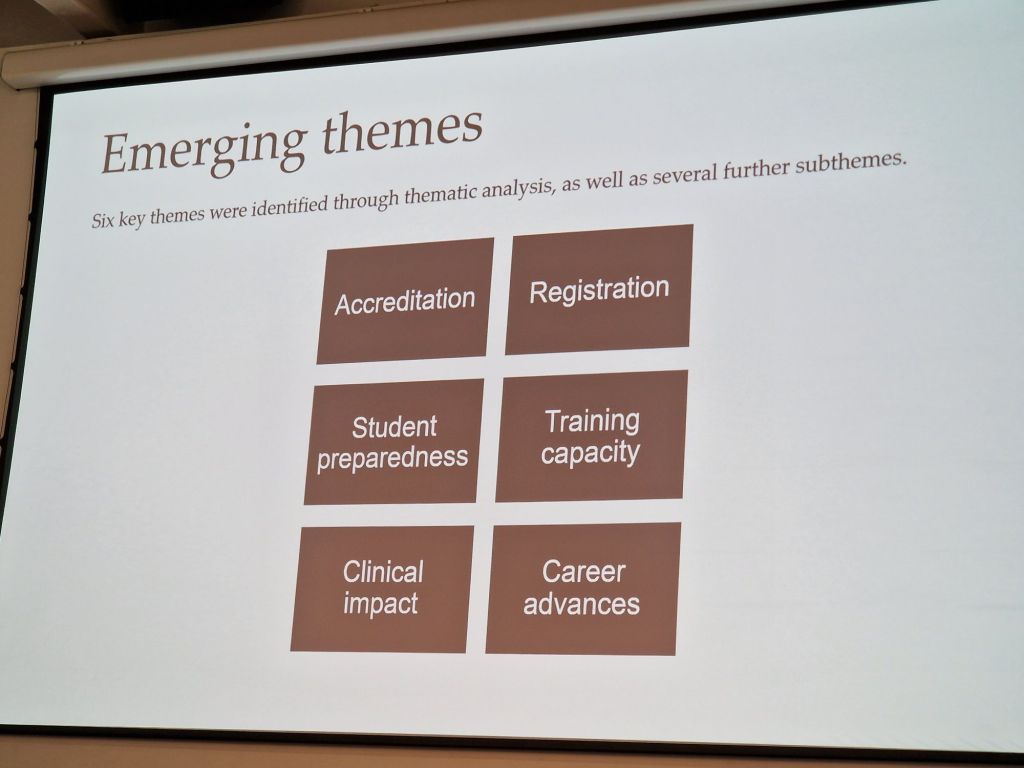
Her PhD research focuses on the impact Biomedical Scientists have on the patient, with there being a lack of direct evidence on the quantifiable impact on diagnostic pathways on patient outcomes. Furthermore, a lack of training posts and placement opportunities can hamper progression. There is further ambiguity of how to progress through the Biomedical Scientist profession to advanced roles. Her research has so far highlighted accreditation, registration, student preparedness, training capacity, clinical impact and career advances as key area of importance to the profession as part of focus groups.
Her research has focused on career advances in the biomedical science profession, which when done well and encouraged, can benefit all areas of the profession and support students entering clinical laboratories. To address this, the project is looking deeper into investigating behavioural traits that impact career progression. Are the opportunities clearly available? Do staff members feel empowered within their departments to take on opportunities for progression? It is also important to consider how barriers to progression change as someone moves through the profession, looking at how a trainee may feel compared to a more senior staff member.
Getting the room actively engaged in the session, a poll identified management support as a key barrier when done poorly, and excellent facilitator for progression when done well. One comment stated how there can be an expectation from managers for staff to progress, without actively facilitating this progression.
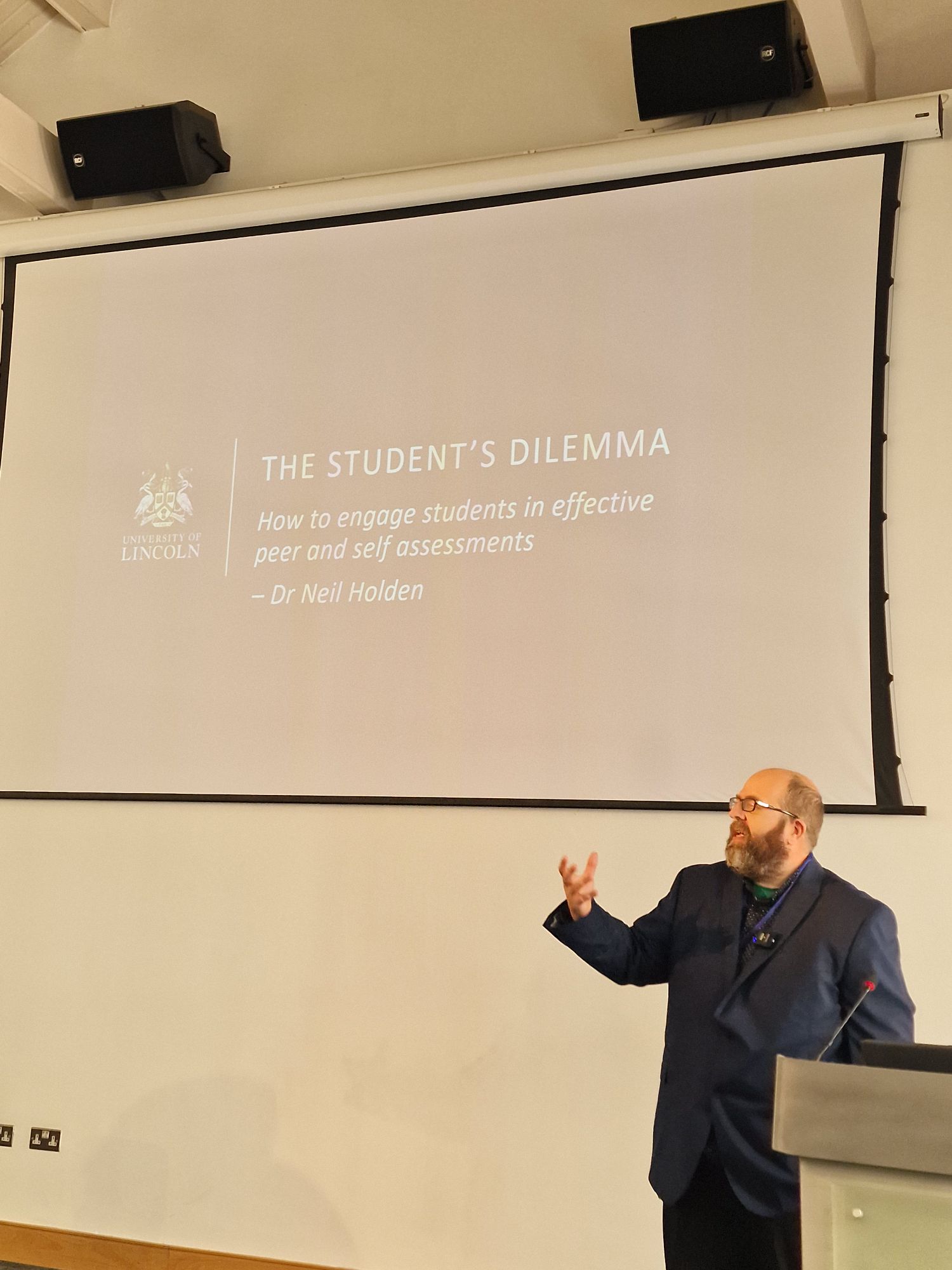
The students dilemma: how to reduce bias in student peer and self-assessments – Dr Neil Holden (University of Lincoln)
Neil brings a fresh perspective to the conference with a background of academia and international pharmaceutical industry experience. He’s passionate about what placements can bring to the academic journey. A key theme developing through our talks this morning is finding our barriers and how we can overcome them. Neil has been asked to talk today about authentic assessment and how to engage our students in this work. How we might bring them into the fold of University culture. We need to acknowledge how education is changing and how we can keep up. Neil feels an essential part of this is bringing the students into the process, and learning how they might assess themselves. The view inwards is becoming more important in this modern AI generated world.
Neil has instigated a peer review assessment in his popular Pharmacology and Toxicology module. Peer review is hugely beneficial – it has enhanced performance, and it massively helps with social skills and ownership. It can have greater impacts than even the lecturers feedback, when it is done well. But how can we ensure that it is done well? How do we identify and overcome bias to create an authentic assessment?
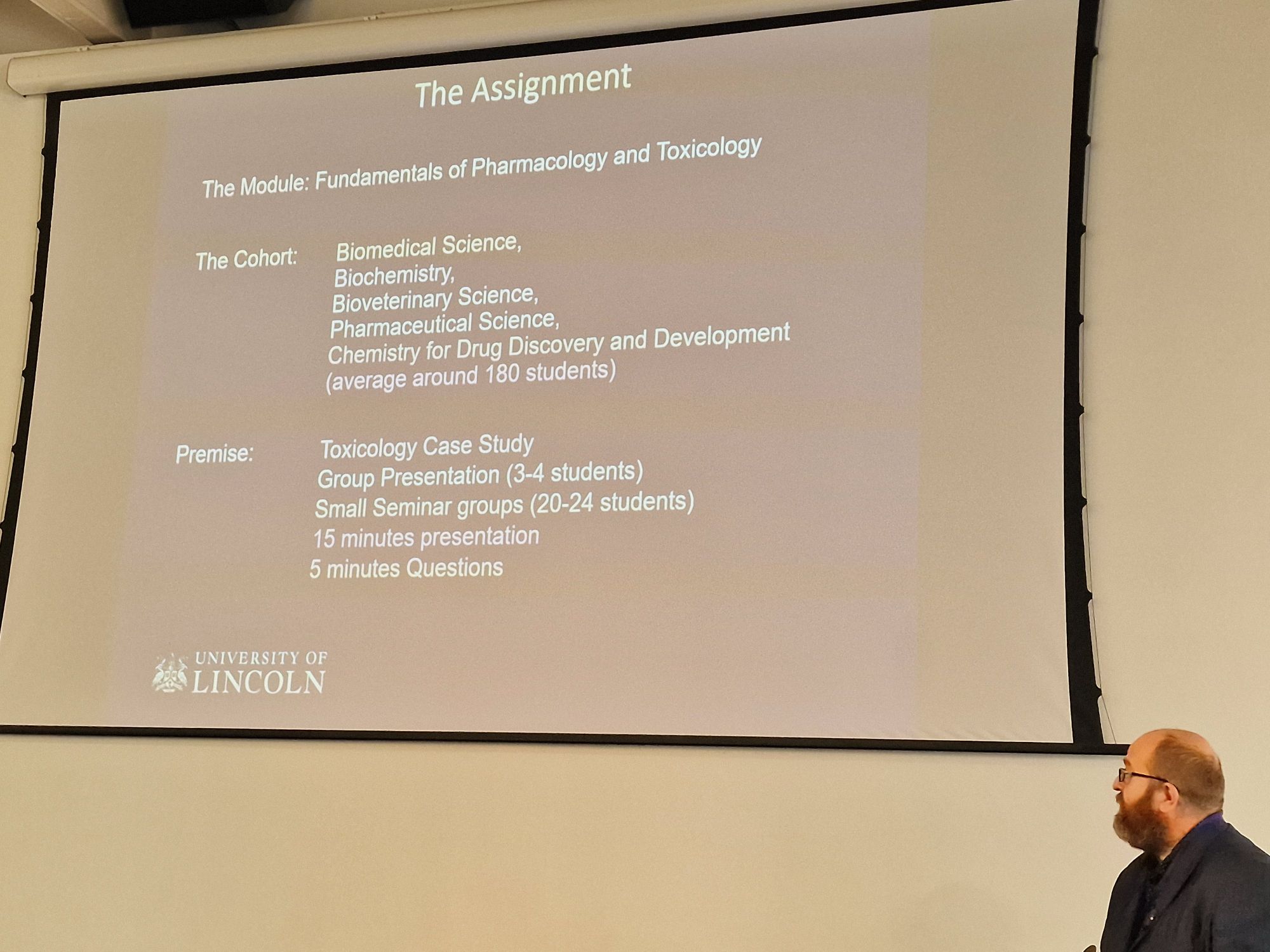
Neil’s approach to this covers around 180 students per year from a really wide range of disciplines – Bioveterinary through to Chemistry students. He makes use of real-world toxicology case studies and asks students to work on a group presentation in small seminar groups. Neil walks us through an arsenic poisoning case as an example of the materials the students engage with – it’s surprising just how funny the odd case of poisoning can be (!)
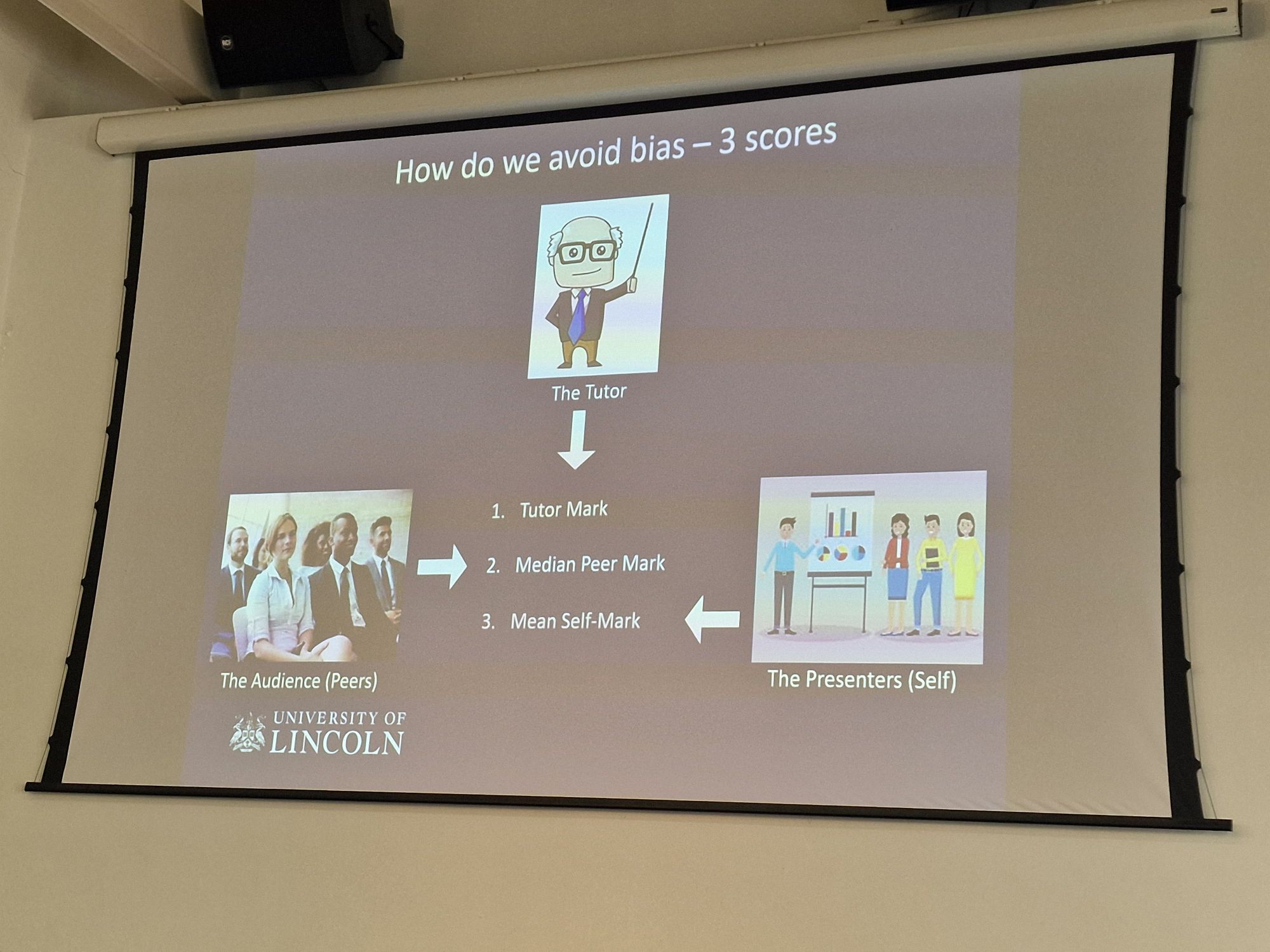
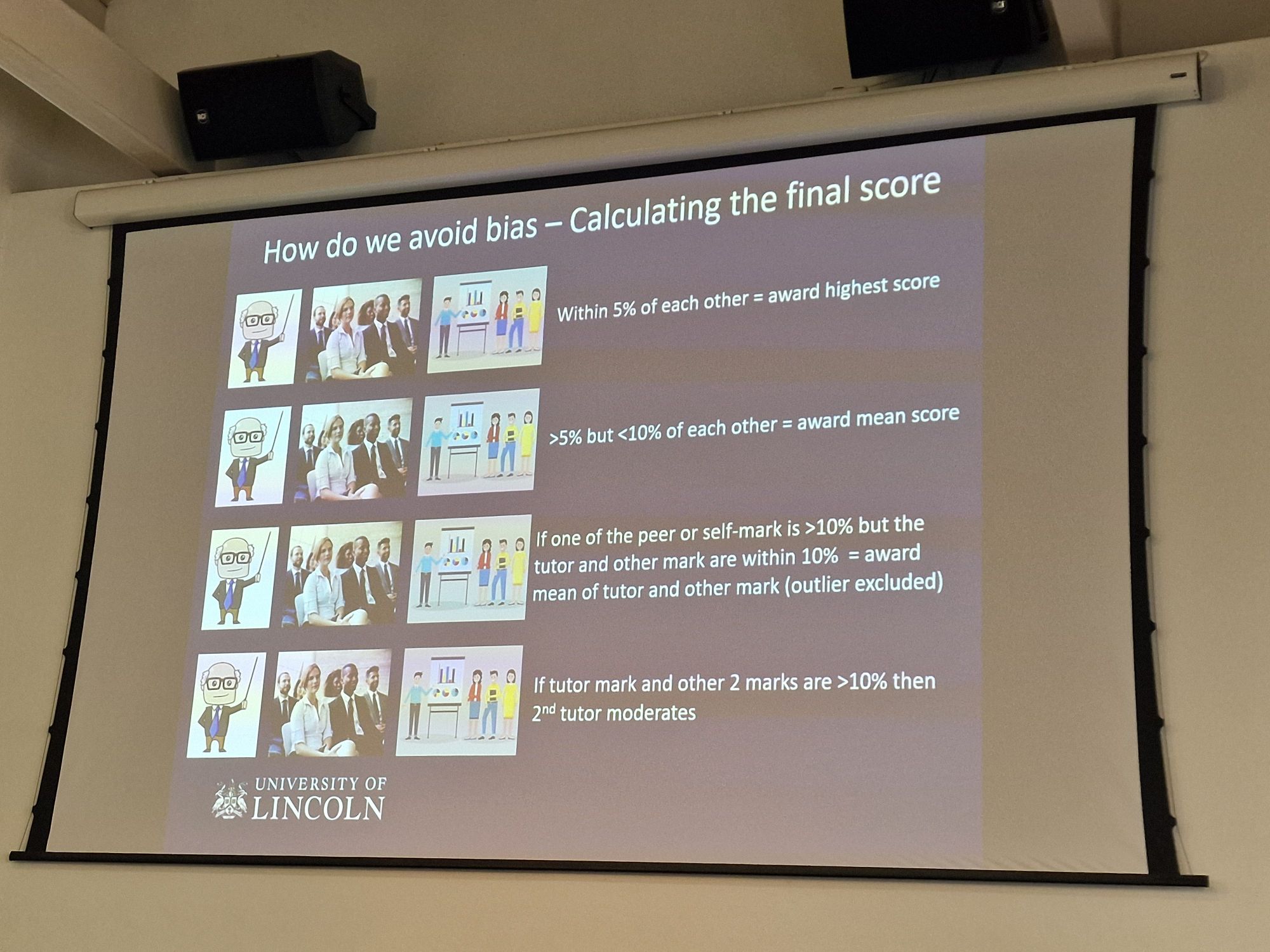
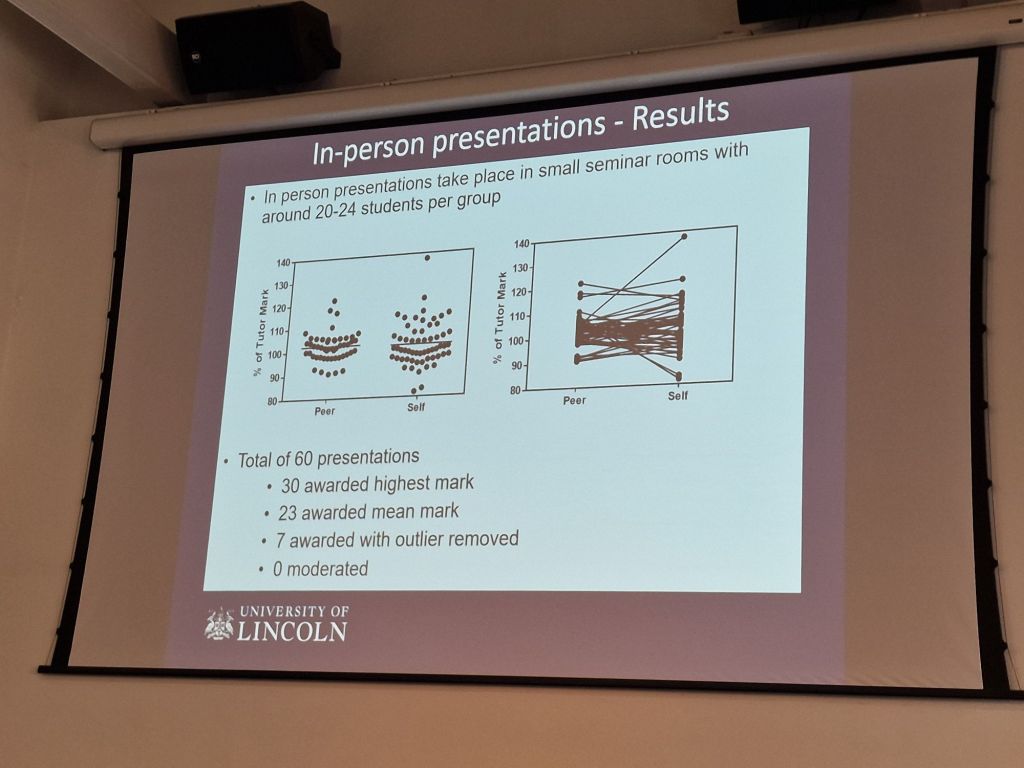
In this approach three different assessors are used; the tutor, their peers and self assessment. They all mark on a number of criteria, with the opportunity to add in constructive peer comments to justify their responses. To avoid bias in the marks the tutor mark, the median peer mark and the student’s self mark are all recorded. Calculation of the final mark is a fairly complex process! If all three marks are within 5% of each other, they get the highest of the three marks. But if they are >5% but lower than 10% they get the average of the three marks. Furthermore, if the self mark is >10% but the tutor and peer marker are within 10%, the mean of the tutor and the peer is awarded. This inventive process really encourages self reflection, and an understanding of the students skills in the difficult area of group presentation. and it works! Last year half the students were within 5% of Neil’s mark, whilst only 7 were awarded with the outlier removed. It’s amazing to see how rarely students are inclined to massively over or under estimate themselves.
Student feedback – they feel engaged, and just about all of them come out of it with a net positive experience. This is a second year module which really helps develop the students skill prior to their third year work. What a nice note to end the final session of the morning on! Authentic assessment leading to such positive benefits to our next generation of pathologists.
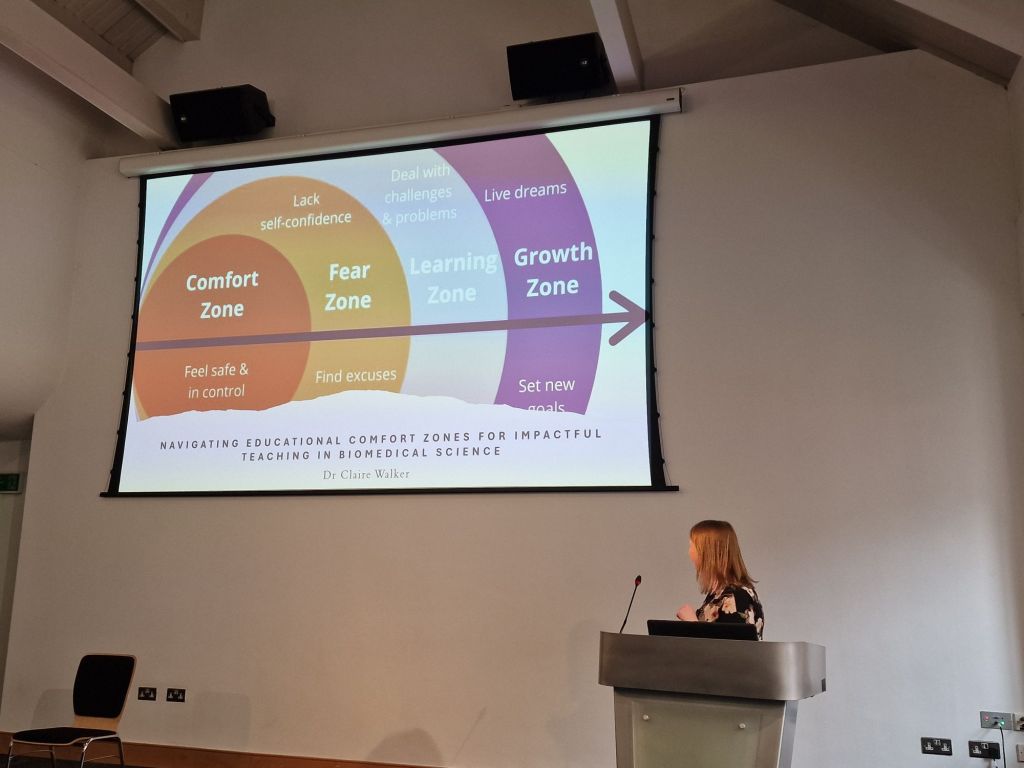
Navigating educational comfort zones for impactful teaching – Dr Claire Walker (University of Lincoln)
We are all being asked to do more with less, but that means we may need to acknowledge that this will require us to step out of our comfort zone. Comfort zones are about delivery teaching in areas where we feel relaxed and at ease – either linked to topic or style. Many of us who are of a Healthcare Science background feel comfortable delivering 1:1 training or teaching within the lab, this is less possible however if you end up teaching tens or hundreds of students. Claire is a paediatric immunologist, but acknowledges that in her current lecturing role she will only get to give teaching on that topic once a year, all of the rest requires her to become comfortable with stepping out of her preferred teaching area.
Although stepping out of your comfort zone has many benefits, as it expands and supports your learning, that doesn’t stop it being challenging. So how do you create an authentic learning experience? How does this relate to the education and learning that most of us experienced during our training, where most of us learnt from a didactic teaching i.e. standard lecture style, but that often doesn’t work for the topics or students of the day. Claire’s comfort zone is narrative style teaching where she uses stories to communicate, weird wonderful and gross stories, although memorable however it could still be considered didactic. Students love it, but sometimes they find it difficult to tie the stories they remember to the facts that they will need to be able to answer assessments and therefore apply it in practice.
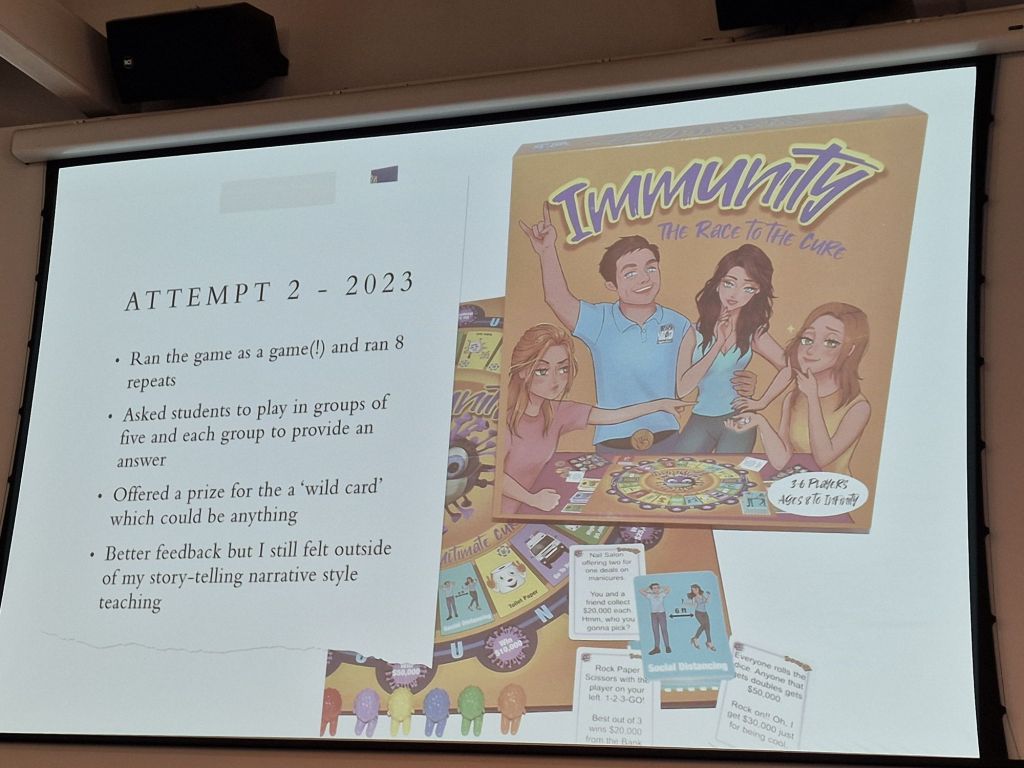
It was suggested by Neil (previous speaker) that it might be worth using an interactive learning approach based on a top trumps style gaming method. It was so out of her comfort zone that when it was first run she ran the game as effectively a lecture, that sat within her comfort zone, delivering for eight hours with limited engagement. It made her reflect that her comfort was actually impacting on what students’ experience of the session actually was. Some of the student feedback was positive, but some of it included that watching someone passively playing a game was not engaging, or that they felt uncomfortable interacting in big groups, which limited their participation. So, for the same session the next year she acknowledged that it did need to truly change. Therefore Immunity: the race to the cure was born. She made it really clear to students that this was an experiment and tried again. Students fed back that they really like the engagement but also gave extra feedback about how it could improve.
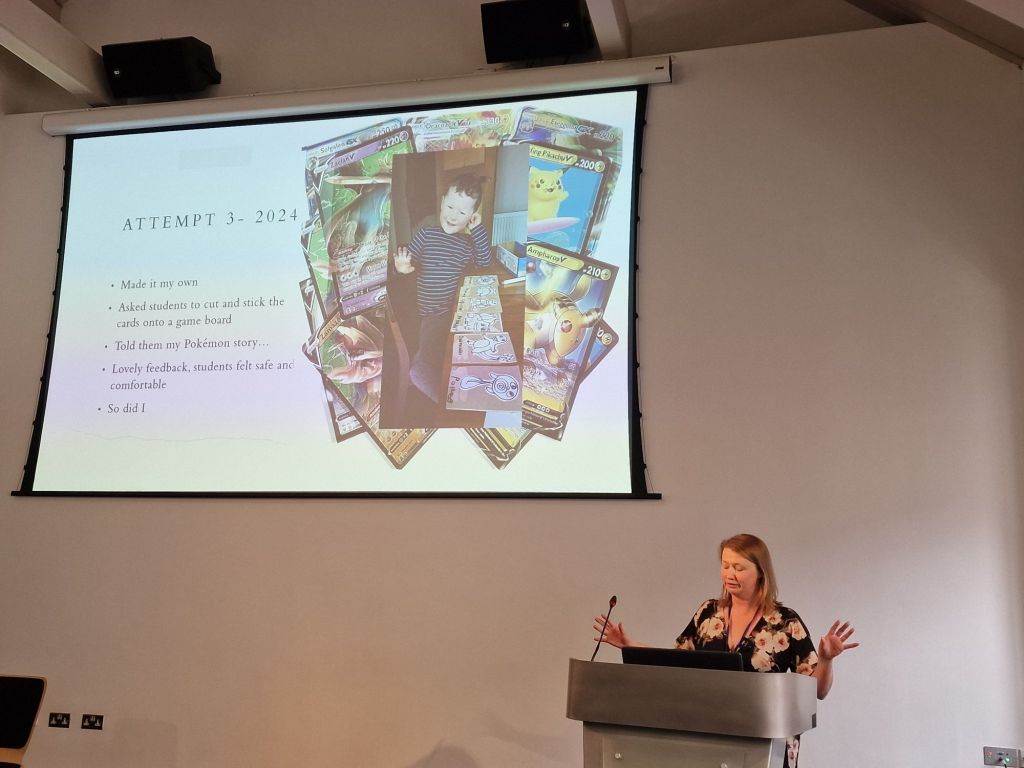
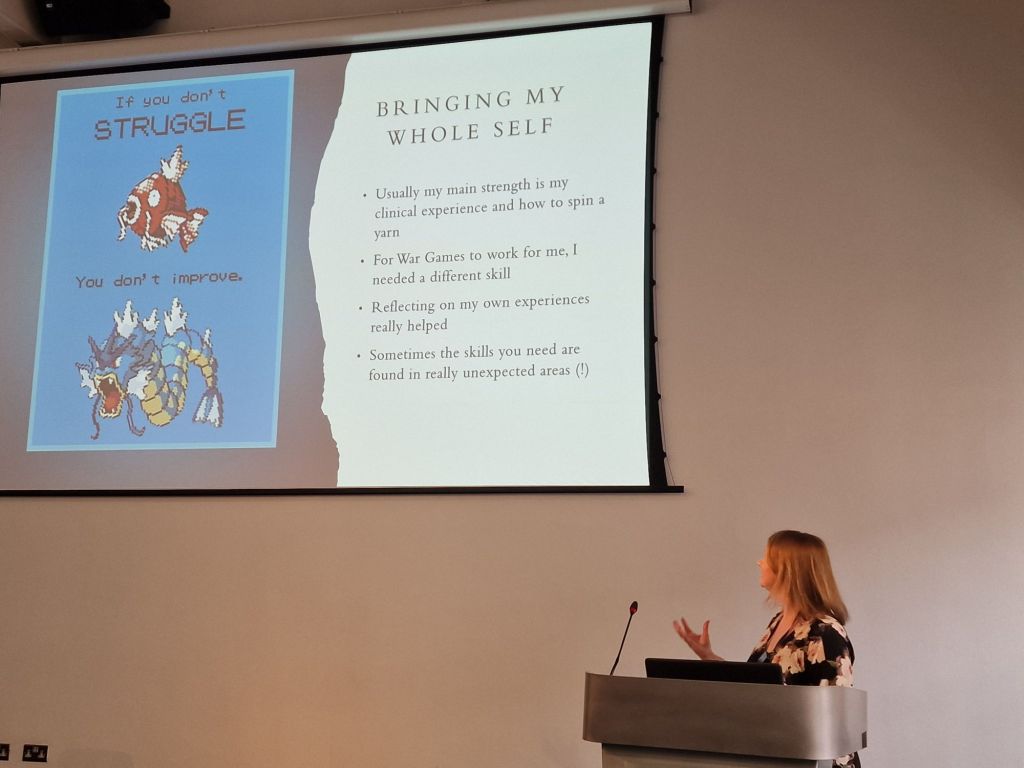
Version 3, Claire changed the way the session was constructed again, and put students much more in control of the session and the game. It vastly improved the student feedback, it improved their comfort and feeling of safety. The students now play the game in order to revise in small groups where they full interact with each other. Although, it still feels out of her comfort zone, the feedback makes it worth it. There is also a shared understanding that this is an iterative process where both Claire and her students need to reflect on the session and improving it, with Claire also focusing on why it felt so uncomfortable in the first place. It’s about expanding your comfort zone, but also about understanding yourself. As part of this process it’s really important to take on the feedback. Growing with that feedback, even if it’s bad, and even if it isn’t pleasant to hear. It is an essential part of any process. Learning to take on what serves you and using it to develop is the best possible approach for both yourself and for those you teach/train.
Blogged by Girlymicro
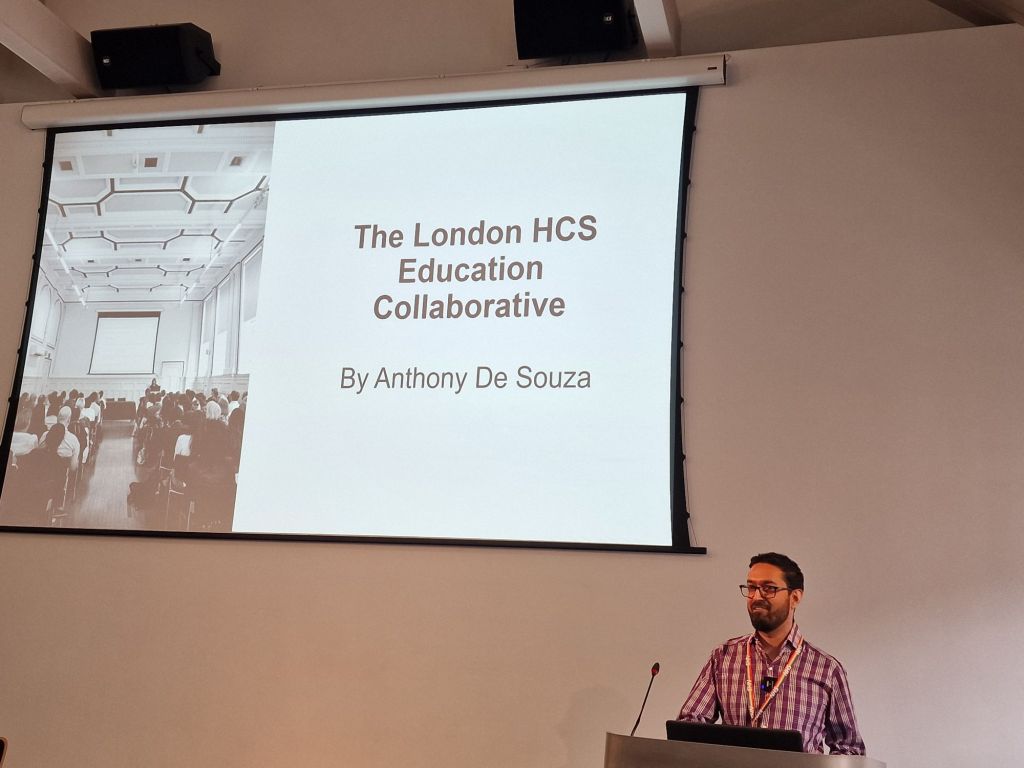
The London Healthcare Science (HCS) collaborative project – Ant De Souza (Great Ormond Street Hospital)
Anthony De Sousa (Lead Educator for HCS at GOSH) gave a wonderful presentation updating us around the work of London Healthcare Science Education Collaborative Project. This is a consortium of HCS at various London NHS Trusts who have secured funding to provide opportunities for HCS workforce education across NHS sites, with a focus on bringing people together to develop networks and to actively form collaborations. Ant illustrated the impact and reach this approach has had for London HCS.
Ant told us that the collaborative formed in 2018 as a result of a Healthcare Science Education event. Post pandemic it is has provided opportunity to re-engage with each other. He showed how, when viewed through the lends of authenticity, there were four key pillars of authenticity: Self Awareness, Unbiased processing, behaviour, rational orientation.
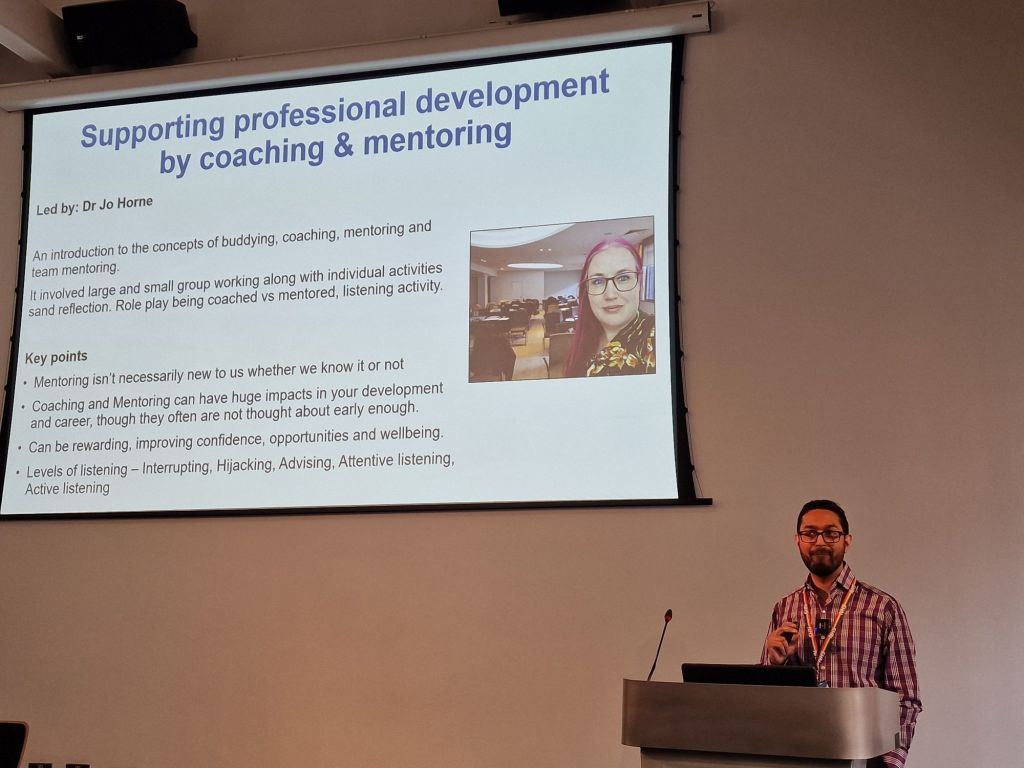
The first event was led by Dr Jo Horne where the concepts of buddying, coaching and mentoring (team mentoring) were introduced. There was small and large group working, alongside individual activities and reflection and listening activities. Ant showed that the learners feedback was overwhelmingly positive. He also discussed how many HCS have never been exposed to mentoring or coaching.
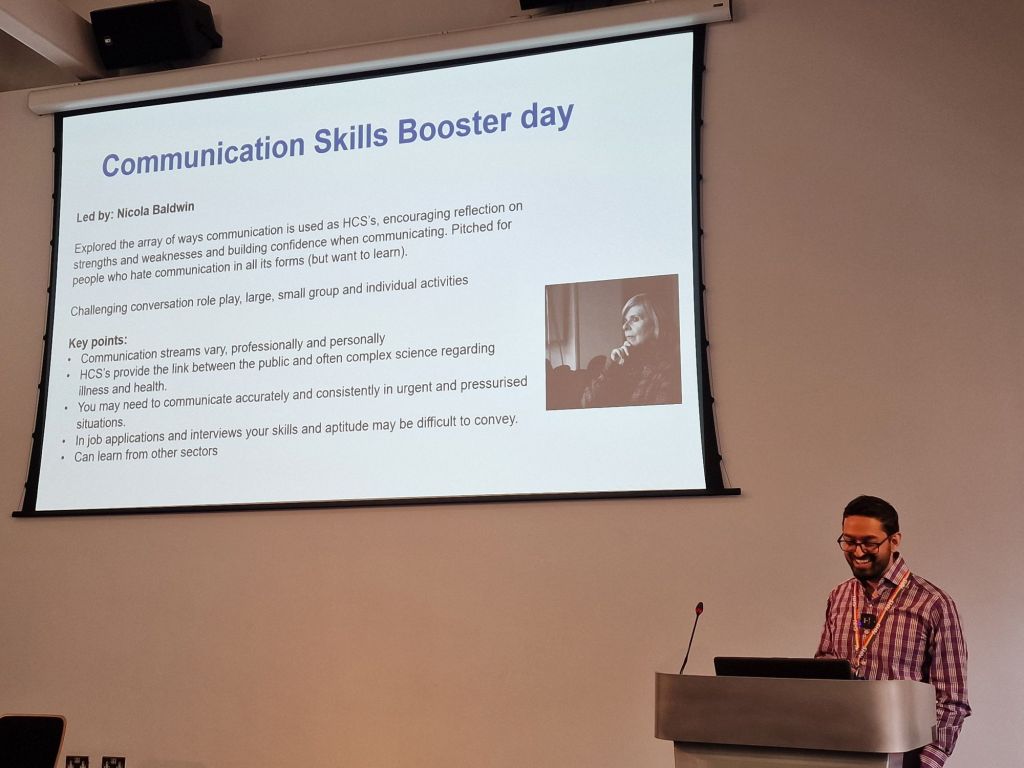
Event two was led by a playwrite called Nicola Baldwin. Nicola explored ways of communicating, encouraging reflection on strengths and weaknesses, and building confidence when communicating in all its forms. Challenging role play was utilised alongside small/large group and individual activities. The key points from learner feedback was that HCS already communicate in different ways in different situations but had never reflected on this and understanding how those decisions were made. Overwhelmingly, learners felt reassured that others were in similar situations with in difficult communicative arenas.
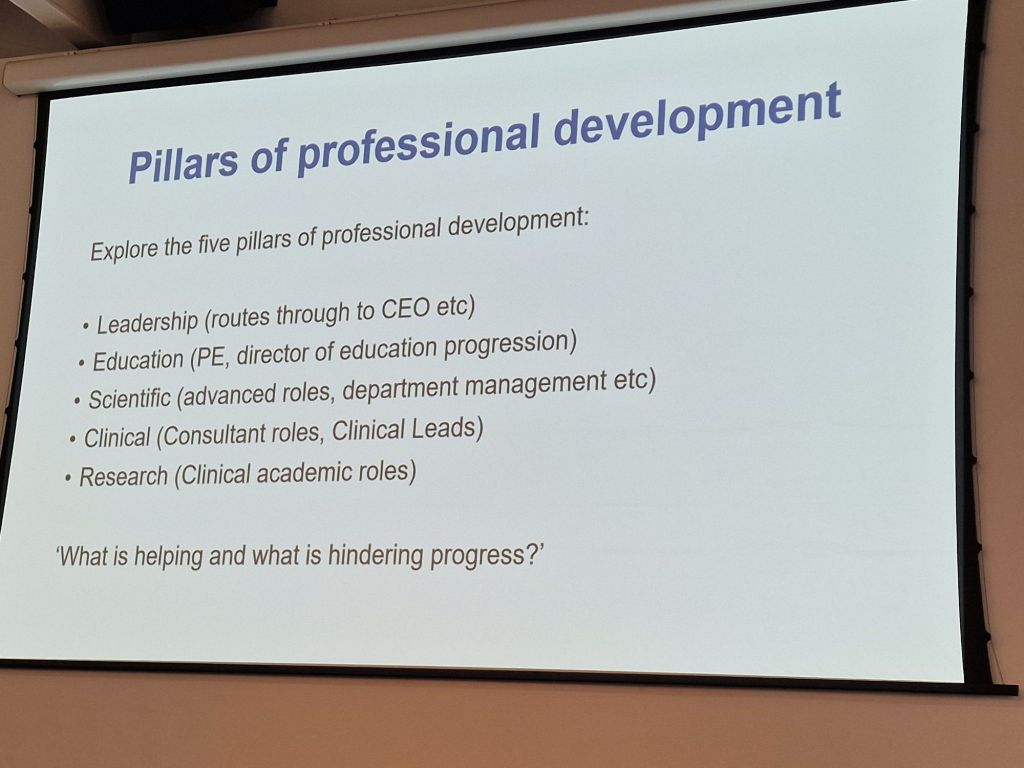
Event three focused on the pillars of professional development:
Leadership
Education
Scientific
Clinical
Research
Key points included:
Senior staff wanted more strategic leadership, educational development and inter-professional education
Juniors wanted sessions on career pathway progression, technical and digital skills, resulting and analytical skills
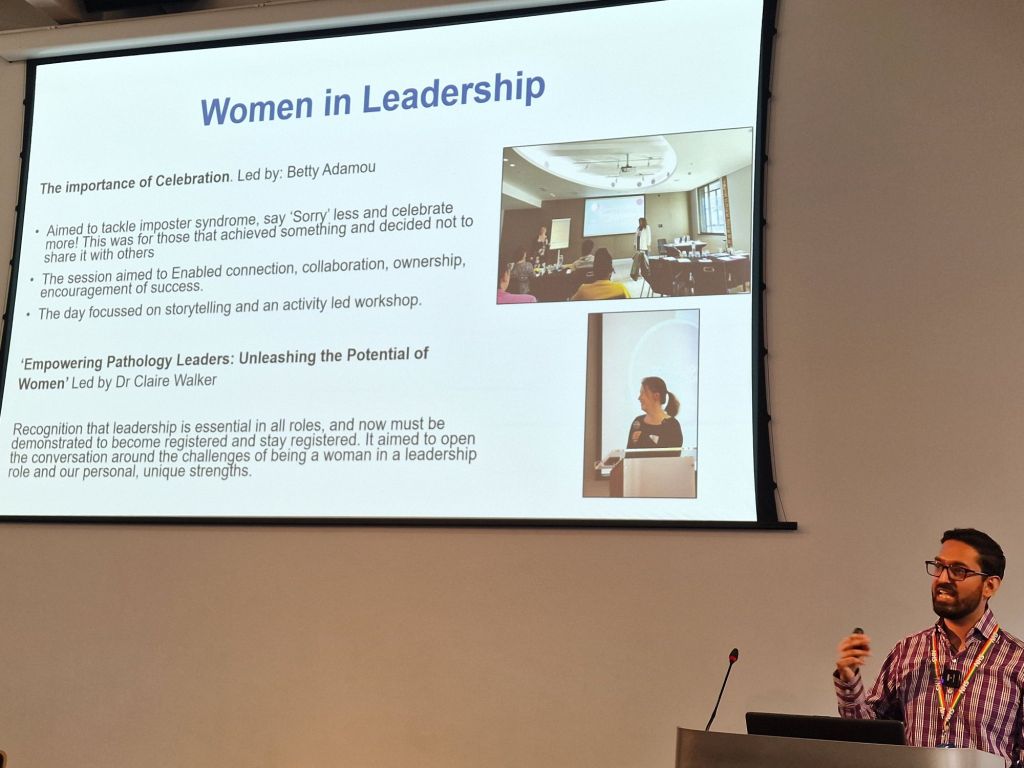
Event 4 on women in leadership was led by Betty Adamou and Dr Claire Walker. This session aimed to tackle impostor syndrome, encouraging women to say sorry less and to celebrate more. Sessions aimed to enable connection, collaboration, ownership, and encouragement of success. Ant shared that learners at this event felt empowered and had never encountered a celebratory event like this before.
Ant summarised the benefits felt by HCS learners who attended all the events:
Self-awareness – learners worked out how they react, what their values are, and how not to work against themselves (Johari Window)
Unbiased processing – learners were able to objectively self-assess without blame or denial. He showed how attendees learned to hold themselves to accountability and to not to get in their own way and filter out noise
Behaviour – Learners explored their values and if they were crossed how they would react. They learned how to be aware of the way they are reacting
Rational Orientation – attendees learned how to develop close relationships & have difficult conversations.
Ant summarised that learner feedback during these sessions indicated that they:
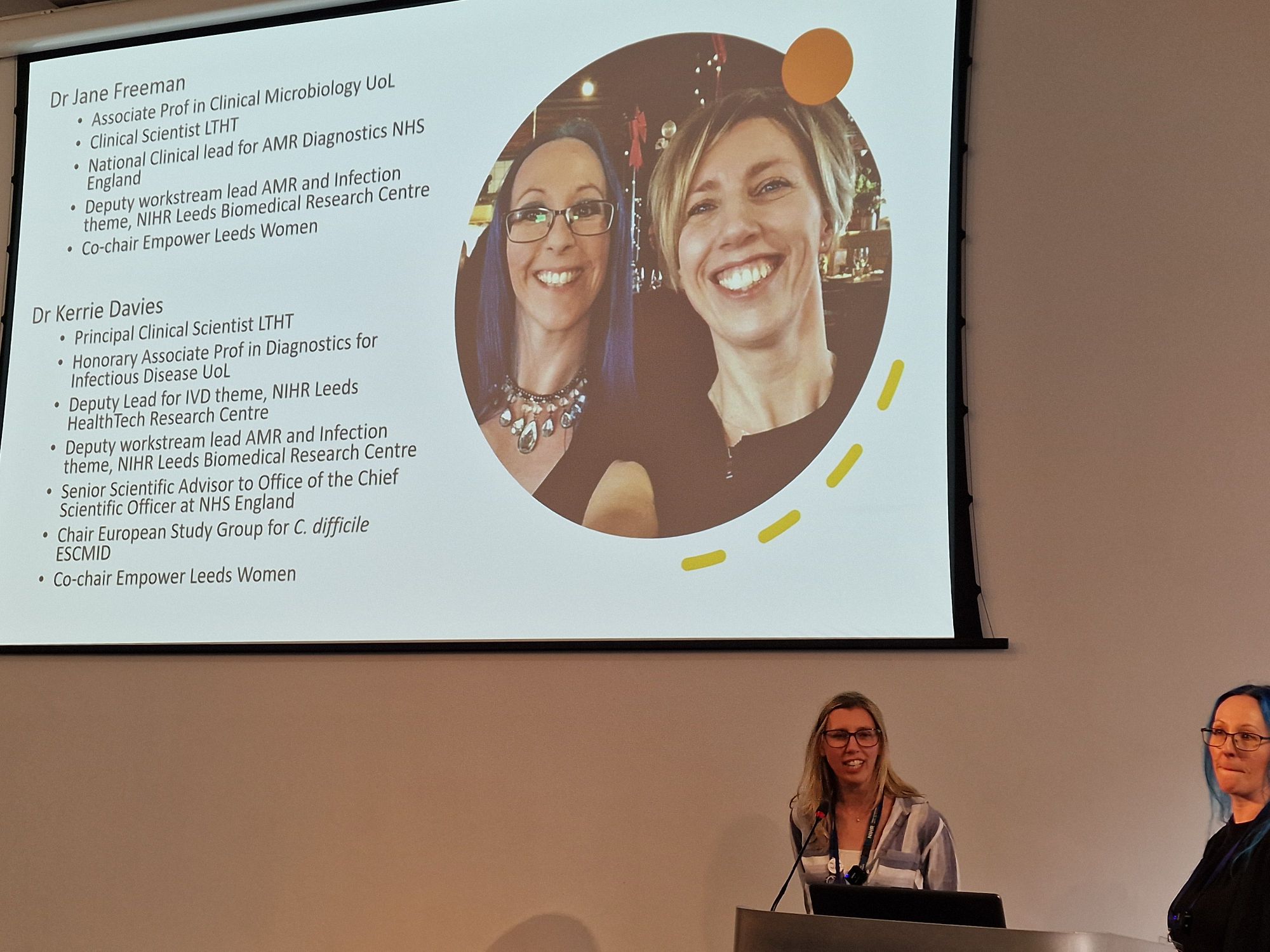
To close the day we had the incredibly inspiring duo of Jane and Kerrie talking about how we are more than the sum of the professional hats we wear, and why it’s important to acknowledge who we are as people, not just professionals. They also emphasised the importance of giving yourself time and the use of tools to reflect on who you are, both as individuals and leaders. Not just because this is important in allowing you to find your place, but also in order to understand how it might impact how we interact with others. It’s also important to appreciate how much strength there is in diversity and bringing all sorts of different approaches together for the best possible outcomes.
This was such a brilliant way to end the day and to encourage us to think more, strive more and be more. Thank you to everyone who contributed to the day, but also to those who guest blogged today. You guys are the best! We hope you can join us next year for #HCSEd25!