How Do You Become a Scientist and Other Career Day Questions: Some info to help in your scientific career journey

Last week I was part of a careers day for Queen Mary University of London, where I did my second Masters degree and where I currently act as an external examiner for the same Masters 15+ years later. I used to do these kinds of events all the time pre-pandemic but it’s been the first one I’ve done for some time. I know that many of the people who read this blog are already working scientists, but there are definitely some of you who are just starting out on your journey and so I thought I would share some thoughts in relation to some of the questions I was asked.

What is a day in the life of Clinical Scientist like?

I’ve blogged before about what a Clinical Scientist job is like as a Clinical Microbiologist. I think the main defining characterisation of Clinical Scientist jobs is that they are all quite different from each other. If you look at the NHS website it gives the following fairly generic description:

Clinical scientists research and develop techniques and equipment to help prevent, diagnose and treat illness.

Clinical scientists are healthcare and medical experts who support clinical staff in their work with patients. Their work is very wide ranging and can include laboratory work and testing, basic and applied research, management and teaching.

https://nshcs.hee.nhs.uk/healthcare-science/careers-in-healthcare-science/roles/clinical-scientist/

There are 4 main areas of Healthcare Science, each of which will have sub disciplines:

The day is a life for each is therefore pretty different. I work as a Consultant Clinical Scientist, and my training was within Microbiology. My Consultant post is even more specialised however, as my main area of practice is within Infection Prevention and Control. I love this as it means that I still maintain my practice within virology, mycology and bacteriology, whereas otherwise I would have had to choose a specific route.

These days I don’t get to spend so much time in the lab. My day to day involves supporting clinical decision making, managing outbreaks and infection risks, as well as supporting PhD students and research activity. I basically act as a hospital detective, trying to work out what is going on and solving cases of infection. I also sit on a number of national and international committees to try and translate some of the learning I experience and research into clinical practice. One of the things I love is that I run something called the Environment Network, that came out of my PhD.

What was my pathway into Healthcare Science?

My pathway into Healthcare Science was probably not that similar to most of you applying today, mostly because it wasn’t really something that was discussed when I was at uni and there were really quite restricted ways into the profession – things like T-Levels and apprenticeships just didn’t exist back then. My undergraduate degree was in Zoology, and although I loved it there were no real jobs in it. When I was an undergraduate I knew I didn’t really want to be your typical academic, where I thought you would spend your whole career looking at a single pathway in a lab, and that it wouldn’t really impact on the ‘real world’. I always knew I wanted to do something that changed things, that made life better for people, I just didn’t know how to do it.

When I graduated doing a master wasn’t really an option. I wasn’t in a position to pay for ongoing education – I needed to work. I then lucked out and was approached because the uni where I did my degree was looking for biologists to start on a new trial MRes that was focused on developing an interdisciplinary approach. They were developing a course called the Physics of Biological Interactions at Surfaces, and they wanted biologists to take it in conjunction with physicists, not only that but they were paying ยฃ10,000 tax free to anyone who would do it. I jumped at the chance, who wouldn’t.

During this MRes I discovered clinical research, research that was aimed at change and at making life better for patients. All of a sudden a new world opened up to me, I knew this was the kind of science I wanted to do. My best friend, who was a microbiologist, handed me an advert for a trainee Clinical Scientist job in London in Microbiology. Now, my project had included micro during my MRes, and I’d done one module of micro during my undergrad, but I was far from being a microbiologist. Despite that I took a leap of faith and applied for the job. There 240 applicants and 4 posts. I cried when I left the interview as I really wanted the job and I felt the interview was a disaster. Next day they called and offered me the job. I was shocked, so shocked I asked them why. The interview had been a bunch of scenarios, they replied that that they could teach me facts but they couldn’t teach someone how to think, and they liked the way my mind worked. That has stuck with me, and I bear it in mind as I interview to this day. The rest, as they say, is history.

What are the common routes available to people trying to enter into Healthcare Science today?

There are multiple points into Healthcare Science careers, which is great because no matter what stage of your career you discover them there is a route that will be appropriate for you!

College level entry

Discovering Healthcare Science careers early is great as it maximises your ability to choose your path forward and the amount of time that you can spend developing in this particular careers path. The main way to enter at this point is via T-Levels (I’ve written a separate blog post on these), as they enable you to build a good base and explore the different specialisms to help you make an informed choice.

Degree level entry

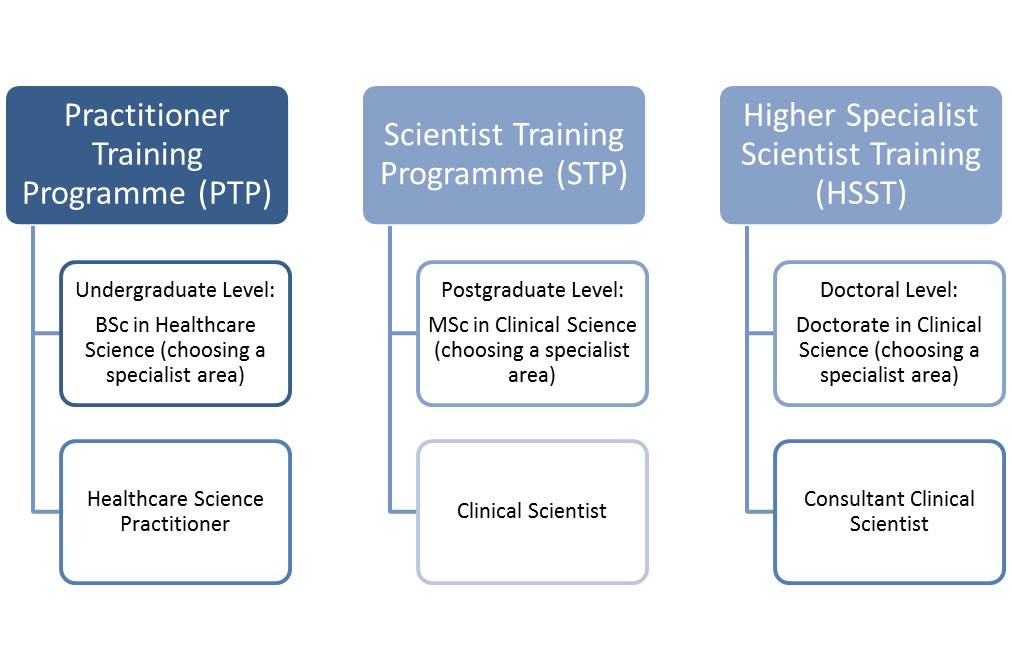
Degree level entry can look different depending on whether you are looking at going down the physiological sciences or life sciences route. For physiological science there are accredited degrees that enable you to access the Practitioner Training Programme, or PTP. This enables you to get work experience and training during your degree. There are also two different types of programme that in life sciences will support entry into the field as a Biomedical Scientist (BMS). Both of these include selecting Institute of Biomedical Science (IBMS) accredited degrees, but one includes choosing a degree that has a placement year so that you come out ready for registration, whereas the other will require you to do a registration year as part of work when you graduate (see post graduate entry).

Post graduate level entry

Once you have a life science (or other acceptable degree depending on specialism) the there are multiple routes into Healthcare Science:

Direct entry training posts – these include trainee BMS posts for those who have undertaken an accredited degree but still need the year in post to complete their portfolio.

Centrally recruited training post – these posts are traditionally either Scientific Training posts (STP), or Higher Specialist Scientific Training posts (HSST). STP posts involve training over three years to be a Clinical Scientists, and HSST posts involve training for 5 years (once already registered as a Clinical Scientist) to become a Consultant Clinical Scientist. STP posts involve further academic training to get an MSc, whereas HSST posts require working towards clinical exams and a taught doctorate.

In-post development and training, there are frequently opportunities to develop via informal routes when you are in post. If you have taken an accredited degree some posts will support you in completing your portfolio to get state registration whilst working as an associate practitioner (AP), or if your degree was not accredited, your employer may support you in taking top up modules that would then enable you to move onto the next stage of portfolio completion.

Finally, there are routes in via something known as equivalence or route 2 registration, especially for Clinical and Biomedical Science routes. These routes mean that you might do something like apply for a post when you have gained an appropriate PhD and over a period of years gain enough clinical experience to be able to complete a portfolio that demonstrates a similar level of knowledge and experience to someone whose gone through a formal training route. This is what I need for my HSST registration, as I already had a PhD and several years of clinical and academic experience.

Apprenticeships

I’ve put apprenticeships separately here as these are applicable to every level, although the Clinical Scientist one is not yet formalised. This means there are routes where you can be training and earning qualifications that support your career progress, as well as gaining valuable experience. These change periodically and different Trusts will support different ones, so I’m not going to list them in detail but I would encourage you to look at the .Gov website I’ve listed below so you can find the latest information and entry requirements:

  1. Healthcare science assistant (level 2) Carrying out routine technical and scientific procedures and support within hospitals, doctor surgeries and other healthcare settings for a wide range of people. Apprenticeship category: Health and science
  2. Healthcare science associate (level 4) Working in hospitals, primary care and other healthcare settings, carrying out routine technical and scientific procedures. Supporting healthcare science (HCS) practitioners and clinical scientists. Apprenticeship category: Health and science
  3. Healthcare science practitioner (integrated degree) (level 6) Supporting the prevention, diagnosis and treatment of medical conditions. Apprenticeship category: Health and science

What other types of science careers are there?

Healthcare Science is obviously not the only way to become as a scientist as a career, there are a world of different types of way to work in science. Starting in one does not mean that you cannot transfer to another, and different career options may be appropriate at different stages of your life. What I’m really saying is don’t worry too much about feeling like you are committing to a certain pathway if you get offered an entry level job in one area when your idea may be in another. Gain learning and experience and don’t be afraid to move between if that’s the decision that is right for you. Here are a few I can think of off the top of my head:

  • Industry – pharmaceutical, manufacturing, medical writing and so so many others
  • Academia – university based, but there are plenty of different pathways within, including specialising in teaching or research
  • Public sector – this can include jobs such as Healthcare Science, but could also include other routes such as public health, food science, environmental science, and options such as science policy
  • Clinical – there are other routes that enable you to work with a clinical aspect to your role, such as clinical trails, without entering into Healthcare Science
  • Charity sector – there are numerous charities, such as cancer research, Wellcome etc, that employ scientists and really value scientific input, whether that’s in their grant structure, policy development or science governance
  • Communication – science communication and public engagement is a really important area, from writing for news papers to developing content for employers such as the BBC, there are a lot of options in this area

What are my top tips for science applications?

I’ve previously written about this is more detail in 2 blog posts, application tips and interview tips, which I hope will be useful. Below are some more general tips that might help:

  • Don’t be afraid to use non-science examples. Have you worked in retail and dealt with money or conflicts? Have you been a guide or a school council member, both of which show leadership potential? You don’t have to have spent a year in a lab to be able to complete the form
  • Be prepared to talk about your why? Why science? Why this job? Why this place?
  • Know how to complete the application form. If you are applying for an NHS job you will need to explicitly state how you match each point with examples. Do avoid recruitment bias it’s all done on a point based system. You can’t get points if you aren’t writing against the JD, so don’t waste word count on items that are unlinked
  • Make sure you tailor your application to the job. Generic CVs won’t get you very far and a generic NHS application form will not get you the points you need. It takes time but it will pay dividends
  • If you get an interview make sure you visit before hand. It will give you pointers as to what they are looking for and ensure that it also feels like the kind of place you want to work
  • Practice common interview question answers ahead of time
  • If you are interested in them supporting further development, like supporting portfolio completion, use your opportunity at the end of the interview to raise it. An interview is as much you interviewing them as them interviewing you. If something is important to you make sure that you raise it, then you can make a fully informed decision about whether the role is right for you

What are my top tips for career planning?

I’ve blogged before about the fact that I’ve not had the smoothest academic pathway and that I really believe that academic success does not have to define who you are. I really believe there are so many many ways to end up in a place and a career that is right for you. There is not one way to do something, but here are some principles that I hope might help:

  • Don’t think you have to have it all figured out – follow what inspires you and supports your passions and everything will work out
  • You don’t have to be the smartest person in the room – being tenacious gets you far further than being talented alone, just keep going
  • Do your research – if you want something invest the time to learn about it, if there is a specific job reach out and speak to the people advertising it to get to know them, the workplace and more about the job
  • It’s OK to try a number of different ways to get into the field, don’t focus too much on it being on the ‘right’ pathway, as long as it enables you to be gaining experience, and in an ideal world training, you are still moving forward even if you need to move horizontally later
  • Keep an open mind about training routes in, don’t rule out apprenticeships and vocational routes, even if you consider yourself to be more academic, they will let you gain experience at the same time as earning money and studying
  • Be open to the fact that you are likely to have to invest your own time. Working in science has enormous opportunities, but if you sign up to a Healthcare Science pathway you are also signing up to continuous professional development, some of which will likely need to happen in your own time if you want the best possible outcomes
  • Maintain a growth mindset – no matter what the stage of your career be open to still developing, be open to opportunities and next steps, and be prepared to keep driving yourself to be better
  • Take a chance on yourself – sometimes we are our own biggest barriers and the most important thing is to get out of our own way. Don’t talk yourself out of taking chances, don’t tell yourself you can’t or that things won’t work out so you won’t try. Be brave, take your chances and leap!

How can I get work experience?

Work experience in Healthcare Science can be difficult to acquire, don’t be disheartened though there are still plenty of ways forward:

  • See if you can gain experience within industry or academia as these both tend to have specific work experience programmes that you can tap into
  • Some professional bodies, such as Applied Microbiology International, Microbiology Society and the Royal Society of Biology all have studentship and placement grants. I’m sure there are many others. Consider becoming a student member if you can afford it, or reach out to someone you would like to have a placement with and see whether they could apply or support you to do so. These mean that you can have some living allowance, if like me you couldn’t do it without, and bring some money with you to do a short project. They also look good on your CV as demonstrate both commitment and application/grant writing skills
  • Ask one of your current lecturers if they have any project opportunities with them
  • Gain an entry level post and use that to gain the experience you need to support your next steps
  • Consider apprenticeships to gain some exposure alongside your qualifications
  • Consider volunteering in adjacent roles, most hospitals and care facilities have volunteer programmes where you can gain experience, but also give back

Remember, you don’t need extensive experience to support your application for an entry level role, even a cup of tea with someone who does the job will enable you have a better understanding of the role. A couple of days to a couple of weeks is an advantage but not essential.

Useful places to find more information

Below are some links that might be helpful in getting some further information and reading up about possible next steps. These are great jumping off points, but you should also reach out to mentors and people doing the different types of jobs you are interested in to get deeper information not listed on the websites. There will be an option that works for you, but not every option works for everyone, so the more research you do the better fit you are likely to find.

Apprenticeships

NHS Healthcare Science careers

Equivalence

Institute of Biomedical Science for Biomedical Science careers

Association of Laboratory Medicine for life science Clinical Scientist careers

STP information

HSST information

PTP information

Healthcare Science T-Levels

International and PhD routes to registration via Association of Clinical Scientists

PhD finder

All opinions in this blog are my own

It’s All in the Preparation: My top ten tips to help prepare for your conference presentation

I was presenting at my first conference of the year last week, which is a sign that conference season is soon to well and truly kick off.โ€‚I know that this often puts many of us in a state of anxiety.โ€‚We know that conference presentations are important for both getting our work out there and also for personal and career development. Presenting however, can feel like quite a high stakes manoeuvre, especially if you are not comfortable with public speaking.โ€‚With this in mind I thought it might be useful to share some tips that I have learnt, in the hopes that it might help with your next upcoming session.

1 – Know your audience

The first thing to realise is that we often make presentations about us, when actually they aren’t really about us at all, they are about the audience and what we are trying to achieve on their behalf.โ€‚We are often given a fairly generic topic to speak on, or have submitted an abstract of what we wish to present.โ€‚That’s great but actually probably doesn’t have enough clarity to start putting together the session.โ€‚My first step whenever I’m asked to speak is to think about the learning objectives for the session.โ€‚What might benefit the audience most?โ€‚What are they expecting?โ€‚Learning objectives act as a guidepost, and I will usually include them with the blurb I’m asked to write for the agenda.โ€‚This means that people selecting their sessions will be able to make an informed decision about whether your session will work for them.โ€‚Are you pitching an introduction level session or an update on the latest research that assumes pre-existing knowledge?โ€‚You want to match your pitch to the audience that you are expecting.

It is also worth thinking about what kind of atmosphere is likely to be present?โ€‚Is it a fairly informal setting where the session will be more discursive or is it a formal conference session where you may need to prepare for possible confrontational questions? Prepare for questions and queries whilst you’re preparing your session, try to think about the rabbit holes that the audience might want to go down and for any potential pitfalls where you will need to have a pre-prepared strategic response.โ€‚If you’ve been clear about what the session covers and audience pitch this should be less of an issue, but it’s always worth being prepared.

2 – Be prepared to bring your authentic self

One of the things I’ve come to truly believe is that, no matter how formal the session, you should bring your whole self to it.โ€‚I’ve written previously about how we should feel free to wear clothes that empower us, and conference sessions are no different.โ€‚This can be something as simple as wearing your favourite colour, but whatever it is, delivering talks is easier when you feel good and empowered so do whatever you need to feel that way.โ€‚My top tip is that whatever you decide to wear, ensure that it’s comfortable.โ€‚I used to wear heels to speak but now I always wear flats, as I’ve decided that the pain isn’t worth it for me, especially when you consider how long you will be networking after your session.

The other place were I try to ensure that I also include something that is a little bit me, is within the presentation itself.โ€‚Again, this can be levelled dependent on setting, sometimes I just choose a colour scheme or icon that speaks to me.โ€‚Other things you can include are quotes or images that are meaningful to you.โ€‚Again, it doesn’t have to be something big or in the face of your audience, but something that centres you and makes you feel more like you own the space you are presenting in.โ€‚Sometimes however going big is the way forward, sometimes making something memorable is the right approach, it all depends on your confidence level and the setting.

3 – Judge your session

I’ve talked up above about thinking about how informal/formal the setting you are presenting in and how this can impact on your content. There are however other things that are beneficial to think about in terms of expectations for your setting.โ€‚The type of session will dictate a number of things, as will time slot and room allocation.โ€‚If you know the venue you are going to you may be able to predict numbers of attendees for instance, if you are allocated a room you may be able to find out whether its for 15 people versus 1500.โ€‚High numbers of attendees will limit your options for interactions, as will being given a 15 minute time slot.

Common types of sessions include:

  • Debates
  • Research presentations
  • Topic presentations
  • Workshop
  • Plenary or keynote
  • Speed presenting
  • Poster presentation
  • Careers presentations
  • Panel sessions

There are obviously others but these are the main ones that spring to mind.โ€‚Just from looking at the list you’ll be able to see how different ones will attract people with different levels of pre-existing knowledge or interest.โ€‚There are some key questions that are worth asking to help you support judging your session when the email comes in.โ€‚First, always confirm length of session and whether or not this will include time for questions.โ€‚Second, ask about number and types of attendees both for your session and the target audience for the conference/meeting itself.โ€‚Finally, as this will impact your options for engagement with large audiences, will there be free Wi-Fi available for attendees so they can access voting apps? Don’t feel like this information should confine your creativity and what you want to undertake but build any limitations into your thinking in order find solutions ahead of time.โ€‚Finally, please please please never be the person that delivers a 40+ minute talk despite being given a 30 minute slot.

4 – Use the agenda to guide you

Once the agenda is released and you’ve starting to build the content of your session you can also use it to help in your preparation.โ€‚Your timing and position on the agenda can influence the build of your talk.โ€‚If you are directly after lunch, you might want to think harder about the engagement side to wake everyone up and get them back into the flow.โ€‚If you are just pre lunch, you might want to stack some of your more exciting parts towards the end and build towards them to ensure you keep the audiences attention.โ€‚If you are going first or last you probably need to start and finish with a bang.โ€‚

The other area where the agenda can really help you is to see what others are covering, especially if they’ve listed any focuses or learning objectives in their descriptions.โ€‚This may mean you can get valuable slides back if someone is talking on a similar topic ahead of you, and will therefore have given a lot of similar introductory slides, thus giving you more time to build on the subject in your slot.โ€‚It can also give you ideas of areas to avoid, so that you don’t give too much overlap.โ€‚One of the things to not do is be intimidated by anyone else on the agenda.โ€‚If you are speaking/presenting you have earned the right to do so, it doesn’t matter if the person before you is Dame X or Professor Y, acknowledge what that might do to the atmosphere in the room (i.e. may mean you have a larger audience) and then plan as if they were any other speaker.

5 – Have a plan on how to engage attendees

Engagement can start before the event even begins.โ€‚If you have a poster session for instance, you might want to share a picture of your poster and it’s location on social media.โ€‚Sometimes I also find running polls can help with working out pitching your session, and also in building engagement so that you are more likely to get an audience.โ€‚This can be especially important if your session is at an event where there are multiple sessions running at the same time and therefore you almost need to sell why someone should comes to yours when there is so much choice available.โ€‚Taking some time to raise awareness via social media using the event # can be really beneficial under these circumstances.

Depending on the availability of Wi-Fi and session details you may also want to consider using tools or apps to support interaction with the audience during your session.โ€‚You can use tools such as Mentimeter and Slido to build voting or other forms of interaction into your session.โ€‚This approach is especially important if you are asked to do a workshop session.โ€‚It’s also worth asking additional questions during the prep phase, such as the type of seating, to see whether it would support group discussions.

Even if you are giving a standard presentation without interactive tools you still need to think about how to engage your audience.โ€‚There obviously many different ways of doing this, starting from basics like pitching correctly so you bring your audience with you.โ€‚If you can bringing yourself to your session by using framing such as story telling it can really help, alongside the use of humour.โ€‚You can even think if there are props that would be appropriate to support what you’re talking about, although you also don’t want to make it gimmicky.โ€‚Whatever tool you feel comfortable with, practice using it as it will make sure your session is more memorable.

6 – Make sure you have a plan B

Things go wrong, they do, despite your very best endeavours.โ€‚Having a plan B in your pocket never hurts.โ€‚This can be as simple as having a USB with your slides on it with you in case they haven’t managed to load it before you arrive.โ€‚If I’ve included videos or anything else ‘fancy’ in my presentation I will always have a plan B and C.โ€‚Plan B is an extra copy of my talk without the ‘fancy’ bit in it in case it doesn’t work when I test with the AV tech ahead of my talk.โ€‚Plan C is a script in my head that I can use to describe the video in case it worked on test and suddenly fails during the real thing.โ€‚If I’m doing a smaller session, I will also sometimes arrive with print outs of my slides so that I can approach it old school if needed.

Having a plan B is especially important if you are using voting or something tech related.โ€‚If your entire session is going to be based on audience participation you need to have a plan if no one there can get signal or access to Wi-Fi.โ€‚It’s worth building this flexibility in when you are developing the session so you will not need to entirely wing it if the unexpected happens to you.

7 – Be prepared to push yourself

I’m just throwing this out there.โ€‚You should be prepared to push yourself into a space where you feel uncomfortable.โ€‚Growing your skills is a never ending task, even if you feel like you are a pretty good public speaker, there are always things to learn, improve and do better.โ€‚Sometimes the very act of speaking is a sufficient push because it’s not an area in which you feel comfortable.โ€‚If you are comfortable talking ‘science’ maybe also stretch yourself by bringing more of yourself into the session.โ€‚Embrace the creative possibilities and strive to have more impact, build better engagement, be more memorable.โ€‚Read and research on the topic of how to present better in the same way that you would read and research your content and find inspiration about the next thing you could try.

8 – Facilitate a relaxed state of mind

Having just encouraged you to step out of your comfort zone by planning your presentation I also now want to encourage you to remove the stress that can be present outside of the speaking component itself.โ€‚I speak from experience.โ€‚I once agreed to speak at 2 conferences on the same day, on different topics and in different cities.โ€‚This was beyond foolish.โ€‚There simply wasn’t enough time to get from point A to point B and I arrived to land on stage for the second session with 1 minute to spare.โ€‚I’ve also learnt that travelling up on the day of a session doesn’t work for me, it just makes me too stressed.โ€‚I now will always travel up the night before, even if I arrive really late, because then I can go to sleep knowing that I’m where I need to be rather than lying awake all night stressing about whether an act of god will stop me making it to my session.

I also comfort myself by reading up on the areas that I have identified during my gap analysis that I might get questions linked to, or to reassure myself – even if it’s a topic I know really well – that I have up to date information and references.โ€‚Feeling like you are walking up to a podium prepared is the best way I have to remove any of my stress linked to presenting.

9 – Plan to do your own timing

This is one I have learnt the hard way.โ€‚I don’t like clocks present in the corner of a screen when I’m presenting as I want to be looking out at the audience and connecting when I’m speaking not constantly looking down at a monitor, probably slightly influenced by the fact that I don’t use notes as it enables me to feel more organic.โ€‚I know some of you will feel differently.โ€‚I’ve learnt to manage this by having a phone with a big clock (on silent) with me when I present so I can see it as I move around.โ€‚I know that there will often be Chairs or speakers who will signal when you have 5 minutes left.โ€‚I personally find that I need to pace my session throughout, as otherwise at 5 minutes I could be left with waaaay too much to cover, and so I like to time check myself.โ€‚The final reason I do this is that I have been caught out. I’ve turned up and started a presentation and realised there was no clock or timing device visible anywhere.โ€‚The panic, for me, at that point is real people, it’s a real stressor for me.โ€‚You may have a different thing that triggers you, but once you identify what it is, do your best to have a plan to redress it so it doesn’t distract you from the moment you are in.

10 – Use the opportunity to build your networks

This last one I think is really important, if you are given the opportunity to have a platform use it!โ€‚No matter how nerve racking it is, no matter how much you may not like presenting.โ€‚In fact, if this is not your naturally comfort zone all the better, go out and seek opportunities that enable you to do it more.โ€‚With practice comes familiarity and skill development.โ€‚Don’t feel alone in your discomfort, but do know that there will be something in you that can inspire and give confidence to others.โ€‚The world needs to see more people like you, whomever you are, especially if you have the courage to bring some of yourself to the podium.โ€‚There is not enough diversity present on agendas and that is something that needs to change, and we need to have the courage to do that together as a collective.

The other thing to bear in mind is that so much within health and science is dependent on who you know.โ€‚It’s probably not fair but it is true.โ€‚Connections and networks are where you gain invites and opportunities, and presenting and meeting people is a big way to build these relationships.โ€‚Whether you do this by following the hashtags for the event on social media, by speaking to those presenting or partaking in networking and social events at the meeting, networking is key.โ€‚For those of you, who like me, find networking challenging I’ve previously written a post which I hope might help, but presenting is often an easy way to do it as people will come to you and you already have a shared interest through the topic.โ€‚Whatever your level of networking comfort it’s worth putting in some time ahead of the event to think what your strategy might be, and who you might want to catch up with.

I really hope that this post will help support you, no matter how many presentations you’ve done, to bring a little bit more of who you are to the room you are presenting in and to be a little bit braver in some of the choices you make when developing sessions.โ€‚I also hope that by sharing some of the learning I’ve gained by making mistakes, or making life harder for myself, that you won’t make the same ones.โ€‚If you have any other top tips that you’ve gained to support presentation preparation then please do add them in the comments.โ€‚See you at the podium!

All opinions in this blog are my own

If you would like more tips and advice linked to your PhD journey then the first every Girlymicrobiologist book is here to help!

This book goes beyond the typical academic handbook, acknowledging the unique challenges and triumphs faced by PhD students and offering relatable, real-world advice to help you:

  • Master the art of effective research and time management to stay organized and on track.
  • Build a supportive network of peers, mentors, and supervisors to overcome challenges and foster collaboration.
  • Maintain a healthy work-life balance by prioritizing self-care and avoiding burnout.
  • Embrace the unexpected and view setbacks as opportunities for growth and innovation.
  • Navigate the complexities of academia with confidence and build a strong professional network

This book starts at the very beginning, with why you might want to do a PhD, how you might decide what route to PhD is right for you, and what a successful application might look like.

It then takes you through your PhD journey, year by year, with tips about how to approach and succeed during significant moments, such as attending your first conference, or writing your first academic paper.

Finally, you will discover what other skills you need to develop during your PhD to give you the best route to success after your viva. All of this supported by links to activities on The Girlymicrobiologist blog, to help you with practical exercises in order to apply what you have learned.

Take a look on Amazon to find out more

Me and My Bathroom: Being an adult scientist has way more to do with bathrooms than I’d expected

Last week, I was lucky enough to be the Lord Mayor’s Colloquies (an academic conference or seminar) on water and sanitation, where the wonderful Dr Susanne Surman-Lee was speaking. It was an event sponsored by the Lord Mayor and supported by the Worshipful Company of Plumbers.

What has this got to do with bathrooms I hear you ask? Is it because it was on water and sanitation? Is it because these things impact healthcare design? Or are linked with infectious diseases? Is it because of the LAKANA Mali study? You’d like to think, but actually the trigger for this post was none of these things. It was triggered because I have a habit of hiding in bathrooms.

Hiding in bathrooms

I have posted before about networking, and that I’m not a natural in this regard. I have over time developed tools and approaches to aid me, but I still don’t love it. Now for a confession, and to be honest I genuinely don’t know if this is just a me thing as I haven’t really talked about it. Sometimes when I just can’t face networking, I hide in the bathroom of wherever the event is taking place so I don’t have to be in the room until just before the event start so I don’t even have to try. I’ve hidden in some pretty Class A bathrooms in my time, at the Houses of Parliament, at fancy hotels and most recently at Mansion House.

Some days, I just can’t face the sea of people and trying to come up with something interesting that I can bring to the conversation. It is especially bad when entering rooms when I just don’t know anyone or at least anyone well. Occasionally, my game face just fails me and so I find myself locked in a toilet cubicle negotiating with myself about what point I will leave in order to still look like I’m arriving in a timely fashion and with a window to grab some tea.

The negotiation is also about convincing myself to not a) hide at the back of the room, b) just call it quits and go home, and c) look confident and like I haven’t been hiding in a bathroom when I enter the room.

The negotiating doesn’t end here. Many years ago I made a deal with myself. I am allowed to hide in the bathroom, but only pre-event. Once I make it to the room I am not allowed to leave without speaking to at least one person I don’t know. It doesn’t have to be extensive, but it has to be a deliberate act of networking. One of the reasons I find this bit easier is because post event, at least, the one thing I have in common with the other attendees is that we’ve just engaged in the same activity. So that’s the rule, one person, one conversation before I’m allowed to leave. I don’t know if I’m the only one that has these types of rules, but now you all know if you see me hiding out in a bathroom, there is a reason why.

Developing a more than normal interest in bathrooms and water

You won’t just find me in bathrooms at events, however. Working in IPC has waaaaay more to do with bathrooms than I could ever have imagined before I came into post. From overflowing toilets to drain flies, we deal with it all. We often joke that we don’t know which members of the team are Mario and which are Luigi, as even when it isn’t an IPC issue, we still get all the plumbing calls.

As time has progressed, I’ve developed strong opinions on a wealth of topics that I never thought would hold meaning for me, from sink design to tap choice. I’ve also learnt a lot more about IPS panels (the panels at the back of your sink) and TMVs (thermostatic mixer valves) and how both can impact on other areas, such as my need to revalidate my specialist mechanically ventilated rooms.

One of the key things I’ve learnt, as well as being open to continuously learning, is that relationships in this area are key. This is an area where you need to be able to ‘phone a friend’. Friends aren’t just other people in IPC. You need to build relationships with engineers and designers, as well as those people in the lab who can talk you through your water-based results. You simply can’t do this one alone. There are too many factors. Collaboration is key, and the sooner we recognise we can’t do it alone, the more impactful we will be.

Promoted to a bathroom

I don’t know if there’s any meaning behind it, or whether it is just an amusing coincidence, but when I finally got to a point in my career where I was allowed my own office it turned out it was a converted toilet cubicle. My office still says on-call bathroom on the door, alongside one of my favourite things the team have ever given me, my Dame Elaine sign (they always joke it will happen one day). It is a rather compact space, but I love it, and at least they remembered to take the actual toilet out.

The irony of a blog post that starts with how much I hide in bathroom cubicles then discussing how my office is now one is not lost on me. Quite a lot of people don’t like it as a space, as it has no natural light or any ventilation. I don’t know if it’s because I’ve been hiding in bathrooms for way longer than I had a bathroom office, but I find it a really comforting space. I like the lack of distractions. I like being able to spin my chair and reach for anything I need. I like being able to listen to peppy music whilst I work, as I hate working in silence, and not having to worry about bothering others. To me, it’s sanctuary.

Being considered a bathroom expert

One of the things I didn’t realise when I started out as a Healthcare Scientist is how organically interests grow and end up turning into something more. I started involving myself in all things built environment and IPC, because I wanted to understand it better. I wanted to learn more. As time went on that wanting to learn led me to develop more and more questions, as I found gaps in the literature and questions I couldn’t find the answers to. Maybe because I am a scientist, those questions led me to create studies and collaborate with others to gain knowledge that not only solved some things but also created more questions. I’ve also had the painful experience of making bad decisions based on a lack of evidence to enable me to make better ones. Therefore, I think this area (water and water safety) is one that is often overlooked and yet is critical to all healthcare and healthcare environments.

One of the reasons it’s so easy to make less than ideal judgements and decisions in this area is that IPC teams get so little training on this. Most will know something about Legionella pneumophila and Pseudomonas aeruginosa, but very few will know much about other key organisms, such as atypical mycobacteria or Elizabethkingae. What can feel like fairly low consequence decisions based on aesthetic appeal, such as which tap you prefer, can have significant consequences down the line which might not be seen for years. This can make it hard to tie up cause and effect in order to lead to improved learning without external support.

I never aspired to, or meant to be considered an expert in this area, but somehow I have accrued some level of knowledge by being in a Trust that is always building, and having stayed in one place for 20 years to see the cause and effect in real time. For the same reasons, I’ve also published a few papers linked to ways to improve water hygiene, although only a handful.

The main thing I’ve done is establish the Environment Network as a way to share learning and talk through challenges, and more recently, a course that sits alongside it to help support those who are interested and don’t want to make the same trial and error mistakes that I did. I am far from an expert in reality. There’s too much to learn, and the landscape alters too quickly. What I am is intellectually curious and determined to try to learn enough that every decision I make it better than the last one.

Bathroom based recognition

I started this post talking about a Worshipful Company of Plumbers sponsored event at Mansion House and my bathroom based adventures. I thought I should finish it by telling you why I was there and how this transpired in case any of you would be interested in joining me at future versions.

As I said, there don’t seem to be that many people who work clinically who are interested in water safety, although I’m pleased to say the number is increasing. There are, however, amazing women working in this area from the microbiology perspective, women like Dr Susanne Surman-Lee and Elise Maynard. The brilliant thing about these women is that they are truly interested in engaging with others and also raising up other women. I first met Susanne 17 years ago as a trainee when she was working at UKHSA, she won’t remember the event but she made a definite impression on me, and I’ve known Elise for over a decade. They are my ‘phone a friends’ when I need expert advice. They also lead on a bunch of different guideline writing groups in relation to water, and over the years have been kind enough to include me so that these groups, which are usually fairly heavily engineering led, include a clinical perspective.

Over the years, we have written a few BSI guidelines together, and the one that I think is most useful to those of you out there in IPC is this one, BS 8580-2:2022 Water quality. Risk assessments for Pseudomonas aeruginosa and other waterborne pathogens. It has a wonderful table at the back from Elise that contains all of the kinds of organisms you are aiming to control and if there are any specific areas to be considered, such as Klebsiella pneumoniae and sinks. We’re currently writing a new one to help people make sampling based decisions, and one on atypical mycobacteria should hopefully start later in the year. Susanne also organises the Royal Society of Public Health water webinar series, and I’ve been fortunate enough to deliver a couple.

All of which ended up with me being here:

Worshipful Company of Plumbers Livery Ceremony May 2023

In 2022, I was asked if I’d consider becoming a Liveryman for the Worshipful Company of Plumbers, linked to my work on water and women in leadership. It’s been a fascinating process, and at some point I might do a blog post on it. Needless to say, I agreed and in May 2023 I was clothed in the Livery. One of the great things about joining has been to meet so many people who are also really interested in how we manage water better and differently. There are also so many different perspectives. At the Mansion House event, my one conversion ended up being the leader of a sustainability nonprofit who was interested in using STEAM (science, technology, engineering, arts and mathematics) approaches to change how people think about water. This strikes a bell with me, as some of the challenges in the healthcare setting are around people thinking of sink areas being ‘clean’, whereas they are frequently highly loaded with bacteria and therefore potential risk.

Members of my team now jokingly refer to me as Her Plumbship, and all plumbing queries are light heartedly directed my way. The thing is, in this area, none of us can do it alone. I’m not a plumber (despite what my CV says). Nor am I an engineer, an environmental microbiologist or sustainability expert. If we are to make things better, make thing safer and deliver on key goals like those listed by the UN, we have to come together. We have to embrace the fact that there is no such thing as a stupid question, be prepared to stick our heads above the parapet and be uncomfortable in our lack of knowledge in order to work towards a better shared understanding.

All opinions in this blog are my own

My (possible) Mid-Life Crisis and Me 2023 Edition: Entering 2024 has left me questioning….have I peaked at 44?

Heading into 2024 is a slightly odd event for me. Let me tell me why. 2023 ticked boxes for me I had never imagined existed, let alone had on my list. I attended the King’s Coronation. I got to fulfil a lifelong dream and go to Eurovision. I even managed to tick off the last remaining thing on my professional wish list and made professor.

Coming hard on the back of 2022 and 2021, I just don’t really have words for how privileged I feel to have had the experiences I’ve had. This is all amazing and mind-blowing. When you take a moment to breathe and reflect on all of this, however, it leaves me with one over whelming thought. What next?

I’m 44 years old. This year will be my 20th as a Healthcare Scientist, my 20th year working in the NHS. I have at least another 10 years of service in me. But what does that look like? I could never imagine where I am now, so how do I envision what’s to come? How do I therefore make it happen? I, like many others, have always kind of joked about people having a mid-life crisis, but for the first time ever, I can see how people get there. I’m super fortunate that I love my job, and I don’t want a change. At the same point, I also don’t want to stagnate. I want to keep on pushing. I want to keep getting better as a person and moving things forward for others.

Recently, though I have to admit, I am recognising how much I also need to get some rest and recognise how far I’ve come. I went from finishing my PhD to making professor in 8 years. Things have happened at pace. Part of my brain screams its time to sit back and smell the roses for a while and mentally catch up with all thats happened. The other part is saying that I need a plan to climb the next mountain, whatever that might be. I enter 2024 therefore in somewhat of a no man’s land, trying to work out who I want to be as I turn 45 and enter the next phase of my career. I don’t have much of this figured out yet, but I thought I would start by talking about the few things I do know.

It’s about giving back

For me, tunnel vision was very much a thing during the early stages of my career.โ€‚I knew where I was going and what I wanted to achieve.โ€‚In the last year or so I’ve very much had a change of perspective.โ€‚I’m lucky enough to be offered a lot of opportunities, previously when I would have said yes or thrown my hat into the ring I’ve had a change of heart.โ€‚When these opportunities come up, quite a lot of the time, I actively decide to not take them up, or to pass them on.โ€‚It’s hard to gain experience and make connections when you are early in your career.โ€‚I never really had that person in my career who would push me into the limelight, or pass things my way.โ€‚I am aware, from seeing this happen with medical colleagues, quite what a difference it can make to someone’s career progression.โ€‚I want to be the person who makes conscious decisions to do that now, and to pay things forward.โ€‚I also want to still be open to mentorship and coaching opportunities where I can support others to take these steps.โ€‚I feel like it’s not about me anymore, it’s about growing the people who will replace me, and do the job I’m doing even better, who will grow the change even further.

It’s about inspiring others

It’s so much harder to become something if you don’t know it exists. How do you follow a road map to a destination that you don’t have a location for. Everyone has their own pathway, but it’s so much harder if you can’t make informed choices about what your options could be. I struggled with this so much for a very long time. I was lucky, in that I could picture what I wanted, but as there was no one I could find in that space I just didn’t know how to get there. It must be even harder if you dont have that strong sense of where you want to be. Now, I don’t know that I’m particularly inspirational, but what I can be is visible and work to be even more so. Visible enough so that people feel they can reach out and ask questions, visible enough that I can show possibility for those thinking about future destinations.

I still remember the scientist who came into my primary school classroom. I have so much love for all the people, like Ruth Thomsen and others, who are living embodiments of the possibilities that are available for scientific careers. I want to continue to ring fence time so that I can live up to those examples. Although I took a while to realise it, I think that visibility is another reason why this blog is so important to me and why I hope that it will continue to grow and be useful to others. So, every day I want to consciously be trying to do better and inspire more.

It’s about opening doors

I have been blessed to have a career that both challenges me and fulfils me. I have also been fairly successful and managed to tick my personal tick boxes, becoming a Consultant Clinical Scientist, maintaining a clinical academic career, and making Professor. That’s great for me, but I think that if I don’t make it so that others can achieve those things or make the pathway easier, I will actually have fundamentally failed in my goals. Now I’ve finally managed to get over the line I’ve realised that the goal was never just about me. It was about making sure that anyone who had those aspirations had a pathway that they could follow, rather than wandering in the darkness and making it up as they went alone, like I did. So that’s the job, sharing my mistakes and learning so others don’t have to repeat them and can start a bit further along the pathway.โ€‚

It’s also my job to put a wedge in the door so that others don’t have to push anywhere near as hard to get it open as I did, and by using what level of influence and privilege I have to serve those who will follow.โ€‚I am fortunate enough to have access to some resources that mean I can make practical contributions to this, not just work as a mentor or from an individual standpoint.โ€‚I sit on national groups and run national meetings, which I really hope means that we can build networks and change things together.โ€‚We are always stronger as a group.โ€‚This is something that is really important to me, and a priority I want to continue to pursue.

It’s about trying new things

Now, when I say I’m passing on opportunities, it’s not that I don’t want to be challenged or to stagnate.โ€‚I still want to take on new challenges, develop skills and take on new things.โ€‚I’m just aware that there are experiences I’ve already had that could benefit others more. Some of the things I want to do are work adjacent, rather than purely work based skills.โ€‚I’d like to get better at doing things like this, writing my blog, structuring it into something new, but also other things like science communication.โ€‚I’d also like to be a better leader and communicator in general.โ€‚I think, for me, it’s about moving from pure knowledge acquisition to pass exams etc, to skill/tool acquisition and application to help me implement change.โ€‚I’m still passionate about my job and excited for the scope it gives me, I just want to gain the skills to do it better in the broadest possible sense.

It’s about knowing myself

All of this change has come from feeling like I’m growing into my own skin and learning to be unapologetically me.โ€‚That doesn’t mean I’m a saint, I have so so many flaws, but it’s a growing acceptance that I’m a work in progress and that that is OK.โ€‚Being open to that knowledge and that improvement is something I want to embrace.โ€‚The more I get to know me, flaws and all, the more I can understand my drivers and responses.โ€‚The more I do that the more I can reduce the noise, the more clarity I can have to embrace where I want to move towards.โ€‚In my 20s and 30s I think I was scared to look and really see myself as I was clinging to ideas of perfection.โ€‚Now in my 40s I just want to be the best authentic version of myself, and that’s the journey I’m on now.

It’s about finding time and balance

Part of that knowing myself is acknowledging that I use work as a way of feeling worthy and marking progression.โ€‚There is so much more to me, and my sense of self worth cannot rely on numbers of papers published, or my professional reputation.โ€‚Finding value in myself through work drives a fairly unhealthy relationship, where it’s difficult to step away and leads to working an excessive amount of hours. At one point prior to the pandemic I didn’t have a weekend off for 3 years,โ€‚Weirdly I was OK with this, but now I have staff and students, I’m aware of how toxic an example this is to set.โ€‚Also, as my health gets more challenging, I just can’t maintain it.โ€‚I need rest and relaxation.โ€‚I need to have periods where I completely step away, for both my physical and mental health.โ€‚I want to learn to read books for fun again and take long bubble baths.โ€‚To move away from my work being quite so core to my identity for the good of everybody, especially Mr Girlymicro.

It’s about allowing time for celebration and joy

The other part of allowing space to relax and enjoy life is finding time to celebrate.โ€‚I’ve been very much ‘onto the next thing’ for so long that I’ve forgotten what it’s like to really sit back and smell the roses.โ€‚I’ve always been the same.โ€‚I never managed to celebrate GCSE results, degree results etc.โ€‚By the time I finished the exam I was so burnt out and broken all I could do was crawl into my bed to recover.โ€‚Having posted last year about the importance of celebration, I want to try to learn a new healthier habit where I do celebrate things, both large and small.

Again, this is something having students and teams has taught me.โ€‚I want them to embrace their successes and take time to really recognise what they have achieved.โ€‚It’s not therefore just about taking time to recognise my own progress but really ensure I put a focus on celebrating the progress of others.โ€‚It’s so easy to put it off and say we will do it another time, then nothing ever happens, it’s time to prioritise joy.

It’s about staying brave

Finally, I want to make sure that I stay open to failure.โ€‚I don’t want to avoid trying things or embracing experiences just because I fear I will fail or what others will think of me.โ€‚I want to stay brave, I want to be fierce.โ€‚Being fortunate enough to have reached a position of some privilege I want to also ensure I own that position and continue to speak my truth, even if that comes with risk or discomfort, for the benefit of others. I want, when needed, to know that I will always stick my head above the parapet, be seen, be part of the conversation, and use what voice I have for the benefit of people other than myself.

I may not know where this next phase will lead me, but there is joy in the not knowing as well as fear.โ€‚I genuinely think that as long as I keep to the list of the things that I do know as a cornerstone of my decision making, it will all work out.โ€‚I want to strive to be kind, I want to know myself better, and I want to leave this world a better place than I found it.โ€‚I hope whatever part of the journey you are on you are able to find your own signposts to the life you want to lead.โ€‚Welcome to the mid-life, it’s not so scary as it seemed!

All opinions in this blog are my own

An Uninvited Guest: Food Poisoning and Foodborne outbreaks, who are the villains of the piece?

This month is the start of a painful re-entry into normal life. Normal life in terms of work demands, normal life in terms of commuting and normal life in terms of getting back to not eating party food and leftovers for at least 50% of our meals. Now, mummy Girlymicro, Mr Girlymicro, and I have done our fair share of celebrating over the last few weeks, including eating out at large catered events and throwing our own parties for friends. Clinically, norovirus is now giving us its cyclical peak, and there was also a lot of food related outbreak news over the holidays. I thought, therefore, that I would start this years IPC related posts with one on foodborne outbreaks and the kinds of organisms involved.

Food related sickness and outbreaks can be caused by a number of different microorganisms and through a few different routes.โ€‚The two main routes are infection and intoxication, and these are related to the organisms that tend to be the causative agents.โ€‚The foods that are linked to these routes are also different, and if investigating can give you an idea of what you might be looking for, especially when combined with presentation, both in terms of clinical symptoms and speed.

Infection vs intoxication

Intoxication based food poisoning is usually linked to rapid onset symptoms following the ingestion of the food i.e. a matter of hours.โ€‚This is because the symptoms aren’t related to an infection based process, where symptoms are linked to the invasion and replication process of the organism.โ€‚There are two main types of toxins, heat stable and heat labile toxins.โ€‚Heat stable toxins can be problematic, as once present in food these cannot be removed purely by re-heating to an appropriate temperature.โ€‚Heat stable toxins, such as those produced by Bacillus cereus, are produced when the bacteria are present, hitting the right temperatures then kills the bacteria but the toxins remain.โ€‚This process can be exacerbated when foods are not rapidly chilled or are left at a temperature where the bacteria could grown, there is therefore a prolonged period when toxins could be produced. Toxin related food poisoning (intoxication) can be caused by both bacteria and fungi.

Infection based food poisoning is linked to the ingestion of the organism itself, and presentations are therefore usually delayed as the organism needs to infect the gut mucosa.โ€‚Many organisms that produce toxins can also cause infection related symptoms if present in high enough loads, and if suitable temperatures for bacterial kill are not met.โ€‚Infection based food poisoning can be due to viruses, such as norovirus, parasites, such as E. histolytica, as well as bacteria, and the risks are often related to food hygiene efficiency as well as production factors.

Patient management

Most food related illness self resolves and management is mainly focussed on maintaining hydration and electrolyte balance.โ€‚There is usually a requirement to undertake a minimum isolation period of 48 hours post symptoms in order to prevent any ongoing risk of person to person transmission, even if the original acquisition is thought to be via a food related source.โ€‚Isolation may need to be prolonged in relation to certain groups because of the risk of ongoing to spread to others, either through personal hygiene awareness or through work based activity.

Recommendations for the Public Health Management of Gastrointestinal Infections 2019: Principles and Practice has a lot more detail on the main organisms associated with foodborne illnesses and some of these requirements for isolation.โ€‚I’ve attached a copy below, but the link is also here in case it’s useful.

If symptoms continue for period of a week or are especially severe it may be necessary to take samples in order to identify a causative organism in order to support patient management.โ€‚When taking a patient history it’s important to capture any patient specific risk factors (see below section on risk groups), travel history, recent event attendance history and details of hobbies (such as preserving) that may impact of food ingestion patterns.โ€‚Additional individual management options can include antimicrobials (antiparasitic or antibacterial) and for non-bloody diarrhoea without fever antidiarrheal agents.

How do these organisms get into food?

Organisms can get into food from numerous sources.โ€‚They can be present in the environment in which the food comes from, such as manure that is used to fertilise salad plants can contain organisms, like E. coli, even more so if human waste is used.โ€‚Food, such as oysters, can be contaminated as part of their life cycle as filter feeders if they are growing in an environment where they are exposed to animal or human waste, and so can harbour organisms like norovirus and become highly loaded.โ€‚Food can also become contaminated as part of the production or manufacturing process, contaminated from other items that are produced in the same facility, contaminated from the processes, such as the water or preservatives utilised, or from failures in the preservation process that would normally have removed organisms that are naturally present linked to food.

Organisms can also come from the humans involved in the process.โ€‚Those manufacturing or handling the food may be carrying or infected with organisms, whether symptomatic or not.โ€‚A Staphylococcus aureus colonised person making sandwiches may contaminated the food they are making.โ€‚An asymptomatic norovirus infected canteen worker could expose those being served food by unwittingly contaminating food and/or serving implements.โ€‚In the case of bacteria, low level contamination from those producing the food may then be able to grow up to levels where ingestion results in symptoms if the processes are not well enough controlled.

Food processing and manufacturing

Most food preserving techniques aim to ensure that if contamination occurs during production or manufacturing it is not able to replicate to the point where the organism would cause symptoms in those who ingest them.โ€‚Many preserving techniques aim to control organism survival or replication/loading via either temperature, cell lysis/resource availability or both.โ€‚There are two main groups of techniques, either physical or chemical.โ€‚

Some of these processes are more prone to risk of failure than others, both depending on the process and where is it being undertaken.โ€‚When undertaken in food manufacturing, these techniques are usually undertaken under highly controlled conditions using the HACCP process in order to manage some of this risk variance:

Food preparation in the home

Obviously, none of us are following HACCP processes when we are preparing food at home, that doesn’t mean that there isn’t any risk to home cooking.โ€‚One of the hazards linked to cooking at home can be the home environment itself.โ€‚I’m still aware of people who wash out chicken or turkey cavities in their kitchen sink, unaware of the droplets that are produced and how they can then deposit on other surfaces, which are now contaminated whilst appearing visibly clean.โ€‚Other hazards can link to the fact that most of us don’t have access to rapid (blast) cooling, and therefore when cooking big batches of food and putting in the fridge, the cooling process may not be fast enough to prevent bacterial growth.โ€‚Also, in terms of equipment, I work in IPC and I’m a bit of a control freak so I possess things like meat thermometers, in order to ensure that meat has reached appropriate safe temperatures.โ€‚I am aware that not everyone lives in this particular world, and so may not have some of these pieces of kit lying around.โ€‚

Most of the time if you end up preparing food less well at home the consequences are non-ideal but not massively serious, however, if you have an ‘at risk’ member of your household or visiting then it becomes more important to focus on controlling these risk, both through the food that is brought and how it is prepared.

Food preparation (catering)

We’ve already talked a little about the HACCP processes that are put in place to control risk in formal settings.โ€‚Catering can be a tricky area of risk, even if undertaken by professionals.โ€‚It is one thing to undertake catering in your restaurant or a space you work in all the time.โ€‚Catering however, is often undertaken in sites that are not the ‘home’ of either the professional or the average person.โ€‚Catering equipment can be hired to serve food in church halls, for weddings or other special events.โ€‚It can also be undertaken on beaches, in forests and other remote locations with variable levels of power to support refrigeration.โ€‚This can mean that control processes, such temperature control, are undertaken in atypical ways, such as temperature control using ice packs, which will have variable efficiency depending on external factors, such as ambient temperature.

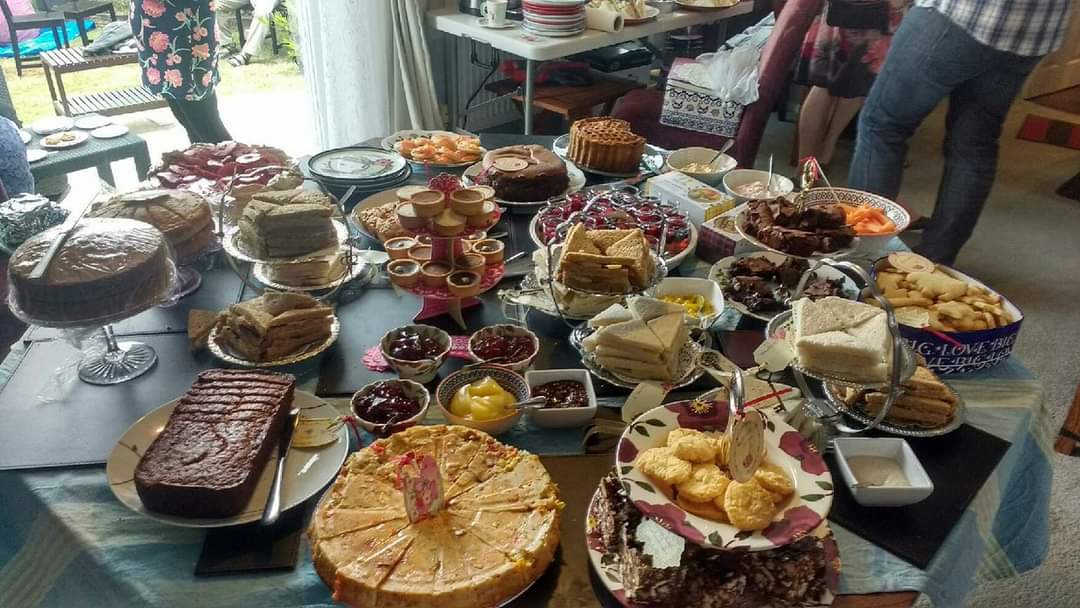
Home catering for parties also brings risks.โ€‚I love to throw an afternoon tea party for charity, but that means that I am suddenly trying to put waaaaaay more in the fridge than I normally would.โ€‚Food may be out on a table for a number of hours.โ€‚Some of the food may also be high risk, such as cheese or smoked fish, and it will be next to less high risk foods. Also, if you are not used to prepping food for large groups, you may inadvertently increase risks by the order in which food it prepped.โ€‚That is without the risk of people bringing food to contribute to yours which you don’t know the origins of, or people picking up food with fingers and therefore increasing risk of spread if they have anything onboard.

Food storage

Once all of that catering is done, you are then left with a decision, what do you do with all the food that is left?โ€‚Do you then try and shove it all in your fridge or freezer?โ€‚Do you give it people to take home in Tupperware pots? How much have you taken into account the length of time that food has been non-temperature controlled?โ€‚What does that do to the use by?โ€‚Is everyone aware of any re-heating requirements or the dangers irrespective of re-heating of intoxication?

Issues with food storage are true not just for party catering, but also for batch cooking, something a lot of us are doing more and more of now the weather is colder and because food it more expensive.โ€‚Foods like stews and rice dishes, which are high risk for intoxication, are also the kinds of foods that fulfilโ€‚a lot of batch cooking requirements.โ€‚It is really important to bear these risks in mind, ensuring rapid cooling and that temperature is monitored appropriately.

This also extends to ensuring that even dry goods are stored appropriately.โ€‚We’ve all been there when we’ve found the pack of spice that 15 years old.โ€‚Spices, canned goods and other preserved food have been identified as the source of outbreaks, and even when originally in good condition can become a risk if not well maintained, such as dented cans or if moisture has gotten into packets.

What kind of incidences are we talking about?

Over the Christmas period there have been two well publicised food related outbreaks, one linked to E. coli in cheese and one linked Cronobacter sakazakii (previously Enterobacter sakazakii) in infant formula.

BBC News – One dead after E. coli outbreak linked to cheese

This outbreak was linked to the presence of STEC toxin producing strain of E. coli.โ€‚This leads to an intoxication that can impact of kidney function.โ€‚Although not stated, elsewhere it was reported that the cheese may have been made from unpasteurised milk, removing one of the stages used to control organism risk in food production.

Advice for individuals from UKHSA included:

“Washing your hands with soap and warm water and using bleach-based products to clean surfaces will help stop infections from spreading. Don’t prepare food for others if you have symptoms or for 48 hours after symptoms stop.

“Do not return to work or school once term restarts until 48 hours after your symptoms have stopped.”

https://www.bbc.co.uk/news/health-67840758

The other recent recall was linked to possible contamination of infant formula detected at manufacturing.โ€‚Formula feed outbreaks linked to Cronobacter sakazakii have been noted in the past, with a large outbreak in France being the last large scale event.โ€‚Infection does not just lead to GI symptoms but is associated in some patients with presentations such as blood stream infection and/or meningitis.

The formula included in this recall is mostly used in healthcare or is prescribed to individuals.โ€‚This makes it critical as it is likely to have been given to an ‘at risk’ population.โ€‚Milk related contamination is particularly challenging as heating impacts the nutritional content of the milk and so use of thermal risk reduction is not straight forward.โ€‚Some hospitals, such as the one where I work, undertake an additional step, pasteurisation, for any formula feeds due to be given to high risk infants because of this well acknowledged risk in order to support infection risk reduction.

BBC News – Baby formula recalled over bacteria contamination fears

Current and Future Perspectives on the Role of Probiotics, Prebiotics, and Synbiotics in Controlling Pathogenic Cronobacter Spp. in Infants
October 2021 Frontiers in Microbiology 12

There are obviously multiple examples every year of foodborne risks linked to contamination at source or HACCP failure, but these are the ones that have been most recently featured in the national press.

Are any groups at higher risk?

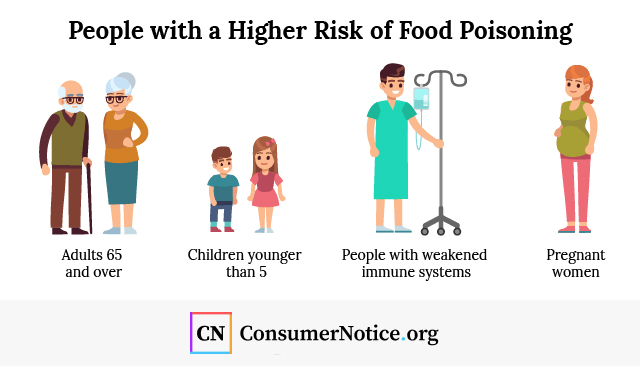
Although food related infection or intoxication can impact anyone, certain groups are more at risk of significant symptoms requiring treatment or are more at risk linked to certain organisms in terms of presentation. These groups are your very young, very old, the immunosuppressed and pregnant women. The very young and very old are more likely to need support linked to dehydration, and all 4 groups are likely to be less able to mount immune responses to invasive infection. The immunosuppressed and pregnant women have specific guidance linked to avoiding high-risk food groups because of severity of impact if infection occurs.

One particular organism linked with significant infection risk for pregnant women and the immunosuppressed is Listeria monocytogenes.

Microorganisms 2022, 10(8), 1522

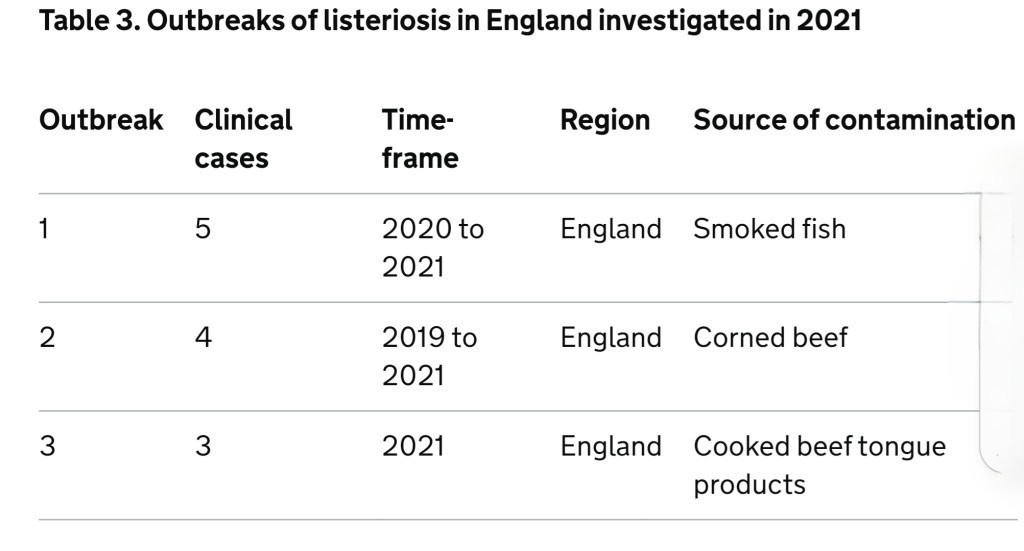
Listeria crosses the gut wall at locations known as Peyer’s patches, and from there invades lymph nodes and blood. Once in the bloodstream, it can progress to cause meningitis/encephalitis by infecting the brain. In pregnant women it can also cross over into the placenta, where it can cause infection in the foetus/unborn child. Foodborne listeria outbreaks have been associated with a wide variety of foods, but are often linked to preserved foods and cheese.

https://www.gov.uk/government/publications/listeria-monocytogenes-surveillance-reports/listeriosis-in-england-and-wales-summary-for-2021

How do we investigate foodborne outbreaks?

There are a number of stages to investigating foodborne outbreaks. Initially, there will need to be some sort of flag to suggest an outbreak event. This is usually a number of people attending GPs or A&E linked to a single event, an uptick in samples positive for a specific organisms that is noted through lab reporting, or any cases of specific reportable organisms which will then get followed up.

Depending on the circumstances, a combination of the following steps will be undertaken:

  • Patient questionnaire (case)
  • Questionnaire of those who attended the same event but did not get sick (control)
  • Sampling and microbiological testing of possible implicated food, if still available
  • Sampling of the production environment, such as factories or restaurant kitchens

Investigation needs to be undertaken to identify the target food or batch as most production facilities will make more than one kind of food and will have multiple batches. If the outbreak is linked to a specific event, multiple types of party or other food is likely to have been available. Getting more information about what those who got sick ate vs the others enables you to narrow down what the culprit might be.

Once you have your questionnaires, it’s time for a little bit of stats. This enables you to calculate something called the relative risk for the cohort. The cohort being all those people who were at the same event, ate at the same restaurant, brought food from the same factory etc. This will include those who became unwell and those who did not. For each type of food or batch you can calculate a ratio of the risk of disease (infection/intoxication) in people who have been exposed (ate that food) compared to those unexposed (decided that food was not for them).

You then get a list of risks for different food types eaten.โ€‚So if the following food was available at our event you can then undertake the calculation:

  • pigs in blankets
  • mini fish and chips
  • turkey and stuffing roulade
  • mini pavlova (with cream)
  • cheese pinwheels

If the number if >1 then it indicates and increased risk, if RR = 1 then it doesn’t impact on risk, and if RR <1 then there is a risk reduction.โ€‚So in the case of our party food:

  • pigs in blankets RR = 1
  • mini fish and chips = 0.98
  • turkey and stuffing roulade = 1.73
  • mini pavlova (with cream) = 1.1
  • cheese pinwheels = 0.99

In conclusion………the turkey probably did it!

I hope that’s helpful, I know there’s loads more that could be covered, and if you are interested in anything in particular drop me a comment and I’ll see if I can post a follow up.โ€‚The main take away is that there are multiple organisms that can cause foodborne infection/intoxication, and whether it’s home or out and about we can all be impacted.โ€‚For most of us, it’s an unpleasant but low consequence event, but there are are people and populations where the outcomes can be much more severe.โ€‚So, if you’re ever asked to complete a questionnaire please do so, and don’t ignore those news articles that tell you to throw an item away as it’s not a risk worth taking.

All opinions in this blog are my own

Taking the End of Year Hype with a Pinch of Salt: Understanding the social media declarations of successes probably come with undeclared context

I’m not a massive New Year person. I talk a lot about how much I love Christmas, but when it comes to New Year’s Eve, I kind of find putting so much pressure on a single night a bit much for me. That said, I do understand the benefits of using it as a moment to reflect, celebrate, and recognise the progress we’ve made. We all know that I’m a fan of ring fencing some time for reflection, I think the benefit and challenge of New Year is that it feels like the whole world is doing it simultaneously and occasionally the messaging that comes with that can be hard to digest and process.

I think it can be especially challenging if perhaps the year hasn’t gone so well or if you are going through something hard just as the year turns. The plethora of messaging out there, whilst laudable, can easily send individuals into a spiral that adds to what they were already dealing with. So, this year, instead of adding to that burden by merely posting my highs, I thought I would post a blog that I hope will remind anyone struggling to read those posts for what they truly are, nice words with limited context. I thought I would also throw in a few thoughts on how I work to process them when the world overwhelms me. Happy New Year, and welcome to 2024!

New Year is an arbitrary marker

The first thing I want to be clear about is that New Year is actually a completely arbitrary marker. There is nothing that states that this is the best time for you, as an individual, to reflect. January is cold and dark, and depending on how you feel about Christmas, it can come after a time that has already been emotionally challenging. It may not, therefore, be sensible to think you have the bandwidth to undertake some true reflection at this time. I see the world differently when the days are longer and when I have access to sunlight. I feel differently about the world when spring hits, and my challenges donโ€™t seem as overwhelming. I thought I would start by saying, therefore, that there is no rule that you should do your reflection piece now. Choose a time that works for you. Be as individual as you choose and empowered to just opt out if you so wish.

Celebration and supporting others is important but…….

I’ve posted about how important I think it is to celebrate and support others. I think lifting each other up is key and an important way to give back. The way you do this doesn’t have to result in you damaging your own mental health and wellbeing however. You can choose to like posts as you scroll down them rather than fully engage and comment if you are having a difficult time. You can choose to have a social media break and know that at this time of the year, there will be plenty of others prepared to carry that particular load on your behalf. Sometimes, noting and filing away, so your congratulations or support comes later and individually, can actually be the more meaningful way to respond. My point I suppose is this, if you are in a difficult place there is nothing wrong with periodically prioritising your wellbeing.  This is different from choosing not to engage and celebrate others, and it’s OK, not that you need my permission or anything.

Not everything is as shiny as people say

One of the reasons I don’t fully engage with the hype at New Year is that I’m aware that people feel like they have to put something out there. Many people feel like they have to find something to shout about. I can, in many ways, see why this is helpful, as even if you’ve not had a great time, it encourages you to find the good. I actually feel this is a positive way to process if you are in the right space for it. If you are not, however, it can add undue pressure and make things worse. If you are in a place where you can’t do that processing, it’s worth noting 2 things. First, you will get to that place at some point. You just don’t need to get there in time for an arbitrary date that may or may not work for you. Second, a percentage of what you’re seeing posted won’t be from a place of true reflection and joy. It will come from the social pressure to post something.  There are a heap of people out there desperately trying to find something to say, and even more who are not posting anything as they are in the same space as you, they are just not visible in their absence. On this one, I would be aware of the absence of things as well as the presence of others and use it to help contextualise how your feeling.

Benchmarking against others is not always helpful

Betty, from the Tales of Female Badassery podcast, reminded me of a phrase today ‘comparison is the thief of joy’. It really struck me, today of all days, how true that can be. Benchmarking is a useful tool. It can inspire you, show us the possible, and help us plan the paths to our dreams. If you try to do it without full context or all the information, however, it can lead to negativity and self-recrimination. So, if you are tempted to fall down this particular rabbit hole, ask yourself……is this helpful? If the answer is no then it’s time to crawl your way back out into the sunlight and park it for later, you are probably either using the wrong sources or are not in the right head space for the undertaking. Your journey is yours, and benchmarking is a tool, not an outcome.

Life is multifactorial

You’ll see a lot of posts about professional success at this time of year. I wanted to take a moment to remind us all, however, that life is not just about work. When you are considering successes it needs to include not just work financial components but what happened in other aspects of your life. Did you take that drawing class you’ve wanted to? Did you finally manage to finish writing a poem? Did you get the kids to school in one piece this term? We are more than one thing, and our reflections should encompass all of who we are, not just a box that society deems we should tick off. It’s OK to bring all of you to whatever it is you’re doing, and that includes reflection and celebration. No one gets to tell you what matters and what is significant but you.

People are often not sharing the bits that didn’t go well

I have had an objectively amazing year. I got to go to eurovision, to the Kings Coronation, I got papers out, and won awards. All of which are brilliant.  The other side of that coin is that I’ve pretty much broken myself physically and mentally at points, to the extent that even writing this blog, which means so much to me, had to be paused for a month. Now, because of what this blog is, I’ve shared some of those challenges as well as the highs. You often don’t get to see both sides of the coin, however. Success often comes at a cost, and that is a conversation we often seem to avoid having. There is nothing wrong with deciding that it’s a cost that you are not currently prepared to pay. Even straightforward things, like exams, come with a financial and time penalties, and depending on where you are in life, you may say not now, or not ever. People are also always shocked when I talk about failure, as so many people don’t, but failure is a part of life, and it’s OK both that it happens and that we talk about it. You’ll see some people sharing their CVs of failure and this time of year, as well as their successes, and I think that that is brilliant and brave act, and something we should do more of.

You are on your own journey

Fundamentally,  we are all on our own path. No one will be on the same path as you. You have your own values, your own goals, your own history, all of which will be personal to you and impact on your decision-making. Celebrating rather than crushing that individuality under the weight of expectation and comparison is something I’ve found is key to my own happiness.

It actually, from my experience, takes a fair amount of courage to own this individuality and way of approaching the world. So what I’m wishing for us all in 2024 is the bravery to walk and own our paths, and to use that ownership to be a little less impacted by the distraction of the paths of others. You do you! Leave others to be themselves in turn.

Goals should support aspiration, not self-recrimination

Goals and even New Year’s resolutions should be tools that help us on this journey. They should not be a weight around your neck to suffocate you if you do not achieve them. Goals need to be flexible enough to change as the landscape changes, and we need to be able to respond and throw them off if there are no longer relevant. I think we should all bear this is mind, least of all me, even with what should be simple things. Sometimes, when I say I will post on a specific day and I don’t manage it, I will go into a flight of self recrimination that baffles Mr Girlymicro who points out that the world has neither ended nor has someone been harmed by my lack of delivery. Perspective is needed. What are the consequences of achieving a goal or not? They should be map markers to aid you. If they become more than this, they probably need to be reviewed and further understood as to why they matter so much. Understanding your drivers is key to understanding yourself after all.

Sometimes, getting off the hamster wheel is more important than staying on it

One of the things I can’t work out if I learnt due to the pandemic or would have learnt in my 40s anyway is that sometimes the goal itself may be to become OK with not having a goal. Sometimes, the important thing is not to tick another box, add another level, or achieve more. Sometimes, the important thing is to do the opposite, to do less, take on less, to feel freed. In a world about consumption and visible gain it can be hard to feel legitimately able to make decisions that go against the tide and decide it’s time for a break. It’s often not even talked about as an option. It is however one. It’s OK to step away. It’s OK to table something for later. It’s OK to pause and re-evaluate. The rat race isn’t going anywhere. It will be there waiting for you when you are ready to re-join it. So go ahead and breath, everything will be fine.

Here’s to celebrating the little things in 2024

My 2024 will not therefore be filled with grand declarations. I’m hoping that it will still be filled with success, but the success that I want is about the little things. It’s about finding time to make and drink tea out of the pot instead of always rushing and having it from a tea bag in a cup. It’s about finding time to write this blog and be creative in a way that is joyful, not squeezed into existence. It’s about balancing my life and work, finding time to deal with my emails during working hours, and even on occasion seeing the bottom of my inbox. It’s about finding more moments with friends and family by achieving that balance. It’s about all those little moments every day that, for me, make life worthwhile. I hope that in 2024, you get whatever it is that you wish for and know, whatever you decide that is, that it is practically perfect in every way. Happy New Year.

All opinions in this blog are my own

A DINK Household: Embracing a life with no kids, no guilt, only joy

I’ve got a few days off this week and so have finally been able to catch up with some friends and family. It’s also given me more time than normal to catch my breath and reflect a little. Most of my friends with kids however are instead running around from show to show, attending carol concerts, and trying to buy presents at midnight. This comparison has caused me to reflect on how glad I am to be part of a DINK household.

What on earth is a DINK? It’s a term I’ve heard thrown around for a while and I finally asked Mr Girlymicro what it stood for. Apparently, it stands for: double income, no kids. There’s also DINKY, which stands for double income, no kids yet.

I wrote a while ago about how it felt to be childless in my 40s and to discover I couldn’t have children. At that point, I had come to terms with it as a reality. Now, in the year my niece would have become a teenager, I have to say I’m more than OK. 13 years on I have such a different view on the whole situation. Not only am I OK, but I have come to embrace and enjoy all the opportunities that have come my way, many of which would not be available to me if I was looking after the next generation. This post is not to revel in the stress of those who have a different path, but to share that there can be joy for those of us who are on a different journey.

It’s not them versus us

Too often when I post about being childless on social media, whether defending my right to still leave work on time or stating that my life still has value, I get a response that sets me up as if it’s the childless vs the parents. My claiming that people who are not parents still have the right to work life balance does not take away from the rights of parents to have the same. One group having value does not detract from the other. I think it’s an interesting societal artefact that we are set up as opposites, when really we are nothing of the sort. It is not ‘Them vs Us’. It is about an appreciation of difference and recognising  the challenges and impacts on everyone’s lives of the decisions we make. I can want to have my life recognised as ‘of value’ without asking for someone else to have theirs diminished. 

My friends with children are a brilliant and an important part of my life. Being the fun aunt is important to me. My wonderful colleagues who have children absolute deserve to have allowances made so that they can be present and involved parents. I love hearing about the activities of their kids, their lives, and seeing the pictures. On the rare occasion I also need to leave on time to see my family, they are brilliant about ensuring it happens. I hope they feel I support them in the same way. This positioning of ‘Them vs Us’ isn’t real and if 2023 has taught me anything, it’s not to feed the trolls, so let’s see and value each other.

I have found my joy

I work hard. The days are long, and I’m often pretty tired and worn thin. I think there was a certain level of work for distraction for a while, but an awareness of using it to avoid processing has enabled me to face some things head on. As 2023 draws to a close, it’sย turned out to have been a year of some amazing highs. 2022 in fact, also had some particularly rocking moments. There were some great professional wins brought about by all that work, which I’ve been forced to acknowledge would never have happened if I’d had to split my focus. I also had some truly wonderful times with Mr and mummy Girlymicro and some great friends, many of which would have been harder or more complicated if we’d had children. Sunsets, cocktails, and shopping would have just been more complicated. I experienced pure and unadulterated joy in just being in these moments. In the freedom, we have to just book a weekend away on a whim. Freedom that being a DINK household gives us that we would be unlikely to have otherwise. Joy that has become uncoloured by the ‘What Ifs’ that had previously removed some of the shine. Learning to live in and for these moments without looking back.

My life has value

One of the biggest challenges I’ve faced in moving forward is the unwritten societal expectation. I don’t know whether it is unconscious evolutionary pressure or a societal construct, but there is a perception that somehow your life has less value as you are not contributing the future by having children. That’s not to say that it all comes from other people. A lot of this is something we put on ourselves. It is not helped by people feeling like it is OK to make you justify your decisions at every point. You can’t have children? Why don’t you adopt? Have you considered IVF? Have you researched trying via a surrogate? To which I have a tendency to want to scream back ‘Oh no, I never considered any of those things. I’ve never lied awake at night running through my options. It just never occurred to me to research and find out more. Thank you so much for changing my life by enlightening me that there are other options!’. All of these conversations, whilst driven from a place of support, just reinforce the fact that no kids = no value.

Let me tell you now what I tell myself every day. I have value. It may not be in the same way, but my life is valuable, my contributions are valuable, and although different, I am still contributing the future of humankind.ย  I feel like I contribute professionally, but also by supporting friends with their families. Recognising this contribution in myself means that I now feel empowered to put more boundaries around my life to protect it and to respect that value. I am trying to leave work on time. I’m trying to not work weekends. I’m trying to find time for contributions that mean something to me and which I believe matter, like this blog and being a visible woman in STEM. If I don’t do it, how can I role model that for others, and how else can we have conversations about how to change some of the perceptions about value and childlessness.

I refuse to feel guilty

I’m done apologising. I’m done apologising if I need to put my life first some times. Now, I’m not talking all the time. We all have to be team players. I am, however, done with throwing myself over the metaphorical ledge in some perverse form of self flagellation for something I had no control over. I am also done with being made to feel guilty in conversations where I talk about my life and my opportunities. Yes, I get to go on holiday to New York and shop because I’m not paying out a crazy amount of money in nursery fees. I’m not going to hide it because I get to do something someone else can’t. In the same way, I embrace people showing me pictures of their kids, even if I can’t have any. Their children are an important part of their lives, and I care enough to be interested. The way I feel about lunch at Serendipity III in New York and the fact it featured in one of my favourite movies with my sister has meaning for me. Things are meaningful for different people in different ways, thus is the joy and variety of life.

I’ve heard the phrase ‘Not everyone is cut out to be a parent’ said to me a few times in recent years from a variety of sources. This is almost always linked to conversations about activities in which I’ve embraced my childless existence. The first few times, it really stung, almost as if it was a way of saying that if I’d been able to have kids I would have been a bad mum. It made me pretty unhappy that it was OK to throw around that kind of judgement. The more I’ve heard it though, the more I now see it as a sign that I have genuinely grown to be comfortable with who I am now. My identity is now so OK with my childless state that I am also OK with talking about the pieces of motherhood I would have found challenging, about being open with who I am to others. Although, if you feel like saying these words, probably best to discover how they might be taken before you do. Six years ago, the response may not have been so open and embracing of the conversation.

Embracing the life we’re given

Becoming comfortable with who you are, whether you have just encorporated grief into that identity or not, has been the first step in giving myself permission. Permission to make choices that work for me, permission to be happy, permission to draw boundaries, and if needed permission to stay in the bath soaking for 3 hours with tea and an audiobook.

Embracing the life I lead, rather than some sort of societal expectation or perception of the life I should lead, has completely changed how I make choices. Being aware of my privilege in getting to make those choices makes me value them even more. In one week this year, I got to go to the King’s Coronation and Eurovision. My life is pretty epic, and none of that is defined by whether I have a child or not. It’s defined by the choices I make to lead me down wonderful and unexpected pathways and filling my life with love through the people I make the journey with.

Never looking back

I’m done with ‘What Ifs’. If you are looking back all the time you can’t truly look forward. I’ve embraced the road that led me here but I’m not defined by it. It’s just a part of who I am, not the whole. It is all too easy to be haunted by the past, especially ifย  the reality of that past was that we had no control over the events. This can lead to a sense of disempowerment and a feeling that we lack agency from that moment forward. At some point, to regain a sense of control, you have to have some hard conversations with yourself about what that control looks like. For me, it’s about waking up every day and consciously choosing to embrace my now. To see the future as filled with possibilities rather than filled with ghosts of a future that will never be. I no longer have a crick in my neck from looking back, and I’m OK with that.

Travelling the road less travelled

So join me, whether your circumstances are driven by choices out of your control or not, in embracing the road less travelled. Join me in committing to being braver in facing up to uncertainty, reality and in having difficult conversations with ourselves when needed in 2024. We don’t know where the doors we open by these acts of bravery will lead us, but I can almost guarantee it will be unexpected. Your journey doesn’t need to look like anyone else’s. It’s uniquely yours, and that is the joy of it!

All opinions in this blog are my own

A Shout Out to My Girls: This one is for all the women that support others & see them as inspiration not competition

I was fortunate enough to be asked to record a podcast last week with the absolutely awesome Betty Adamou for her series Tales of Female Badassery.  Just as we were prepping to record I was struck with a moment of panic.  I didn’t know whether I was a Badass.  I didn’t know if I’d every done anything that would make me a Badass.  I called one my girls in a state of panic, she responded with ‘don’t be so ridiculous, you’re not only a badass, you’re one of the most badass people I know’.

It got me to thinking. I am super fortunate to be really close to my family and to have the wonderful Mr Girlymicro as my constant companion. In more recent years I have, however, also become aware of how wonderful it is to have a small tight knit group of women in my life. These are the people who understand if I don’t call them for months. The ones who know me well enough to know when to challenge and when to comfort. The ones who I can sit and watch bad movies with in pyjamas and who would never judge me for the state of my house. Some of them I have known for decades, others more like 5 years, but time doesn’t really matter.ย  They are my girls. They get me, and this post is dedicated to them and why you should consider finding your own equivalents.

Constructive challenge

Not everyone has a Mr Girlymicro in their lives and to be honest we all need someone to call us on our BS sometimes. Having a small cicle that you trust completely, which have the ability to stop you in your tracks when you’re going down a cognitive rabbit hole is so valuable.

I suspect we’ve all been there, sounded off about X or Y, when suddenly someone trusts calls us out on what we are doing that could trigger that behaviour, or pushes us to understand why we are so triggered. This calling out opens up a whole new vehicle to understanding or route for a response that would not have been available to us otherwise.

In my case, my girls often join forces with Mr and mummy Girlymicro in asking me why? Why have I decided to take on yet another thing? Why do I think it’s needed? What extra will it add? What will I drop to enable me to take on the shiny new? What does it mean for them? Will they see even less of me now? Will I be even more distracted and do even less at home? These conversations can lead to me walking back commitments,ย  or at least force me to articulate my thought process and gain a better understanding of where I actually am with my workload.

Unconditional support

The reason that constructive challenge can happen is because I know these guys are 100% on my side. They are unwavering. They know all the bad in me and choose me anyway. They can, therefore, be brutal about the truth when needed, as they are also around for the rebuilding that is sometimes required after being faced with a harsh truth.

This also means that I hear what they say. If they tell me someone is out of line and validate my feelings, I hear it more because I also know they would tell me if the opposite was true and I was the one who’d acted badly. To me, unconditional support isn’t about just giving me what I want to hear. It’s giving me what I need to hear in terms of the truth/reality check. They tell me both that I’m not superwoman, but also that I’m a god damn queen who can achieve anything she puts her mind to. Just not simultaneously.

Shared experiences

Not through any deliberate endeavour,  but just because of how life has worked out, my girls all happen to be kick ass women who either work in STEM (science, technology, engineering and maths) or are STEM qualified. In fact, they are all coincidentally PhD qualified. I didn’t meet them all through science however. For instance, Diane, I met my first day at uni and has been keeping me sane for over 20 years. Claire (known as Dr Claire, as she was the first Claire with a PhD) I met because she was dating a friend of my future husband, the boyfriend exited the picture and we stayed friends. Claire (Captain Claire, due to our shared appreciation of Captain Jean Luc Picard) and I met over several bottles of wine when we were both doing our PhDs and have continued on the wine trajectory ever since. This means we have both a bunch of shared and different experiences.

Our shared experiences, linked to being women in science, mean that they can sometimes help me see challenges coming in a way I wouldn’t have anticipated.ย  Theyย  can also share what did and did not work for them when they encountered something similar.ย  We can, on occasion, also just rage about the injustice of it all in a way that enables us to put our feelings in a box and carry on regardless.

A different view of the world

I have some wonderful women in my world who I count as dear friends but whom I still work with. These wonderful women are often my go-to for support and guidance as they are emersed in my world. The difference between them and this group of girls is that we donโ€™t work together, and have never worked together in the same department. This means that we took different paths through both work and life. We don’t just reinforce each others perceptions and bias therefore through having pre-established knowledge of the other people in each others lives or work. We have a bunch of shared experiences, but a lot of our progress has led us to very different places. Some of us have kids, some don’t, some of us still work academically or in science, some don’t.ย  This breadth of experiences mean that they can sometimes offer a very different view to mine. They can point out nuance I would have missed or when my previous experience is biasing me to a current situation.

We also have very different ideas of what constitutes a good time. I’m a book, fire, sofa and afternoon tea kind of girl. Whereas the Claires would way prefer to be with their animals (chickens, wallabies, etc) and Diane would happily be walking through the Scottish countryside.  This is also helpful. It has always pushed me to try things I wouldn’t have. Once it pushed me to try camping. This was a mistake. Camping was a step too far. They love me anyway.

Parachute provision

I’ve written before about my tendency to shame spiral. I’m not alone. Captain Claire and I are known to call each other up mid shame spiral and offer each other a parachute outta there. We talk through what we’ve done, talk through the possible consequences, and how we might act or handle things differently next time, in a space of acceptance without judgement. It’s this last piece that is key. We’re not trying to ‘fix’ each other, just support each other by providing a safe space for verbal reflection and to articulate our fears, whether rational or not. From my perspective, this often permits an early exit from the spiral combined with some centering and learning. What more could a girl ask for?

Sometimes, we all cry

That same space of zero judgement is also important as it provides a space where you have licence to just feel. Sometimes, I have to ride the wave of emotions to process them and get through to the other side. It’s no secret to the readers of this blog that there have been some tough times in the last few years. Having a space where you can just have freedom to express that you are angry or upset by the state of the world or the way you have been treated professionally is so special. I have this with Mr and mummy Girlymicro as well, but it helps them to be able to share the load, especially when things can go through intense periods. Sometimes, I just need to cry and say that things are unfair, and then I get it out of my system and find the emotional band width to remember my why and can get back on with the fight.

Borrowed courage

When I phoned up Dr Claire and declared ‘I’m just not a badass’, her first response of ‘hell yes you are’ gave me courage. It made me brave enough to go ahead and record something I was hesitant about. This is what my girls do. They loan me courage when mine fails me. When my imposter syndrome or my fear tells me I can’t, they are always there to tell me I can.ย  When I receive awards or recognition and I ask ‘why me’, they respond ‘because’. They see me when I cannot see myself. They will tell me to ignore the fear and just get on with it. They will challenge me when I’m avoiding things because I’m not brave enough and loan me the courage I need to do what is needed. When required, they bring out the bad ass warrior in me.

Courageous authenticity

The validation I am lucky enough to receive from my family and my girls is important for another reason. They make me feel like it’s OK for me to be myself, not some projected version of myself. I’m pretty open in this blog about who I am, how I feel, and how I respond to challenges. I’m also (I hope) pretty honest about my personal flaws and areas that I’m trying to grow and improve around. This blog wouldn’t be possible without having people around who not only validate that that message is OK, but that it is actually important and helpful to talk about these things.

There are days for all of us where we can’t love ourselves. Days where all we can see are our flaws and none of our strengths. Days when we compare and we just don’t stack up. Having people in your world who also see and acknowledge these weaknesses, love you anyway, and tell you you have value even in their presence is one of the greatest gifts we can receive from another person. It enables you to still be who you are even when that may be the last thing you want to be. To continue to work on being unapologetically authentically you.

Mutual appreciation society

One of the best things about these relationships is that they are bi-directional. Most of the time, when one of us is having a bad time, the other is doing OK and can be there to lift the other up. On the occasions where we are both just going through it, then a shared pit of despair can still provide comfort. (We’ve decked ours our with pillows, blankets, and everything). I think these ladies rock it. I trust them completely. I trust them to call me out and challenge me, which means when they validate my other feelings, I believe that too. I love them and consider myself blessed to have them in my life. I also hope that I am there for them as much as they are there for me.

My girls and I aren’t in competition with each other. We’re all on different paths. We value different things, and that’s not only OK but joyous! It doesn’t matter who is achieving what. It doesn’t matter if that’s getting the kids to school on time, or getting out of bed and just making it to work when we’re having a bad time and just wish to hide from the world. All of it is valid and worth celebrating. When they were having kids and I was finding it hard as I was still working through my own situation, they were always mindful but still knew that I was genuinely happy for them. One thing does not obliviate the other.

Distilled awesome

So, to end, I want to say thank you. Thank you to the women out there supporting other women. Thank you to the ladies who straighten my crown even when I don’t realise it’s crooked. Thank you to my girls, the one’s who I cry, scream and cheer with. You are distilled awesome and I will never be able to truly describe the difference you’ve made to my life and how grateful I am to have you on this journey with me. I may be absent for months, I may be a special kind of crazy, but know I am always here for you!

All opinions in this blog are my own

World Antimicrobial Awareness Week 2023: Thinking differently about ‘Super Wicked’ problems

It’s the end of November and we’ve just come to the end of World Antimicrobial Awareness Week 2023 #waaw. I have previously posted about some of the challenges linked to antimicrobial resistance and this year I’ve been really impressed by the amount of information on social media. I also know of some face to face events (more on that later) linked to speaking to school children and healthcare staff. Many of us are involved with an engagement push linked to this week, and one-off events are both valuable and have strength of purpose. I wonder though how many of us have really thought about how we design or put these events together in a chain for greater impact or in the wider context of the challenge?

What do we normally do?

It is sometimes tempting, especially if we’re doing a one off event, to focus on the activity or engagement first. This means that we will often come up with the cool fun idea of what we are going to do, focussing on the science, and how to break that down. This means that sometimes we start towards the end of the process, rather than starting off spending time thinking about what it is we want to achieve and then building everything based around that.

Even when you have the objectives nailed there are a number of different ways and factors that may impact your messaging and how that message is co-created/received, and your audience is a key component of the design process. Factors to consider can include aspects such as:

  • Gender distribution
  • Geographical location
  • Age
  • Family status (care givers, children)
  • Professional status
  • Socio-economic status
  • Education level
  • Shared experiences (special interest groups, prior intervention
    experience)
  • Social and cultural norms (beliefs or religious practices)

Different objectives lend themselves to different things, and to different audiences. Infographics are a very common way of communicating. They are easy to share and have great longevity, as they can be used in social media, but can also be utilised in print form for posters and leaflets to allow a different form of targeted spread. They can work better with some groups than others, and depending on the content are more likely to appeal to individuals with pre-existing knowledge or interest.

One of the challenges with a lot of the way that we communicate is that some of the facts can come across as pretty scary. The classic message that often gets used is modelling data that more people will die from antimicrobial resistance (AMR) than cancer by 2050. The problem with using these kind of shock statistics is that it runs the risk of turning general members of the public off the message as it’s both a scary and a big problem, which they can’t face engaging with as they don’t feel they have the capacity to influence it. This is especially true for those who see themselves as rarely interacting with healthcare, who might go to the GP every other winter for a course of antibiotics, but don’t see themselves as getting sick.

Another challenge is balancing some of the messaging, the message that everyone is responsible can sometimes read that no one is actually responsible. When I’m out and about having conversations about this right now, the pandemic has definitely had an impact. There is a lot of compassion and other fatigue post SARS CoV2, where people feel like they have given up a lot for the ‘greater good’ and don’t want to feel like more is being asked of them, in terms of personal sacrifice.

It is also hard to get both your ‘what’ and your ‘why’ into a single infographic. Messages linked to action are very powerful, but they tend to work better for audiences who already have a strong grasp of why the message is important and how it relates to a specific issue.

Great programmes, such as the Antibiotic Guardian programme, are already doing great work and position themselves linked to a behaviour change by encouraging individuals to sign up to behaviour pledges. They tend to appeal to people who have some pre-existing baseline knowledge, with pledges acting as re-enforcement. For instance, images, like the one below, are great and super easy to interpret, if you already have an understanding of antimicrobial resistance being a One Health issue. This is valuable, especially if your target audience is those using large amounts of antibiotics in daily life, such as farming, or antimicrobial prescribers, such as medics and vet.

Other types of engagement options enable you to tackle some of the frequent mis-conceptions, such as the fact that it is the person and not the organism that becomes resistant. Face to face encounters allow you to get a greater feel for where any of the knowledge gaps or pre-conceptions lie, in a way that is harder when you are just sending messaging out into the world. The limitation of this approach is always going to be the number of people who can be engaged. So the choice of objective really does impact which approach would be best, alongside whether you are aiming for knowledge/awareness raising or whether you are aiming to impact or change behaviour.

One of the other challenges with designing content or activities without having first defined your audience is that the language pitch can be particularly challenging. Words like diagnostics work really well when talking to healthcare professionals, but may resonate with the wider public. The things are also not static, the wider public may be more comfortable with certain terms post pandemic than they were before, this may or may not be maintained as part of common language as the years past. Therefore language options that may be appropriate in 2023 may not be appropriate in 2027, and undertaking a conscious review of pitch and language is required every time.

What does the literature tell us?

We recently published a paper focussing on some of these issues and processes linked to designing outreach or engagement for AMR, and it really made me think about some of the steps that might be helpful. It also made me realise how we should be using other tools and options when designing both our activities and evaluations linked to social behavioural models (Participatory learning and action approaches (PLA), Information-Motivation-Behavioural (IMB), Transtheoretical approaches) taking the learning and understanding from other areas to maximise our success in this area. Some of the key prompts for me included:

  • How many of us really take the time to define our target populations and think about what would work for the group we are going to target?
  • How many of us really define the single simple message we want that target audience to take away from our interaction and think about whether we are looking at knowledge/awareness increase or behaviour change?
  • How many of us design evaluation strategies based on population and target message/change in order to understand whether we have achieved our aims and how to improve it next time?

Without really embedding a rationale, design, and evaluation process, are we ever going to achieve what we want to achieve within a highly complex landscape? Because of the ‘super wicked’ nature of communicating about AMR unless we take a co-productive approach, will any of our interactions lead to long-term impacts? Are we really going to reach the groups that could most influence that change?

How can we approach things differently?

It takes a lot of time to design activities and I for one am always tempted to re-use and re-purpose as I’m time resource limited. One of the main things that came out of writing the paper, for me, was being very conscious of picking of the right tool for the job, and that one size doesn’t fit all because of the different reasons we might be undertaking the work in the first place.

Another thing that really struck me when reading the literature in this area is how much the power of telling stories can really address some of the issues that are linked to fear or the complexity of the challenge. It offers a route into the topic for people who are not necessarily already engaged by offering entertainment, and also to describe scenarios in a way to allow people to not feel so judged about personal actions whilst raising knowledge/awareness. It can provide a safe way to engage with a topic on an emotional level with reduced risk.

We’ve tried some of these concepts as part of The Project Nosocomial, with different approaches, from drag Klebsiella and panel discussions, to complete plays aimed at different audiences.

It is not just us that have tried this approach, there have been films such as Catch and musicals such as The Mould that Changed the World.

Not everyone is going to write a full on play however in order to engage others. Despite this I think there are things that we can still learn as scientists, like feeling empowered to tell our stories and our whys, that can support connections and innovation in this area. These approaches can be embedded in a low key way in all of our activity planning in order to enrich them. This type of experience, just like with Ted and others talks, can be really valuable in helping us improve our wider communication skills, and therefore also help with our wider professional practice.

One of the big challenges can be feeling secure enough to bring yourself, as well as the scientist, to your activity. By doing so, by sharing our stories and our why, you can engage in a deeper way than by just being the expert in the room. It adds depth and the ability to respond during engagement that hopefully leads to improved longevity of impact, and inspiration of intellectual curiosity of those involved. It also provides a route for us to learn as scientists, not just about communication, but also about how lived experience can impact patient choices.

I suppose, my point in this article is that I hope we can all be a bit braver, both in acknowledging the challenges we face in addressing an issue of this complexity, but also the steps we take in designing our responses to those challenges. I’d love to hear what other people are doing, so if you want to let me know that would be great, or you could even write a guest blog on your experiences of what you are up to in this area.

All opinions in this blog are my own

Do Or Do Not, There Is No Try: Why seeking external validation will never be enough

This has been a pretty amazing week, I was fortunate enough to receive the HIS Early Career Award from the Healthcare Infection Society. As the first woman and the first Healthcare Scientist to receive it, it was pretty wonderful. As part of receiving the award I was also given a 30 minute speaking slot. Now, unlike normal, the brief was pretty open which resulted in 2 things. First, a sense of overwhelming panic about what I should talk about. Two, a gradual realisation of what a privilege it is to be given the opportunity for 30 minutes as yourself and how invaluable such an opportunity is to represent yourself and others.

The other thing that happened was I spent some time thinking about how amazingly fortunate I have been in terms of external recognition in general. The thing is though, at its heart, it’s unsustainable. My husband is always telling me (tongue in cheek) that I have to stop winning things so that others can. No matter how much this is said in jest, there’s a lot of truth in this statement. When do we get out of the way so that recognition can be given to others? And what happens when that external recognition has become a benchmark in how you assess your own standing or success? This blog is the result of some of my musings on reliance on external markers of success, and what work we might need to do on ourselves whilst enjoying the recognition.

Recognition is amazing

In all honesty, I was never someone who won awards, not at school, not at university. It wasn’t really part of my psyche or something that I realised could happen to someone like me. After all, I’m a pretty normal run of the mill kind of girl. I work hard, but that’s my main feature. Then waaaay back in 2015 I was nominated for rising star award at the CSO awards by a kind Consultant Healthcare Scientist. I didn’t win, but it made me aware that such things exist. As Trust Lead Healthcare Scientist, I’ve always remembered that kindness and what it meant to me, and as a team we try to always ensure that we nominate as widely as possible for any external awards that come up. We even started the Healthcare Science Awards at GOSH in order to provide a similar kind of internal recognition.

Recognition is great. It’s a real confidence boost. It can also open doors (like to the Coronation) that you never thought would be open to you. Increasingly, awards and recognition are increasingly important for things like career progression and grant funding, so they are no longer just a nice to have. Now, sitting on/chairing a number award judging panels, I see how it impacts those in the running and how important those decisions are.

Recognition is also sometimes the only thing that gets you through. For a long time, there was not much acknowledgement of my value as a Healthcare Scientist internally. There have been some very challenging times. The external recognition I received was the thing that told me it was worth persisting, that I was doing something right when I spent a lot of time questioning myself, my value and my vision. The problem with this as a coping strategy is that recognition can become addictive, and as a people pleaser, you can come to believe that unless you receive it, you don’t have intrinsic value.

Acknowledge that we are trained into a certain way of viewing the world

Whether you’re a people pleaser, a gifted child, or someone who was just raised to strive, we are taught to see the world through a specific lens and to judge our success by it. There’s an always ‘onto the next thing’ mentality combined with a need to know we are good enough, as we secretly suspect that we aren’t. That specific lens can engender large amounts of success, but it can also make it hard to have a true appreciation of the facts, making external validation take on an increasingly significant role. But what happens when it stops?

I hate to break it to you, but there are only so many awards and qualifications out there, IPC and Healthcare Science are small worlds after all. What do you do when you have ticked the qualification boxes, and other forms of recognition are few and far between. This is especially true when you become a senior leader, and to be honest, no one is interested in tapping you on the back and telling you you’ve done a good job anymore. Doing a good job is assumed. Everyone will be quick enough to tell you you’ve messed up, but silence is where positive feedback used to be. If you are someone who needs external reinforcement, this is a lonely place to be, and it’s better to recognise it before you get there so you can have already begun work on your coping strategies.

There are benefits to the ‘onto the next thing’ mentality

One of the traps we can find ourselves in is that the ‘onto the next thing’ mentality can reap huge rewards. In competitive fields, such as academia and medicine, it can be an important driver to success. It allows you to dig that little bit deeper and be that little bit more focused. To tick the boxes that need ticking, and to sometimes tick them faster or more efficiently than would have been possible otherwise. This means that both the good and bad aspects of this personality trait get enforced, and whilst there are training competencies to be ticked and qualifications to be had, the negative side of this particular coin don’t feel so bad.

As time goes on however, and careers change, the boxes that need ticking are no longer so clearly defined, and the list of things to do has no end. The positive reinforcement produced from this way of dealing with the world therefore turns into a sense of failure and inability to see progress. The list of jobs never ends, and so a sense that it is because of a failure in ourselves, rather than the system we are working in, persists. We run faster on the hamster wheel in order to try to reach the finish line without realising we’re going in circles, and the line will always be just out of reach.

It will never be enough

One of the dangers when on the hamster wheel, therefore, becomes that we further lose sight of how to benchmark progress. This means we turn even more to others to guide us as to whether we are doing OK. Whatever OK is. And that’s a problem, isn’t it. No one really knows what we are seeking, especially when we don’t know what it is ourselves. Progress when early career may be challenging, but it is often fairly straightforward to define. As we develop, both ourselves and our careers progress and how we need others to feed back to us is frequently becomes less clear.

The other thing to note is that if you listen to the positive comments and hold them to be so significant, you will also listen to the negatives, and probably even more intensely. As the saying goes, ‘you have to take the good with the bad’. Now, listening to constructive negative feedback is an important part of developing. The sad thing is that sometimes it’s not so constructive, and that can lead to some pretty destructive self-talk, spiralling, and challenges with processing of the feedback you are getting. So, how do we move ourselves from the position where we hold the opinions of others in such high account, to where we can evaluate and add our own self reflection into the mix, in order to achieve a stable equilibrium?

Know that what success looks like changes

As I’ve said, what success looks like changes, and it may not look the same from day to day, let alone year to year. One of the things I’ve become increasingly aware of in recent times is that I want to achieve across my life. I’ve spent a long time focusing on achieving at work, but this means that my long-suffering husband has lacked support, and any non work achievements have very much been on the back burner. I want to regain some balance in my life. It won’t happen overnight, and progress is being made by inches, but that is what success for me would currently look like. Everyone is different and your idea of success may look very different to my current one, but unless you take the time to identify what it looks like for you you will continue to be driven by how others define it for you.

Beware of your self talk

I’m so guilty of staring at myself in the mirror and telling myself how stupid I’ve been or asking why the fuck I said that. I suspect that no one else talks to me as badly as I talk to myself, and when I do screw up part of me wishes people realised there’s no need to make me feel bad about as I’m already waaaaay ahead of anything they could say. The thing is, this is not a healthy way to treat myself. I am now putting in active effort to become a better cheer leader for myself. Before my talk at HIS, I took 2 minutes to tell myself that I could ‘do this’. I could appear like a grown-up and give a good talk. I tried to speak to myself the same way I would speak to my students and/or colleagues before they were due to do something they were nervous about. I gave myself the same compassionate time that I would give to someone else. This isn’t something that is an embedded behaviour for me yet, but I’m hoping if I continue to work at it it eventually will be.

Miss out on the best bits of yourself

If you live in a spiral of self critism or an echo chamber where you only value the opinions of others, you will miss out on the best bits of yourself. I’m a pretty weird person, but I think at heart we probably all are. I think I’m also pretty compassionate and loyal, as well as occasionally funny. It’s super cliche, but as I get older I do think that our relationship with ourselves is one of the best ones we can ever develop. It takes courage to stand and know your flaws and love yourself anyway. It takes time to see past that long list of flaws to see that many of them have flip sides that represent strengths. To honestly work on them whilst not constantly chastising yourself because they exist. If asked, I could immediately give you a list of the best qualities about just about everyone in my work and personal life. It shouldn’t therefore have taken me to my 40s to be able to produce an equivalent list for myself, but I’m a work in progress afterall.

Start by giving some conscious time to your thought processes

I made the shift (am making the shift?) by giving myself the gift of time and self reflection. When I react strongly, when I feel certain ways, I’m trying to just take a few moments to understand what drove me to behave or feel that way. My poor husband also spends a lot of time with me talking through just about everything. I personally need that verbalisation as part of the process to support my thinking. I should probably just get a coach and relieve my hubby of the process, but I trust him so much to call me on my bullshit when I’m trying to avoid seeing things I don’t like about myself.

I’m also allowing myself to care a little less about others think of me. There are certainly people out there who are not my biggest fans. The thing is that is their process, their decision. I used to try and bend myself into knots to change those opinions, but at its essence, I can’t control what others think of me. I can only control how much weight I give to those opinions. I’ve been described as marmite in the past, and just like you will never persuade me to like marmite, I suppose I cannot persuade those who find me jarring to like me.

Give yourself the pep talk you would give to others

I’ve talked about being aware of the way I talk to myself, and the occasional reassuring pick me up chat before high consequence moments. I’m stuck though by how much we don’t service our own needs in the same way that we respond and service those of others. At least once a day I will have a pep talk conversation with my colleagues or trainees. I may also have virtual ones in order to support my professional communities or friendship groups. Yet we don’t invest the same care, or energy into ourselves. More and more recently I’ve been prioritising the fact that if I feel certain ways that it’s OK to step away, get some alone time and give myself the same kind of pep talk that I give others. Now, in all honesty I don’t always believe the words I say to myself yet, hearing it from yourself is not the same as hearing it from someone else. That said, if we are setting benchmarks of kindness then those should extend to ourselves, not just others. I believe, like most positive change and habit formation, it will become easier the more I do it, and slightly less cringe inducing.

Give yourself permission

One of the biggest changes I’ve consciously made it to also give myself permission to feel the way I feel. Instead of telling myself to ‘get over it’ or telling myself how stupid I am for feeling a specific way, I allow myself to feel it and then to follow up with a question about why I feel that why. Asking why, with the aim to move towards resolution or at least greater understanding, rather than festering in denial. I think it’s important to acknowledge that we don’t live in this idealised space where we all feel good and confident all the time. If we wait on someone else ‘fixing’ us when we feel anything less than perfect then in some ways I’ve come to believe we’re not putting in the work. That’s not to say that I am not over the moon when someone recognises what I’ve been up to, it’s highly validating and makes so much of the extra hours and effort worthwhile. If we wait to be noticed and to receive that recognition however, and don’t strive to have internal validation that stands alone, we may not be able to receive it when we need it most.

If you are fortunate enough to be given a stage you are obligated to use it

Finally, from a recognition junkie, it is so important that if that recognition results in opening doors or giving you a platform that you choose to consciously use it. It is lovely to sit in the warm glow of someone telling you you are doing something right, but recognition offers more than that. It gives you a voice, a voice that you can use to shine a spotlight or to raise awareness. It is one of the reasons that I still strive for recognition, even having acknowledged some of my not so positive personality traits that it can amplify. If someone gives you a stage, stand on it and use it for the good of everyone who hasn’t been given one and who may not yet have a voice of their own.

All opinions in this blog are my own

Guest Blog from Sam Watkin: Researcher in a clinical space

As I continue the slow road to feeling more like myself again I thought it might be nice to have a guest blog from the wonderful Sam Walker on some of the things that have been happening in the research Girlymicro world, so you know I haven’t been entirely resting on my laurels and eating copious amounts of chocolate. One of my favourite papers ever is based on the release of cauliflower mosaic virus DNA into a ward space, to support prospective tracking of where organisms go, instead of trying to guess based solely on where we find them without origin data. Due to a number of technical factors this approach to improving environmental transmission pathways hasn’t widely been repeated………..until now!

Sam is a Doctoral Research Student whose research focusses on the development for environmental surface monitoring protocols to inform clinical risk assessments and infection control procedures. His project aims to develop an evidence base for the presence of nosocomial pathogens in the hospital environment, as well as model the transmission of pathogens in clinical spaces. He obtained an MBiol degree from Aston University in 2020, with projects focusing on C. difficile spore germination.

Infection Control Research

โ€œI imagine the swabbing part will be easy, itโ€™s the data processing Iโ€™m worried aboutโ€. I think I said this about a month before the largest, and final, sample collection campaign in my PhD project. Famous last words.

A little bit about me โ€“ my nameโ€™s Sam and Iโ€™m one of Elaineโ€™s PhD students. Iโ€™m finishing off my third year now (crunch time!). My project focusses on developing evidence-based surface sampling guidance to inform infection prevention and control practice. Practically, this involves collecting a range of samples from different clinical spaces and seeing that they can tell us in terms of microbial communities and microorganism dissemination, then using this information to target guidance for designing the most effective surface sampling protocols. In order to best inform this, we designed a study which looks at the movement of microbial surrogate markers through several different wards at Great Ormond Street Hospital. This involved a lot of preparation and many evenings swabbing sites across four wards. As of last week, all this sampling work has finished and I thought Iโ€™d share a few reflections on what the experience of conducting research in an active clinical space was like.

Working across settings is amazing!

For many projects focusing on clinical practice, particularly ones relating to IPC, working in collaboration with a clinical institution is absolutely essential. As my project involves collecting evidence from clinical settings to then process and develop into guidance, in my case this work wouldnโ€™t be possible without this collaborative approach. As the end goal of my project is guidance that will inform clinical practice, not only is it important that the evidence is gathered from clinical settings, but itโ€™s essential we understand the routine challenges faced by IPC teams. We can design the best set of guidance with all the technical detail in the world, but if we donโ€™t take into account every day IPC challenges and what implementing this guidance will actually look like, then in a way it would fall flat. Being in the clinical space also opens up the possibility for conversations with the people who live and breathe IPC all day โ€“ the hospital staff! Informal discussions we have had over the course of this most recent sampling project have given me completely new insights and ways to view the work weโ€™re undertaking which I never would have thought of otherwise! Getting this insight from working in clinical settings will ultimately improve both the quality and utility of the work we produce.

Stepping out of my comfort zone

As a lot of project is lab-based, the trips outside of this setting into clinical environments can be a bit of a shock to the system. Iโ€™m used to, and probably most at home in, a quiet laboratory space with a few other people at the most, maybe the odd visitor and the trusty PCR machines. The majority of the time I make the journey from UCL to GOSH, itโ€™s to meet either with Elaine or other members of the IPC team, or maybe to pick something up from the microbiology labs there. When itโ€™s time to collect samples however, this is a completely different experience.

The units we looked at in this most recent piece of work we did were two outpatient and two inpatient wards, serving different patient populations. One of the first things I really noticed was just how different these wards all were. I knew that there would be some big differences, for example I knew that the cardiac intensive care unit would be a very different experience to the oncology day care unit. What I didnโ€™t necessarily expect however, was just how different the two outpatient wards would be from each other, and how different the same ward could be on different days.

With these differences came a different way to approach the research at hand. For the outpatient units, that often meant waiting until all the bed spaces were free so we could go in and collect the samples from the environment. This wasnโ€™t always possible though, and sometimes we just had to accept that we werenโ€™t going to get all of the samples we set out to gather. This took quite a while to get used to โ€“ my inner laboratory scientist was wincing at the thought of lost data points. Being able to put this to one side and carry on was a skill that took a while to master, particularly when sampling with a team. No-one will thank you when youโ€™ve been on the ward for an hour and a half and you propose โ€œjust waiting a few more minutesโ€ to see if a bed space will become free. Having that skill to just move on however turned out to be very useful when collecting the data, as it meant we could focus more effort in the areas we could collect samples from.

All this boils down to how the space is used completely differently. The hospital is first and foremost for providing care to patients, and as a researcher I have to acknowledge that I am a guest in the space. Understanding and accepting that we wonโ€™t always be able to collect all of the 65 or so samples we planned to on a given day is just part of the process when conducting sampling in the real-world hospital setting. At first, I remember feeling like this may be frustrating when it came to analyzing the data, and that it would make interpreting my results harder due to data gaps. However, looking back on it now, I actually feel it makes understanding the story the data tells easier, and much more insightful. Being able to relate the information we gathered to how the space was used at the time of collection, even where samples could not be obtained, just makes the story all the more applicable to real clinical practice and, in this case, how microbes could move through the clinical space under all sorts of conditions.

Anticipate the challenges

While embracing the dynamic environment of the clinical space is really important for putting data gathered in these settings into context, it doesnโ€™t mean that there isnโ€™t a fair share of challenges with it. Before I began the sampling campaigns, both my supervisors absolutely insisted that I pre-planned every tiny detail. Down to the exact number of extra swabs I would take for each day. And I cannot think of better advice when it comes to performing this sort of work. Planning is absolutely everything. One of the reasons missing some data points during collection didnโ€™t impact the overall quality of the data was because we anticipated that we may miss some points each day, so planned to take extra to account for this. We planned a detailed sampling sheet, so we could not only check off samples as we took them, but could make notes as we went around the ward on the environment to help with the downstream analysis. I cannot stress it enough; thorough planning made the whole experience so much better.

One challenge of conducting this piece of work was the intensity of the settings. I have a very much academic background, having done my MBiol degree and gone straight into my PhD. In other words, I have no clinical training whatsoever. This wasnโ€™t so much of a problem in wards which were not high dependency, however I really noticed this lack of clinical exposure when we did the sampling in the cardiac intensive care unit. I knew it may be a difficult experience, given the nature of the ward we were going in to, but it still was a shock the first day of sampling there. Iโ€™m incredibly grateful for the team I did this part of the work with, who had the experience to navigate the space as well as make sure I was alright being in the setting. I think that this support, alongside taking some time to reflect on the overall experience, was invaluable for this particular component of the work.

This leads me on to the other absolutely key point for doing this sort of research โ€“ having the right people with you. As academics, we often wonโ€™t have been trained in clinical practice. This can not only make some clinical spaces quite intimidating, but also can make them hard to read. For example, without a clinical understanding of what is going on in a bed space, it can be hard to know whether to ask if itโ€™s alright to take a swab of the bed rail quickly, or if you should leave the space and move on. Having people with you who can help read these situations is so important, both for help with collecting the data but also for supporting the researcher. Another massive benefit I noticed was the links formed between me, the researcher, and the ward staff. Having someone involved who has experience in both worlds can really help break down any barriers on entering the space and help everyone understand the work that is being done, and how it relates to the ward.

Top tips for laboratory researchers gathering samples from clinical spaces

So, having said all that, my top tips on performing research in clinical spaces as an academic are:

  • Planning is everything!
  • Anticipate and embrace the unique challenges of this sort of research
  • Have a good team who can support you in the clinical space
  • And finally, get involved! Undertaking research in clinical settings is very rewarding and I would highly recommend it wherever possible!

All opinions in this blog are my own

An Unexpected Absence and Why It’s OK to Not Be OK

I haven’t taken more than 2 weeks off from posting on this blog for over 3 years, but I have been unexpectedly absent in October. Normally, I would have tried to get some guest blogs to fill the void, but I kept thinking I would feel better/different, so time has just slipped away, and so here we are.

So what happened? Well, some of you will remember how excited I was to go on holiday mid-September. It was my birthday and wedding anniversary, and the Girlymicro team were super excited as we were heading off to the Agatha Christie Festival, a trip 10 years in the planning. Sadly, things did not go to plan.

We arrived on the Saturday and everything was glorious. By the Monday Mr Girlymicro had an upset stomach. By my birthday on Tuesday, he was feeling so unwell with a temperature that he had to retire to bed. On Wednesday, I went out and brought SARS CoV2 tests for everyone. Both mummy Girlymicro and Mr Girlymicro were stonkingly positive. I followed soon after on Thursday. Now you might be thinking, what’s the big deal? Everyone has had COVID by now, but you’d be wrong. Mr Girlymicro had avoided it for over 3 and half years. Mummy had had it once, and I had a nasty respiratory version in March, but nothing like this. Thus ensued 2 weeks of laying on sofas and not leaving the holiday let whilst temperatures ran riot and I worried about whether hospital trips were in our near future. As is obvious, we all survived, although no festival was had.

So what’s the problem? The problem is that in addition to the physical side effects (tiredness, auto immune etc) my mind is quite frankly fucked. I can barely type sentences without errors, and the cognitive impacts have included a delightful range of emotional instability and anxiety outside of even my normal range. Long and short, I’ve felt cognitively paralysed and quite frankly far from OK. This is week 6 though and I’m trying to force my mind back into some sort of normal, but if you’re reading this and it makes no sense please just give me a free pass for a bit. Just in case anyone else has been experiencing this delightful combo, below are some thoughts about how I’m trying to weather this particular storm and also be OK with just not feeling entirely like myself.

Getting back to basics

One of the key things I’ve been trying to do whilst riding this particular wave is to focus only on the things right in front of me. My inbox is a bit of a car crash as a result, sorry about that, and you may or may not have noticed that I haven’t really been on social media much. I’ve been struggling just to pick up the basic tasks of survival, like eating, and to generally pretend to be functional.

All the extra bells and whistles have, therefore, had to go. I’ve not been able to pull late nights or work weekends, which is where I generally manage to get my above and beyond done. In consequence, it’s just not been happening. I’ve not even been able to make myself work on the tube on my way in. Hence, these posts have just not happened. Normally, this would cause me huge amounts of anxiety, and I think it’s telling that I’ve just not even been able to worry about letting you all down. It’s been one foot in front of the other, and I’ve needed to just accept that that is the most I can do and my current new normal.

Learning to give myself a break

Speaking of anxiety, I tend to have a decent amount just in everyday life. During this period however, my god, I’ve never experienced anything like it. It’s been crushing. Up side, I’ve had so much I couldn’t get anxious about the things I would normally worry about. Down side, every interaction is something I’m struggling with. Partly because I’m super aware that my brain is not working the way it normally does. I’ve never been great with names, but now I’m a car crash. I just can’t find the words I’m looking for, or worse, I’m using words that I know are not correct. I write emails, which I check because I know I’m not at my best, and hit send. Then, when I read them later, they are just strings of random words. As someone who usually thinks of themselves as an OK communicator, it’s crushing to not be able to trust yourself.

I am having to let some of the self judgement go though. I’m doing the best I can. So I forget words or names, so what! I’m still understandable. Others are probably either not noticing or not caring. Plus, it is what it is, and will continue to get better. I just have to myself a break and learn to be OK in the now.

Working out what’s real

One other big challenge right now is working out what of my self-talk is real and what is being driven by this enhanced anxiety and de-stabilisisation. Am I really bad at things? Am I just being paranoid about the agenda of others or their motivation or judgement towards me. How much of the 3am panic is genuine towards things I should have done, or is the fear the world will end because I didn’t respond to that email totally self contrived?

Trying to get out of my own head is hard right now, so I’m trying to just not make big decisions or be too expressive linked to individual thoughts and judgements. To be honest, I don’t trust my instincts or responses right now. I even had a massive rant at Mr Girlymicro for no reason. We’ve been together for over 20 years, and that’s never happened before, and it was totally undeserved. I believe I may be apologising for the next 20. It’s a good thing he’s such a saint. I’m thinking awareness of my current mindset is key and, in some ways, is a good chunk of the battle. Knowing enough to realise this isn’t the time to responsively engage is a step forward. Knowing to run your thoughts processes by others to sense check your assumptions and thinking is another. I am currently an unreliable witness to my own life.

Allowing myself to ostrich

Because of all of the above, I have pretty much given myself permission to ostrich and hide away for a while until I feel more like myself. Mr and mummy Girlymicro will always be my safe space, but beyond them, even close friends I’ve known for years are triggering my spirals. There are many times in life when I tell people to feel the fear and do it anyway. This, for me, is not one of those times. Right now, I’m putting up walls and hiding away in my castle until I feel more like myself.

Most people think of me as being super extroverted, but in reality I’m not. I happily turn it on when I’ll presenting or networking. I can maintain it for several hours. Then, I need to retreat and chill with a trusted few to recharge. Right now, though, I don’t have the capacity to turn it on for very long at all. So, if you see me at conferences or meetings, forgive me for not appearing like myself. Right now, my ideal is lying under a blanket, listening to an audio book, as I lack the concentration to even read. I’m giving myself permission to do just that rather than pretending I can manage otherwise. Plus, as I’m still really tired, hiding out and napping is the biggest piece of self care I can give myself.

Working on my boundaries

I’m naturally a people pleaser. Making people happy is important to me. I’m also a planner, I always have lists and know what my tasks are (even if I dont manage to get them done). All of that is out of the window right now. I can’t face my lists, I just can’t make myself do even the simple things that need to be done, such as messaging people or booking household tasks in. Simple requests, such as organising trips for next year, are just beyond me, and for once, I’m the one pushing back and saying,’I can’t think about that right now’. I’m putting one foot in front of the other and trying to set boundaries linked to things that make it harder.

On the way into work, I’m watching nonsense TV instead of writing blogs. On the weekend, the ever wonderful Mr Girlymicro is playing Balders Gate 3 for me whilst I very deliberately do not write talks or emails. I’m consciously changing the demands I put upon myself, as the requirements for these things come from me rather than anything external. If I set these demands, I can also consciously change them, and for now, I am. Until I have the energy and capacity to cook and do basic household tasks, like putting my clothes away, I’m not accepting other demands on my time. Even if they come from me.

Knowing that I will get back to me

I suspect one of the other reasons that I haven’t blogged in this time is that I like to hope that what I write can be constructive or helpful. I’m only just now getting to the space where I can think about what interventions or comments could fulfil that brief. You don’t all need 2000 words on the fact that I feel rubbish. On the other hand, I did want to write about the fact that sometimes it’s OK to not be OK. It’s OK to admit it. It’s OK to ask for help. It’s also OK to tap out for a bit if you need to. I think it’s sometimes helpful to have others acknowledge and talk about this. No one can run at 100% all the time. Currently, I honestly believe just showing up and doing whatever I can in the moment has to be enough.

The other thing is, I know this is temporary. It’s not like some of the other things my body does to me, which are a fact of daily life and need to be managed. This one just needs me to do 2 things I’m not great at, be patient and kind to myself. Every week it’s a bit better. The fact that I’m getting this blog out today is a testament to that. I will feel more like me again, until then I have kind people in my world who will remind me of who I am and that it’s OK to take a break occasionally. Normal service shall resume, but until then there shall be copious amounts of tea and self care. See you on the other side.

All opinions in this blog are my own

The Power of Celebration: Why we should see celebration as essential and not a selfish act

I’m still laid up with COVID, and so today I’m missing out on a pretty great event. The London Healthcare Science Collaborative is running an event on the power of celebration (led by Betty Adamou) and women in leadership (led by Claire Walker and Ant De Souza). Whilst I’ve not been able to attend, it has caused me to reflect on the topic and some of the different thoughts and experiences I’ve had linked to opportunities for celebration.

I’ve gone through periods of my career where I’ve definitely not felt like I’ve been allowed to celebrate my successes. I’ve also gone through periods where the barrier to celebration has definitely been me rather than anyone else. Some days, I feel like I’m not allowed to even discuss or mention successes as it will be seen as ungracious or egotistical. In contrast, there have definitely been times, and other situations, where I’ve felt not only empowered to celebrate but that others fully engaged and amplified those celebrations. I’ve been thinking, therefore, why celebration is important and what factors can impact whether we choose to undertake it or not.

Marking your progress

One of the first reasons I think celebration is important and powerful is that it can be used to mark big transitions in life, whether work related or not. The challenge comes in deciding whether the event is ‘sufficient’ and worthy of celebration. It can be easy, at least work wise, to be so focused on an end goal or big picture that nothing is considered to be worthy of celebration along the way. The problem with this is that there is always another step, another target, and so if celebration is not prioritised, it may just never happen. My plea on this one is that we all support each other to celebrate the little things as well as the big things. Sometimes in life, merely getting out of bed is worth a celebratory cup of tea. At least that’s true right now in my COVID world.

Celebrating the journey, not just the destination

But why should celebration be prioritised anyway? One of the key reasons is that it is easy to forget how far you’ve come and to not sufficiently recognise your true progress if individual moments are not recognised. Ensuring that you take the time to celebrate is actually a key part of you recognising your progress and investing in some self care.

Recognising individual stages of progress can also help with the big stages. Sometimes, completing a task, such as writing a PhD thesis, can just seem unattainable. Breaking down the massive task into sections that feel more achievable and allowing yourself to recognise that progress can, mean the entire task feels more managble. It can also help maintain momentum and positive attitude during tasks that are particularly challenging or where it can be easy to become bogged down. After all, most of the learning, and therefore the reason to celebrate, occurs as part of the journey rather than just at the destination.

Owning your progress

We often talk about owning our failures and the learning that results from them. We don’t talk so much about owning our successes. Now, I suspect that some of this is down to imposter syndrome, and the stories we tell ourselves that our successes are down to luck and is ephemeral, whereas our failures are somehow much more real rooted in truth.

The thing is, if we are going to ‘own it’ we need to own ALL of it, the good and the bad. Your progress is yours alone, you are responsible for the things that don’t go well, but the flip side of that is that you also get to claim responsibility for the times when they do. Own it, celebrate it, for once let taking responsibility not be a burden but an act of celebration and joy. Otherwise, you may find that there are plenty of people out there who may take ownership of the good on your behalf.

Enjoy the moment

The other thing about taking ownership is that you should use it to buy you time to reflect and enjoy the moment. Trust me, if you rush through it, always onto the next thing, you’ll reach your destination, only to be aware that the journey has been a blur, and wishing you’d savoured it more. I was in such a rush to ‘get things done’ that I never stopped after one thing before leaping head first into another. In hindsight, that meant it took me longer to learn key lessons. It took me longer to see where I sat within the big picture. It meant I missed out on sharing my successes with those who had contributed or given up a lot to enable them to happen.

Celebrations are not just about you. They are an opportunity for you to give back and acknowledge the input and impact of others. By choosing not to celebrate, we also steal an opportunity away that could be used to thank and recognise colleagues, friends, and family, without whom none of this stuff would happen.

Extrinsic vs intrinsic recognition of success

One of the reasons I’ve written about owning my success is because this is a real work in progress area for me. Success and reasons to celebrate come in all shapes and sizes. I have gotten into the habit of needing external validation, prizes and the like, in order to measure how well I’m doing. These are lovely, but there are some problems with using this as a yardstick. Firstly, how many prizes and awards can you realistically actually win across your career, and are you suddenly worthless when they become unavailable? The other issue is that if we need others to tell us our value, rather than being able to see it in ourselves, you are are constantly in a vulnerable position, especially with people who would use that requirement against you. It is a necessary step in growth to be able to see that we have intrinsic value and to celebrate that, rather than relying on others to see our worth.

Integrate all the versions of yourself

One of the other big challenges I wrestle with is whether it is OK to be seen to celebrate. Is it boastful? Is it narcissistic? Does it end in arrogance? Here is where I have landed in my thinking. It is not a bad thing to share and celebrate your successes, as long as you also share and discuss the learning from your failures. Those people who only shout about the triumphs are within their rights to do so, but I think those shouts are much more meaningful if you’ve also journeyed with them through the failures it took to get to that success.

The other thing I’ve decided is that it is important to celebrate throughout all the aspects of who I am. I am a scientist, IPC professional, and academic, but I am also a wife, a daughter, an aspiring creative, and sister. Therefore, I want to show the depth of all of that when I celebrate and acknowledge the roles and importance of people across those aspects when the good things happen. It takes a village after all.

Understand the power of being seen

Having struggled with the whole celebration thing for some time, I have also come to realise something else. I celebrate not only to share success and say thank you to those who have helped but also to be visible to others that those attainments are possible. I know I say this a lot, but you can’t be what you can’t see. If you don’t know that a route is open to you, it is much harder to aspire to achieve it. If you only see medical colleagues winning a certain award, you may not think that you could get there as a scientist. We break new ground to make it easier for those who follow, but if no one knows about it, we are not fully completing the job. You never know who may see that tweet, read that blog post, or listen to a podcast. You may never meet or know the people you inspire, but by sharing and being visible, you will be inspiring someone, so don’t be afraid to be seen.

Let no one steal your joy

You will encounter people who will try to mute your celebrations, who attempt to steal your joy. I have been told my success makes other people feel uncomfortable. I know there is sometimes eye rolling at my social media presence. The thing is, that aspect will always be there, whether you celebrate or not. Whether you talk about it or not. Those comments and those people don’t go away. You do, however, have the power to decide how much they influence your decision-making. To decide how much power they have over you. How much right they have to stop the work you are doing or to dampen all the reasons I’ve written about that you should celebrate and be seen to do so. You can’t control the reactions of others, but you can control how they affect you.

Share and amplify the celebrations of others

Finally, celebration is not just about you. To really embrace the art of celebration, we need to see it as the gift it is. We need to amplify the celebration of others! When you hear of good things happening, buy that card or bottle of fizz to support the person who may be struggling to feel they can celebrate. When you see a social media post, share it and comment on it. Let the person know how happy you are for them and help to get the word out. Be genuinely happy, rather than challenged, by the success you see all around you. People are showing you what can be achieved, and you are inspiring others. Let’s truly be a community that values and celebrates success, not just our own but of everyone.

All opinions in this blog are my own

Methods for Dealing with Rejection: Remembering there is a difference between ‘that wasn’t for me/us’ and ‘oh that’s bad’

Rejection and my ability to deal with it have been on my mind a lot lately. This is because I finally got over myself and started submitting a book proposal linked to this blog and feel like I’ve now become the Bridget Jones of the submission world, overly obsessed with approval and external validation. The thing is only 1 – 2% of books get picked up, which shocked me as it’s even worse than the success for grants, which is about 20%. However, having lived in an academic world filled with rejection for almost 20 years now, it is not like rejection is new to me.

I blogged a bit about the idea of writing a book when I first started playing with the idea, but it’s been a while, and it’s hopefully progressed on a bit. I ummmm’d and ahhhhh’d about keeping the details of this phase to myself, as there is a literal 99% chance of failure, but that doesn’t really align to my values.  It’s also caused me to actively reflect on rejection and how I manage it. As rejection is prominent across all areas of science (and life), I hope by talking about my tips for dealing with it, that I can share my learning and support others who may be going through similar things, whatever the source of the rejection.

Acknowledge that failure/rejection hurts and that’s OK

Let’s start by being honest. Failure hurts. It does. There’s no way around it. If it didn’t hurt, so many of us wouldn’t fear it so much. I have begun to think, however, that the reason it hurts as much as it does is because it forces us to have a look in the mirror and reassess, often with increased clarity. It forces introspection upon us, and that can be a challenging thing.

Failure is inevitable however, it’s a key part of the learning process, and the sooner we embrace that inevitability, the better placed we will be to deal with it when it arrives. Developing coping strategies and knowing yourself enough to manage your response is key. For instance, I have 2 key methods. First, I never only have a single plan. Therefore, if grant A is rejected, I will always have hope that grant B is still making its way through the system. Not having all my eggs in one basket keeps me sane. Second, I allow myself an indulgent 48 hour grieving period for failure. I allow myself to feel, to feel disappointed, to move through the self critical emotions without further self critique by forcing denial. 48 hours. That’s it. After that, I move to a more forward focused place. What’s next? What have I learnt? If I try this without the grieving period, I carry it with me, so I’ve learnt I need to move through the emotional aspects before my logical brain can kick in.

Find your support

As I’ve said, failure and rejection hurt, and like other forms of emotional trauma, your recovery is quicker with friends. From going out for cocktails during a breakup, to tea and cake when a paper is rejected, support is key. During the 48 hour grieving period, I may quite frankly need some bitching time. Some time to make the rejection about ‘the system’ rather than myself, to move towards depersonalising the failure. I may also need someone who can point out that the failure is definitely not as bad as it first appears and that the world is, in fact, not actually ending.

Put it into context

The reason the 48-hour grieving period is key for me is because all failure and rejection come with learning opportunities. The challenge is to get to the point where you can make the most of these. For me, I have to move from an emotional headspace to a growth mindset that’s more based in logic in order for this to happen. My emotions and passion drive my creativity, but when out of control, they act as barriers to seeing the big picture and where the learning lies.

Once I’m in a place where I can undertake a true review, there’s always something I can learn. Be that based on feedback I’ve received, be that based on how I’ve handled either the initial experience or my response to it, or the onboarding of more knowledge linked to the strategic landscape which will enable me to do better next time. Being open to this learning is what moves failure iteratively towards success, and if we don’t find a way to engage with it, we’re just doomed to repeat the outcome.

Evaluate when a ‘no’ is a ‘not for us’ – taking yourself out of the mix

Context is key. Without it, you can’t truly get to a place where you can understand feedback. There is, for instance, a big difference between a no and a not for us. I mean, I know the outcome is the same, but the process of moving forward is different. If something is ‘not for us’ it feels different. A flat ‘no’ can feel like a value judgement. It can feel like the idea/work is bad. A ‘not for us’ doesn’t feel the same. It means that the drivers and vision of the people who are assessing don’t align with your proposal. There are always more people, though. There are always other visions, and so this type of rejection is actually an opportunity, an opportunity to find someone who better aligns with where you want to be. I find one crushes my dream, the other opens a different set of doors.

Focus on what you can control

So much of the scientific and writing process ends in a place where we are not fully in control of the outcomes. That said, in the process, there is so much that you can control. You can control your approach, who you are submitting to, what your aspirations for the work are, and how you balance that with other pieces of work that you have in process. I find I need to trick my brain so that when I have something that has reached the part of the process that I have little or no control over, I am still working on another piece of work where I am still in control of the process, be that a paper, grant, blog post etc. This helps to stop me spiralling and obsessing about something I can no longer influence.

Have a plan A, B, and C

One of the key ways I’ve developed to maintain a sense of control is to understand there is never a single route to getting things done. There are always multiple ways to approach any aspiration and once you acknowledge this, you can make sure you include some of these alternatives in your planning.

The other component of this is to make sure that ‘the plan’ is rooted in realism, in both approach and time scale. There is nothing more disheartening than having a plan/approach that fails due to a lack of research/understanding. This is where your baseline skills as a researcher will come into their own. No matter the task, take the time to familiarise yourself with the barriers and options to ensure your plan is up to scratch.

Take inspiration from those who have succeeded

Big steps take time, and how you feel during this period is rarely static. There are times when I will love a paper, feel completely prepared for an exam, or feel like my dream could be a reality. Then, there are moments when I hate everything I’ve done and question why I thought I could ‘do it’.

At times like these, it’s worth looking to others for inspiration. For instance, Professor Julia Lockheart and Professor Mark Blagrove from DreamsID (https://dreamsid.com/index.html) invited me to their book launch earlier this year. Seeing their dreams made real was really inspiring and provided an extra push to just get on with following my own. When everything feels too far from reality, look to those who can demonstrate the outcome you are aspiring for.

When it’s all too much focus on associated goals

Sometimes, the dream itself is not enough. Running head-on at goal can, at times, be both painful and exhausting. When this becomes overwhelming, it’s sometimes better to choose to come at things sideways or progress associated goals for a while. For instance, if that paper has been rejected for the 4th time, it might be time to write a blog post on it and use that as a different opportunity to think about the core message.

This can be a really useful approach for the lulls that will inevitably occur, either because you’re waiting on responses or because you have to build yourself up to try again. These periods can feel like ‘dead time’, and trying to make more direct progress can just leave you feeling despondent. Understanding this and knowing how you can keep going in a different way helps.

Press the reset button – Decide whether it’s worth the pain – Return to your why

Despite all of these thoughts about how to manage rejection and carry on, I want to make clear that it is also OK to think about quitting. This sounds a bit strange doesn’t it, after all, in science we don’t quit. Except we do. Part of our growth is being able to reexamine our work, be that an experiment, paper, or project in light of new information. When you get rejections, then it is important to decide whether someone has spotted a fundamental flaw that you just can’t fix or takes the work in a direction you just don’t want to follow. This isn’t encouragement to throw the baby out with the bath water, but an acknowledgement that there are times when the right decision is to pause or discard a piece of work and that it’s important to acknowledge that as part of our processing.

Evaluate progress made

Once you’ve decided that you are still invested or that the piece of work you are doing still has value, to you or others, then it’s important to remind yourself of how far you’ve come. It will always be further than you think. This is easier if you had a plan when starting out, but even if not, you can spend 10 minutes just listing all the steps you have proactively taken in moving towards your goal. Listing your rejections and the learning from them is a key part of this evaluation process. Putting everything down in one place may enable you to see opportunities you might have missed or help develop your plan B and C options further. I would advocate doing this regularly, even in the absence of rejections, but it can be a particularly useful re-centering process when things feel hard.

Understand that the only way is through

Finally, if you’ve decided that what you are undertaking still matches your why, and that it is not flawed enough to walk away from, the only thing to do is JFDI (just f**king do it). Keep the faith, both in the work and yourself, and go all in despite how hard it can feel. Have a plan and take a single step at a time, until, before you know it, you’ve reached your destination. Anything worthwhile is worth the effort, and future you will thank past you for your persistence and determination. Have a hard conversation with yourself, and just keep going.

All opinions in this blog are my own

If you would like more tips and advice linked to your PhD journey then the first every Girlymicrobiologist book is here to help!

This book goes beyond the typical academic handbook, acknowledging the unique challenges and triumphs faced by PhD students and offering relatable, real-world advice to help you:

  • Master the art of effective research and time management to stay organized and on track.
  • Build a supportive network of peers, mentors, and supervisors to overcome challenges and foster collaboration.
  • Maintain a healthy work-life balance by prioritizing self-care and avoiding burnout.
  • Embrace the unexpected and view setbacks as opportunities for growth and innovation.
  • Navigate the complexities of academia with confidence and build a strong professional network

This book starts at the very beginning, with why you might want to do a PhD, how you might decide what route to PhD is right for you, and what a successful application might look like.

It then takes you through your PhD journey, year by year, with tips about how to approach and succeed during significant moments, such as attending your first conference, or writing your first academic paper.

Finally, you will discover what other skills you need to develop during your PhD to give you the best route to success after your viva. All of this supported by links to activities on The Girlymicrobiologist blog, to help you with practical exercises in order to apply what you have learned.

Take a look on Amazon to find out more

A Thank You Shout Out to the Enablers: The people who help get things done but are often invisible

The Environment Network ran its 7th annual event last week, and it got me thinking. Thinking about all the people it takes to make such a thing happen. All the people that give of their time freely to enable a concept come to fruition. We all know these people. They are often not the ones who stand at the front of the room opening the day, being ‘the face’. They are the cheerleaders, the ones who print and stuff name badges. The ones who, outside of events, see what’s proposed and jump on board to help break down barriers. The ones who say ‘We can’ instead of of ‘We can’t’. Also, having shared the first chapter of my book earlier this week, I really wanted to write a post dedicated to thanking those who always get on board my crazy idea train to help it reach its destination, not for the glory or the visibility, but because they see the value in the journey.

It’s also my birthday week and here is the birthday present of all my favourite things my fabulous team gave me – Isn’t it awesome!

Thank you to those that inspire

I think there are so many people out there who inspire me and inspire others and don’t really even know it. People who just think they are doing their jobs, or their ‘thing’, who don’t see it as special. I really want to start naming people throughout this post, but if I did, I think it would be thousands of names, and most of you won’t know who they are. Instead, I’m going to make a vow to tell people instead of just thinking it.

These people inspire me to do better, to think outside the box, to keep going when things are tough, and remind me of my values and my why. Creativity of approach needs inspiration, and there are so many of you that I am grateful to.

Thank you to those that facilitate

Big ideas come often come with big price tags, be that in time or money. I don’t have either of those things in abundance and so this is a big one for me. So many people come together to make these big ideas come about by giving of their time freely, or much cheaper than they would charge otherwise, just so that those ideas can turn into a reality. You won’t know these people who spend hours printing and prepping, booking train tickets, hotels, or chasing consumables or organising actors, but none of this would happen without them. They are the people who really make stuff happen but don’t get the spotlight. These people deserve it all and rarely get any recognition. I see you all, and I am so thankful. I know how much I get to realise my dreams because of the work you do.

Thank you to those who keep the rest of the world turning

Whilst I am off ‘swanning about’ teaching or at meetings, trying to change the way we do things now, I want to give a thank you shout out to those who keep ‘the now’ working. I recognise my ‘head in the clouds’ thinking can be challenging to the people invested in the day to day. So I want to recognise everyone whose hard work means that I can do what I do and thank you for your patience. Especially those who are so open in their support of why I do it and give me permission to keep being me. I’m not sure gratitude is enough, but it’s a place to start.

Thank you to those who don’t come with a price

So much comes with a price, fact of life. This thank you goes out to all those whose view of life is not transactional, the people who don’t say ‘I will do X for you if you do Y for me’. There’s nothing wrong with that transactional life view. It’s often the price of getting things done. I do have a special place in my heart though for people who build relationships and know that all things come right in the end and therefore aren’t interested in the quid pro quo. The people who grow over time to feel more like friends and family than colleagues. You guys are always there, I hope you will always get more than you give, and I can’t wait to get to spend decades in your company and shout your praises.

Thank you to those who believe

Big dreams require leaps of faith. Now, the process is often a lonely one, but it is made less so when you are surrounded by those who buy into those dreams, not because they have evidence that you can achieve them, but purely on the basis that they have faith in you. It is easy to see the barriers. It is so easy to criticise and say that some dreams are unattainable. I want to say thank you to all those people who see that supporting one another’s dreams comes at no cost to the individual. To those who see the vision, even before it’s well enough developed to be articulated elegantly. To those who share the joy of exploring the possible. Thank you.

Thank you to those who defend

As I’ve said following a dream, sharing a vision, can be a really vulnerable place to be, as you are sharing a piece of who you truly are. Criticism or minimising of that vision can therefore really hurt and feel super personal. That said, it’s probably a key part of refining what that dream actually is. It may be that crucible is in fact necessary. That said, this one goes out to those who defend the dreamers, who defend their right to aspire, to live with their heads in the clouds. These wonderful people often go unseen, as defending often happens when the dreamer isn’t present, but we all know it happens. I may not hear the words, but I know you exist, and I have so much gratitude to all of the shielding that goes on behind closed doors.

Thank you to those who put me back together

Finally, and this is a big one, I want to thank those who put my broken pieces back together when the criticism lands, when the failures occur, when reality hits. Those who persuade me that being me is valuable, that the dream is still worth the cost, that no matter what it feels like in the moment I still have value and it’s worth perseverance. I am a drama queen with few equals, and a fragility to match. The patience with which you put up with me is beyond measure and my gratitude struggles to match your generosity. True friendship is seeing someone broken and managing the sight of it without judgement, only love, and I have so much love for you all in return. You are the best of us, thank you.

All opinions in this blog are my own

An Unexpected Journey: My foray into writing a non-fiction book, all constructive feedback appreciated

In January 2022 I posted about a secret ambition I had, to turn the Girlymicro blog into a book. Now it’s taken a while and and I finally have the first 2 chapters and a non-fiction proposal put together. I thought as I start to send it out I would also share chapter 1 here as a way of owning my journey and showing progress.

I became a scientist because science is embedded in all of our lives, in every act we undertake, from vaccinating our kids to driving a car to work. Despite this, the people who undertake scientific work, the scientists, are often seen as remote or โ€˜otherโ€™. If you watch TV or movies, scientists are either the villains or super smart people who live anything but normal lives. This situation has only been amplified during the pandemic, where public disagreements amongst scientists has demonstrated that science is anything but black and white, and has made it possible for increasing amounts of disinformation and medical anxiety to spread.

At a time, post pandemic, when science, especially infection science, has become more prominent than ever before and yet somehow has also become more veiled by commentary linked to politics and the media. Scientists have never been more significant, yet paradoxically they are seen less as people than ever before. I want to lift the veil shrouding what it is like to work in science and how to become a scientist. This book, linked to the Girlymicrobiologist blog, aims to share the highs, lows and frankly weird aspects of working as a Healthcare Scientist in the NHS and what it is like to be a female leader in the modern workplace. It will talk about what it is like to be a normal girl, with normal grades who ends up advising nationally during a global crisis. How she got there, stayed there and managed to maintain her sanity and sense of self whilst doing so.


Chapter 1: It Was the Best of Times, It Was the Worst of Times

On the 13th February 2020 (roughly a month before we went into lock down) I posted the below on my personal Facebook page:

โ€œAs Coronavirus progresses and makes (what most of us feel) is a slow and inevitable move towards being a pandemic, itโ€™s weird how different it feels from the other times Iโ€™ve been here.

This will be my third pandemic. The first was swine flu in 2009. There, we had treatment options, we knew that some of our drugs worked and that a vaccine could be developed. Middle Eastern Coronavirus (MERS) has been grumbling on for years, but although we get query cases and the individual patient impacts are great, itโ€™d always been too virulent to really establish itself in widespread transmission. Now we have SARS CoV2 (COVID-19 is the clinical condition). The characteristics of an influenza outbreak are well documented and so can, to an extent, be predicted. That isnโ€™t what we have now.

Most pandemic plans focus on mortality but now itโ€™s the mass disruption that is likely to be the issue. Individual mortality impact is likely to be slight but we may still be removing 30% of our working population for 14 days. That will impact travel, infrastructure and healthcare. A vaccine is going to be difficult to develop and we donโ€™t know yet what drug combinations will work, if any. Most people will be mildly unwell (still feel rotten but not hospital sick). So, from an individual standpoint there is no need to panic. From an organisational standpoint it feels unprecedented.

As weโ€™ve seen nothing like this before itโ€™s unpredictable. Iโ€™ve had three requests to go on ITN to talk about it but Iโ€™ve declined as I have no evidence to present. This is a slow burn that now looks unlikely to fizzle but how things will transpire is far from certain.โ€


When asked by a friend what would happen if it became a pandemic, I replied that it would take 2 โ€“ 3 years for us to find a new normal. Looking back on it today, over 3 years later, itโ€™s strange to think of the things I had right, and the all the things that I could never even have imagined, after all we were in territory that no working scientist has ever experienced. In all honesty I had no idea what surviving for that long in Infection Prevention and Control (IPC) would look like or the personal impact it would have.

So who am I? Iโ€™m Elaine, a girl from Birmingham who went to state school, wanted to win an Oscar, always asked a few too many questions for the comfort of her teachers, and ended up working as a scientist. Iโ€™ve worked in healthcare for over 18 years, almost all of them in Infection Prevention and Control, although the Prevention part was only added about 10 years ago. Thanks to IPC Iโ€™ve presented all over the world, published papers, worked on national guidance to improve patient care and been fortunate enough to be awarded a New Yearโ€™s Honour for services to healthcare. But by far the most important part of all of this is the work is that Iโ€™ve done with and for my patients.

You may ask what is it that a scientist actually does with patients? For many years my friends and family have asked the same question. Surely scientists sit in laboratories in universities and not in hospitals? I am what is known as a Healthcare Scientist. Iโ€™ve spent all my working life in hospitals supporting not only the diagnosis of what is making people unwell but also, in recent years, managing patients and supporting treatment decisions. Scientists practice within practically all the different parts of a hospital; in imaging (X-rays, CTโ€™s), in checking heart, lung and brain functions, in decontamination, to ensure that surgery is safety carried out, as well as in laboratories working with patient specimens. They are involved in making over 80% of the patient diagnoses that happen in the NHS and so if you are ever unwell and need someone to find out whatโ€™s wrong with you, or part of you via a specimen, you will almost certainly encounter a scientist along the way.

I probably donโ€™t look like anyoneโ€™s idea of a scientist, I hardly ever wear a white coat, I am also female, short, and wear pink and purple as some of my favourite colours. I spend most of my time these days working directly to support patients, families and the healthcare professionals who are looking after them in order to try to reduce infection risk whilst they are staying with us. I donโ€™t sit around listening to Opera like scientists do on TV, I also donโ€™t know everything scientific from Wikipedia by heart. Instead, I like watching movies, reading mystery books and enjoy my fair share of trashy TV. What I do know is how to find information, hold it all up against each other for comparison and look for themes and ask questions, after all, science is more about asking questions and looking for answers than spouting truths.

In many ways this is why the pandemic has been challenging for science and scientists, if you watch any of us on TV and in the movies, weโ€™re there to give answers, not to explore questions. Therefore, in times of stress and challenge, like the pandemic, the public want us to be the people that give them those answers, the solutions, the โ€˜fixโ€™ to the problem. As a scientist who works to diagnose and help patient management, I am much more comfortable with this than many of my colleagues; it still doesnโ€™t make me able to answer in absolutes.

As January 2020 had moved into February and more information became available I had already ordered spare pyjamas, phone chargers and everything else I think I might need for an unexpected hospital stay, not because I was concerned about being admitted but because part of me thought that I wouldnโ€™t know if there would be nights when I just needed to sleep in my office, so I put together a grab bag for under my desk and tried to prepare for what might be about to happen. A friend sent me a blanket to keep under my desk. One of the things I always do is run scenarios in my mind, trying to work out what eventualities might unfold, trying to picture various events in order to make sure I am as prepared as possible, both mentally and in terms of what I need to deal with whatโ€™s in front of me. Despite that nothing could really prepared me for how things were about to unfold.

It’s a strange thing to think back to that time, now when in many ways Iโ€™m exhausted and broken by it. Although it was filled with a level of fear, Iโ€™m not sure that I was actually afraid, at least not at the start. There was a sense of knowing that something was coming in a way that others didnโ€™t truly appreciate as Iโ€™d been seeing various reports coming out of China since December 2019. There was also a sense of anticipation, a sense that I had spent years training for this. You donโ€™t get into IPC (weirdly) if you donโ€™t like decision making during uncertainty but that often clashes me being more than a little bit obsessed with control. I am both risk averse and excited by the unknown, itโ€™s why I like research, as you always feels like youโ€™re a bit of an explorer. It also felt strangely nice to suddenly be on everyoneโ€™s friend list, suddenly people cared what I did for a living. Suddenly we werenโ€™t the nerd squad or health police, we were the people who everyone wanted to involve and ask our opinion. For once it felt like we mattered. This probably sounds strange if you donโ€™t work in healthcare, but it took me over 13 years to get a full-time funded post because no matter how much everyone acknowledges that IPC is important, itโ€™s also not sexy in terms of attracting funding. Iโ€™m not separating conjoined twins and being filmed by the BBC, Iโ€™m not undertaking the first face transplant, Iโ€™m doing the necessary things to keep people safe and hand hygiene is not going to be on the 9 oโ€™clock news โ€“ at least not pre pandemic.

At the start of February although things were ramping up it was still within the realms clinically of what Iโ€™d experienced during other pandemics. There was the rush to work out if we could develop and validate a test in a matter of days rather than a matter of months. There was dashing about to meeting after meeting working out what systems we had in place to identify patients, were we asking the right travel questions, was there a symptom list we needed to be ticking off. Then there were all the questions about what to do with staff, our staff tend to be one of the biggest routes of exposure to patients when things start, because they are the ones who are going out and about in the world, whereas our patients are often longer term and staying on site. The changes began to come rapidly.

Working as I do, you have friends and contacts working all over the world and the reports started coming back from other countries who were ahead of us in terms of case numbers, and none of the information we were getting was good. The number of clinical cases was in line with our fears, making us reflect on how this might outstrip our capacity, even if in the majority the severity was not that high. The thing you have to remember is that healthcare runs close to capacity all the time, we donโ€™t have lots of spare beds and even if we do you have to have minimum numbers of healthcare workers to man those beds. It is usually not the physical number of beds that is the limiting factor, it is the number of nurses needed to open those beds.

The number of patients that a nurse can cover for a shift is based on something called acuity, if a patient is an Intensive Therapy Unit (ITU) patient they would normally have 1:1 nursing, if the patients are less unwell a single nurse may care for 4 patients. Nursing numbers are based on standard acuity, if suddenly your ward is full with higher acuity patients you canโ€™t magic the extra nurses you need out of thin air. In my world, the world of children and young peoplesโ€™ healthcare, then staff numbers are even more important. We have young babies that not only need healthcare, but they also need to be held and played with, they are developing not just physically but socially and that is also a caring responsibility. We knew therefore that staffing was going to be our biggest challenge. Not only that but for children there was just so much more about the virus that was unknown, as so many of the cases had been in adults. Viruses rarely behave the same across age groups, it was hard therefore to predict whether this particular virus was going to be more or less severe in children, we just didnโ€™t have the information. This is important as there are actually very few paediatric beds in the country, especially paediatric intensive care beds. Weโ€™ll talk about why children arenโ€™t just small adults more later but even from a basic perspective, kids are different, you need different beds, you need different sizes of needles, tubed and other equipment, and so you canโ€™t just switch an adult bed. So, for our hospital and my team, this was going to be a big challenge.

Trying to find a way to test staff and patients became crucial, we were still in winter after all, and so many other respiratory viruses were still circulating. Itโ€™s probably worth talking a little bit about how test development normally works. First, to detect a virus by polymerase chain reaction, more commonly known as PCR, you need to know what the genetic code of that virus is. This was tricky as although the labs in China were sequencing the virus, they also had quite a lot of their own sickness and their own demands to manage. In the early days we were all desperately reaching out to our colleagues, contacts and networks trying to get hold of the viral sequence, the chain of A, T, C and Gโ€™s that would allow us to start testing and finding out what was happening in our staff and patients. Once you have the sequence you then design what are known as โ€˜primersโ€™ – complementary pieces of DNA that will bind onto your unique target and permit you to then replicate or amplify your viral target so you can detect if itโ€™s there, even in low levels. Even this was different compared to normal, as there are only a few companies and manufacturing facilities that could make them, and suddenly everyone across the country wanted them at the same time. There were many late night phone calls and chasing emails just to make sure that your order would be delivered. You would have thought therefore that this was the most complicated bit, this in itself would normally take several months to design and then make sure that it worked efficiently. For SARS CoV2 however we managed this part in under a week, which required so many people to pull together.

The challenge was made harder as you need positive material in order to be able to both validate (check it works) and to act as a control (ensure it is still working) every time you run the test. We had a test (sometimes called an assay) but in February we just didnโ€™t have any control material, we knew it worked in principle but sadly you donโ€™t know the assay really works until you start getting positives and you canโ€™t get positives until you have an assay that works. We are so lucky in the UK to have amazing scientists who stepped up and worked with international colleagues to be able to get us the material we needed to be able to start testing locally. Over 3 years on, the idea of not having any virus available seems bitterly laughable, as I now have freezers full, but back then it was a real barrier to getting everything up and running. Ironically, in the early days of the pandemic, we needed more people to be getting sick and having positive tests before we could get access to enough virus to be sure our testing worked, never mind getting enough information to help with the still distant possibility of vaccine development.

Thereโ€™s probably something I should mention here, I have a history of not dealing with viruses well, especially respiratory viruses. Iโ€™ve been hospitalised on a number of occasions, and I spend every winter basically moving from one illness to the next. The irony of working in IPC and yet physically not being able to manage my own infections is not lost on me. I also have family with autoimmune conditions which mean they also donโ€™t respond well to infection. As the situation progressed in Spring 2020, therefore there was another layer to how I was feeling about the information I was seeing and what I was dealing with. I began to lose the differentiation between the Dr and the person. Usually when I am dealing with incidents at work you are able to walk away. No matter how bad the day is, no matter what you have dealt with, you can walk away and go home put on a movie, snuggle down with a cup of tea or a martini and switch off. This wasnโ€™t like that. I was working in an environment that potentially put me at higher risk of exposure and then carrying that risk home with me to someone who could be potentially significantly harmed by it.

Not only that but having been ventilated due to a respiratory virus previously I knew that every day I was rolling the dice with my own personal health and well being. There was no separation of identities, I eventually just became Dr Cloutman-Green all the time. It was the only way to control the fear and to be honest it was all anyone wanted to speak to anyway. Friend, family, they all wanted to have the latest updates and the latest advice and so the only conversations became about SARS CoV2. There was no switching off, there was no stepping away, there was only the pandemic, decision making and risk control.

By the time we reached the 20th March 2020 the situation had become real enough that I wrote and sent a Letter of Intent, in lieu of a will to a couple of my friends to hold in case anything were to happen to me. I wish I could say that in hindsight I felt that had been an unnecessary step but between then and October 2020 too many people I knew and some I cared for deeply died and so it was probably one of the most sensible moves I made. From March onwards there was definitely a sense of change, a growing understanding of what was now on our doorstep and how life would be forever changed.

People fall into 2 main camps when reacting to scenarios like this, where itโ€™s becoming apparent that significant change is afoot, one camp fall into complete denial and the other immediately believe the world is going to end and everyone will die. The reality of this scenario, like so many others, is that the truth is somewhere in-between. Working in IPC is about being comfortable living in the grey and working with ever changing information. Thatโ€™s not a place that many people feel comfortable. I became increasingly aware that we were very bad at communicating and educating about what being in this place of shifting sands means.

Messages from the government and media are all about communicating with certainty and reassurance. Is it any wonder therefore that people lose faith if they are told that something is definitely A on day one and then on day 7 they are told that it definitely B instead, with little or no explanation about how that shift occurs? I am often not the mediaโ€™s favourite guest as they want to talk about a topic they have chosen and the answer must be yes or no. This was very much the case during this stage of the pandemic. People were scared and the media and other sources wanted to respond to that fear by giving certainty, but frankly there wasnโ€™t any. Instead of having the more complex conversation, instead of trying to educate and support the public so that they had the skills to assess the information that was coming out, everything was simplified into single issues that could be communicated with a 30 second sound bite.

I felt it was increasingly important to step up to the plate (see, I can even sports metaphor) and do my bit to ensure that the science and information being communicated was as accurate and balanced as possible. Iโ€™ve spent years going into schools, universities and different public forums to talk about healthcare science and IPC but this was something really different. There was so much need from the public but there was also a lot of political implication and the media and others had interest in telling particular aspects or taking particular approaches. It was therefore quite a scary thing in terms of putting your head above the parapet in case there was a backlash, either personal or professional. As a scientist it was also very challenging, as you can see from my Facebook post I was in a scenario where every day we were learning, every day the information was changing and the guidance was evolving. Normally when I offer expertise itโ€™s because of precisely that, I have knowledge and expertise. In 2020 none of us had the clinical expertise to provide the full picture, what was often asked was that you be a source of comfort and definite answers in a world where everything was changing rapidly. Something that in good conscience I couldnโ€™t provide, all I could do was tell it how it was at the moment I was on the radio/in front of a camera.

I had gradually moved from the person who posted in January, saying I wouldnโ€™t speak to the media as I had no evidence, to the person in March onwards who felt obliged to talk to the media precisely because we had no evidence. At this point in time there were so many academics who had never worked in clinical labs or in hospitals sitting in studios and talking to the public about how they saw the world. Sadly, this was often in a way that wasnโ€™t really reflective of what was going on or even helpful. I remember very clearly sitting in a studio for Saturday morning radio with LBC trying to smile at my fellow expert whilst wearing enormous headphones that weighed down my head, feeling exhausted after weeks of extreme stress and very little sleep whilst he, an academic virologist, talked and talked about his book on viral pandemics and thinking โ€˜he has no idea what itโ€™s likeโ€™. He hadnโ€™t made the choice to continue going in and working despite personal risk and not knowing what would happen, he had never worked till the last tube was due to go because you canโ€™t close down your computer and leave patients if everything hasnโ€™t been done, and they certainly had no experience of trying to make diagnostic testing work in a lab that was already stretched to capacity when you can no longer order swabs or reagents as there is now a global shortage as suddenly everyone needs the same equipment to be able to test their patients. What they were interested in was selling a few more copies of their book and sounding smart for the clip that they could play to their colleague.

The reality for me was that every piece of information that got out there that wasnโ€™t truly reflective of the situation, that drove people to their extremes made it more and more difficult for me to manage my day job. There were those people who reacted to fear by putting their head in the sand and dismissing all of the information coming out as inconsistent because it was ever changing and we werenโ€™t putting it in context. The ones that listened to the commentary that said it was โ€˜just like fluโ€™ and not a big deal. This meant that we had people who wouldnโ€™t do what we were asking, who wouldnโ€™t declare symptoms, who just didnโ€™t want to know because they didnโ€™t acknowledge the risks. The other side of that coin were the people who had been driven to the extreme by fear and believed that we werenโ€™t doing enough or were hiding things from them because the situation was worse than was being communicated. These people were cancelling clinical appointments that were really needed because they werenโ€™t convinced enough was being done, I even had staff doing things like buying and wearing disposable rain ponchos as they didnโ€™t believe the personal protective equipment we were issuing was sufficient. Much of this was driven by the way information is communicated, but not just that, it was driven by the way we communicate about science. Instead of science and scientists being there to help people understand risk and supporting personal judgement by enabling conversations about different situations, having different solutions, both the way we educate and talk about science, leads us to being invited onto public platforms to give an answer, a one size fits all solution.

I did what I could to be the person who sat on shows, who posted on social media, who was present enough to say โ€˜these are the things you need to considerโ€™ โ€˜these are your options based on your personal circumstancesโ€™ and most importantly to say โ€˜this is the situation as we know it today, but obviously we are finding out new information all the time and so it will change and be updated as we know moreโ€™. I became increasingly aware however that if I only communicated at the bequest of other people I would only have the opportunity to speak about the topic they gave to me to in a window they chose. It began to feel more and more important to have a route to speak to the public as openly and as directly as I could, in my voice, in something that was unedited and allowed them access to me as a person as well as a scientist, somewhere I could talk about the good, the bad and the ugly so that people saw the whole picture.

This wasnโ€™t the first time Iโ€™d thought about having some way to talk science directly with anyone that was interested. On the 5th of December 2015, Iโ€™d started a blog, but after one post, abandoned for lack of time.

โ€œHello World

So, this is my first ever blog post. Bear with me as I donโ€™t really know what Iโ€™m doing. Iโ€™m what is known as a Clinical Scientist and I work in Infection Control.โ€

I posted this just after I finished my PhD but it took a pandemic to enable me to see both the need and the requirement to find a place where I could use my own voice in my own way in order to talk directly to the public without being filtered by what someone else thought should be communicated.

Reviving it now was an act of self-preservation, although I didnโ€™t really know how true this was at the time. I just knew that to get myself and my team through what lay ahead, I had to find a way to hang on to โ€˜meโ€™. Thus, the Girlymicrobiologist blog was born… Little did I know that as Girlymicro โ€“ a blog I wrote that began as professional reflection on some of the technical aspects of working in science, like antimicrobial resistance โ€“ would soon grow to encompass…..Formula One, zombies, MeToo, women in science, the women who went before, and terrible personal grief. It would spawn an online community of followers, lead to performances in a zoology museum, the Wellcome Collection, online Stand-Up comedy nights, and the Bloomsbury Festival. It would enable conversations among Healthcare Scientists and the general public over vaccine development, risk assessment and my love of microbes, and incredibly I would receive a New Yearโ€™s Honour, a trip to Buckingham Palace in Queen Elizabethโ€™s final year and an invitation to the Coronation of King Charles III in the first year of his reign.

But all that was in the future. For now, there was the job.

Itโ€™s not just about hand washing!

What I do working in IPC is about balance of risk, not definites. Itโ€™s about risk assessment. If you stand in a room with a patient with X infection your chance of getting that infection from them is Y. If we do things like wear protective clothing, wash hands or give the patient treatment, the chance of you getting an infection drops. Those measures are always done in groups however and you rarely do any individual action i.e. introduce masks without introducing measures to control the other aspects of transmission. There arenโ€™t studies therefore on what difference an individual measure does or does not make, it would be unethical to do them, I would never normally deliver a lower standard of protection in order to scientifically understand each of them better – my job is to protect everyone after all. So, when called to be on the news or radio and asked a yes or no question I am probably not going to be their favourite guest, as I will pull my favourite impersonation of any politician and try to answer the question with an answer that I want to give, often a story, rarely containing the words yes or no. Working in IPC means living in a world of grey rather than black and white.

So what is working in IPC actually like? Well, when I started working in IPC in 2007 I, like many people, believed that it was all about hand hygiene i.e. cleaning your hands with either alcohol gel or soap and water. Little did I know that it would include: monitoring ventilation and water sources, taking samples for things like chicken pox/measles and now SARS CoV2, laundry contracts, surgical instruments, food hygiene inspections, vaccination programmes, working with occupational health, pest control, Reindeer audits (more on that later) and so much more. Fundamentally, working in IPC is about stopping the spread (transmission) of infection. Sounds simple doesnโ€™t it? Sadly itโ€™s far from simple in practice, 10 plus years in and Iโ€™m still learning every single day even now. So why is it so complicated?

Firstly, itโ€™s complicated as there are so many possible ways to become what we call colonised or infected. Colonisation is something seen mainly in bacteria as we need many of the bacteria that exist with us to live, either as they help us produce nutrients, or they occupy a niche that means they stop us being colonised with more pathogenic versions. If you are colonised this means you have an organism present, for example MRSA, but it isnโ€™t currently causing you any harm. As humans we have bacteria present all over our bodies, many parts of our body arenโ€™t sterile i.e. organism free. If you have an organism as part of what we call โ€˜normal floraโ€™ present that would make an infection more difficult to manage. I will manage you differently as I want to make sure of two things, one that the organism you carry with you doesnโ€™t spread to someone else and two that it doesnโ€™t move from the site where itโ€™s causing you no harm, such as in your nose, to somewhere else like a surgical wound where it could go on to develop as an infection that I would then need to treat and might make your hospital stay longer and mean you take longer to recover. As patients who are colonised have no symptoms we have to specifically search for these organisms, this is called surveillance and means that we might do things such as screening patients on admission in order to better understand their risks. This is different to SARS CoV2 where you donโ€™t become colonised but there is an asymptomatic phase where you are infectious to others but have not yet developed symptoms. Infection on the other hand is where you have organisms present that result in symptoms, leading you to actually feel unwell. Infections therefore more frequently require some for of management, even if this is just taking on fluids and getting plenty of rest, compared to colonisation which doesnโ€™t usually require any intervention.

Having said all of the above every person, every patient is different and therefore itโ€™s crucial to remember that when judging risk and making management decisions. I for instance have been admitted as a patient myself numerous times as my immune system does not deal well with viruses, my risk from a respiratory virus is probably different therefore to that of my husband. Organisms are all around us but the risk they pose to patients is different depending on what is going on with them. A bacteria known as Pseudomonas aeruginosa is frequently found in water and we come into contact with it all the time without it doing us harm, but if you are a patient on a ventilator in a hospital I work really hard to make sure you arenโ€™t exposed as it could get into your lungs and cause pneumonia. Infection risk therefore cannot be separated from people. People also behave in different ways that mean they are exposed to different types of risk, some people backpack through the Andes, some people keep exotic pets and others work in jobs like mine which mean that they may be more at risk of coming into contact with viruses and high risk organisms. Therefore, rather than my science and IPC being all about organisms it is in reality all about people and how they experience the world.

One thing to really bear in mind is that nothing is static, things change all the time. Pre the 1980s no one had heard of MRSA, in the 60s and 70s HIV didnโ€™t exist, prior to the noughties we didnโ€™t have the original SARS CoV and before the 2020โ€™s SARS CoV2 didnโ€™t have a name. Even since starting to write this book weโ€™ve had another pandemic declared in the form of Monkey Pox, by the time this book is published Monkey Pox will likely no longer be the name of the virus. Organisms change, especially RNA viruses which are much more likely to mutate and alter. Itโ€™s not just that though, people change as well. When I started working in healthcare conditions that killed patients are now recoverable, genetic conditions are now picked up earlier by neonatal screening and we have new treatments coming online all the time. This means that we have a greater number of patients with chronic conditions that make them susceptible to things like infection not only surviving but being managed in the community rather than in hospitals. Therefore, the group impacted by things like SARS CoV2 is also larger.

Compared to previous global pandemics that everyone has quoted, such as the 1918 flu pandemic, the world is also a different place. We all travel much more than we once did, SARS CoV showed how quickly a virus could therefore move around the world if an outbreak occurs somewhere that has good transport links. Everyday all of us come into contact with large numbers of others. If like me you commute on the tube you will spend time with hundreds of strangers. That means that containment of transmission is very different from these early outbreaks, where individuals were much more likely to know who they had spent time with, concerts with 90,000 plus people are very much a feature of modern life rather than in the past. When the pandemic hit there wasnโ€™t a handbook about how to manage it. Iโ€™d been part of plenty of table top exercises looking at how weโ€™d manage a flu pandemic, but SARS CoV2 was different, we didnโ€™t even have a name for the virus when it hit, let alone an idea of how it was transmitted or the best ways to stop it and treat it. We were learning every day, going back to first principles and making our best informed guess, all while the world looked on and judged how we did.

Another thing to remember is that no IPC intervention comes without cost, some financial but a lot of it in terms of individual cost for the sake of the wider good. If I place a patient in isolation in order to minimise their chance of transmitting to others there are consequences for them. Studies have shown that patients who are in isolation (put in single bedrooms) are more likely to experience drug or other errors in care, as there often is only a single member of staff looking after them and so there isnโ€™t someone else present to double check decisions. I know, I know, I think that I would be thrilled to have my own room, the reality is though that if you are in hospital for a long time then having a room on your own can be quite literally an isolating experience. You may see very few other people at a time when you are in need of support and potentially distraction, this can lead to depression as other studies have shown. Even basic things like the requirement for enhanced cleaning can present a problem, this cleaning is easier if patients are on the end of surgical list, for example, this means that they are much more likely to get repeatedly cancelled as theatre list run over time. Impacting waiting times for surgery and over time on patient outcomes. Decision making in IPC is often a fine balance between protecting everyone whilst minimising the harm you could be doing to the individual patients, something that is hard enough when you have evidence and experience, but thatโ€™s even harder when you are going into something truly new and undefined.

The day to day of IPC feels like it is something that happened in another life a very long time ago, a new normal has taken over erasing much or what came before. By the time October 2020 rolled around I saw something that finally made me make the leap and start regularly posting on my blog, it made me realise that I needed to change the way that I was talking about the pandemic, COVID-19 and science in general and so I posted:

โ€œThis week I was going to post about Antimicrobial Resistance (AMR) as, in many ways, it has been quite a momentous week in my professional life and it all ties into AMR. I may stillโ€ฆ but I wanted to raise something that has been playing on my mind this week in light of the social media reactions Iโ€™ve seen to the new COVID-19 (donโ€™t call it a lockdown) tiers.


Let me say now that this isnโ€™t a political post, purely one linked to reflections that have been triggered for me that are linked to some of the pitfalls of traditional communication, medicine and dissemination.

On Wednesday, I saw this tweet from YouGov (16:02 14/10/2020):

โ€˜68% of Britons say they would support a two-week nation-wide โ€˜circuit breakerโ€™ lockdown at the start of the school half term later this monthโ€™

The scientist in me responded with, โ€˜well of courseโ€™ and โ€˜surely people understand the ramifications for everyone if we donโ€™t find working containment measures.

When I see posts like this, I usually scroll through the comments. I think itโ€™s important to read what people are posting and see what the challenge is like, as itโ€™s all too easy to see the world through the eyes of those in your bubble. Those people in similar situations to us, with similar views to us, who then use stats like this to reinforce the positions we already hold.

Then, as part of the comments, I saw this:

โ€˜68% of people in secure jobs, WFH or on final salary pensions. Patheticโ€™ and โ€˜Nail on head. All these commentators, MPโ€™s, scientists, professors, journos tec, not one of them worrying about how to pay their rent/mortgage, feed themselves/their kids, pay their council tax/leccy bill, pay for fuel/phone bill. Easy to call from your ivory tower innitโ€™

My first reaction to this post was to blow out my cheeks and sigh. โ€œThe needs of the many outweigh the needs of the fewโ€ and all that. Thatโ€™s an economic problem that should be addressed, not an infection issue: think of the number of people who will die etc.

Then I stopped and realised there is truth to this

I do live in an Ivory Tower

Now thatโ€™s not to say that I am rich, and itโ€™s not to say that my response to the poll is wrong. It is to say that we must reflect and admit the truth to ourselves. I can pay my mortgage. My job is not at risk (although my husbandโ€™s may well be). I can buy food and cover my bills. That gives me a privileged position where I can engage with and make decisions about how I feel about the science, the justification, and the way they are implemented. I donโ€™t have to react from a place of worry and fear. That privilege means that I can digest information from a place of logic and not emotion. That privilege also means that I can lose perspective about how others may receive the same information and I certainly have to be aware of that privilege when it comes to judgement.โ€

From October 2020 onwards the Girlymicrobiologist blog became something that I not just used to communicate, but something that frankly I used to help me survive. It meant that I had a way of reflecting that made me better at my job. It helped me manage during the pandemic whilst I lost family members, whilst I lost colleagues and whilst I made the tough calls that at some points felt they would come every day and might never stop. It helped me have a voice when even friends decided to lash out against scientific advice and other family members were on social media breaking the very rules set out to protect them, whilst I lived in fear of what would happen if I got sick. More than all of that it also enabled me to find my joy when times were dark, to find the humorous side of some of the madness and to feel less alone by seeing the responses and the reads rack up. It really was the best of times when I saw how people came together to achieve what we had believed to be unmanageable.

IPC had found itโ€™s place on the international stage and I had found my voice. I had no idea how important those things would be to surviving the next 2 years and how fragile they both were.


And that’s it. Chapter 1 is done. Chapter 2 and a full book submission are also done, and I’m slowly going to send it out to those who might be interested.

I am super happy to receive all constructive feedback and any thoughts about where I should think about sending it to……..or thoughts on self-publishing. If you think it’s dead in the water, you can also tell me this, but you must simultaneously send gin!

All opinions in this blog are my own

Guest Blog Joanna Ward by: A year in the life of an MBio student

As summer draws to a close, results come in and we all think about what our next steps might look like it felt like now would be a good time to share a guest blog that has been written to help inspire what some of those options might look like.

Joanna Ward is a prize winning MBio student based at the University of Lincoln. She has recently completed her MBio and been accepted into a prestigious PhD programme, continuing under her MBio supervisors Professor Claire Hills and Professor Paul Squires.

A year in the life of an MBio student

As I come to the end of my degree, I have been reflecting upon my experience at the University of Lincoln, but in particular, my masterโ€™s year which I have just completed. As an MBio student, my degree consisted of a three-year BSc Biomedical Science course, before an additional โ€˜mastersโ€™ year in which I was fortunate enough to join the University of Lincoln Renal Group. Supervised by Prof Claire Hills and Prof Paul Squires, the group has research interests in diabetes, chronic kidney disease and cardiovascular disease. Specifically, they study the underlying mechanisms which drive disease progression, to better understand how we can intervene clinically and improve patient outcomes.ย  I love these areas of research which aim to bridge bench to bedsideโ€“ it epitomises everything I have ever wanted to do and I am driven everyday by the possibility of our research being beneficial to so many people.

After a disrupted undergraduate degree as a result of COVID, going into my masterโ€™s year I had very little lab experience and the thought of completing a lab-based project was quite a daunting prospect, but I was incredibly fortunate to be part of a team where thereโ€™s no such thing as a silly question and support is always at hand. I soon realised that I loved being in the lab and the research absolutely fascinated me.

Being part of a very active research group meant I spent a lot of time at the bench, conducting experiments and analysing data. My typical day in the lab would involve firstly checking on my cells; tissue culture forms a huge part of our research so getting to grips with the techniques behind it was a key part of being able to run the experiments. I used human kidney cells to create an in vitro model of chronic kidney disease which then allowed us to determine whether the drugs we were treating our cells with were having a protective effect. After this, I would run multiple different experiments throughout the day, these could involve techniques that include Western blotting, PCR and several different laboratory assays. Having a lab-based year through completing the MBio gave me the opportunity to develop so many different lab skills, something which I am hugely grateful for.

Aside from lab work, this year I have also developed multiple skills important to a career in science. One of these is keeping up with the literature surrounding our research topics, this is both essential but also difficult since papers are published so frequently and knowledge around specific subject areas can develop quickly. Creating a system which enabled me to keep up with this early on was something which made my life a lot easier as the year progressed so I absolutely cannot recommend this enough! Science communication forms a huge part of research, and through being lucky enough to attend the Diabetes UK professional conference, regularly presenting at lab meetings, research showcases and poster presentations, I have developed more confidence in public speaking. Importantly I have developed a greater appreciation for the ability to communicate our research to people in other disciplines.

I have had the most incredible year and have grown on both a personal and professional level, but this absolutely hasnโ€™t happened by chance. I have been incredibly fortunate to be guided into the world of science by the most wonderful supervisors who have not only given me so many incredible opportunities but have also encouraged and supported me every step of the way. They have believed in me when I didnโ€™t believe in myself and have made me realise a career in research is exactly what I want to do with my life. They are also incredible scientists who I look up to enormously- as an early career researcher you absolutely need mentors who are supportive and whom you trust, so having supervisors like this has been an absolute privilege. ย I have also been blessed with the most wonderful lab mates who have become some of my best friends and make every day full of laughter and fun. They have taught me more than they will ever know and couldnโ€™t have been more supportive, reassuring, and hilarious. I look forward to every single day I spend with them!

My masterโ€™s has been an absolute joy, I would tell anyone considering doing an MBio to give it everything that you have, go above and beyond, be a team player and make the most out of every opportunity you are given.ย  I am incredibly excited to see where my path in science and research takes me next and will forever be thankful to team Renal for providing the very best start in this.

All opinions in this blog are my own

Molecular Diagnostics and Me: How can I learn more, and how can we utilise them better for patient management?

This year, I’ve jumped into entirely new territory. Myself and the Healthcare Science Education team at GOSH, part of our GOSH Learning Academy (GLA), have launched a one week course on how how to utilise molecular testing, polymerase chain reaction (PCR), molecular typing, and next generation sequencing, to impact patient care.

The course is Clinical Interpretation and Implementation of Microbiological Sequencing Techniques and was a project I was super excited about. It’s funded by Health Education England (as was) and is co-delivered with my professional body, the Association of Clinical Biochemistry and Laboratory Medicine (ACB).

What does the week look like?

The week itself is split into lectures that aim to inspire, sessions that give some information about the techniques themselves and their pros and cons, and finally, some workshops on how to implement them into clinical workstreams.

Each afternoon, there are a whole bunch of activities to help you put what you’ve heard in the morning into practice. If you attend the face to face week, there are also some great opportunities to learn from each other and build your networks, as these are done on rotating tables.

What to expect?

This course is aimed at the clinical decision part of the patient pathway, and focuses on ensuring that we pick the right test to answer the clinical question we are asking. You will get plenty of information therefore on how you should pick that test and why. This is a dry course (as in not lab based) though so won’t teach you the ‘how’ of doing molecular diagnostics. It focuses on the ‘why’ and the ‘when’. A week is also not enough time to teach bioinformatics, so this course won’t teach that. It will teach how to interpret some of the outputs to support better clinical decision-making.

How can I sign up?

Signing up is a two stage process. Firstly, you need to register an expression of interest, and then when allocated to a date, you can register. The course is entirely free and it would be lovely to see you.

There are two remaining dates:

  • 26-30 September 2023 – virtual setting – allocated 30 CPD credits
  • 20-24 November 2023 – in person at Goodenough College, London – allocated 45 CPD credits
  • The course has been accredited for CPD by the Royal College of Pathologists.

https://www.acb.org.uk/our-resources/news/new-course-whole-genome-sequencing-and-infection.html

What have I learnt?

This is my first time being involved in a project quite like this one, both in terms of the size of the education project, but also in terms of switching between delivery methods and some of the content development. I’ve learnt a lot, both as a scientist and someone interested in education, and as this is a Girlymicro blog after all, I thought I would share some of that learning.

The importance of a multi-disciplinary approach

The first thing, which I’ve always known but this has emphasised, is that we make better decisions as an MDT. Watching table discussions where there have been scientists, medics, and nurses working together and sharing their experiences has been so powerful. Those tables not only feel like they learn more from each other, but that they also make better collective decisions where many different aspects are taken into account. I think we all feel this is true of the conversations we have back in our work setting, but almost being able to compare mixed and non mixed tables in a controlled setting has made me even more certain of how important it is to foster back in my clinical space.

The importance of having the right people in the room

The importance of understanding roles and backgrounds extends not just into participants, but also to those delivering the sessions. I don’t think I’d realised how important having a mix of roles in that education space was. I knew you needed the educators who bring their pedagogical knowledge and some subject matter experts (SMEs) to deliver the content. What I hadn’t realised the value of quite as much is in having facilitation of tables by people who have experience of the area in order to support better discussions. Not necessarily full SMEs, but people who have an understanding of the science and processes to make better conversations. Facilitation within such a complex area requires some level of knowledge to make it work. You need the right mix of people who can challenge you and the content in order to make it better.

The importance of expectation management

I’m fairly used to delivering big projects, but this one has taught me a few new things. Firstly,ย it’s so important to manage expectations when learners sign up. The first run of the course we had, quite a few people were disappointed not to learn bioinformatics. Now, as someone who has been working in this area for over a decade, I know that I don’t know how to undertake bioinformatics. I’ve been on many a short course to learn and have picked up enough to ask questions, but that is all. If someone hasn’t had that experience they may think it is something we could teach in a few days, rather than coming into that space with the knowledge that it is a vast discipline where the process depends upon both the question and the input. We’ve been trying to better manage expectations around this one since the first run and to share that awareness from the outset.

The other aspect of this one for me, is always how interesting it is to manage a project that feels like it constantly evolving, as different people come on board and bring their own perspectives. This adds so much value, but as someone who likes a plan, the flexing can always feel challenging to me, and I just have to know that about myself in order to be better able to adapt in the moment.

The importance of listening and being open to change

One of the reasons there is so much change to embrace is because this kind of course, delivered in this way, hasn’t been done before. The power of listening, therefore, is so important. Are learners getting what they need to change practice? Are they getting what they expected? Are they getting what they want? This has made me so aware of the importance of evaluation,ย evaluation that is embedded throughout, not just at the end. By embedding throughout, you can fix or modify as you go in order to improve the quality of what you’re delivering, but also to make sure you are meeting needs or knowledge gaps you hadn’t anticipated. I think this is something that I want to do more in all of my teaching moving forward.

The other aspect to this was thinking about the differences required between digital and face to face delivery. Really being open to the challenge of delivering in a way I hadn’t really used for a course before, because there are so many reasons why having different delivery modes matters, for accessibility if nothing else. Ensuring that online delivery was tailored to make it suitable, whilst ensuring that the learning experience was of the same quality as that experienced by someone attending face to face in a classroom. I’ve learnt a lot.

The importance of sharing a vision

This last one is the reason I got involved to start with. I was really interested in what theย  strategic vision was, in terms of where we want the workforce to be, in terms of SARS CoV2 legacy, in terms of technological change. Lots of conversations have been had in terms of what that vision might look like and what is needed to help support the Healthcare Science profession in order to deliver it. It was really interesting to be part of delivering something that helps explore some of those aspects but in very practical terms.

I don’t think anyone taught me how to write a business case, no one ever taught me how to design a lab, but these are key tools that may be needed to support delivery of that vision piece. We felt it was, therefore, really important to ground some of the aspirational sessions we were delivering by including some sessions on these skills and how to develop them. I had no idea how they’d land, but I think for some, they were probably the most valuable sessions of the week, and I’m strangely proud of what has ended up being produced.

Register here to take advantage of this free to access course, either in person or face to face

All opinions in this blog are my own

The Oliver Surrounded by Estellas: Training as the person who doesn’t have a financial float

OK OK you need to forgive me for getting my Dickens on with the title of this blog. It just felt right as this situation isn’t something our trainees and students should need to manage in the current day, but especially in the current financial climate what should or should not happen has little impact on what . Great scientists don’t just come from wealthy backgrounds, and the current approach means that we are less likely to find the great minds of the future if just getting through to qualification has so many financial strings attached.

My family are my everything, but I don’t ‘come from money’ and there have definitely been points in my life where both I and my mum have struggled to keep afloat, pay bills and afford heating. We have, on the other hand, always been lucky enough to be able to eat and have a roof over our heads. We’ve also always felt blessed, my husband is my everything, and my mum and I are super close, and so we’ve always had each other to lean on when times got tough. When one of us had something, we all had it, and I’ve lost track of the number of times we’ve covered each others bills or shopping.

It is a bit challenging however when you enter the world of clinical training and most of your seniors either have parents who are giving them ยฃ10,000 for house renovations or have been senior for so long that they have forgotten what it’s like to not have savings and have never experienced not having enough money in the bank to be able to pay their rent that month. This is the reality of a lot of students and trainees at the moment however, and I just wanted to take this moment to talk through, not only my experiences, but also how we can be mindful of making our learning environment as inclusive as possible.

Let me start by saying that I don’t resent people having more money or coming from a more affluent background. I have always led a (experience) rich and wonderful life. What I do want to say, as someone who now doesn’t worry about paying my mortgage, is that unless I am deliberately cognisant of the fact that others aren’t in the same position it is easy to make assumptions and unconsciously overlook barriers to others who are not in the same position and impact on their ability to participate and make the most of the learning opportunities we belive we are offering them.

I thought I would kick off with some of my experiences during training to show what I’m talking about.

When they forgot to pay me

It took me 13 years to get a permanent position in the Trust I trained and worked it. This meant that there were a number of Octobers when I rocked up to work and my access had been disabled, my logins removed, and despite continuing to work as I got used to resolving these, no pay check at the end of the month. There were at least 3 occasions when I got paid nothing, not a single penny, as someone had forgotten to let someone know I still existed or some piece of paper hadn’t gone through. The feeling of being forgotten by the system is bad enough, but I don’t know about you, but I don’t have reserves enough to manage to pay my (then) rent if I don’t get paid. On one spectacularly humiliating occasion, I sat in my consultants office and cried as HR couldn’t fix it in the normal 3 days. He wrote me a personal check for ยฃ1500 and told me to pay it back when I could. I will forever be grateful, but we also shouldn’t be putting anyone in that position. We have a duty of care to those training with us, and the system shares that responsibility. It needs to work. I had a kind consultant who saved the day, but what if I hadn’t?

When I was sent away to a training course

In the second year of my training, I went to Leeds for a mycology course. It was a necessary part of my training and it was my first time travelling for work. I planned the trip, sorted the POs, and checked the Trust paperwork to work out subsistence payments, as they were part of the policy. The trip was slightly less minute as the course had been full (it only ran every 2 years), and I was taking the place of someone who dropped out. Because of this, I hadn’t had time to adjust my finances. It was planned at short notice.

Just before I left, I popped in to see the lab manager to update her and double-check everything, as that’s the kind of girl I am. When I hit the subsistence part of the conversation, she stopped me. She told me that I wasn’t entitled, despite travelling for work purposes. She told me that as a Clinical Scientist, I wasn’t entitled to it, as that was only for medics and Biomedical Scientists. My training pot covered the course costs but nothing else, and I would have to find what was probably ยฃ500, for the train and everything else, not only to initially pay out which had been what I believed, but full stop. I didn’t have that money, but as the course was booked and they changed the information at the last minute, I had already brought the train tickets and booked the hotel. I was locked in. That was a difficult week. Luckily, I had some family in Leeds who came and took me out for dinner one night, and the course included lunch, and the hotel had breakfast, so I knew I would eat every day. The costs I had to figure out later and I had just enough to put on my credit card, as I knew I had to pay, I was just expecting to claim back rather than cover it long term.

For me, this one is about 2 things, parity of access and clarity of information. To be honest, I’m still fuming that my professional discipline was used to stop me from having access to the same resources as the colleagues I worked with every day. The other thing is that we need to be really clear with everyone ahead of time about how access to opportunities and finances are going to work so that they are empowered to a) choose whether they want to engage and b) how that engagement might work best for them.

When they reduced my hours to 3 days a week

This is probably, and I’m using my sarcastic voice here, my favourite example of the system making changes without considering the individual.

I finally had a full-time permanent NHS job. I thought the days of forgetting to pay me were behind. Then, out of the blue, I get my pay slip, and it is rather less than I was expecting, and that’s being polite. I’m really confused, and so I reach out to payroll. Those days, they were in-house, and I knew them pretty well as I’d sat and cried in their office whilst they sorted emergency payments for enough years. They investigate and tell me that I now work three days a week……….I look at them in confusion and point out that I don’t, and that, if I did indeed, work three days a week it would be nice of someone to have told me.

It turns out that a general manager, who had left 6 months previously, had asked before they left for a delayed change to be made to my hours on the HR system, reducing me to 3 days a week. They hadn’t told my bosses, they hadn’t told me. As they had left, it wasn’t possible to find out why it had happened, but it had. This was the most stressful one as I reached out to my union to see whether someone could, in fact, just change my working hours that way. It was also stressful because, unlike the annual contract mix-up, they couldn’t issue an emergency payment because it looked like a deliberate change and had to be investigated first. I have no idea what the underlying rationale for this one was, but my take home is that if you are going to make changes that impact someone’s life, you should probably tell them.

So, having experienced a variety of incidents myself, I’ve been trying to think of how can we do better. Where can we be more aware? Where can we make different choices?

Too often we expect students to pay and reclaim

This one is tricky as supervisors and mentors we are not always there to pay instead or we may not always be able to cover it ourselves, depending on circumstances. When I was training I was expected to find, frequently thousands of pounds, to pay out for training courses etc that would eventually be reimbursed. Sometimes, this took over 12 months once the expenses were submitted. If I can, I always try and get courses for my students paid by invoice, despite the work involved, so they don’t have to bear the upfront costs. If there are other expenses I will either try and pay and then reclaim myself, if I can, or make sure they have all the forms, know all the rules and get included in the emails so any delays to repayment are minimised.

Your access to training should not be limited by the amount you can outlay up front, when there is funding available, and so we should do everything we can to make sure we don’t impose barriers to learning for our students and trainees.

Choosing between committing to post and surviving

The fact of the matter is that many of our students are struggling right now. Many have had to take on additional jobs or hours to make things work financially. This can prove challenging in terms of supervision, as it understandably means that they are becoming more stressed. More stressed, not just because of the money worries, but because they now have no downtime to recuperate and process the challenges of their studies.

I know one of my colleagues has done a pretty great job of trying to find extra funded, flexible bits of project work, that has enabled her students to pick up extra income without the regular commitment required to take on weekend shop/pub/restaurant work.

In some circumstances, additional work is what is needed for someone to make it through the week and pay their bills. In this case, it’s about having supportive and clear conversations where expectations are managed and signposting is undertaken.

Conferences – outfits and food

Conferences can be stressful experiences at the best of times, especially if you are presenting or nervous about networking. This can be exacerbated by worrying about what you’re going to wear or how you are going to afford to eat, especially if its taking place in a more expensive city or country.

One of the things I think we can do is to assure students that they don’t have to go and invest in a suit to present their poster or talk. They don’t have to turn up in a formal expensive outfit. They should present in something that makes them feel comfortable and like their best selves. Frankly, I don’t care if that means they present in a giant hippo costume. Students shouldn’t feel like they have to spend money in order to share their work, and I’m prepared to be a complete mummy bear academic of anyone, making them feel less because of it.

The other thing we try and do is make sure that breakfast is included in any hotel bookings, and depending on circumstances, dinner, so that those costs are already taken care of. We also try to eat dinner together so that as a supervisor team, we pick up those expenses so our students don’t have to outlay. Then, it’s only lunch that needs to be covered by the individual.

Awards and other dinners

I’ve already written a little bit about this one. Once you’ve been to a few awards dinners, you by default have stuff to wear and an idea of what to expect. I think we forget that these may not be the exciting experience they are sold as if you don’t have something to wear and so the reward can feel more like a burden. I hope that organisers now take into account that having things like ‘black tie’ dress codes can actually exclude people who are worthy to be there. I personally hate the tag line ‘dress to impress’. If we want to be inclusive we should think about which we are unintentionally excluding or making uncomfortable with our decision-making. This is one of those areas where I think we all need to give it some more thought about how we do it well.

Social pub outings – the dreaded Christmas dinner

When I go for coffee or lunch with my students and trainees I will always pay. Nit because I’m rich or have loads of disposable income, but because I have more of it than they do. I never want someone to turn down a coffee invite because they don’t have the disposable income to pay for it, and therefore miss out on the discussion we would have otherwise had. They should also know that this is the rule, so that they don’t have to face any uncertainty anxiety, over whether this time I will cover the cost or not. There is a consistency that they can rely on.

For things like Christmas dinners, we will usually cover the food and the first drink and soft drinks. That means that anyone who wants to get a drink to toast with, and after that they can make an individual choice. I know other groups who pay for wine during dinner but not afterwards. I think every group is different and that is OK.

The main thing is that everyone needs to know what the parameters are, and no one should be excluded from attending, if its a group activity, by financial parameters. This is one of the reasons (and there are others, like equity of access) why I dislike the evening pub visit approach to academia, where decisions and ideas are discussed within a setting that not everyone can have access to. It increases the less visible gaps that are already present.

Membership fees as barriers to progression

In my field there are a LOT of professional fees, I pay out over ยฃ1000 every year in fees alone. I’ve been doing this since before I had a consultant post, as it takes time to find one in Healthcare Science. I pay the same fee level, despite earning 2/3 of the salary of my medical colleagues in similar roles, for the same right to use my abbreviations. This is OK now, I accept that as what is required for my practice and I can make it work. For trainees trying to attain those qualifications, the fees may present an insurmountable barrier. As you have to tick these boxes in order to progress, not being able to pay for them may also artificially delay talented staff from achieving their potential. On a national scale, the formal training schemes mean that less individuals are impacted, but those who are on less traditional routes still need support and ways forward. One of the thing we’ve tried to do as Healthcare Science leadership team is to offer routes where some of these fees could be reimbursed. Admittedly, you only get them for the first attempt, but at least it’s better than nothing.

Child care or caring costs

We talk a lot of about what to increase access and support learners, but I’m not sure we always fully scope out what that means. What support do we offer to those with caring responsibilities to allow them to engage with the same activities as their peers. I’m not just talking child care here, I’m talking about those students that love with grandparents or have family with other caring requirements. One of the great things about SfAM, when I was a Trustee, was that they launched a child care grant. ASM now have child care facilities at all of their meetings. This is a great step forward but we have further to go. A ยฃ300 child care grant will not pay for an overnight carer to look after your disabled husband. If you have visual impairment and need someone to attend with you, it will not cover the cost of them doing so. I don’t have solutions for this one, apart from mentioning it on committees and other things I’m involved with, but it is worth considering if we could do more.

Awareness of how much thinking space this takes up

I just wanted to finish by saying that as supervisors, mentors and managers we should have an understanding of just how much thinking space dealing with financial worries can take up. We may not always be able to fix the problem, but it is key that we are both empathetic to it’s existence and have done the work on our side to be able to sign post to support and other services that are available and may have some solutions. Finances are incredibly personal and it takes trust for individuals to discuss them, and so we should consider any sharing of concerns as a real demonstration of that trust, and do our best to show it was well placed.

One of the ways we can stave this off is by setting up our groups and interactions so that they do not introduce barriers, either intentionally or unintentionally. We won’t always get it right, but hopefully we will learn from our mistakes and do a better job next time. Our trainees and learners are the future, and that future should be bright and not dependent on them being able to financially be able to access opportunities in order to allow them to succeed.

All opinions in this blog are my own