Things I Wish I’d Known When I Was a Trainee: My top ten tips for making the most of your journey

It’s an exciting time for a lot of people right now, a lot of people are planning new phases of study starting in September/October. In the world of Healthcare Science we have people starting PhDs as part of HSST (people training towards becoming Consultants) and new STPs (people training to be become Healthcare Scientists) all beginning their new journeys. It feels like a really good time to talk about all the things I wish I’d known when I started out in order to make people feel less alone, as well as encouraging them to make the most of every part of this next stage.

It’s never about being the smartest person in the room

When I first started in my role as a trainee Clinical Scientist, and then as a PhD student, I just remember being over awed by everyone is the room. Everyone had amazing titles, years of experience and just an aura that suggested competence and knowledge. Even all these years later I sometimes feel that way, especially in rooms I haven’t been in before. It took me a long time to understand that my contribution wasn’t about being smarter than anyone else, I’ve never been the smartest person in any room. Your contribution will be about offering a new perspective that is unique to you. Sometimes that’s from a technical scientific point of view. Sometimes that will be by who you can connect the people in the room with. Sometimes that will be by offering a different lens through which the situation can be seen, being new to an environment means you will be able to review things without historical bias.

Manage your training officer/supervisor

I’ve been on both sides of the fence. I’ve been the PhD student who couldn’t get time with their supervisor and the Clinical Scientist trainee who just wanted to be included. I am now the PhD supervisor/training officer whose diary looks like a train wreck and who feels constantly guilty about not having enough time to devote to those who she’s training. One of the key skills that I had to develop as a trainee, and now encourage in those I supervise, is to develop skills in supervisor management. This includes things like understanding what your own needs are: do you like micromanagement/close support, or are you more interested in a light touch. Ask how your supervisor works: are they someone who likes drop ins, or are they like me i.e. if it isn’t in the diary it won’t happen. Learn how to support the process by keeping notes of the meetings and emailing them for record keeping/prompts. Finally, spend the time to think about what you want from each face to face to make sure you maximise your time. Also, don’t repeatedly stand them up – it sends out ALL the wrong signals and if you don’t value my time I will value our meetings less.

We all fail, frequently

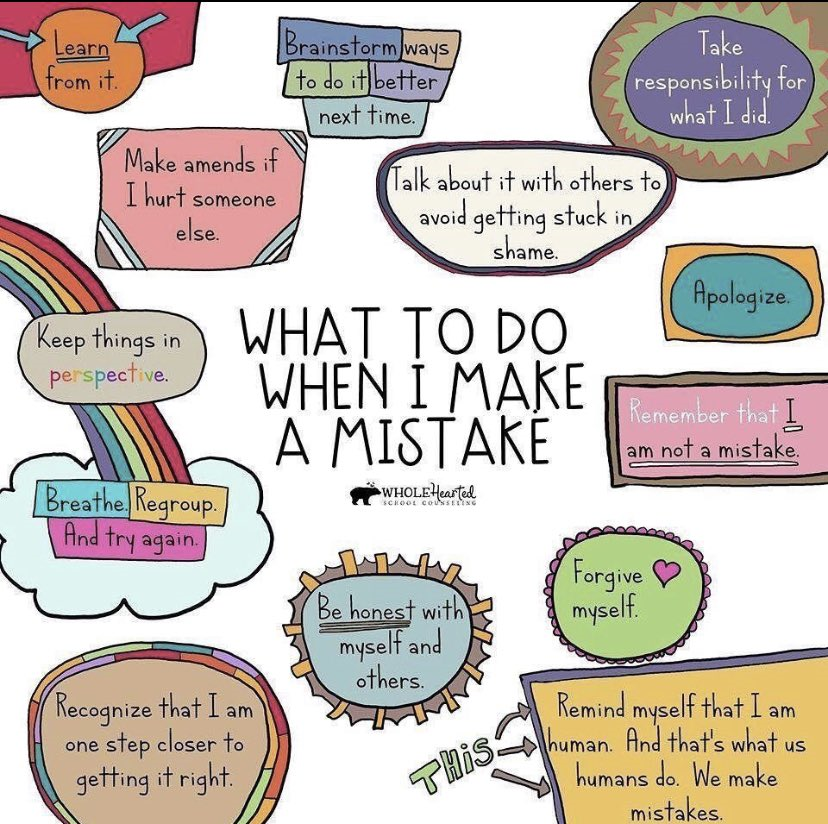
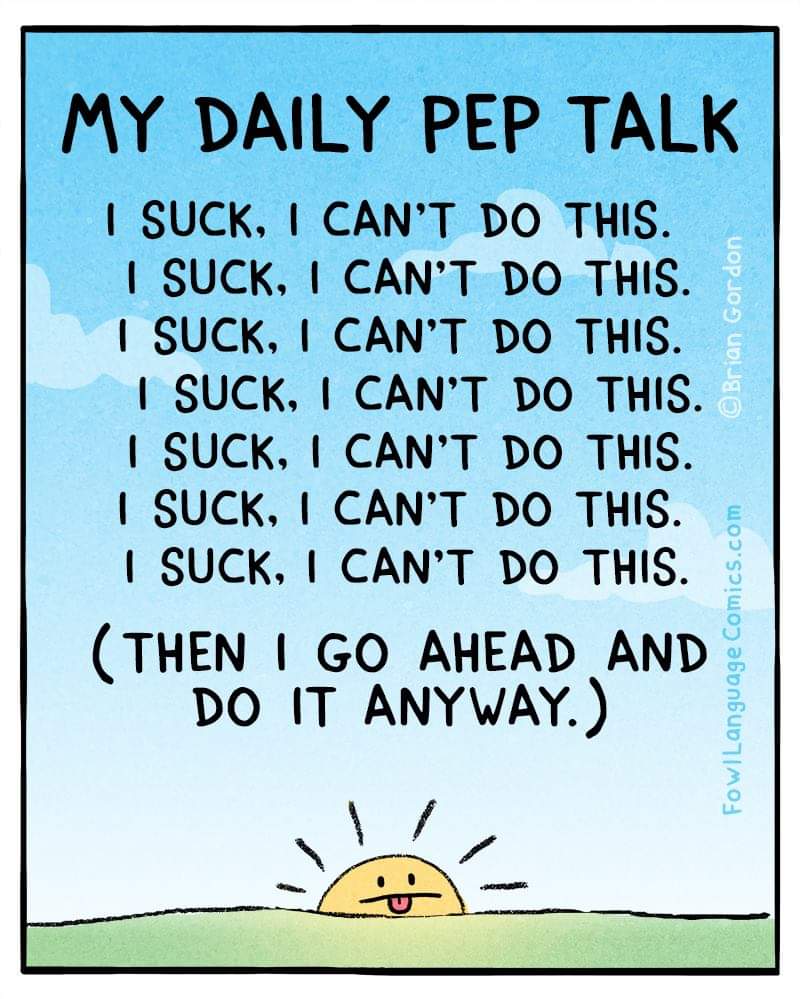
No one really talks about it but we all fail, I fail all the time. Now sometimes those failures are big and sometimes they are small and minor, like not having a conversation well. I wasted a lot of time at the start of my training by trying to be perfect and as a consequence I feel I didn’t maximise the learning in those first few years. If I discovered an error I quickly (and safely) corrected it, but I had such anxiety over it I didn’t really reflect on it, I wanted to fix it and move on. I also (apart from safety reporting) didn’t really talk about it with my supervisor. This meant that the team as a whole missed out on learning from system based failures. If mistakes happen, especially serious errors, they tend to be compound events linked to multiple failures along a pathway. The best way to avoid these errors to identify the weak points in the system when minor issues occur singly, so it reduces the chance of a compound failure later on. Long and short, don’t be afraid of failure, focus on learning from it and know we are all in this together.

There are no stupid questions

I love people that ask questions, it makes me think, it makes me remember why I’ve made decisions and assess if they are still relevant. When I started out I was worried that asking questions would just demonstrate my ignorance, and at the start of my training I was concerned about what people thought about me coming in as a non microbiologist and being behind everyone else. It takes courage to ask questions and be part of the discussion. As a trainer it is very difficult to evaluate whether you are covering knowledge gaps or pitching what you are doing correctly if the dialogue is one way. As your confidence grows it is also good to question and challenge, there are many different ways of doing things and only by having dialogue can you really understand why certain decisions get made under some circumstances and not in others. If you are an introvert and not comfortable asking questions openly, make notes, email and discuss your findings, find a way that works for you and work for your mentor.

Make copious notes

You will be given a LOT of information when you start, well to be honest all the way through your training, but the start can present information overload. When I look back at my notes from the first week of my training I obviously didn’t know what some of the words meant, let alone the context. By taking copious notes throughout however it meant that once I had found my feet I could review those notes and gain new information I was unable to take in the first time. By reviewing notes when you come back to something, after a break or rotation else where, you will be able to make connections which may not have been obvious to you the first time around. It will also enable you to ask questions better (see above) and have more enriched meetings with you mentor/trainer/supervisor as you will have access to specifics. Not only that but it will mean that you demonstrate attention and will enable you to ask questions that add to your experience. Plus when you look back at your notes from 10 years ago it will make your realise how far you’ve come and how much you have achieved!

Be the master of your own destiny

Every trainee/student is different. Hopefully you will get a supervisor who will have the time to help you reflect on your learning needs, but you need to also be able to develop the skills to do this yourself as you won’t always have access to someone to do it with you. Most training programmes are quite structured but there are always many different ways to deliver on the same learning outcomes. This is a career and every career journey is personal, so the sooner you can get into the habit of thinking about what your strengths and weaknesses are, and what your specialist areas of interest could be, the more you will get out of any opportunities you are offered. Within academia and the NHS you will often not be offered opportunities on a plate, but if you know what you want and find the opportunity out, you will very rarely get blocked from accessing them. Start thinking early about what could enrich your training and find ways to access those experiences.

Sadly this is not a 9-5 but you can do this and have a life

I’ve sat in a lot of lectures from very senior people who talk to trainees about clinical and academic work not being 9 – 5, it’s true but in many ways this saddens me. It gets spoken about as if you can’t have a life, you either choose devotion to this vocation or it isn’t for you. There will definitely be points where you have to commit more than the standard hours, exam revision, dissertation writing etc, but this shouldn’t be all the time. I encourage my guys to take on extra curricula activities such as STEM engagement, which often happen on the weekend, but this is a few times a year. Training shouldn’t be about burn out. To fully learn and develop it is crucial to have mental space to reflect and recovery time. You need to early on find strategies that work for you to manage your time. Do you want to block out every Friday afternoon for paper reading? If you do need to put in some extra hours would you rather do it at your desk to maintain work home separation, or work on the sofa. Be aware early of working to manage stress rather than to manage task and develop strategies to enable yourself to walk away and unwind (my trainees and students will be laughing at the hypocrisy of me writing this line, but do as I say not do as I do, I too am constantly learning).

Have a plan for what’s next

3 years feels like a long time when you start but it’s not really. Before you know, it will be 18 months in and you will need to start thinking about what the next stage of your career may look like. As part of your progress it is therefore important to make sure you regularly check in with yourself about what you’ve enjoyed and you’re aspirations to make sure you’re on track for the career you want. The more you do this, the more you will be able to mould your training around the experiences and networks you will need to help you succeed. A lot of us fall into career choices, but if you can be deliberate it will help you find happiness as well as success.

Reach out and connect

It’s not what you know but who you know. This isn’t entirely correct, but finding opportunities often depends on knowing the people who are making them or have access to them. This is often difficult when you are starting out in a new field or career as you don’t know who people are in order to hear about things. This goes for job posts as well as learning and accessing skills. There are now some ways where you can do this on your own, such as social media, which are less reliant on introductions – join us on Twitter. However this is where extra curricula’s can really help. Join your professional body, find a trainee network, engage in patient and public engagement, go for coffee with your fellow trainees and PhD students. Relationships and connections forged now will pay dividends later and are worth the investment, even if you are busy with other things.

Enjoy the ride

I was so focused on the end goal that I didn’t enjoy the journey as much as I should have. I spent 17 years focussed on making consultant, ticking boxes along the way like PhD and FRCPath, that I didn’t live in the moment. I was always focussed on the next step, the next target and so I didn’t enjoy the freedom that my training presented me with. Being supernumerary only occurs early in your career and gives you a freedom to make decisions and enjoy experiences you just won’t get later on. Learning is your focus right now, free of the demands of the inbox, meetings and other peoples agendas. Make sure you relish every moment as you will have less and less time to just enjoy learning as your career progresses.

All opinions on this blog are my own

If you would like more tips and advice linked to your PhD journey then the first every Girlymicrobiologist book is here to help!

This book goes beyond the typical academic handbook, acknowledging the unique challenges and triumphs faced by PhD students and offering relatable, real-world advice to help you:

  • Master the art of effective research and time management to stay organized and on track.
  • Build a supportive network of peers, mentors, and supervisors to overcome challenges and foster collaboration.
  • Maintain a healthy work-life balance by prioritizing self-care and avoiding burnout.
  • Embrace the unexpected and view setbacks as opportunities for growth and innovation.
  • Navigate the complexities of academia with confidence and build a strong professional network

This book starts at the very beginning, with why you might want to do a PhD, how you might decide what route to PhD is right for you, and what a successful application might look like.

It then takes you through your PhD journey, year by year, with tips about how to approach and succeed during significant moments, such as attending your first conference, or writing your first academic paper.

Finally, you will discover what other skills you need to develop during your PhD to give you the best route to success after your viva. All of this supported by links to activities on The Girlymicrobiologist blog, to help you with practical exercises in order to apply what you have learned.

Take a look on Amazon to find out more

Fulfilling A Promise: Why we need to talk about whether we are actually delivering on patient centred care

Warning – This is a long one and I’m not even a little bit sorry as I think we need to talk about this

Lets get this bit but out of the way first. I don’t believe that any of us for one second mean to provide anything less than the best care we are empowered to give. I do however believe that there are a couple of key components that may mean that we don’t always provide the care we aspire to. In my head there are three key reasons behind this:

  • Empowered to give is the key phrase here. Are we supported in delivering the best care? Do we have the right staff, equipment, training etc?
  • Does the organisational culture support delivery of patient centred care, in terms of high level decision making, expectation setting and provision to challenge?
  • Are we as individuals aware of the behavioural patterns we fall into during times of stress i.e. if we trained during a hierarchical medical era is this where we shift to in our practice in times of psychological challenge, such as a pandemic?

This post isn’t a criticism of individuals or centres, but it is a challenge to ensure we are thinking and questioning as part of our everyday practice. An encouragement to question whether we are providing the best in patient care, or at least actively identifying areas where the system has fallen down. We can only improve if we question, question ourselves, the situation and the system.

So why am I posting this now?

I’ve had more to do with being on the other side of healthcare than I’d like over the last three weeks. The outcome was pretty dire and I made a promise to the amazing person who was the patient that I would use whatever influence I have to remind people that we get the principles of person centred care wrong it is the patient that suffers. In my case it meant that the patient suffered loss of dignity and the final weeks of their life without the support of family and friends.

I work in paediatrics and I must admit I had fallen into the trap myself of thinking that every world was like my world, not that I’m claiming my world is perfect. Paediatrics is however more family focussed by it’s very nature as we need families to support us in providing care. We also need to listen differently as many of our patients can’t articulate their clinical condition and so the input of non verbals and families into their care is especially important. My sojourn in the world of adult healthcare was therefore a considerable shock to my system and has left me both reeling and questioning my own practice.

Impacts on dignity and right to choose

The NHS Constitution clearly sets out key principles that we should be using in all of out interactions, with each other and with our patients. These include clear statements on respect and dignity. For us really to fulfil this pledge though we need to hear what patients are saying to us.

For example, if as part of a patients’ care they are experiencing loose stools and they are not supported to access the bathroom, and instead left lying in a contaminated bed, they will not only be at increased risk of infection (from the femoral line they have in), but they are also likely to become less compliant with their care in general. Are we under these circumstances really demonstrating through our actions that we care for the patient in front of us?

As healthcare professionals we are often a bit non-plussed about faecal contamination, for those not in our world however we need to remember that to many individuals this is a humiliating event. If we compound scenarios like this with not explaining why medically we are making it worse by adding in medication, such as laxatives, which make the situation more likely to reoccur, then are we really thinking about how we are impacting on patients psychological health, or undertaking holistic healthcare?

Is this really seeing patients as equal participants in their care choices if we aren’t giving them the information to inform those judgements?

Too often we make decisions based on our knowledge and do not engage with the patients and families in front of us in order to support their engagement with their own care. How often do we ask them what matters to them? Only by asking this question can we establish what dignity and the right to choose really means for the patient impacted.

Importance of communication assumptions about levels of understanding

Communication is especially important right now. Due to the pandemic patients are frequently isolated from support mechanisms. This lack of support may mean they don’t challenge their care, it also means if that challenge is unheard that they don’t necessarily have access to escalation procedures, or even worse access to sign posting about what to do next. They are effectively in a very lonely bubble, with the only people to support them a bunch of strangers who may or may not have the time to develop connections or truly support.

When I was finally allowed to visit the healthcare centre (a story for the next section) not a single person, apart from the palliative care team, introduced themselves until the last day when to be honest it all felt too late. Not one ‘hello my name is’, not one explanation to the person before them or us their family as to why they were there and what they were doing. Because of my job I felt like I could explain things and to ask the questions that needed asking, but most people do not have a healthcare professional as part of their family. This was apparently the way the whole episode of care had occurred. I thought we had come so far in terms of not just seeing patients as anatomy and conditions, but this just showed me how wrong I was. On the day of his death everyone was brilliant, supportive and demonstrated amazing communication skills (apart from the medics who didn’t even come in) but the impact of those skills would have been so much greater if used when someone was able to respond and participate.

The Palliative Care and Support team came to visit on the day before he died. They said ‘hello my name is’, they didn’t however explain what palliative care was or even really check my family knew what the reality of that visit meant. When I spoke to my family after they had gone they were shocked when I explained. We have to remember that not everyone lives in a world where those words have meaning, we need to stop hiding between titles as barriers and truly check that what we believe has been heard is actually what was received. The other extreme is the ‘infantilising nature of healthcare’ where we assume that people don’t have the knowledge and capacity to be involved in their care or decision making. It takes time to get a feel for the level of a patients engagement/understanding and pitch your content appropriately. Some patients have a considerable amount of knowledge about their own condition, but whatever their level of knowledge we should be talking to people at the level that is appropriate for them, not what is appropriate for us.

Long and short is that I’m saying how we communicate matters, not just what we communicate, and that we should all spend time (me included) reflecting on how we do this in practice. I’m as guilty as anyone for rushing in, delivering the information in my head and then rushing onto the next task, but is that what is actually needed of me? Take the time to get patients names right, learn who they are not just the reason for admission, and make sure we communicate in a way that works for them.

See the source image

Who are we making COVID-19 decisions for?

The hospital in which all this occurred has banned all visiting because of COVID-19. Not only that, they had removed all entertainment centres, and thus a big means of distraction, for all patients. This may seem really trivial, what does it matter if someone can’t watch TV. It matters because England got to the European final and football, as trivial as it may seem, is super significant in some peoples identities. Dying without being able to engage in one of the few seminal moments you are still able to experience is significant. It matters because if you have unexpectedly found out you have only weeks to live and you have no visitation to provide support then distraction is probably one of the few things that may aid you processing that information.

The same hospital that banned visiting had less than 20% of the staff on the ward wearing masks. If a patient is in a cubicle I can see no barrier to visitation from an IPC perspective, just get them to wear a mask. If we are insisting on banning visitation in order to prevent in-patient acquisition then staff need to be also protecting their patients. If staff are not wearing masks and protecting their patients then I question what is the point in banning visitation? Who are we protecting? What is the purpose of this policy that leaves someone at the worst time of their lives alone without support?

Visitation was allowed during end of life care. Sadly end of life care wasn’t from the moment they said you were going to face a life limiting condition, it was for the hours/days where death could be imminent. Sadly it is during these times when the patient themselves becomes less cognisant of their surroundings. It is beyond the time when you can have conversations about wills, final wishes, funeral arrangements. It is passed the time you can have most impact in terms of psychological support. Visitation also involved battling every day at reception for the password to be permitted to visit. Battling because no one had ever put the name in the book that allowed them to issue it. Delaying by 15 to 30 minutes when you would get to the ward. Extending a period of incredible stress as you wouldn’t know what you might find. All because no one had filled in a form. I of all people understand how busy everyone is and that it seems like a minor thing, but I can tell you as the person who uncharacteristically could have screamed at a stranger in those moments, a minor thing for us can have significant consequences for others.

So after this outpouring which I’m hoping will make us all think, what do I believe that we should be doing differently, myself included:

  • Make every conversation and encounter matter. Think about what you are delivering and how it has been received, has it been understood? Have we really listened to the response rather than just delivered information?
  • Even during a pandemic patients are more than their conditions. Against their will they are living in our world. A world that they don’t necessarily understand the rules or the language of. We are their translators, a key role that we need to understand we fulfil. Simple things like explaining our roles can make all the difference.
  • Challenge where needed systems and processes that don’t feel like they are supporting patient centred care. Sometimes the people making the rule/policy will not understand the true impact of it unless they get the feedback about it’s impact. We all need to be part of the change.
  • Take the time. Understand how you react to stress and how that response impacts on your practice. It’s hard to reflect on our practice right now but it’s rarely been needed more.

All opinion on this blog are my own

Just One More Sleep: Why ‘Freedom Day’ doesn’t feel like Christmas to those in infection prevention

Working in Infection Prevention and Control is basically about assessing risk. It’s pretty much what I do, what I eat and breath. So today I wanted to post (with that in mind) why I’m tired to the core of my being when I hear the joyful proclamations about the 19th July and so called Freedom Day, and it’s not just me others are definitely feeling it too.

This doesn’t mean that I don’t understand the strong urge to ‘get back to normal’. This is a very human trait. We all like to feel in control and this has been a prolonged period of high stress and uncertainty. I suppose my frustration is with the failure to really communicate that normality comes with a cost. It will likely bring economic benefits but it will cost some people their lives and NHS workers just a little bit more of their sanity. If as a society we agreed that the economics were worth it I would grudgingly keep my mouth shut but we’re not even having the conversation. There is no such thing as a free lunch and at the moment society is passing me the bill when I’m not sure I’ve brought my wallet.

It’s All About the Shades of Grey

For cognitive comfort we tend to feel comfortable seeing the world in black and white. The reality is (as with most things) that the world and decisions are made up of shades of grey. It is possible to live in a world where we are neither in complete lock down nor where everything is effectively considered back to normal and presenting increased risk.

When I’m dealing with an outbreak in a hospital setting (I acknowledge the situations aren’t identical) I bring in a series of measures to find the source and stop transmission. Often because of the risk to patients and staff you do all these things at the same time, in order to maximise your risk reduction. Then once you have identified the source and stopped further cases being identified you gradually reduce your measures.

You do your intervention reductions in this way for a number of reasons:

  • You often don’t know what is having the greatest impact so a step wise reduction enables you to learn more about how you might control a similar outbreak better in the future. You will know which interventions are most important.
  • Reducing your measures one at a time enables you to continue to monitor your cases. If they come back you know you need to maintain that intervention for longer and maybe step down others with a lesser impact first.
  • It tells you more about whether you have effectively dealt with your source without putting large amounts of people at risk again.
  • It stops you going all the way back to square one if you aren’t where you thought you were. You’ve worked hard to get things under control, so you don’t want to return to where you have an escalating scenario.

Stopping basically all of your public health measures in one go, masking, social distancing, most contact isolation etc without taking a staggered approach means that not only are you rolling the dice on your main intervention (vaccination) working in isolation, but also you are failing to gather the information you need to support staggered reintroduction of key control measures moving forward if it doesn’t.

Risk Assessment and Personal Choice

One of the things that has really struck me is that we are moving from a place where that risk assessment and risk reduction is guided at national level to personal assessment.

In many ways there is nothing fundamentally wrong with personal risk assessment. We ask healthcare staff to do this in clinical situations on a daily basis. What do I mean when I’m talking about personal risk assessment. In healthcare it could be something like: You are going in to take blood from a 4 year old child. Before you go into the room you might gather the following information in order to assess the risk and take steps to reduce it:

  • Is the child on its own?
  • Do they react badly to needles – are they scared?
  • Do you know the child? Do you have a relationship where they are more likely to trust you?
  • Do you have safety needles available to reduce the risk of a sharps injury?

The difference with the government approach to risk assessment and personal responsibility is that we are asking people to do this who are:

  • not necessarily used to undertaking this kind of assessment in relation to infection
  • not necessarily accessing the information/evidence to enable them to make such an assessment

It is hard enough working your way through the information and evidence that is related to SARS CoV2 even if it is your job. We are asking the entire of England to be able to do this with little or no support. The quality of information out there is highly variable and often not context specific to make it particularly usable. There is plenty of misinformation out there which could lead to individuals with the best of intentions making bad decisions.

Mixed Messages

This then brings me onto the mixed messages. The government is telling people to use the evidence to make their own risk assessments and then supporting events that are contrary to a lot of the information we are saying is important in making those risk assessments.

The evidence still shows that masks will be important in confined spaces or in areas with high people density. We are at the same time encourage events where people in their thousands meet without those measures included. You can say that the research events are there so you could obtain data to improve future measures and risk assessments, although when only 15% of those attending complete the post event testing the outcomes become dubious. Outside of the research events however, large numbers of people are gathering in public settings, such as Trafalgar and Leicester Square, with no testing or monitoring. These events cannot be said to support the same goal.

It is not rocket science that combining alcohol and emotion can lead to the abandonment of key sections of the risk assessment process.

One of the other things we need to talk about is that personal risk assessments are fine, but in this particular circumstance your risk assessment and behaviour directly also impacts my risk. Mask wearing is about protecting others, so if you opt out of wearing a mask and I wear mine, I bear the brunt of your decision.

We are also not talking enough about how the knowledge linked to vaccination may impact on risk assessment. I know a lot of people who feel like SARS CoV2 doesn’t impact on them any more because they are double vaccinated. In healthcare we are seeing a lot of people who are still getting pretty unwell despite their vaccination status. They are not hospital unwell, but they are still pretty unwell, can’t get off the sofa unwell. They are also still able to pass on the virus to others in their household, at work, or elsewhere. Some of the people then exposed will not be able to have the vaccine, such as children or those with certain underlying conditions. They can therefore still get very sick. Again, the transmitter may not experience such extreme personal consequences but they can cause them for others.

The government messaging doesn’t strongly support prevention of harm to others. Personal choice makes it sound all about the person. A pandemic response however is about as much of a group effort as you can imagine mounting. Personal choice undermines all of what we have been trying to message and removes that shared responsibility.

If we are truly serious about supporting individuals to make their own risk assessments then we need to do a much better job of giving them a framework and high quality information in order to make it. We also need them to understand the consequences of making an incorrect risk assessment. I have no answers on this one, just anxiety and fear about where the current approach is leading us.

All opinions in this blog are my own

What It’s Like To Know Too Much (Whilst Still Not Enough): The Difficulties of Having Health Conversations Outside of Your Day Job

This week’s post is about some of the challenges of having healthcare conversations when not in a work context. With increasing frequency I get asked to give medical advice and guidance in social settings, often indirectly: i.e. being asked not by the affected individual. When I’m talking about conversations today I’m not talking about the ‘I’ve been prescribed X antibiotic what does it do?’ queries. These kind of queries are about giving information and signposting, rather than diagnosis or critical review. The conversations I’m talking about here are the, ‘my aunt has just been diagnosed with pancreatic cancer, can I send you her biopsy picture?’ type of dialogue. I’m writing this because sometimes, when I back out of these more significant conversations, I worry that it can come across as showing a lack of interest or as being callous and uncaring. The opposite is true, but there are constraints as to how much I can become involved. And some very good reasons why it might be inappropriate… I thought it might be good to share.

First things first. I’m not a medical doctor, I’m a Healthcare Scientist with a PhD and the same post-graduate qualifications as my medical microbiology colleagues. This means that I am qualified to give advice within specific confines linked to infection and infection control. I do not, however, have their broad breadth of experience or – therefore – associated expertise outside of this area. I think it’s really important to be aware of professional boundaries. That said, compared to many members of the public and due to working in infection control (which sits across subject areas), I have an awareness of healthcare linked to a number of disciplines. I thought it was important to write this here because I think if you work in healthcare this delineation is taken for granted. We often forget it’s not as clear to those who don’t.

Are You Talking to Dream or Dr Cloutman-Green?

Many of you who read this blog regularly will know I go by four main names. My friends have called me Dream since I was a teenager, as I was always day-dreaming and walking into things. I get called Elaine by work colleagues and, when I’m in trouble, by my family. My brother and sister have always called me Laney when they are not mad at me. Then there is Dr Cloutman-Green, who you’ll meet in a professional context.

Now I’m no Beyonce/Sasha Fierce, but I do think that there is some context-specific nature to the way I engage with the outside world. I try to be authentically me no matter what context you engage me in, but Dream isn’t the same as Dr Cloutman-Green. Dream drinks shots, enjoys trashy TV and has been known to dance on the odd table. Dr Cloutman-Green deals with making significant and serious decisions all day, everyday, and so has to deal with a fair amount of pressure and stress. As Dream, I do my best to leave that at the door when I come home. It is always quite jarring when Dream gets asked questions and is involved in conversations that are in Dr Cloutman-Green territory.

How Much do You Really Want to Know?

The main issue with Dream having conversations that would normally be had by Dr Cloutman-Green is that Dr Cloutman-Green has access to all kinds of information and resources that Dream doesn’t. Examples of these are when you get called up by a friend or relative asking if they can send you photos/tell you about a friends medical condition. One of the cornerstones of professional practice is understanding when you don’t have all the information and when you are stepping outside the scope of your experience. If I have those encounters in my day job, I have access to medical records, expert colleagues, test results and the ability to recommend follow up investigations. As Dream I have access to none of those things, as well as second hand information given by someone else without knowledge of individual consent.

The other reason that these conversations can be challenging is that you may be aware of the potential serious outcomes of the information you are being given for the individual without the information to determine likelihood. For instance, I am aware of poor outcomes associated with certain cancers. If the person involved has not been prepared for that conversation by their medical professional, or if the conversation has happened and they have not been able to process. Is it appropriate for me to wade in, unaware of the complete story, in what is the professional remit of another healthcare professional?

Finally, if the news is not good there is a reason that these conversations are undertaken by a healthcare professional with some distance from the situation, rather than your friend/relative. Emotions can be targeted, whether justified or not, at the person delivering the news. There is a reason we talk about ‘don’t shoot the messenger’ and ‘being the bearer of bad tidings’. Being involved in these conversations, whilst not being so involved as to have all the information, can result in permanently changed relationships on both sides. It strikes me that in these circumstances I should mostly be there to signpost and support as a friend, not acting as their medical professional.

Having laid out my rationale you would have thought it would be fairly simple to keep these worlds siloed, but it isn’t. These conversations are often sudden or sprung in unusual situations where you’re not expecting them and, therefore, take time to adapt and respond to. Hence the fear of coming across as distant.

But I Thought I Was Just Here to Party?

Stepping away from the more serious conversations, there is just one more setting where I find this topic difficult:

The Art Of Parties.

Now I work in a paediatric setting and so, understandably, many people want to talk to me about paediatric infections. That sits well within my ball park of expertise. There have been occasions, however, that despite this, and the situation not requiring serious conversations, I’ve not wanted to engage. I was once invited to a party (it was supposed to be child free) and when I arrived, apart from my husband and I, everyone there was a family unit with kids in tow. That’s fine – I’m OK with that. As the afternoon/evening progressed, however, I became progressively less happy. I was basically on a conversation carousel of parents who wanted to talk about herbal remedies for their kids cold, whether the fact that their child had had three colds that year warranted paediatric referral, or whether vaccination X should wait because of their trip to Y. After 6 hours I had managed not a single Dream conversation. Nothing on a non-healthcare subject. Not one conversation about movies, books, geekery or the things I enjoy talking about outside of work. Not only that, but because I kept being pulled into these conversations, I felt less and less like I was at a party and more and more like I was work.

When all is said and done, I expect to talk and love talking about science, medicine and my day job. After all, I have the best job in the world. There are just also times when I need to talk about things that aren’t linked to these. I struggle with small talk and therefore really don’t help myself as sometimes (well quite often) my work is all-encompassing. It is therefore frequently my own fault and actually just a way that people use to try and connect with me. It’s something I need to work on. If we do meet in a social setting though, please talk to me about tea, cake, your favourite novel/film/TV show and help me be Dream/Elaine rather than Dr Cloutman-Green. I’m keen to know more about you.

Also, if we meet and you do want a serious health-based conversation, understand that, if I don’t fully engage, it’s not because I don’t care about you. It’s because I care about you enough that I want you to have medical advice from the person who has access to all the information and resources to take the best care of you, your healthcare professional. Also know its because I value you and our relationship enough that I don’t want to risk it being damaged by changing the context of that relationship to something that should be more distant and professionally limited. I’m still here for you, and I still want to support and signpost, but let me be your friend rather than your Dr.

All opinions on this blog are my own
Talking About the Taboos: My Journey to being an ‘Obstinate Headstrong Girl’ Whilst Working in Science

I’ve had a few encounters recently that have led me to write this blog. I’m not writing it as an expert; This isn’t anywhere near my field. I’m writing to share my experiences and learning in case it helps others. Apologies, as it’s not a short read.

I’m challenged by some people I that I’m too worried about raising the profile of women in science, of talking too much about ‘female’ issues, and of challenging my colleagues too frequently. A really respected mentor once said to me that he didn’t think actions against women in the workplace still happened. I shared some stories and pointed out that they still did, they just didn’t happen to him, where he could see them or when he was paying attention to them. I count myself lucky that nothing really serious has ever happened to me at work, but I shouldn’t have to count myself as lucky: they just shouldn’t happen.

I have another post brewing about everyday sexism in the workplace, but this one is different. This one is about why I set out becoming the ‘obstinate head strong girl’ that I aspire to be!

I finished my undergraduate degree in 2002 and spent a year working before returning to undertake an MRes. This was my first experience of full-time ‘proper’ work. I took a six month temp contract for a council, working in their business development office. It was a mostly male floor, supported by myself, two other part time admin staff (both female students) and a lovely older lady who managed the team. My job was to support the officers in tasks such as typing up letters. Yes, they wrote by hand as some of them still didn’t know how to use a computer; I also ran reception, took minutes, that kind of thing.

The Problem is that You are Too Friendly

I’d been there about a month when I was in the post/stationary room stamping that day’s mail. One of my older male colleagues came up behind me and stuck his erection in my back and grabbed my breasts. I stood there, stock still, in complete shock. I didn’t know what to do. These things didn’t happen to me: I was the nerdy girl not the pretty girl, I had no experience of how to handle this kind of breach (I am not implying that pretty girls should know, or have to put up with this either). After what felt like hours (but was more likely a few minutes) where he spoke to me about what we should do next, I shoved him away and ran out of the room.

I went to my boss, the person responsible for me, and told her what had happened. She said she would speak to her boss, who also happened to be the boss of everyone on the floor. I recovered from my shock and got angry whilst I waited, but I was sure there would be censure and we could all put this behind us. She came back and we talked. She explained to me that I was overtly-smiley and chatty with my colleagues. This could be misconstrued and, in future, I should probably just take steps to not be alone with the man that had done it. That was it. The married man with multiple children could do what he wished as it was my friendly demeanour that was the issue.

I spent the next four months being hyper-aware of when I could go into rooms on my own, to be friendly, but not too friendly. As my contract end-date rolled up, I experienced a similar repeat performance from the same individual. It wasn’t as bad this time as I had learned from the first event, but I just couldn’t let it go. What if he went further with someone else, what if he did it to someone else who wasn’t in the privileged position I was in to ‘let it go’. On my last week with the council I emailed HR directly to express my sadness over the way the situation had been handled. They told me to get a cab down and speak to them. I did. I recounted the event, the way it had been handled, the way I felt. The guy got suspended on full pay whilst an investigation was undertaken. I was called back in to repeatedly account for the event and my actions. It was determined that as it was my word against his nothing could be done. I learnt early that even when people listen, accountability is not always the result. No policy was changed. At least the guy had a note on his record in case he did it again so that it was no longer the ‘future girls’ word against his.

I’m ‘lucky’: that was the worse thing in a workplace that has ever happened to me. We all the know of the labs where you wouldn’t apply to work at because of the way the PI behaves, or the ‘expectations’ placed on the post docs if they want to advance. It didn’t interfere with my progression. It did, however, teach me an important lesson about the importance of bystanders. However annoying the bad behaviour of the individual was, the worse thing for me was that the people I trusted and who held responsibility for my safety at work chose to make it about me being too smiley, rather than address the action of the person who had breached barriers and made me feel unsafe. I swore that I would never be that bystander and I would support others so they would not feel as alone as I did in that workplace.

The Problem is that You Are Not Friendly Enough

Roll on some years and I’m now working as a scientist with a part-time academic contract. I’ve learnt the lesson taught to me about not being too friendly, about boundaries at work, about always keeping it professional so my actions couldn’t be used against me. I’m working as the only microbiologist on a research project. The PI on the grant begins to spend a lot of time with the other female researcher. Late night drinks, wine in the office, that kind of thing. I stick to my guns about being valued for what I can add to a project: that doesn’t require me to be available to have drinks with the boss at 9pm. Suddenly, protocols are written that are not technically appropriate, papers are written without a standard authorship order, and presentations and conference trips are handed on the basis of time spent with the PI. When queries and issues are raised, I’m now told that I’m not committed enough, not friendly enough, I’ve not invested enough in building relationships outside of work structures. Unlike before, my future is impacted because I have not walked the tightrope of being approachable well enough. The difference this time is that, although I cried, I simultaneously empowered myself to leave by looking for funding to support an exit. Again, I was fortunate enough to have a way out, to be a clinical academic rather than academia being my only option. I had also started to learn the power of finding my tribe, and making sure that I always had support from other embedded around me. This enabled constructive challenge of my perceptions, but also assurance when things went awry.

Why are you Reacting to Such Little Things? It’s only people being friendly/joking

I’ve now been working as a scientist for 17 years. Issues crop up less frequently the higher you climb up the ladder. However, when they do they always feel like high stakes. I’m no longer in a position where I could easily find another post, co-applicants on grants are harder to switch around as the world we inhabit is small, and relationship building is a key part of my role. So do things still happen?

Sadly, the answer is yes. The thing that makes the incidents happening now worse, in many ways, is that they get laughed off as being linked to me being overly sensitive. I still try to embody the friendly girl I was at 22 without opening myself up to unwelcome physical acts at work. I have, however, on 3 occasions being kissed full on on the mouth in unsolicited encounters with male members of staff. None of it threatening, like when I was in my first job, but still unwelcome. Blocked doorways that, as you’ve tried to go through, have resulted in a facial assault because ‘its Christmas’ or because it’s someone’s ‘last day and they just want to say thank you’. I’m by no means prudish but the only person who gets to kiss me on the mouth is my husband! Uninvited physical intimacy is just not OK. It always comes as a shock and it always takes me back to being a 20 year old with no coping mechanisms standing in a post room.

What happens most frequently however are the comments. Just before the pandemic I was in Paris at an academic meeting. The organiser forgot to book my second night in the hotel. I’m sitting there in a room full of senior male academics at the dinner when the organiser came through and said I had no room. The most senior man in the room responded by saying ‘don’t worry about booking her in the extra night, we’re in Paris, there are more than enough brothels where she could go and work in’. Every man in that room laughed. No one called him out, no one indicated that the comment was humiliating and inappropriate. I didn’t know what to say and so sat there in silence as they laughed away. This isn’t a one-off event. The ‘little ladies’, ‘sweethearts’ etc. may feel innocuous enough but are too frequently used in conversations to undermine women in the room. That’s not to say I’m anti-endearment. I have plenty of colleagues where we have built up relationships over the time where I welcome this reinforcement of our relationship. It is different to do it when your relationship capital doesn’t justify it, or when you are doing it in order to enforce power or hierarchy.

So why have I written this post? I want to let people know that these behaviours happen. It’s unwelcome and it’s not up to the women involved to modify who they are in order to not tempt others to behave badly.

Here, therefore, are a few of my thoughts about how we can all act differently:

  • Don’t be a bystander! Know that if you are in the room you have a duty to act as the impacted individual may not be in a position to do so.
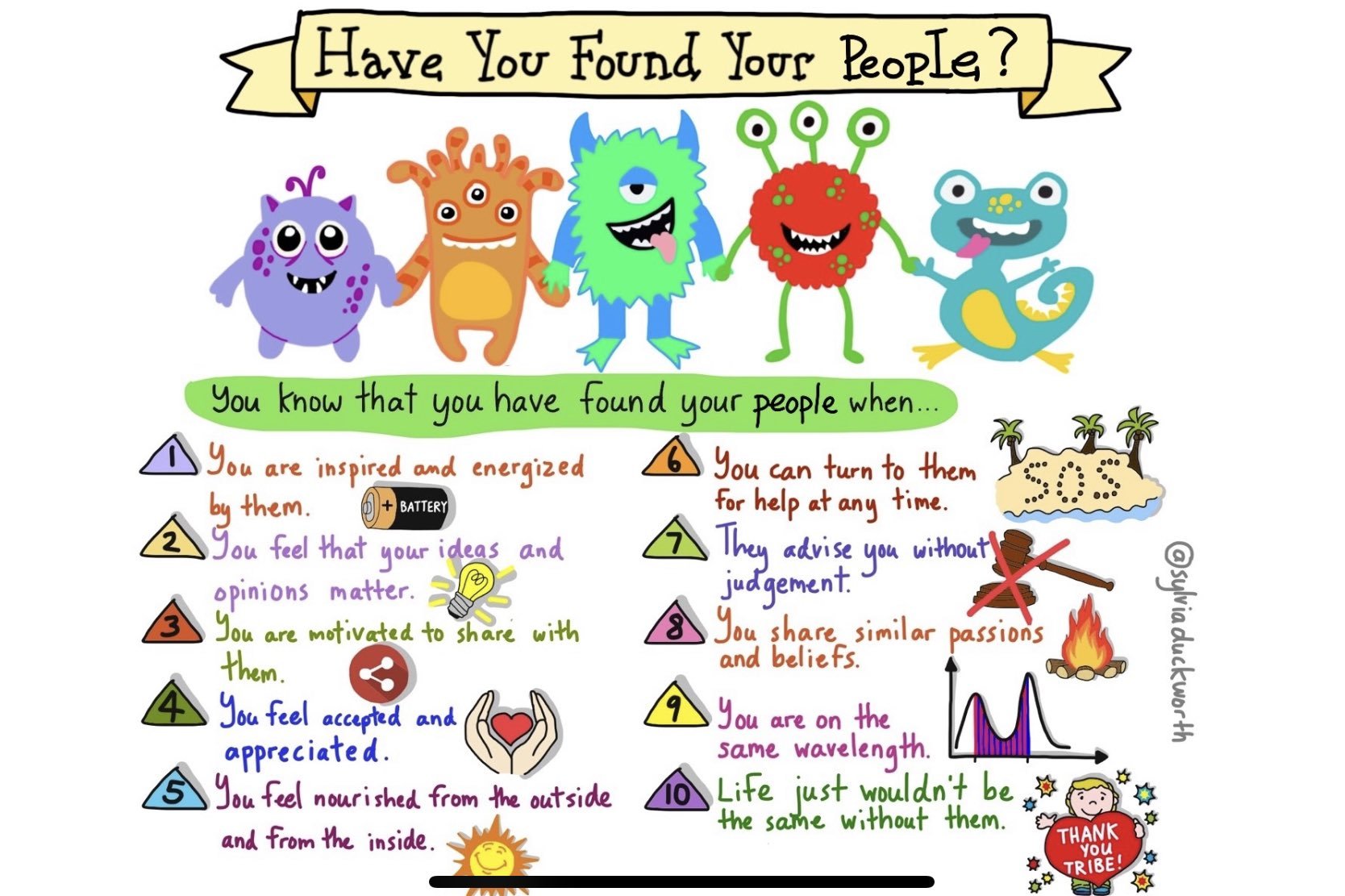
  • Find your tribe so you have support for when (and hopefully if) these events occur.
  • Talk about your experiences so that we can raise awareness, share learning, lead improvements and, most importantly, so others don’t feel alone.
  • Know that you have more power than you feel like you do. There are people out there who are ready, willing, and able to support you.
  • If someone comes to you with their story remember that you have a duty of care. Don’t brush things under the carpet because it is easier to do nothing than deal with a situation.

Finally, to all my obstinate headstrong women out there who are standing up and challenging, I applaud you. I appreciate all you are doing now, I appreciate the fact that you are leading the way and that you are members of my tribe. To all those who consider me difficult for calling out these situations when I see them, I understand why I make you uncomfortable, but I have no plans to change. In fact I plan to grow into this role more. In my opinion we could all do with a channelling a little Elizabeth Bennett from time to time.

All opinions in this blog are my own

If you would like more tips and advice linked to your PhD journey then the first every Girlymicrobiologist book is here to help!

This book goes beyond the typical academic handbook, acknowledging the unique challenges and triumphs faced by PhD students and offering relatable, real-world advice to help you:

  • Master the art of effective research and time management to stay organized and on track.
  • Build a supportive network of peers, mentors, and supervisors to overcome challenges and foster collaboration.
  • Maintain a healthy work-life balance by prioritizing self-care and avoiding burnout.
  • Embrace the unexpected and view setbacks as opportunities for growth and innovation.
  • Navigate the complexities of academia with confidence and build a strong professional network

This book starts at the very beginning, with why you might want to do a PhD, how you might decide what route to PhD is right for you, and what a successful application might look like.

It then takes you through your PhD journey, year by year, with tips about how to approach and succeed during significant moments, such as attending your first conference, or writing your first academic paper.

Finally, you will discover what other skills you need to develop during your PhD to give you the best route to success after your viva. All of this supported by links to activities on The Girlymicrobiologist blog, to help you with practical exercises in order to apply what you have learned.

Take a look on Amazon to find out more

What Is Antimicrobial Resistance and What Might It Mean for Me?

As the Rise of the Resistance Festival is happening this week, I’ve been talking to quite a lot of people about antimicrobial resistance. What has struck me is that something that has such a massive day-to-day impact on my working life hasn’t really made its way into the public consciousness just yet.

I thought I should take the opportunity to repost a blog I wrote in 2020 to talk about antimicrobial resistance, and why I think we should be working hard to talk about it more: in the pub with our friends, with our families over the summer, and with our patients and students.

Photo courtesy of Anthony De Souza

What Is Antimicrobial Resistance?

When I go into classrooms and speak to members of the public they sometimes think that antimicrobial resistance is when our bodies become ‘immune’ to antibiotics. This isn’t the case. When we talk about antimicrobial resistance or, for the rest of this blog post, antibiotic resistance (as I’m talking about bacteria) is when the individual bacteria are not affected by the antibiotic or it works less well (see my introduction to antibiotics post for a bit of background).

Antibiotics work in two main ways. They are either:

  • Bacteriostatic = inhibits the growth of bacteria.
  • Bactericidal = kills bacteria.

The way the antibiotic works against the bacteria can be linked to the way that the bacteria become resistant to the antibiotic. I’m going to do another blog post with some of the technical details of how this works and how we detect it, so bear with me for a couple of weeks. For this post, the main thing is to know that it is the bacteria that become resistant, not us, and that there are a number of different ways that this can happen:

  • Intrinsic resistance = the antibiotic will never work against that particular bacterial species because of the characteristics that species has. This includes things like Vancomycin not working against Gram negative bacteria as the molecule is so large.
  • Selective resistance = where a mixed population of resistant and sensitive bacteria are impacted by antibiotic use and the resistant ones survive and therefore become dominant.
  • Acquired resistance = where previously sensitive bacteria acquire the ability to resist the effect of an antibiotic, often through acquiring genes, which allow them to change the way they function or replicate.

What has antibiotic resistance got to do with me?

The Review of Antimicrobial Resistance (2016)

Levels of antibiotic resistant bacteria are being detected in increasing numbers in food (linked to farming), in the environment, and within humans: both in hospitals and in the community. It’s for these reasons (and others) that it has been modelled that more people will die linked to antimicrobial resistance than cancer by 2050. If, as a population, we have more resistant bacteria onboard as part of our normal flora, it is increasingly more difficult to treat us when we need it. It will also become increasingly more difficult to do ‘standard’ surgeries such as hip replacements, tonsillectomies etc. as these require us to give prophylactic antibiotics when in surgery in order to reduce infection risk. This means we may have to live with long-term conditions that currently we would surgically correct.

Most of us think about antibiotics as being something that we either give to really sick people in hospitals or a fairly harmless way to get back to our every day lives when we’re feeling unwell at home. In many ways that is true. Most of us will have had multiple courses of antibiotics during our life and have never given it much thought. Some women may have had the odd bout of thrush when they’ve taken antibiotics for a urinary tract infection and that is the closest they’ve seen to side effects. The case of a woman getting a fungal infection (thrush) because they’ve taken antibiotics that have wiped out the non-harmful colonising bacteria in their vagina is a pretty good example of exactly what can happen in less obvious sites when we take antibiotics. For example, there’s plenty of data that the use of antibiotics can impact on the bacteria in your gut, providing selective pressure and changing what the population of bacteria looks like. Usually this returns to normal over time. However, in a world where the bacteria we encounter are increasingly resistant, that return to normal could take longer; if they got out of the gut to another location due to surgery during that time they could be more difficult to treat.

Colonisation vs Infection

Most of the time, if we have resistant bacteria onboard we would never know. They are colonising us, just like our normal bacteria, and not causing us any harm. There’s good data to show now that when we travel abroad to countries with a high prevalence of antibiotic resistant bacteria in food or the environment, that we may exchange some of our sensitive bacteria for resistant ones. You’d never know, especially as when we get home they will usually be replaced again with sensitive versions. However, if you happen to get an infection whilst you have them onboard because you’ve had an accident on holiday, or you’ve travelled for medical care overseas, then the infection may be more difficult to treat.

It’s not just the antibiotics we use in humans that can make this situation worse. Antibiotics are used as growth promoters in farming. We use antibiotics to treat our pets. Because of how expensive and difficult antibiotics are to develop, we are not really developing new ones and so the pool of available antibiotics is getting smaller.

Because antibiotics are used in so many different ways in solving the issue of how to impact levels of antibiotics, resistance is complicated. It requires us to be able to diagnose and detect resistance faster, to work with drug companies in order to tackle the drug development pipeline, and to take a ‘One Health’ approach, looking at farming and veterinary approaches as well human.

So, what can I do?

  • Be aware that not all mild respiratory and other conditions require antibiotics. Many are viral and will improve with rest and hydration. Therefore, consider waiting before requesting a prescription for antibiotics.
  • If given a prescription, make sure you complete the course. Do not just stop because you start to feel better. Stopping early might mean that you have not completely treated the infection and the remaining bacteria can grow back and sometimes develop resistance.
  • Do not buy antibiotics when you are abroad in a country that permits an over-the-counter purchase.
  • Do not store antibiotics and use them at a later date. Neither should you use antibiotics that were prescribed for a family member or (and I know of people who have done this) a pet.
  • Think carefully about whether travelling abroad for healthcare is the right choice; make a risk assessment about where you are planning to travel.

If we want to continue to experience healthcare in it’s pre-COVID-19 form, we all need to work together to change the way we use antibiotics so that the modelling predictions do not come true

All opinions on this blog are my own

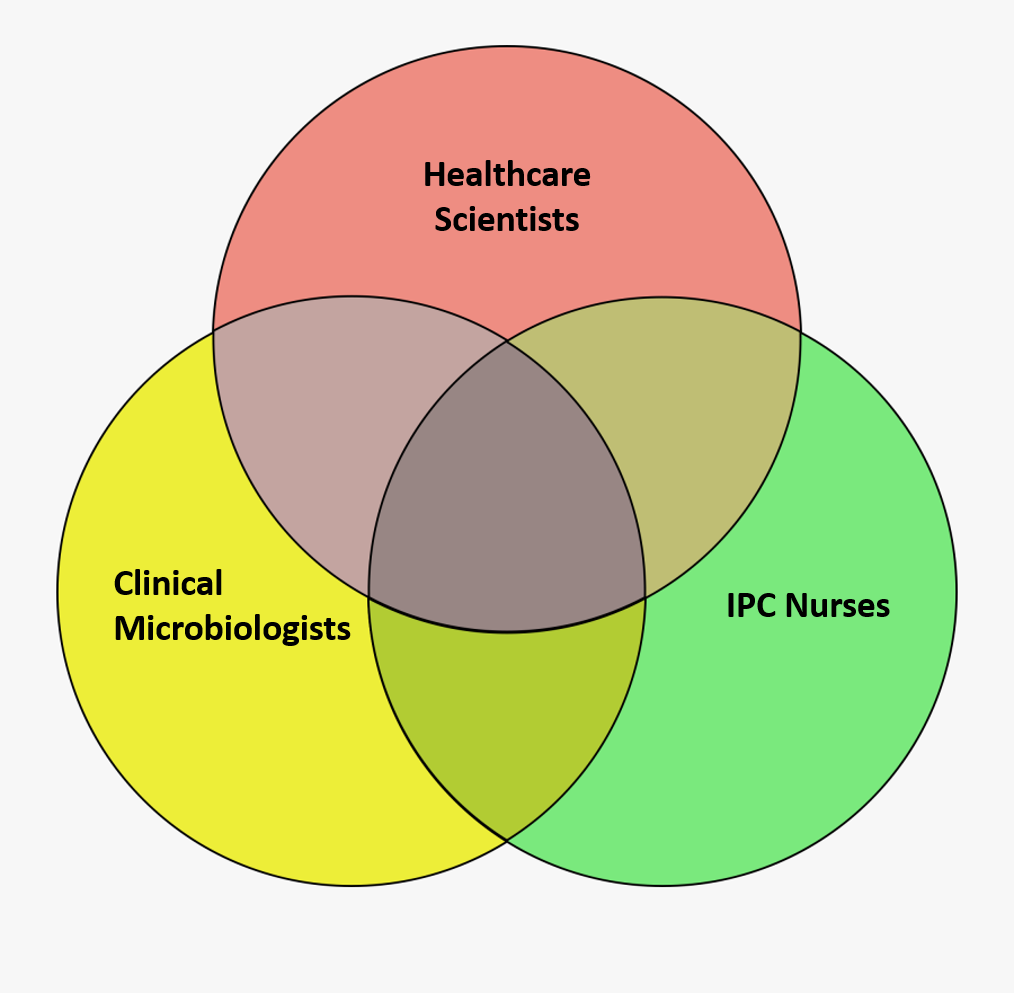
Greater Than the Sum of Its Parts? How Professional Diversity supports impact by Infection Prevention Teams

This blog is late. I make no apologies for that as last night was Eurovision, one of the highlights of my year. It’s been one hell of a week and so, in an attempt to find some work life balance, I had the evening off. Malta and Iceland were robbed (in my personal opinion), and I now firmly believe that all teams should have jumpers with the faces of the team upon them #bonding. Well, now that’s over with, onto the other thing that was on my mind this week.

I recorded a podcast with the wonderful Martin Kiernan for the Infection Matters podcast just over a week ago. The podcast series is on Spotify and definitely worth checking out if you have a moment (link below to the 1st episode). We had a chat about the role of Healthcare Scientists within Infection Prevention and Control (IPC) teams: a subject you may have noticed I’m pretty passionate about. Just being asked to have that conversation felt like an enormous step forward, in terms of recognition of the role and the benefits we can bring.

So, imagine my disappointment when last week I received a grant review which reminded me of just how far we have left to go…

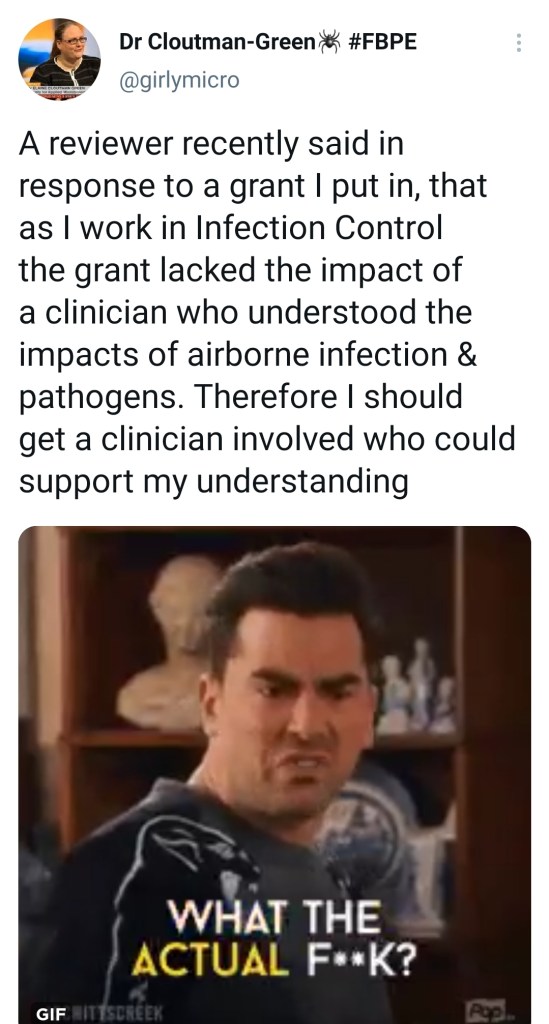
The grant was about the detection of bioaerosols in hospitals to support rapid IPC interventions and changes to patient management in regard to their infection/colonisation. The reviewer, a respiratory consultant, responded to the proposal to say that, as there was no medic on the proposal, the team could not possibly have an understanding of the risks associated with respiratory infection, and that one was needed for the grant to be funded. I must admit to being more than a little peeved by the response.

For context about what Healthcare Scientist career pathways look like in IPC, I have previously written a blog for the Healthcare Infection Society which might be useful. The main take away points for me are these:

  • I have the same post graduate qualifications as my medical colleagues (MSc Clinical Microbiology, Medical Microbiology part 1 and Medical Microbiology Part 2 by examination leading to Fellowship of the Royal College of Pathologists)..
  • In addition to the qualification required for my medical colleagues, Healthcare Scientists require a PhD (usually) to attain a consultant post. Mine is in the ‘Role of the Environment in Transmission of Healthcare Associated Infection.’
  • Healthcare Scientists are required to be engaged in research as part of their state registration (needed to practice within the role). I currently hold £21 million+ of grant funding.

My point, therefore, is this. I am not a wannabe medic who became a scientist because she couldn’t get into medical school. Neither I am a second class medic, where the Trust hired a scientist because they didn’t have the money to hire a doctor instead. I am a proud scientist who chose this career path, knowing what being a scientist can bring to the conversation. I add to the team, not subtract from it. I bring something different, and that something different is not only important for where we are now, but crucial for what we can achieve moving forward.

Infection control is a highly complex discipline requiring complex thinking in order to address the problems we face. The strength of a multidisciplinary approach is that we bring all of the advantages of our different approaches to the table, whist compensating for each other’s weaknesses. As a scientist I can be focussed on standardisation, consistency and evidence evaluation. This is useful, but can sometimes be limiting. My colleagues push me to be more flexible in my thinking, thus helping me innovate. They ask questions and then push me to see what solutions could be used. I can also sometimes be too engaged in the ‘vision piece’, which enables us to acquire grant funding to support changes in practice. My team ground me and keep me focussed on impact by asking ‘so what’. We learn from each other and crucially appreciate what one another add to the mix.

I feel we’ve made headway in achieving this recognition within individual teams and, more recently, across the IPC professional landscape. What the reviewer’s response has shown me is that we have a hell of a lot to do to get the same recognition for our contribution across the healthcare system. Moving away from the traditional structure is going to be key, however, if we are going to make the changes that need to happen to ensure the quality of NHS care.

I normally finish my blogs with advice or actions. This time I feel its more of a call to action, along with some questions:

  • What can we do together to change this?
  • How do we reach out more widely to show the improvements and the impact made by this approach?

I’d really value any thoughts. I would also value us all challenging opinions, when we hear them, that suggest we are not all equal within our teams. Maybe the main thing is to start the conversation. By doing so, we may bring these attitudes into the open, engage with discussion about them, and talk about how they impact individuals, teams and systems. This may, perhaps, stop them being voiced in anonymous reviews where the reader cannot engage with the source, in order for us to learn and move forward.

All opinions on this blog are my own

Dealing with Writer’s Block: How I Write When it’s the Last Thing I Want to Do

It’s just gone 6am on a Saturday morning and I need to get some writing done this weekend for a project that is overdue and has a final final deadline on Monday. It’s been a really long week and I don’t have much in the tank. To be honest, all I want to do is sit on the sofa with a pot of tea and spend the weekend watching Netflix with my hubby. I think we all have moments like this, and, to get me into the right head space, I’m starting my morning by writing this blog. I hope this might help some of you who are in the same place.

Know When Procrastination is Part of the Process and When You Are Just Wasting Time

When I was writing papers and my PhD thesis, I used to get really angry at myself for wasting time.I would spend the first three days wandering around and doing anything but putting words to paper. When I did sit down, I would just get words out. In general it takes me about two days to write a paper. I would then be even madder at myself for not getting to it earlier as I felt that I could achieve so much more if I just focussed.

Over the years I’ve discovered that the reason the words come easily when I sit down at a laptop is precisely because I’ve spent three days prevaricating. During that period of wandering around I’m thinking. Thinking about the story I want to tell with my results. Thinking about my top points. Finally, thinking about structure. It is all of this thinking, not all of it active, that enables me to hit the ground running when I come to actually write.

This isn’t to say that I’m not guilty of procrastination. There’s a reason this book chapter is late. I’m tired and finding it difficult to concentrate, which means that everything just makes my mind wander. It is really important to know yourself enough to know when you are in ‘preparation phase’ vs ‘procrastination’: one is useful to you and the other isn’t.

The Fear of a Blank Page

I find blank pages intimidating. I do. I know that I should see them as full of possibility and exciting, but I see them as a physical representation of how far I have to go. One of the first things I have to do, therefore, is get stuff onto that page in the least stressful way possible. How to do this depends on what the project is. For papers, I often just start by getting headers down. If I’m lucky enough to have some previous text on the subject I will copy and paste bits in as reminders. Usually I keep these highlighted so I know they are old text that needs re-working/replacing. If it’s something completely new, I will populate with lines from papers that I’m going to build reference structure around.

When I was writing my thesis, I wouldn’t even start chapter writing until I’d done a reading phase to help avoid the ‘blank page fear’. I would spend a week reading all the papers linked to the chapter I was about to write. During that reading phase, I would write the key points and linked references down in a Word document. I’d then shuffle them by topic. When I got to the week allocated for writing I would then have lots of text to import into my structure so I could avoid the blank page terror.

Structure is King

I’ve spent quite a lot of time writing different types of documents and I’ve discovered that there are only so many types of underlying structure, even though they often look different. Papers are a great example of this. One main advantage to them is that you can clearly see what that structure is, and you have access to all the information you need to help you.

When writing papers (and I’ve blogged about this before) you can look and see how many paragraphs that journal tends to have under discussion vs methods vs results. This helps you know where you need to focus the majority of your words. The same is true for grant applications: if you look at a section’s word count, it gives you a clue about what the readers will want to see. For less formal writing, I still tend to look at other pieces of content that have come out and decide if any of them fit what I want to write. It saves re-drafting and focusses the mind.

Structure will help you write. I will use bullet points under headers to show what my structure is, i.e. a bullet point per paragraph. If there are three paragraphs (such as tends to be used for an introduction) I will use them as follows:

  • Paragraph 1 – What’s the setting/problem?
  • Paragraph 2 – What are the knowns and what are the unknowns?
  • Paragraph 3 – What am I going to do? what’s the plan of action?

By planning my paragraph structure I try to avoid falling down too many rabbit holes and maintain the story of what I’m telling. I am then able to do the same with each of the paragraphs:

  • Line 1 – State what I’m going to tell you.
  • Line 2 – Tell you what I’m telling you with all the detail.
  • Line 3 – Reinforce my key point and link to the paragraph that will follow.

Doing this means that I’m not worrying about what comes next when I’m writing. I’m just hanging words off a structure that helps me as well as leading the reader.

Sometimes The Only Way Is Through

There are times that, no matter how much research I’ve done, no matter how prepped I am, I just can’t make the writing work. I’m lucky. it doesn’t happen to me very often but the pandemic has made it a more frequent event. Normally I hate working in silence. I’m not good at doing one thing at a time. I need music or TV when I work to actually help me focus. I know this may sound odd to many people. When I hit a particular wall, however, I’ve learnt that I have to shift from the way working normally works for me. In these circumstances I call upon my husband, Jon. I tell him what I need, i.e. I must work for 3 hours to break the back of this document. I tell him the night before and let him know the timeline. The next day he banishes me to the office, frequently supplying me with tea. On these occasions I work in silence and need enough dedicated time to get into ‘the zone’. Because I don’t want to do it, anything that can make me distracted, will make me distracted. I therefore retreat to a space where all the things that usually help me aren’t present. This shift allows me to trick my brain enough to make progress. Finding your Jon to push you when you can’t push yourself is super helpful.

The other thing I do is make deals with myself and – most importantly – stick to them ,i.e. I am allowed to go and bake that cake I want to if I’ve done three hours. I am not allowed to do it if I do less than that. There’s no letting me off for good behaviour. This is a Yoda moment ‘Do or do not, there is no try!’. Being honest with yourself is key: after all, there is a good chance you’ll know when you’re lying. Make the reward proportional to the effort, i.e. when I run a half marathon successfully I buy myself a nice dress, for 3 hours work I get a new pot of tea.

Know When to Walk Away

Some days, be aware that writing is just not going to happen. This can happen for a bunch of reasons: tiredness, illness, last minute invitations to a cocktail bar. It is only possible to enjoy the freedom of walking away if it’s a) not a project that has to happen or b) you’ve left yourself enough deadline time so that you can come back to it later. If either a or b are true then sometimes it is better to just not punish yourself and return to it later. That’s completely OK. You may need more thinking time; you may be having a super bad day. Lets not punish ourselves more than we already do. Embrace the fact that you have project-managed well enough to let it go for a bit. Also, be aware that you only have so many free passes before you are sitting here early on a Saturday morning and there are no more to take. Use them wisely!

Top Tips:

  • Let the frustration with yourself go as it doesn’t get you anywhere. Work out the source and find a way through or around.
  • If you do the research on structures beforehand you may find the writing process easier and more efficient.
  • Know when you have time to defer and when you need to push through. Make an active choice rather than defaulting to the last minute.

All opinions on this blog are my own

If you would like more tips and advice linked to your PhD journey then the first every Girlymicrobiologist book is here to help!

This book goes beyond the typical academic handbook, acknowledging the unique challenges and triumphs faced by PhD students and offering relatable, real-world advice to help you:

  • Master the art of effective research and time management to stay organized and on track.
  • Build a supportive network of peers, mentors, and supervisors to overcome challenges and foster collaboration.
  • Maintain a healthy work-life balance by prioritizing self-care and avoiding burnout.
  • Embrace the unexpected and view setbacks as opportunities for growth and innovation.
  • Navigate the complexities of academia with confidence and build a strong professional network

This book starts at the very beginning, with why you might want to do a PhD, how you might decide what route to PhD is right for you, and what a successful application might look like.

It then takes you through your PhD journey, year by year, with tips about how to approach and succeed during significant moments, such as attending your first conference, or writing your first academic paper.

Finally, you will discover what other skills you need to develop during your PhD to give you the best route to success after your viva. All of this supported by links to activities on The Girlymicrobiologist blog, to help you with practical exercises in order to apply what you have learned.

Take a look on Amazon to find out more

A Pandemic is a Marathon Not a Sprint: Find the Things that re-energise you to Carry on Fighting the Good Fight

I’ve just come off a Sunday morning Zoom call for Rise of the Resistance, a digital festival I’m involved in that will be happening on the 4th and 5th June 2021 about Antimicrobial Resistance. It’s been a long week and this blog is late because I’m super tired, but what struck me when I came off the call is that whilst on it (and for a while after) I’ve actually felt energised and enthusiastic. That’s not to say I don’t love my work and I never feel like this about my job. I do. But I’ve noticed that, after a year plus of the pandemic, I don’t feel it as much as I used to. This made me reflect on why that is, and what feeds my energy and enthusiasm and where I feel drained.

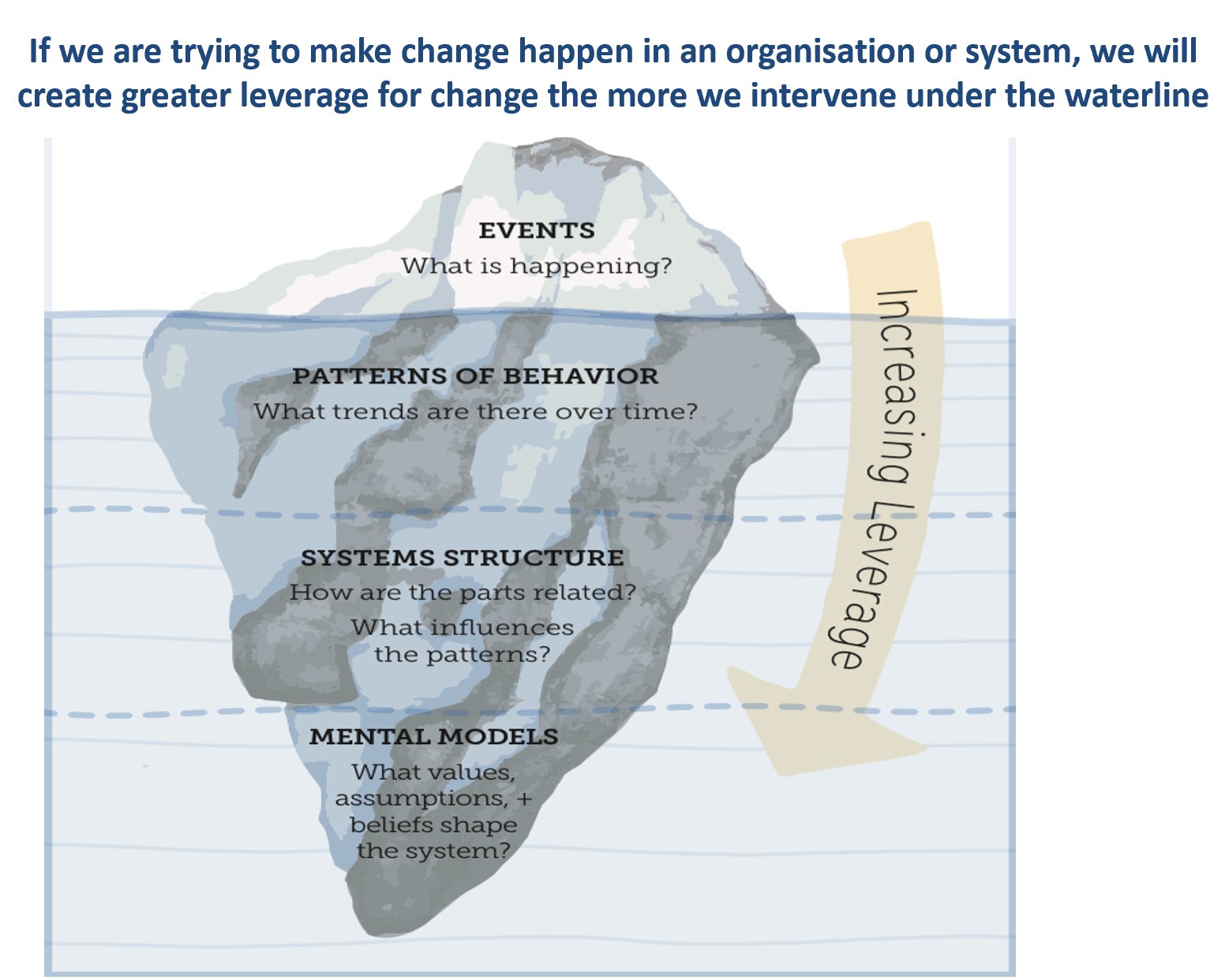
Now, I’m not the biggest fan of Myers-Briggs but I do think that it can be a useful start in terms of reflecting what energises and what drains you. I flip between ENFP and ENFJ, depending on the test and how stressed out I am. Where I never vary is on the feeling dynamic: I need to feel connected to people in order to feel inspired, creative and like ‘me’.

One of the issues I’ve experienced during the pandemic is the ‘feeling connected’ part. I get this through being creative, working collaboratively with others and spending time with people who enable me to feel secure and support free thinking. I find routine to be draining. It seems weird to describe the pandemic as routine, but in many ways it’s been the worst combination for me. There’s been no time, thinking space, or resources for true creativity and innovation. Whilst at the same time everything has been constantly changing and so most of my available intellectual and physical resource has been focussed on administration and reacting to change, rather than driving it.

True change and innovation require time for self reflection and the establishing of partnerships. This has definitely been something that has been resource-limited.

If you use DISC profiling I’m about as strongly DI as it’s possible to be, with an additional focus on collaboration. A lot of my team are much more C (see below) and so react to the challenges faced by this change in working structure very differently to me. For them, they haven’t enjoyed the ever-changing guidance but for a different reason, as they prefer routine and structure. Interestingly, no matter who you are, this way of working has probably been draining for us all, rather than energising us.

It feels to me that all of us are therefore coming out of the last 12 months plus in a drained rather than energised state, both as individuals and as teams. If we are able to continue for the next 12 months, we probably need to take some time that we don’t have to reflect on what our working lives are like right now and how we can change them to build in some of the activities that energise rather than drain us. For me I’ve found things like Myers-Briggs and DISC a useful starting point. But they are just that: a starting point.

I’ve spent a lot of time thinking about where my passion lies over the last 12 months. I have the best job in the world but there’s no getting away from the fact that it has been hard and frequently draining lately. Not just that, but it is likely to continue to be so for some time. I’m incredibly lucky to have projects like Nosocomial and to be involved in teaching, which enables me to visualise and see impact and change, as well as to build connections and networks that are super important to me. A lot of these projects have been on hold for some time, but – as the things that energise rather than drain – now is the time to dust these off and make the deliberate choice to re-engage.

My thoughts on what energises me:

  • One to one or small group chats in non-hierarchical settings (like tea and cake catch ups) where connections are developed/sustained.
  • Making plans for the future.
  • Having time to throw around ideas and discuss concepts.
  • Time spent with people where I don’t fear judgement.
  • Creation – whether a project or idea.
  • Passion projects about communicating science.
  • Teaching/educational activities where you can engage and see the impact on those involved.

Time and resources are no less limited now than last year.But, if we are going to survive to the end of this marathon,now is the time to invest in what makes us better at all we do. So for yourselves and your teams, find what it is that energises you and support each other in making the room to make it happen.

All opinions in this blog are my own

It’s Been A Long Road To Get Here but the Journey Is Part of the Learning: My Hopes and Fears on Starting my first Consultant Role

It’s Easter Monday and tomorrow I get to start a post which in many ways I had never thought would become a reality.. I get to start as a Consultant Clinical Scientist in Infection Prevention and Control! For 16 years I’ve been training towards this. John, my Consultant, and I have been actively aiming for this moment since I started my NIHR Doctoral Fellowship in 2010, but there have been a lot of bumps along the way. The past two years I had really begun to question if it would ever happen.

I am over the moon but I wanted to mark the occasion by acknowledging some of the barriers that have existed, so others know they are not alone in facing them. I also want to talk about some of my hopes and fears in starting such a big phase of my career.

Acknowledging the Barriers

I started my training in October 2004. when I started I was told I was on an 11 year journey to consultant practice. As it transpired, it really wasn’t that straightforward. Although there are now great training schemes for post registration Clinical Scientists to take them through FRCPath and a PhD, they didn’t exist at the time. I am grateful and fortunate to have been able to become an NIHR Doctoral Fellow, which gave me the time and money to undertake both a PhD and achieve FRCPath by examination over 5 years. In the end I was able to get around the barriers by taking a novel route that enabled me to gain equivalent qualifications to those on the current structured schemes. Speaking of equivalence, getting this novel route acknowledged was also not possible for a number of years after I passed my exams in 2015/2016. Last year, however, I was able to get these formally acknowledged due to the existence of the Academy of Healthcare Science equivalence route, so now I sit on the same register as those now qualifying through the National School of Healthcare Science route.

For me the biggest barrier is that I always wanted to be a Consultant Clinical Scientist in Infection Prevention and Control, as this was the field I had specialised in since 2007. Over the last few years, however, I had begun to doubt that this would be possible. I am qualified to apply for Consultant roles in Medical Microbiology and although these used to be rare they are becoming much more common place. These roles are great but they didn’t represent the dream job that I had been working towards. As these roles don’t really exist, and certainly didn’t exist in my current organisation, I agonised whether I should go for the standard route or continue to fight for a dream that may or may not ever happen. Needless to say, I fought. This is nothing new as, when I started in IPC, I was the only person I knew fulfilling that role and change doesn’t happen unless someone creates that new pathway. It has not been easy but, boy, is it worth it now the moment is here! So for all of you doubting (like I did!), continue to fight the good fight, follow your dreams: the pay off will be even better than you think!

Lets Start with the Fears

As I’ve covered above, this is my dream job and I’m so excited about it. Like many scientists, however, I have a tendency towards perfectionism and, as it means so much to me, I really don’t want to mess it up. I am embarking on something new and part of the fear is that I don’t know how much of it is new and how much change there will be. As with all things new there’s is always some level of adjustment required.

My new job description actually consists of bits that I mostly already do, although there will be expansion into new areas like surgical site infections. It will require me to develop new networks and new relationships, to build up credibility and to become comfortable with being the final point of clinical escalation.

This means I will inevitably make mistakes, both in terms of individual acts but also in relationships as I get to know people in a new context. I have a tendency to enter a shame loop even with very minor errors, which leads to fear in terms of making errors and impacts on my stress levels. I want myself and the team to understand that we will support each other through those mistakes and make deliberate, thoughtful choices in relation to the below to support reflection, learning and moving forward.

There is also a tendency when we step up to a new role to worry about what others think of us and whether we are capable of performing. This can drive me to over-question myself and to obsess about details. Working in healthcare, I think it’s key to not let this get in the way of constantly questioning ‘why?’ To be flexible in our thinking and learning from every interaction. I can’t go into this new post thinking I know it all, as much as I want to arrive at work tomorrow in a super-hero outfit fully formed, the reality is there will be a period of transition. I am going to need to grow into this and, therefore, I need to enter the role with a growth mindset:

See the source image

So What are My Hopes?

My hope has and will always be the same: to make a difference. It doesn’t have to revolutionise mankind but I want to make a difference, one moment, one interaction at a time. That could be making someone smile, it could be getting that result out faster, it could be changing national guidance to make patients safer. I am fortunate enough to have been given the opportunity to make that difference. To have a job that means that my passion for change and my profession aligns with the post I have been offered. I don’t want to waste that opportunity, not for one single minute!

On a professional basis I want to continue to ensure that progress is made by improving patient pathways linked to bringing evidence based practice on line, and advancing what we do with the research I undertake in my academic world. I also want to continue to raise the profile of what Healthcare Scientists can bring. I am a passionate believer in how much my profession can benefit healthcare and Infection Prevention and Control/Microbiology in particular. Healthcare systems are changing, becoming more complex The impact of science is greater than ever before. I intend to continue to advocate and shout about the benefits of HCS, so those coming behind me won’t have to fight the same fights that I have fought. They will get to fight different ones for the ones that follow them!

Finally, I want to continue to learn. I want to rise to the challenge and not be stopped by fear. I want to remain brave and unafraid to ask the stupid questions. To take onboard the wealth of knowledge and experience that others have and to become better because of it.

So, yes it has been a long road, but every step has been worth it. I’ve learned so much by encountering barriers and I’m stronger in my commitment to the role because of it. Whatever journey you are on I hope that the same can be said by you when you reach the finishing line.

All opinions on this blog are my own.

Laboratory Testing for SARS CoV2 (COVID-19): Is all testing the same and why should I care?

Why Am I Posting This Now?

Every tube is a person

This week Panorama aired an episode about how testing is undertaken in some community testing laboratories. They didn’t really cover the differences in testing between hospital and community testing streams.and I’m concerned, as others are, that this programme will create the impression that all testing is done in the way it was portrayed in this episode.

BBC iPlayer – Panorama – Undercover: Inside the Covid Testing Lab

Mention is made in passing to the high quality NHS system that existed prior to the COVID-19 pandemic and is still providing world class care. It doesn’t go into the difference between the 2 parallel lab systems in any way that would be clear to the audience, or reassuring to those not being treated by the so called ‘mega labs’. They also only really refer to academics vs the recent science graduates running laboratories. No mention is made of the army of highly trained, highly qualified Healthcare Scientists who have spent years providing high quality, rapid, advanced testing who have been the backbone of scientific testing in healthcare for decades. No Healthcare Scientists were even featured to comment on the practice.This is such an upsetting oversight that it I felt like I needed to put something out there in order to raise awareness of how all of this works in practice.

This hidden profession deserves to be seen and recognised for the amazing work they do, and not conflated with the bad practice seen in this programme

Before I go any further, I need to be clear that this post isn’t talking about point of care testing (POCT) i.e. the lateral flow testing which I am going to cover in another post; nor is it looking at the technical aspects such as how PCR works as I’ve already covered this in another post. This post is about the different testing streams and why the service and quality they offer may not be the same in all circumstances. This is clearly only my view of the situation and others may see it differently.

How Did We Get Here and How Does the Testing System Work?

When the pandemic started, the government released a document called Coronavirus (COVID-19): scaling up our testing programmes. This document was last updated in April 2020, basically setting out how we were going to enable the country to go from testing a few hundred virus samples a day in each local hospital for patient management to 700,000 plus swabs per day: from both hospitals and the community for: patient management (pillar 1) and epidemiology and surveillance (pillar 2).

The decision was made not to scale up the local hospital and public health networks that already existed (pillar 1), but to bring on line a second parallel system for community testing which would be called pillar 2.

English Government Testing

Tests in the UK are carried out through a number of different routes:

  • pillar 1: swab testing in Public Health England (PHE) labs and NHS hospitals for those with a clinical need, and health and care workers.
  • pillar 2: swab testing for the wider population, as set out in government guidance.
  • pillar 3: serology testing to show if people have antibodies from having had COVID-19.
  • pillar 4: blood and swab testing for national surveillance supported by PHE, the Office for National Statistics (ONS), and research, academic, and scientific partners to learn more about the prevalence and spread of the virus and for other testing research purposes, such as the accuracy and ease of use of home testing.
The 5 pillars of testing shown as a building

The decision to scale up using multiple pillars was made to improve capacity and was supposed to be designed with the following in mind:

  • Accuracy and reliability of tests.
  • Getting the right supply of people, lab space, equipment and chemicals.
  • Logistics.

What Points Did the Panorama Programme Make?

The Panorama programme asked the question, ‘Can we trust testing to keep people safe’. As mentioned , it focussed on pillar 2 testing in one of the ‘mega labs’, a not for profit lab in Milton Keynes set up to process 70,000 samples a day. The 7 lighthouse labs should between them be able to process 700,000 tests a day. To put this in context my lab in pillar 1 processes up to 600 SARS CoV2 tests a day at maximum capacity, but it is a comparatively small lab. I know other centres are running 10,000 tests, but still the numbers are smaller: mostly due to the context in which we are running, i.e. patient management and staff testing.

The woman who investigated worked 18 shifts over the course of the programme and was a life science graduate given 4 and 1/2 days of training before she started on the job (bear this in mind when we talk staffing and training later).

The programme showed a large number of quality and technical issues (I needed a glass of gin afterwards), such as failing to check sample details so samples needed to be discarded, safety failings in the way they were using hoods and dealing with leaking samples and substantial issues with quality controlling results prior to release. This last point meant that the reliability of the result given could be questioned, with a number of potentially false positives being sent out.

Many of these issues are linked to what we call quality assurance, so here’s the CDC definition:

Laboratory Quality Assurance (QA) encompasses a range of activities that enable laboratories to achieve and maintain high levels of accuracy and proficiency despite changes in test methods and the volume of specimens tested. A good QA system does these four things:

  • establishes standard operating procedures (SOPs) for each step of the laboratory testing process, ranging from specimen handling to instrument performance validation.
  • defines administrative requirements, such as mandatory recordkeeping, data evaluation, and internal audits to monitor adherence to SOPs.
  • specifies corrective actions, documentation, and the persons responsible for carrying out corrective actions when problems are identified.
  • sustains high-quality employee performance.

In summary, it’s how we feel sure that the result we give you is the right one, is accurate, and is given within an acceptable time frame that means it is useful to you.

The issues shown were mostly therefore linked with the pillar 2 lab failing at being able to undertake the quality assurance that meant that you got the right result on the right person at the right time. This links back to the stated aims in the government document linked to the need for ‘Accuracy and reliability of tests‘. So why did this happen and why is this quality assurance different in pillar 1 testing?

Why are There Differences Between the Labs in Pillar 1 Testing and the Labs in Pillar 2?

It is worth stating here that (my understanding) the aims of pillar 1 and pillar 2 testing are different. I am in no way excusing the poor practice as discussed in the episode but it is worth remembering that. Pillar 1 testing requires highly accurate repeatable results on an individual level as we are using it to monitor and make clinical decisions such as treatment options for the individual. The level of accuracy and repeatability required is therefore extremely high. Pillar 2 testing feels, to me, to have different aims. Although individual results are processed through the community system, in many ways it feels like it is there to get national and regional data to inform policy decision making on a large scale, such as containment choices. This is much more of an epidemiological approach where individual results matter less, as the data input into the system reaches hundreds of thousands. The focus on each tube being a patient therefore feels like it gets lost.

Staffing and Training

Pillar 1 testing is run and managed by Healthcare Scientists. To become a Healthcare Scientist requires at least degree level qualification and most of my staff have masters degrees. Healthcare Scientists in laboratories also need to be registered in a similar way to nurses and doctors on a professional register where their fitness to practice is monitored. This register is called the Health and Care Professionals Council (HCPC) register and you can either be on it as a Biomedical Scientist or a Clinical Scientist, depending on how much clinical advice you give, but both groups are Healthcare Scientists. Registration take a minimum of a year post degree (and for some routes 6 years plus) with completion of training competencies. Then as part of this professional registration you have to maintain your training, but also fulfil scientific and professional standards. This would mean that some of the things seen in the programme could result in professional sanction and possibly loss of license to practice.

Pillar 2 testing was initially mainly run by academics who were able to be seconded over or volunteer due to university closures. As a Clinical Academic I live in both worlds and my academic colleagues are amazing. However, they are used to working in very different environments without the same standardization and quality assurance checks that are utilised in a clinical laboratories. Most of these highly-skilled academics have now returned to working at their universities as courses have re-opened and so it appears much less experienced graduates have taken their place. This means that despite best intentions and good will they are unlikely to have the experience and training required to fulfil the complex and high standards of laboratory practice required in clinical settings.

This is why the ‘getting the right supply of people‘ piece in the document is so key. Healthcare Scientists like medical staff, however, require years of training prior to independent practice and so I acknowledge that within the timescales we have faced this has been a challenge and is a strategic issue that needs addressing in the years to come.

Quality Monitoring

In theory there should be no difference in the quality monitoring or quality assurance between pillar 1 and pillar 2 testing. It was stated in the documentary that the lab featured has been recommended for accreditation, but what does this mean?

Within England labs are assessed against a set of standards known as ISO 15189 Medical laboratories. These standards set out a list of requirements for quality and competence and were developed by the International Organisation for Standardization’s Technical Committee. If a lab demonstrates they meet these standards they are known as accredited labs, meaning that they are able to provide high quality accurate results. The accreditation body is called UKAS and it works in a similar way to the CQC for hospitals and OFSTED for schools.

All pillar 1 clinical laboratories are required to have UKAS accreditation to run. The process of getting accreditation is highly time-consuming, requires specialist knowledge, and a LOT of paperwork. Most labs have at least one full-time quality lead in order to keep on top of it, and to undertake crucial monitoring like auditing to provide the assurance part of quality assurance.

To set up the monitoring systems and get accreditation, even for one test, is not fast and it seemed to me that this is where the lab featured was failing. It is almost impossible to do high quality work when it is undertaken in a factory setting with hourly targets and when the staff present aren’t trained to a high enough level (4 and 1/2 days). Obviously, this is just a view from a set of data given through the lens of a specific piece of reporting. Having been through the accreditation process numerous times myself, it is of no surprise to me that centres set up so quickly with limited staff training are struggling to comply or even to truly understand the issues.

So Where Does that Leave Us?

Firstly I want to clearly state that this post is not an attack on the people working in the mega labs, they are doing their best under tremendous strain with what they have available.It isn’t even an attack on the mega labs themselves as I understand how we have gotten to where we are with them. This is a post to explain what we already had in place and how we might in the immediate and longer term look to do things differently.

These labs have been created at pace and utilising what resource could be sourced to set up a completely separate stream. In many ways I understand this, as just the logistics of getting 70,000 specimens a day into a building in terms of vehicle access are huge. Healthcare Scientists also cannot be magicked out of thin air. The problem is that this is being treated as a factory, without (it feels) acknowledging that the work we do is highly-skilled and technical: that this needs to be acknowledged in order to achieve high quality outputs.

As stated in the programme:
‘If we’d spent the money supporting the existing system we would have been better off’

That may not have been possible for reasons of speed and logistics at the start, but it is certainly possible now. The answer to the question in the programme ‘Can we trust testing to keep people safe?’ is yes, but maybe not in the situation we’re in right now. So let’s acknowledge the workforce that have the expertise in this, who can deliver the quality required and build the infrastructure to ensure that no matter where you are tested, for whatever reason a sample is taken, you are acknowledged as the patient behind the tube!

As to whether you should care about testing and where your sample is processed. We should all care: results and quality should not depend upon testing site. We should also care about the plans for how this is done in the future, as this will be a key legacy that the pandemic leaves behind.

All opinions in this blog are my own.

Why I Went Through the Equivalence Process and Why I think it’s Important as a Lead Healthcare Scientist to Lead By Example

Yesterday I posted for Healthcare Science Week 2021 with some tips about applying to start your career as a scientist. Today I wanted to post something linked to career progression as a Healthcare Scientist. So todays post is about going through the equivalence process with the Academy of Healthcare Science (AHCS). I know that this one may be a bit contentious, I know this because when I announced I’d been through the process on Twitter I got some push back and interesting discussion. That said I still think it’s important and so I want to take you through not only how I went about it but my thought process as to why.

The equivalence process enables individuals who have gone through different progression routes to achieve progression similar to the end points reached by the structured routes offered by the National School of Healthcare Science (Scientific Training Programme (STP) and Higher Specialist Scientific Training Programme (HSST)). Equivalence can be undertaken for either programme and requires you to demonstrate that you have covered both the breadth of scope and qualifications contained in the curriculum that is involved in the structured centrally delivered programme. Once you’ve gone through the equivalence process you can then register on the AHCS register, in the same way as a programme graduate.

For people like myself who attained a PhD and FRCPath by examination prior to the introduction to these structured programmes there is no requirement for us to demonstrate equivalence to the HSST. For many people in a similar position to myself they are also already in Consultant posts, and so the participation in this process is perceived as costly, with little added value.

So why do I think it is important for me as a senior leader and Lead Healthcare Scientist to go through this process and put my money where my mouth is:

  • I want to understand the process so that I can support my workforce when they are submitting for the equivalence process themselves.
  • I want to lead by example. These structured programmes are what my future workforce are going to be going through. I owe it them to understand the breadth requirements of the curriculum so that I can be a better advisor.
  • I want to demonstrate the value of the register. Although HSST equivalence is not currently required it is likely to become an increasing requirement in posts that are being created (I’ve seen one recently). In order to maximise flexibility for my workforce to apply for posts in the future I think it’s important to get on the register early and show why it might be important for their futures.
  • STP equivalence is much more embedded and within my workforce I’m working hard with the team to raise awareness and support for this route. It would feel hypocritical of me (as Lead Healthcare Scientist) to be pushing the importance of considering undertaking this process and not have been prepared to engage with it myself.
  • As well as being a Lead Healthcare Scientist I am also a Healthcare Scientist Training Advocate for National Institute of Health Research. As part of the development of training plans for doctoral and clinical lectureship fellowships then the role of equivalence plays an important part for those who will go through the non-standard route that I undertook. By having been through the process I can help in guiding applicants in what items their clinical training programme will need to contain.
  • Finally, I did this for me. I wanted to show that I am competitive for posts, that I have the skills required. I am not in a consultant post and will therefore potentially be competing for posts against people now exiting the training programme. I found the process of putting together the information and reflecting about my career against a set of standardised benchmarks incredibly useful. It is so useful to identify gaps that you may not have recognised, or reassuring that you have covered everything and you are good to go.

So What Is the Process for Applying for Equivalence

My experience is of putting together the Stage 1 application pack, which consists of the following:

ï‚· A completed Stage 1 Summary Mapping Template – this is basically linking your structure CV to the standards to show that you have met them all
ï‚· Job description and person specification
ï‚· A structured curriculum vitae (CV) – this is 1500 words that outlines your qualifications, job role, experience and anything else you need to demonstrate you meet the standards
ï‚· Two appropriate professional references
ï‚· Qualification certificates
ï‚· I also added some additional information to the end of my structured CV that included: a publication list and grant funding received, as well as a list of committee and guidance groups I am a member of

It took me a while to look at the standards and reflect on content, but I have to admit the bit that took me longest was finding all the documentation (certificates, driving license etc) in order to scan them in and submit them. The other bit that took time was getting the references as we all know how busy everyone is.

The whole application is online and you upload each part and you have it. It gives you a progress bar so you know how close you are to completion. I didn’t know anyone else who had completed it and at that point there were in fact no microbiologists on the HSS register to talk to about it, so I just put things together based on intuition and what I would like to see if I were assessing. Mostly this was about leading the reader and making the information easy to find, as well as making sure that in the mapping document it was clear that all the competencies had been covered. I’ve included mine below, not because I’m claiming it is the most amazing document ever, but so that you don’t have to start from scratch like I did in terms of your thinking.

Once I had submitted I waited. I was fortunate enough to get an Outcome 1 (see above) feedback as shown below:

After which I paid my £50 and became the first microbiologist on the ACHS HSS register.

Overall the process was pretty simple and straight forward. The thing that took the longest was the thinking ahead of putting it together. I found it useful to have a list of the competencies and then listed all the different things that I could use as evidence against them. I could then focus my thinking and my CPD review on areas where I didn’t have so many items mapped.

Equivalence will not be for everyone, but as the profession of Healthcare Science enters a much needed phase where training and careers become more structured then it will be needed. I hope that by having gone through this process I have gained the skills and knowledge to support others, as well demonstrating leadership in an area that I feel is important. So I would encourage you to review: Is its right for you? Is it right for your workforce? and What’s stopping you?

All opinions on this blog are my own

It’s Recruitment Season in Healthcare Science and Academia: What have I learnt which might help

It’s recruitment season in both Healthcare Science and academia right now. Many promising young scientists have applied for the Scientific Training Programme, whilst others are applying for PhD positions and taking their first steps to becoming independent researchers. I’ve been having lots of conversations and I’ve been getting lots of emails/tweets about what I would be looking for as part of this process. I’m also going through a recruitment process myself and so this has been on my mind. I’m going to share what I look for, but I want to be very clear this is just that, what I look for. Others may have different opinions and so it’s always worth canvassing more than just one person as there are people out there who are experts in this.

There are obviously two big sections to this, the application process and the interview. If you get to the interview then you will have got there because I believe that you can do the job. At that point it’s about team dynamics and shared vision and it’s as much about you interviewing me as it is about me interviewing you. So for this post I’m mostly going to focus on the application process and getting that foot in the door.

Photo by Andrea Piacquadio on Pexels.com

Know Your Audience

When you are applying for a post you will have access to a whole bunch of information, some of which will be more apparent to you than others. There will be names listed, names of specialisms, names of the recruiting staff, all of which will give you a clue as to how to get information on the type of people who will be interviewing you.

Getting to know more about the people involved in the recruitment process will help you prioritise the information in your proposal. Is the Trust and department you’re applying to research active? If not then you might want to use that word count about your undergraduate dissertation for something of greater interest to them. For STP applications you should include reference to the fact that you’ve spoken to people who work in the field to demonstrate an understanding of the job. For PhD applications make sure you include specific references to the papers the hiring academics have recently written in your cover letter so you have shown you know who they are. This enables your to start out building a relationship with the people who are shortlisting, they know you’ve taken the trouble to know more about them and it’s a sign of respect that will stand you in good stead.

DON’T do what once happened to me when I was interviewing a male candidate. The panel was entirely female and the interview was going well, the candidate obviously had done his homework on us. The last two questions blew it however. We asked him about research experience and he proceeded to tell us that he had looked up our work and how he could guide us in doing it better. He then followed up when asked if he had any questions with ‘When will you let me know I have the job’. Needless to say that call never came.

Do Your Research

Following on from knowing your audience is doing your research. I’m going to be super honest here. When I applied to be a clinical scientist I kind of knew what it was but I wasn’t super confident. That was because there weren’t the resources out there to give me more information. That is no longer the case and there are a lot of internet resources available. This means that if you’re applying for this kind of post now it is expected that you will know not only about the job, but also to have defined answers about why you want to do it and why you are suitable for the post.

For PhD positions doing your research is even more important. I want it to be clear on your application why you want to do this particular PhD. What is it that attracted you to the topic, what work have you already done in this area, what reading have you done to demonstrate your interest. The one thing that many candidates don’t come with to the interview that makes them stand out is what questions their research on the PhD so far has raised in their mind, what questions are they are interested in asking. Even during the interview I want to see the scientific curiosity that will make you a great scientist and separate you from your competition.

DON’T send me an application that is generic and hasn’t been personalised for the position. If you can’t put in the effort to research the post and personalise your application then I won’t put in the effort to interview you as it will feel like you’re not really that interested.

Obey the Rules

In every job advert there will be information and guidance about how to apply. You would be super surprised at how often applicants don’t pay attention to the guidelines. Now most of your scientific career will require you to apply for things, business cases, grant funding, conference attendance etc. If you can’t demonstrate the care and attention to detail when applying for the post it indicates that you may also not adhere to the guidance when applying for these other things, directly impacting your chances of success and career progression. I’m all for individualism and for thinking outside the box, but an application process is about enabling me to do a side by side comparison, which I cannot do if you side step what’s requested.

For NHS posts you need to be demonstrating in the personal statement section what is asked of you in the job description (JD), as this is what you will be scored against. If you don’t cover the points then you cannot get the marks required for short listing. Also pay attention to where you are expected to demonstrate the skills, knowledge etc. It will usually say whether it is on the application, or during the interview. If it stated during the interview and you are limited on words use them to tick the ‘demonstrate in the application’ boxes. Also use the ‘demonstrate in interview’ descriptions as a hint to what questions you are likely to be asked during the interview process.

For PhD posts make sure you send what you are requested, make sure that your cover letter contains the information requested in the advert and that your CV reinforces your key points.

DON’T send a CV to an NHS job application and miss stuff off your personal statement as I won’t look at it. If you’re applying for an academic post don’t just send a CV without providing the information specified in the advert as I won’t look at the CV if I consider your application incomplete.

Know Your Unique Selling Point (USP)

When I applied for my trainee clinical scientist post there were 240 applications for 4 positions. The scheme has only got more competitive since then and PhD positions can be equally if not more competitive. Although interview questions will vary across post types you will almost always get asked why you? Why do you want this post? Why are you suitable for this post? How will this post get you where you want to be? What is your 5 year plan?

It is therefore worth taking the time to think about what it is that will enable you to stand out from the competition and make sure that you have clearly stated it in your application. Are you applying for a PhD post and already have published papers, got a travel grant or partaken in science communication activity? Make sure that it is there and easy to see, as this will enable you to stand out from the field.

Are you applying for an STP post and have already done work experience in a clinical lab, worked with patients or have a lived experience that could help you? Make sure that this is clear as it will help during the short listing process.

Remember that for both PhD and STP positions they are effectively graduate training schemes. These are first steps in a career that will last a lifetime and so knowing where you want to go on that journey is important to both know and to communicate to your recruiters.

DON’T hide the things that could make you stand out. Think about what your USP is and make sure it is clear and easy to find. The person trawling through these applications is unlikely to have the time to read every line you write and so make sure you grip them in the first couple of paragraphs so that they will keep on reading.

Make It Easy

This year for the STP programme there are over 6000 applications to shortlist. I have had to go through over 150 applications for PhD programmes before now. I would like to say that I always have the time to give each application the time it is due, but the honest truth is that I am trying to make this work on top of a very busy clinical job. You’re application therefore needs to stand out and be really easy to process.

For NHS applications that means using the terminology used in the JD I am scoring you against, ideally using sub heading and bunching information together so I’m not searching for whether it is present in your personal statement. It also means that if it is key information I would include it in more than one section so I’m less likely to miss it.

For PhD applications it means being very explicit in your cover letter showing that you have: an interest in the topic, that you have researched linked to the work and why you want to undertake this specific PhD. It also means making the information in your CV related to the PhD proposal really easy to find. Don’t put down every technique in the world if only 25% of them are applicable to the topic you’re applying. List in detail the relevant ones and the group the rest and bring them up at interview if appropriate.

Put your USP up front and clear, put it a box, underline it, give it it’s own paragraph or sub-heading. Do something to make it easy to see when your application is being skim read.

DON’T send a 150 page CV containing every certificate you’ve ever achieved. I will just toss it on the no pile without reading it.

I want to wish everyone the best of luck in the posts you’re applying for now and in the future. Remember every job is different and you will obviously want to tailor some of these tips to whatever you are going for but my top tips are:

  • Personalise the application
  • Say who you are and why this is the post for you
  • Read the application notes carefully so you give the short listers what they are after
  • Make it easy for whoever is looking at what you submit by using techniques such as sub-heading so the information is easy to find
  • Become familiar with the people and organisations you are applying to so you can tailor what you are writing

All opinions on this blog are my own
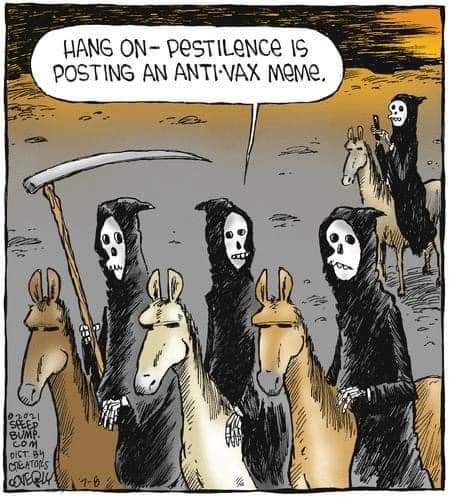
If you would like more tips and advice linked to your PhD journey then the first every Girlymicrobiologist book is here to help!

This book goes beyond the typical academic handbook, acknowledging the unique challenges and triumphs faced by PhD students and offering relatable, real-world advice to help you:

  • Master the art of effective research and time management to stay organized and on track.
  • Build a supportive network of peers, mentors, and supervisors to overcome challenges and foster collaboration.
  • Maintain a healthy work-life balance by prioritizing self-care and avoiding burnout.
  • Embrace the unexpected and view setbacks as opportunities for growth and innovation.
  • Navigate the complexities of academia with confidence and build a strong professional network

This book starts at the very beginning, with why you might want to do a PhD, how you might decide what route to PhD is right for you, and what a successful application might look like.

It then takes you through your PhD journey, year by year, with tips about how to approach and succeed during significant moments, such as attending your first conference, or writing your first academic paper.

Finally, you will discover what other skills you need to develop during your PhD to give you the best route to success after your viva. All of this supported by links to activities on The Girlymicrobiologist blog, to help you with practical exercises in order to apply what you have learned.

Take a look on Amazon to find out more

My Best Science Comes from a Cup of Tea: My top tip for Healthcare Science Week

Welcome to Healthcare Science Week 2021! Depending on how I feel and how busy this week is I’m hoping to post a few times and to make up for not posting much recently as I’ve been unwell. Also, as I’ve been not well I’ve had plenty of time to reflect on the importance tea has in my life. My husband is a sweet heart who makes me many a cup and it is my place of comfort and salvation when the world gets too much. It is also a place of reflection and helps me do my best thinking. So this post is devoted to one of my favourite things in the world and something that helps me be the best scientist I can be…………..a lovely cup of tea. (NB for me this is ideally a cup of Darjeeling or Lady Grey served black. You can I am sure substitute it with your favourite, or blasphemy, even exchange it for coffee).

Tea and Planning

Most of science is not actually in the doing, most of the best of science is actually in the planning. If you get that right then everything else will follow. If not you can spend a lot of money getting a lot of data that is in fact not much good to anyone and definitely doesn’t answer the questions you were asking. When I was starting out, and sometimes even now when a deadline overwhelms me, I thought it was better to be doing. To be in lab getting ‘somewhere’. Needless to say I spent a lot of time getting ‘somewhere’ but that wasn’t where I needed to end up. Tea cannot be drunk in the lab. Sometimes making a cup of tea therefore is a really good way to break the cycle of doing and force yourself to have time to step back and plan. It is one of the reasons I have exceptionally large cups as they give me the time to get into the right headspace and adjust my thinking before I reach the end. It also helps that I drink my tea black so that it also has cooling time. By the time I’ve cooled and finished my mind is usually in the place it needs to be and I’m in planning mode not panicked doing mode.

Tea and Networking

I believe it is no secret to anyone that reads this blog that I appreciate a piece of tea and cake. This is partly because I like to host as it gives me a structured way to talk to other people. It is also because I believe that when we are sitting and eating/drinking with other people it removes hierarchy, especially if that can be done outside of the usually work environment.

This next but may shock you, but I HATE networking. I’m pretty good in 1:1 situations where I know the other person, but I’m rubbish at faces and I’m even worse at remembering prior conversations. It’s definitely not the fault of the person I’m speaking too, it’s just my memory doesn’t work that way. My memory is super context specific. I therefore find the horror of speaking to people who know who I am, who I have spoken to before and me not remembering, one that I regularly encounter. I also hate networking as I actually have no small talk. I spend a LOT of my time working and my geeky hobbies are not ones that many people will engage with on first meeting and so I struggle. It’s one of the reasons I started on Twitter almost 20 years ago. Twitter meet ups at conference meant I had already done the small talk and we already had shared context and so I didn’t have that panic inducing moment where I tried to find something sensible to stay (NB this is still a top tip of mine if you’re starting out going to meetings).

Tea makes me relax. At conferences I can always talk about the food and the tea. It also means that I worry less if I’m talking to a Noble prize winner or someone of international renown. They need to eat and drink just like I do. Also, if you find someone hanging around the tea area with no one to talk to they are probably in the same boat as you and will be super relieved that you are the one that made the conversation opener so that they didn’t have to.

Tea and Sympathy

For all you amazing young scientists starting out please don’t take this one too much to heart, but use it a short cut to help your mental well being. Science is 80% failure. You will fail at grants, you will fail when you submit papers, you will have bad supervisor meetings and elevator pitches and most of all you will have failed experiments. Sometimes in the case of lab work these failures can go on for months or years and be super costly, both in terms of money but also in terms of your mental health. What you need to know now is that this is normal. The most amazing scientists you meet will have sat there in a puddle of tears with mountains of self doubts and fear that nothing would ever succeed again. No one ever sat me down and told me this. For a long time I felt I was alone in the failure. Then over time my colleagues became friends and we finely got to the point where we could voice our fears and disappointments. Only then did I realise that I wasn’t alone. That these failures were crucial points where I learnt and developed and that instead of fearing them I should embrace them.

So my advice now, for all those I supervise and support, is to spend time early developing a few key relationships. Then when you are experiencing the failures you too can have someone who will listen and tell you that it’s normal and support your mental wellbeing as well as helping you get back on track. You will also learn from being the person who supports others when it’s your time to pull out the tea, biscuits and box of tissues.

Tea and Reflection

Moving on from tea with others I wanted to reinforce the importance of tea with yourself. This touches on the Tea and Planning section above but is wider than that. As scientists with are often process driven and tend to be rather task orientated. That means we are great at getting things done but poor at working out why we are doing them. Working as a scientist these days is super complex. Not only are you dealing with regular failure, but you are dealing with complex political environments and career pathways that are anything but clear. When we fail to give ourselves time to reflect and check in with ourselves we can end up going down rabbit holes that don’t get us where we want to go. It also means that our relationships suffer. As you gain students, direct reports and more leadership responsibility it it really important to think about why certain conversations went the way they did. To reflect on things like your leadership style and which situations it’s working in and which it isn’t. As trainees it’s worth taking time to think about why you didn’t get the supervision support you were looking for, did you pick a bad time, did you not manage to articulate what was needed etc. Only by working on ourselves can we really move forward, and this is the one thing we often don’t take the time to consciously do.

Tea and a Pep Talk

So you might say to me ‘what is the different between tea and a pep talk and tea and sympathy’. I would respond that they are actually very different things and both have their place. Tea and sympathy isn’t about trying to ‘fix’ things, it’s about centering yourself when things are going wrong and not feeling along. Tea and a pep talk is more like a coaching experience, It’s about someone giving you constructive support to help you navigate a challenge. It requires a bit of work from both parties in order to try and progress the issue and although it should also enable you to come out feeling better, it should also enable you to come out with a plan of action. You may not be needing a pep talk because you’re upset but because you have a barrier to traverse, a conversation to have, or a direct to pick. You may also want your pep talk to be from someone different to your tea and sympathy as it may be that you want to access knowledge or experience. It is often a conversation that is not so reliant on trust as your tea and sympathy chat may be and you will want to bear that in mind when picking who to have these conversations with. Having tea in these conversations often means you can change their location to outside the working environment (if needed) but also set them up to not be rushed and have the time needed to reach the destination required.

Tea and The Late Night Session

I’d like to say that I have this work life balance thing cracked, but I suspect that my family, friends and colleagues would say that probably isn’t the case. Even if I has I think there is no way of getting around the fact that if you work in science there are going to be some late nights. Sometimes that’s because you are doing a growth curve that is going going to take you 20 hours, sometimes it’s because you have a full working day and then need to do some work for a dissertation and sometimes it’s because of some form of urgent need that means you need to start something for a patient at 6 when you were due to leave at 5.

I used to try and just push through these sessions. I used to think that finishing as early as possible was the best way to balance it with everything else. What I learnt is that when I pushed through I made mistakes. I learnt that for me even when pushing to get things done I need to schedule short ‘walk away’ periods where I could have a cup if tea and move in order to think, especially if I was at work beyond 8 o’clock. Otherwise I made silly mistakes, For the sake of transparency sometimes these wake up ‘walk away’ sessions involved me dancing across the lab with tubes in hand to Lady Gaga, but mostly they involved a cup of tea and ideally a biscuit as I wouldn’t have eaten. My practice is to give myself a 5 minute break to make the tea, go back and do another 20 minutes whilst it cools and then to have a 15 minute zen moment whilst I drink it. I’m sure you will have your own method, but developing one with save you errors and stop you having to repeat these late night efforts.

Now, with this written I’m off to have a cup of tea. Remember my top tea related tips:

  • Find your tea and sympathy peer
  • Take time to reflect
  • Planning will save you time
  • Know how to push yourself and strategies to avoid mistakes
  • Don’t be afraid of networking but think how to make it work for you

All opinions on this blog are my own

If you would like more tips and advice linked to your PhD journey then the first every Girlymicrobiologist book is here to help!

This book goes beyond the typical academic handbook, acknowledging the unique challenges and triumphs faced by PhD students and offering relatable, real-world advice to help you:

  • Master the art of effective research and time management to stay organized and on track.
  • Build a supportive network of peers, mentors, and supervisors to overcome challenges and foster collaboration.
  • Maintain a healthy work-life balance by prioritizing self-care and avoiding burnout.
  • Embrace the unexpected and view setbacks as opportunities for growth and innovation.
  • Navigate the complexities of academia with confidence and build a strong professional network

This book starts at the very beginning, with why you might want to do a PhD, how you might decide what route to PhD is right for you, and what a successful application might look like.

It then takes you through your PhD journey, year by year, with tips about how to approach and succeed during significant moments, such as attending your first conference, or writing your first academic paper.

Finally, you will discover what other skills you need to develop during your PhD to give you the best route to success after your viva. All of this supported by links to activities on The Girlymicrobiologist blog, to help you with practical exercises in order to apply what you have learned.

Take a look on Amazon to find out more

The Fear of Next Steps: Should I Stay or Should I Go?

I think that it’s only natural during a stressful time like a pandemic that we feel the need to reflect and re-evaluate the direction of our lives and careers. For me this has been very much about the next stage of my career and how or when I should take the leap to trying to secure a consultant grade post.

For those of you who are less familiar with Healthcare Science career paths, when I joined in 2004 I was told I was on an 9 – 11 year pathway to Consultant grade (equivalent to my medical colleagues). In reality that pathway is anything other than transparent or straight forward.

The stages were due to be:

  • Train for three years and complete Clinical Scientist training
  • Take MRCPath part 1 in medical microbiology and, after 4th anniversary, gain Health and Care Professionals Council registration
  • Spend five years doing a part time PhD whilst in clinical service to become research accredited
  • Years 9-11 take FRCPath in medical microbiology and become clinically qualified, equivalent to medical colleagues
  • Get consultant post

Sounds Straightforward. Right?

For the main part, the pathway for me worked out OK. Mostly because I was awarded fellowship money from the National Institute of Health Research (NIHR), which brought me out time to do both FRCPath by exam and attain a PhD. I completed my PhD and passed FRCPath in 2015,11 years after starting my training.

Five Years Later and I Don’t Have a Consultant Post. Why is that?

Partly, it’s not that simple. Consultant Clinical Scientist posts are just not that common. It’s also because from 2016 – 2019 I was undertaking another fellowship from the NIHR, a Clinical Lectureship, and so was continuing my training as I didn’t feel ready. Since finishing that I’ve been somewhat held up by a global pandemic but also, and I’m being honest here, by deciding what the right step forward was for me.

What Does Success Mean to Me?

When we talk about pathways it always appears clear-cut: after a certain number of years of service and training we should step up. Success is about getting acknowledged at the right banding and in the right job. In the last couple of years I’ve been forced to realise that it’s so much more complicated than that. Our professional careers do not live in isolation outside of our lives. For me I’ve been forced to realise that I’m not Superwoman. I have some physical health issues that mean, these days, I can only push myself so hard without paying the consequences. When I was doing (simultaneously) a PGCert, PhD and FRCPath I didn’t have a weekend off in three years. I developed alopecia and lost sections of hair and exacerbated my autoimmune condition. I’ve been made to realise that I clearly cannot keep up that pace. There are also costs I’m no longer willing to pay in terms of my family life. My husband and family have put up with missed birthdays, anniversaries and just being absent. My husband has taken the majority of the load in keeping our lives together and, at some point, I have to take back my share of the load. My sister and niece also died during this time and reminded me how short the time we have with people is. I suppose my point is that I realised I didn’t want a consultant post ‘at any cost’. It had to be the right consultant post, one that I could balance with my family and health commitments and also one that was professionally satisfying.

By the time I felt that I was psychologically ready to take up a consultant post I became increasingly aware that, although the situation was changing, it really wasn’t like they were sitting around waiting for me, at least in the areas that I could currently make work with all the considerations I talked about above. Once you have defined what your version of success looks like, you then have to go about starting to fight to make it happen. I’ve been pretty lucky in terms of having advocates and mentors to support me, but it has been a deliberate effort to go and find both. There’s no getting around the fact that even when you’ve decided what your end point looks like you won’t be able to get there on your own. That said, no one else can make it happen for you. You need to drive the process and seize upon the opportunities presented to you. Sometimes that means sticking to your boundaries and making a space for yourself at the table that works for you. As women we often feel uncomfortable negotiating and setting expectations, but if you want to achieve your version of success there’s no way of getting around the fact that you will have to be prepared to lead and embody the senior position you wish to attain.

So I’ve decided I’m ready now, ready to go, ready to take the leap from where I am now to a consultant post. Now I just need to find the one that is right for me. I’m working on it, but only time will tell if I will succeed. Even thinking about taking that next step makes me feel fear. It makes me question whether I am good enough. Whether people will respect me. Whether I will succeed as a scientist in the world of medics. You know what? That doesn’t matter. I feel the fear, I acknowledge it, and then when my moment comes I intend to do it anyway!

So, if you too are reflecting on next steps, be that because of the pandemic or for other reasons, my thoughts are these: don’t let others peoples definition of success define yours, spend time working out what your success criteria look like, but once you know what they are don’t let fear stop you. Find the people who will help lift you up and rationalise that fear. Look over that cliff edge and jump.

All thoughts in this blog are my own

The Things I Love Best About Working in Infection Prevention and Control

Having posted about some of the struggles earlier this month, and with another couple of weeks on clinical cover looming, I wanted to talk about why I love the job I do, and how it is so much more than most people realise.

On my first week in Infection Prevention and Control, I received a call and was asked to make a risk assessment about bringing in a Komodo Dragon in from London Zoo as it needed an MRI. It was at that point I knew that this was the job for me. I loved it then and, even in a pandemic, I love it now.

That brings me onto the first reason that I love it:

You Never Know What You’re Going To Get!

Those of you who have read the other articles on this blog know that patience is not one of my virtues. I thrive on, and really enjoy, variety and situations that force me to think creatively around challenges.

No two days in infection control are the same. In fact, it sometimes seems like no two hours in infection control are. I think that’s why I’ve found SARS CoV2 difficult: although there is responsiveness to the ever-changing guidance, the core of it is very much the same.

In infection control, one moment I will be speaking to a family and talking them through what an antibiotic resistant organism may mean for them. The next I will be talking to the wonderful scientists in the lab, discussing how we can improve typing to identify outbreaks and cross transmission faster. I’ll then move straight from that to a decontamination committee, where we will talk about how we need to manage surgical instruments to control prion (BSE) risk.

This was something I had no idea about when I started. I thought, like many people, it was mostly about hand washing. Instead I have responsibility for any staff, patients and visitors in the Trust. I don’t just cover hand hygiene and line care but I also cover laundry, pest control and things like antimicrobial stewardship programmes.

I love the creativity required to apply scientific and clinical knowledge to an ever-changing set of questions and the challenges that are created. It can be many things, but life in infection prevention and control is never dull.

Image from GOSH IPC presentation

It’s All About Teamwork

I sit in a multidisciplinary team that consists of medical and nursing staff, in a department filled with the most inspiring Healthcare Scientists. On a daily basis I will work with healthcare professionals across backgrounds, as well as academics and families. I’ve always been a people person (I think), that is what initially put me off a ‘standard’ laboratory science career: I thought I would be confined to the lab and feel quite isolated. The reality of this job could not be further from that.

I am, by instinct, most at home when collaborating. At its core, that’s what infection prevention and control is: a collaboration. One small team sitting centrally in the Trust cannot act as command and control for over 3000 staff and over 300 beds. In order to succeed we need to collaborate, co-create and allow those we are working with to have ownership of the best solutions for their setting, their patients, their workforce.

We are all very different people within the team, coming from different professional backgrounds. We also approach problems and challenges from different directions. The great thing about being in a team that is made up like this is that differences of opinion and constructive challenges lead to solutions that no single one of us could have come up with on our own.

I also find that having an academic, IPC and Healthcare Science Education team means that there is always space to go and be revitalised – both in terms of energy, but also creative thinking when things get too much. Again these different environments can give you a different lens by which to view a problem, and a different group of people to bounce ideas around.

I Get to Use All the Skills I’ve Picked Up Along the Way

I’ve definitely had a meandering path to where I ended up in terms of the science I’ve studied and the topics I’ve really enjoyed. One of the marvellous things about where I have ended up in terms of IPC is that none of that time was wasted. The studying of colloidal science, as part of my physics MRes, has been incredibly helpful in terms of some of the decontamination and surface modification decisions that I’ve needed to face. Similarly, the applied biofilms work I undertook, as part of my thesis, comes in useful all the time when tracking down environmental sources of outbreaks and understanding how cleaning agents may impact upon biofilm. Even my zoology knowledge has been useful in terms of some of the pest control decisions, as well as risk assessing animal visits and dealing with zoonotic infections.

I suppose my point is this: clinical environments are multidisciplinary and so I love the fact that IPC enables me to maintain that diversity of scientific knowledge and that it actively aids within my role.

Travel the World in Order to Share Ideas

Percy the hamster (who is officially our IPC mascot) and I have been lucky enough to travel the world in order to learn how to do what we do better, as well as share what we do. We’ve been on sabbatical to Boston Children’s Hospital for two months to become embedded in how they do things. We’ve been to academic conferences on three continents. On these trips, we never fail to meet people who will ask questions that trigger new ideas and new approaches. We also meet people and develop collaborations where we get to share what we have learnt from our practices, our decision making, and our mistakes in order to add to the shared learning within our profession. This is so important in order make progress for patients, in order to improve the quality of care we can give. It’s also why applying for research funding, so we can have these opportunities to meet and to transition what we learn into clinical practice, is so important. It is really where the science of IPC happens in order to make things better.

Finally, I get to do the most AWESOME stuff. Like the annual reindeer audit to check that it is safe for patients to meet Santa and his reindeer. We check that all the hand hygiene is set up and that the guidelines are there, but it also means that once a year I get to feed a reindeer some carrots. That right there makes any bad days worth it!

Photo from 2019 pre COVID-19

All opinions on this blog are my own
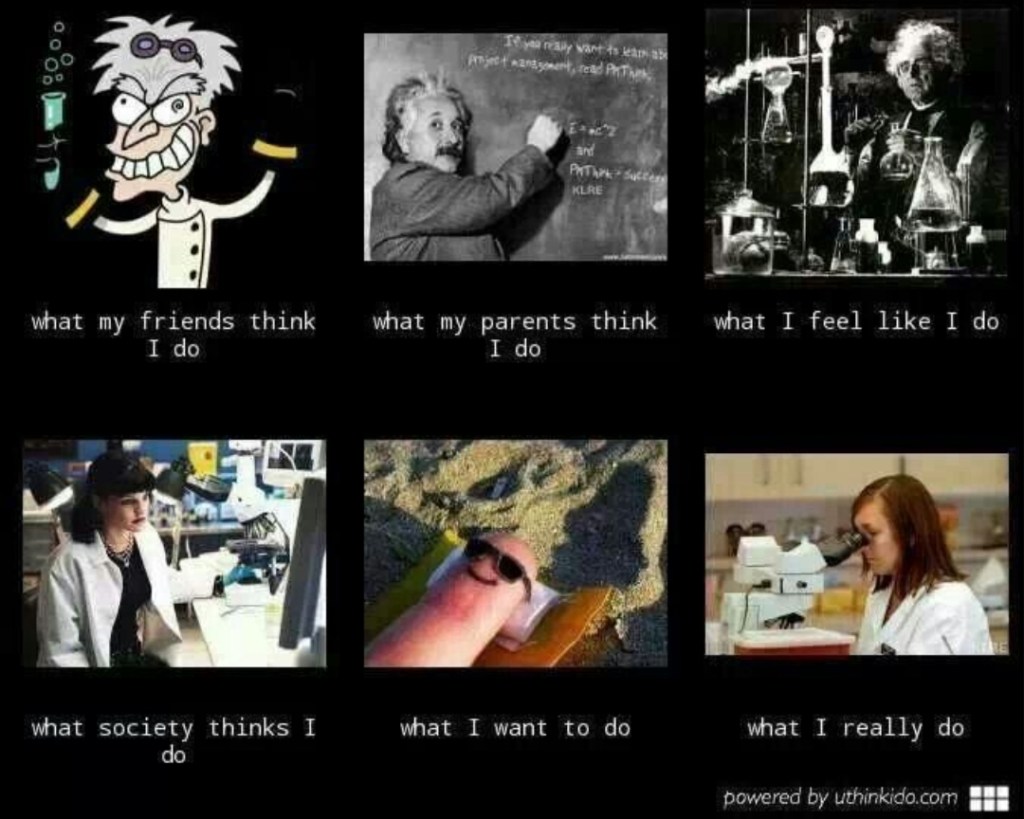
My Sunday Afternoon Rage – The Mask Goes Over the Nose, People!

You may or may not know this about me, but I’m a pretty big sports fan. Not the kind that remembers statistics or can quote drivers/players, but a screaming-at-the-TV-or radio in-support-of-my-team kind of fan. When I lived at home in Birmingham, I had a season ticket for the Holte End at Villa Park to see my boys (Aston Villa); now the main live sport I get time to see close up are the London Games when the NFL comes to town (I’m a Green Bay Packers fan and they’ll never visit). Sport is a massive release for me: Watching Sunday night NFL football and F1 is something that my hubby and I really enjoy doing together as these are our shared passions (N.B. in our household, I’m the big general sports fan rather than him).

So imagine what my Sundays in 2020 have become. Imagine that at the end of every race you sat and watched images of Max Verstappen engaging in face-touching whilst wearing a mask that is barely positioned to cover his nose.

The content of the interview is not important, but he rubs the edge of his mask, then moves his finger to his eye, then messes with the vent, then re-positions it by touching the front. All in a video that lasts less than 55 seconds.

The NFL is even worse. At least in F1 drivers are – for the most part – wearing masks, even if they appear to not know how to control their face-touching impulses. Within the NFL, the numbers of coaches not wearing masks at all has led to fines for individuals and for clubs. The NFL is big money in the US. A number of teams have been shut down for SARS CoV2 outbreaks, and yet the behaviour has continued.

So, Why I am Writing this Post?

Every week I get on tube trains to travel to work. During the first lockdown there was ~90% compliance with appropriate mask wearing. In recent weeks, compliance was less than 50% and I’ve seen all the variations in the image below and more. All this whilst I’m having to live with increasing numbers of clinical cases and receiving daily reports of the same elsewhere. I’m writing this as, although some of it is because of a decision to be non-compliant, I think a lot of it is about the fact that we are not really getting the message out about why appropriate mask wearing is important: not just box-ticking to have one near your face. I don’t think we’ve taught people about which bits of masks are contaminated and that touching those areas is where a big portion of the risk lies. This is why I was pretty much against selective mask use when it was introduced. Universal mask use is much more scientifically valid, but it’s not a panacea and actually increases personal risk if not done appropriately.

I’ve seen all of these variations and more

Why Does it Matter That I Wear My Mask Like a Necklace?

We know respiratory pathogens on the outer surface of masks may result in self-contamination. In my PhD thesis back in 2015, I discussed this as a potential route for hand/face contamination. However, in the context of a respiratory pandemic, and mass mask-wearing without training, the implications are much more significant.

The T-zone includes the mucous membranes within the eyes, nose and mouth.  It has been noted that, even within a healthcare setting, members of staff engage in frequent face-touching, with one study noting that healthcare workers touched the T-zones a mean number of 19 times over a two-hour period, which may place healthcare workers at risk of organism acquisition/transfer.  Additionally, organisms could survive on the skin for minutes to hours and thus present a source of hand contamination when touched in the future, with a possible spread to patients and surfaces.(Journal of the American Board of Family Medicine. 2014;27(3):339-46)

My thesis (2015)
BMC Infectious Diseases volume 19, Article number: 491 (2019) 

Fabric masks can protect by filtering up to 50% of particles, reducing exposure. The risk from inhalation is not the only one, however: viruses can survive on skin, paper and fabric, for hours in the case of SARS CoV2. The virus can also infect by self-inoculation into the eyes and contact with other mucous membranes, for instance people rubbing their nose after removing the mask. The above paper used fluorescent particles to demonstrate how contamination of the external of a mask works, and to help visualise the risk of moving that contamination around the mask and skin. If masks are not put on and taken off appropriately, if they are not worn the right way, and if we don’t wash our hands and think about how we touch our faces, we put ourselves at risk. We make the problem worse.

Back to Sport

Role modelling is so important in raising awareness. Teams and individuals have a massive platform to get this message out. People will say that sportsmen and women are not medically trained, so why should they take responsibility to get this message out? I would say that sports like F1 and NFL have huge levels of access to the worlds best clinicians; they have huge levels of medical investment and there is no doubt that these individuals will have been trained and taught. So they need to lead by example and enable me to get back to using Sunday afternoon sport as an escape, rather than a lesson in IPC failures.

Top tips for safe mask wearing:

  • Wash your hands or use a minimum 70% alcohol gel before putting on (donning) and removing (doffing) a mask.
  • If using a fabric mask, ensure that you are washing between each use.
  • If you remove a disposable mask, throw it away: both sides will be contaminated and if you store it you just move that contamination around.
  • Make sure your mask covers your nose and mouth.
  • Be aware of face-touching and use hand hygiene if you accidently contaminate.
  • Know that the outside of your mask is NOT CLEAN!

All views on this blog are my own

What Is Antimicrobial Resistance and What Might It Mean for Me?

I’ve been talking to quite a lot of people about antimicrobial resistance lately. Partly because I’m involved in a big clinical trial called LAKANA, but also because I’ve been recording some content for the Department of Education and school teachers linked to Infection Prevention and Control. What has struck me is that something that has such a massive day to day impact on my working life hasn’t really made its way into the public consciousness just yet.

As last week was antimicrobial awareness week, I thought I should take the opportunity to talk about antimicrobial resistance and why I think we should be working hard to talk about it more: in the pub with our friends, with our families over Christmas, and with our patients and students.

Photo courtesy of Anthony De Souza

What Is Antimicrobial Resistance?

When I go into classrooms and speak to members of the public they sometimes think that antimicrobial resistance is when our bodies become ‘immune’ to antibiotics. This isn’t the case. When we talk about antimicrobial resistance or, for the rest of this blog post, antibiotic resistance (as I’m talking about bacteria) is when the individual bacteria are not affected by the antibiotic or it works less well (see my introduction to antibiotics post for a bit of background).

Antibiotics work in two main ways. They are either:

  • Bacteriostatic = inhibits the growth of bacteria.
  • Bactericidal = kills bacteria.

The way the antibiotic works against the bacteria can be linked to the way that the bacteria become resistant to the antibiotic. I’m going to do another blog post with some of the technical details of how this works and how we detect it, so bear with me for a couple of weeks. For this post, the main thing is to know that it is the bacteria that become resistant, not us, and that there are a number of different ways that this can happen:

  • Intrinsic resistance = the antibiotic will never work against that particular bacterial species because of the characteristics that species has. This includes things like Vancomycin not working against Gram negative bacteria as the molecule is so large.
  • Selective resistance = where a mixed population of resistant and sensitive bacteria are impacted by antibiotic use and the resistant ones survive and therefore become dominant.
  • Acquired resistance = where previously sensitive bacteria acquire the ability to resist the effect of an antibiotic, often through acquiring genes, which allow them to change the way they function or replicate.

What has antibiotic resistance got to do with me?

The Review of Antimicrobial Resistance (2016)

Levels of antibiotic resistant bacteria are being detected in increasing numbers in food (linked to farming), in the environment, and within humans: both in hospitals and in the community. It’s for these reasons (and others) that it has been modelled that more people will die linked to antimicrobial resistance than cancer by 2050. If, as a population, we have more resistant bacteria onboard as part of our normal flora, it is increasingly more difficult to treat us when we need it. It will also become increasingly more difficult to do ‘standard’ surgeries such as hip replacements, tonsillectomies etc. as these require us to give prophylactic antibiotics when you’re in surgery in order to reduce infection risk. This means we may have to live with long-term conditions that currently we would surgically correct.

Most of us think about antibiotics as being something that we either give to really sick people in hospitals or a fairly harmless way to get back to our every day lives when we’re feeling unwell at home. In many ways that is true. Most of us will have had multiple courses of antibiotics during our life and have never given it much thought. Some women may have had the odd bout of thrush when they’ve taken antibiotics for a urinary tract infection and that is the closest they’ve seen to side effects. The case of a woman getting a fungal infection (thrush) because they’ve taken antibiotics that have wiped out the non-harmful colonising bacteria in their vagina is a pretty good example of exactly what can happen in less obvious sites when we take antibiotics. For example, there’s plenty of data that the use of antibiotics can impact on the bacteria in your gut, providing selective pressure and changing what the population of bacteria looks like. Usually this returns to normal over time. However, in a world where the bacteria we encounter are increasingly resistant, that return to normal could take longer; if they got out of the gut to another location due to surgery during that time they could be more difficult to treat.

Colonisation vs Infection

Most of the time if we have resistant bacteria onboard we would never know. They are colonising us, just like our normal bacteria, and not causing us any harm. There’s good data to show now that when we travel abroad to countries with a high prevalence of antibiotic resistant bacteria in food or the environment, that we may exchange some of our sensitive bacteria for resistant ones. You’d never know, especially as when we get home they will usually be replaced again with sensitive versions. However, if you happen to get an infection whilst you have them onboard because you’ve had an accident on holiday, or you’ve travelled for medical care overseas, then the infection may be more difficult to treat.

It’s not just the antibiotics we use in humans that can make this situation worse. Antibiotics are used as growth promoters in farming. We use antibiotics to treat our pets. Because of how expensive and difficult antibiotics are to develop, we are not really developing new ones and so the pool of available antibiotics is getting smaller.

Because antibiotics are used in so many different ways in solving the issue of how to impact levels of antibiotics, resistance is complicated. It requires us to be able to diagnose and detect resistance faster, to work with drug companies in order to tackle the drug development pipeline, and to take a ‘One Health’ approach, looking at farming and veterinary approaches as well human.

So, what can I do?

  • Be aware that not all mild respiratory and other conditions require antibiotics. Many are viral and will improve with rest and hydration. Therefore, consider waiting before requesting a prescription for antibiotics.
  • If given a prescription, make sure you complete the course. Do not just stop because you start to feel better. Stopping early might mean that you have not completely treated the infection and the remaining bacteria can grow back and sometimes develop resistance.
  • Do not buy antibiotics when you are abroad in a country that permits an over-the-counter purchase.
  • Do not store antibiotics and use them at a later date. Neither should you use antibiotics that were prescribed for a family member or (and I know people have done this) a pet.
  • Think carefully about whether travelling abroad for healthcare is the right choice; make a risk assessment about where you are planning to travel.

If we want to continue to experience healthcare in it’s pre-COVID-19 form, we all need to work together to change the way we use antibiotics so that the modelling predictions do not come true

All opinions on this blog are my own
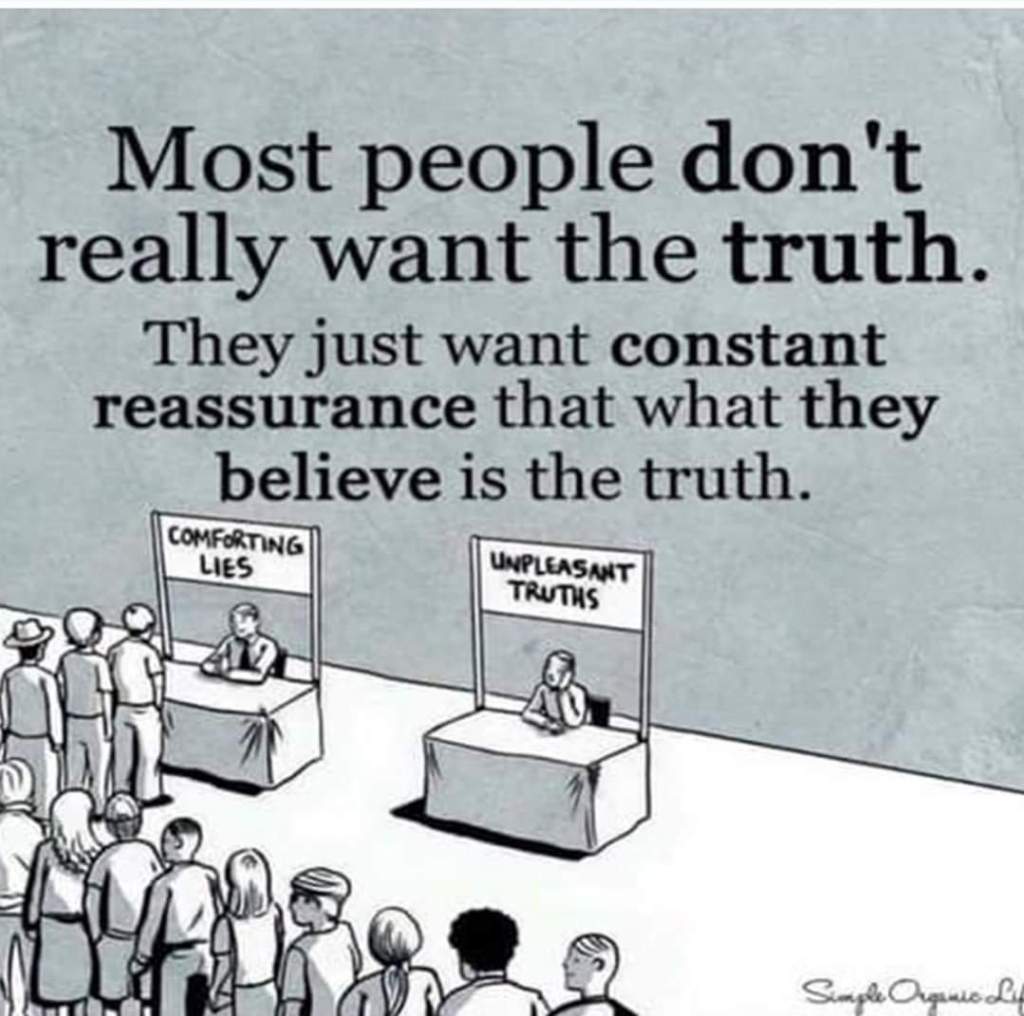
A Short Post Written for my Facebook Friends on the Welcome News of the Approval of a SARS CoV2 Vaccine

Content Warning – this was a post written for my friends on Facebook who have been super-excited about the vaccine and what it might mean. This is a non-referenced post, written on a tube train, which may or may not be of interest to the wider world

There’s lots of stuff flying around about vaccines at the moment. I don’t know if its useful, I don’t know if anyone cares anymore (I would forgive you if you didn’t), but here are some thoughts/comments. They will be an oversimplification as I can teach whole modules on this but there we go.

Vaccines have 2 main functions:

  • 1 – to prevent or, more commonly, reduce transmission risk.
  • 2 – to attenuate infection, i.e. you still become infected but will get less sick and, therefore, your risk of mortality (death) or morbidity (long term consequences) is reduced.

Almost all vaccines are a combination of both of these aims but they are often focused more on one than the other. Most people seem to be commenting thinking that the main aim of the SARS CoV2 vaccines is mainly number 1, when in reality the main thing we’re trying to achieve is actually to reduce mortality and long term health consequences.

The vaccine is much more likely to function like the flu vaccine where you are given it at six month or 12 month intervals depending on whether you are currently in a group where your risk indicates that aim 2 might be helpful. It will inevitably have an impact on aim 1. However, you will, from the current predicted vaccinable groups, have a large reservoir where the virus will still be actively circulating and will be for the foreseeable future.

BBC News 02/12/2020

In addition to that, we will still have some vaccinated people who acquire infection and actively shed virus, they just get less ill. This is to not even mention vaccine failures, of which there will be some as with other vaccines.

What does this mean?

Well, the availability of a vaccine is great news. It will help in reducing deaths, preventing healthcare associated cases and will be a step back towards normality. It sadly does not mean that it is the only step back to normality or that those steps will happen a lot more quickly. It just means that hopefully less people will die along the way. I don’t think we are talking enough about the new normal, but that is where the vaccine will lead us, not to where we were before. Obviously everything is speculation until the peer-reviewed studies are out and this is just me. I am only one person so my crystal ball could be wrong. Be hopeful, look to the future but also know that our personal responsibility for controlling spread and protecting others will not end with one or two injections.

Anyway, what do I know…?

All opinions of this blog are my own

Musings for my Facebook Friends on SARS CoV2 Testing

Content Warning – This was a post written for my friends on Facebook who have been discussing testing a great deal; this is a non-referenced post written on a tube train which may or may not be of interest to the wider world

I’m on a tube so this will, again, be stream of consciousness, but I’ve seen multiple conversations about testing in recent days and so here are a few comments/thoughts:

Testing is undertaken for 2 separate, but linked, reasons:

  • 1 – epidemiological testing in order to control transmission risk and instigate additional measures such as isolation.
  • 2 – clinical management so we know what your viral load (we’ll come back to this term) is doing and how you may be responding to medication.

The testing that is being done for SARS CoV2 testing in the community is called Pillar 2 testing. The testing in hospitals is called Pillar 1 testing. Most of the testing undertaken in hospital labs is logically much more focused on aim 2 rather than aim 1, although we care about aim for prevention of hospital outbreaks. The main function of Pillar 2 testing is based around aim 1, but it also acts to give information if you present at a hospital. Clinical management is not the main aim of Pillar 2: most of your healthcare management will be based on symptoms, irrespective of a positive result, and on physiological measurements such as 02 Stats.

Back to how testing works.

The gold standard test for SARS CoV2 is polymerase chain reaction or PCR, where we look for fragments of the virus, and then create replicates of this original fragment until we have enough to detect. This means that if you have more virus on board you make the number of replicates needed to be detected as positive quicker than someone who is shedding only a low level of the virus.

We normally deal with positive tests in terms of cycle threshold (CT). This is the number of replication cycles required to detect the virus. If your CT value is very low i.e. 20 cycles then you had millions of viral particles present in your sample. If your CT is 38, you had hundreds and it took a lot longer to replicate enough to detect. Still with me? As that was the technical bit! The thing to take away is (counter intuitively) a low CT = lots of virus, a high CT = low levels of virus. This is important because every test has a limit to its sensitivity. PCR can detect down to a few hundred or few thousand copies of the virus but it has its limits.
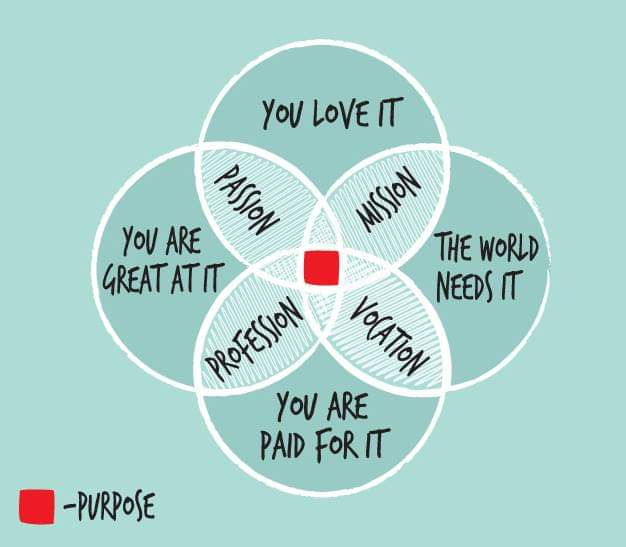
One of the problems with SARS CoV2 is where the virus initially does most of its replication, i.e. in the nasopharynx: the back of your throat and upper nose. That means to try and get a good sample to enable the testing you need to get into there which is not only uncomfortable but pretty hard to do to yourself in terms of visualisation. This means that, even though the test process itself is pretty good, the samples we put into it are often not that well taken (which is why in hospitals they are taken by someone else) and so you may not have enough virus present to count as positive when the PCR is run. This brings me onto the picture below and asymptomatic testing. The first thing I want you to remember is that a test is only valid at the moment it is taken. It does not (if negative) represent what will happen 5 minutes or an hour later. Therefore taking a screen when you are asymptomatic has very limited value to either of our aims. Within healthcare and for contact tracing purposes, we default to the fact that you could be asymptomatically shedding virus for 48 hours before you develop symptoms but that brings us onto viral load. This is called the pre-symptomatic phase.
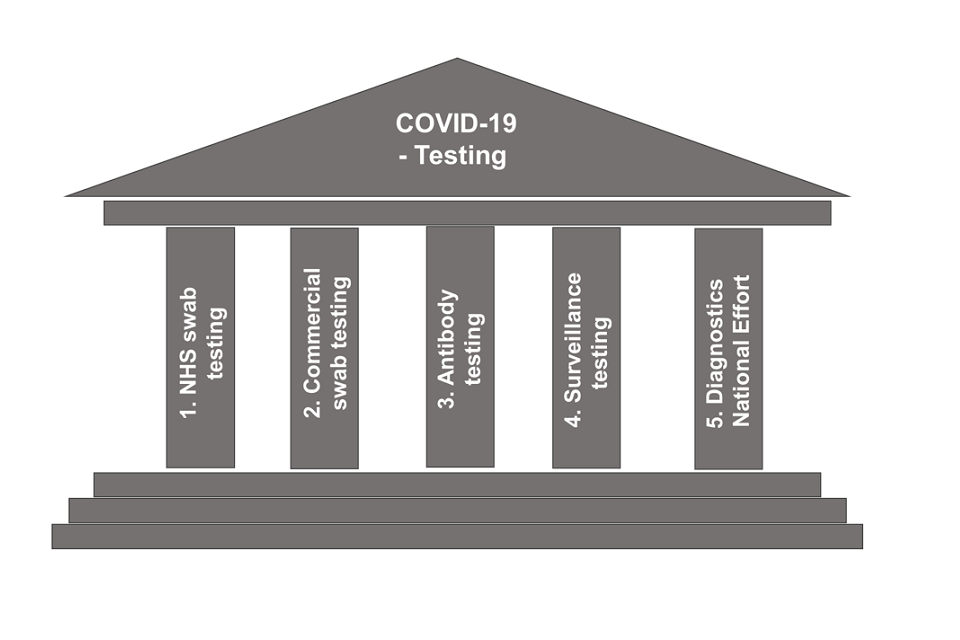
Virology, transmission, and pathogenesis of SARS-CoV-2 BMJ 2020; 371

Viral load is a term we use to talk about how much virus you are shedding or have in your cells. The viral load gradually increases in the asymptomatic phase of infection BUT, and there is a BUT, not everyone will shed virus as the same level even when symptomatic. Some people will control the virus better in terms of replication and will therefore not be detected positive in the pre-symptomatic phase or even on day one of symptoms. The most sensitive day to test is actually on day three after symptom onset. Therefore an early negative test is not helpful. Yes, if positive it means you can put your actions earlier but it is not reliable. Therefore asymptomatic testing needs to always be undertaken with caution and is only valuable in very specific settings. The reason we talked so much about asymptomatic transmission earlier in the pandemic is that we didn’t have our symptoms right. We were looking for flu-like symptoms and ignoring things like anosmia (loss of taste and smell) and, now we’re including it, we don’t see much that meets asymptomatic transmission outside of the 48 hours before symptoms develop. As time goes on replication can predominately move into the lower respiratory tract, i.e. lungs etc. and then you may get negative nose and throat swabs where as deeper samples taken from the lungs are positive.

What does this mean?

  • If you are asymptomatic please don’t request a test as it probably doesn’t give you the information you think you are getting.
  • If someone has been asked to isolate as a contact that doesn’t mean they have exposed you, it means we are asking them to isolate to reduce the risk of them exposing you in the pre-symptom 48-hour phase and so there is no alerting necessary until they have symptoms.
  • If you’ve been exposed to a positive test: work on the isolation guidelines, based on symptoms not just on the test results.
  • Samples can be taken in a way that doesn’t capture the true picture: they may be taken too early and/or be below test sensitivity Pillar 2 testing aims to support stopping transmission and not clinical management, so bear that in mind

Right, back to the coal face

All opinions on this blog are my own