The World Needs More Allies: How can we support each other better to feel comfortable to be ourselves?

I often worry about writing posts like this one, not because I’m worried about how needed they are, but because I’m not an expert. As a scientist I usually post in areas that I feel I have expertise in, and as Girlymicro I frequently post about my own lived experience. This post is different, as I’m in no way claiming any expertise on this, just a wish to do more and do it better.

The thing that led me to post is that I’ve been thinking about how many of us who are in influential positions, and placed to be better allies to make a difference to others, do not always feel like we know enough about how to be effective in that role. I tell myself that I will lead with intention in this area, and will just always try to do my best in every encounter and situation. Aiming for that rather than perfection. The problem with that entire sentence is that there are far too many I’s in it, however, and I feel like I’m missing the point. It should never be about me, but about the people I serve and those that I am in a position to support.

So, in that spirit, and after listening to a talk this month where BAME interviewees described that they felt they were not able to bring their 100% authentic selves to work, and in support of Pride month, I thought it’s time to stop making this about my uncertainty, stand up and post what I can about how we can be better allies.

Create safe spaces

I have a saying at work that what happens in the bathroom stays in the bathroom. Now, if you don’t read this blog regularly that sentence may make no sense at all. My office at work is a converted bathroom cubicle, and it still says on-call bathroom on the door. I wrote last week how I didn’t feel like I had a safe space to cry or express how I was feeling when I was a trainee. I hope that the bathroom is now that space. Anyone can come into the bathroom for a chat, and what happens during that chat stays within those 4 walls. Sometimes people need to vent. Sometimes people need a safe space to be upset. Sometimes people need a safe space to check in and see whether something that has happened is OK or not. To raise concerns or talk something through. I’m also happy to be booted out of it at any time so someone has a safe space to process and have some time alone as needed.

Safe spaces aren’t just physical however, they are more often what you can provide to someone else as part of your interactions. A place where anyone can bring what they need for discussion, but also a space where they can be fully themselves without fear of judgement. A safe harbour so that, even if it’s for a few minutes each day, they don’t have to wear a mask. A place where they will feel heard and validated. This can be 1:1, but also ensuring you have networks and other peer spaces that can provide support. It is also about making spaces for others, in terms of creating space for opportunities and progression, that feel open and inclusive to anyone who wants to take them up.

Call out in the moment

It’s all very well trying to create safe spaces, but how do people know about them or that you can help and support. This one is about walking the walk. Not just talking about action, but being the action. It’s about being the person in the room who is fortunate enough to have a voice and being able to challenge in the moment when behaviour happens. Challenging when someone makes a homophobic joke, or reaches out to touch the hair of a colleague without their consent. To challenge the person who refuses to use someone’s chosen pronouns, makes inappropriate comments about someone else’s appearance, or calling out microaggressions to make their behaviour visible. Challenging in the moment, rather than making excuses for the behaviour, or letting it go ‘as it was just a one off’.

For me, this one is about being prepared to experience one tiny component of the level of discomfort of the person being targeted, in order to challenge the behaviour and demonstrate both allyship and, hopefully, lead to behaviour change from the instigator. Having sat and been the target in moments like this and been so shocked that I couldn’t respond. Having felt voiceless to protect myself. I’m so aware of the importance of someone else stepping up in that moment and how it can completely change how you then feel about having to continue to exist in that dynamic after the moment has happened. We have the capacity to be the person that steps in and with one sentence shuts down the scenario, and then follow on by offering support to the person impacted. All of which is much more powerful if you do it as it happens rather than at a later date.

Challenge the status quote

Culture is a difficult thing to change. I’ve worked in environments like warehouses and pubs, during my student days, where certain ways of speaking to people or joking were common place, but I found them very uncomfortable. I’ve been there and not had the courage to speak out. Now that I am older, hopefully more confident, and certainly a little braver, I see it as my job to try to raise awareness and tackle some of those cultural norms, as and when I find them. Trying to remind others, and challenge in a consistent way to address the culture as a whole, in an attempt to help with making that culture feel welcoming to everyone.

Another part of trying to influence and impact cultural change is awareness about how I offer opportunities.  I used to think that just asking for volunteers and being open about the fact that the opportunity existed was enough. I’m now very aware now that that isn’t enough, as if someone feels marginalised, or invisible, they are unlikely to step forward. This is a work in progress for me as I’m aware that tapping people on the shoulder for opportunities is also not fair and transparent. So I’m currently trying to support individuals and boost confidence to throw their name into the hat, whilst still retaining the openness of opportunities. I’m sure over time I’ll find better ways, but I think as a starting point we should be aware of the complexities and not assume we’ve ‘fixed’ the disparity by taking a single straight forward approach. It’s also about being very open to feedback and input into how to do this better.

Demonstrate curiosity

As part of the acknowledgement that I need to do better, I’ve been thinking a lot about and trying to engage with, how I can be better at tackling inequity in all the areas I’m involved with, and how to be a better ally. For me, at least, the first step is to always seating any change in openness and genuine curiosity. Curiosity and a wish to learn about different identities, biases, and how systemic issues impact the very people that the system should be set up to support.

Too often, as part of that wish to learn, we want to take the easy route and ask those most impacted to invest their time and energy to educate us, to tell us the answers, to validate that we are doing OK. This places a burden onto those who are already having to deal with the consequences of discrimination and bias, for the benefit of the very group that may be enacting the behaviour. If I want to know more about MRSA, I don’t ask the organism, and my starting place isn’t talking to others with the expectation that they will give me all their baseline knowledge. My starting place is to do my research, to read and access resources in order to give me the foundation to learn more. Being a better ally is no different. There are some great books out there. There is a trove of internet and other resources. More than that though, so much of this is about using that starting point to then undertake the self-reflection and self-work to start this journey. The more I think and explore, the more complex I realise this subject is, how much it depends on individuals and circumstances, and so being open to constant learning and development is key.

See with your eyes wide open

It is easy to be so focussed on your life, your lens, in the moment that you don’t pay enough attention to how others are acting and what they may be saying through actions other than words, that you aren’t present enough to be the ally that you want to be. You can fail to pay attention to the experiences of others, and fail to read their reactions, and thus fail to provide the support that is needed.

It is crucial that we challenge our own internal bias. There is so much from my position of white privilege that I need to recognise, that I need to actively be aware of and self monitor, as well as being aware of in others. It can be uncomfortable to turn that reflection onto ourselves, but to me that is a symbol of the very privilege we need to be aware of. Those from marginalised groups don’t have the option to choose to be uncomfortable or not, and so we need to be prepared to experience discomfort and face up to the fact that we will all have bias. There is often also a tendency to excuse or forgive behaviour that is linked to that privilege, and to impose standards or acceptance criteria on others based on that very biased starting point. We need to enter situations with our eyes wide open, prepared to fully see ourselves as well as others.

Own your own privilege

I come from a white middle class background. I am a female with a chronic health condition, but I would in no way consider myself to be disabled. I apply all of these labels to myself and I’m pretty certain that these and other labels are applied to me by others. I have experienced challenge because of those labels, but I am also aware of how much some of those labels protect me from the injustice, discrimination and physical risk felt by others. I’m aware of how much my privilege protects me and how much it has permitted me to have a voice that is not available to others.

No matter how much self reflection you do, it can be challenging to recognise your own bias, it’s referred to as hidden bias for a reason. You can reach out to peers, and those who know you well, but those responses often come with their own bias, and will be through a lens that probably takes into account your intent, rather than truly neutral. There are some good resources out there that you can use to recognise your own bias, and then include that awareness as part of your improvement journey. One of the big ones was developed by Harvard University, although there are plenty of other options out there:

These tests are based on speed of decision making and can be really enlightening as to underlying levels of bias across all kinds of different characteristics.

Address the systematic issues

There is bias and discrimination in all settings. Some of it is embedded in the very systems that should be there to protect from and remove it. Some settings are definitely worse than others, and some characteristics are definitely more targeted than others. It is everywhere though, and we should all acknowledge that and actively look for it in order to tackle it, rather than sitting in our comfortable space as we are less impacted.

The start of this for me is to own the responsibility and look at policies and structure with fresh eyes to determine whether our systems actually are fit for purpose. Whether they are merely ticking boxes, or are actually set up in a way that excludes people, and then work to be the change and influence it to make those systems better. This can be everything from basic things, like are meetings routinely organised at 8am or 6pm, thus excluding people with caring commitments, or the lack of provision of prayer space, to the need to look at recruitment processes to remove the influence of intrinsic bias. There is so much that can be done, and we all have a responsibility to start somewhere and drive for continuous improvement.

Connect with other leaders

One key way to make sure that we make enough impact is to ensure that we are including these discussions in all the leadership spaces that we occupy. Making sure that it is including on evaluation and review criteria, as well as on agendas to support reflection and action. Collective leadership is much more likely to lead to sustained change, and so it is crucial to build the networks that will allow this change to happen. A word of warning on this one, if you look at the make up of equality, diversity and inclusion committees, they are often made up more of the individuals with characteristics that face the challenges than the allies that have power in places that would support improvements. As leaders, we need to be prepared to invest our time and energy, even in the spaces that may not benefit us as individuals, in fact, even more so if we are not the ones that will benefit. We also need to share the learning and data we get, so that the same lesson doesn’t have to be learned multiple times, but that a single experience leads to positive change for everyone.

Embrace advocacy

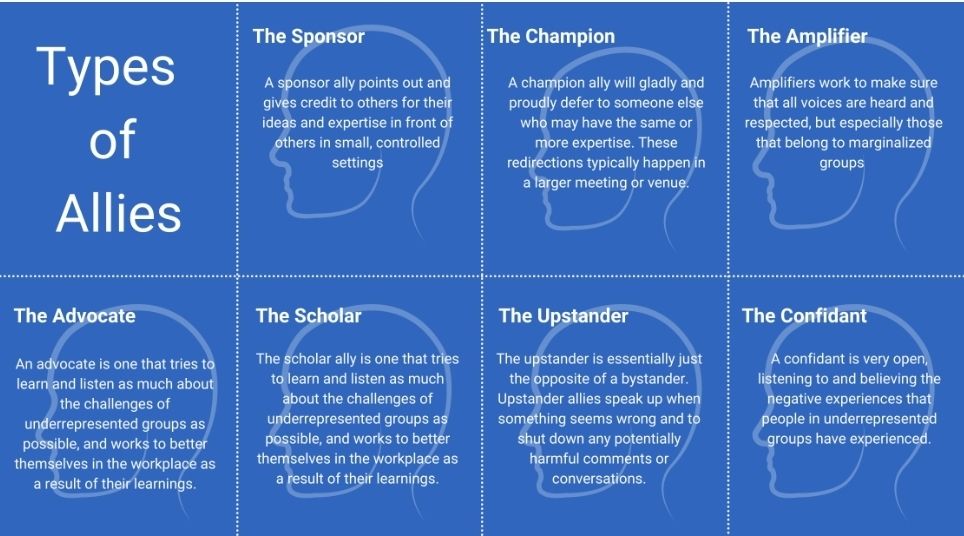
There are all kinds of ways to be an ally, but the most important thing is that you are consistent in your behaviour, and that you lead the way in behaving as you would want others to behave. Sometimes, the most appropriate kind of ally role will depend upon the situation and circumstance you find yourself in. Most types of behaviours, however, are ones that we should embed in all of our interactions. It is just good practice to acknowledge the work of others and give recognition of work done, so that it is recognised by everyone in the room. All of us should defer to individuals who have greater knowledge than ourselves, and hold spaces, so that the person with the most amount of expertise is able to fulfil that role. These behaviours are beneficial as a leader irrespective of scenario, but are especially important to ensure that those who are often overlooked, or silenced, are heard.

Consciously signal support

Finally, part of the power of leadership is the impact that conscious signalling of support can have, not just for individuals, but on changing culture. These can be small steps, like the inclusion of pronouns on your email signature, meaning that you are open to others sharing theirs with you in return. It can be something like wearing an inclusive lanyard or badge, that signals you are open and supportive. One of the big things for me is being clear that I am open to challenge and willing to learn and grow from my mistakes. I will, on occasion, mess up someone’s pronouns or name pronunciation, never on purpose. I will always try and clarify and act on the information received, but I am far from perfect. I want to accept criticism and correction, to hear it constructively and become better as a result. It is no good knowing you wish to be a safe space if you don’t let others know. People won’t give you constructive feedback if you don’t signal that you are open to the learning. Let’s make sure that we the only part of this conversation that is about us is on how we can do it better, in order to be better leaders, followers, and members of our communities.

All opinions in this blog are my own
Leadership: In the words of Wicked ‘It’s All About Popular’, or is it?

With the news of the Oscar nominations for Wicked Part 1 coming out, I thought  it was finally time to dust off this post that has been languishing in draft for over a year. I guess it will surprise none of you dear readers, that I am something of a musicals fan and Wicked is one of my favourites. I saw it for the first time on honeymoon in New York with Mr Girlymicro and knew very little about it going in. Whilst watching it, the song Popular rapidly became one of mine and Mr Girlymicro’s favourite tunes (alongside What Is This Feeling?).

The words have always triggered something in me in terms of thinking about leadership, especially the line ‘It’s not about aptitude, it’s the way you’re viewed’. With everything going on in the world right now, it feels like a really important concept to explore. Is leadership all just really all about being popular? And what does that actually mean?

When I see depressing creatures
With unprepossessing features
I remind them on their own behalf
To think of
Celebrated heads of state
Or specially great communicators!
Did they have brains or knowledge?
Don’t make me laugh!
They were popular!
Please!
It’s all about popular
It’s not about aptitude
It’s the way you’re viewed

So it’s very shrewd to be
Very very popular
Like me!

What’s makes someone popular?

I’d like to start this by saying that I don’t really think I would know what makes someone popular from first principles. If I was in a 90s school based movie, like Mean Girls or Clueless, I would definitely be the girl who hides out in the library rather than being an IT girl or one of the popular kids. So, I’m probably not coming from a position of expertise on this one. I have however put those library skills to use and come up with this from those with greater expertise:

This popularity doesn’t just impact how we interact with others, it also impacts how we are treated, opportunities that we are offered, and helps reduce negative emotions linked to social rejection. This may seem self evident but it is also backed up by research with one study defining popularity as ‘generally accepted by one’s peers’.

How we are perceived by others can, therefore, definitely impact on our working lives and likability, or popularity. Whilst how we are liked one on one is referred to as inter-personality, popularity is determined at the group, rather than the individual level, and is related to a person’s ability to make others feel valued, included, and happy on a more general level. The question is………is all popularity therefore about making others happy, and is leadership therefore all about attempting to make the most people happy in the widest possible way? Does getting ahead professionally mean that you need to be part of the ‘in crowd’ in order to succeed.

Is it all about people pleasing?

If you’ve seen Wicked, there is a great scene where The Wizard talks about how he wants to be seen. A lot of the plot across the entire musical is about superficial appearances rather than the ‘truth’. A lot of sub-par decision making within the plot is hidden behind the mask of popularity, and poor leadership is permitted because of the wide spread popularity of those making the choices.

I’ve written previously about the challenges of being a people pleaser and how it is impossible to please everyone. One of the challenges, in terms of leadership, is that if popularity is considered to be the way forward, in terms of being a good leader, you will be forced to chase good opinion rather than focusing on strategic or other vision. It also inevitably leads to your leadership being less and less authentic as you try to follow, not your central ethos, but a diluted version based on the perceived views of others.

What are the advantages of being civil?

So am I saying that it is not necessary to be nice? Just being ‘nice’ is often considered to actually be a disadvantage within work place settings, it is often good for making friends in a 1:1 setting, but as I’ve said popularity is determined on the group rather than the individual level. Within this context being nice or perceived as ‘warm’ can actually have a negative impact on careers, as warmth is often considered to be inversely associated with competence i.e. you can’t be nice and good at your job. According to Porath (2015), being seen as considerate may actually be hazardous to your self-esteem, goal achievement, influence, career, and income. So being nice alone is not enough. What does allow the switch from nice to being popular?

According to the same paper by Porath, it is about not being considered nice, but is actually linked to respect, and in this context civility, which comprises of both warmth and perceived competence:

“Civility is unique–—it leads people to evaluate you as both warm and competent. Typically, people tend to infer that a strength in one implies a weakness of the other. Many people are seen as competent but cold: He’s really smart . . . but employees will hate working for him. Or as warm but incompetent: She’s friendly . . . but probably is not smart. Being respectful ushers in admiration–—you make another person
feel valued and cared for (warm), but also signal that you are capable (competent) to assist them in the future.”

Civility, in this professional context, demonstrates benefits that being nice alone does not, especially in the context of leadership, where those who reported feeling respected by their leader reported 89% greater enjoyment in their work and 92% more focus. So maybe less about pop…u…lar and more about civ…..ili….ty? Or maybe they are one and the same thing?

Being able to be civil is itself a privilege

I do have quite a significant word of warning linked to this linking however and that is, is the ability to be civil linked to privilege? If being considered civil, and gaining the associated advantages, linked to not having to fight or voice unpopular opinions? Anything that requires warmth as part of the algorithm risks benefiting those who are in a position where they can court popular support, rather than feeling like they need to make a stand. Having the energy and resources to be able to invest in being seen as civil is in-itself linked to privilege. If you are working part time or under resourced, you are unlikely to have the time resource to invest in some of the relationship building needed to be identified as both warm and competent. There are also people who believe that they cannot invest because of the risks to their careers in coming off as warm without the associated benefits of being seen as competent. The costs in terms of income or self esteem are not ones that everyone can risk in case it goes wrong.

Is civility just another way of benefiting those already in positions of seniority?

Is it therefore that civility, and it’s associated popularity, are just another route that benefits those that are already in a position of privilege. Is popularity linked to status? Traditionally status is based on attention, power, influence, and visibility, rather than acceptance from peers, and so popularity may be more significant in informal vs formal leadership settings. This isn’t saying that senior leaders shouldn’t be civil, and that they shouldn’t come across as warm. It does mean that they are probably at lesser risk from the disadvantages and risks once they are in a formal leadership position, where they are able to draw upon different markers of power and visibility to gain influence. This can give the false impression that you need to be popular in order to be a senior leader, whereas the reality may be that you can afford to be popular as a senior leader as you are less at risk of any of the negative consequences of you only being viewed as part of the equation.

What is the difference between being nice and being kind?

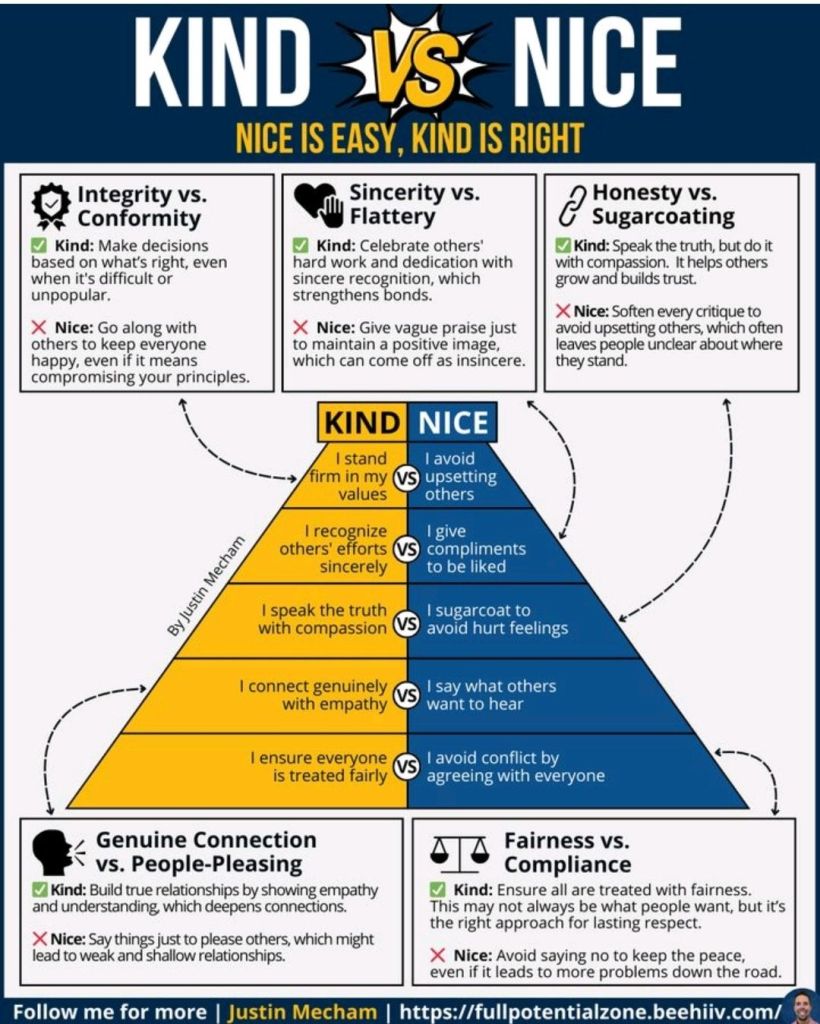
So, I’ve talked about being nice as not always a risk free move in terms of career progression, but what about kindness? I’m a massive advocate of kindness, but sometimes I wonder if people have the same understanding of the term as I do or whether they use it as a proxy marker for other things. For instance, we often talk about kindness and niceness as if they are interchangeable, but I’ve been wondering if the difference between the 2 is where the perception of warmth vs civility (combined warmth plus competence) actually sits.

I have certainly met people who believe that being kind and supportive means always being in agreement or always saying yes, whereas I believe that this is more acting from a position of people pleasing and being nice. In contrast I believe that sometimes the kindest thing that you can do is to say no, either because you’re not in a position to deliver what they want or that saying yes would put the other person in a challenging position. Nice can often feel right in the moment, whereas kind considers the wider, and sometimes longer term, implications.

How do we manage kindness in a way that is authentic?

Being kind can be challenging as it is not always about taking the easy route, sometimes it’s about making hard choices in order to help yourself, others or the organisation, to be the best version of itself. It can challenge some of the behaviours linked to people pleasing in order to move towards authenticity in terms of interactions and leadership. For me, kindness is very much about doing the right thing instead of the easy thing, but to really deliver on your values, you need to invest the time to understand what those values are first. What do we stand for? What three words would we assign to our core descriptors of self? Knowing what your core values are enables you to have a self check benchmark to help identify when we are being nice over kind.

Where does social capital fit in here?

Obviously, civility and kindness are not the only factors that come into play in the ‘popular’ discussion.  There are all kinds of other forms of social capital that can impact on how successful we are at network building, influencing and leadership. Especially in the world of science and healthcare, expertise comes into play quite significantly, and access to funding can never be under estimated, in terms of providing leverage and empowerment.

It is always worth being aware of, and investing in, all of these different strands for long term success. Having said that, all of these also require you to have the capacity to invest. As someone who can’t have children, and therefore have greater freedom to balance my work and home life, I’m aware that I probably wouldn’t have been able to build a clinical academic career if my life had been different. If I’d had to leave on time for school pick up or had to be lead carer on the weekends, I wouldn’t have been able to publish the papers or apply for the grants required. There is inbuilt privilege in my being able to prioritise my career at times. This blog requires hours every week. Hours that I enjoy investing and which I reap the benefits of in terms of networks and connections. These are things that I wouldn’t be able to do if I needed to pick up a second job or was caring for a parent. When we ask people to have these additional pieces of capital to progress, we need to be aware that we are putting barriers in place so that not everyone can make the most opportunities. We need to make the most of the tools we have available to us, but as leaders, we also need to understand how to support people to access opportunities in a way that doesn’t disadvantage them in relation to others.

Let’s not forget that leadership is hard

I think that one of the things that it is often easy to forget is that leadership is hard, in some ways, if it’s easy you probably aren’t doing it right or stretching yourself enough. Part of leadership is making the unpopular and challenging decisions, and sometimes there are no win wins. Being popular, being considered empathetic is always a nice thing but it is not the only thing that makes your leadership successful. So is it, in the end, actually all about popular? If you were to ask me it is instead all about authenticity. The key thing, from my perspective, is to let people know who you are, connect with people as much as possible and share/co-create the vision. Then they can make informed decisions about whether to get on board the Girlymicro train or not! On this one, I may be with Elphaba.

All opinions in this blog are my own
A Thank You to All the Cheerleaders: At the end of a tough 2024 my gratitude for all the support

2024 was always going to be tough. Wonderful colleagues were facing challenges on all fronts. Close family members were going through significant change. Things that were going to impact not just my ability to balance life and work but also how that life was lived were very obviously coming down the line. I don’t know about you, but as a planner, I sometimes find the anticipation of the bad ‘stuff’ almost worse than its arrival, and 2024 kicked off with plenty of anticipation.

Now the end of 2024 is so close I can almost taste it, and much of the ‘stuff’ has both come and gone, I find myself still standing and grateful for all of you that have supported in enabling this to be the reality.

As a result of this year, I have spent a lot of time thinking about what keeps me going, what I need, and what I’m grateful for. None of the answers to these questions were linked to productivity or achievement. The answers, as it turned out, were all linked to people and relationships. These people, connections, and relationships were the answer to all my questions and remain the foundation of my everything. So, for my last post in 2024, I wanted to put something in writing that says thank you and talks about all the reasons why you are my team and my cheerleaders. You guys are the best!

I don’t need to see you to know that you are there

When times are hard, or adversity strikes, it is easy to end up feeling isolated and alone. It can be tempting to disconnect and enter protective mode, where you share less of who you are in order to limit your exposure. One of the things this year has shown me is how fortunate I am to never really feel that way. I know that whatever the world throws at me I am not alone. I am so lucky to have Mr and Mummy Girlymicro in my life, but it’s not just them. I posted this time last year about the amazing close friendships I have with some of my girls. These people, who I may not have even managed to see in person this year, are still there supporting me, even if I haven’t had a lot of time to connect. I still know that they are there and are backing me. I know if I reached out and I needed them, they would be there in a heartbeat. I’m aware of the privilege of this, and I am thankful for it every day.

We don’t need to always agree

One of the greatest signs of trust in any relationship is feeling safe enough to disagree, whether it be in work, romantic, family or friend based relationships. In travelling uncharted territory, there is no rule book and often no guide for how to make decisions or choices. This uncertainty can therefore inevitably lead to differences of opinion about what is the right approach in any given moment. Being able to disagree and yet still feel supported whilst working through the disagreement, in an attempt to reach consensus or just accept difference, is a real blessing. Even more so if it can happen without triggering preexisting insecurities or feeling exposed to judgement. I am trying to make conscious decisions to value moments where I learn more about myself and others by going through these disagreements, whilst also knowing how fortunate I am to have people in my life who are a safe space for these moments to occur with.

You forgive me for making mistakes

The process of learning and growing is not an easy one, and sometimes we have to face difficulty truths about ourselves and our flaws. I am flawed. I make mistakes, like ALL the time. I’d like to think that I grow each time and try not to make the same mistake twice, but even that is not 100%. One of the benefits of learning from disagreements is that it helps to garner enough understanding from any negative outcome that results to help make better choices in the future. I am grateful to my wonderful colleagues, friends, family and readers of this blog, for not only forgiving me for making those mistakes but also supporting me in sharing my journey in learning from them, not only face to face but also in this blog. My hope is always, that by being open, I support others in making more informed choices as we are all learning together.

You lift me when I am low

This year has had some significant lows. It has has included the deaths of some significant figures in my life, such as Professor Nigel Klein, who had been a key part of my working life for almost 20 years. He was the person who supported me in my first steps in academia, who supported and supervised me during my PhD, and has continued to be a key figure in my clinical academic career ever since. Significant health challenges have been present for colleagues and family and this has hit me hard at times, even if I am not the person unwell. I’ve been feeling pretty mortal, and also powerless to help in any meaningful way. So many of you have been so kind and lifted my spirits, from sending memes or commenting on the blog, to unexpected treats from friends and family that have made me feel seen and loved. Having a safety net of people who are prepared to pick up the slack when I’ve struggled or to remind me that everything will be OK has been an invaluable asset in 2024.

You drive me to be the best version of myself

When the world is overwhelming, when everything feels too much, it can be so tempting to want to throw in the towel and just ride the wave. Having to try (and sometimes fail) to get this blog out every week and to continue to show up has been crucial to just keeping me going whatever my mood. There have been weeks when this blog hasn’t happened. There have been days when I haven’t delivered in the way that I would wish. I have certainly been too tired to step up and see people or do things on the weekends or in my free time. Knowing that there is an expectation of levels of engagement, be it from my PhD students, colleagues, readers of this blog, or family, has kept me going and kept me present. You support me in trying to be the best version of myself and to keep showing up in the best way I can in the moment. You support me in not just accepting but seeking out things that challenge me and keep me on my learning pathway. Hopefully, I then get to feed that back via this blog, and therefore the loop continues.

I know you would always straighten my crown without telling me it was crooked

We’ve all been there, we’ve sent an email or written a slide, and it’s not quite right. There are people who reply to you and give you a heads up so you can issue a no drama correction, and there are people who reply all or stand up at the end of the talk to point out your error. I count myself so fortunate to have so many people who sit in the former rather than the latter bracket in my life. This is a pretty basic example, but I’m hoping you see what I’m trying to say. I have so many people in my corner who will steer me back on course when I’m beginning to drift, or who will gently escort me from a conversation that I’m not in the right head space to have. People who know when I need saving from myself, from reminding me that having that dairy filled cake is not wise, to pointing out that I can’t physically manage to book myself into speaking at three conferences in different cities in a week. I know my well-being is at the centre of their actions, and having that safety net is of incalculable value to me.

We are in this journey together

When I made my first blog post in 2015 I didn’t even know what this blog was going to be. When I started posting regularly in 2020, I knew my why but I didn’t really know my how. Now, looking back on the last 200+ posts I feel like I’m more comfortable with some of the how. My next challenge is the where. I feel very much like I want to continue to grow and that this blog is a medium through which I can do that. I’ve learnt so much from the journey so far, but I am certain there is so much further I want to go. This year the blog broke 20,000 reads for the first time, and that makes me feel like we are in this journey together, wherever it might lead. I love seeing the interactions when I post. I love hearing your thoughts and feedback. I love feeling like this is something we are doing together and that I learn from you as much as you, hopefully, learn from my experiences. I don’t know where this road ends, but I know that I am determined to keep following it.

You understand that performance is not consistent

This post has been really hard to write for some reason. It’s taken me hours of staring at the screen, and I don’t know how well it will be received. Some posts spring to life, almost fully formed, and take no time at all to write. Some just make themselves harder work. I am pretty sure, therefore, that not all of them knock it out of the park. There are certainly ones that speak to some people more than others. Having spent some time thinking about it, I’ve decided that this is OK. As long as my intention is to communicate something, and I never post for the sake of posting, then how it lands is out of my control. The main thing is that I always try to do my best.

The same is true with posting frequency. I will always try to post weekly, but this year has shown me that sometimes I just can’t manage that. I used to obsess and spiral about it, and now I’ve decided that if I am not in the head space to write something worthwhile, I am better waiting until that resolves. I’ve been so grateful with the patience shown to me on this front in 2024 and that you have stuck with both me and this blog through all the random trains of thought and erratic posting frequencies.

You don’t judge me when I bear my soul

I try to always be honest in this blog. I try to share both the good and the bad, in a balanced but honest way. The concept of authentic leadership is important to me, and to fulfill it I think I need to show all sides of myself. I can only do this because I feel that I have built up a trust and feeling of safety in writing this blog over the years.

I remember when I first started to post things that were more personal, I used to brace myself for the comeback. I almost expected my confessions of inadequacy or failures to be weaponised against me. In all the 200+ posts that have been written, I’ve only had a single comment that could be considered to be less than supportive of my sharing, and even this was written (I believe) from a place that the author thought it would be helpful. As a result of this building of trust, I write from a space where I am comfortable sharing my lived experience without revision or overlay. I genuinely believe that this means that the sharing has much more value because of it. So, thank you for supporting me in getting to this place of confidence and comfort and always encouraging me to bring my full self to our interactions.

I hear you when you tell me this is valued

In my darker moments this year, when I was questioning a lot of the things that required focus or time, I reflected on whether writing this blog was something that was valued by anyone but me. Whether it was a good use of several hours of my time every week, when I didn’t have time for a bubble bath or other self care. Then every time I went to a conference I would have lovely conversations with people about the blog, and all of them were so positive, and inspired me so much.

Over the last year, I’ve even had people spontaneously mention it in meetings or 1:1 interactions. It’s hard to communicate how much this means. When I sit on my sofa and need to choose between pulling out the laptop to write or watching some trashy TV to unwind, it is these interactions that keep me reaching for my laptop. When I’m on the tube and I need to choose between closing my eyes and escaping into an audio book or doing some blog writing on my phone. It is the memory of these moments that keep me plugging away. Knowing that others value reading this blog, hearing stories in response to putting my experiences out there, make every minute spent worthwhile. So thank you, thank you for giving this blog meaning, thank you for showing the time invested has value, and thank you for taking time out of your lives to join me in this endeavour that means so much to me.

All opinions in this blog are my own
Tales of a Recovering Workaholic: Talking about the darker side of success

I’ve been thinking a lot about pathways in healthcare lately, from having conversations about T-levels and apprenticeships this week, to equivalence and Higher Specialist Scientific Training (HSST) posts. It’s made me reflect a lot on my own training pathways and the fact that the majority of the advice I received was that the only option, in terms of approach, was to work harder and do more. Now, don’t get me wrong, there is some merit to that, and there is also some truth, but I had it drilled into me that you can’t be successful if you do a 9 – 5. You must always do more. You must always over deliver. You must always be adding to and diversifying your CV.

This advice and approach has been key to me developing into the person I am now. I am objectively successful and so grateful for the support I’ve received along the way. I have the long dreamed of Consultant post, and my dream job. I was made a professor within 10 years of finishing my PhD. I’ve held multi-million pound grants and have over 50 publications. The other side of the coin is that, despite being exhausted, I can never sleep for the number of things I haven’t finished, and I constantly feel like I’m not doing or achieving enough. I’ve also written before about the impact of my anxiety levels when I’m tired or try to step away. So, as new starter season comes upon us, I wanted to take a moment to really talk about the messages we are giving our trainees, and ourselves, to think about how true they are for current training opportunities and what we can do better for those that follow us.

Let’s start with a bit of history and the messaging that we used to focus on as part of training

Goal orientated view of the world

During my first week as a trainee Clinical Scientist, I was sat down and told that it was an 11 year training scheme to Consultant, but it was up to me to put in the work and make it happen. Well, I worked pretty damn hard, including not having a weekend off at one point for 3 years, and it still took me 16 years. Does that make me a failure? I don’t think so. Does that mean that I should have worked hard to make it happen in 11? I’m not sure of how I could. In fact, I don’t know of anyone who made it happen in 11 years. Of the 4 of us who started, only 3 are now Consultants, and we were a pretty committed bunch. So were we all set up to fail?

The whole scheme was designed with that 11 year target in mind. I understand it from a strategic point of view. There are a lot of boxes to be ticked. Our situation was made even harder as there were only 3 years’ worth of funding for a scheme that required 4 years of professional practice to gain registration. That meant you also had to prove yourself worthy and useful enough that someone would decide to fund you for that extra year. Otherwise, everything had been a waste, and you would walk away unregistered and unlikely therefore to get a job.

My main problem with this approach is that it doesn’t really allow scope for exploration, and it really doesn’t allow time for creativity. It trains you into the ‘onto the next thing’ approach. I certainly had no time for celebration or reflection between stages. I was always trying to make sure that I was useful enough to remain employed, and in later stages, as it took me 13 years to be made permanent, I had to also ensure I was bringing in sufficient money to cover my salary so I would be kept in a job. It also means that when you finally do get all those boxes ticked and get your dream job, you are so trained into the tick box way of life that you are left searching for what the next box should be, rather than embedding and celebrating what you have achieved.

There is nothing that cannot be fixed if you work hard enough

When I started work, I used to read a book at my desk during my lunchtime, like I had when I worked at Birmingham City Council. It would always be some variety of fiction novel. I came into work one day during my first few months, and a pile of textbooks had been left on my desk with a post-it note suggesting that maybe I should read these instead. The implication, to me, was that it was not acceptable to have downtime, that any moment I had should be used to continuously work and improve myself. In short,’I must try harder’ ‘I must work more’ in order to justify the privileged position I was in. If I wasn’t going to lunchtime talks, the time should be used for other improving activities.

I also remember clearly listening to amazing female Healthcare Scientists talking at events about how, to achieve as a woman, you always had to work harder and do more than anyone around you. It was made very clear that it was required to constantly go above and beyond if you wanted to reach their position, if you wanted to succeed, if you wanted to make a difference.

The messaging has always been pretty clear. No matter how hard you are working, it probably isn’t enough, and you must work harder. Otherwise, you will fail and let everyone who had faith in you down, as well as yourself. If experiments fail, you don’t go home, rest and reflect, and come back tomorrow. You stay and set it up again. There were just too many midnight finishes to count during my journey to Consultant. If you want it, you will just work harder until it happens. I submitted my PhD a year early in order to achieve FRCPath whilst on my fellowship. At the same time, I took a PGCert in education because I recognised that it was important for my career path and my interests. Looking back, doing those three things simultaneously was foolish beyond measure. At the time, I thought I was just demonstrating that I had what it took.

Effort must be continuous

At the very start of training, I remember sitting over a bunsen burner crying. I was so ill, but no one around me ever took any time off sick, and it was just not considered to be OK. Eventually, I was sent home as I just couldn’t breathe, but it was very much ‘see you tomorrow’. Having an ‘off day’ was not something that happened. The hard earned truth I’ve learned to accept is that my best looks different from day to day. Some days, I could take on the world. Other days, I struggle to crawl across the line at the end of the day. Especially with a health condition made worse by stress, the idea that I can just ignore it, carry on, and always achieve amazing things every day is sheer madness. This was how I tried to work, however, and it took seniority and growing older to come to terms with the fact that this was just not achievable.

The thing about seniority is interesting. There is something about seniority and being able to give yourself permission to do things differently, which is worth mentioning. That’s not the real difference, though. I think the real difference is in the expectation setting. I try to be the person who gives others permission to acknowledge that some days are harder than others. Who checks why people are still there when they should have gone home. Doing this for others has the side benefit of reminding me that sometimes it’s OK to also do this for myself. It is not possible, nor is it necessary, to work at 100% all of the time. There will be days when you absolutely need to bring it, but there will be recovery days when what you should do is catch your breath, and if possible, do some reflection in order to make things better long term. A career is a marathon and not a sprint, after all.

There is no room for failure

This one isn’t just a work thing. It’s definitely a family thing too. My father is infamous for saying that no child of his has ever failed anything, and we weren’t about to start now when I was worried about FRCPath.

The Clinical Scientist training programme has always been competitive. Getting into the programme was competitive,  but even when you were in it, my experience was that the programme itself was pretty competitive. The people on it were used to being at the top of their class, and I experienced a fair amount of posturing throughout my first 4 years. Far from being tackled and a focus placed in peer support and collaboration, I feel like the rhetoric around the programme added to this. The focus on there not being enough places for us all to get posts when we finished, and the constant commentary on only the best of the best being able to get Consultant posts, placed us in direct competition with each other from day one. Therefore, you couldn’t talk about challenges for fear of disclosing weakness that would impact your future. That atmosphere is one of the reasons I’m so passionate about talking about the reality of the job on this blog, both the highs and the lows, as I didn’t have any way to normalise my experiences when I was training and in the midst of them. I hope posting will help others in finding a benchmark for ‘normal’ that I didn’t have.

Even on a day to day basis failure was not an acceptable part of training. To this day, I remember that one of my fellow trainees reported a NEQAS result (part of a quality control scheme), and she got it wrong. The result got reported, and the department lost a point on the national scheme. In reality, it should have been checked by someone else before it went out, but it happened. The virology consultant at the time never spoke to them again. We would sit in joint tutorials, and he would ask a question, he would then wait for my response even if I was just repeating what my colleague just said. He would respond to my answer but not theirs. There was never a review of what had happened and how the mistake had occurred. There was no acceptance of the fact that being part of a quality scheme is there to support learning and to identify where improvements can be made. There was just a long-term change in the way that trainee was seen and how they were then supported. It was a clear demonstration of what would happen if a mistake was made and that it would impact how your working life would be from that point on.

Quitting is not an option

The same trainee went through a hard time during her final year. She basically spent a lot of her time crying, and the response was that she was allowed to come in 30 minutes late. She started to see a therapist, and even though we never met, I owe that therapist a lot. Her therapist pointed out that in the three years she had been in post she had never been out for a cup of tea with a colleague, so she was given homework to ask someone out for tea, and she asked me. This was a real turning point for me. We went for tea, and we had a real conversation about the things that were both hard and good. It was the first time that I felt less alone. It was also the start of a conscious decision I made to take people off site for tea, to support better conversations, that I’ve continued to this day.

Later that year, she walked away. She made a decision to go a different way. It took enormous strength to do it, and even now, I have enormous admiration for her. Until that point, I hadn’t known anyone make a decision that prioritised their wellbeing rather than the CV tick boxing. The general attitude was that Healthcare Science is a small world, and you were incredibly fortunate to be a part of it. It was so hard to get into, and you had put in so much that you would be crazy to walk away. There was judgement linked to failed experiments, let alone walking away from the programme. Seeing someone break that mould was incredibly powerful.

The truth is none of these messages are entirely true, so how do we do a better job of messaging for current training programmes?

Training is just that, a learning programme, a time to explore, fail, and reflect on those failures in order to learn to do things better. If the messaging I experienced as a trainee now feel less than ideal, what messages should we be encouraging? I’ve been having a think and these are some that I would like us to have better conversations about:

We are more than the sum of our qualifications

Not everyone is going to become a Consultant.  Not everyone is going to get FRCPath and a PhD. You know what, that’s perfectly OK. It doesn’t stop you aspiring for those things if that’s what you want. However, our trainees are not in a Hunger Games style competition to be the last one standing. More than that, how good you are at your job is not dictated by how many qualifications you pick up along the way. Some of the most amazing Biomedical Scientists I know and have the privilege to work with don’t have a masters degree. It’s OK to be a brilliant band 7, and be satisfied and fulfilled by the role you have. Your qualifications don’t define your worth, and it’s OK to make choices that aren’t about playing CV bingo. It is also OK to decide that those things matter to you, you still aren’t defined by them. They have the value you choose to give them.

It’s OK to pause and reflect

No career is a straight path, no matter how it looks from the outside. There will be bumps along the way and the odd hill/mountain to climb. You will reach the destination better for it. You will be able to handle the journey a whole lot better if you allow yourself time to pause and reflect along the way. A big part of development is about making time to reflect on where you are and where you are going to, but also asking the big questions about whether those decisions and reflections you’ve made previously are valid for where you are now. You will be working for decades, and the decisions you make in your 20s are unlikely to reflect the decisions you might make in your 40s, so making time for active reflection isn’t a luxury, it’s an essential part of a professional career.

Knowing when to change direction requires courage

In many ways, I’ve been pretty fortunate, the things that I’ve wanted have aligned with my values and have stayed pretty consistent. This could easily have changed, however. I suspect that if I’d been able to have a family, my focus may have altered somewhat. Knowing when to change your focus or direction is important. This a balancing act between knowing when you just need to double down because things are getting difficult, or when you have truly shifted as a person and that you have to change direction to reflect this. Mentorship and coaching can really help with both this and the reflection that may get you to that moment. Acknowledging that continuing down a path ‘just because’ may not be the right thing and that it requires courage to sometimes jump off a cliff and make a big switch is a step that may require additional support.

Your value is not defined by your productivity

This is the one that I struggle with most and therefore know I probably fail to provide the best leadership around. I often feel that ‘I’m do what I say’ not ‘do what I do’ in this area. I often feel defined by my to-do list, and when that gets out of control, as it often does, I place a LOT of judgement on myself. The thing is, if I get hit by a car tomorrow, no one is talking about my to-do list failures at my funeral. I hope that they will talk about how I made them feel, and maybe even this blog. It is hard, but we can choose what defines us. You have that power. One of the reasons this blog is ‘Tales of a recovering workaholic’ is because I recognise I need to change, and I’m hoping to do a better job of playing this on forward and encouraging our trainees to be defined as well rounded individuals with interests outside of work. We need to encourage a holistic view of value in ourselves and others.

There is no prize for working the hardest

The biggest lie I felt that was embedded in my original training programme was that if you just worked hard enough and ticked the required boxes, the prize was there at the end of the race. The hard truth is working hardest does not get you the job. Ticking all the boxes makes the outcome more likely, but it doesn’t guarantee you anything. There is no prize for the most midnight finishes. Trust me, I’ve done enough of them to know. To a certain extent, the prize for working hard is more work. If you set the bar at working most weekends, then your work just expands, so you have to work most weekends in order to keep on top of everything. If you require external validation, like me, this can be a really dangerous game to get into. If we see this in our trainees or ourselves, I think it’s important to recognise and actively find other ways to find that validation before it becomes built in or results in negative consequences.

The next generation of trainees deserve to benefit from the experiences of those that came before, both in terms of knowledge and in learning how we could do it differently. The working environment has changed, as have our trainees and training pathways. By thinking more about our messaging we can make the work place right now more suited to where we want it to be, rather than relying on chance to make it better. Everyone has a role to play, but we, as leaders and educators, should be prepared to lead by example and own the change we wish to see.

All opinions in this blog are my own

It’s Me. Hi. I’m the Problem, It’s Me: Why being perceived as the ‘difficult’ one may just mean you’re doing your job

Over the weekend, whilst I was playing email catch up, Mr Girlymicro headed off do a museum tour with our long-term friend. Whilst he was wandering he fell upon part of the Taylor Swift songbook trail and sent me this picture:

Now, everyone globally now seems to be a Tay-Tay fan, but she and I go all the way back to FRCPath revision tracks. I’m currently obsessing about the track Anti-hero, which has the following bridge:

It’s me, hi, I’m the problem, it’s me (I’m the problem, it’s me)
At tea time, everybody agrees
I’ll stare directly at the sun but never in the mirror
It must be exhausting always rooting for the anti-hero

Whilst working on a Saturday, when I would have preferred to be the one taking the photos in the Victoria and Albert Museum, these words really struck a cord. I was making my way through over 2000 emails, and it’s true, I am the problem, it is me. I am the one who apparently spends most of her time asking the questions people don’t want asked or holds the line saying ‘none shall pass’ (and not in a cool way like Gandalf).

This can feel really soul destroying. It can be hard to be perceived as the person ‘who always says no’ or the person ‘who is just being difficult’, especially when you are undertaking that role with patient safety and the best practice of all involved as your priority. So for this week’s delayed post I thought it might be useful to remind myself, and you if you need it too, why sometimes being difficult just means we’re doing the job we’ve been employed to do.

Needing to understand before agreeing

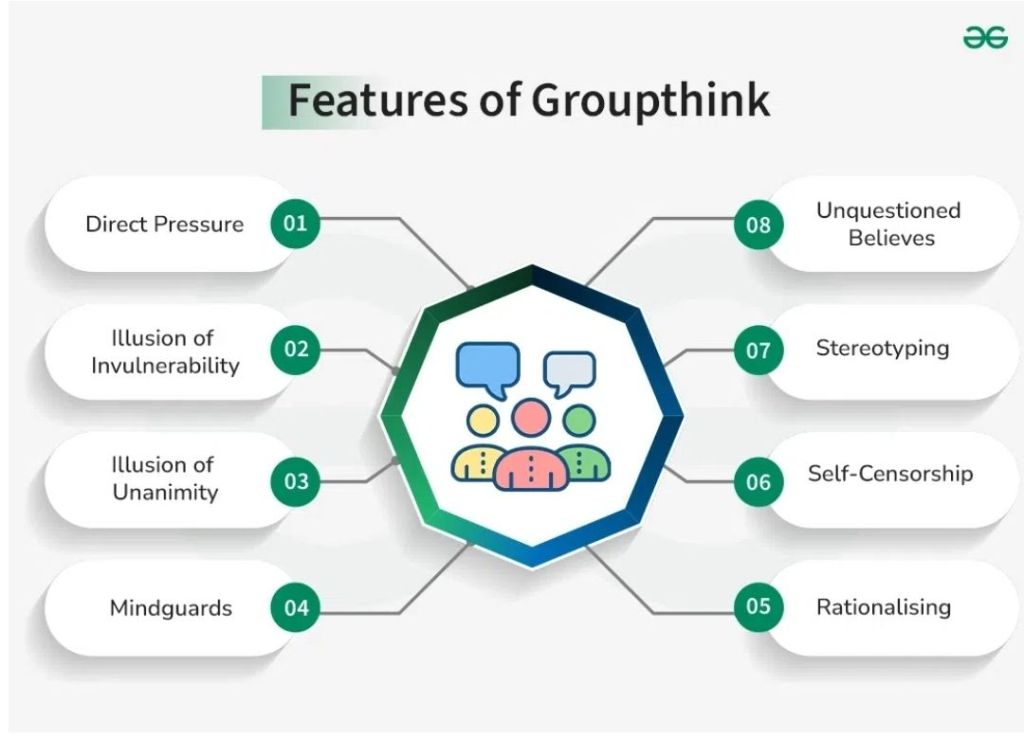
I’ve talked before about how important it is to understand what your role in the room is. Are you there as an advisor or a decision maker? Either way, I’d like to think it is crucial to understand what is being suggested in a thorough way before either advising or making a decision. This is important as Group Think is something you can see happening in a lot of rooms across the different types of spaces I work in.

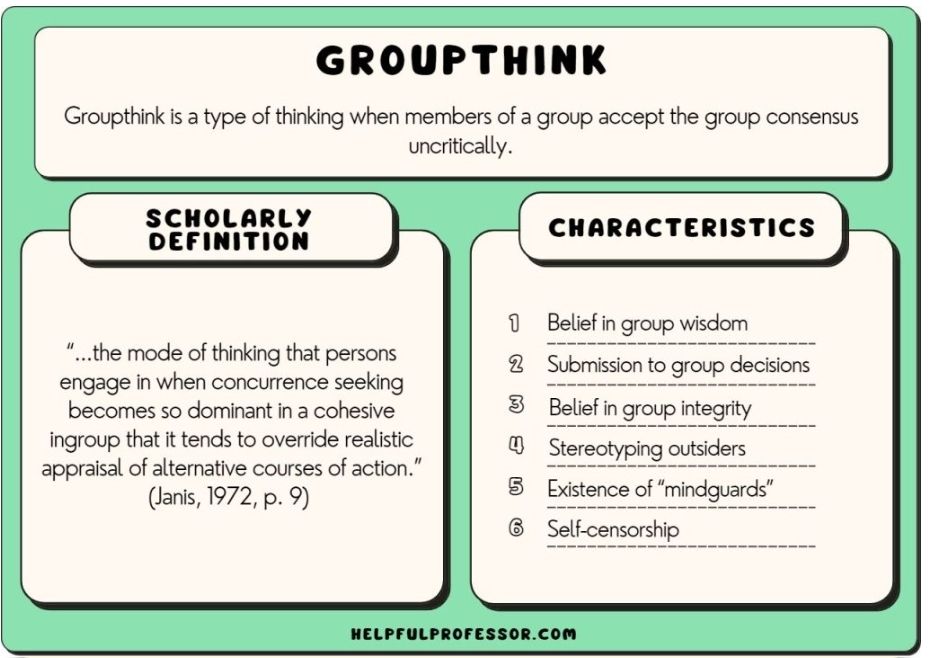
Groupthink is a phenomenon that occurs when a group of well-intentioned people makes irrational or non-optimal decisions spurred by the urge to conform or the belief that dissent is impossible. The problematic or premature consensus that is characteristic of groupthink may be fuelled by a particular agenda—or it may be due to group members valuing harmony and coherence above critical thought.

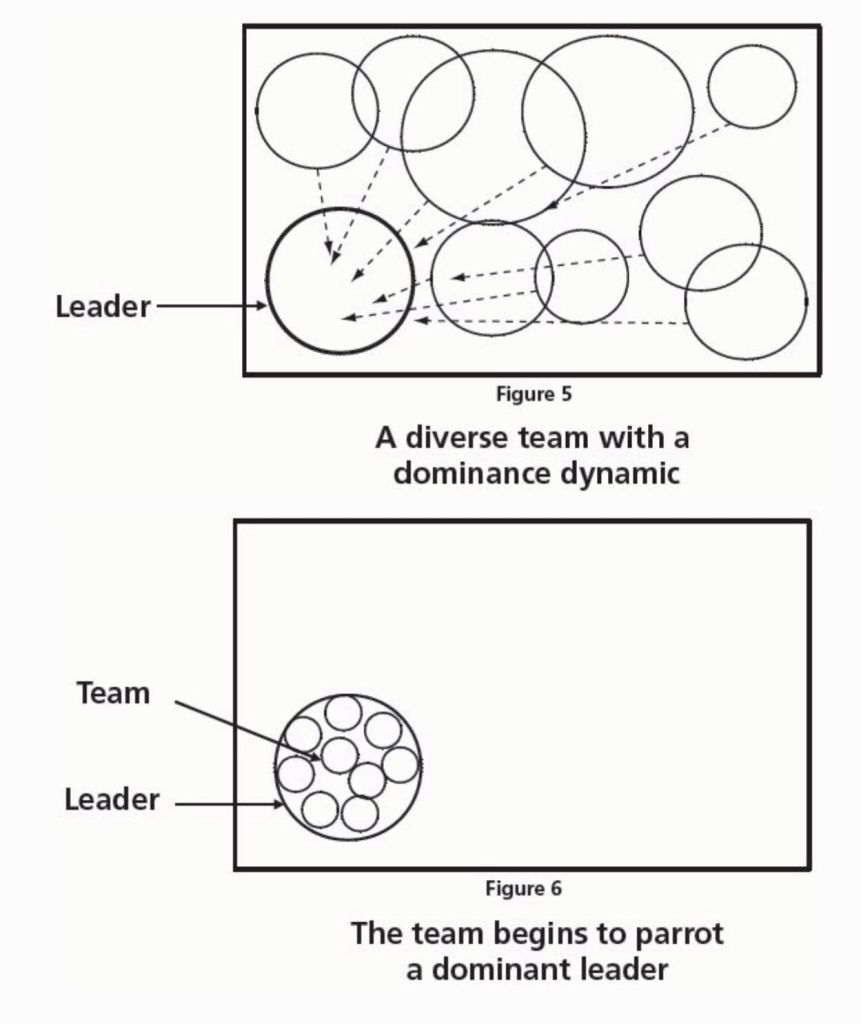
We’ve all been there. There is one dominant or senior member in the room, and they speak first. Instead of engaging in discussion or unpicking the components, other people in the room then just agree. This unchallenged agreement can come from all kinds of individual drivers:

  • Not really being engaged in the issue
  • High levels of respect and low wish to challenge
  • Avoidance of challenging as may impact on relationship capital
  • Lack of understanding combined with a wish to not draw attention
  • Absence of empowerment to question
  • Time pressures

There are obviously plenty of other reasons, and every group is slightly different. What doesn’t change, however, is that if we are in the room, we have the responsibility to ensure that the evaluation process is as effective as possible, and sometimes that requires us to be the ‘difficult’ person who drives the discussion to go that bit deeper before decisions are made.

Asking the annoying questions

One of the key ways to drive discussions to a deeper level is through the use of questions. These can help in the obvious ways to gain a greater understanding of process, evidence, or data. They can also help in other ways by increasing your understanding of the drivers behind positions and eliciting responses from those who are participating less actively.

The way in which this is done can be very audience dependent. If a rep from a company comes to see me selling a product, I will feel I am licensed to ask probing questions linked to their evidence, as they have come to me and my job in that space is to thoroughly evaluate their claims. In a room where I may not fully understand a process that is being suggested, then my questions will be aimed at clarity and come from a place of curiosity so that I can feel I have everything I need to comment. I’m quite far past a fear of looking stupid at this point. I’m OK with appearing foolish as long as it gets us to the right place. Questions are key to avoiding group uncertainty and Group Think, so buckle up, we may be here for a while.

Standing against the tide

This all sounds pretty straightforward, right? Sadly, I’ve been in rooms where it has been anything but. There are quite a lot of ways where meeting structures themselves can be manipulated, either by design or unintentionally, to make discussion and questioning difficult. A really simple example of this is the allocation of timings to agendas. This is, in general, a really great thing and allows significantly improved Chairing of a meeting. If an agenda item has only been given a 5 minute slot however, it is unlikely to get a decent level of discussion associated with it. It can then require commitment and bravery to ask the Chair for it to be re-tabled at a later date with increased time allowed. Chairs, in meeting settings, are key to facilitating good decision making. It is a hard and often thankless job. The problems really tend to happen when your dominant voice is also the Chair and doesn’t recognise the need to flex their style whilst they are in this different role. At this point making requests to change agendas, or increase discussion time can be challenging, as it depends on the Chairs appetite to support.

Pointing out the obvious

Earlier in my career, I sat in many of a room where I felt I could see obvious flaws or issues, but kept quiet as everyone else seemed OK with it, and I therefore felt I was just missing something.  I’d then leave the room and point out what I’d noticed, and invariably, someone else in there had been thinking the same thing, but was also reticent to speak up, or saw things differently after the discussion. This taught me how important it is to own your role in the room. If you are there, you have a responsibility to understand and then speak up if needed.

This isn’t easy. It isn’t comfortable. If you don’t do it, however, then you are complicit, and you have to own any negative outcomes. I find this one particularly hard when you are pointing out fundamental flaws in a passion project or where others are highly invested, and therefore may only be seeing the positive aspects rather than a holistic view. Being the lone voice in this setting can be incredibly hard, but that doesn’t make it any less necessary and probably makes it more important.

Holding your ground

I’ve been called a lot of names for trying to ensure the best possible outcome, with difficult and obstructive probably being the nicest version of them. The thing is, I’m never doing this for the sake of doing it. I welcome innovation. I’m excited by change. I’m not interested in either at ‘any cost’, especially working in healthcare. For example, adding a beautiful ‘green wall’ makes complete sense from a mental health point of view, but no sense from a patient risk perspective in an immunocompromised setting. My job is to articulate that, and both draw and hold the line where needed. So, sometimes, I can be pretty intransigent on the big issues. That’s because big issues can have big consequences if we get them wrong, and my role is to put patients before my ego or comfort. To me, that’s what working in Infection Prevention and Control is all about. I suspect it’s also why I don’t get sent boxes of chocolates from other departments at Christmas.

Keeping others to account

One of the other reasons it’s important to be able to hold your ground and bring discussion to the table is that Group Think is not just how you react as part of the table, it’s about how the whole group is working. The way groups develop and work changes over time, as there are different phases of group formation, according to Tuckman’s model:

  • Forming
  • Storming
  • Norming
  • Performing
  • Adjourning

Depending on where the group is, in terms of its development, can influence how comfortable members are with communicating, but also how at risk of Group Think the group is.

Being a conscious participant in this process so that you can raise awareness of how well decisions are being made and how the structure of the sessions are set up to, either to help or hinder, is a key responsibility of being part of any group. Groups can become pretty toxic or non-performing, but they tend to do so by inches, and that sometimes means it takes time to notice or a big act/decision for it to become apparent. 

It takes bravery to stand out and be the one who says that things aren’t working well, but it is better than becoming complicit in the process by knowing and not doing something. It can be even harder during the initial phases of a group becoming less effective, as this is often more of a feeling than a tangible change. Finding the right time and the right way to talk about it is therefore key. I often think that it is, at times like these, encouraging an active group effectiveness review is a good way to start, where you look at what the group is trying to achieve and how well they are achieving it, combine with some anonymous survey questions to capture the ‘feeling’ component. Building these reviews in from the start at period intervals can also enable any creep to be captured without relying on individuals to put their heads above the parapet.

Speaking your truth

I know I’ve said this before, but sometimes, at its most basic, it’s OK to disagree. You are allowed your opinion,  and you shouldn’t have to feel silenced, or that your opinion doesn’t matter, just because you are not the most senior/dominant person in the room. You and your voice matter.

I had an interesting conversation with a colleague a few weeks ago who pointed out that from their perspective, we never agreed. Now, putting aside the dialogue about whether this is true, I don’t think that disagreement is a fundamentally bad thing, especially if it’s handled with mutual respect. We don’t want clones of each other in a room. We want diversity, we want different lenses and visions of the world, we want different lived experience, and different ways of thinking. It is only through that constructive challenge that we may find the route forward that no one can see on their own, or from their own perspective. Good discussion, good collaboration enables us to make better decisions, that’s why we have groups in the first place.

All of this is a long way of saying that I think it is crucial to speak your truth, to offer your opinion and insight, as long as you don’t believe it is the only truth or way forward. It’s OK to be the person who disagrees as long as you are doing it for the right reasons.

Keep it classy

This brings me on to the fact that I think there are different ways of handling how you speak up and associated discussions, and they can impact how the situation feels for all involved. One of the reasons that I think it’s important to start with curiosity and questioning, is not only to gain information, but to show you are not starting out with judgement. The other thing that I find helpful is to keep the focus on the task, process, object in question, rather than letting it drift into me and them territory. This can be so hard because people are often deeply invested in their position and view points. I’m no different. It can also be hard as it can feel, when someone is questioning, like the individual is being attacked rather than the item in question. This can lead to an emotional, rather than logical response on all sides and mean that discussions become much less productive. Being aware of this and how choices of approach and word selection can impact is crucial to outcome.

One of the reasons that I’m emphasising this, is because when we are worried about speaking out, we, at least I, can work myself up prior to it happening, because I expect the worst. You can then enter the scenario is a defensive stance, when really you need to focus on being as open as possible in order to facilitate the discussion. The balance between openness and holding the line can be a difficult line to walk, but both are important. I’m still learning and trying to be better at this one, but where you can, leave your emotions at the door.

Keep the faith

At the end of the day, when you get home and look at yourself in the mirror, you need to be able to face what you see. For me, although I’m a people pleaser, I also know that I need to put that aside and be OK with being uncomfortable, in order to deliver on my role and ensure that patients are the constant focus. Does that mean it is easy? No. Does that mean I should stop doing it? Hell no. Nothing in this life that is worth doing is easy. Do I sometimes wish that others would appreciate what it takes to sit as the lone woman in a room and voice an opinion that does not align with the rest? All the time. No one is going to give you a medal for the kind of bravery this takes however, the reward is knowing that you left things just a smidgen better than how you found them. So keep the faith. Keep the faith in the system, but most of all, keep the faith in yourself. You are able to make great change and achieve great things, you just have to keep going, keep moving, one step forward at a time.

All opinions in this blog are my own

Understanding the Scope of Our Influence: Why we have to stop trying to ‘fix’ everything

I was having a retro moment recently, and I happened to hear The Mending Song from Bagpuss. It landed with me in a way that it hadn’t before. Many of us are ‘fixers’, that’s probably the reason we ended up working in healthcare. We are focussed on trying to make everything better, be that people, organisations, cultures or situations. There is no challenge that many of our ‘fix it’ nature’s won’t try to tackle.

This seemed especially poignant, as I posted last month about approaches when work life becomes challenging. A key aspect that struck me when I was writing that post was about really understanding what sits within our scope to impact and what doesn’t. There’s a really clear reason why it is important to understand this. If the thing you are trying to impact or ‘fix’ is outside your scope of impact or control, no matter how much you want it to be otherwise, you are setting yourself up for failure if your success criteria include change. You are setting yourself up for disappointment, stress, and frustration before you even start. This doesn’t mean that you can’t work to change your scope of influence or set a different set of success criteria, but that is really a different thing. If just just dive right in there, without first addressing this fundamental barrier, all you will impact is your blood pressure.

We will find it, we will bind it We will stick it with glue, glue, glue We will stickle it, every little bit of it We will fix it like new, new, new.

So, how do we understand what is in and out of our scope to impact or control. Well, there are layers to this, and it does truly depend on whether you are trying to influence or whether you are going as far as trying to control.

In terms of true control, the only person is we can exert that on is ourselves. Trying to control anything else sets us up for failure. So why did we try?

Impact and influence are a bit different. I think deep down we know the piece about control, but we are less good at having the conversation with ourselves about impact and influence. We start trying to ‘fix’ things and then see ourselves as failures when it doesn’t happen. The years during and since the pandemic have been a real life lesson in this area for me. So, in this post I’m going to talk about 6 areas where I’ve sought to undertake ‘the fix’, failed, and learnt why I’d set myself up with expectations that could not be achieved.

You can’t always ‘fix’ people

Throughout my life, I have been a somewhat collector of lost souls. From early boyfriends to PhD students who have had supervision issues, I’m a real believer that we should always be there for others and take situations as we find them, rather than judging based on hearsay or prior scenarios. Before I get started here, I’d like to say that I still strongly believe in this. What I have learnt the hard way though is that a certain percentage of time, the prior experiences of the person are so strong that patterns cannot be altered. If you take the open door approach, there will, therefore, be times when you can’t change the outcomes in the way you’d like.

When this happened to me recently, I wasted a lot of time agonising about what I should have done differently, where my flaws were in terms of response, where I had failed. I have come to realise that that time was wasted emotional energy that removed my focus from other important things. Don’t get me wrong, I think active reflection is always important, but there is a difference between that and entering into a self flagellation pity party. One is essential and productive, and the other leads to spirals and self recrimination.

Once I exited the spiral I realised I had fallen into thinking I had control rather than understanding my influence on another person, especially a person who is not a close friend or family, is always going to be highly limited. You can offer support, and you can change environments within your influence, but the person who actually has the control is the individual you are aiming to support. The work has to be done by them and not you. You can’t work harder as a surrogate for them.

As a result of this, I’m trying to be much more self-aware of where my control actually sits and using this to support my thinking in terms of boundaries and expectation setting. I’m giving myself permission to avoid entering into relationships that extend beyond support into ‘fixing’ territory. I’m also learning that this is important in maintaining my mental health and well-being. It is hard to see how badly those can be impacted until the situation is resolved, but I can’t help anyone else if I am not in a good space, and so sacrificing my mental well being is actually a short sighted response that leads to no one getting a good outcome in the end. It feels selfish, but sometimes you have to put yourself first.

You can’t always ‘fix’ situations

There are plenty of times when people come to you as someone in a leadership position and want you to ‘fix’ something. Sometimes, this is possible, often, more often than I’d hoped, you can make or help someone to make a step, but the ‘fix’ is out of your control.

On a large scale, I have previously written about some of the decision-making  during the pandemic. It was a really humbling and eye opening experience to discover how quickly scope of influence can expand and contract, and how much that scope of influence changes based on whether you are currently acting in the role of decision maker or not. Having people come to you and advocate for vastly different positions, combined with actually having a time limited ability to influence, made me realise how important it is to face up to the reality of where your scope lies. It also made me realise how much you may need to review where those zones lie in rapidly changing situations. Relationships and scopes of influence are never static and so always require periodic review, but this is even more important in changing or high stakes situations.

On a one to one level, I often experience this, not about organisational but about individual situations. A common one is the ‘I want to do a PhD’ approach. This happens multiple times each year. Sometimes, people just want more information about the pathway or what the options are. I’ve written a blog about this as I get asked the question a lot. Other times, it’s framed more like ‘what can you do to get me a PhD?’. In these circumstances, I give the information, but I often get stared at towards the end as if I’m not delivering. I then have to enter the discussion that acquiring a PhD is a self driven process and needs the individual to drive it. The same is true with a lot of postgraduate training pathways or career opportunities.  I can help and support, but I can’t do it for them. I can’t ‘fix’ the holes on CVs that need filling. Only they can do that. I can open doors, but they are the ones that need to choose to walk through them.

You can’t always ‘fix’ injustice

Sometimes, when I’m approached, it is about a situation, but just on the surface. When you dig deeper, it’s not about someone not stepping up and doing the work. It’s about a whole bunch of barriers they didn’t know about or haven’t been able to fix. Individuals either then reach out or I become aware, and of course, what I want to do is ride into those barriers, sledge hammer swinging, and break them down to bring equity and justice to the situation. This is definitely one where I thought, and do, have more influence over as I get more senior. The sad news is that although I can do more, I’m discovering I still can’t ‘fix’ everything.

I have a great number of examples on this one, anything from male colleagues not having to apply for or be interviewed for roles when female colleagues are made to jump through hoops, to scientists getting paid a third less to do the same jobs as medical colleagues. I wish I didn’t have so many, but if I started listing, I would be here all day.

So if I can’t fix it, what are my other routes of action. Well, firstly, writing things like this blog enables me to shine a light and at least raise awareness of the injustices I can’t ‘fix’. Then there are a whole bunch of active positions I can take with my leadership, even if the issue is too big for me to ‘fix’ alone. Actions such as advocacy and saying people names in rooms where they are absent in order to increase access. Being brave enough to call things out as they happen, challenging that misogynistic, racist or homophobic comment in the moment, and taking a stand. Being accountable and actively demonstrating my values, and by doing so, hopefully offering a safe space to those who might need it. Being there to support, whilst acknowledging that no sledgehammer wielded by a single person is going to be enough, so you have to lift up others so you can hammer those walls together.

You can’t always ‘fix’ cultures

Organisational cultures bring with them different values and different aims. They are complex and act almost like living beings, in that they develop and change over time. If ‘fixing’ individuals is difficult, then ‘fixing’ cultures can come with mind-boggling complexity.

One of the things I’ve found challenging is when I’ve been part of a group or organisation which started off with values that were completely aligned with my personal value set, which is the reason I joined, and then morphed into something where those two things were far from the same. It is also complicated even further when the espoused values do match, but the values demonstrated by the group decision making tell a different story.

There are a few different choices I’ve made at various points in my life and career, depending on how much continued participation mattered to me. The big one is always do you stay or do you go. Do you stay and try to influence internally, or do you call it quits and move on to something that is better aligned. The right decision, for me, is based on a) how committed you are to the purpose of said group and b) how much influence do you have to affect the change you want to make?

Large-scale organisations are even more complex as they not only have an overall culture,  but they will also consist of a number of smaller subcultures, which may be easier to change or influence. I count myself fortunate to be part of a team that I feel is super aligned with my values and beliefs. It hasn’t always been that way however. I’ve been part of other teams that haven’t been the same. On one occasion, many moons ago, my then team mates and I even had to escalate that we would leave if a change in leadership did not occur as the disconnect was so pronounced.  This was one of the most powerful examples of collective action I’ve been involved with, and it succeeded because our point of escalation was also aligned to our values and purpose. Knowing your scope of influence and the landscape you are navigating can therefore be incredibly powerful,  but understanding that scope is key to success.

You can’t always ‘fix’ the way others see the world

Firstly, and I cannot say this strongly enough, just because someone holds a different opinion, view, or vision of the world to you does not automatically make them wrong. There is room for diversity of thought in this world, and the very presence of that diversity makes us stronger as a whole. This is especially true when that diversity of thought is not causing anyone harm and drives us to better evolve our thinking in response.

The ‘not causing harm’ component of this one is key for me. If that world view is harming others by restricting access to care or opportunities, for example, I will always endeavour to challenge, as already discussed. What I’m having to learn, though, is that that challenge does not necessarily lead to changes in behaviour, no matter how many facts you put behind the discussion. Human beings are complex, and they have both intrinsic and extrinsic beliefs. Sometimes, it’s not even those that are proclaiming their beliefs that are the ones who are most firmly set in their world view and then it can be difficult to even identify where to start your discussions.

I think accepting our scope of influence in these cases is crucial to understand in order to not get disheartened.  In a world of spiralling conspiracy theories and loss of faith in science, it is important to know that it is not just a case of sitting someone down with a bunch of evidence and having a single good discussion. Changing someone’s beliefs or understanding of the world requires you to understand where the origin of those beliefs lies, and it may be no where near as obvious as we’d like to think. Additionally, long-term change is usually not seated in facts but in emotion, and that’s a whole different ball game that we may not be equipped to play.

Interestingly, for me, this ‘not causing harm’ component also extends to harm to self and links nicely back to not being able to change individuals. I’ve had people I’ve thought of as friends, who were so locked into self-destructive patterns of behaviour, based on their view that the grass was always greener elsewhere, that they couldn’t stay in any one situation long enough to start to ‘fix’ those patterns. I discovered the hard way that no matter the presented evidence you couldn’t get them to see the world in a different way. Sometimes, an external lens is just what someone needs to see themselves enough to spark change. Sometimes, that view is just so alien that discover you are not even speaking the same language.

You can’t always ‘fix’ yourself

Talking about changing people, we are not ourselves above having the same light cast upon us, and in theory, this is the one area where our scope should include control and not just variable levels of influence. The problem with discussion about ‘fixing’ ourselves is the mistaken assumption that some form of perfection can or will be able to exist. I have to tell you, as a recovering perfectionist, there is no such thing, and this is one of the biggest lies we tell ourselves. Worse than that, by aiming for such a lie, we set ourselves up to fail, over and over again.

None of us are, or can be perfect, we are constant works in progress. Perfection indicates some form of static existence,  whereas that cannot be the reality. Life is change, and we need to change and adapt with it. We learn and grow, and with that comes failure and the ability to do better next time. So my view on this has become: accept your flaws, and own your areas for improvement. After all, we are humans, not machines. The most powerful thought that I’m striving to embed is that I need to acknowledge there is sometimes beauty in both the flawed and the broken. If it is necessary for me to ‘fix’ parts of myself, as part of striving for improvement and healing, it is because I am better for it rather than because of punishing myself with the myth of perfection.

The one thing I hope we all take away from this blog is to not confuse the reality that change is outside of our area of influence with powerlessness. We always have the power to change. To change ourselves, to change our scope of influence, and eventually, if it matters enough, to work towards collective bigger change. Until then, treat yourself with the compassion that you would offer others and learn to not set yourself up for failure and distress by understanding where your current boundaries and influence lie. Stop trying to ‘fix’ what cannot be fixed, and try learning to love the flawed and different when it is right to do so.

All opinions in this blog are my own

Reputation is Everything: Why reputation matters & how reputational attacks can create shock waves

It’s not something that comes up in conversation on this blog very often, but I’m a bit of a swifty. Watching the Taylor Swift in the Reputation concert video is a happy place for me, I often watch it on my commute when I’ve had a challenging day, and the music forms a staple of my ‘get psyched’ mixes, along with a fair share of rock and big band music.

Now, for those of you who have yet to discover this particular joy, there is a speech she makes linked to why we worry about how we are perceived and the impact of having a ‘bad’ reputation that really lands with me:

“For example, having a bad reputation in our mind could get in the way of finding real friendship, real love, real acceptance, people you really fit in with because you think what if they have heard something about me that isn’t true, what if they’ve got these preconceived notions about me that they heard from gossip and then they never want to meet me and then we’ll never know what could’ve happened,” she continued. “And I think that’s why some of us…meaning if not most or all of us are sort of afraid of having a bad reputation because we’re so scared of something fake, like gossip, or a rumor about you or a name you got called getting in the way of you finding something real.  And so, when it comes down to that fear and that anxiety, it’s just all really delicate,”

Taylor Swift – Reputation Tour 2018

There are many forms of reputation:

  • Personal
  • Professional
  • Organisational

I think there are a couple of reasons why anything that impacts reputation is so powerful. The first one is that both trust and reputations take a long time to build and can be destroyed in the blink of an eye, depending on the scenario. Another is that, I believe, at the core of our being most of us want to be liked, and having someone affecting how we are perceived can directly impact on that. Finally, it is difficult to know how to respond to situations that influence our reputations.  We say ‘stick and stones may break my bones, but words shall never hurt me’, implying we should rise above it, but we also say ‘no smoke without fire’, implying there is a burden of proof upon us to correct what is being said.

I think, depending on who you are and the circumstances, the impacts on different types of reputation may not feel equal. Now, I went to a girls school, and one of the reasons I’m glad to no longer be a teen or in my twenties is because I’ve learnt and grown so that personal reputational attacks in general have a lesser impact on me. I would love for everyone to like me, but I know the reality is that this will never be the case. Although often highly impactful, personal reputation attacks can often be dealt with by removing the individual from your social circle. You often have the choice to interact or not, and the other members of your circle often know you well enough to not listen too closely.

What I have found more challenging are circumstances that impact my professional reputation. For a self declared people pleaser, like me, the thought that someone could lead you to be a scenario where you were perceived to be difficult, mean, or destructive, is particularly stressful. This is doubly so when you have a very particular set of values, about being collaborative, supporting others, opening doors, and being patient focused, and the commentary indicates you are anything but.

There’s a movie I love called Gossip, most people have never heard of it. It starts with a group of college students running an experiment where they create some untrue gossip and then track how far it spreads, how it evolves, and the impact. Needless to say,  it doesn’t end well. Now, I’m as guilty of gossip as the next person. We all want to feel in the know and to almost feel special by knowing something others do not. There’s a bunch of research about why this is. Gossip in real life, just as in fiction, isn’t harmless however.

Although gossip is bad enough, I feel there is also a significant difference between gossip and the escalation to deliberate character assassination or attempts to damage the reputation of another person. The weaponisation of reputational attacks, or even the threat of them to gain leverage, can be one of the most stressful things I’ve encountered in my professional career. Partly because they tend to come as a complete surprise to those targeted, but also because it’s difficult to know how to respond whilst in the midst of it. I’ve seen this happen to others and been a (somewhat) minor victim myself. Having hopefully come out the other side, I wanted to capture my thoughts for anyone caught in a similar situation in the future.

You may not escape the fallout

The first thing to say is that I am always a fan of taking the high ground and not engaging. Engagement can just end up adding energy to the situation rather than letting it burn out. It is important to note that taking this sensible higher ground approach may not mean you escape reputational damage, however, at least in the short term. You need to be aware of the fact that a time may come when you do have to address what is happening, and you may need to have a plan for how you will do so. Hopefully, it will never get to that point, but like with many things in life, preparation is key.

You have to remember the long game

One of the reasons to start out with a policy of none engagement is that most of the time, this will just turn out to be a blip and nothing more. Something you will look back on in a few years, possibly sigh, but see as a learning experience and nothing more. Professional careers span decades. Sometimes, it’s very easy to be caught up in the now rather than seeing it in that context. No matter how bad it feels in the moment, you need to ask yourself: how will this feel in 6 weeks, 6 months or 6 years? Very often, with the distance of time, it won’t feel anywhere near as bad, and that is the context you need to hang onto.

You have to faith in those that know you

It can be pretty shocking when you first hear reports of things being said that could impact how you are seen by others. It can be easy to feel like you should rush in and respond, but as I’ve said, for many reasons that is unlikely to be the best option. During what can be an unsettling time, it is important to remember that nothing really has changed. You have had professional relationships with many people ahead of this moment, relationships built on mutual trust and respect. These relationships haven’t changed, and you have to have faith in those people who know you and know the value you hold. Never let a single moment devalue everything you have already built.

You have to believe in the system

We work within systems, systems that provide individuals with routes for escalation and complaint. It’s incredibly important that everyone has the opportunity to feel heard. Everyone has their own perception that is unique to them, and those perceptions are real, even if they don’t match our own. This can be hard to accept when that variance in perception means that we feel attacked, or worse than that, if it feels that there are other drivers behind the responses that mean they are less genuine. The harsh truth is that it doesn’t matter. The system is set up, crucially, so that individuals can pursue making complaints, and this is an essential part of parity and fairness. If actions are taken that are erroneous, you have to believe that the requirement for evidence and facts count. That truth will out. Even if it takes a little time.

You have to try and not get sucked into the whirlpool

Whilst rumours/gossip/complaints are swirling it can be easy to get sucked into the drama and the emotions of it. It can be easy for those voices to be the voices that you carry with you and for you to only hear them in your head, not the ones of those that support you. To focus on the negative, the stress and the fear that comes from a lack of control. It’s hard, but none of this is useful to you. If you can’t find a way to put it in a box and distance yourself from it, it will be all you see and experience. This can really start to impact how your interact with the rest of your working life, or even how you feel outside of work. You need to make a deliberate effort to not engage with the whirlpool and to maintain your sense of self.

You have to control your own responses

Part of not engaging is making sure you retain what control of the situation you can. In the end, the only thing we can ever truly control is how we respond. You have no control over how others perceive you, you have no control over their actions, or what they say. You can absolutely decide how you react to that stimuli. It is all too easy to let the fear associated with being unsettled lead to responses that are seated within that fear, or to appear angry and let that drive our interactions. Those kinds of responses aren’t helpful however, in fact they just add fuel to the fire. You have to be aware, that if not careful, you can end up with a self fulfilling prophecy if you lose control, becoming what you are accused of.

You have to keep being authentic

For me, some of the worst reputational attacks, are those that attack us around those values that we use to define ourselves. Calling us self interested, when our focus is on parity and fairness, calling us unsupportive, when we believe in lifting others. These may not seem so significant in the scheme of things, but when those things you prioritise and use to define yourself, are the things that are under attack, it can feel incredibly personal. From what I’ve seen, responses to this tend to go one of two ways. First, people stop undertaking some of the associated activities, as they fear further attacks or putting their head above the parapet. Or, second, they change the way they do it, through anxiety or fear. Now, I’m not saying changing is bad, but I think it needs to be based on genuine reflection, rather than in response to negative emotions. I think stopping, in some circumstances as a temporary measure, is a wise choice, but it shouldn’t be the long term solution. It’s important to not allow circumstances to change who you are and your values.

You have to find your support systems

All of these aspects can be highly challenging, and to be honest you are not going to be able to navigate this on your own. You will need support, you will need help to undertake reflection, you will need an external view point to aid you to sense check and evaluate responses. Feeling personally attacked can really throw off your sense of inner balance, and you will need other people to help you find and retain the sense of self that you need to traverse what is happening. I think you need to find people from your professional context, as well as your personal, so that you have people who know you, all of you, as well as people who know the players and the landscape in which this is all playing out. It can be easy to want to ostrich, whereas, in reality, what you need to do is use those connections and networks you have to be able to understand what is really going on. Word of warning here, I am not suggesting you go out and start talking to everyone about what is happening, or the person who is doing the talking, that would be as bad as the initial reputational attack. I’m talking about having a few key supports where you can safely and openly talk about how you feel and what’s going on.

You have to make the sensible choices

I’ve said to not engage, but I’m not saying to be foolish and ignore what it happening. I’ve already talked about the fact that you function within a system, with processes and requirements. The first thing you should do is really learn about what those processes look like. What are the requirements upon you, what kind of evidence may be required. Have you encouraged reporting/escalation? Have you referred to occupational health? Have you offered alternative lines of reporting/management? Have you spoken to your line management or HR to confidentially gain advice? You may not need to do anything complex, it could be as simple as recording meeting content in emails, or not meeting 1:1. Seeking advice however is key, as these scenarios can also be complex, dependent on whether the person is in your organisation, a direct report, a peer, all of which impacts the information you need. You need to know enough to make sure you are making sensible choices to protect yourself and that you are acting proportionately and appropriately.

You have to check what is perception and what is reality

It can be easy, when you feel like the rug has been pulled from under you, to lose your sense of what is real. The resulting self doubt can make you question every interaction you have. Paranoia can set in and it can colour the way that you see the world. It can also colour your perceptions of your interactions with those associated with the commentary that is currently ongoing. You can’t let this happen. You need to find strategies to manage this, otherwise you will read negativity into everything. This is another reason why being sensible and not having 1:1s, or having email confirmation of any discussions, can be helpful. You can get a neutral opinion that gives context to interactions, and written communication can be helpful to ensuring shared understanding. As the emotions can spill over into other spaces, you also have to check yourself more widely. If you are like me, you can be sent into a spiral of being hyper critical about yourself, and this can colour your perceptions. Awareness is part of the challenge, and if you can become aware of how you are responding, and how that might impact on the lens through which you are seeing your interactions, you can start making proactive steps to adjust appropriately.

When it is over you have to let it go

You will get through this situation, you will come out the other side. No matter what the outcome, this isn’t forever. It can leave you with a certain amount of trauma, or a changed view of the world, or level of trust. That’s understandable, I get it, depending on what has happened the personal cost can be significant, even in just emotional impact. The thing is, despite recognising this, you have to let it go. You need to take the learning, and grow, without letting it fundamentally change who you are. You can’t become less trusting, or have less faith in people, there wasn’t enough of both of those to start off with and the world can’t afford for us to have less. You have to move on, wiser, but fundamentally unchanged. So deep breaths, take one day, one hour, or if needed one minute at a time. Keep the faith, and the world will turn out OK.

All opinions in this blog are my own

Stepping Into Leadership: What becoming a senior leader actually means

I’ve had some interesting experiences over the last few years as Lead Healthcare Scientist, and inevitably, some of these experiences were things that went well, and some went not so well. As spring arrives, it makes me reflect on these and what they’ve taught me about leadership.

When I mentor, I often get asked about the difference that happens when you step into more senior leadership roles and how you know when you are ready for that next step. I’ve sometimes found it hard to articulate. In light of my reflections, though, I think I’ve made a list of what I believe are probably the biggest shifts. I’m sure there are others, but these are my big hitters.

It’s no longer about you

There is a freedom that I don’t think I recognised or appreciated in just being responsible for yourself. You can choose who to build relationships with. You can make decisions on what is best for you. You have a certain amount of license to be selfish, as you didn’t sign up to be otherwise. The more senior you become however, the less that this is either true or acceptable.

I’ve experienced what it’s like to be in a leadership space with individuals who are still behaving like they have the independence of being more junior leaders, and the impacts can be pretty catastrophic.  They have failed to recognise that they no longer have the freedom to choose not to work with people or to not engage in projects because of personal feelings about who they are being asked to work with, leading to a failure in delivering the collective vision.

When you step up, you no longer have the freedom to judge based on relationships or let that judgement impact the decisions that are being made for the greater whole. You don’t have that kind of freedom anymore as you have moved into a space where the word We, rather than I, should dominate.

You have to get out of your box

We can have pretty small worlds at work, consisting of one department or cluster of departments. This can feel pretty comfortable as you know the people, you understand the rules, and communication is much more straightforward. The thing is, when you step up, that world shifts, and to succeed, that world needs to become a whole lot bigger. At a minimum, you are likely to be working across the Trust, across professional disciplines, and with much larger numbers of people. In reality, your world is likely to be even larger and require you to engage with and understand systems you are less comfortable with in order to maximise your impact.

The expectation will be that you actively engage and independently work to develop the necessary relationships to build your leadership in this area. You will probably get introduced to people, but the follow-up steps need to be owned by you. Now, sometimes, this isn’t a comfortable process. Not everyone is an extrovert after all, but it is necessary for success, and so it is worth investing development time in these relationship building skills.

You need to have and be able to sell a vision

Many of us, as individuals, know where we are going. When stepping into leadership, however, that is no longer enough. You can’t just have a vision for yourself anymore. In fact, the vision that you create is no longer even owned by you. You have to switch mindset. You need a strong, clear vision, but it’s no longer about you and your path. It’s about your team, your workforce, your service, and your patients. You need to develop the vision enough to be able to communicate it, and then you have to share it. Sharing also needs to be bi-directional. Your vision now includes others, and so taking on their input is key so it becomes a co-produced direction of travel that can really land and embed to become a reality.

You will never be ‘in control’

Often, people think that as they step into leadership you have both more control and more freedom. This is both true and false. You have more autonomy, but in some ways less choice about how to use it.  I’m sure some people in leadership positions do feel in control, possibly because they enjoy a more micro management style of leadership than I do, but the honest truth is that I never feel in control. Now, to be clear, this doesn’t mean that I feel like I have lost control either. It’s just I have accepted that leadership is unpredictable.  You can plan all you like but there will be things that come up that mean you have to maintain a flexible approach and the ability to pivot and think on your feet.

I also want to have trust and not control of the staff I lead. I trust them to escalate as needed, I trust them to know their skills and boundaries and where I need to support them in gaining clarity when needed. This is obviously flexible, dependent on level and experience, but for me, development requires supported freedom to make decisions and learn from the process. I always say to my students that I want them to learn all they can so that one day they will become my boss, and I really mean it. It is not my job to be so in control that I clip the wings of those around me. It’s my job to support others to fly.

You can’t play favourites

This one should be obvious, but it is sometimes not as simple as it seems. It takes active effort at every stage to try to ensure that opportunities are openly shared and that individuals feel like they are open to them. One of the reasons for this is that when you advertise or offer up these opportunities you’d be shocked by the number of times no one steps forward. There are lots of reasons for this, personal circumstances, lack of individual confidence, issues with how it was disseminated, and it just not being the right moment. This can lead to you actively needing to identify and encourage individuals who you think might be a good fit. That inevitability introduces bias however, as they are likely to be individuals you are more familiar with. I’m not perfect with this but I am conscious of it and therefore am a work in progress.

I’ve also known some senior leaders who liked to pick and choose who they worked with based on comfort and existing relationships.  I’m not sure that this is the right way, for the reasons I’ve said, so if you only find yourself working with individuals you find comfortable, I think it’s worth reflecting on why, and if that is the fairest and best approach. You are probably doing yourself, your colleagues and your service a disservice without even realising it.

You will have to make the tough calls

The reason this blog post is on a Monday rather than the normal Friday is that last week was tough. It was a week of tough days and tough calls. One of the things I don’t think I’d truly been able to understand, before I was in the position to make them, is quite how hard making some of those calls is. Whether clinical, scientific or leadership, you are likely to either have a) never encountered the situation before or b) not have all the information. The truth of the matter is you make the best decision you can with the amount with the knowledge you have. You have to make that decision confidently and you have to own it. People are looking at you for direction and guidance. You should always feel able to canvas opinion, seek knowledge and input, but at the end of the day the decision, and therefore the consequences, lie with you. It is not possible, nor is it acceptable, to be a leader who cannot make decisions when needed. Vacillating leads those around you to lose confidence in the decision made. It is also not fair to pass that decision making down the chain, so that those who are more junior are made to own the consequences instead. If you make the step up you have to own all of it, the good and the bad, boldly and in a way that enables others to have the confidence needed to do what they need to do. You need to spend every day striving for gumption.
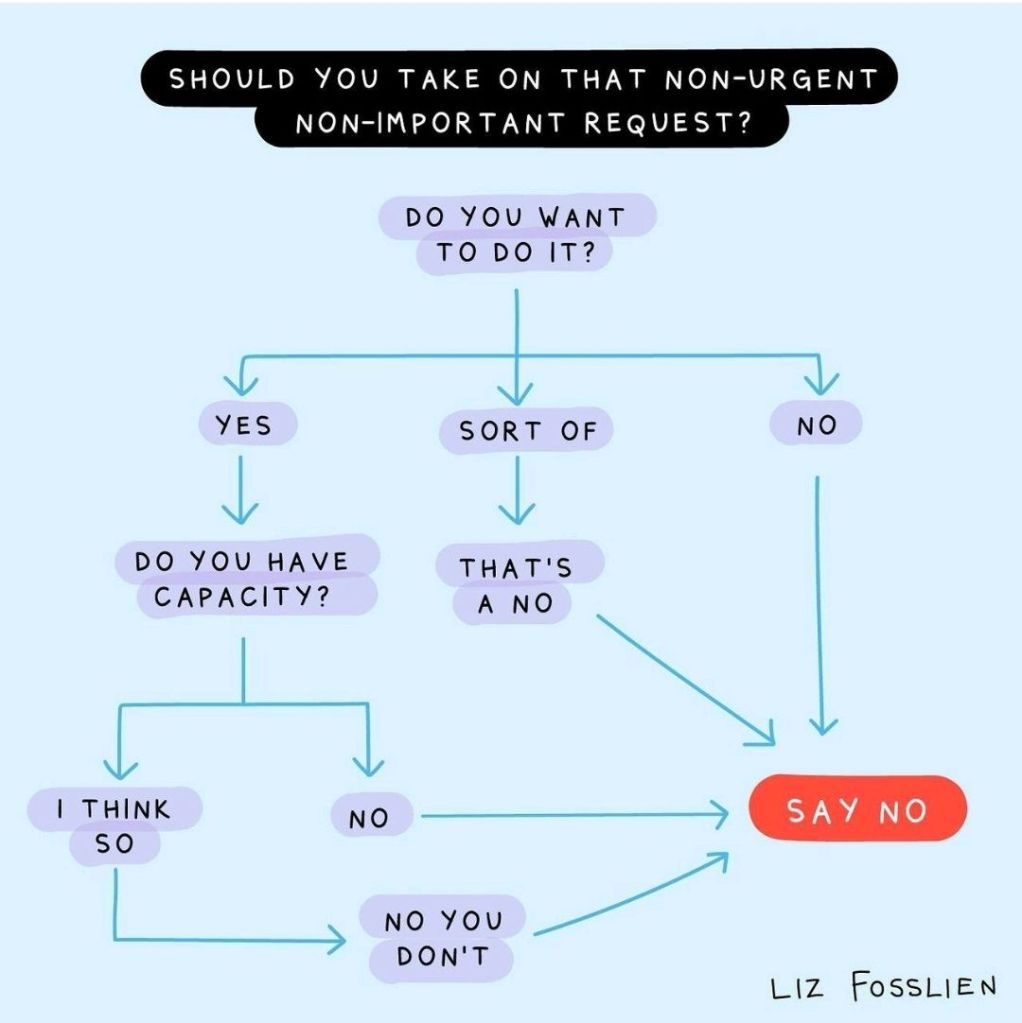
You will need to own your choices, no matter how they turn out

Having said that you need to be confident in your choices, not all of them will turn out the way you hoped. I had a scenario a few years ago where I had to say no. In fact, I have them all the time, but this one sticks with me. I had to say no because otherwise, I was setting the person up to fail in a way that wasn’t wise. There are often times when, as a leader, you have to allow people to fail and grow as it’s a key part of learning.  There are circumstances, however, where the scenario is either too high stakes or risks reputational damage where a no is required. Frankly, this experience did not end well for either of us as it resulted in resentment.  That’s on me as I obviously failed to communicate the rationale in a way that aided processing. I offered, as is key in these circumstances, other options, other routes to attain the same end, but they didn’t lead to resolution. The thing is, I stand by the action, and I own the outcome, as well as the learning. As I said above, you can’t be liked by everyone, you can only try to be consistent and fair.

If you are going to be the person who says no, or make the big calls, you have to own the consequences of that decision. The same is true for when you say yes. If you are a decision maker, you need to understand that you are in a position to make decisions that impact people and patients and that those decisions should not be made lightly. You also can’t absolve yourself of any subsequent events linked to those decisions. You can only challenge yourself to make them for the right reasons and course correct and learn to be better if you get it wrong.

Sometimes, you just have to take it

Last week. again, was a great example of this one. Things went wrong. They were not under my control. I was, however, the face of the corrective actions required. Stress levels were high as well as emotions, and no matter how unpleasant, individuals needed to be able to express some of those emotions. It is much much better that those individuals expressed how the situation made them feel at me than carry them into their next encounter with a patient or different staff member. I understood the context and driver for the response in a way that the next person might not. It was, therefore, better for me to  be the conduit for that emotion. To stand there and hear the concerns and emotions in order to support processing and let them feel heard. Was it pleasant? No. Did it require tea and possibly a quick weep in my office? Yes. Was it the right thing to do? Also, yes. Sometimes, leadership is about allowing others to express unpleasant emotions so they can move past them to a space where they can take the actions needed. I’m not talking about allowing bullying or unacceptable behaviour, but about working with those impacted to move forward in what can be high stakes and very stressful situations. Sometimes being a leader is about doing what is needed to help everyone move forward, both emotionally and in action, so we can all start a new chapter together.

You have to be able to see the jigsaw, not just the pieces

One of the things that can really help with making the hard calls or dealing with the stressful moments is being able to see the whole picture and what that new chapter might look like. This is why having a vision and understanding the wider networks and landscape you are working within is key. You need to be able to take a step back and see the whole jigsaw and know whether the decisions you are making are right across the different levels of context.  That can mean making harder choices, but if you can return back to those wider drivers to sense check, it can make life easier.

One minor example of this is the choice I made to always refer to myself when possible as a Healthcare Scientist, not a Clinical Scientist.  It’s not that I’m not proud of my professional title. On a national and strategic platform, however, using a single name and description gives bigger numbers and a single voice.  It doesn’t require the person trying to navigate that landscape to understand all of the nuances that we experience if we work in the area. So I pivot based on context how I even describe myself, not for my personal benefit but to benefit the profession as a whole. It helps support a single identity and advancement for everyone, rather than any profiling raising I do benefiting just to me as an individual. I strongly advise taking this kind of active reflection across all we do, you never know when a simple change will maximise impact.

You can never be ‘just a passenger’

The final thing, and this can sometimes be hardest for me, is you no longer have the right to disengage. It’s no secret that 2024 has already been quite a challenging year, and I’d be lying if I said that I was in a great head space. My innate reaction to feeling the way I am feeling right now in to hide, to ostrich, to try to protect myself by creating distance. I can not do that. As a leader in challenging times you have to be even more present, even more engaged and involved than you would be otherwise. When circumstances and change are making everyone be unsettled the last thing you can do is become absent or disinterested. You have to step up, you have to be seen, you have to (try to be) the calm at the center of the storm. Personally I can come home and hide in my castle with the safety of Mr Girlymicro for recovery. Once I am out there professionally I need to put all that to one side and throw myself in 100%. You owe too much to your team/s and to your patients to do anything else.

I should say, this posts focuses on the things that can be challenging and the things that may be less obvious from the outside. Being a senior leader though brings so so much joy that all the challenge is more than worth it. Seeing those around you succeed, seeing things become better or change that you envisioned comes to pass, is massively rewarding. There are tough moments but if you are in the right place, with the right people, even the dark times lead to illumination. So take the next step and see what change you can make!

All opinions in this blog are my own