Clarity of Role and Its Impact: Why knowing and being clear about your professional boundaries matters

This one’s been on my mind for a while, and by posting it the aim is to explore my thinking, not to target anyone or any group. I’ve been seeing a lot of posts on twitter and having a lot of conversations about identity, especially in relation to professional identity, and so wanted to take this opportunity to reflect and process.

I’m going to start with myself based around a non-clinical example of what I’m talking about. I am a scientist who communicates. I am not a science communicator. It took me an age to really get the difference, but the difference is this………it’s about where my expertise lies. I hope that I happen to be a scientist who has some decent communication skills, and it is a subject that I am pretty passionate about. My qualifications and expertise, however, are in the science, that’s where I sat my exams, that’s where I have almost 20 years of practice.  My expertise is in science, not just that, but my real expertise is actually in quite a small subset of science. I took a zoology degree 20 years ago, but I am not a zoologist, that knowledge is old and only at undergraduate level. My expertise is probably in Infection Prevention and Control.

Now, if I were a science communicator, my expertise would be somewhere else. My skills would be around communicating science in general. Many science communicators haven’t worked in science for some time and some may only have undergraduate levels of science specific expertise. What they have, and I don’t, are qualifications and vast levels of experience in communication and pedagogy. These skills enable them to break down highly complex topics and also pitch in a way that I can only aspire to. They have significant levels of pedagogical skills that I can’t pick up by attending a couple of courses, just like they can’t pick up mine by attending a week long course on whole genome sequencing.

So, to me, the difference is where my expertise and knowledge lies. This doesn’t mean that I couldn’t transition from one to the other, but I have to acknowledge that I’d be moving from my area of expertise and therefore would need to rebuild both it and my qualifications to demonstrate skills within a different area. It would be a growth area rather than a straight transition.

OK but why does this matter?

I’ve been reflecting that we are definitely in a period of substantial change within the NHS and one that isn’t likely to stop any time soon. This means a lot of our pathways and traditional professional boundaries are changing with it. I think, in the end, that this can only be a really good thing. (Although I think if it is going to work it needs to be implemented across staff groups with no ivory tower protections). With this change comes fluidity and, because our pathways are embedded, change can occur before we have the processes to keep up.

During this period of change and recognition of different skills and pathways, for instance, the HSST, more Healthcare Scientists working in education, IPC becoming more interdisciplinary and the development of Clinical Academic pathways outside of medicine, clarity is key. I’ve been number one in a field of one when I didn’t know anyone else working as I did in IPC and it was a balancing act. I’ve been through people asking ‘are you one of the nurses’ and hanging up if you said no, but also I can’t claim to be a nurse. If we don’t understand our boundaries, it can be hard to be clear about them with others. If we can’t be clear about them with others, assumptions can occur about knowledge and skills that can lead to potentially dangerous practice or misleading those we’re interacting with. To me, it’s about owning your difference and being open to talking about the benefits it brings, whilst being very aware of when you should defer to someone else.

Labels not hierarchy

I guess what I’m talking about is actually the importance of labels. Now, this may seem a little ironic as I’m not a labels and silos kind of girl, but bear with me. The reason we use labels as human beings is that they enable a cognitive shortcut. One of the reasons that they can be bad is that they come with a bunch of assumed information that is not nuanced, and may in fact not be true. In the case of knowledge and professional roles, they come with an expectation that if you say you’re a virologist, you have a significant amount of knowledge about virology and virological processes. If you say you’re a consultant, you will be assumed to be practising at a certain level with certain qualifications behind you. These labels mean that when we interact, assumptions are made about our scope of practice based on an assumed level of knowledge or experience.

The problem with some of the developing pathways is that the information behind those labels is not yet established and embedded widely across the NHS or for the public we’re interacting with. The assumptions made linked to those labels may, therefore, be incorrect. Due to this it is really important to be clear about who we are, our experience, knowledge and boundaries, not because one label is better than the other, but to ensure that all involved have clarity in order to not increase risk. If you are in a new or developing area/role, the onus is therefore on you, to clearly communicate about you practice boundaries in the absence of a default label.

Asking, where is my expertise now?

Everyone wants to feel like they know what they are doing. Everyone likes it when someone comes to them and asks them to engage in events or answer questions due to perceived expertise. The problem comes when we respond to the request based on the pleasant feeling it creates without self-checking if we are the right people to undertake the task.

Obviously, the risks are not always the same and occur on a continuum. I’ve been asked to give talks on antimicrobial stewardship and have referred on to someone else as it was for a conference, and that’s not my area of study. If that request was to teach an undergraduate class, however, I have the knowledge base and experience to do so if there was no one better available. I would however be very open with the organiser that I might be better placed to speak on a different topic. Being clear about your boundaries in a clinical environment obviously holds much greater importance. I have FRCPath and used to regularly do ward rounds. Since the pandemic and moving entirely into IPC, I haven’t given clinical microbiology advice in the same way. This doesn’t mean I couldn’t run a round, but I would want to re-up my skills before I did so, there is a difference between what I could do on paper and what I would feel comfortable to do in practice.

When I interact with others or get requests, I always run a quick internal check with myself about whether I’m the best placed person to respond. There are tasks that are always best served by having input from multiple viewpoints and backgrounds, and these I will bring back so we can discuss them as a team. There are other things where I will refer to someone else specifically, as I know they have a greater understanding of that clinical practice. I’m aware that this all tied into our professional registration, but I am often slightly struck by how, when people are trying to define a new identity, they try to own the label they want before they have fully developed enough to go it solo. I think this is often the moment of greatest risk in any development pathway.

None of this is about restricting access

I want to be clear that I am truly excited by the change towards more dynamic progression in healthcare and recognition of the skills different professions bring to the mix. I do think that when you are already established within a profession, it can be challenging to go back to actively undertaking that gap analysis and flagging your difference all the time, especially when others don’t necessarily know what your role is or react negatively, as we are used to being the ones in the know. The thing is, the only way that you can establish the new pathway or role is to start the work but be mindful to continue to flag your scope/difference as needed. No one hangs up on me anymore when I say I’m not a nurse or a doctor. People have gotten used to it. They wouldn’t, however, if I’d not been open about it in order to engage with the conversation and just defaulted to their expectations.

It is easy to get drawn into the conversations with some conservative colleagues about whether this is the right direction for the NHS to go in and to feel defensive about it. I think that being willing to engage calmly in those conversations is part and parcel of being a pioneer. To see each conversation as a learning opportunity, both for yourself to communicate your role better and for the other person in terms of knowledge exchange. Change is unsettling, especially when it goes against traditional structures and hierarchies, and it will take time for people to adjust.

You can be passionate about something without being an expert in it

Finally, and just one side thought that is not related to clinical work as such. It is OK to have an interest in something and not be an expert in it. It is OK to say for me to say that I’m interested in science communication but not to claim expertise in it. It is OK to be an interested participant and to want to engage in an area because of the growth that engagement offers. You don’t have to enter every space wearing your expertise as a shield. It’s just worth being honest and open with yourself and others when you do it. Not claiming expertise will open doors to shared learning that you might not otherwise be able to access. We don’t always have to be the smartest person in the room. We should just should aim to be the most able to communicate our purpose and vision for being there.

All opinions in this blog are my own

Talking About the Taboos: My experience of informed consent and organ donation

CONTENT WARNING: MY FAMILY SHOULD SKIP THIS ONE.

This post is traumatic (at least for me) and is likely to be triggering for some people. I think it may also be important, which is why I’m writing it. It is highly personal, and for once, I’m not up for debate about how it made me feel, although I’m hoping it might trigger wider discussion with others. That said, it is only the experience of 1 girl in 1 room.

Please note that I am a passionate advocate for organ donation, which is why I’ve never talked about this as I’ve always felt worried it might put off others. Now, with people objecting to ‘opt out’ change to the donation rules I feel the time may be right for me to talk about it, as I’m hoping it will change for others the hardest experience I’ve ever gone through.

Here’s the background

My sister died in 2010. At that point, despite the existence of organ donor databases, if you wanted to donate the organs of a loved one, you had to go through a process of informed consent and opt into the process.

Defining consent

Informed consent – the person must be given all of the information about what the treatment involves, including the benefits and risks, whether there are reasonable alternative treatments, and what will happen if treatment does not go ahead.

https://www.nhs.uk/conditions/consent-to-treatment

In 2020 this situation changed and the English system changed to what is known as presumed consent or the opt-out system, and means that unless the deceased has expressed a wish in life not to be an organ donor then consent will be assumed.

This means that there are now three ways to approach organ donation in England, vs the one that I experienced back in 2010.

I was at a workshop this week, and as part of the ethics discussion, the issue of switching to an opt-out system of organ donation came up. It was a really interesting discussion in order to support seeing a complex issue from multiple viewpoints. Is opt out coercive? Will it actually address some of the issues around numbers of donors?

I found myself talking about something that, to be honest, I never talk about. Something that I think has been locked away in my head (and for me, a completely different reason), beyond the numbers and ethics, why I think opt out is a good thing. Why? Despite passionately believing that organ donation is the right, logical, and good thing to do, for someone to ever go through what I had to go through to donate my sisters organs was not something I’d wish on anyone. When I lie awake at night and cry, it is not over the moment that I found out she was not going to make it. It is over the 24 period that I lived through trying to do the right thing. Informed consent is the gold standard, but it can also be highly traumatic to those who have to go through it. This didn’t even come up as part of the discussion, but I wanted to share my experience of informed consent to aid understanding of why I think that moving to presumed consent might also be a good thing.

Knowing is different to doing

I’ve written before about how the circumstances came about of losing my sister, but I sort of glossed over some of the 48 hours between her effectively dying and being declared brain dead. This part was obviously traumatic but not perhaps because of the reasons people think.

From when we were kids my sister and I always talked about organ donation and how we would always participate. Maybe an odd thing, but we came from a pretty science based household where all kinds of conversations were common. I remember going to get our first Boots cards together and being very impressed that on the application form, you could also tick to confirm you’d like to be an organ donor. I can see the form in my head even now. We both ticked very thing but eyes. I don’t know why we didn’t tick eyes, but I clearly remember we didn’t.

So, when we were given the news that my sister was brain dead and that there were going to start the 24-hour confirmation process, I knew what the next conversation would be. I’m fact because I knew her wishes. I actually instigated it. It was the right thing to do.

Never, as it transpired, has doing the right thing been easy.

Experiencing informed consent

They said they’d get the transplant nurse come to speak to us, they were so pleased they hadn’t had to broach the subject, you could see the relief. I had a friend who’d just started working as a transplant nurse and they had told me how hard it was and so I wanted to make the process as straight forward as possible. I wish I’d asked them.more questions and known more, but I hadn’t, and I didn’t.

Here is the assumption I had made. My sister had been on the organ donor registry, she had ticked her boxes, we knew and supported her decision. We would therefore go into a room where we would sign a paper to that effect and walk out in order to wait for her official demise. Spoiler alert – this I not what happened.

What happened instead is you walk into a room, with a very nice and kind nurse, with a clipboard loaded with papers. They warn you that this will take some time and will be personal. Bear in my my brother in law is understandably distraught and therefore most of this process is being covered by my mum and I, to be honest I can’t even remember, but I don’t think he was in the room. Then it begins.

It starts with the scene setting, what was my sisters sex life like, how frequently and with whom? As a scientist I know this information is key and it aids risk assessment, as a person I’m talking about my dying sisters dating history and I have to say frankly it’s a bit jarring. I also only have the answers because we spoke every day and we were super close.

For the next (what feels like several hours) you proceed to verbally dissect your loved one organ by organ, piece by piece. For each piece you go through numerous options. Are you happy to donate her pancreas, if so who are you happy to donate it to, the cells? To an academic lab? To a privately run company? How do you want it disposed of once they are finished with it? If they take parts of her gut but then can’t use them (in case she is too fat, but they don’t have that info yet as they haven’t got my sisters info) is it OK if they throw them away? Every time you believe there can’t be more there is.

I know where this comes from, from multiple organ scandals, and I know the importance of informed consent. In the room it feels like none of that matters, in the room it feels like some kind of psychological torture that will never end. I’m lucky, I’m in doctor mode and all the horror is not happening at the front of my brain, doctor brain is evaluating and deciding and ignoring the screaming from the girl who is experiencing the pain. I have no idea how my mother survived it, she just calmly went through and discussed bits with me as if we were talking about a shopping list. To this day I don’t know how we survived. At one point I turned around to the nurse and asked, surely we can just blanket consent, and she confirmed that she had to read the text for each bit and that we had to actively make decision and understand.

When I have nightmares about this process I see my sister in the dress we picked for lying her out in and as each organ is called out I get a dolly zoom onto the anatomically correct part. My brain does love to torment me.

Once we reached the end of the list, I took a deep breath, relieved it was over, but it wasn’t over. As a thank you for agreeing to donate her organs you then get another form to go through. She gets to be laid out in the Chapel of Rest post surgery. Please could we go and find something (now) so that she can be laid out in, they need it to make everything ready. Also, would we like some of her hair to keep? If so what colour ribbon would we like? This was the bit that blew my mind. I had coped with the organ by organ dissection, but what fucking ribbon do I want for me dead sisters hair, how the hell do I know. I know all of things that mean I should know, I know her favourite colour is purple, but it feels like one decision too far. You get to keep one piece of her, now make decisions for the one thing in the world you will have left of someone who has been part of your life every day since you were born. Something simultaneously so simple and yet crushing. Colour picked, now off you go, find an outfit that is clean, she would have liked and still fits the body of someone who was 5 months pregnant but had yet to buy maternity gear as she was worried about what would happen to her child. Oh, and I forget the second best bit. Whilst you’re there, you can pick a personal item or toy for her to have in the theatre whilst they vivisect her. It’s not like it’s going to be an infection risk to her.

So off we go, we pick a dress, we pick her huge black stuffed cuddly dog. Then you wait for the 24 hours to be up do she will be called.

At this point my willpower failed me. I couldn’t be there when she went into theatre. I couldn’t wait for them to come out and tell us it was over. I’ve been in theatres and this is where we come to the part that I still can’t really deal with. After all these years I still have days when I feel it. I feel like I killed my sister. I feel I gave someone permission to open her up and whilst her heart was still beating remove bits of her one at a time until she died. I can see it in my head, with that cuddly toy on the end of the bed. I can see it all so clearly. It’s like a horror movie and I know every single piece because I went through them all like it was a shopping list. It doesn’t matter that there was no way back, it doesn’t matter that it was what she wanted, it doesn’t matter how many lives were saved, it matters that I went through a list of her body like she was a joint of meat and said which parts could be sold to who.

Time heals most wounds

I didn’t even find out who those organs went to. All of that info went to her husband as next of kin, and he didn’t bother to share it, and I never had the strength of will to ask. Just recently a wonderful colleague gave me the number of someone who might be able to tell me, but I don’t know if I’m ready to re-open this particularly deep wound, maybe after writing this post I will be able to get there.

I’m horribly aware that this post might put others off signing off on donation but I’m hoping that by contextualising at the start you’ll know that that is not is what I want to achieve. It is however the reason I don’t talk about it. I believe so much that it is what we should do. At the same point I know that I don’t think I could ever go through that experience again. Which brings me to presumed consent. I am desperately hoping, although I have no idea, that by having some assumptions in relation to consent, that no one else will have to go through the same process I did. I know why it’s there, I also know how complex it is sitting on the other side. Giving people options is key, there should be choice about what goes where, but I believe there should also be the option to have a blanket ‘I donate everything but this and it can go everywhere but here”. Otherwise, you harm people trying to do the right thing in ways I can’t even fully explain. This isn’t a neutral opinion, though, and I get that. It is one driven by pain and horror, so perhaps I am not the best person to have an opinion on this after all. Either way, the time has probably come to talk about it. Nothing in this area is simple and so maybe by talking about it more, it will enable better conversations so that if you ever end up in that room, you won’t be as blind sided as I was.

I have no regrets, I am OK with the choices we made. Deep down, I know I respected the wishes of someone I loved. I just can’t deny that every now and again, the guilt still knocks me for six, usually when I least expect it. That isn’t a reason to not do the right thing. It’s just a cost worth acknowledging.

All opinions in this blog are my own.

Conference Season is Upon Us: My top tips for conference presentations

I’m off to ASM in Houston in a few weeks and conference season is well and truly upon is. I’ve been fortunate enough to get asked to speak at a number of events over the years, but I still clearly remember how terrified I was when as a trainee I spoke to my first big room. Last year, I gave my first key note lectures. I’d been asked to do a couple in 2020, and then the pandemic hit, so all of those events were cancelled. I felt as nervous as that trainee again. I prevaricated, I self flagellated and then finally managed to force myself to sit down in front of a blank screen and just get started. If you are in any of those stages, this post is for you, I hope it helps.

No one can tell you the best way – only what is the best way for them

First things first. When as a trainee I was preparing my first talk I got A LOT of advice. My first problem was trying to use all of it, even when it was conflicting. I was advised to rehearse over and over until I had it memorised, I was advised to have a script and notes. I was advised to do none of those things as it would be too staged. So, my first tip is this. Seek advice, gain knowledge from those more experienced, but then use what helps you and discard the rest. Your personal process will be different to everyone else’s, and it’s worth acknowledging this early and accepting that you will find a way that works best for you and refine it with experience.

For instance, I hate rehearsals, and I never have a script. It makes me stressed and forces me to feel like I have to deliver the same way every time. I know my content, I know my story and the audience and I are a team who deliver the final product together. I bounce off them and try to read the room, and fingers crossed, it seems to work OK.

The one time I don’t work this way is for extremely time restricted presentations, such as 5 minute fellowship interviews. For those I practice so much I can recite the words in my sleep. These are different because:

  • you HAVE to get all your content in, your career kind of depends on it
  • the time lines are short and hard, they will just cut you off and so you need to know you will finish in the window given
  • there will be no audience bounce, there will be no reading the room, they are going to remain neutral to what you are presenting, and so focussing on them can make the scenario even more stressful.

What I hope you take away from this is that there are no hard and fast rules, there will always be exceptions, but if you can, do what works for you and don’t try to be anyone else.

Ask for learning objectives and check what other talks/speakers are in your session

There is little worse than sitting, waiting to go on for your talk, and hearing the person before you give the talk that you have basically written to give next. I have learnt the hard way to make an effort to ask what an organiser would like me to cover, and to always check what the agenda is before I turn up for the day to see the lay of the land from other speakers titles. A little repetition is not a bad thing, ground hog day is unlikely to land well. This one is more of an issue for invited speaker sessions, although even if you are presenting novel research data it’s worth seeing who else is in your session, as you may be able to reallocate slide time if the 3 people in front of you are talking about the same virus. They are likely to have covered a lot of the generics and you can then invest time elsewhere.

I don’t always get very far, but these days I also ask for learning objectives when I’m invited to speak – what would you like me to cover? any particular highlights that you are interested in? what is the audience size and mix likely to be? All of these things can dictate not just your content but how you think about delivery, such as how much interaction you can include.

Think about your audience

This one seems like a no brainer, but I often think that it’s forgotten. It is really easy as the person delivering to get caught up with your nerves and write a presentation that you feel comfortable with, without thinking about those that will be listening. Now, I’m not suggesting that you deliberately produce content that makes you uncomfortable, but sometimes it is easy to teach in a way that suits us rather than the learners. It can be really worrying to include interactive content, what if no one responds, but if you are on at the end of the day after 7 hours of didactic teaching, your learners may be ready for something that re-engages them.

The thing that scientists and clinicians also often do when they are nervous is to resort to technicality and jargon. It can act as a shield. If you are presenting to a mixed cohort, of either different levels of knowledge or professional backgrounds, this defence mechanism can end up making your content inaccessible to a number of people within the room. It’s OK to have a couple of slides that stretch people, it’s usually not OK to have a whole talk like that, unless you know your audience really well.

Think about the tone of the presentation

I struggled a lot when I was asked to do the talk below. I struggled thinking that maybe I should turn up as ‘Dr Cloutman-Green’ with formality and pretend gravitas. You would not believe how long I went around in my head about it. I then decided that they had asked me to speak about my blog, and my blog is anything but formal and hierarchical, and so I turned up as me, with all the sarcasm and self mocking that entails. In the setting, at the end of the last day of the conference, when everyone was tired, including a little humour felt like the right way to go.

I would however have made different choices if I was turning up to present my PhD thesis in a viva, or if I was presenting to the board, I would have still been me, but a slightly less overt version. Some settings require a formal tone, some lend themselves to informality and some you can decide the path you wish to walk. The key thing is to make an active decision based on the invite, topic and audience to ensure that you match what your tone is with what you wish to achieve.

Find out if you need to allow room for questions

One of the things that often catches people out at research meetings is there is not always a standard of whether there will be time for questions or not, you can sometimes guess by slot length but not necessarily with any certainty. It is always worth explicitly asking if you need to allow time for questions so you can plan your talk length accordingly. I’ve Chaired conference sessions where this wasn’t handled well and it meant that it was really challenging to keep everyone to time and some speakers had much better opportunities for audience interaction than others. If you aren’t told definitely ask, not least so you can prepare for what your answers might be.

Think about what you want for your slides

This again might be a really obvious one, but if you are teaching on an MSc you are likely to want a lot more information on your slides, as they are likely to be annotated and used for later learning. Your conference talk may be recorded, the slides may get circulated, but the reality is that they are much less likely to be used as a later teaching resource. Therefore you will want to pitch your slide content based on your participants/learners, which is another good reason to find out a bit about them.

It is also worth thinking about how important it is for the people in the room to be able to read and understand what you have included on a slide. I’ve lost track of the number of times I’ve seen speakers apologise for tables and overwhelming numbers of charts that are not visible to anyone sitting beyond the front row. Unless it’s high level conceptual stuff there is little point including slides that are not going to be accessible to your audience. It is also worth (and I am not good at this) ensuring that colours and fonts etc do not present unnecessary challenges to engagement.

Plan in your breaks/interactive moments

Even if you are the best speaker in the world, and I am definitely not, there are always slots in any agenda or meeting which will make it more challenging. The post lunch slot, where everyone is digesting and sleepy, and the end of day slot where everyone wants to make sure they catch their trains are just a couple of examples. If you are allocated one of these slots, or are given a 3 hour lesson slot, planning how to keep learners engaged is key. More than 20 minutes staring at your powerpoint is going to be enough for anyone. So can you include things like videos or other types of content to break it up? Can you include live quizzes that embed some of the discussion topics? Can you get people to talk to neighbours or even do some group work? It is sometimes easy to stand up and go through 60 slides, when the experience of everyone in the room might have been better with 6 and a modified activity based approach. Again, it depends on the setting and audience, but if you can be brave and consider stepping beyond the lectern during your session.

Make sure you have backups

No matter how prepared you believe you are for giving a session there are some days when it will not be enough, for this one you need to make sure you are the master of your own destiny. There have been numerous events where I have turned up to speak believing that my slides will be already loaded as I had sent them to the organiser well ahead of time, and had the tech guy look at me in bewilderment as they had nothing. I always carry my talks on a USB stick, having emailed them so I can also get access to an email version in case my USB files is corrupted, and I will have them stored on cloud storage as a back up in case I need to download directly onto a system. The fear of having to just get up and talk without slides haunts me too much to leave anything to chance.

Know how you might wing it if needed

The reason I know very clearly what it feels like to have a slide deck that doesn’t work is because it happened to me at a conference in 2021. I rocked up having sent my slides ahead of time, having been told that the organiser had checked them when they were loaded onto the laptop. I started my talk and then realised that every single slide that had a table or anything other than a textbox was entirely blank. I then proceeded to give my 30 minute with a variety of blank slides. When you’re up there there is nothing that you can do but wing it. I pivoted to a session where instead of trying to focus on my slides I talked about clinical experiences linked to the visible titles. I survived, it was even well reviewed, but I never want to do it again. That said, those 30 seconds staring at the first blank slides and working out what to do taught me a valuable lesson, and now I do my ‘what if’ worst case scenario planning ahead of staring at the audience whilst on my sofa with tea, so that I know what I will do if something goes wrong. I also now try to make sure I personally check my slides prior to any session.

Have a watch or phone that you take up with you

You would be amazed at the number of teaching and conference rooms that don’t have a clock on the wall or visible from the stage. I’ve been caught out by this a few times, and when you full screen your slides you can’t always seen the clock. That means you are subject to the session Chair giving you a 5 minute wrap up when you are only half way through your slides, as time feels different when you’re staring into 1000 faces and hoping not to screw up. I always take my phone (on silent) these days and set a stopwatch so that I can gauge where I am in relation to time without having to rely on someone else. I find the slide rush just waaaaay too stressful otherwise.

Be prepared to handle the question that is a actually a comment

This may be a shock to you, but I’m a woman. This means at any given presentation with questions I have a ~30% chance of a male colleague standing up and giving me the question that isn’t a question, but a comment on how they would have a) done my work better b) point out some key point I have missed c) tell me about their work and their experience. This may not be my most attractive feature but I have made a life choice to shut all of these options down hard. I am open to questions and shared learning, I am not open to someone taking question time from someone else in order to rail road a session into something different. If someone starts with “this isn’t really a question but more of a comment” I will generally reply before they get any further with “that’s really great and I’d love to hear it over coffee but I think we need to address the questions in the room first” and then actively call on someone else. You may wish to have a different technique, you may wish to pivot the comment back into something relevant to your talk so you effectively answer it as if it was the question you wanted to hear. You may have a completely different approach (I’d love to hear them all). If there is plenty of time I also sometimes let it slide, but it is a particular bug bear of mine.

Bring yourself into the room

I’ve touched on this one a little throughout, but I think you will have a much better experience, as will your audience if you can bring yourself into the room. That can be anything from including your favourite colour as part of your slide colour scheme to sharing parts of yourself, in terms of stories or experiences, as part of your session. The more you are prepared to share of yourself, the more your audience will connect with you and the better the chance of your content landing. If you are giving your research presentation, maybe take 10 seconds to share why you chose you that given topic, especially if you have a passion for it – like mine for Klebsiella and Adeno. Don’t be afraid to include humour and light and shade within what you are presenting. Audiences often want to know why they should care about what you are talking to them about, so feel free to convince them, and not just by sharing raw data.

Put your nerves into context

It is almost always nerve racking speaking in front of people, even after you’ve done it for years. One of the things I always say to both myself and my students is “what is the worst that can happen”. I’ve seen some truly terrible talks in my time, but I don’t remember who gave any of them, I remember the topic and why it was bad. Even if I did give a bad session and someone remembered it was me, would they remember in 3 years? If they did, the worst outcome is that they may not invite me back to speak, there will be plenty of other people who will, plenty of people who weren’t in that room that day or who won’t remember. Everyone, and I mean everyone, has bad days at the office. Everyone has sessions that don’t go well or land in the way they hoped. The important thing is to learn from them. Sometimes there isn’t even that, I have given the same activity sessions dozens of times, and every now and again it just won’t work. The participants may be in a bad mood, or there’s tech failure. It happens. Bring your best to every moment and that is all you can do, the rest doesn’t matter, the rest isn’t permanent. So good luck and be bold and I can’t wait to hear you speak!

All opinions in this blog are my own

If you would like more tips and advice linked to your PhD journey then the first every Girlymicrobiologist book is here to help!

This book goes beyond the typical academic handbook, acknowledging the unique challenges and triumphs faced by PhD students and offering relatable, real-world advice to help you:

  • Master the art of effective research and time management to stay organized and on track.
  • Build a supportive network of peers, mentors, and supervisors to overcome challenges and foster collaboration.
  • Maintain a healthy work-life balance by prioritizing self-care and avoiding burnout.
  • Embrace the unexpected and view setbacks as opportunities for growth and innovation.
  • Navigate the complexities of academia with confidence and build a strong professional network

This book starts at the very beginning, with why you might want to do a PhD, how you might decide what route to PhD is right for you, and what a successful application might look like.

It then takes you through your PhD journey, year by year, with tips about how to approach and succeed during significant moments, such as attending your first conference, or writing your first academic paper.

Finally, you will discover what other skills you need to develop during your PhD to give you the best route to success after your viva. All of this supported by links to activities on The Girlymicrobiologist blog, to help you with practical exercises in order to apply what you have learned.

Take a look on Amazon to find out more

An Unexpected Invitation: Representing the Healthcare Science & IPC workforce at the Coronation of King Charles III

Please note, this is a rather self indulgent post written to help me remember in future years what was a truly spectacular day and set of events.  Please forgive me and feel free to skip.

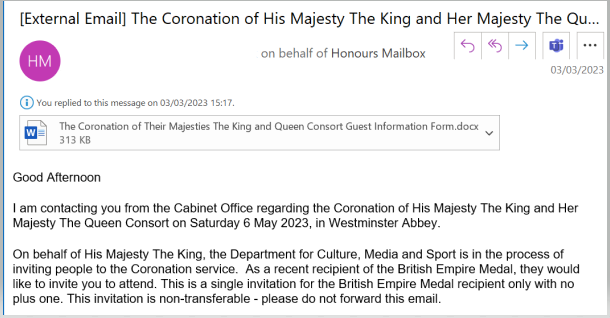
Let me start off by saying what an incredibly normal person I am.  I have a job I am passionate about, friends and family I love, but apart from quite how fortunate I count myself to be, I am incredibly normal.  I don’t have ‘connections’, I didn’t go to private school, and neither I nor my family are part of any clubs or other exclusive societies.  So imagine my outright shock when in March this email dropped into my inbox on a Friday afternoon:

This is a joke………right?

On the 31st January 2020, I was fortunate to be awarded the British Empire Medal for services to healthcare and I wrote a little about how I didn’t believe it in a blog post.  That was a fascinating process in itself, especially as I couldn’t tell anyone. When this email dropped into my inbox however, frankly it felt like someone was playing a bit of a joke.  I opened and returned the form, almost on auto pilot because it felt like the kind of thing you should do, but as soon as I hit send I phoned my mum and Mr Girlymicro and had a bit of a breakdown after I calmly got the words out.  Just saying the words ‘I think I’ve just been invited to the Coronation’ put me into a complete spin.  You see, I’m the girl that snuggles down with a cup of tea and Agatha Christie when I manage to get time off, or to be completely honest, some truly awful reality TV (hated by my husband 🙂 like Love is Blind.  I am not the girl that gets invited to fancy dinners or big events, let alone something to be seen on the international stage.  Writing the Girlymicro blog is often the most down time I get on a weekend.  So after sending my reply I sat back and just assumed that they would at some point realise their mistake and life would carry on.

Costume drama

As time went on and more emails went back and forth it gradually hit me that I may, in actual fact, need to attend the Coronation.  I went through a period of properly freaking out about how I wouldn’t fit in, and how I’d have nothing sensible to say, my family pointed out it was too late for that, I’d accepted the invitation.  I was locked in.

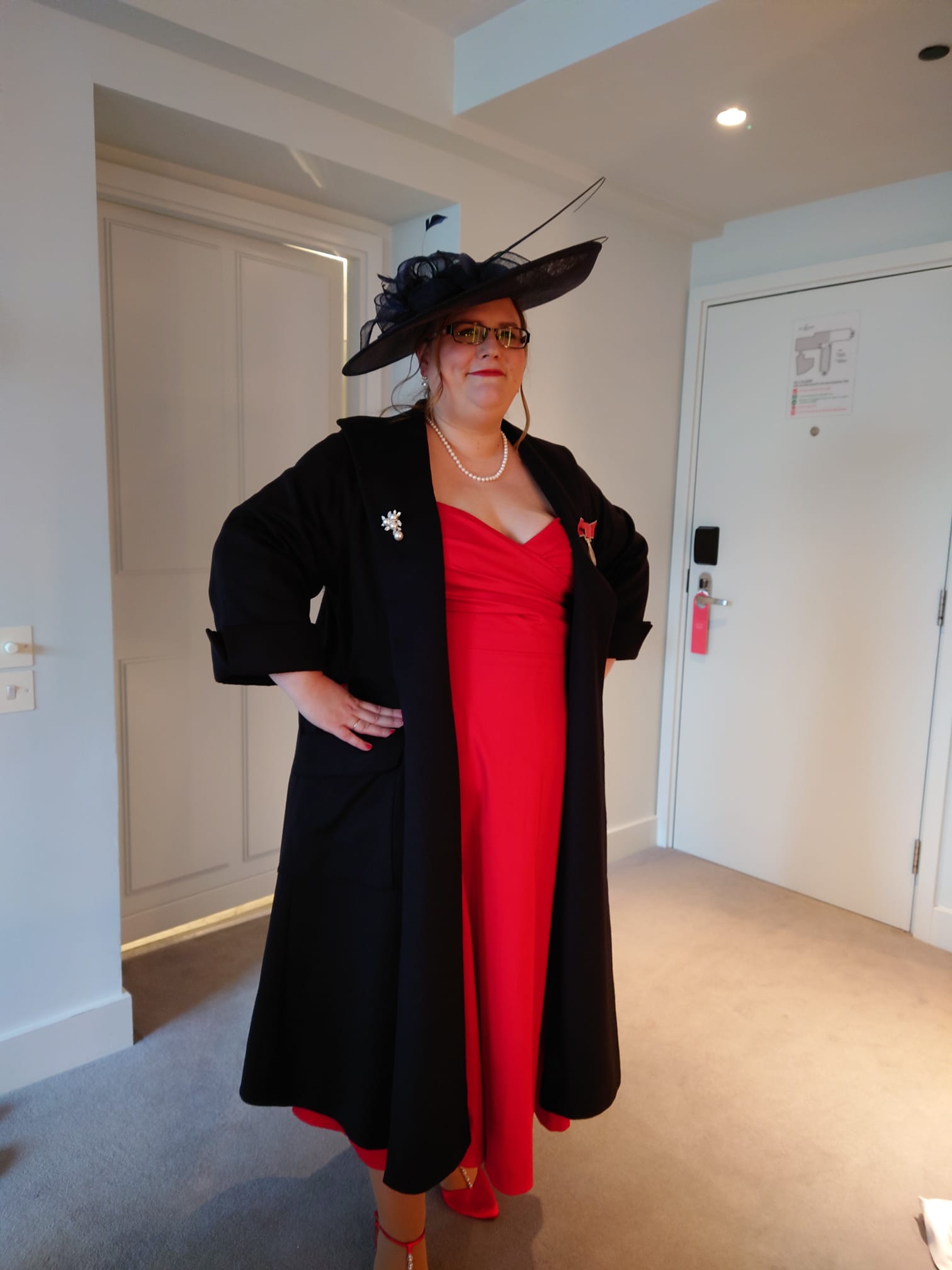
Then I proceeded to have, what a dear friend, referred to as a ‘Costume Drama’. Now, I get up in the morning and dress in the clothes in front of me.  I am guaranteed to have covered myself in food/tea/detritus within an hour of dressing.  I don’t wear makeup, and when I do I am lucky to not poke my own eye out with my eye liner.  As the reality dawned on me, it also occured to me that I was going to need to have something to wear.  Bear in mind that when I went to the Garden Party at Buckingham Palace I had a tail spin because I had never brought a hat and I just didn’t know what to expect. It took me 6 months to find something to wear and I had a little less than 6 weeks to get this sorted.  This also felt like a complete level above what I had needed to achieve for afternoon tea.

I have previously posted about how I feel about clothing expectations.  In this case, I began to increasingly feel like clothing would have a role as armour, as a way to step into a space where you felt like you needed to put your best foot forward.  I needed to find something to wear that would help me feel like I deserved to be there and could occupy the space I had been given.  At the same time, I wanted to balance the costume with who I am, I wanted to feel both like I belonged and still feel like me.  So, being a scientist, I hit research mode and pulled together as many sources as I could to find the ‘uniform’ that was likely to be worn at such an event, and then to find ways to modify it so I could ‘fit in’ and still be me.  I know some of you will be reading this and feel disappointed that I was not prepared to stand out. To make a statement.  Sometimes, I feel that the freedom to make a statement comes from a position of privilege.  Not always, sometimes it’s merely bravery and not worrying about the consequences.  In this case, I didn’t feel I wanted to make a statement, I don’t feel like I come from a place where I have enough privilege to go against the tide. You may think it shows a lack of bravery, but the last thing I wanted was to stick out in anything but a ‘that’s a nice dress’ way.  I was nervous enough, and a lot of those nerves stemmed from knowing that I was representing not just myself but all of you, my family, my profession, and my friends.  What I wanted most was to make everyone proud, and so standing out needed to be done in the best possible way by rocking a look that acknowledged the event and still felt like me.

Feeling the weight of representation

You see, as time went on, I became more and more aware that the invitation I’d received wasn’t really about me, it was about us.  I didn’t get a BEM for my work in isolation, it was for the work we had done as a community, I was just lucky enough to be the one who got a medal pinned to her chest.  As the event drew nearer, I was so aware that I was representing both Healthcare Scientists and Infection Prevention and Control on an enormous stage.  I am so proud to be part of both of those groups.  I am prouder than I can state about my profession, a profession that is so often hidden and doesn’t get mentioned at the big events.  I knew that the one thing I would be able to do on the day was talk about it and shine a spot light, if even just to a few people, on the amazing work my colleagues do and the sacrifices that they all made during the pandemic.  I was aware that even though it was my name on the invite, in point of fact, in many ways, it wasn’t about me at all.  I needed to use this unique opportunity to shine that spotlight on the people who deserve to be seen.

Coming, ready or not

Knowing it wasn’t really about me didn’t stop me from feeling nervous, however. I often get in my own head about big moments or events, especially things like this that feel too big and outside of the normal, for someone as normal as me.  At times like this, I like to remember a quote of one of my favourite TV series:

Bottom line is even if you see ’em coming, you’re not ready for the big moments. No one asks for their life to change, not really. But it does. So what, are we helpless? Puppets? No. The big moments are gonna come, can’t help that. It’s what you do afterwards that counts. That’s when you find out who you are. You’ll see what I mean.

Whistler – Angel Season One

My family, friends and colleagues did a great job of helping me get out of my own way.  I really struggled at first with people asking me why I’d been invited.  I didn’t know, I didn’t have an answer, but with the help of those around me I practiced an answer I could use on the day, ‘I got invited because of the great work that IPC and Healthcare Scientists did during the pandemic, coming together to really make a difference for children and young people, in terms of not only testing but also in keeping them safe in healthcare.  I’m representing a great group of people who all go above and beyond every day, and I’m really honoured to be invited.’ I was as prepared as I was going to be.

A fairy tale day

So, the day arrived.  I continued to be nervous, but I had all the lists and instructions to make me feel prepared.  In the end, everyone I have to say was simply wonderful.  I had been prepared for the formality, but I don’t think I had been prepared for the nice bits, the bits where we laughed and the bits where the event was in some ways just like every other event, just bigger and shinier, and with some of my hero’s present.

The day started at 5:15 am.  I knew that there wouldn’t be many bathroom opportunities and so I could only have one (yes, that’s right, one!) cup of tea.  Because I also knew that doing my hair and make up would stress me out and I wanted to enjoy the day, and because London has people who will do this for a very reasonable price at 6am, a wonderful lady arrived to make me feel pretty.  I was made up, hat on and in a taxi by 7:45.  All the time, with the news running in the background saying people were arriving and making me feel like I was already late.

I had that strange anxiety, like getting to an airport, where you just want to get through security and take your seat.  I have to say that from the minute I showed my invite and started walking from Victoria Gardens down towards the Abbey, everyone was just so lovely and the nerves started to fade.  Security was easy, and the atmosphere just felt really special.  I felt like I do when running a half marathon, when everyone on the side of the road cheers you on, with less running and more hat.  This part was made even nicer by running into another IPC legend Clare Johnstone as I was nearing the Abbey.  This was great because not only did I have someone to experience it with, but we could also take a photo of each other to record the occasion. 

Clare and I weren’t sitting in the same area, so I made my way to find my seat, just behind the North Quire.  I was in some way saddened to realise that I wouldn’t have a good view of the procession, although to be honest, I’d not been expecting one.  What I hadn’t expected was that everyone from Rishi Sunak to Ant and Dec would have to walk right by me both before and during the ceremony, as the Quire was mostly blocked with performers.  This meant I got to do some grade A up close people watching in the 2 hours plus you had to be seated prior to the arrival of King Charles III, including Lionel Richie being a complete gentleman as he went by, asking how I was doing and saying he like my dress.  The other thing that was interesting to note was that everyone had to scrum for seats.  Now, as a pleb I’d expected this to be the case for me, but no, it was also the case for those much more famous than I.  Those entering through the West Door had reserved seats, but everyone else was very much equitable in terms of finding your own within the section you had been allocated to.  I found this somewhat pleasing.

We all knew the toilets were going to be locked down at 10am, and having been sitting since 8am it seemed sensible to try to get a visit out of the way as there would be no further opportunity until after 13:30.  I state this here because, although the event was spectacular, the fact that toilets are always an issue somewhat amused me.  There were 3 female toilets for the entire of the Abbey, for everyone from Hollywood celebrity to little old me, it made no difference.  My colleagues have often heard me swear I will never use a portaloo, as I hate them from an IPC perspective.  The available toilets were a step up, but they were still just temporary toilets.  Of the 3 cubicles available, 1 did not have a working lock on the door, and 1 was blocked, only leaving 1 toilet in reality for everyone to use.  Also, the cubicles were small.  Normally, this would be less of an issue, but as I’m not someone who has often tried to negotiate such things with a rather large hat, it was challenging.  Toilets are an issue, even if you are a King.

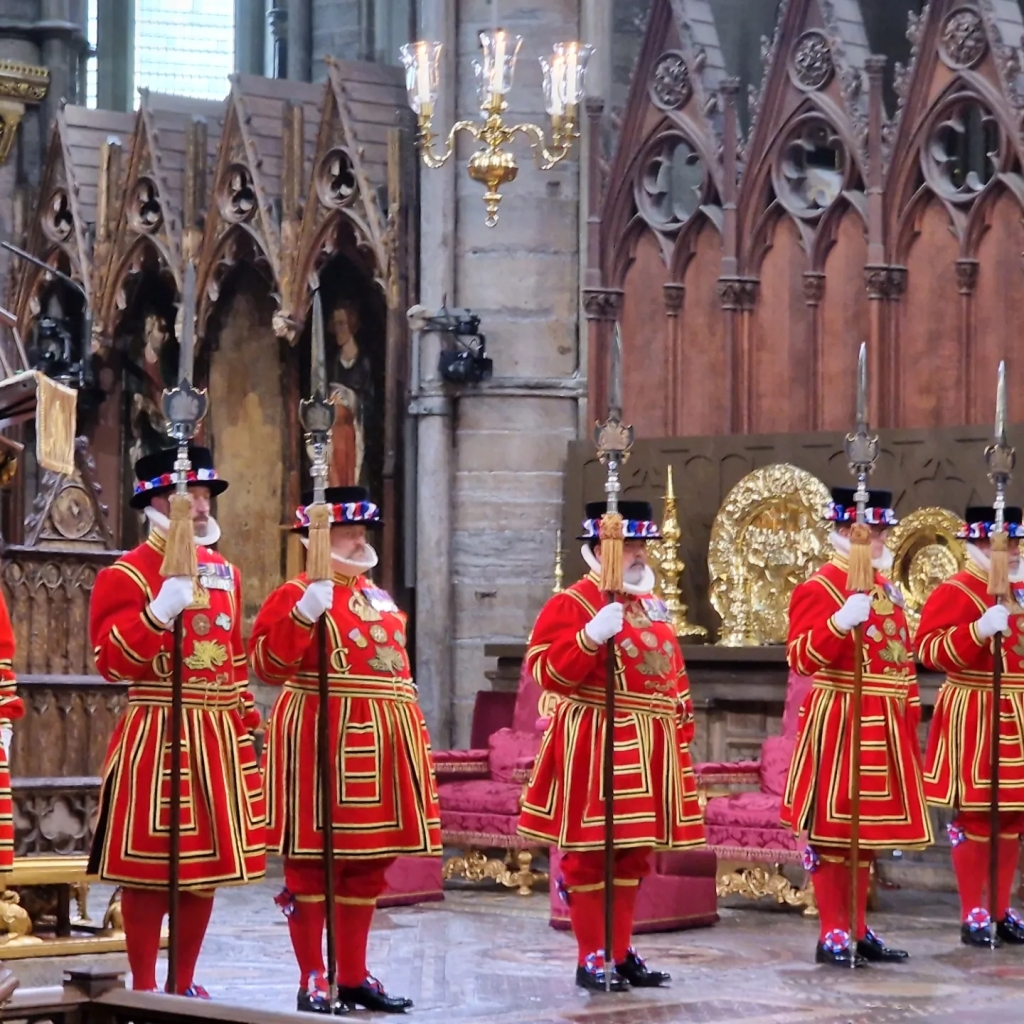
When the ceremony started I was fortunate enough to have found a seat next door to the seating reserved for the Heralds.  This was very cool as I got to see them process, but also got to sit and get an up close view of all their regalia and to see a lot more of their roles.  The advantage to being off to one side and therefore not quite on camera was that although the event was still very formal, I got to enjoy some informal moments that made us all laugh.  Some parts of the order of service did not quite go as planned, such as the Prince and Princess of Wales entering iut of order. Because we were in quite close quarters together there was a real sense of comradery, which I hadn’t expected, as we all got up at incorrect points or couldn’t work out when to sit down when things were not quite as stated.

There was also some slight drama, when during the first hymn, the older lady next to me tried to drink some water, choked and then vomited water all down her, me and quite a chunk of the floor.  Trying to silently signal and collect tissues, check she was OK and clean her up was significantly easier given where we were seated, but again our whole section silently pulled together to try and help.  This is the disadvantage of telling people that bathroom access is limited, as over 5 hours is a long time for some people to not feel like they can drink.

There was never really a dull moment during the service, and it felt like the congregation were constantly involved in small ways during the service.  The moment when the enormity really struck me however, of where I was and what was happening, was during the singing of the national anthem, it made me choke up a little, it just felt truly historic, it really felt like I was living through a never to be repeated moment, and I felt so lucky to be there to witness it.

And then it was over, and yet somehow the time after the Coronation itself felt like the nicest bit.  You could almost feel the collective sigh of relief, and the atmosphere suddenly became much more informal, with people taking selfies with each other, talking and introducing themselves and mingling much more freely.  At this point I could really talk to people about the amazing work my colleagues do and what an honour it was to be there.  It also meant I could get a couple of pics of the Abbey in a way you weren’t permitted before the ceremony.

Then, as I was leaving the Abbey something happened that really made my day.  I got to leave the Abbey and walk with Dame Judy Dench and Sir Kenneth Branagh.  I mean, I didn’t have the courage to say anything, especially as they were just talking to each other in a really normal way, but I got to wander down the road with 2 complete legends, and then say hi to Stephen Fry.  The only way I could have been  more excited was if I’d gotten to meet Michelle Obama, but it appears she didn’t get an invite.

It was a truly magical day that exceeded all my expectations, I got to talk to people about the work we do, I got to feel part of history, and I got to visit a world, however briefly, which I never believed would welcome someone like me, and yet it did with open arms.  I felt like I was welcome, I felt like I was seen and unexpectedly I felt like I deserved to be there.

My 7 seconds of fame on the BBC, plus the legend that is Dame Judy Dench again!!

Carrying your family with you

My friends and family mean so much to me, and they properly stepped up to the occasion, from sending gin minis for after the service that I could use to celebrate, to sending me pieces of jewellery that I could wear on the day and therefore carry them with me to help me deal with the nerves, and to help me feel like I belonged.  They helped me move from feeling worried about the need to represent people and a profession who mean so much to me, to feeling the joy of doing the same.  They helped me stay in the moment and understand that rather than fearing letting people down, I should celebrate making them feel seen.

Seeing their excitement, feeling their support for me stepping onto this enormous stage and celebrating me embracing all of who I am and where I’ve come from made all the difference, and no amount of drizzle could dampen the day.

I was collected by my husband Jon after the ceremony, and not only did he bring me an umbrella, but he also brought me comfortable shoes to switch into. I’ve rarely loved him more. Sharing the build-up and the day with people I love, as well as seeing the responses on social media, really did make it a day I will never forget. Thank you for sharing it with me.

All opinions in this blog are my own

Guest Blog by Dr Claire Walker: Bots, ChatGPT and AI – Is this the end to assessments in Higher Education as we know it?

Whilst SARS CoV2 continues to kick my ass and make doing much other than getting out of bed a challenge, the wonderful Dr Claire Walker has stepped up yet again in order to ensure that whilst Professor Cloutman-Green may be dozing, Girlymicro still delivers!

Dr Walker is a paid up member of the Dream Team since 2013, token immunologist and occasional defector from the Immunology Mafia. Registered Clinical Scientist in Immunology with a background in genetics (PhD), microbiology and immunology (MSc), biological sciences (mBiolSci), education (PgCert) and indecisiveness (everything else). Now a Senior Lecturer in Immunology at University of Lincoln. She has previously written many great guest blogs for The Girlymicrobiologist, including one on the transition from lab to academia.

Bots, ChatGPT and AI – Is this the end to assessments in Higher Education as we know it?

The impact of ChatGPT on assessment is a hot topic in high education at the moment, you can scarcely open a newspaper without seeing scaremongering headlines shouting this is the end to course works as we know it.

I’m not sure I really agree with this, I’ve had a play with ChatGPT and remain fairly confident that I can spot a bot at forty paces. Students have always had access to a use a ghost-writer for take-home exams and essays, and from this perspective, ChatGPT is hardly a new problem. I’m also convinced that my  students are honest, and genuinely believe that they want to prove their knowledge and understanding through coursework’s and examination. Afterall, they will need these skills when they venture out into the world of work so there is no benefit to committing academic fraud. Even if you aren’t caught on day one, it’s going to catch up with you eventually.

That said, there is a question being whispered around higher education institutions at the moment regarding the coursework questions and exam papers – ‘have you run it through ChatGPT? What did you think? Could you tell it was a bot answer?’. So before I throw the baby out with the bathwater and panic, I thought I’d take time to note down some of the flaws that I see in ChatGPT. Currently, ChatGPT only has access to information up to 2021 and cannot access papers behind paywalls so if you design your questions to reflect on current knowledge and practice, the bot will return an error. I often create a new virus, disease or genetic defect for a paper, the bots also error when presented with these and cannot hypothesise the way a student can.  Bots cannot make personal reflections which are essential in synthesis of clinical information, it’s very obviously if a reflection is generated by AI.. Also we know our students, we know their writing styles and have a very good idea of what level of knowledge they have – it’s our job (!). We do teach the content of the modules after all. Finally, we already have AI detecting tech built into our anti-plagiarism systems. This is a cat and mouse game, and the bots won’t stay ahead for very long. 

Even so, this is just one lecturer’s opinion so I thought I’d go right to the source – and ask ChatCPT itself. And you can read for yourself. I’m not convinced we’ll be getting it to write any more blog posts any time soon….

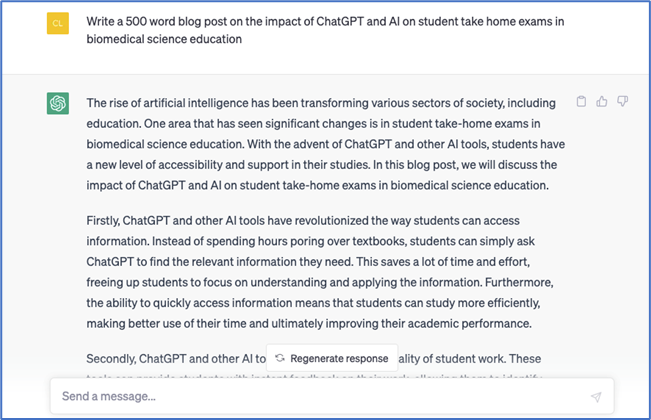
Input Question: Write a 500 word blog post on the impact of ChatGPT and AI on student take home exams in biomedical science education

ChatGPT Blog Post:

The rise of artificial intelligence has been transforming various sectors of society, including education. One area that has seen significant changes is in student take-home exams in biomedical science education. With the advent of ChatGPT and other AI tools, students have a new level of accessibility and support in their studies. In this blog post, we will discuss the impact of ChatGPT and AI on student take-home exams in biomedical science education.

Firstly, ChatGPT and other AI tools have revolutionized the way students can access information. Instead of spending hours poring over textbooks, students can simply ask ChatGPT to find the relevant information they need. This saves a lot of time and effort, freeing up students to focus on understanding and applying the information. Furthermore, the ability to quickly access information means that students can study more efficiently, making better use of their time and ultimately improving their academic performance.

Secondly, ChatGPT and other AI tools have enhanced the quality of student work. These tools can provide students with instant feedback on their work, allowing them to identify areas for improvement and make corrections before submitting their assignments. This means that students can produce higher-quality work and learn from their mistakes more quickly. Additionally, AI tools can help students catch errors that they might have missed on their own, leading to more accurate and thorough work.

Thirdly, ChatGPT and other AI tools have increased the accessibility of biomedical science education. For students who may have difficulty accessing traditional classroom-based education, these tools offer a new avenue for learning. With ChatGPT, students can learn at their own pace and on their own schedule, making education more accessible to those who may have other responsibilities such as work or family commitments. This also means that students who live in remote or underprivileged areas can access high-quality education that might otherwise be out of reach.

However, while there are many benefits to using ChatGPT and other AI tools in student take-home exams, there are also some potential drawbacks to consider. For example, there is a risk that students may become overly reliant on these tools, leading to a reduction in critical thinking skills. Additionally, the use of AI tools may make it easier for students to plagiarize, as they can simply copy and paste information without fully understanding it.

To mitigate these risks, it is important to ensure that students are taught how to use these tools responsibly. This includes educating them on the importance of critical thinking and encouraging them to use AI tools as a supplement to their learning, rather than a replacement for it. It also means teaching students how to properly cite and reference sources, and providing them with opportunities to practice these skills.

In conclusion, ChatGPT and other AI tools have had a significant impact on student take-home exams in biomedical science education. These tools have improved the accessibility and quality of education, while also helping students learn more efficiently. However, it is important to approach these tools with caution and ensure that students are using them responsibly. By doing so, we can continue to harness the power of AI to enhance biomedical science education for students around the world.

Certainly ChatGPT has a high opinion of itself but there are some good points made here. This could be a useful study tool to help students learn and revise topics. With this in mind, you can’t uninvent a technology. Now is the time to elevate the different assessment methods that we use. So with that I’m off to mark an in-person practical exam, set a group work project and spend a week listening to students present a critical evaluation of papers written after 2021. I don’t think ChatCPT has me out of a job just yet…

TLDR – It’s not like the Bot started the blog post with ‘I am become death the destroyer of the higher education assessment system’, just yet.

All opinions in this blog are my own

It’s Not All Bad in the World of Infection Prevention and Control: The most wonderful time of the year is approaching!

NB this article was originally written for the Association of Clinical Biochemistry and Laboratory Medicine and published December 2021

There’s no getting around the fact that it’s been a tough couple of years in the world of Microbiology, Virology and Infection Prevention and Control (IPC), but at this time of year its worth reviewing the bits of our jobs that are to be honest pretty awesome.  The bits that energise rather than drain us and remind us of why we love our work. 

Before I go any further, I should probably make a confession and declare that I am a bit of Christmas fanatic.  I’m the person who goes to Christmas shops when on holiday in June and thinks that as soon as November hits Christmas films and music are go!  So it’s probably of no surprise that my favourite IPC event occurs in December as part of the build up to Christmas.  Hopefully, you will also appreciate how great it is even if you don’t love Christmas as much as I do. 

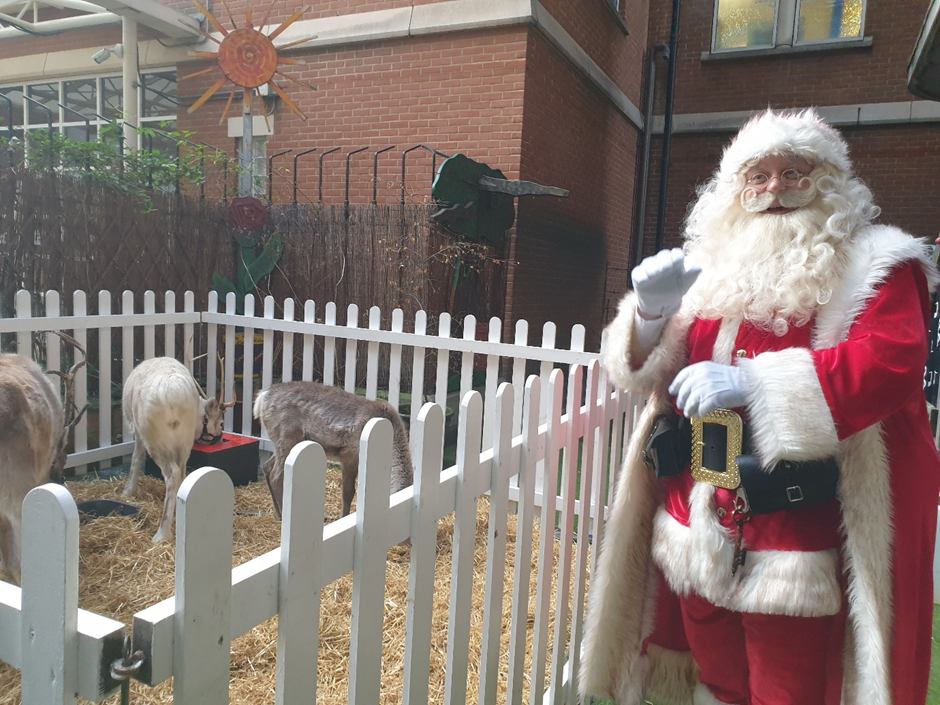
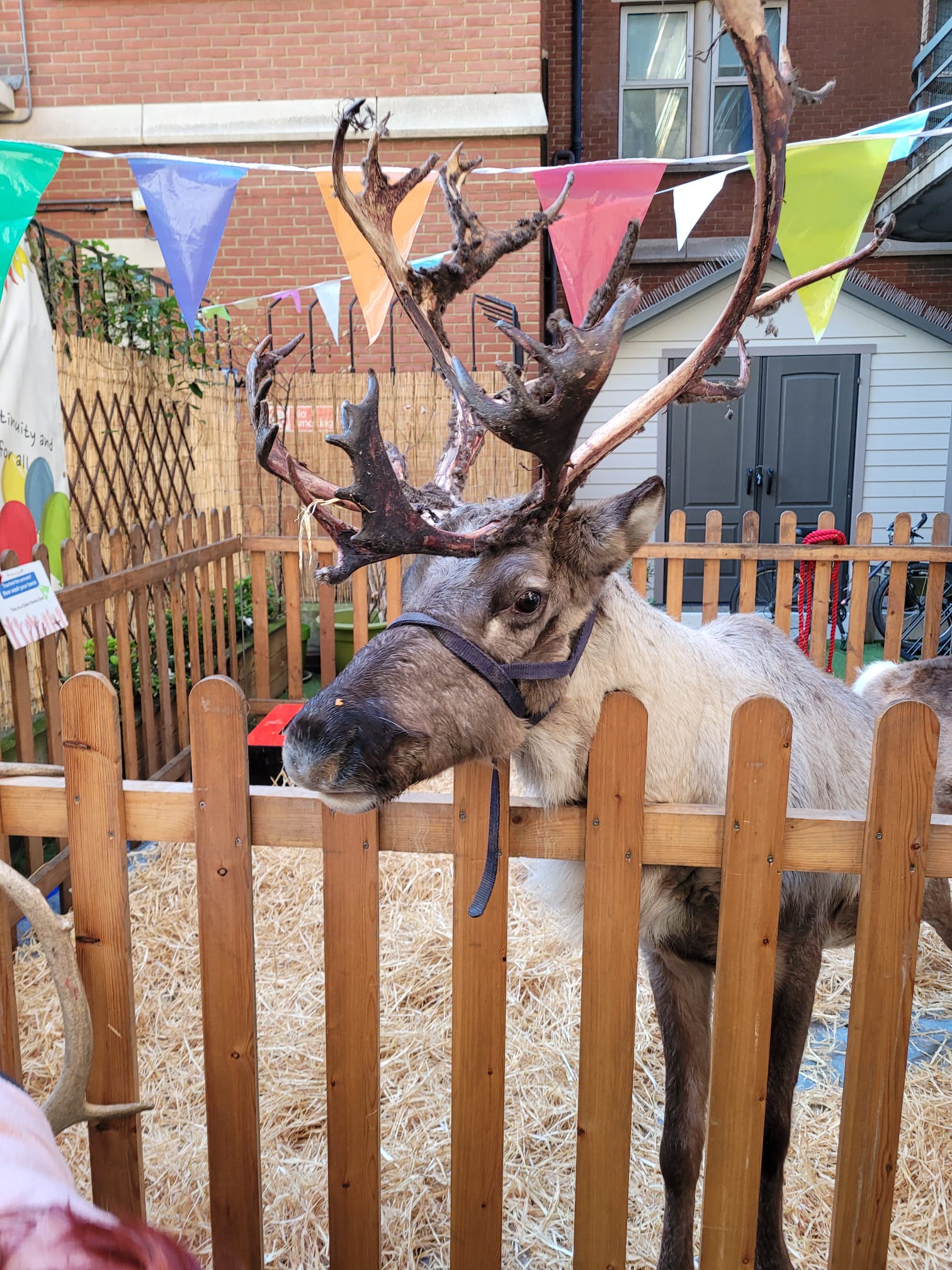
I work in a paediatric hospital and every year the patients are lucky enough to be visited by not only Santa, but also his reindeer.  What does this have to do with IPC I hear you ask?  Well any animals brought onto site need to have an IPC risk assessment as they can be linked to zoonotic transmission of infection and thus pose a risk to patients.  My colleagues’ favourite time of the year is when she gets to do this for the rabbits and ducklings at Easter, but for me the reindeer assessment is very much my favourite.

Reindeer can be a source of ticks, which can harbour organisms that lead to Lyme disease and other tick borne infections, as well as being a source of more exotic bacterial infections (List of zoonotic diseases – GOV.UK (www.gov.uk)).  The reindeer that come to us are captive rather than wild, but even so they are still coming onto healthcare premises and need a review. The task therefore, although a joy, does have a serious aspect in terms of ensuring that the area is properly set up in order to permit the patients to visit, whilst ensuring that they are kept safe and not exposed to any risk.

We work with both the school and Santa to ensure that:

  • All animals are established in an environment that supports safe handling of the reindeer to avoid injury for them and anyone interacting with them.
  • Signage and other provision is made to ensure that there is no eating or drinking near to the animals or their enclosure, to reduce any infection transmission risk.
  • Hand hygiene facilities are available for hand hygiene after contact, especially as the patients will feed the reindeer.
  • Decontamination equipment is available to ensure the area can be adequately cleaned after Santa and his reindeer leave to visit other children.

Last year when we inspected we also had the added aspect of ensuring that Santa was SARS CoV2 free and was protected from any exposures whilst on-site.  This included having Santa complete a health screening questionnaire, including questions like whether he had any symptoms or SARS CoV2 household contacts, such as Mrs Claus, in order to assess his SARS CoV2 transmission risk.  He also needed to wear personal protective equipment i.e. fluid repellent surgical masks, to protect him and the children and young people.

This was a new aspect to the visit that made it more challenging and certainly inspired the patients to be differently engaged and ask questions such as: how does Santa manage to avoid the quarantine restrictions linked to visiting red countries?  and if Santa was vaccinated?  We responded that Santa was of course vaccinated as he had been part of the SARS CoV2 vaccine clinical trials and was therefore an early adopter of the vaccine.  We also talked about the fact that because he could manipulate time, he and the reindeer had plans about how they were still going to be able to safely visit all households and quarantine as necessary.  We also discussed that whilst he was with us we would provide him with personal protective equipment training, in the same way their clinical teams have, to ensure that he is kept safe and also protects the children he encounters along the way.  It turned into a really good way to talk to families about how we use a variety of measures in hospitals and healthcare to keep people safe, and to emphasise that although masks look scary they are actually a really good way of protecting everyone.

This experience brings me joy every year but last year in particular it reminded me that keeping people safe and raising awareness of what we do, does not have to exist in isolation from activities that are fun and engaging.  I love visiting the reindeer, however seeing patients be inspired to ask questions and explore IPC in a way they may not feel confident to do normally, also made me aware that it may be not only a joyous experience but a useful one.  It turned something fun for all involved into something that was also educational and supportive of good practice.  So this year as well as making sure I have enough carrots I will be ensuring that I’ve thought about how to make the most of this unique encounter to make a difference for everyone involved.

All opinions on this blog are my own

Guest Blog by Dr Claire Walker: The Power of Yes – Why it’s important to spend the weekends doing Science Outreach, and taking up catering as a hobby

Dr Walker is a paid up member of the Dream Team since 2013, token immunologist and occasional defector from the Immunology Mafia. Registered Clinical Scientist in Immunology with a background in genetics (PhD), microbiology and immunology (MSc), biological sciences (mBiolSci), education (PgCert) and indecisiveness (everything else). Now a Senior Lecturer in Immunology at University of Lincoln.

Those of you who know me know I have a serious problem saying no to any outreach activity, even when it falls well outside the very tiny limits of my comfort zone. My science family have persuaded me to run schools’ days, science clubs for toddlers, blog posts and even the odd science stand-up comedy night. It’s not that I am an extrovert, quite the opposite is true, I am the quintessential laboratory nerd. I like analysing data, planning experiments and some quiet time with my beloved flow cytometer. However, I know the power of outreach and I only need look to the inspirational scientists who came before me, and took the time to speak with me when I was young, to justify pushing myself outside the comfort of my lab and into the spotlight again.  And to be clear. I really love my lab.

So during the summer break my good friend, colleague and mentor @girlymicro picked up the phone and asked how I felt about coming to help support a ‘little event’ she had planned. As I’ve said before, one of the most charming features of @girlmicro is that she rarely recognises what a big deal she is, nor indeed that what she considers a ‘little event’ is most peoples idea of a very BIG deal. Now @girlymicro knows all my weak spots. She knows I love a bit of outreach, she knows I love working with children, she knows I love the drama of the theatre and, more than all this, she knows I absolutely adore baking and harbour an intensely secret desire to be a professional pâtissier one day. ‘It’ll be a wonderful day’, she said, ‘an intimate event celebrating healthcare scientists – you wouldn’t mind baking a cake or two would you?’. I had already said yes and was thinking about recipes when it occurred to me, I hadn’t asked about the venue or numbers, or really anything at all.

Of course, the event was the Bloomsbury Festival(!) and a couple of cakes was a free afternoon tea for all comers. For those of you who don’t know, and perhaps didn’t attend, the Bloomsbury Festival is an annual celebration of the area’s creativity which each year presents an inspiring programme of culture, arts, science, literature, performance, discussion and debate. It is, by anybody’s estimation, a very big deal. And what a wonderful day we had.

The inimitable Nichola Baldwin of Project Nosocomial lead us through three really outstanding performances. Remember, Remember – the amazing *true* story of how three healthcare scientists set out to foil the gun powder plot with help from 9-year-old Princess Elizabeth. For me, this show always delights. The children, and adults, in the audience loved it fuelled by their complementary @girlymicro branded cupcakes. Nichola and @Girlymicro showcased a new play – ‘All opinions are my own’, a powerful performance based on this very blog. I can say truthfully there wasn’t a dry eye in the house. We laugh, we cried, we had a marvellous afternoon tea, and we used voguing to demonstrate the importance of the T zone in appropriate mask wearing. Finally, when the heavens opened and we were sure no one would brave the rain to come to our last session, Nichola and @Girlymicro closed the day with a performance of ‘Mrs X and Me: What is AMR and What can we do about it?’. Despite the rain, the superb actors and healthcare scientists performed to a full house and everyone left truly understanding the looming health crisis of antimicrobial resistance and how we can all play a role in preventing it.

I can’t think of a more appropriate way to celebrate the incredible work Elaine does in science outreach and communication than an afternoon of theatre celebrating healthcare scientists with tea and cake. And now I have my Food Hygiene and Safety for Catering certificates – I might even be persuaded to run another one.

Filmed content linked to the Nosocomial Project can be found here on the Rise of the Resistance YouTube channel.

All opinions on this blog are my own

Guest Blog: Claire and Sam take over the Environment Network

Today is the Environment Network 2022 event: The Role of Surfaces and Surface Decontamination in Managing healthcare association infection (HCAI) and as @Girlymicro is busy running the show she has tagged in her willing PhD student Sam Watkin, and regular contributor Dr Claire Walker to live blog this event. Let’s get started #EN2022.

What Is the Environment Network?

The Environment Network works to support people in clinical, engineering and scientific roles who are interested in environmental infection control

Do you want to know more about what to do with your water screening and air sampling results?  Are you keen to understand the evidence behind equipment cleaning and the role of the environment in healthcare associated infection?

Then welcome to the Environment Network!  This is a network for people in clinical/scientific/engineering roles within the NHS and other associated organisations who are interested in the role of environmental infection prevention and control in preventing infection. 

The aim of the network is to support infection prevention and control professionals involved in commissioning, environmental audit, water, air and surface testing within their Trusts.  By working together we can share best practice between Trusts; as well as circulating the latest evidence and discussing personal experiences. 

We are so excited to be live blogging the wonderful EN conference this year. Dr Elaine Cloutman-Green BEM opens the conference setting the scene for a wonderful day of networking, learning and discussions with our clinical, industry and academic colleagues. We’ve all come here today create a friendly network of experts. Because sometimes we all need to phone a friend at 4.30 on a Friday when everything is going wrong, and this is the perfect opportunity to grab every experts number.

Morning Presentation Session

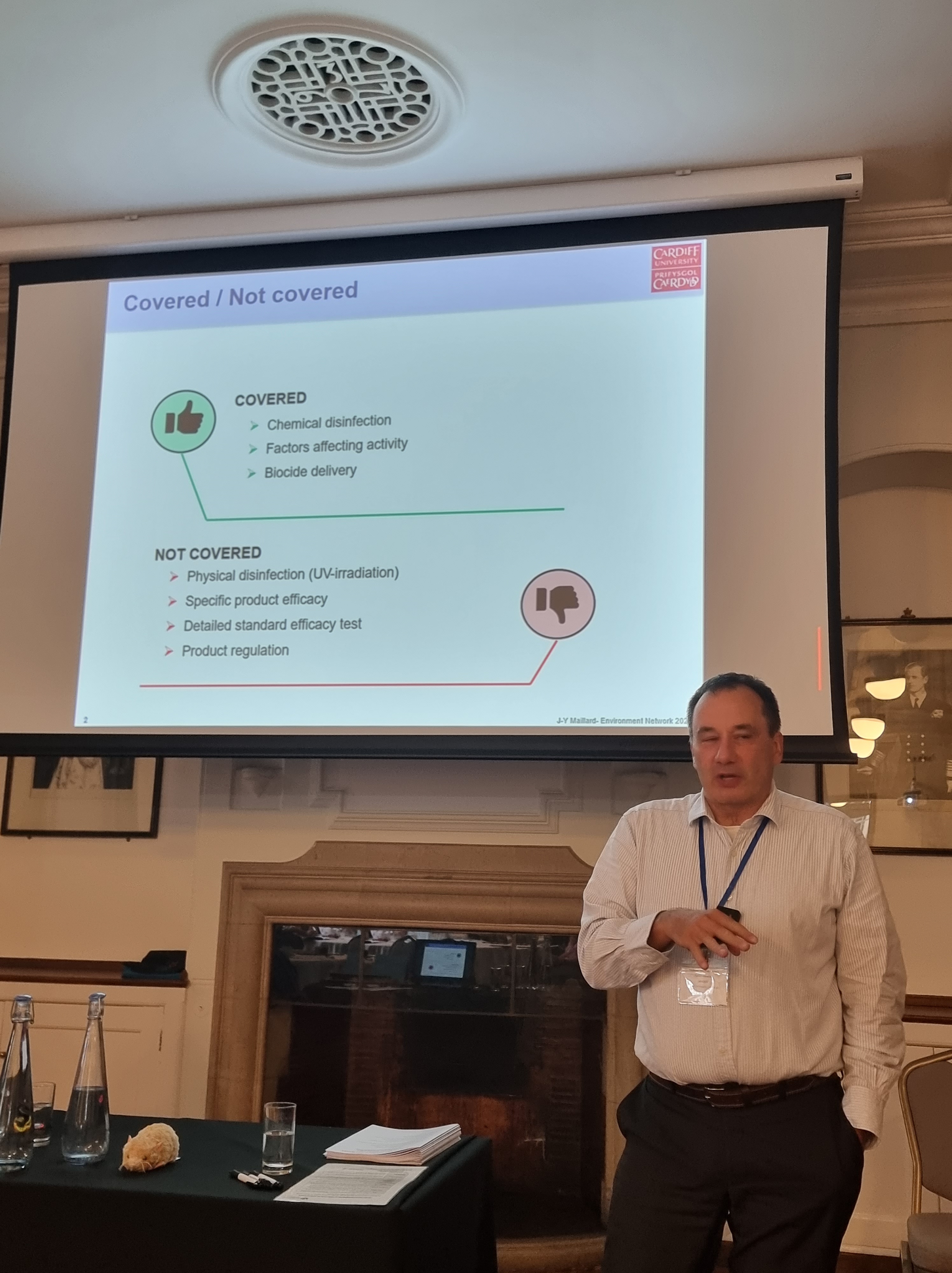
The esteemed Professor Jean-Yves Maillard from Cardiff University leads us through his thoughts on options for surface clean and surface decontamination. This topic is very much at the forefront of our minds in the EN, and whilst there has been huge progress in hand hygiene (thanks COVID!), Prof Maillard’s fascinating talk demonstrates how many factors have to be considered to really make a surface ‘safe’. There are so many variables to consider; what product to use, how effective a product is, what factors impact on that efficacy and unique multifaceted challenges we face in this field particularly when it comes to training and developing best practice across healthcare specialisms.

He raised a very interesting and important point when thinking abut surface decontamination – how do you define a “safe” surface? Let’s talk about norovirus – when we consider that it takes 10 virus particles make you sick and there are one billion virus particles per gram of vomit or faeces – you best hope your cleaning strategy works or the whole cruise ship (or worse hospital ward) is going down. The difference between looking clean and being safe is shown, just because it looks shiny doesn’t mean that you can eat your dinner off it!

As we come to discussing decontamination chemicals, the focus turns to compliance with surface decontamination protocols which are essential in maintaining environmental decontamination efficacy. Prof Maillard raised fascinating points on how products are used and why this matters. Different delivery methods, such as spray, foam or pre-wetted wipes, have significant impacts on the efficacy of compounds and their proper use is often hard to consistently achieve.

Further complicating the issue, different microbes have different susceptibilities to different decontamination agents. Wipes that can remove a Gram-negative pathogen can do very little against a Gram-positive. We know that some key pathogenic organisms like Clostridioides difficile require higher levels of disinfection compared to others, but other pathogens often have different requirements to each other. Multidrug resistant organisms can often be resistant to quaternary ammonium compounds meaning you may be able to clean off antibiotic-sensitive Klebsiella, but the drug-resistant ones could remain. Similarly, despite some company claims to the contrary alcohol gel does nothing against C.difficile spores.

Prof Maillard detailed just how important this is by describing some shocking cases of where cleaning has gone wrong. The use of inappropriate compound concentrations and a lack of consistent training on new products can have truly terrifying consequences in the hospital environment. In untrained hands, cleaning can actually make the situation worse not better, for example poor cleaning with can spread viruses around a patients room rather than remove them. We all have so much to learn from not taking detail for granted and how basic precautions like ‘one wipe, one direction, bin it‘ can prevent healthcare associated infections.

As the talk comes to a close we ask can we trust claims of residual activity of decontamination products? Does it really leave a surface ‘clean’ and ‘safe’ for 48 hours? Do these products really work as well as companies or their representatives claim? Prof Maillard says we really can’t trust everything we read. A disinfectant used improperly can select for microorganisms resistant to that product. This highlights not only the importance of choosing the right disinfectant compound, but on using it correctly too. With pandemics in the press, it’s more important than ever that we have an open dialog and solid evidence base for what we use, how we use it and when to use it to create safe environments for both patients and staff.

In our second presentation of the day Karren Staniforth from UKHSA explains the role of novel decontamination techniques in healthcare

It’s important to acknowledge that in decontamination, one box does not fit all. A high risk patient post chemotherapy has very different requirements to a healthy adult popping to the GP to ask for a repeat prescription. Furthermore, we know can’t sterilize everything. It simply doesn’t work that way, so we need to be decontaminating to an appropriate level for the site. If we can avoid high-level sterilization we should as they are expensive, potentially damaging to the site and generally involve harmful chemicals. So how do we manage surfaces categorized as ‘low risk’? For those of us who aren’t so familiar with disinfection in the low risk setting this means something that comes into contact with intact skin. A huge number of different products are available but today Karren is are talking about UV light, and gases and vapours – why we might want to use them and how we might automate these systems.

Karren raises an important issue that automated decontamination techniques don’t remove human error, particularly as they generally require humans to set them up. We still need manual cleaning of rooms when using these, so they very much are there to support environmental cleaning and decontamination, not to replace manual decontamination. However, there are some incredible advantages to an automated system – not least that they are highly reproducible thus much easier to audit and, with proper calibration, should be highly precise and accurate.

Karren tells us why it is so important to use and understand what disinfectant efficacy really tells us, and why it is crucial to be sceptical and to question the manufacturers claims about their products. She details a fascinating history of working in infection prevention and control, and the journey from cleaned rooms actually causing MORE infections to introducing novel technologies and strategies that are proven efficacious. Her talk is peppered with wonderful real world experience of infection, prevention and control. Simple strategies like removal of felt notice boards from wards also had a huge impact in improving cleaning strategies to rid geriatric wards of C.difficile. As a member of the EN steering group (Claire), I am heartened to hear how sharing our stories can improve real world patient care.

Karren closes her talk with some fascinating points about cleaning frequency rather than specificity. We really need to thing about exactly what we are trying to achieve in each setting, and often a bespoke mixed-approach will be what fits the bill.

Post Coffee Talk Session

Claire has been let loose on her own now – with Sam giving his presentation next.

Revived by our coffee we move onto the much anticipated talk by our pal Sam who, with the knowledgeable Helen Rickard, is guiding us through monitoring microbial surface loads – how we should approach it in healthcare and some key findings from their exciting work. Monitoring let us pick up presence and movement of clinically relevant microorganisms in the hospital setting promoting surveillance and targeted treatment programs. This is done routinely in hospitals, but can be stepped up after an outbreak or when transmission is unexpected.

Sam gives us a step by step guide to the different samples and how you might process them to identify the microbial population present. His data demonstrate how important continual sampling is – just counts of microbial species are a snap shot of the situation, and when repeated sampling is done microbial persistence is revealed telling the whole story.

Helen Rickard walks us through why sink surfaces are so important in HCAI. Sinks are the perfect environment for microbes to thrive, and the presence of running water disperses and aerosolises bacteria. They are also often very close to patients. Helen is interested in the impact the patients will have on sink surfaces. Her exciting preliminary data reveals that numbers of organisms detected on sinks double when patients inhabit wards, and numbers of human commensals massively increase. We’re already excited for Helen to come back and tell us more when she is further along into her project.

Dr Marco-Felipe King from the University of Leeds is up next, telling us all about how one can model the impact of surface decontamination. Dr King’s work links airborne and surface contamination, looking at the impact of ventilation on surface contamination, and then transmission onto human fingers. We watch an incredible computer generated model depicting how viruses spread across a ward onto surfaces challenging the myth that viral particles don’t deposit on surfaces. Dr King’s enthusiasm for understanding microbial recontamination of surfaces (why microbial loads sometime increase after cleaning) is infectious. He showed several delightfully complicated formula to model these (and explained them very well!). In Dr King’s own words, “something funny is going on” with the data, which inspired lively discussion amongst all the delegates. He showed how much relative humidity matters for transferring organisms to hands when surfaces are touched – basically proving you should never lick your fingers when on the tube.

Dr Lena Ciric from University College London brings our morning session to a close with a fascinating talk all about the importance of surface loads, and how they differ in healthcare and the community.

Dr Ciric kicked her talk off by discussing the challenges of achieving low surface loadings in the healthcare setting, explaining that while we want microbially clean surfaces in hospital, we have evolved to live with microbes. She highlighted how few guidelines actually exist for surface loading levels, and the challenge this presents to standardisation. Dr Ciric’s data looked at colony forming units collected from a range of locations – hospital wards, the FA cup final, the Brits and even the Tube – to understand what a safe level of microorganisms on surfaces should be. Safe to say we are never touching a surface on the tube again. But it’s not simply a case of how much of something is there, we need to understand what microbial species are present. Her data on presence of SARS-CoV-2 presence showed that colony forming units (CFU) didn’t reflect how much SARS CoV-2 RNA was present on the tube, so whilst the CFU guidelines are interesting more work needs to be done. Really highlighting the importance of, in Dr Ciric’s own worlds, ‘you’ll find what you go looking for’!

Reflections on Surfaces

What an absolutely brilliant, informative and lively morning. It’s difficult to condense such a varied and thoughtful set of presentations into a few take home messages.

  • The importance of moving past the marketing – we really need to question how good products are, validate them for use and develop sound guidelines.
  • Human factors are hugely important – without proper training even the best tools are not helpful
  • The overall takeaway for the transfer of organisms to people’s hands: “it depends”

TLDR: @girlymicro let Claire and Sam loose on her blog, who had lots of fun but she should definitely have provided a word count.

All opinion on this blog is my own

Keeping Up with the Kardashians: Your K score and the uneasy relationship between science and science communication

I’ve talked previously about benchmarking and the pros and cons of trying to work out if you are doing OK by comparing yourself to others. As scientists we have a tendancy to look for evidence, in the form of numbers, to enable us to do this. In terms of research measures the main ones that I have heard of being used are the h-index (Hirsch index) and the i10-index. These numbers are not just used by us as individuals as marker of impact and progress but they are also used by promotion panels at universities and by external reviews as a marker of quality/excellence. The question is are they measuring the right things? More recently I heard of something completely new (to me), the K-index (Kardashian index) and finding out what it was about kind of blew my mind.

What are these measures?

The h-index is supposed to measure both productivity and impact. It’s calculated by using the number of papers published by an individual that have a minimum number of citations, for instance if you have a h-index score of 4 you have 4 papers that have at least 4 citations. You may have published 20 papers but they only count once they have reached the minimum citation score. The i10-index by comparison is the number of papers with a minimum of 10 citations, and so is a similar but simplified version.

As of August 2021 my scores for these benchmarks (as taken from Google Scholar) are:

I had on the other hand had never heard of the K score or Kardashian index until recently. The K-index is a measure of someone’s scientific productivity in relation to their social media score. It is determined by dividing the number of social media followers someone has on Twitter by the number of citations they have in peer reviewed publications. In my case (as of the 10th August) that would be 4939/703 = K-index of 7.03.

What’s in a number?

But what do any of these numbers actually mean. For the h-index a score of 20 for a scientist of 20 years experience is supposed to mean they are successful, 40 is outstanding and 60 is exceptional. Obviously these vary between disciplines, but as I haven’t reached my 20 years yet I’m OK with my 16. For the i10-index, only really used by Google Scholar, for a similar level of experience an i10-index of 25 is considered to be pretty good. Again, this varies between disciplines. It is also likely to differ between settings, as a Clinical Academic I am unlikely to achieve the same metrics as one of my academic colleagues, as I also hold a clinical role.

“I propose that all scientists calculate their own K-index on an annual basis and include it in their Twitter profile. Not only does this help others decide how much weight they should give to someone’s 140 character wisdom, it can also be an incentive – if your K-index gets above 5, then it’s time to get off Twitter and write those papers”

Hall, N (July 30, 2014). “The Kardashian index: a measure of discrepant social media profile for scientists” (PDF). Genome Biology. 15 (7): 424.

What is it that my K-index means then? Well my K-index is above 5 and therefore apparently means I may have a higher following than my scientific research credentials indicate I deserve. If I had a low K-index (i.e. 1 or 2) it would suggest that perhaps my science was being undervalued. This was actually seen for a quite a few female scientists in this rather tongue in cheek study.

Just call me Khloe

So I am a Kardashian, it’s official! Now if I could also be given their pay packet and I also wouldn’t mind someone who would follow me around doing my hair and nails – although that might be a little weird on ward round.

In all seriousness there have been a number of things that struck me about this as a concept.

  • The idea that scientists only attract followers in order to share their own science, rather than to share and discuss science or to raise awareness of the profession
  • That all of these measures try to claim they measure impact but all they do is measure the equivalent of ‘shares’ by scientists to scientists and I would suggest that that isn’t actually a measure of impact – just a measure of how well you are surviving at publish or perish
  • The lack of perceived benefit from science communication undertaken by scientists in comparison to the requirement to produce new publications. This has been seen in a bias against women in the promotions process as they are usually disproportionately involved in activities such as outreach, which are not perceived to have equivalent value. Only ‘hard’ science counts

What does the existence of this metric tell us (even jokingly) about the relationship between science and science communication?

I am aware that the author of this paper said in 2022 that it was satire and a dig at the use of a metric indicators, but I think it goes deeper than that and sheds light on a much larger set of issues and attitudes.

I have been told my people that I both respect and who are very senior that I should do ‘less of my nonsense and focus on both my science and clinical skills’. The nonsense they were referring to is my education and outreach work, work like the Nosocomial Project. The impact of this work in terms of recruiting future scientists, about the democratisation of science, and impacts on decision making, definitely aren’t captured by the number of citations I have on Google Scholar.

I think these metrics also fail to capture things like translation into clinical practice, inclusion in guidance and use by groups who may not be publishing papers, and therefore are not citing your work, but have applied it to their setting. That is the reason that I publish, to support change, not to chase a h-index, and so these metrics represent only a very traditional view of academic impact.

As for the K-index, as far as I’m concerned my research is funded by the public, the results therefore are owned by that same public and there is an onus on me to share with then what their funding has paid for, discuss with them whether they actually feel it brings benefit and where it can be improved for those with lived experience. I think the time of academics living in an Ivory Tower and only communicating with each other should be over. Yes we need to talk to each other, collaborate and inspire each other, but that shouldn’t be as far as the conversation goes.

There is obviously a difference between being a science communicator and a scientist who communicates science. The JD’s and the skill sets are over lapping but different. That doesn’t mean that scientists shouldn’t be out there talking about science with the wider public. I feel very strongly that sites like twitter shouldn’t be a single sided conversation. I’m not just going to talk about my science, I want to discuss and amplify content produced by others. I want to have, sometimes challenging, discussions in order to show that science isn’t about absolutes.

Communication on social media is about so much more than the sharing of data. It is a way to develop networks, show support and amplify, as well as to communicate information that is real time and may not have gone through the academic peer review process, such as guidelines or funding calls. So maybe instead of putting scientists with a high K-index and low other scores into academic purgatory we should look at developing a different way to evaluate the modern version of what it is to be a scientist. A score that could capture all of the invaluable work a lot of academics do to ensure that there is a workforce of the future and to support scientific literacy and co-production beyond the Ivory Towers in which we live.

Anyway, apparently I’m off to the paper mines to prove my academic worth. I intend to continue to smuggle out tweets whilst the WiFi permits however, because as much as its lovely to talk to scientists and people like me, science is more valuable when it is truly shared and available to everyone.

All opinions on this blog are my own

Celebrating National Pathology Week: What is a clinical microbiologist?

This one’s a re-share of a post from last year but I thought it was still a good one to continue this weeks exploration of roles.

To celebrate this week being National Pathology Week , I thought I should take some time to post about what a clinical microbiologist is. I do this because, when I was at university, I really didn’t know that this career path existed. So here is a shout out to all those students who are trying to decide their next steps. You too will find your way.

When I googled microbiologist this is the first item that comes up

Microbiologists study microorganisms (microbes) in order to understand how they affect our lives and how we can exploit them

Prospects.ac.uk

This seems like a pretty good cover-all description. It goes on to discuss that there are microbiologists in many different areas:

  • medicine.
  • healthcare (I’m not sure how they differentiate this from medicine or visa versa).
  • research.
  • agriculture and food safety.
  • environment and climate change.

I must admit that when I was at university most of the options I encountered were linked to the food and drink industry or pure research. I think that their list missed things like Pharmaceuticals (although they may count that as medicine) and other forms of production, i.e. cosmetics.

At university I only did one module of microbiology (I was reading Zoology) and that module was about environmental bacteria and plating out bacteria onto agar plates to see what grew.

How did I go from Zoology to Microbiology?

I really wanted to work in an area of science where I could work to make a difference. I wanted to work somewhere that I could see that difference being made. Working in research felt too abstract to me. When I discovered, through a friend, that I could become a scientist in healthcare I knew it was what I wanted to be.

The National Careers service says you need to have two to three A-levels to become a microbiologist, plus a post-graduate degree. That is mostly true. However, in a world of apprenticeships and T-Levels, that is no longer the only route.

When I became a Healthcare Scientist I became a Clinical Microbiology trainee. So, what was the difference between that and what I’d done at University? The main difference with clinical microbiology is that I focus on organisms that cause infection: parasites, viruses, fungi and bacteria.

I also discovered that there was so much more to microbiology than agar plates. Although – don’t get me wrong – agar plates are still a mainstay of life within the bacteriology laboratory.

One of the techniques I learnt to love was polymerase chain reaction (PCR), which enables us to look for the DNA or RNA of a microorganism instead of growing it. Viruses and parasites don’t grow on agar plates and bacteria and fungi may not grow well if exposed to antibiotics or if present in low levels. PCR allows us to diagnose patients with infections that would not be diagnosed otherwise, or to speed up the process so patients get put on the right treatment faster.

Variable number tandem repeat typing of Klebsiella pneumoniae

PCR also enables us to do things that are harder to do using traditional bacterial techniques such as culture. The picture is of patterns that are like bacterial fingerprints so that they can be clustered into similar groups. This enables me, as a clinical microbiologist, to tell whether bacteria within the same species are the same or not. This is important when deciding whether a bacteria has spread from one patient to another. It helps in acting like a hospital detective, which is a lot of my work in Infection Prevention and Control.

As a trainee I spent four years rotating within laboratory settings. I spent one year in a molecular laboratory, diagnosing patients using PCR. I then spent six months rotating between benches (each sample type has its own laboratory bench) in bacteriology: wounds, respiratory samples, faecal samples, blood cultures, urines, fluids (cerebral spinal fluid etc.) and the primary bench where samples were put onto agar plates. Six months in virology, a year in research and time in food and water, parasitology and mycology (fungal) labs.

The diagnostic process is pretty similar in principle between the specialisms:

  • collect specimen from possible site of infection.
  • select the most appropriate test to detect any organisms (agar plate for bacteria, PCR primers for viruses, etc.)
  • evaluate whether the result (positive or negative) is accurate and whether there are other tests that should be done, i.e. further characterisation of positives such as antimicrobial sensitivity.
  • decide on treatment or management of the infectious cause, i.e. antimicrobials or non-antibiotic management such as surgery.
  • advise on infection control if actions are needed to investigate where the infection came from or to protect others from risk.

During my first four years I spent most of my time in the laboratory doing the first three bullet points.

Time goes on. I’ve been in the NHS for 17 years. Most of my time is spent at my desk in the on-call bathroom. Since 2010, most of my time has been spent either in Infection Prevention and Control undertaking the final bullet point or increasing my skills by gaining Fellowship of the Royal College of Pathologists to do bullet point four.

I still support the lab and, occasionally, get my lab coat on – but not as much as I’d like. It is, therefore, possible to be a clinical microbiologist and be anywhere on the spectrum. You can go as far as you’d like and do the type of work that makes you happy. It’s why being a clinical microbiologist is a great career!

Modernising Scientific Careers Framework

All opinions on this blog are my own

If Not You Then Who? Why seizing the opportunities that come your way is so important

We’ve all had the emails arrive with requests. We are looking for a new member of X committee, a training rep for X group or would you like to give a lecture to Y. For many year when these dropped into my inbox I ignored them. They were being sent to everyone and so ‘they’ weren’t actually looking for someone like me. I wasn’t experienced enough knowledgeable enough, connected enough to ever find success in replying to something like this. Then one year I took a chance and replied. I volunteered to become the HSST lead for the Microbiology Professionals Committee of the Association of Biochemistry and Laboratory Medicine (a LOT of letters I know). They couldn’t reply fast enough with how happy they were I’d replied.

Don’t get me wrong, the ACB weren’t particularly excited that I’d replied……..more they were excited that anyone had. What I’ve learnt since from sending out these emails myself, is that hardly anyone does. The world is full of people who doubt that they would succeed and so don’t put themselves out there and give it a shot. So today I want to talk about all the reasons why, when that email arrives, you should click reply, open the next door in your career and step through it boldly.

You never know where these things will lead

When I sent that email I had no idea where it would lead. Now I know it was the first in a series of steps that took me from where I started to being considered a leader within my profession. At each step I never could have predicted what the one a couple of steps down further down the road would involve. What I do know is that each one I took, I took with purpose. Sometimes I wanted to give back, sometimes I wanted to increase my skills and sometimes I wanted to gain experience. The choices are your own but also not taking those steps and being purposeful is also a choice.

What I hadn’t realised back then is that people frequently ask people they know to get things done, not necessarily because they are the best person but because they are the person they can identify. This means that visibility and being part of networks is key to getting some of the opportunities that would benefit you and your profession.

In my case, that application to be a HSST rep emboldened me to apply for a bursary to attend my first overseas conference in Denver (see pic). After attending my first SHEA conference I was encouraged to apply to their international ambassador scheme, and became the first UK Ambassador. That then led to them paying for me to attend a conference at Disney in Florida, which was not only amazing, but meant I made the connections to sort out a 2 month sabbatical at Boston Childrens Hospital. This helped my NIHR Clinical Lectureship application. That progression helped give me the confidence and experience to apply to become Trust Lead Healthcare Scientist and to become a Clinical Academic.

Gain experience you won’t get in the day job

There are many reasons why it can be difficult to get the kind of experience that volunteering for professional bodies/guideline groups/any external responsibility can provide:

  • Sometimes its hard to be seen in a different way if we’ve been in post for a while, and therefore it can be hard to get identified for opportunities internally
  • Internal committees may find it difficult to accommodate extra people under existing terms of reference
  • Concepts linked to hierarchy may matter more for exisiting structures versus new groups/committees
  • External groups are often specifically looking to engage new people, garner new views and so it can be easier to align personal desires to be exposed to new experiences with the needs of these groups
  • Experienced provided by external groups may just not be provided internally i.e. experience of being a charity trustee

The activities linked to these groups may provide a lower stakes way to get experience. This can include chairing your first meetings, making decisions linked to the success of small pots of grant funding, inputting into a strategic plan. When doing this as part of our day jobs this can feel high stakes and be daunting. If you can gain experience of similar processes in a lower stakes environment you can participate in the learning without some of the stress and anxiety which might otherwise be present.

Often the experience isn’t limited to the activity itself but the experience of working with new people from different backgrounds. This experience helps make us more rounded professionals as well as supporting us in expanding our networks.

Progression is a series of steps

As I described in ‘not knowing where things will lead’ it is often hard to see where taking a series of these smaller steps will take you to. Frequently engaging in these activities is not about ticking off part of a big life plan but about making small progressions that support the whole. If you are a trainee it can be a really nice way of ticking off competencies, if you are already registered it can bring some variety to your CPD for the year. Meeting new people and making new friends is a benefit in itself.

One of the wonderful things about seeing these encounters as small steps is that you don’t have to feel overwhelmed by the big picture, in fact you don’t have to know what that big picture will look like. I talk a lot about having goals in mind, and I stand by that, but there is also joy in taking small steps into the unknown where you just enjoy and value the step in itself. Where you focus on the learning and the experience of that encounter for what it’s offering you in the moment. Taking multiples of these small steps combine to lead to big changes but the little steps have value in themselves and should be appreciated as such.

Don’t be afraid to be seen

I think on some level we all fear being visible, of sticking our heads above the parapet. It feeds into imposter syndrome and our fear that we aren’t ‘enough’. Fear of failure, of not getting chosen, is embedded in most of us from standing in lines to be picked at school if nothing else. I know and understand these fears. Fear is OK, it’s natural, in some cases in the right amount it can even be helpful. The problem comes when it overwhelms, or when we pay it too much heed and therefore we let it stop us from becoming all that we can. I feel this is especially true if it stops us learning, either from the experience itself or from even engaging in the opportunity to start with.

I often sit in my fear for a bit when I’m trying to move forward. This may sound like a strange phrase or a strange thing to do, but sometimes I need to experience the fear to understand it. I don’t dismiss it as I’ve never been able to make that work, instead I allow myself to feel and to ask myself ‘if this fear is real what is the worst that will happen’. What are the worst case scenarios. Then I ask myself, ‘what does this worst case scenario actually mean for me?’. Is the worst case that someone doesn’t pick me? In which case I’ll be a bit bummed out for a few days but there will be more opportunities. Is the worst case that I will make myself look like a bit of an idiot? To be honest I’ve been there before and whether its for this specific reason or not I am likely to be there again. One thing I’ve learnt it that you and your behaviour/embarrassment has way more longevity in your mind than in others. To be frank you are simply not important enough to most other people for them to remember a stupid comment in 6 months time, and those that you are important enough to probably won’t care. Most of the time when I do this I realise that even in the worst case scenarios the event would have little meaning in my life a few months down the line. Therefore the potential cost is still worth it. I don’t talk myself out of fear, I embrace it and that way it doesn’t control me.

Help your community

Finally, and I think this is so important. Our communities survive because of the fact that we engage as part of them. Guidelines don’t get written if people don’t volunteer to write them, events don’t get organised, outreach doesn’t get undertaken and manuscripts don’t get published. It really is a case of trying to make the sum greater than the parts.

As well as learning experiences in themselves, these opportunities are vital for both our profession and our patients. So much of what we do isn’t ‘paid’ as such, so much of our impact is based on the community choosing to engage and work together towards making things different, and hopefully better than they are today. We reap the benefits from the work of this community whether we volunteer or not, but we benefit so much more if we are part of the process. As each one of us steps forward to support our communities the output benefits, as the contribution comes from a more varied group of people and stands a better chance of therefore representing the society/community it is linked to. So instead of seeing your application as a way to benefit you and feeling stressed or worried about how it is received, see it for what it is, something that will benefit those receiving it and something they will be grateful to open.

Since sending that first email asking to be considered I’ve travelled the world, met amazing people and opened up a world of opportunities I just couldn’t have imagined, just because I hit reply and YES. So give yourself the gift of believing in yourself the way that you believe in others, you deserve it!

All opinions on this blog are my own

Prioritising the Needs of the Many: Great communicators let the message do the talking

Let me start by saying that I am by no way a ‘great communicator’. I’m OK, I’ve never been the one who wins best presentation prizes or anything like that. I have however had the privilege of seeing some truly amazing communicators speak. I’ve also sat through more hours than I’d care to mention of bad conversations,  bad presentations and bad interviews. What these combined experiences have shown me is that truly great communicators focus on the message and not how they want you to perceive them. They let the listener feel like they own the communication and thereby feel like the message is personal to them. They make the audience feel valued and like they matter by creating a shared experience.

We can’t all be great at this, it’s not where everyones skill set aligns. The greats also seem to me to have a bit of magic that probably can’t be taught. For the rest of us mere mortals however there are things we can do, in terms of thinking and preparation, that may make us a little bit better. So what can we do differently?

It’s not about appearing to be the smartest person in the room

We’ve all been there. We’ve probably all reviewed papers or seen talks where the communicator focused on appearing smart rather than the message. They used complex sentences and words to demonstrate just how much of a scientist they are. In some ways it feels like they have done just about everything they can to make it harder to engage with their message, by making it clear that most of the audience isn’t smart enough to understand what it is they are trying to convey.

In fact the real skill with highly complex topics is being able to present them in a way where they don’t feel complex at all. Being able to break down a complex topic into pieces that when combined make the whole process understandable can only be achieved if you yourself really understand your subject. It’s why Feyman utilised trying to teach something as a way to better understand his learning gaps.

Working out what your message is

Before you start the process of breaking down what you want to teach and going into detail you really need to start with the message.  Too many of us when we are trying to plan a lesson or lecture, or even a paper, don’t put in the pre work to think about what it is that we are actually trying to communicate.  What story are we trying to tell.  We don’t often think of communicating science as telling a story but in reality we are, and there is lots to be gained from thinking of it in terms of these structures.  A story has a key theme or message that it is trying to be communicated to the audience.  Stories also build, they are comprised of sections, even if these are simply: a beginning, a middle and an end.  Before starting to communicate we should therefore think the same way about the topic we are trying to get someone to take away.  We can make sure that everything else we talk about comes back to and enforces this key message. 

The next thing is to then flesh out this message by planning learning objectives.  What are the 3 – 5 things you would hope that someone who has attended will be able to know/achieve after they leave.  These effectively are used to give you your beginning, middle and end.  Your learning objectives for sessions delivered to different audiences may be at a high level the same i.e. raise awareness of the work of a microbiologist. In order to maximise their effectiveness however you will need to tailor them for different audiences to ensure that they can be achieved i.e. talking about AMR will be different for lay pubic audiences versus researchers. This is where the specific and relevant components really come into play.  Everything you put into your session should be based around these learning outcomes in order to support the audience have a clear sense of direction with your overall message.

Remember who your audience are

If your message is going to land then designing your way of communicating it and the learning objectives with them in mind is key.  If you have an audience of 4 year olds then your method of communication is going to be very different to if you are talking to a room full of post graduate PhD students.  If you have a drop in 15 minutes with a large group at a science outreach stand you will need to have a very different method to if you have a small group for an hour as part of a workshop.  You also need to bear in mind whether these audiences are ones you have a relationship with because they’ve met you before, or are they a one off encounter.

When you are writing items like lay summaries for research grants and papers this is especially important.  Most lay summaries should be aimed at an audience with a reading age of 12.  You need to be very conscious of abbreviations and scientific terms that we may all use without even thinking about them.  There are some good websites that can be used to check wording and language, but even more simply you could ask a member of your family (or even ideally a lay focus group) to read through it and see what the message is that they take away vs the one you think they will take away. The same is true for verbal presentations as well. Think about the language you use and whether it invites the audience in or acts as a barrier for engagement.

Try out a metaphor or two

I’m presenting tonight at an AMR event and I have one slide to talk about my work.  The audience is likely to be mixed and I want to talk about the differences between phenotypic, fragment based sequencing and whole genome sequencing, and how different techniques are best in different circumstances. These are challenging concepts to describe in under 5 minutes and so I’ve picked something I think most people will be familiar with for them to hook their knowledge onto…………cake. A good metaphor puts your audience at ease as you are discussing something familiar. You are also able to take shortcuts in explaining some concepts as you are hooking new knowledge onto a pre-existing framework. Hopefully your audience will walk away with your message and if you’re really lucky as someone they will remember.

Take it one step at a time

No one wants to sit in a talk and feel lost or read an article that makes them feel stupid for not understanding it. It makes the person engaging feel bad about themselves. It also makes them disengage which can be distracting for the audience as a whole, depending on how they behave when it happens. I’ve been that person in immunology talks at conferences. I’ve been fully engaged and listening for 15 minutes and then the presenter either takes a step assuming knowledge I don’t have or I blink for a second and miss something and I spend the next 30 minutes with no idea what on earth is going on playing with my phone.

The lesson for me here is twofold. Make sure that every progression step your audience needs is present, you can rarely make assumptions about your audience. If the information is key to understanding the information to come, make sure you give it however briefly. This is where we come back to knowing your message and learning outcomes. By only having the info in your session that is essential to serve those you buy yourself time to spend on the blocks of info needed. The second lesson is to make sure you refer back to previous building blocks of info in your talk. That means that if someone misses something they are given a repeat opportunity to contextualise and understand prior to you moving on. It also means that you are embedding the previous knowledge because the next step builds upon it.

Know when to present yourself vs your CV

Connection between yourself and the audience is always key to getting your message across. There are times when, as much as I wish it wasn’t, that standing in front of an audience as a living version of your CV is required in order to be taken seriously. When establishing your credentials before you start communicating is key to your message being heard. At these moments I’m Dr Elaine Cloutman-Green who leads X and has Y amount of research funding. When you are trying to speak in a lot of other settings however it’s important to remember that credentials can in fact get in the way of the message you are trying to present. Remember it’s about the message and not about you. If I stand in front of audience to talk about science being for everyone and reel off my list of fellowships and leadership roles I have immediately moved myself into a box of ‘other’. Someone not necessarily like them, someone with different professional experience who doesn’t share their experiences and aspirations, someone that it is hard to connect with. When doing sessions like these I’m definitely not my CV, I’m Elaine or Girlymicro.

The best way to get better is to practice

As I’ve said I encounter people all the time who are so much better at all of this than I am and I’m always super attentive when I hear them speak, not just to hear their message but to also learn ways to do it better myself. There are obviously some people out there who are born great at this, but even they needed to learn and improve how they did it. The best way to do that is to practice. Write blogs and get involved in writing papers with others who you think are good at this. Try out thinking about messaging and designing learning objectives, until it becomes easier because you’re used to it. Most importantly practice talking to people, practice one on one conversations with those you supervise, with your colleagues who are in different disciplines and with your friends. See what bits interest them, which bits they respond to. Be brave and book in to do some outreach and volunteer to give that departmental seminar you’ve been dreading. Doing is in essence how we learn, you can only get so far by reading about something. Once you’ve had a go its then important to take the time to reflect in order to learn how to do it better next time.

The other key part of practicing and learning how to communicate better is to make sure that you are building evaluation into your sessions/activities. We often try to guess at what well, what audiences actually heard and what we could improve upon. Guessing is fine to a point but you will never have the backgrounds of everyone you are engaging with. The only way to really know what they are responding to, what worked well and what didn’t is to actually ask them. This is where the measurable part of your learning objectives is important. As scientists we respond well to data, it gives us concrete direction in which to improve. Lets apply that to the way we communicate so that we make the most of every opportunity, every moment, in order to succeed in getting our message across.

All opinions on this blog are my own

Healthcare Science Week 2022 – Join us on Friday 18th March to talk about blogging, communicating and the importance of drama

Healthcare Science Week performance based on the weekly ‘Girlymicro’ blog by Dr Elaine Cloutman-Green, followed by a discussion on blogging

“So, this is my first ever blog post. Bear with me as I don’t really know what I’m doing. I’m what is known as a Clinical Scientist and I work in Infection Control.”

Thus began the first blog post by Dr Elaine Cloutman-Green, Lead Healthcare Scientist at Great Ormond Street Hospital, in December 2015. It would be five years and one pandemic before her second post, in October 2020, began her weekly blog as ‘Girlymicro’ (‘scientist changing the world one swab at a time’).

Girlymicro blogged at first about the job, to promote Healthcare Science, offering professional exam or interview advice for HCS trainees, before ranging more widely, into women in science, the challenges facing HCS, exploring the limits of what overstretched teams and individuals can achieve, saving lives in labs through insight, accuracy and interpretation.

Each blog written in a snatched hour, Girlymicro became a mental space populated with personal reflection, meditation on loss, favourite microbes, special guests, puppet shows, and… zombies; always with Elaine’s trademark humanity and humour.

‘All Opinions In This Blog Are My Own’ is a showcase of a devised work in progress based on the Girlymicro blog by The Nosocomial Project, adapted by Nicola Baldwin, performed by two actors, Becky Simon and Peter Clements, and two Healthcare Scientists, Anthony De Souza and Dr Elaine Cloutman-Green.

The short performance will be followed by a conversation on writing and blogging. Why blog? What might you learn along the way? Does writing create a safe space for reflection? Or create new pressures? To blog or not to blog…. That is the question.

All welcome

Date and time

Fri, 18 March 2022 15:00 – 17:30 GMT

Location

South Wing University College London

IAS Common Ground, South Wing

UCL Gower Street London

London

WC1E 6BT

please register to attend on this link, please take a lateral flow prior to the event and wear a mask

Continue reading

When Heroes Fall: How the intersection between fandom and public health can change who you root for

Today is the day, we have reached Super Bowl 56 and for those of you who know me well you will know how much I love Super Bowl Sunday. This year its the LA Rams up against the Cincinnati Bengals. We will be a divided household as the Rams are one of my secondary teams and my husband is a lifelong Bengals fan. Now I’ve been a big NFL fan for many years, after my husband introduced me to the game – I describe it as chess with violence. For all of this time I have supported the Green Bay Packers. Unlike in the Premiership because of the divisionary structure you can have secondary teams, such as my liking of the Rams, but the Cheese Heads have always had my heart. One of the reasons for this is because of the ethos of the team, they are owned by the community and include community service in all of their contracts, why oh why therefore would I be secretly quite glad that my team have not made it to the Super Bowl this year?

Who is Aaron Rogers and What Did He Do?

Aaron Rogers is the Quarter Back for the Green Bay Packers, in effect he is the leader of the team. He is currently on a 4 year contract valued at $134 million (remember this number when we talk fines later). In November 2021 it emerged that Aaron Rodgers had COVID-19. These things happen I hear you say, you can get COVID-19 even if vaccinated. All true, what also emerged linked to this however was the Aaron Rodgers had lied/obfuscated about being vaccinated for SARS CoV2. He had also followed NFL guidance for vaccinated players when unvaccinated, leading the Green Bay Packers to also not be compliant with NFL COVID-19 guidance.

The NFL COVID-19 guidance is:

If a vaccinated person tests positive and is asymptomatic, he or she will be isolated and contact tracing will promptly occur. The positive individual will be permitted to return to duty after two negative tests at least 24-hours apart and will thereafter be tested every two weeks or as directed by the medical staffs. Vaccinated individuals will not be subject to quarantine as a result of close contact with an infected person.

If an unvaccinated person tests positive, the protocols from 2020 will remain in effect. The person will be isolated for a period of 10 days and will then be permitted to return to duty if asymptomatic. Unvaccinated individuals will continue to be subject to a five-day quarantine period if they have close contact with an infected individual.

https://operations.nfl.com/updates/football-ops/2021-covid-related-operating-principles/

Everyone makes mistakes. It’s the learning from those mistakes that matters. However when it came out that Aaron Rogers had lied, instead of demonstrating learning he doubled down and used the coverage to talk about his scientific opinions and the research he had done. Again, I support people gathering information. When you gather that information from known discredited sources and use your platform to continue to spread that disinformation however I have an issue. So much so I tweeted about it and how it made me feel as both a scientist and a fan:

So What Did He Say?

Aaron Rogers admitted that he had misled others by avoiding or implying he was vaccinated when he had instead chosen to take a homeopathic approach to COVID-19. He appeared on a Friday night American talk show called The Pat McAfee Show in order to respond to the detail that had been released:

“I believe strongly in bodily autonomy and ability to make choices for your body: Not have to acquiesce to some woke culture or crazed group of individuals who say you have to do something. Health is not a one-size-fits-all for everybody.”

Aaron Rogers – The Pat McAfee Show

Rodgers then went on to say he had received monoclonal antibodies and taken ivermectin for his COVID-19 infection and went on to thank podcast host Joe Rogan – whose podcast has been criticised for spreading SARS CoV2 disinformation.

“I consulted with a now good friend of mine Joe Rogan, after he got Covid, and I’ve been doing a lot of stuff that he recommended,”

Aaron Rogers – The Pat McAfee Show

If you’re not part of the solution you’re part of the problem

A lot of the science quoted by Rogers has been disproven time and time again and it wasn’t just me that was upset that he was spreading mis-information, even when challenged, under the guise of him ‘doing own research’:

When you are acting as a spokes person for information that has been shown to be incorrect then this isn’t a zero sum game. People who look up to you may not have the scientific knowledge or background to unpick what you are saying and challenge that information. Those same people may follow on and take up your advice and so your actions could actively result in harm. I feel this is especially true if you are an athlete and therefore you make money from sponsorship and other activities linked to your physical health, which could be viewed as being based in increased health knowledge/awareness.

It’s a matter of leadership

Quarter backs act as the leaders of their team, Rogers has been in the NFL for a long time and acts as one of it’s senior leaders. Whether you want it or not that position comes with a level of social responsibility. One of the reasons I fell in love with the Packers is that social responsibility is imbedded throughout the culture of the team. It is therefore even more jarring when the leader of such a team goes against that culture. During his interview Rogers even went on to state that his actions were themselves imbedded in his role as a leader:

Rogers claimed he had a “moral obligation to object to unjust rules and rules that make no sense.”

Aaron Rogers – The Pat McAfee Show

My issue with this statement is that if it was true then true leadership would have been standing up and owning your opinions and being open to challenge. He even went on to challenge the NFL and their medical team by saying he had been told that it was impossible to catch COVID-19 if you were vaccinated and it was this untruth that added to his lack of willingness to be vaccinated. The NFL however responded by saying:

“No doctor from the league or the joint NFL-NFLPA infectious disease consultants communicated with the player. If they had, they certainly would have never said anything like that.”

NFL statement on Aaron Rodgers’ claims about a doctor saying COVID-19 can’t be caught, transmitted by vaccinated players.

This interaction makes me question the response that states it was linked to leadership, as leadership to me does not lie well when linked to deceit.

This isn’t all about Rogers to me though. The Packers leadership has also been questionable. From statements made it is clear that they were aware of the way that Aaron was both feeling and behaving. When he came out with comments accusing the NFL or mis-leading scientific commentary the silence was deafening. Both Rogers and the Packers were fined linked to COVID compliance penalties: the Packers $300,000 and Rodgers was fined $14,650. Speaking of leadership however, how does that fine stand up as leadership? It is likely less than a weeks pay for Rogers and a drop in the ocean for the team. Leadership is linked to culture and if that culture allows the behaviour we’ve seen this year then I can’t help but be disappointed.

When you lie its not just you you put at risk, you remove the choice from others

Before the season started, Rodgers was asked if he had been vaccinated and he said he had been “immunized.” In the same answer, he said of unvaccinated players, “I’m not gonna judge those guys,” seeming to imply he had received the jab. Rodgers during his interview insisted he wasn’t lying in that answer, but conceded he didn’t want to answer more questions about vaccination.

“I wanted it to go away,” he admitted. “Everyone on the squad knew I was not vaccinated. Everyone in the organization knew I wasn’t vaccinated. I wasn’t hiding from anybody. I was trying to minimize and mitigate having this conversation going on and on.”

Aaron Rogers – The Pat McAfee Show

Medical information is personal and therefore it is not a matter that the public have the right to ‘know’, to be honest its none of my business as long as you keep it to yourself and don’t use it as a platform. There is a difference however between not getting drawn into a conversation about it and lying/misleading others. If he followed guidance for vaccinated individuals when he was unvaccinated that is deceit, and it is deceit that could have posed a risk to others. It is not the lie that matters as much as the actions that could have affected others. For instance he was filmed attending a party and other events and even on the side lines speaking to journalists where he breached guidelines for unvaccinated players. That means he knowingly put his team mates at risk, as well as risking the performance of the team as a whole if an outbreak had resulted. If the Packers leadership knew that makes it worse, but I remain to be convinced that everyone he exposed was actively consented into that exposure by knowing his status. I doubt he told the cleaners he interacted with, those who served him food in the canteen. Those people may have been at high risk of severe infection or truly unable to be vaccinated and were under the impression their risk was being controlled. When we assume consent we remove choice and that is not acceptable no matter how amazing your throwing arm. When you say you have the right to make a choice for your body that is correct, but not when by doing so you lie and remove that same choice from others.

Should we reward when off pitch behaviour hasn’t kept to the standard we proclaim to hold?

Last weekend Aaron Rogers was awarded the 2022 Most Valuable Player (MVP) award. I must admit to never having been more disappointed. NFL is one of the few sports that claims to care about off pitch conduct and in holding players to account in terms of behaviour. For a player to be awarded MVP in the same season that they were fined for the way they have behaved seems counter intuitive.

To me this whole situation has sent the wrong message. It says that if you are talented enough, rich enough, important enough the rules don’t apply to you. Even if you get caught out you get a minimal slap on the wrist and you will move on with no consequences. Rules are for the many and not for the few, especially public health rules which rely on us all coming together for the good of everyone. If you opt out the consequences are not just yours but ours. This isn’t just an issue for NFL, but for society as a whole. When those who are seen as ‘special’ are allowed to opt out it means that the rest of us are less likely to comply. In a world where compliance has never mattered more leadership is key.

Finally, I want to clear that this post isn’t about cancel culture. I’ve struggled with the way I feel over this. I’ve struggled with the fact that the behaviour of one individual and the lack of censor from the owners of the team has led me to feel less warmly about the other 52 players on that team. The rest of those players for the most part, won’t have the shield that Aaron Rogers is provided because of his talent, most of them will have obeyed the rules and done nothing wrong, even worse some of them will lose their jobs this year as well as the opportunity to get a Super Bowl ring and the opportunities that come with it. I don’t believe the rest of the team should suffer, but I do believe that when leaders in our communities break the rules they should at least learn from the experience. They should not be permitted to use the platform they have to then spread mis-information and pile on the harm and then be rewarded for it at the end of the season because they have talent. To me it gives out all the wrong messages. Leaders have responsibilities, talented people are not immune from the rules of society………be that beating up your girlfriend or putting others at risk of COVID-19. Until we are all held account to the same rules and the same law holds for us all there is no fairness and I for one will no longer count the likes of Aaron Rogers as one of my heroes, I’ll be sticking to the likes of Ruth Bader Ginsburg instead!

All opinions on this blog post are my own

Celebrating International Day of Women and Girls in Science Day: A view from the Girly Side

This topic means a lot to me. It wasn’t by accident that when, in 2012, I chose my twitter handle: I chose Girlymicro/Girlymicrobiologist. It has felt to me, since I started as a working scientist in 2004, that it was considered unprofessional to bring my whole self to work: to like pink and purple, to bake, to talk about science fiction and gaming. It was the start of the journey that I am still on, to show that we are better scientists when we bring our whole selves to work. Anything that acts as a barrier to that not only harms us as individuals, but also harms what we can achieve as a collective.

The Road Is Long
With Many a Winding Turn
That Leads Us to Who Knows Where…

You may not know this, but I started out as a zoologist. I adored it, I loved it, but there were no jobs in it. My undergraduate dissertation was on the ‘Demographics of Witchcraft Accusations from 1625 to 1715’. You may think that has nothing to do with what I do now but you’d be wrong. Studying human and animal behaviour helps me all the time in understanding some of the group decision-making that occurs in healthcare. The hours of my life spent learning how to undertake statistical modelling was not wasted. What I didn’t study a lot of was microbiology: I did a single module of microbiology during my whole degree.

I then went on to study not microbiology but the physics of biological interactions at surfaces as an MRes. This was where I learnt some microbiology and developed a love of applied science. When I started as a trainee Clinical Scientist, I had so much less experience of microbiology than any of the other more traditional trainees. I once asked why they hired me and the wonderful Dr Margaret Sillis, who acted as my mentor, responded ‘We can teach you microbiology, it’s much harder to teach you how to think’. I still think about that and the transferable skills I picked up by studying other disciplines still come in use all the time.

This trend of not following the standard path has continued. It’s why I ended up in Infection Prevention and Control rather than microbiology. Although the traditional paths are in some ways easier, as you will be able to walk the path that others have walked before you, don’t be afraid to wander the path untrodden if you think that it will be a more satisfying journey for you as an individual. You will learn so much along the way and open up new roads for others to follow.

Making the Invisible Visible

During the last 10 years, one of the things I’ve consciously decided to do is to be visible. In 2015 I was asked if I would be filmed for a project that the Royal Society of Biology were organising called ‘Biology: Changing the World’. For some years I had been told, by my lovely (male) boss, that I shouldn’t do media and shouldn’t be seen as ‘courting attention’ as it a) detracted from the work, and b) people were looking to make a story out of you. Don’t get me wrong, there is some truth to this. It also results in a fair amount of negative feedback, often from female colleagues, about grandstanding and attention seeking. You know what it also does, however: it hopefully means that when a girl in 20 years time is asked the question I’m asked in this video about what female scientist inspired her, there is a chance she will have a name. Not that I think I’m going to be that person. I’m not going to win a Noble Prize or have a Wkipedia page. I do, even today, remember very clearly the male science undergraduate who came and spoke to my primary school class about his job, I can be THAT girl. The one that someone meets up close and personal and shows that normal everyday women can work in science. That the door is open to them. I can shine a light and make the career path visible to those who might follow. So, next time you are invited to do that piece of outreach, that radio interview, that blog and your mind questions your worth, ask: if not me, then who? I promise you that the next person will not be more qualified than you, more worthy than you, more appropriate than you. So please say yes.

The Importance of Valuing Difference

The above point brings me onto something a bit trickier. I’ve been fortunate enough to win a number of awards for myself and with my wonderful team and partners for undertaking STEM engagement. Doing this work requires energy and time, both of which are frequently given on weekends and evenings. Or, in the case of today’s blog, annual leave. I feel a moral obligation to do this work as well as it being an important part of maintaining my registration to practice. The interesting thing is that it is frequently not viewed this way in either my clinical or academic environments. It is not seen as ‘work’ and I have on more than one occasion been told that if I was serious about my career progression I needed to ‘do less of that nonsense’. Sadly this isn’t a unique situation for me, but is something that many women in science face, especially in academia. In these areas women spend a greater proportion of their time undertaking public engagement and utilising ‘soft skills’, which are not valued when it comes to promotion panels.

Over time I believe I have started to change perspectives, but it takes even more work and investment in time. I’ve taken on additional positions, such as Joint Trust Lead Healthcare Scientist. This position has enabled me to speak to senior leaders about the benefits of the work in order to raise awareness and to capture impact. By actively working with wonderful colleagues on projects nominated for awards, such as the Advancing Healthcare Award for Reach Out for Healthcare Science, with Dr Philippa May, and with Nicola Baldwin for the Antibiotic Guardian Awards and CSO Awards for Nosocomial, I have started to make inroads into changing the conversation. Awards aren’t everything, but they do support you in re-positioning what you are doing in a way that fits into the ‘traditional way’ success is captured.

Whilst I’m on this particular topic, I would also like to make one of the points I often respond with when talking to colleagues who aren’t so engaged in public engagement and outreach. The days of healthcare workers being considered to be ‘the authority’ are quite rightly coming to an end. Those of us working in healthcare need to be engaging and working collaboratively with patients and the public to co-create what the future of healthcare might be and should look like. We can’t begin this work until we get out there and start having conversations. Rather than being ‘nonsense’, this work is key to future of the NHS and, especially, Healthcare Science.

“Amplification” is Where It’s At

During the Obama administration, despite it’s progressive nature, women found it hard to get their voices heard.

We’ve all been there. The meetings in which you make a comment or a response and you’re ignored, only for a man in the room to repeat the comment and have everyone react as if it is the first time they’ve heard it. As women in science, we are often the only women in the room and so making ourselves heard can be difficult.

The women in the Obama administration came up with an “amplification” strategy, where women in meetings repeated each other’s ideas as well as deliberately crediting the women who came up with them.

I work with some amazing women in Healthcare Science (Jane Freeman, Anna Barnes, Ruth Thomsen, Kerrie Davies and so many more) who do an excellent job of this amplification. I’d like to think that we all have a definite and deliberate attitude of amplifying each others voices and not falling into the trap (that happens way too often) of competing with each other. Be deliberate when you are in spaces with other women who may not be heard, actively listen and repeat. Focus on those moments that could make a difference and ensure that everyone in the room is heard. It requires active effort, but it definitely changes the course of conversations.

So how our male colleagues can help? This is definitely one of those areas. There are often not the women in the room to do this and so having allies who are happy to support in the same way is a definite help.

Change the View for One That is More Pleasing

One day the super-inspirational Dr Lena Ciric and I sat down over a cup of coffee and engaged in one of our regular consolation sessions. This was because, yet again, I had written a grant that had been successfully funded but it didn’t have my name on it. It had the name of one of my male professors. Lena had experienced similar things over the years and also the reviewers’ response of ‘not enough experience’ as a result of grant after grant that didn’t credit us. This cup of coffee was different: it was during this session we decided that, if we couldn’t change the playing field, we could change the view.

What do I mean by this? Academically, we were applying for funding within the clinical microbiology environment. A landscape that was already filled with vastly experienced and (mostly) older male medics. We were not going to succeed in breaking through the glass ceiling by applying within this space. Life lesson: we needed to find another space. So we very deliberately looked across the different funders to see where there was a landscape that wasn’t crowded with people like us and where we could constructively add something. We found it. We ended up putting in our first million pound grant to the EPSRC, an engineering research council who were looking to fund healthcare research and were not getting applications from researchers with enough clinical experience. We got the grant first time! Now we had a million pound grant AND we had the track record that means we can not only continue to apply in the new landscape but that also enables us to apply in the old arena.

Sometimes, if you continue to bang your fist against a closed door all you will get is a bloody fist. In these circumstances you need to take a step back and review whether there is another way to get to where you want to be. If there is, do it, you may not only succeed in your original goal but learn some other valuable skills along the way.

Finally, I wanted to finish with the above image of Shonda Rhimes. I am as guilty as the next person of talking about how lucky and fortunate I am, and it is true. That said, own your success: you’ve earned it, you’ve put in the hours, you’ve sacrificed, you’ve made it happen whilst balancing families, health issues and all kinds of other demands.

Be the badass I know you are!

All views in this blog are my own

Celebrating International Day of Women and Girls in Science Day: A view from the Girly Side

I’ve been asked to write a number of blog posts this year for International Day of Women and Girls in Science. I wanted to write an extra one that wasn’t so much a career guidance document, but more to celebrate some of the great approaches I have seen as a woman working in science. This post is based around some of the points that came out of a twitter conversation last week.

This topic means a lot to me. It wasn’t by accident that when, in 2012, I chose my twitter handle: I chose Girlymicro/Girlymicrobiologist. It has felt to me, since I started as a working scientist in 2004, that it was considered unprofessional to bring my whole self to work: to like pink and purple, to bake, to talk about science fiction and gaming. It was the start of the journey that I am still on, to show that we are better scientists when we bring our whole selves to work. Anything that acts as a barrier to that not only harms us as individuals, but also harms what we can achieve as a collective.

The Road Is Long
With Many a Winding Turn
That Leads Us to Who Knows Where…

You may not know this, but I started out as a zoologist. I adored it, I loved it, but there were no jobs in it. My undergraduate dissertation was on the ‘Demographics of Witchcraft Accusations from 1625 to 1715’. You may think that has nothing to do with what I do now but you’d be wrong. Studying human and animal behaviour helps me all the time in understanding some of the group decision-making that occurs in healthcare. The hours of my life spent learning how to undertake statistical modelling was not wasted. What I didn’t study a lot of was microbiology: I did a single module of microbiology during my whole degree.

I then went on to study not microbiology but the physics of biological interactions at surfaces as an MRes. This was where I learnt some microbiology and developed a love of applied science. When I started as a trainee Clinical Scientist, I had so much less experience of microbiology than any of the other more traditional trainees. I once asked why they hired me and the wonderful Dr Margaret Sillis, who acted as my mentor, responded ‘We can teach you microbiology, it’s much harder to teach you how to think’. I still think about that and the transferable skills I picked up by studying other disciplines still come in use all the time.

This trend of not following the standard path has continued. It’s why I ended up in Infection Prevention and Control rather than microbiology. Although the traditional paths are in some ways easier, as you will be able to walk the path that others have walked before you, don’t be afraid to wander the path untrodden if you think that it will be a more satisfying journey for you as an individual. You will learn so much along the way and open up new roads for others to follow.

Making the Invisible Visible

During the last 10 years, one of the things I’ve consciously decided to do is to be visible. In 2015 I was asked if I would be filmed for a project that the Royal Society of Biology were organising called ‘Biology: Changing the World’. For some years I had been told, by my lovely (male) boss, that I shouldn’t do media and shouldn’t be seen as ‘courting attention’ as it a) detracted from the work, and b) people were looking to make a story out of you. Don’t get me wrong, there is some truth to this. It also results in a fair amount of negative feedback, often from female colleagues, about grandstanding and attention seeking. You know what it also does, however: it hopefully means that when a girl in 20 years time is asked the question I’m asked in this video about what female scientist inspired her, there is a chance she will have a name. Not that I think I’m going to be that person. I’m not going to win a Noble Prize or have a Wkipedia page. I do, even today, remember very clearly the male science undergraduate who came and spoke to my primary school class about his job, I can be THAT girl. The one that someone meets up close and personal and shows that normal everyday women can work in science. That the door is open to them. I can shine a light and make the career path visible to those who might follow. So, next time you are invited to do that piece of outreach, that radio interview, that blog and your mind questions your worth, ask: if not me, then who? I promise you that the next person will not be more qualified than you, more worthy than you, more appropriate than you. So please say yes.

The Importance of Valuing Difference

The above point brings me onto something a bit trickier. I’ve been fortunate enough to win a number of awards for myself and with my wonderful team and partners for undertaking STEM engagement. Doing this work requires energy and time, both of which are frequently given on weekends and evenings. Or, in the case of today’s blog, annual leave. I feel a moral obligation to do this work as well as it being an important part of maintaining my registration to practice. The interesting thing is that it is frequently not viewed this way in either my clinical or academic environments. It is not seen as ‘work’ and I have on more than one occasion been told that if I was serious about my career progression I needed to ‘do less of that nonsense’. Sadly this isn’t a unique situation for me, but is something that many women in science face, especially in academia. In these areas women spend a greater proportion of their time undertaking public engagement and utilising ‘soft skills’, which are not valued when it comes to promotion panels.

Over time I believe I have started to change perspectives, but it takes even more work and investment in time. I’ve taken on additional positions, such as Joint Trust Lead Healthcare Scientist. This position has enabled me to speak to senior leaders about the benefits of the work in order to raise awareness and to capture impact. By actively working with wonderful colleagues to nominate work for awards, such as the Advancing Healthcare Award for Reach Out for Healthcare Science, with Dr Philippa May, and with Nicola Baldwin for the Antibiotic Guardian Awards and CSO Awards for Nosocomial, I have started to make inroads into changing the conversation. Awards aren’t everything, but they do support you in re-positioning what you are doing in a way that fits into the ‘traditional way’ success is captured.

Whilst I’m on this particular topic, I would also like to make one of the points I often respond with when talking to colleagues who aren’t so engaged in public engagement and outreach. The days of healthcare workers being considered to be ‘the authority’ are quite rightly coming to an end. Those of us working in healthcare need to be engaging and working collaboratively with patients and the public to co-create what the future of healthcare might be and should look like. We can’t begin this work until we get out there and start having conversations. Rather than being ‘nonsense’, this work is key to future of the NHS and, especially, Healthcare Science.

“Amplification” is Where It’s At

During the Obama administration, despite it’s progressive nature, women found it hard to get their voices heard.

We’ve all been there. The meetings in which you make a comment or a response and you’re ignored, only for a man in the room to repeat the comment and have everyone react as if it is the first time they’ve heard it. As women in science, we are often the only women in the room and so making ourselves heard can be difficult.

The women in the Obama administration came up with an “amplification” strategy, where women in meetings repeated each other’s ideas as well as deliberately crediting the women who came up with them.

I work with some amazing women in Healthcare Science (Jane Freeman, Anna Barnes, Ruth Thomsen, Kerrie Davies and so many more) who do an excellent job of this amplification. I’d like to think that we all have a definite and deliberate attitude of amplifying each others voices and not falling into the trap (that happens way too often) of competing with each other. Be deliberate when you are in spaces with other women who may not be heard, actively listen and repeat. Focus on those moments that could make a difference and ensure that everyone in the room is heard. It requires active effort, but it definitely changes the course of conversations.

Some of the comments on my twitter feed were about how our male colleagues can help. This is definitely one of those areas. There are often not the women in the room to do this and so having allies who are happy to support in the same way is a definite help.

Change the View for One That is More Pleasing

One day the super-inspirational Dr Lena Ciric and I sat down over a cup of coffee and engaged in one of our regular consolation sessions. This was because, yet again, I had written a grant that had been successfully funded but it didn’t have my name on it. It had the name of one of my male professors. Lena had experienced similar things over the years and also the reviewers’ response of ‘not enough experience’ as a result of grant after grant that didn’t credit us. This cup of coffee was different: it was during this session we decided that, if we couldn’t change the playing field, we could change the view.

What do I mean by this? Academically, we were applying for funding within the clinical microbiology environment. A landscape that was already filled with vastly experienced and (mostly) older male medics. We were not going to succeed in breaking through the glass ceiling by applying within this space. Life lesson: we needed to find another space. So we very deliberately looked across the different funders to see where there was a landscape that wasn’t crowded with people like us and where we could constructively add something. We found it. We ended up putting in our first million pound grant to the EPSRC, an engineering research council who were looking to fund healthcare research and were not getting applications from researchers with enough clinical experience. We got the grant first time! Now we had a million pound grant AND we had the track record that means we can not only continue to apply in the new landscape but that also enables us to apply in the old arena.

Sometimes, if you continue to bang your fist against a closed door all you will get is a bloody fist. In these circumstances you need to take a step back and review whether there is another way to get to where you want to be. If there is, do it, you may not only succeed in your original goal but learn some other valuable skills along the way.

Finally, I wanted to finish with the above image of Shonda Rhimes. I am as guilty as the next person of talking about how lucky and fortunate I am, and it is true. That said, own your success: you’ve earned it, you’ve put in the hours, you’ve sacrificed, you’ve made it happen whilst balancing families, health issues and all kinds of other demands.

Be the badass I know you are!

All views in this blog are my own

Guest Blog by Katy Heaney: Pathology: hidden service or hiding? Lets stop being shy

This weeks guest blog is written by the ever talented Katy Heaney. The blog includes the first announcement of some super top secret work that Katy and #PathologyROAR have been undertaking linked to the #IValueLabStaff and #PathologyROAR recruitment videos. Keep your eyes peeled and followed the hashtags for me information from Wednesday 9th February. I for one (Girlymicro that is) cannot wait to finally find out what they’ve been working on.

Katy is a Consultant Clinical Scientist working for Frimley Health NHS Foundation Trust, part of the Berkshire and Surrey Pathology Services network. Currently part-time seconded to the UKHSA working as the Point of care workflow lead for Operational Supplies. She has a passion for science communication, patient focused pathology testing, baking and painting.

A cup of tea in bed on a Sunday was a rarity for me in 2020. It had been a hard year for my Point of care testing (POCT) pathology service and there didn’t seem to be any let up ahead. Recruitment had been like a revolving door – as fast as we interviewed, people moved on and there didn’t seem to be any HCPC registered pathology staff not already employed.

As I meandered through my social media on a Sunday morning I found posts advertising recruitment in other healthcare fields but with a significant lack of inclusion of pathology.

My burnt-out brain, reflected on my teams, and the monumental national pathology effort in maintaining current pathology services as well as implementing and ramping up Covid-19 testing. I reached out to the pathology Twitter community to sing our own praises; how could we have been forgotten?

But internally I wonder; Are we really the hidden service, are we hiding, or are we shy?

In my career I have enjoyed being involved in National Pathology Week events reaching out beyond our laboratory doors to sing our praises and explain our science. The Royal College of Pathologists have a fantastic web page now of day in a life for pathology, example career pathways and events that take place for all ages. I was also lucky enough to be part of the Lab Tests Online UK team when we released the free app of the website; we held an app launch event and invited anyone we could think of to join us in celebrating pathology. Channel 4’s Embarrassing Bodies’ celebrity doctors joining us was a big highlight!

The Pathology Cake; designed and produced by scientist trainees at the LabTestsOnline UK App launch event. Note: all stock was expired and saved from bin for use on this “art”

Being a POCT specialist – I don’t spend a lot of time behind lab doors, far more walking the clinical floors to see how my kit is working or helping non-lab healthcare staff use the kit for their patients. I spend a lot of time explaining pathology to non-laboratory staff. I have always advocated that science communication is a skill in itself. It takes practice and thought; we cannot expect our most fabulous researchers or complex method specialists to also be able to explain to a member of the public what pathology is without working on how to translate our science jargon and considering understandable words.

We are under-resourced and small in comparison to many other healthcare staff groups. Finding the time to advocate and advertise pathology is hard to fit into the day job. The events organised by our professional bodies give us focus, but in recent years they have been stunted by service pressure.

We have jobs available; but seem to fail to reach the target audience

Recruitment for us is a long term process; when someone joins us we invest our time and energy in their learning and development. Finding the right individuals is important for us. Doing so at pace is even harder.

A real smack in the chops recognition last year for me was – I am no longer our target demographic! In a big birthday year myself, I recognise I am trying to recruit a younger generation who use different media. They have different career goals and the things that attracted me to pathology won’t necessarily be attractive to them.

Pathology in the media is VERY different from reality. The cringe worthy moments when medical drama surgeons decide to go run a pathology test to diagnose the rarest of diseases isn’t reality! The timelines of a drama episode don’t tolerate the timeline for a complex diagnostic pathology test and certainly not the staff that it takes to achieve it. Our real-life healthcare system regretfully doesn’t either; my own GP tells me my routine pathology test will take 5 days, while I internally sigh knowing it will be done by the following morning, but my overworked/overwhelmed GP surgery won’t be able to review and report it back to me to match the service we provide in pathology.

Media portrayal of the lab; Nope, nope, nope.

The pandemic gave the smallest of glimpse into the world of pathology. PCR, lateral flow tests, and antibody levels being discussed in the news every night, but not enough spotlight was given to the 1000s of pathology staff it took to stand up NHS testing of patients. In my non-work social groups the jaw dropping shock of real life of pathology pressure on staff and service.

 If a blood transfusion laboratory stops running, an A&E will be closed to new patients: we are critical for so much more than Covid-19 testing. There is still a lot of public ignorance on pathology. I use the word here in this blog but know that for many it describes testing the dead or forensics. We are so much more.

So what is the reality of pathology?

A team of highly skilled, dedicated and evidence focused healthcare scientists. We employ those with degrees and those without, we train our own and do our own research and development. Most of our work is on the living; their blood, urine, poop, saliva; samples supplied for investigation. Some of our tests take seconds and some take weeks. IT and technology is a big part of our day. Every sample comes from a patient and everything we do is driven toward providing a better service that helps make better and quicker decisions. We are a fascinating workforce; the diversity of pathology is incredible. We are comprised of 17 different disciplines looking at every aspect of the human (and animal) body, and whether it is working and doing what it is meant to do. The tests you have heard of; glucose, urine pregnancy tests, iron, biopsies, smear tests, Covid-19 PCRs…..and 1000s more that you haven’t.

We have so many different entry points from national training programmes like the Scientist Training Programme, local trainee Biomedical Scientist trainee positions and all the support roles we require for pathology services to run; administration, stores, transport and reception support. There is a role for so many; not just the young generation I refer to earlier, but those looking for a change, a swerve in career or even a few shifts working as part of a team.

There is no denying, we need to grow more healthcare scientists. Our numbers are small, it takes time to gain experience and knowledge, and our workloads expand year on year. 1000s of students do Biomedical science degrees but not enough of these come to pathology for their career. If you are a student considering a career in pathology; consider attending the IBMS Student congress event https://congress.ibms.org/student-congress.html for talks on careers, CV writing, placements and meet the staff working in our services.

What did I do about it?

Well that Sunday morning cuppa sparked a group of us working in pathology to recognise our common goal – the desire to roar about pathology and express how much we value lab staff. We wanted that message to get out there; to students, to influencers, to anyone looking for a career change. And we wanted to do so with real-life examples of those who work in pathology to showcase the passion for their work.

On Wednesday 9th February at 8pm we will be showcasing our #IValueLabStaff videos of real pathology staff; wearing their real-life lab coat or at their desk, talking about what they love about their jobs. Join us for the #PathologyROAR and celebrate with us.

All opinion on this blog are my own

Guest Blog by Nicola Baldwin: Where Is Everybody? Patient and public involvement in the time of pandemic

This week we are lucky enough to have a wonderful guest blog from Nicola Baldwin. Nicola is a playwright and scriptwriter, Royal Literary Fund fellow and a Visiting Fellow at UCL, and co-director of The Nosocomial Project with Dr Elaine Cloutman-Green.

https://www.nicolabaldwin.work/

https://www.nosocomial.online/

Where Is Everybody? Patient and Public Involvement (PPI) in the time of pandemic

As a regular reader and devoted fan of Girlymicro’s excellent blog, writing a guest post is exciting and daunting. The project I’m going to consider was a collaboration with Girlymicro, Sue Lee, and – as you’ll hear – many other people. But these reflections are my own.

In February 2020, I stood in front of assembled Healthcare Scientists and researchers at the Precision AMR launch as PPI Coordinator, and enthused over the workshops, discussions, and Festival of public events which would be available to the 25+ research teams participating in this initiative. Within a month, the UK entered lockdown, universities closed to all but Covid research, public buildings lay empty. PPE no longer represented ‘public and patient engagement’ but preventing human contact and keeping yourself and your patients alive. But our project’s funding was time-limited, its purpose was important, and the genuine need to communicate and raise awareness of AMR central to its aims.

Thus began a two-year adventure in the strange new world of PPPI – Pandemic Public and Patient Involvement.

Defining the challenge

After a 4-month hiatus in which seed-funding application deadline and start date were paused, it was time to review our PPI strategy, factoring in the following changes:

  • No face to face workshops
  • No patient groups
  • No contact at all with patients
  • No science fairs, school visits, open days or usual channels for PPI
  • No public spaces or performance venues
  • Many research teams couldn’t start their projects owing to labs, personnel or priorities being reallocated

On top of which…

  • No one wants to hear about another looming global health crisis during a pandemic

During the delayed start, I began trialling our ‘message’ on AMR informally with friends and contacts who were – like me – non-scientists. I discovered that – like me – none of them understood what AMR was. Explaining antimicrobial resistance enough to discuss it, was a 2 or 3 stage process something like this….

Friend:               I’m pretty sure I’m not antibiotic resistant. I hardly ever take antibiotics

Me:                     It’s not that you become resistant, it’s the bacteria themselves

Friend:               The bacteria? Are you sure?

Me (nodding):                The bugs that cause infection after you have a tooth out, or an operation, become resistant to the antimicrobials prescribed to treat them

Friend:               Ok, so from now on, I won’t take antimicrobials, just regular antibiotics

Me:                     They’re the same. And bugs learn to resist them over time.

Friend:               So if I have a tooth out, or an operation in future…?

Me:                     It might take a longer to find a treatment that works, or in a worst case –

Friend: (interrupting)                 THAT’S TERRIBLE! HOW COME NOBODY TOLD US!

Our PPI strategy needed to enable this conversation, over and over, for each new person to absorb what AMR is, and what it might mean for them before any other targeted messaging about antibiotic stewardship or behaviour change could happen.

This forced me to rethink what PPI means. Involving patients and public in research should be more than a tick-box exercise or add-on. It’s about encouraging public and patients to invest time understanding your processes and objectives. When scientists take part in public open days and fairs, they don’t just demonstrate experiments, they demonstrate enthusiasm; talking about their work, inviting participation, sharing ideas – all of which engages patients and public to invest time in understanding.

I’m a playwright. When I began this PPI project, I was an inaugural Creative Fellow at UCL exploring how drama could build new audiences for academic research. There’s a misconception that as a playwright, your medium is words; really, your medium is the audience. Someone once described it as ‘cooking the room’. Every action, every line of dialogue, every kiss, secret or betrayal, every silent pause or heartfelt song is there to raise or lower the emotional temperature in the room and effect a response in the audience; to involve them, make them care.

SOCK THE PUPPET

Designing a strategy

Given the obstacles outlined about, we needed a PPI strategy which could:

  • Be received remotely
  • Be engaging enough to spark conversations around AMR without us being present
  • Provide a PPI legacy that would have value after the project
  • Encourage and equip researchers to create their own digital PPI
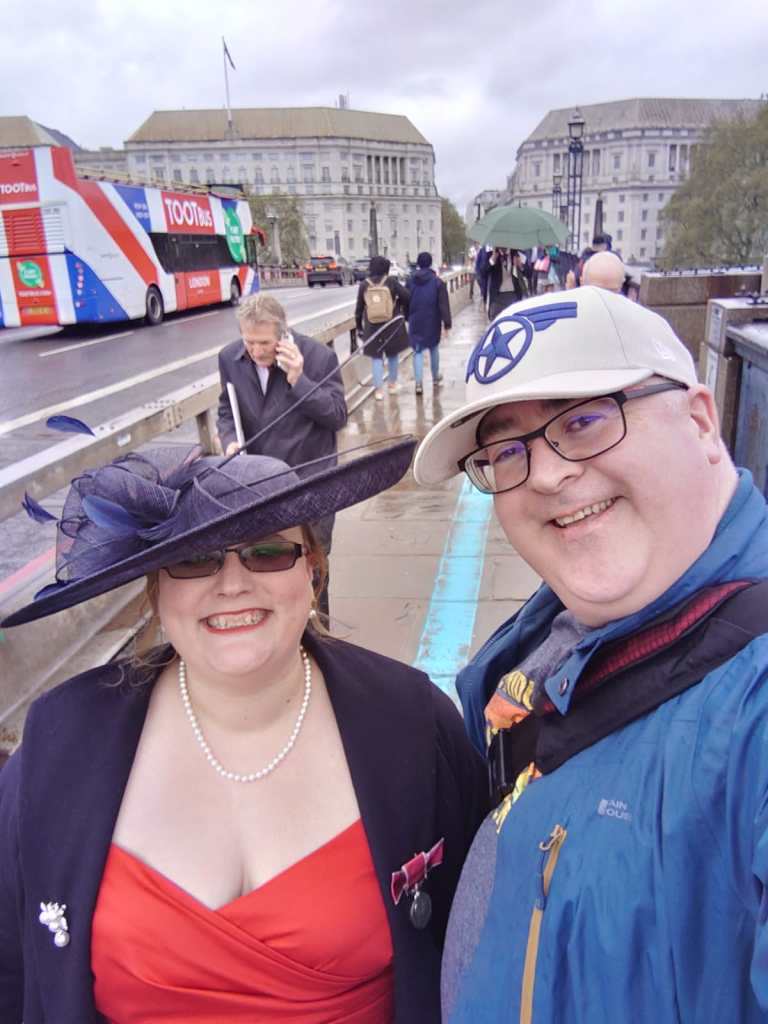
We decided to focus on short films. We commissioned actors, writers and filmmakers with an interest in Healthcare Science and encouraged collaborations between scientists working on AMR with artists who could involve the public emotionally. Some of these artists were, or had been, patients potentially impacted by AMR.
And we discovered that, having been forced to micro-manage our overall PPI strategy, we could be more …strategic, by commissioning artists and film makers with knowledge and experience of areas such as migration and migrant health, homelessness, negotiating the health system as a mother without a UK support network, practical experience of working with puppets, or Under 5s. We started the artist films first to encourage researchers to make films, and to relieve the PPI pressure on Healthcare Scientists and researchers who were facing increased clinical or academic workloads during the pandemic.

Over time, another aim was added to the PPI strategy:

  • To actively support researchers, by offering regular contact time

The drop-ins were small, tending to attract only 1- 5 people, but the researchers who went on to not only make short thesis films but present work in person and/ or perform in the festival, all came through these sessions. In hindsight we should have started these sooner.

LA BIOTIQUE

Sue Lee and I ran a weekly lunchtime drop-in session on zoom for any Precision AMR researchers to discuss their PPI, their micro-thesis films, or talk about their projects. This reminded us that the benefits of conversation and involvement which PPI enables, work both ways. Taking part in a science fair or going on a school visit, reminds Healthcare Scientists why they loved this stuff in the first place. Enthusiasm is rekindled. PPI involves you more closely with your research.

Reviewing our results

Looking back almost 2 years, we did everything we promised, albeit in radically different ways. In fact, we did rather more than we originally intended.  We hosted a series of live public engagement events, screenings and discussions in not one, but two, festivals:

  • Rise of the Resistance 1, June 2021, online
  • Rise of the Resistance 2, September 2021, livestreamed from Bloomsbury Theatre
  • 4 Workshops for Seed Project Awardees on PPI training
  • 12 films by artists, 13 films by scientists, 4 zoom debates, three Q&As, a filmed tour and numerous zoom conversations and related video clips
  • 500 people engaged directly with festival events online or in person 
  • PPI participants reported significant changes in their understanding of AMR  
  • Requests for Rise of the Resistance links and AMR content received from Hospital Trusts, charities, schools and nurseries for staff, patients, and pupils, including timetabled activities for 2022 

My personal highlights? Our interactive AMR puppet show for Under 5s, Sock The Puppet performed by Stephanie Houtman (‘Peppa’ from Peppa Pig Live) receiving videos and photos from children of their Sock puppets, or them explaining AMR; Peter Clements’ incredible drag creation / film Klebsiella – both hilarious and 100% scientifically accurate; Rahila Gupta’s La Biotique, an aria from Puccini’s opera La Boheme which updated Mimi from a seamstress in 1830s Paris dying of incurable TB, to a migrant textile worker in the streets of London’s East End in 2022. Each appealed to different audiences and drew them into the AMR conversation. What Is AMR and What Can We Do About It? a show interweaving dramatic scenes, monologues, and Precision AMR research presentations, performed by a combined company of scientists and actors, succeeded in both raising awareness of AMR, and involving audiences in understanding new research – using gold nano-particles, targeted testing, combatting bacteria in hospital showers – which Precision AMR was supporting.

KLEBSIELLA

In Conclusion…?

Having got to the end of the last two years, we are only at the beginning – of a longer conversation with public and patients on AMR, and a global research and stewardship response. Undertaking PPI during a pandemic has made me understand what PPI really is. And how it takes time, planning, effort and commitment on all sides to make involvement happen. It is hard work.

Healthcare Scientists wanting to add a PPI component to their project for the first time really benefit from individual support throughout the process. Public engagement and PPI employ a distinct set of skills for planning and delivery, but ‘cooking the room’ has many similarities with doing an experiment. PPI – especially in a pandemic – asks much of us, but in return offers new insights, new contacts, increased confidence, a sense of personal achievement, and occasionally, amazement at what everyone has achieved.

All opinions on this blog are my own