Guest Blog by Dr Claire Walker: Can artificial intelligence pass your Genetics exam? Not this one

Everywhere I look at the moment people are talking about ChatGPT and artificial intelligence (AI). On LinkedIn this week everyone was sporting ChatGPT produced images, and I have to say I felt completely out of things as I’d have no idea where to even start. The challenge is, the same cannot be said for our students. As an external examiner I see how the AI creep is really beginning to impact on assessments, so I reached out to my great friend and educationalist Dr Claire Walker, who is actively working to think about how we can respond to the AI challenge when it comes to our assessments.

Dr Walker who is a paid up member of the Dream Team since 2013, token immunologist and occasional defector from the Immunology Mafia. Registered Clinical Scientist in Immunology with a background in genetics (PhD), microbiology and immunology (MSc), biological sciences (mBiolSci), education (PgCert) and indecisiveness (everything else). Now a Senior Lecturer in Immunology at University of Lincoln. She has previously written many great guest blogs for the Girlymicrobiologist, including Exome Sequencing and the Hunt for New Genetic Diseases.

Blog by Dr Claire Walker

So, there’s a new problem in higher education. The elephant in the room that we’re all talking about, or sometimes pretending doesn’t really exist: our chatty friend, generative AI. When I first encountered it, I suspected the impact might be overstated. Students do not come to university simply to cheat; they come for authentic learning experiences and to gain transferable skills. I mean, they want real jobs eventually, right?! But the reality facing educators is more complicated. Alongside the rise of AI, we are also facing another persistent challenge: do more with less. Larger cohorts, less time, fewer staff and an increasing pressure to design assessments that genuinely measure skills rather than copy-paste ability. Many of our classic approaches to assessment – lab reports, literature reviews, and even theses can be generated with just a few of the right kind of prompts.
Our chatty friend or the nemesis of lecturers everywhere

So how can we create authentic learning experiences that are difficult to outsource to AI while still being practical to run and mark? At the University of Lincoln in our Genetics and Bioethics module, we have developed one approach: AI-supported patient roleplay combined with pedigree analysis and ethical reflection. One of the long-standing challenges in genetics education is giving students meaningful practice in family history taking and pedigree construction. Traditional simulated patient encounters are highly effective but expensive and logistically demanding, often requiring trained actors and significant coordination. As a result, many students learn pedigree analysis primarily through static textbook cases. I can’t say this isn’t useful, but it’s pretty far removed from the realities of genuine clinical conversations.

Our solution was to create interactive patient roleplay scenarios in which students interview a simulated patient using Claude.AI during a live teaching session. The students interact with a “patient” presenting with features of the genetic condition hereditary haemochromatosis. They gather the relevant family history by asking structured clinical questions of our AI bot pre-programmed with a real clinical case. The information they need does not exist in advance as a written case study; it emerges through the interaction, requiring students to listen carefully, probe appropriately, and adapt their questioning strategy in real time. This immediately changes the learning dynamic. Students are no longer passively interpreting a pre-constructed pedigree; they must build the dataset themselves by asking the right questions. Mistakes become learning opportunities, and repeated questioning helps them to refine both clinical reasoning and communication skills. Following the roleplay session, students translate the collected information into a formal pedigree diagram using a clinical pedigree-drawing software fortunately available for free online. This requires them to apply standardized genetic notation accurately while organizing complex family information into a clear visual representation that can be assessed objectively, and delightfully quickly. Most importantly – right now ChatGPT can’t draw this from a script. Maybe one day, but for today this assessment is one step ahead.
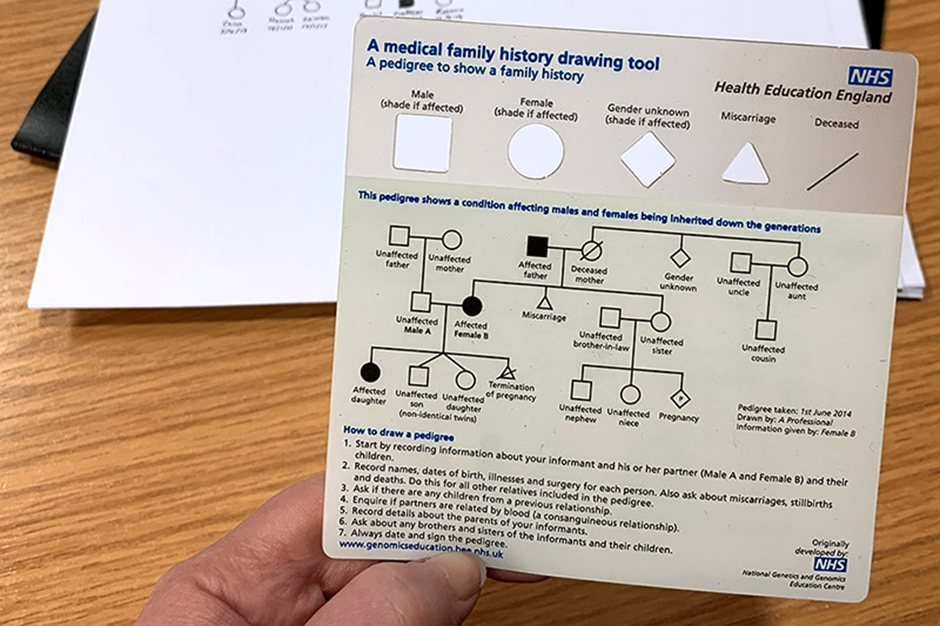
A medical family history drawing tool from Health Education England

The assessment does not stop at technical skills. Students are also asked to reflect on the family scenario and the issues raised during the session to consider a realistic counselling question: would they personally choose to undergo testing for a variably penetrant mutation associated with hereditary haemochromatosis? The genetic test used in the module looks for two common changes in the HFE gene known as C282Y andH63D. In simple terms, the test examines a person’s DNA to see whether they carry gene variants that can affect how the body regulates iron absorption. Certain combinations, particularly inheriting two copies of the C282Y variant, increase the likelihood of developing iron overload, but they do not guarantee disease. Many individuals with these genetic results remain healthy, illustrating the concept of variable penetrance; genetic changes that influence risk rather than determine destiny. Environmental and lifestyle factors such as diet, alcohol intake, blood donation habits, and biological sex also affect whether symptoms develop and how severe they become. Students are therefore encouraged to reflect on how genetic risk, environmental influences, and personal values shape decisions about predictive testing taking into account what they learnt from their virtual patient experience. At the end of the module, they are offered the opportunity, within the academic teaching setting, to undergo testing themselves so they can engage directly with the ethical, psychological, and practical considerations that accompany real-world genetic screening decisions.
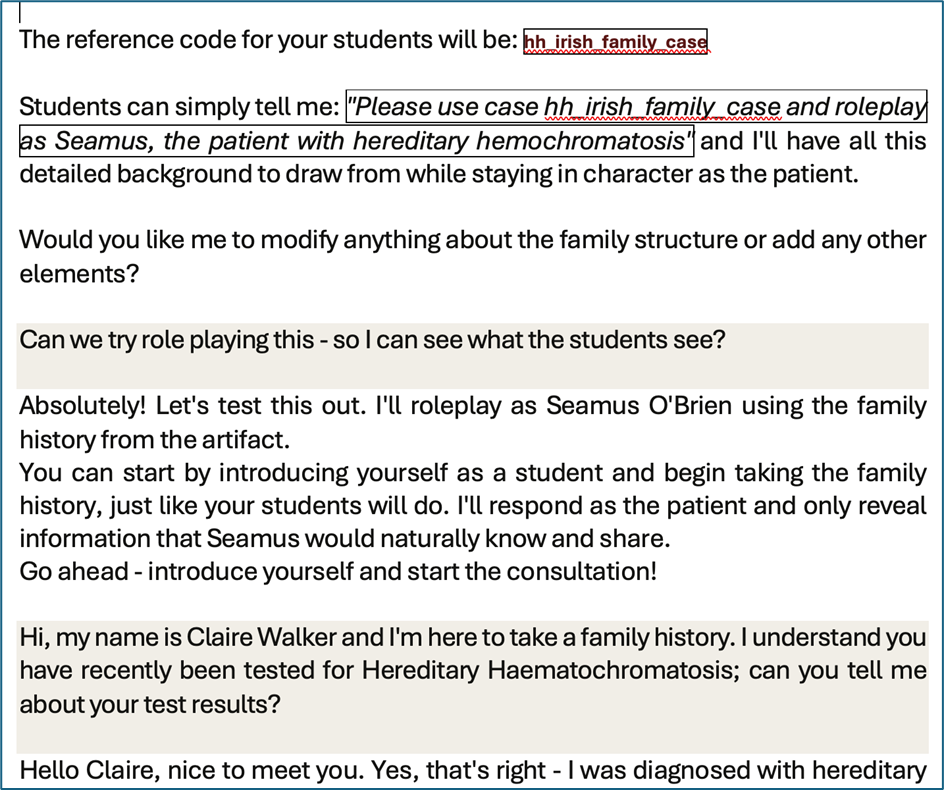
Instructions to Claude.Ai for how to behave as a patient and a excerpt of the transcript of the interview

An additional advantage of this approach is assessment authenticity. Because the key information is generated dynamically during a live interaction, the task cannot easily be completed using generative AI alone. Students must attend, participate, and apply lecture knowledge in context, meaning the assessment evaluates what we actually want to measure: their ability to gather relevant genetic information, interpret it, and think critically about its implications. Equally important, the approach remains scalable and low-cost. No actor recruitment is required, sessions can be delivered across large cohorts, and students can practice interviewing skills in a structured but flexible environment. What once required substantial logistical planning can now be implemented with minimal additional resources. Moreover, all modules must have some laboratory component, and this one falls into a middle of our usual price point.

I’m not offering a complete solution to this huge challenge facing higher education, but it is a step toward something we increasingly need: assessments that measure real skills, encourage real engagement, and prepare students for the complex clinical and ethical conversations they will eventually have with real patients.

TL/DR – If AI can take the assessment, change the assessment.

All opinions in this blog are my own
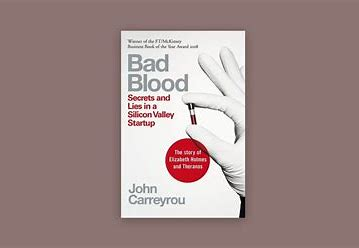
Book Review: Bad Blood by John Carreyrou – talking science and the Theranos scandal

It’s the Easter weekend and I haven’t posted a book review in forever, so I thought I would post a review of something that not only I think all scientists should read, as a tale of when science goes wrong, but also because it’s been dramatised and so you could also spend some of your weekend enjoying it in multiple media forms.

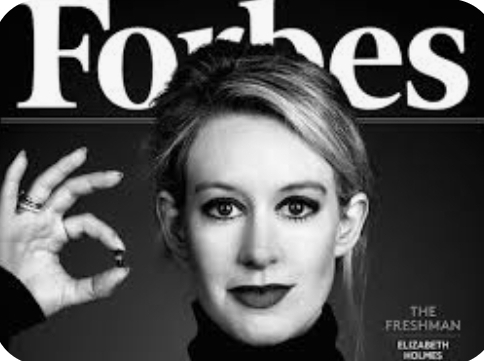
I didn’t really know much about the Theranos company before I read this book. I had seen a couple of news articles and video clips of Elizabeth Holmes, but I don’t think it made quite the same coverage in the UK as in the states. I do remember a video of her talking about being able to do several hundred tests from a drop of blood and rolling my eyes and being dismissive as it struck me as scientific nonsense. I didn’t realise this was a system that had been rolled out for actual patient testing and as the basis for clinical decision-making, which to me is incomprehensible. I’m getting ahead of myself however, here is what the book is about.

Bad blood is written by the journalist John Carreyrou, who broke the story at the Wall Street Journal. It is a chronological re-telling of the rise and eventual fall of the Theranos company and its founder, Elizabeth Holmes. It is based on interviews and fact finding that were collected for the articles and runs up until the start of criminal prosecutions.

Elizabeth Holmes is a self-proclaimed Stanford dropout who left university to pursue a bio tech start-up. She claimed to be terrified of needles, so established a company that would enable the avoidance of venopuncture blood draws by using point of care testing using a finger prick to provide the same level of diagnostic information. The end vision sold to investors was that this could all be done by a small microwave sized machine that could, eventually, be sold for home use as a form of self monitoring. The platform was rolled out into patient use at Walgreens chemists, as the first step in a national roll out. Testing patient samples and providing clinical results in Phoenix, Arizona. Interestingly, to me, as this was a private biotech company, there appears to have been little to no oversight of this diagnostic roll out, despite producing a medical device.

The book covers how investment was attracted and rapid growth attained because of the strength of this vision and the charisma of the woman selling it. It also covers how, despite scientists not being able to deliver this vision, it continued to be sold and how the very negative company culture allowed this to happen. All company employees were made to sign non-disclosure agreements, they were prevented from talking outside their teams, their emails were monitored, and threats of legal action appear to have been common. This meant that many of those working on development were unaware of the significant flaws with what was being sold, and those that were and considered or tried to whistle blow were taken down legal routes, where Theranos had considerable more financial capability  to attain a positive outcome.

This was all compounded by a lack of oversight and, as there were no regulatory affairs staff employed, allowed governance processes to be manipulated. The company had two laboratories, one to develop their new technology known as Normandy, and one which was disclosed and Clinical Laboratory Improvement Amendments (CLIA) accredited which containing more standard technology platforms known as Jurassic Park.

Eventually, after the death by suicide of one of the employees and increasing press coverage seen by external scientists who questioned how this was possible, as well as clinical alarm bells, enough momentum was gained to put together a story that shone the light on why this approach was disastrous for the patients who were relying on it.

The story is already available in many different forms, including a TV series that is currently available BBC iPlayer and Disney+

Listening to the audio book of this book whilst I write this blog post it makes me think that are a lot of points that shock me as a English scientist working in such a highly regulated environment, both for NHS services but also for me as a state registered individual.  It has also made me reflect on how crucial support for escalation and whistle blowing is to ensure that scenarios also get flagged when those services are not providing the quality of service required.  I’ve briefly outlined some of my reflections below:

Governance

I spend a lot of time in governance meetings, both local and national. I even sit on a number of grant, research and ethics panels. I don’t think I’ve ever encountered the kind of lack of governance and accountability described in this book. That said, I’ve never worked in private industry or a start up. Just going through this book has made me have a new recognition for how important it is that boards and other oversight structures, ask the difficult questions and undertake constructive challenge in order to identify problems early and reduce risk.

Responding to No

At every stage in this re-telling smart people tried to raise concerns. When concerns were raised those people raising them were either isolated or asked to leave. Those who played the game and did not rock the boat were promoted, ending up in a scenario where the entire of the senior leadership were either the ones who didn’t want to hear or were people that didn’t want to challenge. In other words Elizabeth deliberately surrounded herself with yes men and thus created her own echo chamber. You can see, to an extent, how this can happen in other settings and where unacknowledged risk could therefore be introduced, and so ensuring that challenge is encouraged and not victimised is key to success.

Female leadership

Being a female leader is challenging, being a female leader in the technology and science sectors is both challenging and unusual. I can’t help thinking when reading this book how much of a back lash will occur and impact other female innovators. Elizabeth was heralded as unique and special for being a female in this area, I feel it’s likely that her actions have significantly set back other women in this space trying to make room for themselves. In addition to the patient harm caused, this is one of the things that upsets me the most.

Authentic leadership

To succeed, Elizabeth crafted a new image of herself. She changed the way she dressed to look more like Steve Jobs, whom she admired. She even changed her voice to use a lower octave, as she felt it made her more unique, memorable and aided success. I’m rather struck by the fact that she changed the way she dressed to look and even sound more like her male compatriots. If she changed these external factors, I can’t help but think what else she changed, and how much she went against all the principles of authentic leadership. She shared little of the real her, and I wonder how much that facade enabled her to distance herself from the reality of what she was doing. For me, it’s a reminder of why authentic leadership is so important, to put yourself out there and also to be held to account, rather than introducing a facade which distances you from your actions.

Quality assurance

Quality assurance, ensuring you get the right result on the right patient in the right time frame, seems to have features little if at all in the Theranos story. They utilised out of date reagents, the way they undertook validation testing is like nothing I’ve ever encountered, and they topped it off by actually lying about how and where results were produced. It’s easy to think that we would never act in the same way, and I doubt any of us would to the same extent, but there are aspects of laboratory life which I think would be open to monitoring challenges. The expansion and use of home testing, and even point of care testing (POCT) presents a lot of quality control and assurance challenges. These tests are conducted outside of standard laboratory settings, often by individuals with less knowledge about the processes. How do we increase access whilst maintaining quality in these circumstances? I think it’s something many of us are wrestling with.

Research and innovation

Innovation has risk associated with it, research wouldn’t be research if there were not unknowns. The patient impacts of this work however have given me a chance to reflect on how import ethics and governance reviews are to controlling these risks. As the testing was not rolled out during a trial, there was no consenting of patients to those risks. The people who ran the institutions in which they were rolled out were also not informed that they were effectively partaking in a research experiment. This means that all those involved are less likely to engage in research based processes in the future, as trust has been broken, even if it were to happen with different more established individuals. Thus the behaviour of a few impacts us all, and therefore as scientists we have a responsibility to flag this bad behaviour as and when we see it.

Listening to the scientist in the room

The scientists in the room were not heard. The company was led by people who lacked technical skill. Rather than understanding their limitations, they actively denied any lack of knowledge. They therefore didn’t listen when those best placed tried to flag issues. There was also no route for whistle blowing, either to the board, or to external organisations, partly due to the NDAs and threats of litigation. As a leader, this has made me reflect on both how important it is to listen to those skilled individuals you have working for you, but also how much there needs to be processes in place that bypass me in the case of a need for escalation. No one is perfect, and it is so important that concerns are heard and acted upon.

Silos limit productivity and communication

One reason that Theranos not only manage to hide its failings, but also probably failed in the first place, was that everyone was kept in silos and isolated from each other. There were no multi-disciplinary collaborations, sharing was actively forbidden, and there were no cross department routes of communication. Everything was linear, up and down. This can easily be seen as a failing in other large institutions, not because of an active plan, but because we don’t encourage enough cross organisational working. Collaboration is key to innovation, trouble shooting, but also to fault finding and improvement. It takes effort to do well, but is worth investing the time and energy into for improved results.

Vision alone is not enough

Vision without follow through is always going to fail. Vision without working pragmatically on turning it into reality will not succeed. Once you move from vision into implementation or delivery, it cannot be enough that you alone own the vision. It has to be shared, it can no longer be owned by an individual. By sharing it, you also have to take onboard the input of those others, and if you cling to the original too tightly then you are setting it up to be a disappointment.

People are the ones who suffer

People were actively hurt by this poor use of science and innovation. The scientists themselves suffered when they tried to raise the alarm, emotionally and through litigation. Most of all though, the patients who placed their faith in a diagnostic that could never deliver suffered, either through over or under treatment. Because this tale occurred in the states, those failings also came with a financial burden, as well as a physical one. This book makes me so grateful for the NHS and our regulatory structure for the governance and protection it provides. Nothing is perfect, but an imperfect something is so so much better than the alternatives. I hope you find the book as eye opening as I did.

All opinions in this blog are my own