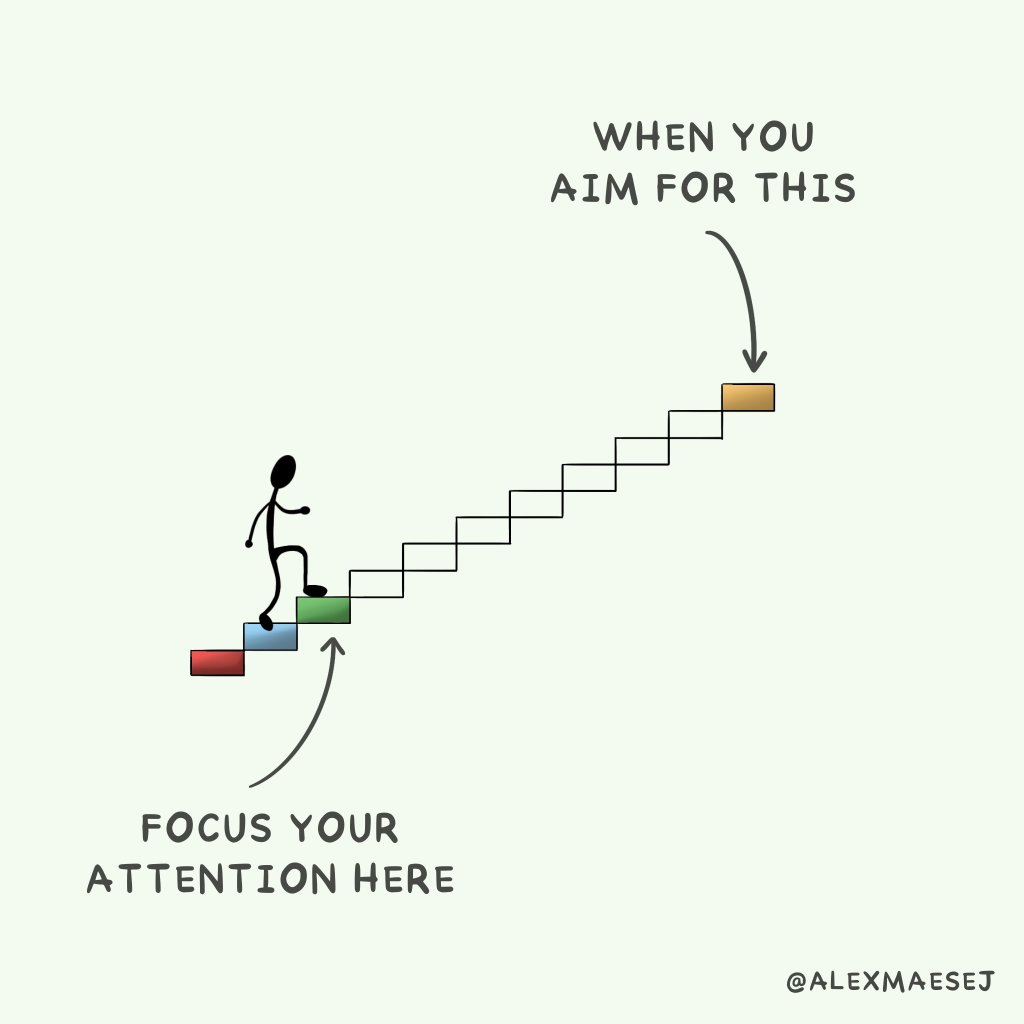
Methods for Dealing with Rejection: Remembering there is a difference between ‘that wasn’t for me/us’ and ‘oh that’s bad’

Rejection and my ability to deal with it have been on my mind a lot lately. This is because I finally got over myself and started submitting a book proposal linked to this blog and feel like I’ve now become the Bridget Jones of the submission world, overly obsessed with approval and external validation. The thing is only 1 – 2% of books get picked up, which shocked me as it’s even worse than the success for grants, which is about 20%. However, having lived in an academic world filled with rejection for almost 20 years now, it is not like rejection is new to me.

I blogged a bit about the idea of writing a book when I first started playing with the idea, but it’s been a while, and it’s hopefully progressed on a bit. I ummmm’d and ahhhhh’d about keeping the details of this phase to myself, as there is a literal 99% chance of failure, but that doesn’t really align to my values.  It’s also caused me to actively reflect on rejection and how I manage it. As rejection is prominent across all areas of science (and life), I hope by talking about my tips for dealing with it, that I can share my learning and support others who may be going through similar things, whatever the source of the rejection.
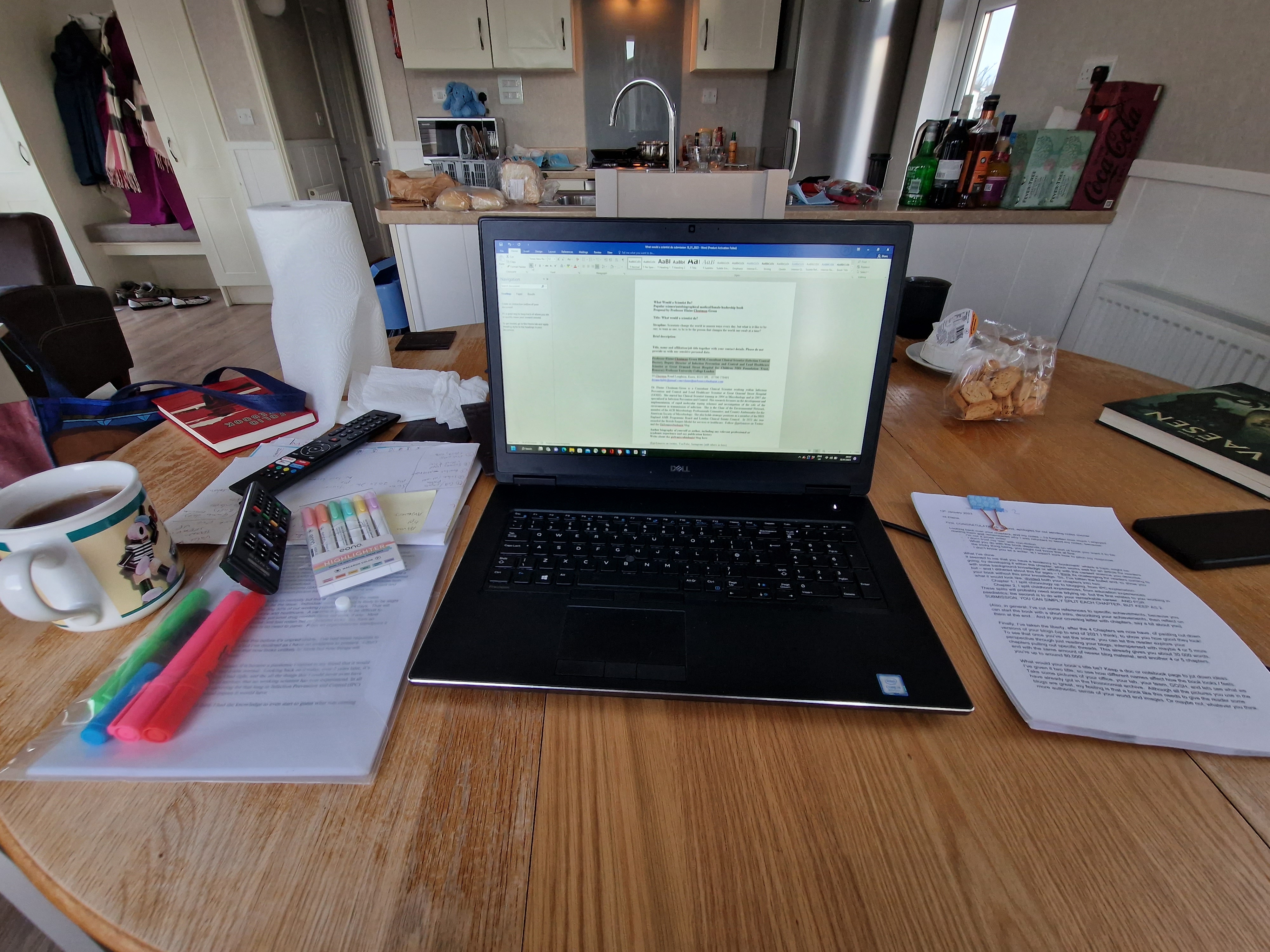
Acknowledge that failure/rejection hurts and that’s OK

Let’s start by being honest. Failure hurts. It does. There’s no way around it. If it didn’t hurt, so many of us wouldn’t fear it so much. I have begun to think, however, that the reason it hurts as much as it does is because it forces us to have a look in the mirror and reassess, often with increased clarity. It forces introspection upon us, and that can be a challenging thing.

Failure is inevitable however, it’s a key part of the learning process, and the sooner we embrace that inevitability, the better placed we will be to deal with it when it arrives. Developing coping strategies and knowing yourself enough to manage your response is key. For instance, I have 2 key methods. First, I never only have a single plan. Therefore, if grant A is rejected, I will always have hope that grant B is still making its way through the system. Not having all my eggs in one basket keeps me sane. Second, I allow myself an indulgent 48 hour grieving period for failure. I allow myself to feel, to feel disappointed, to move through the self critical emotions without further self critique by forcing denial. 48 hours. That’s it. After that, I move to a more forward focused place. What’s next? What have I learnt? If I try this without the grieving period, I carry it with me, so I’ve learnt I need to move through the emotional aspects before my logical brain can kick in.
Find your support

As I’ve said, failure and rejection hurt, and like other forms of emotional trauma, your recovery is quicker with friends. From going out for cocktails during a breakup, to tea and cake when a paper is rejected, support is key. During the 48 hour grieving period, I may quite frankly need some bitching time. Some time to make the rejection about ‘the system’ rather than myself, to move towards depersonalising the failure. I may also need someone who can point out that the failure is definitely not as bad as it first appears and that the world is, in fact, not actually ending.

Put it into context

The reason the 48-hour grieving period is key for me is because all failure and rejection come with learning opportunities. The challenge is to get to the point where you can make the most of these. For me, I have to move from an emotional headspace to a growth mindset that’s more based in logic in order for this to happen. My emotions and passion drive my creativity, but when out of control, they act as barriers to seeing the big picture and where the learning lies.

Once I’m in a place where I can undertake a true review, there’s always something I can learn. Be that based on feedback I’ve received, be that based on how I’ve handled either the initial experience or my response to it, or the onboarding of more knowledge linked to the strategic landscape which will enable me to do better next time. Being open to this learning is what moves failure iteratively towards success, and if we don’t find a way to engage with it, we’re just doomed to repeat the outcome.

Evaluate when a ‘no’ is a ‘not for us’ – taking yourself out of the mix

Context is key. Without it, you can’t truly get to a place where you can understand feedback. There is, for instance, a big difference between a no and a not for us. I mean, I know the outcome is the same, but the process of moving forward is different. If something is ‘not for us’ it feels different. A flat ‘no’ can feel like a value judgement. It can feel like the idea/work is bad. A ‘not for us’ doesn’t feel the same. It means that the drivers and vision of the people who are assessing don’t align with your proposal. There are always more people, though. There are always other visions, and so this type of rejection is actually an opportunity, an opportunity to find someone who better aligns with where you want to be. I find one crushes my dream, the other opens a different set of doors.

Focus on what you can control

So much of the scientific and writing process ends in a place where we are not fully in control of the outcomes. That said, in the process, there is so much that you can control. You can control your approach, who you are submitting to, what your aspirations for the work are, and how you balance that with other pieces of work that you have in process. I find I need to trick my brain so that when I have something that has reached the part of the process that I have little or no control over, I am still working on another piece of work where I am still in control of the process, be that a paper, grant, blog post etc. This helps to stop me spiralling and obsessing about something I can no longer influence.

Have a plan A, B, and C

One of the key ways I’ve developed to maintain a sense of control is to understand there is never a single route to getting things done. There are always multiple ways to approach any aspiration and once you acknowledge this, you can make sure you include some of these alternatives in your planning.

The other component of this is to make sure that ‘the plan’ is rooted in realism, in both approach and time scale. There is nothing more disheartening than having a plan/approach that fails due to a lack of research/understanding. This is where your baseline skills as a researcher will come into their own. No matter the task, take the time to familiarise yourself with the barriers and options to ensure your plan is up to scratch.
Take inspiration from those who have succeeded

Big steps take time, and how you feel during this period is rarely static. There are times when I will love a paper, feel completely prepared for an exam, or feel like my dream could be a reality. Then, there are moments when I hate everything I’ve done and question why I thought I could ‘do it’.

At times like these, it’s worth looking to others for inspiration. For instance, Professor Julia Lockheart and Professor Mark Blagrove from DreamsID (https://dreamsid.com/index.html) invited me to their book launch earlier this year. Seeing their dreams made real was really inspiring and provided an extra push to just get on with following my own. When everything feels too far from reality, look to those who can demonstrate the outcome you are aspiring for.

When it’s all too much focus on associated goals

Sometimes, the dream itself is not enough. Running head-on at goal can, at times, be both painful and exhausting. When this becomes overwhelming, it’s sometimes better to choose to come at things sideways or progress associated goals for a while. For instance, if that paper has been rejected for the 4th time, it might be time to write a blog post on it and use that as a different opportunity to think about the core message.

This can be a really useful approach for the lulls that will inevitably occur, either because you’re waiting on responses or because you have to build yourself up to try again. These periods can feel like ‘dead time’, and trying to make more direct progress can just leave you feeling despondent. Understanding this and knowing how you can keep going in a different way helps.

Press the reset button – Decide whether it’s worth the pain – Return to your why

Despite all of these thoughts about how to manage rejection and carry on, I want to make clear that it is also OK to think about quitting. This sounds a bit strange doesn’t it, after all, in science we don’t quit. Except we do. Part of our growth is being able to reexamine our work, be that an experiment, paper, or project in light of new information. When you get rejections, then it is important to decide whether someone has spotted a fundamental flaw that you just can’t fix or takes the work in a direction you just don’t want to follow. This isn’t encouragement to throw the baby out with the bath water, but an acknowledgement that there are times when the right decision is to pause or discard a piece of work and that it’s important to acknowledge that as part of our processing.

Evaluate progress made

Once you’ve decided that you are still invested or that the piece of work you are doing still has value, to you or others, then it’s important to remind yourself of how far you’ve come. It will always be further than you think. This is easier if you had a plan when starting out, but even if not, you can spend 10 minutes just listing all the steps you have proactively taken in moving towards your goal. Listing your rejections and the learning from them is a key part of this evaluation process. Putting everything down in one place may enable you to see opportunities you might have missed or help develop your plan B and C options further. I would advocate doing this regularly, even in the absence of rejections, but it can be a particularly useful re-centering process when things feel hard.

Understand that the only way is through

Finally, if you’ve decided that what you are undertaking still matches your why, and that it is not flawed enough to walk away from, the only thing to do is JFDI (just f**king do it). Keep the faith, both in the work and yourself, and go all in despite how hard it can feel. Have a plan and take a single step at a time, until, before you know it, you’ve reached your destination. Anything worthwhile is worth the effort, and future you will thank past you for your persistence and determination. Have a hard conversation with yourself, and just keep going.

All opinions in this blog are my own

If you would like more tips and advice linked to your PhD journey then the first every Girlymicrobiologist book is here to help!

This book goes beyond the typical academic handbook, acknowledging the unique challenges and triumphs faced by PhD students and offering relatable, real-world advice to help you:

  • Master the art of effective research and time management to stay organized and on track.
  • Build a supportive network of peers, mentors, and supervisors to overcome challenges and foster collaboration.
  • Maintain a healthy work-life balance by prioritizing self-care and avoiding burnout.
  • Embrace the unexpected and view setbacks as opportunities for growth and innovation.
  • Navigate the complexities of academia with confidence and build a strong professional network

This book starts at the very beginning, with why you might want to do a PhD, how you might decide what route to PhD is right for you, and what a successful application might look like.

It then takes you through your PhD journey, year by year, with tips about how to approach and succeed during significant moments, such as attending your first conference, or writing your first academic paper.

Finally, you will discover what other skills you need to develop during your PhD to give you the best route to success after your viva. All of this supported by links to activities on The Girlymicrobiologist blog, to help you with practical exercises in order to apply what you have learned.

Take a look on Amazon to find out more

Guest Blog Joanna Ward by: A year in the life of an MBio student

As summer draws to a close, results come in and we all think about what our next steps might look like it felt like now would be a good time to share a guest blog that has been written to help inspire what some of those options might look like.

Joanna Ward is a prize winning MBio student based at the University of Lincoln. She has recently completed her MBio and been accepted into a prestigious PhD programme, continuing under her MBio supervisors Professor Claire Hills and Professor Paul Squires.

A year in the life of an MBio student

As I come to the end of my degree, I have been reflecting upon my experience at the University of Lincoln, but in particular, my master’s year which I have just completed. As an MBio student, my degree consisted of a three-year BSc Biomedical Science course, before an additional ‘masters’ year in which I was fortunate enough to join the University of Lincoln Renal Group. Supervised by Prof Claire Hills and Prof Paul Squires, the group has research interests in diabetes, chronic kidney disease and cardiovascular disease. Specifically, they study the underlying mechanisms which drive disease progression, to better understand how we can intervene clinically and improve patient outcomes.  I love these areas of research which aim to bridge bench to bedside– it epitomises everything I have ever wanted to do and I am driven everyday by the possibility of our research being beneficial to so many people.

After a disrupted undergraduate degree as a result of COVID, going into my master’s year I had very little lab experience and the thought of completing a lab-based project was quite a daunting prospect, but I was incredibly fortunate to be part of a team where there’s no such thing as a silly question and support is always at hand. I soon realised that I loved being in the lab and the research absolutely fascinated me.

Being part of a very active research group meant I spent a lot of time at the bench, conducting experiments and analysing data. My typical day in the lab would involve firstly checking on my cells; tissue culture forms a huge part of our research so getting to grips with the techniques behind it was a key part of being able to run the experiments. I used human kidney cells to create an in vitro model of chronic kidney disease which then allowed us to determine whether the drugs we were treating our cells with were having a protective effect. After this, I would run multiple different experiments throughout the day, these could involve techniques that include Western blotting, PCR and several different laboratory assays. Having a lab-based year through completing the MBio gave me the opportunity to develop so many different lab skills, something which I am hugely grateful for.

Aside from lab work, this year I have also developed multiple skills important to a career in science. One of these is keeping up with the literature surrounding our research topics, this is both essential but also difficult since papers are published so frequently and knowledge around specific subject areas can develop quickly. Creating a system which enabled me to keep up with this early on was something which made my life a lot easier as the year progressed so I absolutely cannot recommend this enough! Science communication forms a huge part of research, and through being lucky enough to attend the Diabetes UK professional conference, regularly presenting at lab meetings, research showcases and poster presentations, I have developed more confidence in public speaking. Importantly I have developed a greater appreciation for the ability to communicate our research to people in other disciplines.

I have had the most incredible year and have grown on both a personal and professional level, but this absolutely hasn’t happened by chance. I have been incredibly fortunate to be guided into the world of science by the most wonderful supervisors who have not only given me so many incredible opportunities but have also encouraged and supported me every step of the way. They have believed in me when I didn’t believe in myself and have made me realise a career in research is exactly what I want to do with my life. They are also incredible scientists who I look up to enormously- as an early career researcher you absolutely need mentors who are supportive and whom you trust, so having supervisors like this has been an absolute privilege.  I have also been blessed with the most wonderful lab mates who have become some of my best friends and make every day full of laughter and fun. They have taught me more than they will ever know and couldn’t have been more supportive, reassuring, and hilarious. I look forward to every single day I spend with them!

My master’s has been an absolute joy, I would tell anyone considering doing an MBio to give it everything that you have, go above and beyond, be a team player and make the most out of every opportunity you are given.  I am incredibly excited to see where my path in science and research takes me next and will forever be thankful to team Renal for providing the very best start in this.

All opinions in this blog are my own

The PhD Edit: Links to some of the Girlymicro posts that may help PhD students

During July I’ve posted a series of articles aimed at supporting PhD students and those thinking about entering research or undertaking a PhD. So that you can access them more easily, along with an example of some other posts that might also help, I’ve collated them all for you as a series of links here in a single post. Hope they help.

Tips for when you are starting out

Tips to help when you are designing experiments or struggling with challenges

Tips to help you share your work

Tips to help you get through your thesis and viva

All opinions in this blog are my own

If you would like more tips and advice linked to your PhD journey then the first every Girlymicrobiologist book is here to help!

This book goes beyond the typical academic handbook, acknowledging the unique challenges and triumphs faced by PhD students and offering relatable, real-world advice to help you:

  • Master the art of effective research and time management to stay organized and on track.
  • Build a supportive network of peers, mentors, and supervisors to overcome challenges and foster collaboration.
  • Maintain a healthy work-life balance by prioritizing self-care and avoiding burnout.
  • Embrace the unexpected and view setbacks as opportunities for growth and innovation.
  • Navigate the complexities of academia with confidence and build a strong professional network

This book starts at the very beginning, with why you might want to do a PhD, how you might decide what route to PhD is right for you, and what a successful application might look like.

It then takes you through your PhD journey, year by year, with tips about how to approach and succeed during significant moments, such as attending your first conference, or writing your first academic paper.

Finally, you will discover what other skills you need to develop during your PhD to give you the best route to success after your viva. All of this supported by links to activities on The Girlymicrobiologist blog, to help you with practical exercises in order to apply what you have learned.

Take a look on Amazon to find out more

PhD Top Tips: Finding the inspiration to develop your research question

In the last of July’s posts focussing on PhD tips, I thought I should probably spend some time focusing on research questions and creating an environment that supports having ideas. This sounds like the simplest thing, but I think it’s often an undisclosed struggle for many and a source of silent pressure that might benefit from being acknowledged, especially when you’re just starting out.

I think this area probably ties into who you are as a person. I, for instance, have never found ideas to be a particular issue, but I think that’s because I’m by nature a starter and not a finisher. I often have too many ideas in my head to be efficient in any form of implementation. You may, however, be the other end of the scale, great at implementation, but struggle at the start with staring at a blank sheet of paper. Both of these traits have their unique challenges when it comes to finding ideas and taking them through to realisation. As with so much else, knowing how you interact with the world will probably help in finding the best pathway to success.

So whether you are being over or underwhelmed by inspiration and ideas, I hope this week’s post may help you navigate some of the challenges of finding your next research question.

Science is a creative process

As Scientific Director of the Nosocomial Project, I’ve spent a far amount of time now working with people who are based in what is acknowledged as a creative industry. I think one of the things that has struck me is that there is more that is similar in some of the processes within the Arts and Science than is different. Although science is often seen from the outside as a process driven area, at its very heart, and to be successful, it is actually based around ideas, questions, and developing concepts. Both areas require us to be able to ask new questions and sometimes see the world or challenges in a different way to those who’ve come before.

Creativity in itself is a process. It’s something that requires the identification of time in order to allow ideas to be inspired, developed and reflected on. This is true whether you are a natural ideas person, who needs this time to be able to sort and feel less overwhelmed, or someone who needs space to allow the ideas themselves for formulate.

Now, I’m not going to say good ideas because I believe you don’t know whether an idea is good or bad until much further down the line, ideas aren’t weighted at the start, they are just ideas. Sometimes, the most far out one’s turn out to be best and sometimes the most solid appearing ones turn out to be a waste of time. Which brings me to thought number one: inspiration shouldn’t involve a value judgement. Being open to ideas requires time and occasionally bravery, but the shifting process, where you consider whether an idea has legs, comes later.

Make time for inspiration

One of the biggest challenges I’ve found with the way I see this and even when I’ve been writing this blog, is the temptation to describe and discuss productive time. The thing is, the creation of time for ideas is key but often doesn’t feel productive. I think this is because the very word productive links the time to a value judgement about the ideas produced, whereas creating the time for ideas is where the value lies, whether those ideas end up being genius or merely a stage in process.

This is one of the challenges with science being a process driven environment, with a focus on outputs. If we are not ‘doing science’ time is considered to be wasted. One of the things I try to encourage in my students is that a walk in the park just letting your mind wonder, or staring at the rain through a window to free your mind, is sometimes the most valuable time you will spend during your PhD. Especially if you’ve come up against a tricky problem. Staring at something head on can only get you so far.

Sometimes it’s hard to be passive, I’m really not that great at just ‘being’. If you are like me therefore you may decide a kitchen disco is the best way to free your mind or to go for a run. Finding a way that allows you to distract your mind to enable you to see things in a different way, whatever way that works for you, is the main thing.

Spend time reading and reflecting

Occasionally, the pressure to solve things or come up with ideas can feel a lot like writers’ blocks. Staring at empty screens, lab books, or grant templates. Although space often helps, sometimes you need a kick-off point. I find reading (or going to listen to people speak) can often be helpful at this point. I’m not talking about reading for critique here but reading for inspiration.

Often, when we are reading papers etc we are reading it to evaluate how good it is or to support technical understanding. I think reading for inspiration is probably a different skill. It’s the opposite of the trying to focus on the details we normally do. It’s reading and almost actively listening and recognising those little side tracking ‘what if’ thoughts that we would often try to ignore.

When reading for inspiration, you may also want to try different content that you would normally engage with. You might want to read about your subject from a different disciplines perspective, for instance, infection control but from a human factors perspective. If you are working in a translational area, you might want to read about another use of the technique that isn’t within your specialism or some fundamental science papers. You may even want to read articles and blog posts from patients or advocacy groups in order to get a different perspective. The main thing is to be cognisant in your approach and be open to going down some mental rabbit holes to see where they lead.

Sometimes, you need to act on your thoughts

Once you’ve done your reading for inspiration and have your thoughts the next step is deciding what to do with them. This requires some form of action, often doing some further reading or sitting down to grow that thought, and specifically reflect and write about how that germ of an idea might grown into a more fully formed question or piece of work.

This step is not always easy, but I think it is the part that most of us are more used to as scientists. That said, there are some days where my mind is a hell to me, and I think if it was visualised, it would just be a cloud of buzzing flies. On days like this, I write. I write blog posts. I write postit notes. I scribble notes in books. Writing things down, even if not to do with my research thoughts, creates a little space so that I can see the wood for the trees. It empties my mind on specific topics so I can gain clarity on other things and do the development work needed.

If being overwhelmed isn’t your issue, this is probably the time to hit the reading for research portion of development. This is where you would read more closely around the idea itself and start to see what others have done, undertake your gap analysis, and begin to think about the practicalities of undertaking the work.

Be prepared for failure

A wise person once told me that ‘science is 80% failure’ and that ‘the earlier I got used to that concept, the easier my journey would be’. As you hit the evaluation phase of idea development, you need to be OK with throwing out or needing to redefine a bunch of the thoughts you had in the earlier phases. This is the phase where you take your researched concept and try to change it into a fully formed research question or practical experiment. It is also the phase where you find out whether your idea truly translates into something workable.

Although this part can feel painful, it’s actually the core part of being a scientist and where a whole heap of the learning that occurs. The more you do it the better you get at spotting a good idea in the earlier stages, and actually the easier it is to be inspired and have ideas as it’s a skill that needs to be developed like anything else.

Sometimes it’s better to just start

Because the question develop part can be painful it’s something that, if you are like me, you may procrastinate over. You may just want to sit in the lovely inspiration phase where all your thoughts are still possibilities. The truth of the matter is that it is easy to justify staying in the thinking phase as it can be hard to know when you’ve done enough thinking and prep to move an idea to the next stage. However, if you never try moving from an idea to a reality you will also never succeed, and so sometimes we all need to pull off the psychological band-aid and just try it out. There are also times when you just frankly need to stop being scared and JFDI it to see where it goes.

Appreciate the role of translational reasearch

In my kind of research, which is clinical as part of Infection Prevention and Control, I have found something else that sometimes helps. Sometimes it can be easy to become hyper focussed on scientific issues and challenges. On days when I’m stuck and just don’t feel a way forward I play a little mental game with myself. Now, it’s no secret that I spent a bunch of time in hospital and experiencing healthcare as a child, and I now work in paediatrics. I therefore run myself through different scenarios as a paediatric patient visiting or being admitted to hospital. Scenarios with different incidences, organisms, and experiences. Sometimes inspired by real patient challenges I’ve been involved with, sometimes entirely theoretical. I then try to use that process to better understand what might be important to me, what the significant moments may have been and where we could do better. I find that running this from a patient centred viewpoint can provide me fresh perspectives, which in turn enables me to have better ideas. If you don’t work an environment where you meet patients, but your work is on a specific organism for example, maybe reach out to an advocacy or similar group, to help you also get a fresh perspective, or even just speak to family and friends about their lived experience.

Don’t worry too much about everyone else

I wanted to finish by talking about something that has been a bit of a theme in my academic life and the main thing I have learnt to manage it. That is the fear or reality of ideas being taken by either those more senior or those with more power/access. I don’t think I can say with any good conscience that this doesn’t happen, I have myself previously come in to access my desk to find a senior PI searching it for my lab books containing data they weren’t working with me on.

The thing I’ve learnt is not to hold onto any one thing too tightly. This isn’t justifying the fact that this behaviour exists, it’s just the way I have learnt to maintain my mental health and wellbeing. There are times when you need to defend and maintain ownership of concepts, especially if something is key to your PhD. For the most part, however, I’ve discovered that I will always have other ideas, and there will always be different ways I can spin the original concept. Some of my best work has actually come because of the external push due to someone published some of our shared work as a solo author instead of together. It forced me to take the next thought step and develop more than I may have otherwise.

So I’d like to finish on the note that no matter where you are on your scientific journey, trust yourself. Trust your instincts. Trusts you will always have another idea. Trust that you will always be able to come up with a plan B. Trust that there are people out there who will want to help and support. Sometimes, developing and maintaining that trust is our biggest challenge as individuals working in science, but it is worth doing the work as it will provide long-term dividends both in and out of work.

All opinions in this blog are my own

If you would like more tips and advice linked to your PhD journey then the first every Girlymicrobiologist book is here to help!

This book goes beyond the typical academic handbook, acknowledging the unique challenges and triumphs faced by PhD students and offering relatable, real-world advice to help you:

  • Master the art of effective research and time management to stay organized and on track.
  • Build a supportive network of peers, mentors, and supervisors to overcome challenges and foster collaboration.
  • Maintain a healthy work-life balance by prioritizing self-care and avoiding burnout.
  • Embrace the unexpected and view setbacks as opportunities for growth and innovation.
  • Navigate the complexities of academia with confidence and build a strong professional network

This book starts at the very beginning, with why you might want to do a PhD, how you might decide what route to PhD is right for you, and what a successful application might look like.

It then takes you through your PhD journey, year by year, with tips about how to approach and succeed during significant moments, such as attending your first conference, or writing your first academic paper.

Finally, you will discover what other skills you need to develop during your PhD to give you the best route to success after your viva. All of this supported by links to activities on The Girlymicrobiologist blog, to help you with practical exercises in order to apply what you have learned.

Take a look on Amazon to find out more
PhD Top Tips: Write a thesis they said, but not like this they said

Dear gentle reader, let me tell you a tale, a tale of a naive PhD student and of her nemesis, the notorious villain known as The Thesis. Grab a comforting beverage, as this tale is filled with both thrills and peril for your delectation.

The final 12 months of my PhD were tricky. I had simultaneously signed up to do FRCPath and a PGCert in education on top of thesis writing, which in hindsight was beyond stupid, but made a strange sense at the time. So I was writing not only a thesis, but a Fellowship of the Higher Education Academy (FHEA) portfolio as well, and trying to submit my thesis a year early in order to allow revision time for my final clinical exams. I’d also run into supervision challenges as my primaries vision of my thesis, both in the required level of content and how that content was presented, was different to mine.  Needless to say, it was a bit a grim time.

Fast forward to my viva, I have submitted my thesis without supervisor sign off, and to be honest, there was a good chance I was entirely wrong and had set myself up for failure. The viva had lasted an hour, including having a cup of tea with my examiners. This is either a really good or hella bad sign, right? I’m standing outside the room whilst they deliberate, and I am seriously considering just running away as I’m in the midst of a full-on panic with my rational brain having entirely left the party. Suddenly, I hear them laughing, and I know that I am doomed. I’m about to just leave when the door opens, and they are standing there, staring at me expectantly. I have no choice, I enter the room to hear my fate.

The first words out of their mouths are “can you take a seat, we have some bad news for you and it’s probably better that you’re seated whilst we go through it”. At this point, I almost vomit, and it takes everything I have not to cry. I had been wrong. My primary was right, I’m a disaster, what was I thinking. I sit, and all I can think is that I just need to get out of this room and back to Mr Girlymicro, and the sooner I get it over with, the better. They look at each other and then at me, the external says “we have to ask for some changes and I’m afraid that they are substantial” they look at each other again pausing for what felt like forever before continuing “we need you to add an extra page of conclusions and it MUST NOT be more than 350 words”. They burst into laughter and shake each others hands and then mine. I stare at them blankly and ask them to repeat. When they are done laughing with each other they say, “also, when you have PhD students NEVER show them your thesis, show them a chapter of your thesis, that’s what a thesis should look like”. They then dump the examiner copies of my thesis into my hands to carry from the room so I can experience the weight….still smiling at each other, and the whole thing is over.

I therefore include my PhD thesis below not as an example of the thesis you should write, but perhaps as an example that is so long you might get away with a short viva and the examiners saying they never want to see it again. I also thought that this week I might include some of the lessons that that 12 month period taught me, as well as what I have learnt since from being both a supervisor and examiner.

Your thesis should tell a story, so be aware of what serves the tale

You may have a much better vision for your thesis than I did for mine, but whatever that vision is, it needs to involve telling your reader/examiner a coherent story. You may have done 20 small bits of work that you did because they were individually interesting, but when it comes to your thesis it’s time to put those together into chapters that read like you’d planned all of them together and a tale that hold logical progression from 1 chapter to another.

There are plenty of different ways to do this, and you can take any approach that makes sense for your work, but there are a few things to consider:

  • Think about having a thesis structure diagram so how your work hangs together doesn’t have to be intuited by your examiners, but is clearly laid out
  • Think carefully about the number of chapters and chapter order to ensure they are supporting the overall tale you are telling, be that of scientific discovery or adversity over failure
  • Try to embed being clear about your why and impact throughout, especially if you are doing a clinical PhD. Be conscious about picking the points where you can make your ‘so what’ clear
  • Rationalise what you should include to serve the story you are telling. You do not need to include every single thing you’ve done, in fact it could make it harder to read

Think about what purpose your thesis will serve

This one may sound a little weird, as surely everyone’s thesis serves the same purpose, to convey the work done during the PhD and provide a route for assessment. That is true. However, in terms of longevity, some thesis serve a different purpose. For me, as my research area is also in my area of work, my thesis is a manual I still go back to to remind myself of how to do pieces of work, such as decontamination validations. This won’t be true for some people. Some people write a thesis that will never be read again,  and so the thesis is written to please their examiners as a primary function. Mine, as you’ve read, was less pleasing to my examiners, but acts as a reference text for me to this day, and so fulfils the purpose that I had in mind when I wrote it.

Know your process

We all work differently, but the more you understand how you work the more you will reduce your stress around thesis writing. Are you a, write it up as I go kind of person? Are you a, I need to have all the info to decide what my story it before I start gal?

My process was that, because I was still working clinically part time, I took a month for each chapter of my thesis.  Week 1 I undertook a literature search and collated all the relevant papers, read them and made bullet points, week 2 I created figures and started writing, week 3 I finished writing the chapter,  week 4 I edited and sent it out for comment. Repeat for 5 months, and I was pretty much done.

My PhD students are far superior to me, they are well read, keep spreadsheets of notes, as well as writing up as they go along. As I was balancing responsive IPC and my PhD that just never worked out for me. There’s no point in pretending to be in a category that you aren’t or wishing it were different. Discover how you work, acknowledge it, and then find a practical framework where you can use it to your advantage.

Do your research

Now we are getting the nitty gritty of what I had wished I had known before I started, and this part all comes down to research. There are a few things which I wish I’d invested more time in before I even started writing my thesis as they would have removed a bunch of the wall contemplation and anxiety, as well as saving a heap of time:

  • There are lots of different ways to structure a thesis, and as long as you obey the broad university rules, the detail of how you do it is up to you. Spend time looking at other people’s, as the best flattery is to borrow, to identify the bits you like, the bits you don’t like, and find inspiration for what works for your way of thinking. All of the UCL ones are available online, and I’m sure many other universities are the same
  • Learn how to make/edit writing templates, or find ones that are pre-done. This may be the old person in me but I just didn’t know enough about how to set up word or other document templates to auto generate lists. My poor friend came in at the end and spent 8 hours correcting my thesis so all of it would work and I didn’t have to manually change my indexing
  • Find reference software that you like and spend time making sure your inputs are high quality and not missing details. The last thing you want to do for hours pre submission is to correct hundreds of incomplete references as you didn’t check on upload
  • Know your university submission rules inside and out. You will hopefully never be in the position I was in, where I had to know what would happen if I submitted without supervisor sign off, but even so it is worth familiarising yourself. These rules will help you choose examiners, understand time scales, and be sure your thesis structure is acceptable. Best always to be prepared.

More is not always better

As much as my thesis was long at 95,000 words plus references, for a short time it looked like it might be even longer and I was going to struggle to keep it under the 100,000 word limit. I had an entire other data chapter to put in and just had a lot of self doubt about dropping it as I thought it was the ‘lazy’ option (BTW I often struggle as I think of myself as a pretty lazy person and so find it difficult to self check). The thing is, it didn’t serve my story, and I would have been adding it in just to show how much work I’d done. That really isn’t the purpose of a thesis so in the end I was persuaded to edit and drop it out. It was such a good call but required the help and support of others. Making sure that you are either able to do a brutal edit yourself, or can call in the support of someone else who can, will make your thesis so much better.

Find a critical friend

Which brings me onto having critical friends. These are the people you like and trust to tell you the things you may not want to hear but will make your work better. You need to find a couple of these who will read though and discuss your work with you, preferably ones who will also help edit as they go. You need people doing this who understand what you are doing and you have pre-existing relationship capital with, so it won’t destroy your friendship when they point out that something isn’t making sense and you haven’t slept for a week. Pre build these relationships ahead of time during your PhD, nurture them, they will stand you in good sted, not just for your thesis but for life.

Take advice, but have the courage of your convictions

Writing a thesis is like planning a wedding, once you mention it everyone will just start offering you advice. I understand the irony of this statement in the context of this blog post, but it’s true, and honestly no one is forcing you to read these words 😉 All of this advice can become very challenging, as the likelihood is that some, if not all of it, will end up being conflicting, especially if you have too much of it. It’s one of the reasons I suggest having just a couple of good critical friends, obviously in addition to your supervisors.

I would also suggest reviewing all of the advice you receive on the basis of three things before you take it onboard:

  • The level of knowledge and experience of the person giving it you in the specific task you are doing – accepting a history PhD’s thoughts on your genomic thesis may not be that helpful, although they may inspire a new approach that could work
  • Understand the drivers behind the advice – some people will give you advice just because they feel they have to contribute, and some people will genuinely want to help. Not all advice is benign, however, and so understanding the drivers behind it is key
  • Evaluate whether the suggestion works for the way your mind works – some people will have really good suggestions that don’t work for the way you process the world or your vision – ideas are like dresses, the same ones don’t fit everyone

Be prepared to find your own way forward as you are the person who needs to write it. Keep enough of an open mind to accept a challenge that will lead to improvement, but don’t try to incorporate everything, otherwise you will lose your voice at the centre of it.

Be prepared for revisions

It’s so tempting to think that if you put enough time into your first draft that you will be saving time further down the line. The problem is that that is not always true. Sometimes, spending a lot of time on your first draft just means you go further down an inappropriate rabbit hole. You can lose not only lose a lot of time when you have redo it, but it can also become challenging psychologically to make the change. Think me and the Adenovirus chapter, unnecessary agonising occurred which took up emotional band width and time. In the initial structural work up phase, it is probably worth therefore getting early commentary before you are too attached to a specific approach, so that if you have to pivot you can do more easily.

The other thing to note is that it will always take you waaaay longer to edit than you anticipated. For most of us, we have never had to work on a document this long, and so don’t generally have good projection skills for the length of time it will take. You will also want so many more versions and edits of your thesis than of any other document you’ve done, as you won’t want all those spelling mistakes coming back as corrections, and I for one didn’t realising I would be on ‘final version’ 20 something.

Finally, your supervisors and others reading and editing it will take much longer to get it back to you than other things you’ve sent on because they also have to find larger chunks of time than they normally would. It is also worth knowing ahead of time how many times your supervisors are prepared to look at it, so that you make the most of the opportunities you have and pick the key moments for input. Make sure whatever time you think you’ll need for editing is probably tripled on your project plan.

Remember to take time to decompress

I write this as someone who quite literally lost her hair and developed a bald patch during her PhD, make sure you take breaks. Your brain is processing vast amounts of information during your writing up period and it is easy to become laser focussed. That’s good but it can also be trouble. You need to walk away from a piece of work to see the problems and the gaps within it. From a basic point of view, you will get to the point where you read what you think is there rather than what it actually is there, and that is no good to you in the long run.

So, from someone who didn’t and still lives with the physical consequences, make sure that both your mind and body are able to do what it needed of them by ensuring you rest. Sometimes, all you’ll need is a day in the lab away from the laptop, but some days you will need to have a long soak or a walk in the woods to enable your mind to see what’s right in front of it when you return. Also, I highly recommend booking a holiday between submission and your viva date so you walk into that viva room in the best physical and mental shape you can.

Your thesis is YOUR thesis

Your thesis, like your PhD is one of the few times in your career where the work should be entirely yours, and at the end of the day you will be the person sat alone in a room to defend your choices. I’m not advocating ignoring your supervisors, they will have huge amounts of experience and it is always worth getting the benefit of what they have to say. If the crunch time happens however you can’t use the ‘my supervisor told me to’ defence when you are sat in that room and looking your examiners in the eye. Your work has to make sense to you and be presented in a way that you can walk someone else through and defend it, there’s a reason a viva is called a defence in the US. So, as much as it’s important to get the best possible advice, input and support, when it comes to being in that room you are alone, and so you have to own the decisions you’ve made and the work you’ve done. You will come out of that room all the more developed as a scientist because of it, and whatever happens you should be proud of what you’ve done.

In the end, this princess and general could have chosen to slaughter the villainous Thesis, but instead she adopted it and made it her friend. Now it serves her as a memory charm and library guardian for all the work that came before, and acts as a reminder for her to be kind to all those that are following in her footsteps.

All opinions in this blog are my own

If you would like more tips and advice linked to your PhD journey then the first every Girlymicrobiologist book is here to help!

This book goes beyond the typical academic handbook, acknowledging the unique challenges and triumphs faced by PhD students and offering relatable, real-world advice to help you:

  • Master the art of effective research and time management to stay organized and on track.
  • Build a supportive network of peers, mentors, and supervisors to overcome challenges and foster collaboration.
  • Maintain a healthy work-life balance by prioritizing self-care and avoiding burnout.
  • Embrace the unexpected and view setbacks as opportunities for growth and innovation.
  • Navigate the complexities of academia with confidence and build a strong professional network

This book starts at the very beginning, with why you might want to do a PhD, how you might decide what route to PhD is right for you, and what a successful application might look like.

It then takes you through your PhD journey, year by year, with tips about how to approach and succeed during significant moments, such as attending your first conference, or writing your first academic paper.

Finally, you will discover what other skills you need to develop during your PhD to give you the best route to success after your viva. All of this supported by links to activities on The Girlymicrobiologist blog, to help you with practical exercises in order to apply what you have learned.

Take a look on Amazon to find out more

PhD Top Tips: How to carry on when the experiment you’re doing just feels cursed

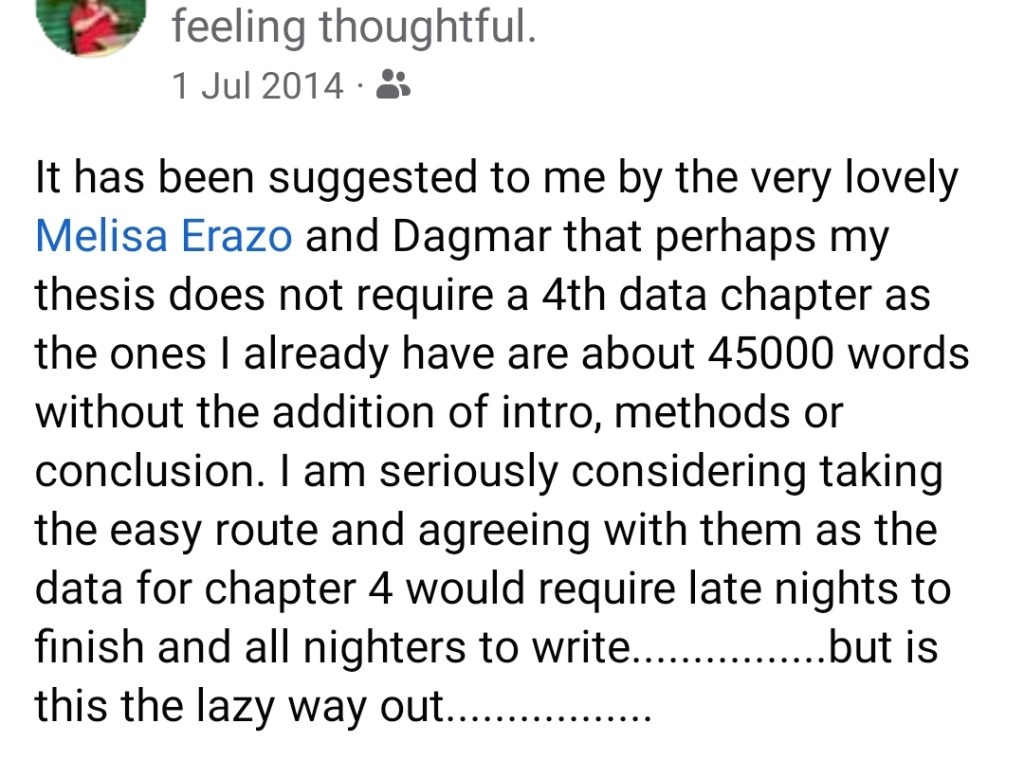
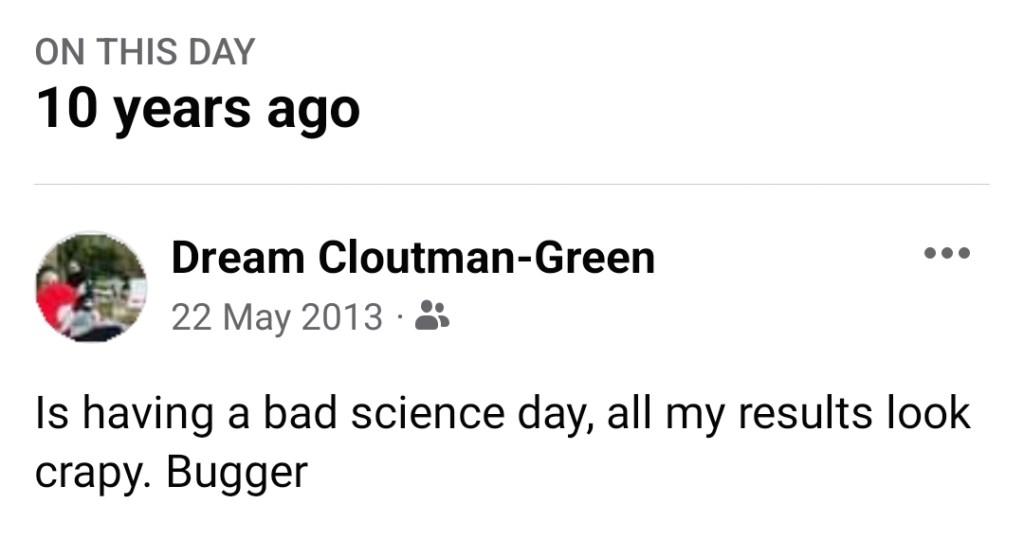
A decade ago, I posted this on my Facebook page:

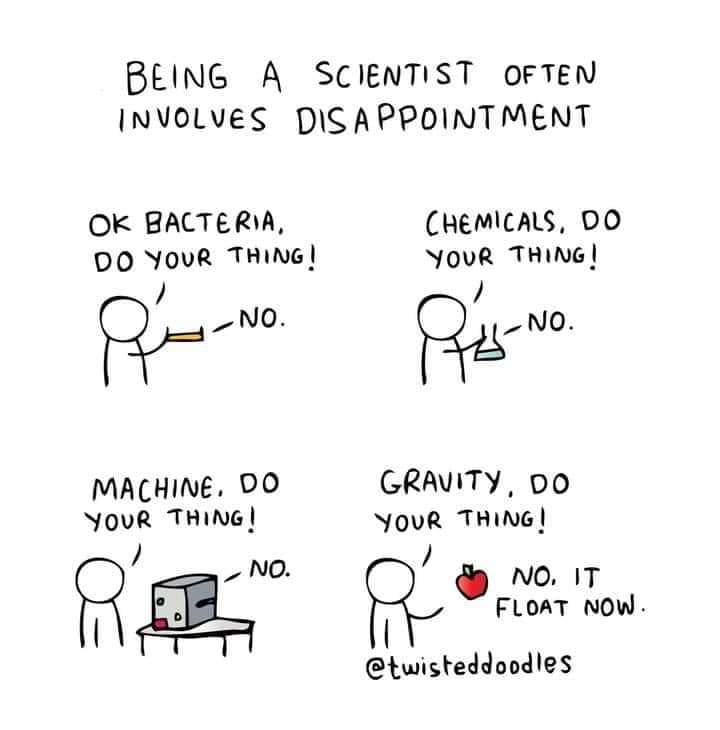
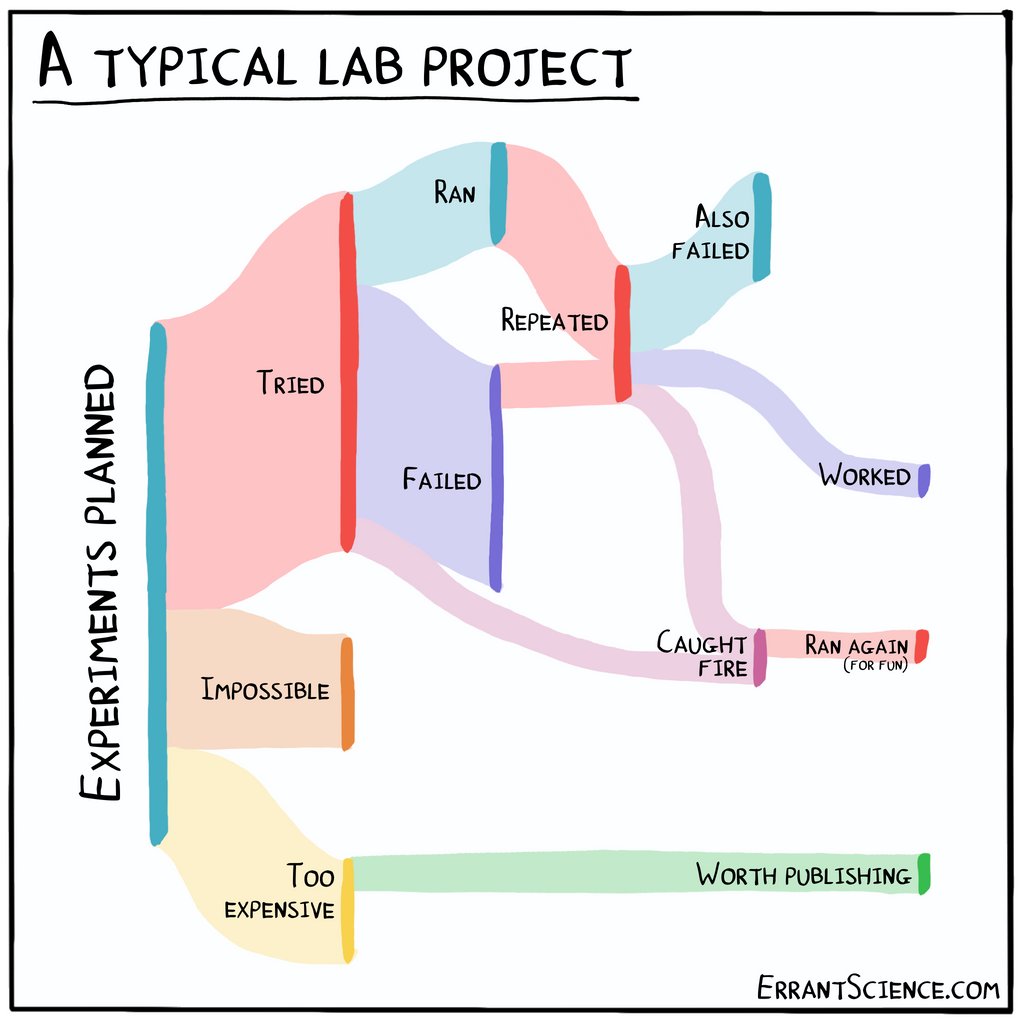
The thing is, it will not have been the only bad science day I will have posted about. You see, science is wonderful, but some days, it can also be heartbreaking. Before the breakthroughs, there is often a period where it feels like nothing is ever going to work again. I currently have a few PhD students who are in the ‘I just need data phase’ and so I thought I would take this week to acknowledge how challenging it can be and share some things I learnt that got me through.

The results of your experiment do not define you as a scientist

I want to say this first, and I want to say it loudly and on repeat, especially for all of those PhD and other scientists who are currently struggling with experiment failure – failed experiments DO NOT make you bad scientists! I shall say it again – failed experiments DO NOT make you bad scientists! All scientists fail, some of us have failed for months at a time, and challenging science is the name of the game. If you were doing something that had been done before, you wouldn’t be doing PhD level work. Therefore, failure, far from being a flaw, is to be expected. The sooner this is accepted, the better your mental health will be.

It’s incredibly challenging some days, but we all have to remember that our success at ticking actions off our list does not define who we are as people. Science is also far more than undertaking experiments. Did you sign up and deliver some kick ass outreach? Did you ask a great question in lab meeting? Did you make your struggling peer a cup of tea or help them with a figure they couldn’t get right? Sometimes, when the thing we’re obsessing about doesn’t go right, that is all we can see, and we ignore all the rest that is going well, make sure to acknowledge the good stuff.

Sometimes, you need periods of failure to get to the success

PhD’s are apprenticeships in research, and all of the failed experiments are far from a waste. They are part of the learning. You will use them to create your method development sections of your thesis, and they will give you great discussion points for your viva. In fact, if you had a completely clean sailing PhD that might be the more unexpected thing if I was your examiner, I’d be forced to dig more about where your learning happened.

Also, and I hate to do this as it’s the most trite thing ever, but some of the best science comes from mistakes and screw ups. Think Fleming and penicillin. The main thing is the mind set through which we view the failure. If we take it personally and let it get in our heads, all we can see is failure. Some of my best science has happened when failure has made me take a step back and pause, and suddenly I’ve seen the problem in a new light, or it’s forced me to make connections I wouldn’t have normally thought about. Sometimes, we need to be sure we see the failure as an opportunity rather than the end of hope.

It can be soul destroying when an experiment you’ve worked on for weeks or months crashes and burns, but the thing I’ve learnt is that often that happens when I push through too much, or don’t give it the attention it deserves. For me, experimental failures can also be warning signs about the pace and intensity of my work and can, in the end, offer a useful way to self check and force me to review my working patterns to give me a better more sustainable pathway to success. If you are crying over a failed run, it’s probably an indication that you need a break or to work differently.

Know when to continue down the rabbit hole and when to pivot

One of the biggest lessons I’ve learnt during my time working in science and doing research is that sometimes you have to be prepared to stop what you’re doing. During my PhD I spent 18 months trying to separate Adenovirus from viro cells using centrifugation to reduce whole genome sequencing read loading towards monkey rather than viral DNA. You know what, I got a bit of a reduction, but not enough to make a real difference, and to get that I worked till midnight for months as that was the only time the ultra centrifuge was available. What I didn’t do was a) set some success criteria b) stick to them and c) have a cut off that was based on effort vs reward. I just carried on…..and on……and on for very little payoff when I should have just stopped.

There will be times when you just need to persevere, as the work you are doing in central to the project and definitely achievable (anything core should be designed at the project level as attainable). There will, however, always be other aspects that need to be evaluated for the resource they are requiring (time, money, etc) vs what they are adding to your body of work. There is no point in spending 18 months on something that will be 2 pages in your thesis, there is point in spending 12 months fixing something that will be a chapter or more.

So one of the main skills I’ve had to develop is the ability to step back and see where the piece I am currently working on fits into the whole, and I can then evaluate what level of effort it is worth. If you haven’t set your success criteria etc beforehand it can be super painful to reach this decision and to walk away. This can be why having a good project timeline for your work/project/PhD can be really helpful. It helps you make pragmatic decisions and gets you out of the weeds in order to help you move forward with a view of the work as a whole.

Some days, you need to walk away to gain clarity

One of the things that has helped me with the ‘rabbit hole or pivot’ conundrum is getting to know myself enough to understand when I am in a spiral. My willpower and persistence are probably the only reasons I’ve managed to get as far as I have. The downside to these aspects of my personality is that I become hyper focused on a goal and the fact that it has to happen, I get in my own way and can’t always do the needed reflection piece. The end result of this is that it takes me longer than it should to realise I should have stopped (this is true of everything for me, not just experiments).

Believe when I say that it is worth developing the self-awareness to be better at this, as combined with the self reflection skill described above, it will be a powerful tool throughout your career. For me, this involved knowing when I need to walk away and distract my brain with some trashy TV or process it by writing a blog. My husband wishes it was the decision to go and load a dishwasher or clean, but no one can have everything. Pre-pandemic it was also things like going for a run, although I have to be honest and say I haven’t got back there. Whatever your technique, it took me a long time to realise this was a key part of my process. I needed to distract my brain, and the very process of doing this enabled me to gain clarity. Far from berating myself for my prevarication, it was actually key to achieving my aims and objectives.

Know when to get support

Frankly, sometimes you can’t manage alone. In fact, in my case, I hardly ever can. It’s why I really believe that science is a team sport. Sometimes, you will need someone else to help you recognise that it’s time to evaluate. Sometimes, you will need the support of others as part of the reflection process, and when it comes to troubleshooting why things are not working, two heads are definitely better than one. Far from being a sign of weakness, seeking support and building networks so you have identified that support are key parts of your career development. There will always be people out there who have more experience than us and learning from them so we don’t just replicate each others mistakes is just good resource management.

Always have a plan b, and ideally c and d

As I’ve already said, failure is just part and parcel of science. There’s no escaping this fact. What I have learnt though is there are routes to being more savvy about anticipating that failure. I had a fairly horrid experience during one of my masters degrees, where the project was designed as just one thing that either worked or it didn’t. Inevitably it didn’t, and I was forced to write 10,000 words on 3 results. This taught me 2 valuable lessons, 1) never blindly follow a project designed by someone else, if you feel it isn’t right for you own the fact that it is your project and you need to input to get it where it needs to be, and 2) never design a project that is entirely dependent on plan A working, as the chances are it won’t.

Taking a modular approach to any project design will enable you to combine parts that work and still have an over arching narrative that makes sense and enable you to succeed, even if individual components fail. If you are designing a project around a core component that you are then attaching spokes to, that component needs to be guaranteed in terms of process success, even if not result outcomes, as you can discuss the results in the context of your work, but you can’t risk not being able to get them. Take time to map this out and to undertake a SWOT analysis, so you can pre-plan for how you will manage any failures. That way you won’t lose time panicking when things go wrong, as you will have a defined pathway already.

Don’t benchmark against the success of others

A lot of the way in which we experience failure is defined by how we emotionally respond to the context of that failure. Sometimes benchmarking against others can be helpful, but more often than not if you are already feeling challenged it can just add to the pressure you are already feeling. I think this especially true when taking a PhD, as both you and your project are highly individual. It can be to look at others and their outputs and not compare, but the truth of the matter is you are likely comparing apples and oranges. PhD’s by their very nature need to be unique pieces of work, and so someone can appear to be killing it but their track record will look different to yours as they might face their challenges in the future, or may have to justify their work in a different way. So look to peers for support rather than affirmation of your progress, as every pathway in different. Otherwise you can make a challenging time even worse for yourself.

Know that we have all been there

I started out by saying that failed experiments do not make you a bad scientist and I want to finish by saying that the way I know this to be the case is that I have yet to meet any scientist who hasn’t spent dark days dealing with failed experiments, or just failure in general. No matter how lonely it feels in the moment, know that we have all been there. That may not make it feel any better, but I hope it empowers you to reach out and let your supervisors/peers know how you are feeling in order for them to support you through it. No one should judge you in this, because in judging you we would be judging ourselves. Science can be a really lonely profession, but it doesn’t have to be, and so reach out to your networks, and if you can’t reach out to them reach out to me. The better job we do of supporting each other the better placed we will be to create work that matters and improves the world just a little bit.

All opinions in this blog are my own

If you would like more tips and advice linked to your PhD journey then the first every Girlymicrobiologist book is here to help!

This book goes beyond the typical academic handbook, acknowledging the unique challenges and triumphs faced by PhD students and offering relatable, real-world advice to help you:

  • Master the art of effective research and time management to stay organized and on track.
  • Build a supportive network of peers, mentors, and supervisors to overcome challenges and foster collaboration.
  • Maintain a healthy work-life balance by prioritizing self-care and avoiding burnout.
  • Embrace the unexpected and view setbacks as opportunities for growth and innovation.
  • Navigate the complexities of academia with confidence and build a strong professional network

This book starts at the very beginning, with why you might want to do a PhD, how you might decide what route to PhD is right for you, and what a successful application might look like.

It then takes you through your PhD journey, year by year, with tips about how to approach and succeed during significant moments, such as attending your first conference, or writing your first academic paper.

Finally, you will discover what other skills you need to develop during your PhD to give you the best route to success after your viva. All of this supported by links to activities on The Girlymicrobiologist blog, to help you with practical exercises in order to apply what you have learned.

Take a look on Amazon to find out more

PhD Top Tips: So you’ve decided you want to start a PhD

It’s that time of a year, the time of year when I get a number of appointments put into my diary from people who want to talk about doing a PhD. This will range from undergraduates, where I’ve taught on their course, to established healthcare professionals with over a decade worth of lab or clinical experience. I thought it might be useful, therefore, to write a post where I go through some of the stages of discussion that take place in these meetings in order to help anyone else thinking about the same thing.

Over the last decade I’ve spent time talking with a lot of people who come to me saying they want a PhD and my first question is always why? I ask this not just because it is the question you will always get asked in your PhD interviews but because your answer will determine a number of things, some of which I’ve covered below.

How much thinking have you done?

Starting a discussion with someone where you ask why they’ve decided to do a PhD is a good way to check how much thinking they’ve done about a) what a PhD actually is and b) how it will enable to them to achieve their aspirations, a PhD is not the end game after all, it’s a step on a pathway. Now, if someone is an undergraduate, they may be focussed on a PhD as the next educational step and not yet have clarity about where it will lead. However, for someone whose already a working scientist, this question holds a lot more weight as they are more resource limited (in terms of time) and probably need higher levels of clarity prior to committing. The way someone answers this question (and it’s one I also use in interviews) helps me gauge how far along in the thought process someone is. In an interview, it also helps me gauge how committed someone is, as they have invested the time to really think about their why and how it serves their purpose and values.

This then leads onto some more specific questions:

  • What subject of PhD? are you looking to progress via a scientific route or via other channels in leadership or education.
  • What type of PhD – if you are coming to me as a Healthcare Scientist looking to progress a traditional research doctorates are no longer your only option. You can now undertake a professional doctorate via a number of different routes.
  • Where do you see a PhD taking you to in 15 years time? Which doors will it open? Are any of these restricted by doctorate type?
  • Why now? What are the opportunities or support you have available to you now. How have these changed (if you’ve been in post) to allow this to be an option now and how might they change in the future? Could any of these changes impact you in the time course of the PhD?

Thinking about what route to PhD you will want to follow is key. Some, like fellowships, come with substantial resource in terms of matched salary and both educational and consumables funding, but are highly competitive and will likely take you over a year to prepare. Others are much more under your control, like self funded, but require you to have resource of your own to begin with.

The route that might work best will therefore depend a bit on where you want to end up, but also on personal factors, such as finances and available time. Some of these routes may also limit progression down certain pathways, if you want to become a full research academic for instance you will probably need a research PhD rather than a taught doctorate. If you choose your route without knowing your why you could therefore close off some possibilities without truly being aware at the time:

  • Unfunded route, where you register but undertake an unfunded PhD alongside your post. Often your employer will pay your PhD fees and you apply for consumables money
  • Self funded route, where you take time out to do your PhD but you fund your own fees and consumables, usually in an academic department
  • Stipend funded, the route most people think of when undertaking a PhD. You apply for a project where the funding and requirements of the PhD have been set out by a supervisor. These are more like fixed term jobs where you deliver on a set of parameters
  • Fellowship, this route in probably the most competitive and requires substantial preparation. On the other hand it can offer a route by which you can undertake a PhD whilst still retaining your salary, and have access to funding for training and consumables
  • Training post, this route will often offer a taught doctorate rather than a traditional research PhD. It is also a way in which you may be able to develop clinically at the same time as developing leadership and research skills, and so might be the most appropriate route if you are aiming to undertake a PhD in order to get a specific role

How much research have you done?

When I talk about research here, I’m not talking about the academic kind, I’m talking about the fact finding and speaking to people kind. One of the ways I can often judge how seriously someone has thought about undertaking a PhD, and establish how far they are along with the process, is talking in a little more detail about what kind of research questions they are thinking of and the practicalities of undertaking a PhD in that area, such as what institution? or what supervisors? This is where the nitty gritty really starts to matter:

What thinking have you done on your research question, how far is it progressed? Do you have a broad subject like Clinical Microbiology, a more specific subject area such as Gram negative sepsis, or something really developed, such as comparison of molecular detections of antimicrobial resistance techniques and their impacts on antimicrobial prescribing decisions. There are pros and cons about having reached different levels of thought. It is good to leave enough conceptual room where your supervisors can support you in ensuring that your research question is both achievable and of PhD level. Coming in with only the broadest level of thinking however, tends to imply you may not have thought about it enough and may limit how much support and sign posting someone can give you, as it will be harder to tell which funders might be interested or academically where it might sit.

Who are you thinking in terms of supervision? Have you approached anyone? Making the right supervision decision is key, not just in terms of topic but also in terms of PhD experience. It is therefore always worth doing your due diligence in terms of research who is working in the area, but also in asking what is their working style? What is the experience of others in their lab? Can they help you in the kind of career path you are envisioning for yourself? If you want a clinical career you may not want to go and work with a fundamental scientist, as their networks will be different and may not support your trajectory.

What institution are you thinking of? Have you read up or spoken to others about what is like to study there? Institutions, like supervisors, tend to have a specific style, and it may be one that works for you but it also may be one that doesn’t. Your institution in some ways may be determined by your supervisors, but you may have the option if you are doing a combined clinical/academic placement to choose. You may also want to bear the institution in mind when identifying your supervisors in the first place and use it as part of your matching criteria. Sometimes, you may also have no choice in institution, especially if you are studying linked to a training scheme – in which case, be aware of travel or other requirements, when decided your route to PhD, as it may impact your experience.

Have you thought about the realities?

PhDs can often be idealised as experiential learning, the reality of them can be very different however, and I’ve already posted about the challenges of the second year slump. The truth of it is that all PhDs are challenging, and sometimes I think that achieving a PhD is more a measure of stubbornness and refusal to give up than of academic competence. There are some things that can be made much easier if you think about them and how they will work for you and your life style before you embark on this particular journey.

The first of this is how will you balance a PhD with your other life commitments? Each of the routes to a PhD have different pros and cons. If you don’t have loads of money in the bank, and like me don’t have a lot of savings, then doing a self funded PhD may not be an option for you. Other options, like a PhD with a stipend, may also be off the table, if you need your current salary to make ends meet. This in itself may determine which route you take. You may have resource in terms of finance but not in terms of time, you may therefore want to self fund or do an unfunded PhD, in a way that enables you to stretch the process out over several years, so your annual time commitment is less. On the other hand, you may be time limited and need to get it done in the next 5 years, and therefore not have the time resource to put all your eggs into the same basket and apply for a fellowship that takes a year to prepare and has a 20% success rate. Being honest with yourself about the different drivers is essential so that you can make the right choices in terms of route.

It is also key to know what kind of learner you are, I’ve already posted a bit about learning agreements, but even in the absence of one you still need to be aware of your needs. Do you need a supervisor who is going to have a lot of pastoral time? Do you want to be in a group with plenty of other PhD students so you have access to peer support? Do you hate micro management and pretty much want high level accessible support when you need it, but a light touch the rest of the time? These things will determine what kind of supervisor and setting you will need to identify, and the questions should be asking (outside of the scientific) in the process.

Finally, and this one is oh so important, what’s your end game? If you want to end up as a Consultant Clinical Scientist but have little interest in a research career, a taught doctorate may be right for you, it will not be the right choice if you want a Clinical Academic career however. If you want to follow a clinical pathway you may want to ensure that this aspect is retained in your research question, to enable follow on post docs and other progression that supports your clinical role. Not to harp on, but if you don’t know your why no one else can, and it can mean that you make decisions that close future routes rather than keeping progression pathways open. Also, did I mention doing a PhD is hard? If you don’t know your why it can be super challenging to just keep going when the tough times do arrive. If you know your why however, at least you can cling to that vision and end game in order to get you through.

I hope this post helps show that there are many different choices open to you if you are thinking about undertaking a PhD, but that it’s worth doing some thinking and fact finding as part of the process to make sure you make the decisions that are right for you and your life style. For those of you who decide to jump down this particular rabbit hole here are some things I wish I had known when I started, and good luck, you will rock it!

All opinions in this blog are my own

If you would like more tips and advice linked to your PhD journey then the first every Girlymicrobiologist book is here to help!

This book goes beyond the typical academic handbook, acknowledging the unique challenges and triumphs faced by PhD students and offering relatable, real-world advice to help you:

  • Master the art of effective research and time management to stay organized and on track.
  • Build a supportive network of peers, mentors, and supervisors to overcome challenges and foster collaboration.
  • Maintain a healthy work-life balance by prioritizing self-care and avoiding burnout.
  • Embrace the unexpected and view setbacks as opportunities for growth and innovation.
  • Navigate the complexities of academia with confidence and build a strong professional network

This book starts at the very beginning, with why you might want to do a PhD, how you might decide what route to PhD is right for you, and what a successful application might look like.

It then takes you through your PhD journey, year by year, with tips about how to approach and succeed during significant moments, such as attending your first conference, or writing your first academic paper.

Finally, you will discover what other skills you need to develop during your PhD to give you the best route to success after your viva. All of this supported by links to activities on The Girlymicrobiologist blog, to help you with practical exercises in order to apply what you have learned.

Take a look on Amazon to find out more

Would You Like That Explained in Words of One Syllable? Thriving in the world of a mansplainer

This post is in honour of international women’s day, I hope by talking about this and sharing some thoughts it will make us all more able to stand up for ourselves and support others in moments like the one below, when we encounter the mansplainer in their natural habitat.

I was at a conference last week, and I was struck yet again by the number of questions that were asked that were commentary and not indeed questions. I paid attention, and, in this case, 100% of those undertaking this behaviour were older men. The reason I started to pay attention was because the first session I attended was filled with a panel of young female scientists. The Chair of the panel, however, was an older man, and when this commentary occurred from one of the attendees, instead of shutting it down, he actively participated and even exacerbated the issue. Not only that, but the commentary was also inherently incorrect and was not even helpful. I must admit I found myself becoming pretty infuriated and later found other women who’d been in the room who found it equally maddening. So this week I thought I would channel some of that science rage into a productive place and talk about survival in the world of the mansplainer.

NB please note I recognise that there are also some women that exhibit these behaviours routinely (and we probably all do periodically). In this post I talk about mansplaining as the behaviour and not linked to gender, unless I’m recounting specific personal experiences.

In the interests of full disclosure, I’ve also had a fair amount of men recently lecturing me about what it is I do and do not know, as well as some ‘interesting’ comments on my blog. I therefore may not be feeling as balanced about this topic as I would otherwise. The thing is, it’s not like it is as unusual as it should be, and you would think, therefore, that I should be less bothered by it. In fact, the opposite is true. Now I’m aware and see it happen to others. I’m even less tolerant. I’m pretty fortunate that it only happens to me 3 or 4 times a year to a level that irritates me. It happened less when I became a Consultant, and I suspect that it will happen less (to my face) now I’m a Professor. Even so, with all of these benchmarks of knowledge and experience, it still happens. So here are my thoughts on living in the world of the mansplainer and how we might all work together to make it more tolerable.

Don’t worry little lady

Let’s start with talking about some classic mansplaining that has happened to me. I’m partly starting out with this because I had a really lovely male boss who just didn’t believe that these things happened as no one had talked to him about it. By putting it down here prior to talking about what we can do in response, I hope to contextualise some of what it’s like for any allies out there who have experienced it less as individuals.

My all-time ‘favourite’ example of mansplaining that has happened to me was an email sent to myself and a female colleague that actually started with the words ‘don’t worry little ladies’. The email in question was sent in response to a query about engineering standards. Now, these days I would respond with ‘that’s Professor Little Lady and I am worried so please explain………and what you are going to do about it’. At the time, though, I was completely thrown by how 4 words could effectively minimise my years of experience, my authority to ask the question, and impact my feelings about my ability to follow up. In my defence, I did follow up and insist on further information and a review, but something so small could actually have impacted my ability to do my job and would never have been undertaken with my male consultant boss. These comments, therefore, are not insignificant when, especially in healthcare, they could lead to a reduction in safety. That said, did I escalate? No, did I forward the email to his boss and explain? Also, no. It’s so normal that it never even occured to me. I suspect if I had, it would have just been called ‘banter’ and waved off.

One of my other favourite things (not really) is when I’m called into a room to have a technical discussion, and when it becomes apparent I’m not convinced by the argument, the room full of men call in yet more men, not to enhance or bring more information to the discussion, but because they somehow believe that having more men in the space repeating each others words will somehow intimidate me or force me into conceding that their science is suddenly correct. I do not enjoy conflict and I generally believe it’s bad form to point out the flaws in someone’s argument in front of others, in a way that could be seen as aggressive or embarrassing for the individual. However, if you pull >20 men into a room to lecture me on, for instance how HPV works, when you are neither a microbiologist or have any experience with viral loading or kill, and think that calling in a further 10 will change the underlying fact that I have just finished writing about it for my thesis, my argument is unlikely to change. All that will happen is that I will cease trying to cover up my level of knowledge in order to play nice and I will quote papers and research at you until you let me leave.

Have you thought about?

One of the other scenarios I’ve found where some interesting male commentary occurs is on some of my blog posts. Now, don’t get me wrong a) most of the commentary I receive on my blogs is super supportive and is what gives me the impetuous to continue to write them and b) I acknowledge that by writing and (over)sharing the way I do I also invite engagement and discussion of the content I put out. Every now and again I get a comment that I don’t approve for public sharing and just leave in the archives as I’m not sure that they are part of the discussion I want to have.

When I posted earlier this year about being overwhelmed and shared some tips that have helped me to get through I received some comments from various male subscribers. These comments were very different from those of my female subscribers, who shared how grateful they were that we were talking about the fact that everyone has days when they struggle and that coping mechanisms are key. These comments all came from a place which I assume was kind and supportive, but ran along the lines of ‘if you feel overwhelmed maybe you should have spent the extra time working and clearing your emails rather than writing this blog’.

On the surface I kind of get it, but also a) it is my right to choose how I spend what free time I manage to have for myself, without commentary from others as long as I’m breaking no laws and hurting no one b) blog writing, for me, has become a method of processing my work load and stress levels and therefore suggesting I abandon it would be removing a key coping strategy I utilise c) the blog post was about sharing experiences and methods to move through feeling over whelmed, not a pity party post about how it sucks, therefore the suggestion that I focus my time on not supporting my community is against the ethos of what this blog is about and frankly kind of sucks and finally d) the assumption that I wouldn’t have considered doing less and not over stretching myself probably doesn’t give me very much credit in terms of self reflection or self awareness. So, I suppose my point is this, sometimes by stating the obvious and your opinion about it, it can come over as pretty patronising, as if it wouldn’t have occured to me and I haven’t done the thinking myself. That said, intent matters, and I don’t believe that these are often meant with any ill intent, so I leave them as unapproved and a source of future consideration and move on.

If you look for it, you will see it

Frankly, some of this is insidious, as I discussed in the intro, I only really started paying attention at the conference because there was such an extreme version of it that it drew my attention and I became deliberately aware of it. Sadly, when I posted about it on twitter the almost universal response was ‘only one’ to my retelling of the male commentator. It’s so universal as a stereotype that we laugh about it, but my thinking is also what can we do to challenge it or support others when we see it.

Summary.   

Role incredulity is a form of gender bias where women are mistakenly assumed to be in a support or stereotypically female role — an administrative assistant, nurse, wife, or girlfriend, for instance — rather than a leadership or stereotypically male role, such as CEO, professor, lawyer, doctor, or engineer. While this slight or mistake might seem innocuous, it can have real ramifications for women. Women must expend extra energy and time to assert and prove their role. Their words may lack the credibility and authority inherent in their position. And when women are not seen as a leader, they may be less likely to be hired into male-dominated roles or to be considered for promotions.

While the real issue of role incredulity is systemic, there are steps organizational leaders, workplace allies, and women themselves can take to prevent and correct it., including setting organizational norms, being an ally, owning your mistakes, and, if you’re a woman, proactively identifying your role.

https://hbr.org/2021/12/when-people-assume-youre-not-in-charge-because-youre-a-woman

I suspect there are few women amongst us who haven’t been asked to ‘sort the coffee’ despite being one of the most senior people in the room, or who haven’t had their bank card saying Dr handed back to their partner. These are little things, and I for one am completely OK with getting coffee, but not because I’m a woman, but because I think we should all take our turn and hierarchy shouldn’t remove us from that. I find it hard therefore to know when to draw the lines over such things, I’m a team player and want to do my part, but I also don’t want to sustain a stereotype that might negatively impact others. Honestly, even thinking about these things in the moment and having that constant dialogue with yourself can be pretty exhausting when it happens over years or decades.

Do these things actually matter?

Even though I feel that I own my place and have so much more strength than I did when I was younger, these comments, decisions, and moments still take up cognitive space. I may rebound more quickly but I still go through the ‘experience-self recrimination spiral-replay’ cycle in order to process it and decide where fault may lie with me or where the learning is.

“What we found was that women largely had negative outcomes as a result of being mansplained to, whereas it didn’t affect men as much,” said Briggs, whose research was published in the Journal of Business and Psychology. “They tended to register that their competence was being questioned more than men did, and to attribute this to a gender bias – so, maybe this person doesn’t think highly of me or doesn’t like me because of my gender.”

This feeling wasn’t shared by male volunteers who were given a condescending explanation by a woman. “Maybe they perceived it as ‘this person is being rude to me’, but they didn’t perceive it any differently if it came from a man or woman, and they didn’t attribute it to a gender bias,” Briggs said.

https://www.theguardian.com/science/2023/feb/03/let-me-mansplain-studies-reveal-negative-impacts-of-behaviour?CMP=Share_iOSApp_Other

It may be therefore that we have to acknowledge the role we play in how we receive the information and the fact that some of the behaviour we experience really does not have any ill intent. However, that also doesn’t mean that those undertaking such behaviours don’t equally have a responsibility to understand how their behaviour impacts others, and in some cases leads to the active detriment of the women who are the recipients. Especially if this behaviour is endemic in institutions/settings or originates from the same individual over protracted periods of time.

So, how do we handle it?

I’ve previously posted about how I learnt to own the place I found myself in with some tips on managing this as individuals. I do think that dealing with direct interactions rather than our own imposter syndrome needs a different set of skills, ones that may indeed help with how we see the world over all. It all starts with being conscious of ourselves in the moment, where do we sit, what do we say when we introduce ourselves, how do we respond in the moment and how do we let our view of ourselves drive these dialogues?

Below are some areas of thinking that have helped me and I hope might also help you in traversing the particular challenge.

Decide which truths to believe

I am often considered over emotional because I wear my heart and values on my sleeve. It’s a running joke within my team that I have absolutely no poker face, and the time to be concerned when in a room with me is when I stop being expressive, as it probably means I have become coldly annoyed.

For a long time, I thought that this was the biggest weakness. I had many a person (male and female) explain to me that I couldn’t be successful as I was and that to proceed I really needed to change and fit the stereotype of what a boss/consultant/professor should be. Well, frankly, screw that. Hiding who we are and pretending to be someone else should not be the only path to success. Being open and honest about my values and who I am is not a weakness. It requires integrity and fairly often bravery to function openly as who you are. We are supposed to be assertive but not too assertive, smart but modest about it, passionate but not emotional. I, for one, don’t want to play that game and, in many ways, just opted out and found ways around it. I strongly believe that we no longer need to play by the rules of those who came before us, let’s set our own rules, let’s choose our own truths and empower the future to be different and better for those who will follow on behind us. Choose your own path and let that be your truth.

Practice makes perfect

Now, I’m not sure I would be comfortable saying any of the below as they are written, I think I would be too scared of coming off as aggressive. For all you women out there who could and own being that assertive, I am not worthy. That said, I have used many of these responses, if not these exact words, in order to manage conversations.

The thing for me is you need to know what language you are comfortable with and practice it before you need it. In the moment I am often surprised and lose my mental footing, therefore if I haven’t practiced how to hold my ground and be assertive I lose it to hesitancy and upset. Practicing enables it to almost be a reflexive approach that you can draw on, so that you don’t have the cognitive additional load of making those nuanced word choices in the moment. So the sentences above may not fit you, but find ones that do and try them on for size well before you need them.

One of the things that also helps me is wearing a different head space when I go into rooms where this is likely to be an issue. ‘Dream’ would never hold up in these spaces, and when I leave them, she often crumbles in the replaying of the moment. Professor Cloutman-Green, however, is much more able to hold her own. It’s almost like my science shield enables me to suffer less from impact in the moment and so allows me to maintain or re-establish myself in that moment much more readily. This is different from not being my authentic self in a space, I am still me, but it gives me the emotional distance to process things later rather than being overwhelmed in the moment.

Self-awareness is key

Ever walk into a room, and there’s a single chair left and you offer it to everyone else who comes in after you? I do this all the time. It’s just polite, right? Absolutely. However, if you are in a room that internalises hierarchy and everyone sitting is a Consultant like you and everyone else standing is more junior, by undertaking this action you are unconsciously giving away your seniority in the room. You are signally you’re difference to your other consultant colleagues. Being aware of your surroundings and what cues you are sending out is important.

Ever sat listening whilst a colleague towered above you? The person who deliberately chooses to lean against your door frame whilst you sit in order to explain X or Y to you. Dominance positioning is a thing, we are primates after all. If we have small and closed body language it says a lot more than our verbal responses in the conversation. Sometimes, when you find yourself in a mansplaining situation the mere act of repositioning yourself can impact the conversation. Stand up, gesticulate using wide body language when speaking. It may be that this merely changes the way you receive the exact same dialogue, but sometimes that is half of the battle. If it also supports you in using some of your practiced dialogue, all the better!

How do we help others?

When sat in the conference room mentioned at the start of this article, I had so much rage at the way these young scientists were being treated. My PhD student who saw and understood my response asked ‘are you going to say something?’. I responded ‘no, these girls are going to handle it’, and they did. They did so perfectly. I think one of my biggest pieces of learning over recent years is not to run in like an amazon warrior to save people, as this can in actual fact be diminishing and takes away their opportunity to act. My response now is to be there as a back up if they signal they need help and to offer support and reinforcement with ‘you were amazing in how you handled that’ afterwards to let them know how successful they were from an independent observer view. By rushing into save we can be as bad as the mansplainer as it indicates we don’t have faith in their ability to handle the moment. That said, if I’d had an official role, such as Chair, I feel it would have been my responsibility to stop the situation from happening in the first place. My take home is this, how you respond has to depend on your role and the situation.

I still love the females from the Obama administration who used their voices to amplify those of other women in the room. Not all actions need to be direct or confrontational, sometimes just being there to repeat the voices of others is enough. I wish that I had been able to breath through my rage and find an amazing follow up question to allow that panel to shine even more in that moment, but I didn’t and that’s my learning. That moment wasn’t about me, it was about them and next time I will have practiced how I can then act to amplify them better in the moment, rather than worry so much about the mansplainer in the room and giving him my energy. Every day I learn a little more.

Right, I’m off to the growlery until I find myself in a better mood. See you on the other side.

All opinions in this blog are my own

Guest Blog from Dr Claire Walker: Turning criticism into a catalyst for change, or how I learned to stop worrying and to love negative feedback

I am currently away enduring the heat of Houston, Texas, at the American Society of Microbiology annual conference. Hopefully, I will find lots of lovely inspiration whilst I’m here to share with you all. In the meantime, and whilst jet lag is kicking my ass, the wonderful Dr Claire Walker has swooped in and saved me by writing another awesome guest blog.

Dr Walker is a paid up member of the Dream Team since 2013, token immunologist and occasional defector from the Immunology Mafia. Registered Clinical Scientist in Immunology with a background in genetics (PhD), microbiology and immunology (MSc), biological sciences (mBiolSci), education (PgCert) and indecisiveness (everything else). Now a Senior Lecturer in Immunology at University of Lincoln. She has previously written many great guest blogs for The Girlymicrobiologist, including one on the transition from lab to academia.

So, the other night before a conference @girlymicro and I were sat in a hotel bar, drinking martinis and listening to me bemoan some fairly harsh feedback I recently received anonymously from a student in the form of the oft dreaded ‘Module evaluation feedback form’. The conversation went a little like the Deep Space 9 meme of Julian and Garek that’s doing the rounds – you know the one….

I love the internet. Meme generators entertain me no end.

Back to the story, I was complaining and @girlymicro, quite rightly, reminded me of two important facts. One, all constructive feedback is always useful even if we don’t particularly like hearing it. And two, not everyone is going to love us even if we really, really want them to.

I went to bed reflecting on this conversation and my poor feedback. Constructive critical feedback is a powerful tool for growth, yes it stings a little at the time, but when we take time to reflect can we see why we received it? This particular individual found me to be blunt and rude, and in honesty, in this specific instance I would say they aren’t totally wrong. This year, my decision to support University College Union strike action prevented me from giving the first lecture of my module. I use this lecture not only to introduce myself and describe the content of the module, but to set the expectations for behaviour in my classroom. I’m what has been described by my friends and colleagues as ‘old school’, and this makes me something of a marmite individual for students. I want to provide a safe space for discussions, and I cover a lot of triggering subjects. I have no time for disruptive behaviour that detracts from the groups collective learning experiences, and I have a low threshold for calling students out on this. Am I blunt? Probably. Could it be perceived as rude? Absolutely. Without these early conversations the students this year weren’t aware of my expectations and thus my behaviour had no context. Does this make the feedback fair? Possibly. In my honest opinion when you come to a place of learning you put your phone down and respect the teacher as well as your fellow students, and at University level teaching you shouldn’t need to be reminded of this. However, what I’ve learnt is just how important those conversations are, and I will be having them come hell or high water next year.

Girlymicro’s second point also gave me pause for thought. Not everyone is going to adore me. My teaching style isn’t guaranteed to work for everyone. So after finishing my martinis I returned to my feedback and applied the Pareto Principle. The Pareto principle asserts that 80% of outcomes result from 20% of causes. When I view negative feedback through the lens of the Pareto principle, I see that a significant proportion of this feedback comes from a small percentage of students. And the same is true of the positive feedback. Understanding this principle lets me focus on how I can direct my efforts to addressing their concerns specifically and prioritise improvements across my teaching to make meaningful change. However, it’s also crucial to recognise the silent majority the 80% who are, apparently, content enough not to provide an evaluation of the module. A major overhaul probably isn’t necessary, but there are tweaks to be made to make the content work for everyone.

Finally, I reflect on the words of wisdom from the great Obi Wan Kenobi himself:

“ You’re going to find that many of the truths we cling to depend greatly on our own point of view.” / “The truth is often what we make of it; you heard what you wanted to hear, believed what you wanted to believe.”

My ‘truth’, my point of view has been that my teaching style is interactive and engaging, and certainly some of my students share this opinion. But this isn’t everyone’s point of view and through receiving feedback I am able to see the opinions of those individuals that differ from my own. I often say that teaching is an iterative process, dependent on a cycle of reflection and growth. I may enjoy a particular style of lecture but if it’s not working for the majority, I have to put it down and build something new. Based on both the negative and positive comments, I have been able to introduce more lab sessions, simulated clinical experiences and data analysis workshops to my modules, and move away from traditional didactic teaching. Yes, it’s more work over the summer but hopefully this will lead to a significant improvement in the learning experience of my students. Who knows? Hopefully that quiet 80% like the changes. Either way I’ll await my next critique and take it from there.

TLDR: You can’t win ‘em all. But you can have a lot of fun with meme generators.

All opinions in this blog are my own

Conference Season is Upon Us: My top tips for conference presentations

I’m off to ASM in Houston in a few weeks and conference season is well and truly upon is. I’ve been fortunate enough to get asked to speak at a number of events over the years, but I still clearly remember how terrified I was when as a trainee I spoke to my first big room. Last year, I gave my first key note lectures. I’d been asked to do a couple in 2020, and then the pandemic hit, so all of those events were cancelled. I felt as nervous as that trainee again. I prevaricated, I self flagellated and then finally managed to force myself to sit down in front of a blank screen and just get started. If you are in any of those stages, this post is for you, I hope it helps.

No one can tell you the best way – only what is the best way for them

First things first. When as a trainee I was preparing my first talk I got A LOT of advice. My first problem was trying to use all of it, even when it was conflicting. I was advised to rehearse over and over until I had it memorised, I was advised to have a script and notes. I was advised to do none of those things as it would be too staged. So, my first tip is this. Seek advice, gain knowledge from those more experienced, but then use what helps you and discard the rest. Your personal process will be different to everyone else’s, and it’s worth acknowledging this early and accepting that you will find a way that works best for you and refine it with experience.

For instance, I hate rehearsals, and I never have a script. It makes me stressed and forces me to feel like I have to deliver the same way every time. I know my content, I know my story and the audience and I are a team who deliver the final product together. I bounce off them and try to read the room, and fingers crossed, it seems to work OK.

The one time I don’t work this way is for extremely time restricted presentations, such as 5 minute fellowship interviews. For those I practice so much I can recite the words in my sleep. These are different because:

  • you HAVE to get all your content in, your career kind of depends on it
  • the time lines are short and hard, they will just cut you off and so you need to know you will finish in the window given
  • there will be no audience bounce, there will be no reading the room, they are going to remain neutral to what you are presenting, and so focussing on them can make the scenario even more stressful.

What I hope you take away from this is that there are no hard and fast rules, there will always be exceptions, but if you can, do what works for you and don’t try to be anyone else.

Ask for learning objectives and check what other talks/speakers are in your session

There is little worse than sitting, waiting to go on for your talk, and hearing the person before you give the talk that you have basically written to give next. I have learnt the hard way to make an effort to ask what an organiser would like me to cover, and to always check what the agenda is before I turn up for the day to see the lay of the land from other speakers titles. A little repetition is not a bad thing, ground hog day is unlikely to land well. This one is more of an issue for invited speaker sessions, although even if you are presenting novel research data it’s worth seeing who else is in your session, as you may be able to reallocate slide time if the 3 people in front of you are talking about the same virus. They are likely to have covered a lot of the generics and you can then invest time elsewhere.

I don’t always get very far, but these days I also ask for learning objectives when I’m invited to speak – what would you like me to cover? any particular highlights that you are interested in? what is the audience size and mix likely to be? All of these things can dictate not just your content but how you think about delivery, such as how much interaction you can include.

Think about your audience

This one seems like a no brainer, but I often think that it’s forgotten. It is really easy as the person delivering to get caught up with your nerves and write a presentation that you feel comfortable with, without thinking about those that will be listening. Now, I’m not suggesting that you deliberately produce content that makes you uncomfortable, but sometimes it is easy to teach in a way that suits us rather than the learners. It can be really worrying to include interactive content, what if no one responds, but if you are on at the end of the day after 7 hours of didactic teaching, your learners may be ready for something that re-engages them.

The thing that scientists and clinicians also often do when they are nervous is to resort to technicality and jargon. It can act as a shield. If you are presenting to a mixed cohort, of either different levels of knowledge or professional backgrounds, this defence mechanism can end up making your content inaccessible to a number of people within the room. It’s OK to have a couple of slides that stretch people, it’s usually not OK to have a whole talk like that, unless you know your audience really well.

Think about the tone of the presentation

I struggled a lot when I was asked to do the talk below. I struggled thinking that maybe I should turn up as ‘Dr Cloutman-Green’ with formality and pretend gravitas. You would not believe how long I went around in my head about it. I then decided that they had asked me to speak about my blog, and my blog is anything but formal and hierarchical, and so I turned up as me, with all the sarcasm and self mocking that entails. In the setting, at the end of the last day of the conference, when everyone was tired, including a little humour felt like the right way to go.

I would however have made different choices if I was turning up to present my PhD thesis in a viva, or if I was presenting to the board, I would have still been me, but a slightly less overt version. Some settings require a formal tone, some lend themselves to informality and some you can decide the path you wish to walk. The key thing is to make an active decision based on the invite, topic and audience to ensure that you match what your tone is with what you wish to achieve.

Find out if you need to allow room for questions

One of the things that often catches people out at research meetings is there is not always a standard of whether there will be time for questions or not, you can sometimes guess by slot length but not necessarily with any certainty. It is always worth explicitly asking if you need to allow time for questions so you can plan your talk length accordingly. I’ve Chaired conference sessions where this wasn’t handled well and it meant that it was really challenging to keep everyone to time and some speakers had much better opportunities for audience interaction than others. If you aren’t told definitely ask, not least so you can prepare for what your answers might be.

Think about what you want for your slides

This again might be a really obvious one, but if you are teaching on an MSc you are likely to want a lot more information on your slides, as they are likely to be annotated and used for later learning. Your conference talk may be recorded, the slides may get circulated, but the reality is that they are much less likely to be used as a later teaching resource. Therefore you will want to pitch your slide content based on your participants/learners, which is another good reason to find out a bit about them.

It is also worth thinking about how important it is for the people in the room to be able to read and understand what you have included on a slide. I’ve lost track of the number of times I’ve seen speakers apologise for tables and overwhelming numbers of charts that are not visible to anyone sitting beyond the front row. Unless it’s high level conceptual stuff there is little point including slides that are not going to be accessible to your audience. It is also worth (and I am not good at this) ensuring that colours and fonts etc do not present unnecessary challenges to engagement.

Plan in your breaks/interactive moments

Even if you are the best speaker in the world, and I am definitely not, there are always slots in any agenda or meeting which will make it more challenging. The post lunch slot, where everyone is digesting and sleepy, and the end of day slot where everyone wants to make sure they catch their trains are just a couple of examples. If you are allocated one of these slots, or are given a 3 hour lesson slot, planning how to keep learners engaged is key. More than 20 minutes staring at your powerpoint is going to be enough for anyone. So can you include things like videos or other types of content to break it up? Can you include live quizzes that embed some of the discussion topics? Can you get people to talk to neighbours or even do some group work? It is sometimes easy to stand up and go through 60 slides, when the experience of everyone in the room might have been better with 6 and a modified activity based approach. Again, it depends on the setting and audience, but if you can be brave and consider stepping beyond the lectern during your session.

Make sure you have backups

No matter how prepared you believe you are for giving a session there are some days when it will not be enough, for this one you need to make sure you are the master of your own destiny. There have been numerous events where I have turned up to speak believing that my slides will be already loaded as I had sent them to the organiser well ahead of time, and had the tech guy look at me in bewilderment as they had nothing. I always carry my talks on a USB stick, having emailed them so I can also get access to an email version in case my USB files is corrupted, and I will have them stored on cloud storage as a back up in case I need to download directly onto a system. The fear of having to just get up and talk without slides haunts me too much to leave anything to chance.

Know how you might wing it if needed

The reason I know very clearly what it feels like to have a slide deck that doesn’t work is because it happened to me at a conference in 2021. I rocked up having sent my slides ahead of time, having been told that the organiser had checked them when they were loaded onto the laptop. I started my talk and then realised that every single slide that had a table or anything other than a textbox was entirely blank. I then proceeded to give my 30 minute with a variety of blank slides. When you’re up there there is nothing that you can do but wing it. I pivoted to a session where instead of trying to focus on my slides I talked about clinical experiences linked to the visible titles. I survived, it was even well reviewed, but I never want to do it again. That said, those 30 seconds staring at the first blank slides and working out what to do taught me a valuable lesson, and now I do my ‘what if’ worst case scenario planning ahead of staring at the audience whilst on my sofa with tea, so that I know what I will do if something goes wrong. I also now try to make sure I personally check my slides prior to any session.

Have a watch or phone that you take up with you

You would be amazed at the number of teaching and conference rooms that don’t have a clock on the wall or visible from the stage. I’ve been caught out by this a few times, and when you full screen your slides you can’t always seen the clock. That means you are subject to the session Chair giving you a 5 minute wrap up when you are only half way through your slides, as time feels different when you’re staring into 1000 faces and hoping not to screw up. I always take my phone (on silent) these days and set a stopwatch so that I can gauge where I am in relation to time without having to rely on someone else. I find the slide rush just waaaaay too stressful otherwise.

Be prepared to handle the question that is a actually a comment

This may be a shock to you, but I’m a woman. This means at any given presentation with questions I have a ~30% chance of a male colleague standing up and giving me the question that isn’t a question, but a comment on how they would have a) done my work better b) point out some key point I have missed c) tell me about their work and their experience. This may not be my most attractive feature but I have made a life choice to shut all of these options down hard. I am open to questions and shared learning, I am not open to someone taking question time from someone else in order to rail road a session into something different. If someone starts with “this isn’t really a question but more of a comment” I will generally reply before they get any further with “that’s really great and I’d love to hear it over coffee but I think we need to address the questions in the room first” and then actively call on someone else. You may wish to have a different technique, you may wish to pivot the comment back into something relevant to your talk so you effectively answer it as if it was the question you wanted to hear. You may have a completely different approach (I’d love to hear them all). If there is plenty of time I also sometimes let it slide, but it is a particular bug bear of mine.

Bring yourself into the room

I’ve touched on this one a little throughout, but I think you will have a much better experience, as will your audience if you can bring yourself into the room. That can be anything from including your favourite colour as part of your slide colour scheme to sharing parts of yourself, in terms of stories or experiences, as part of your session. The more you are prepared to share of yourself, the more your audience will connect with you and the better the chance of your content landing. If you are giving your research presentation, maybe take 10 seconds to share why you chose you that given topic, especially if you have a passion for it – like mine for Klebsiella and Adeno. Don’t be afraid to include humour and light and shade within what you are presenting. Audiences often want to know why they should care about what you are talking to them about, so feel free to convince them, and not just by sharing raw data.

Put your nerves into context

It is almost always nerve racking speaking in front of people, even after you’ve done it for years. One of the things I always say to both myself and my students is “what is the worst that can happen”. I’ve seen some truly terrible talks in my time, but I don’t remember who gave any of them, I remember the topic and why it was bad. Even if I did give a bad session and someone remembered it was me, would they remember in 3 years? If they did, the worst outcome is that they may not invite me back to speak, there will be plenty of other people who will, plenty of people who weren’t in that room that day or who won’t remember. Everyone, and I mean everyone, has bad days at the office. Everyone has sessions that don’t go well or land in the way they hoped. The important thing is to learn from them. Sometimes there isn’t even that, I have given the same activity sessions dozens of times, and every now and again it just won’t work. The participants may be in a bad mood, or there’s tech failure. It happens. Bring your best to every moment and that is all you can do, the rest doesn’t matter, the rest isn’t permanent. So good luck and be bold and I can’t wait to hear you speak!

All opinions in this blog are my own

If you would like more tips and advice linked to your PhD journey then the first every Girlymicrobiologist book is here to help!

This book goes beyond the typical academic handbook, acknowledging the unique challenges and triumphs faced by PhD students and offering relatable, real-world advice to help you:

  • Master the art of effective research and time management to stay organized and on track.
  • Build a supportive network of peers, mentors, and supervisors to overcome challenges and foster collaboration.
  • Maintain a healthy work-life balance by prioritizing self-care and avoiding burnout.
  • Embrace the unexpected and view setbacks as opportunities for growth and innovation.
  • Navigate the complexities of academia with confidence and build a strong professional network

This book starts at the very beginning, with why you might want to do a PhD, how you might decide what route to PhD is right for you, and what a successful application might look like.

It then takes you through your PhD journey, year by year, with tips about how to approach and succeed during significant moments, such as attending your first conference, or writing your first academic paper.

Finally, you will discover what other skills you need to develop during your PhD to give you the best route to success after your viva. All of this supported by links to activities on The Girlymicrobiologist blog, to help you with practical exercises in order to apply what you have learned.

Take a look on Amazon to find out more

Guest Blog by Dr Claire Walker: Bots, ChatGPT and AI – Is this the end to assessments in Higher Education as we know it?

Whilst SARS CoV2 continues to kick my ass and make doing much other than getting out of bed a challenge, the wonderful Dr Claire Walker has stepped up yet again in order to ensure that whilst Professor Cloutman-Green may be dozing, Girlymicro still delivers!

Dr Walker is a paid up member of the Dream Team since 2013, token immunologist and occasional defector from the Immunology Mafia. Registered Clinical Scientist in Immunology with a background in genetics (PhD), microbiology and immunology (MSc), biological sciences (mBiolSci), education (PgCert) and indecisiveness (everything else). Now a Senior Lecturer in Immunology at University of Lincoln. She has previously written many great guest blogs for The Girlymicrobiologist, including one on the transition from lab to academia.

Bots, ChatGPT and AI – Is this the end to assessments in Higher Education as we know it?

The impact of ChatGPT on assessment is a hot topic in high education at the moment, you can scarcely open a newspaper without seeing scaremongering headlines shouting this is the end to course works as we know it.

I’m not sure I really agree with this, I’ve had a play with ChatGPT and remain fairly confident that I can spot a bot at forty paces. Students have always had access to a use a ghost-writer for take-home exams and essays, and from this perspective, ChatGPT is hardly a new problem. I’m also convinced that my  students are honest, and genuinely believe that they want to prove their knowledge and understanding through coursework’s and examination. Afterall, they will need these skills when they venture out into the world of work so there is no benefit to committing academic fraud. Even if you aren’t caught on day one, it’s going to catch up with you eventually.

That said, there is a question being whispered around higher education institutions at the moment regarding the coursework questions and exam papers – ‘have you run it through ChatGPT? What did you think? Could you tell it was a bot answer?’. So before I throw the baby out with the bathwater and panic, I thought I’d take time to note down some of the flaws that I see in ChatGPT. Currently, ChatGPT only has access to information up to 2021 and cannot access papers behind paywalls so if you design your questions to reflect on current knowledge and practice, the bot will return an error. I often create a new virus, disease or genetic defect for a paper, the bots also error when presented with these and cannot hypothesise the way a student can.  Bots cannot make personal reflections which are essential in synthesis of clinical information, it’s very obviously if a reflection is generated by AI.. Also we know our students, we know their writing styles and have a very good idea of what level of knowledge they have – it’s our job (!). We do teach the content of the modules after all. Finally, we already have AI detecting tech built into our anti-plagiarism systems. This is a cat and mouse game, and the bots won’t stay ahead for very long. 

Even so, this is just one lecturer’s opinion so I thought I’d go right to the source – and ask ChatCPT itself. And you can read for yourself. I’m not convinced we’ll be getting it to write any more blog posts any time soon….

Input Question: Write a 500 word blog post on the impact of ChatGPT and AI on student take home exams in biomedical science education

ChatGPT Blog Post:

The rise of artificial intelligence has been transforming various sectors of society, including education. One area that has seen significant changes is in student take-home exams in biomedical science education. With the advent of ChatGPT and other AI tools, students have a new level of accessibility and support in their studies. In this blog post, we will discuss the impact of ChatGPT and AI on student take-home exams in biomedical science education.

Firstly, ChatGPT and other AI tools have revolutionized the way students can access information. Instead of spending hours poring over textbooks, students can simply ask ChatGPT to find the relevant information they need. This saves a lot of time and effort, freeing up students to focus on understanding and applying the information. Furthermore, the ability to quickly access information means that students can study more efficiently, making better use of their time and ultimately improving their academic performance.

Secondly, ChatGPT and other AI tools have enhanced the quality of student work. These tools can provide students with instant feedback on their work, allowing them to identify areas for improvement and make corrections before submitting their assignments. This means that students can produce higher-quality work and learn from their mistakes more quickly. Additionally, AI tools can help students catch errors that they might have missed on their own, leading to more accurate and thorough work.

Thirdly, ChatGPT and other AI tools have increased the accessibility of biomedical science education. For students who may have difficulty accessing traditional classroom-based education, these tools offer a new avenue for learning. With ChatGPT, students can learn at their own pace and on their own schedule, making education more accessible to those who may have other responsibilities such as work or family commitments. This also means that students who live in remote or underprivileged areas can access high-quality education that might otherwise be out of reach.

However, while there are many benefits to using ChatGPT and other AI tools in student take-home exams, there are also some potential drawbacks to consider. For example, there is a risk that students may become overly reliant on these tools, leading to a reduction in critical thinking skills. Additionally, the use of AI tools may make it easier for students to plagiarize, as they can simply copy and paste information without fully understanding it.

To mitigate these risks, it is important to ensure that students are taught how to use these tools responsibly. This includes educating them on the importance of critical thinking and encouraging them to use AI tools as a supplement to their learning, rather than a replacement for it. It also means teaching students how to properly cite and reference sources, and providing them with opportunities to practice these skills.

In conclusion, ChatGPT and other AI tools have had a significant impact on student take-home exams in biomedical science education. These tools have improved the accessibility and quality of education, while also helping students learn more efficiently. However, it is important to approach these tools with caution and ensure that students are using them responsibly. By doing so, we can continue to harness the power of AI to enhance biomedical science education for students around the world.

Certainly ChatGPT has a high opinion of itself but there are some good points made here. This could be a useful study tool to help students learn and revise topics. With this in mind, you can’t uninvent a technology. Now is the time to elevate the different assessment methods that we use. So with that I’m off to mark an in-person practical exam, set a group work project and spend a week listening to students present a critical evaluation of papers written after 2021. I don’t think ChatCPT has me out of a job just yet…

TLDR – It’s not like the Bot started the blog post with ‘I am become death the destroyer of the higher education assessment system’, just yet.

All opinions in this blog are my own

Guest Blog by Dr Claire Walker: Is there a place for Simulated Placement in Biomedical Science Education?

Well, it finally happened, on the third anniversary of lockdown I got faint lines on my SARS CoV2 lateral flow test and my first infection. I’m currently sofa bound and feel like I’ve been hit by a truck and the ever wonderful Dr Walker has stepped in and written me a post so you were not left hanging for a second week without your Girlymicro fix.

Dr Walker is a paid up member of the Dream Team since 2013, token immunologist and occasional defector from the Immunology Mafia. Registered Clinical Scientist in Immunology with a background in genetics (PhD), microbiology and immunology (MSc), biological sciences (mBiolSci), education (PgCert) and indecisiveness (everything else). Now a Senior Lecturer in Immunology at University of Lincoln. She has previously written many great guest blogs for The Girlymicrobiologist, including one on the transition from lab to academia.

Op-Ed. Is there a place for Simulated Placement in Biomedical Science Education?

Hi all, it’s me again, banging the drum for getting students to come and complete an IBMS accredited degree, to get their portfolios and to become members of the NHS pathology workforce. I left my position in clinical pathology and research to come and teach on an accredited degree course to get bums on seats in the NHS – but specifically the best, most talented bums on the best seats in the house. I wanted to inspire the most able, talented students to come and work in the greatest profession around. And to top that off, in the most interesting of all the disciplines, you know, Immunology (Sorry @Girlymicro but it’s clearly superior). All opinions in this blog are very much my own. 

As some of you will know students studying an iBMS accredited degree typically engage in a 39 week generally unpaid placement in a clinical laboratory to collate a portfolio of evidence sufficient to gain Health and Care Professional (HCPC) Registration on completion of their degree. This lets them apply to jobs as a registered Biomedical Scientist when their degree is complete. Sadly, this placement is completed only by a minority of students for a variety of different reasons. There are significant challenges in the implementation and supporting of clinical placements. One only has to consider the high clinical workloads in pathology, especially post-COVID, the increasing complexity of equipment and techniques, as well as the high demand for placements from students which many labs simply lack time and capacity to support. Particularly as there is no guarantee that a student will return to the training lab to work full time at the end of the degree. Put simply, it’s a lot of effort for no guarantee of reward for the lab’s investment. It doesn’t feel like a very sustainable system, and we need innovative solutions.

And the team at Staffordshire University have got them in spades. I was extremely fortunate to attend an ideation event at the Staffordshire Uni on ‘The Role of Simulated and Alternative Placement in Evidencing Standards of Proficiency for Biomedical Scientists’ hosted by Ian Davies and Aimee Pinnington. I was absolutely bowled over by the work they are putting into developing an authentic clinical experience in their biomedical science degree programmes. It’s not hurt by their great links with local hospitals, the fact they both have extensive experience in the NHS as HCPC reg scientists, and their obvious enthusiasm for the subject matter.

Clinical simulation is an exciting component of healthcare education which to date has largely been overlooked in the training of our biomedical scientist workforce. Simulation is a well-established method that allows learners to practice in a controlled environment with no risk of harm to patients. In many healthcare professions, simulation-based activities are used as discrete learning opportunities throughout the curricula as part of academic modules but perhaps there is a need to do more to integrate this learning to create a more authentic learning experience. There is much enthusiasm amongst those of us walking the clinical/academic line as HCPC registered Senior Lecturers to do more to support our students to get their registration. The ideation event at Staffordshire University gave us the opportunity to discuss different options to embed skills and behaviours within the University experience. Overall, I felt that this was not with the aim of replacing a traditional laboratory placement, but rather to find tools to support routes to registration and really consolidating the value of the student placement experience. I feel we need to work out exactly what students get from their time, and if any of this can be done in the University environment to reduce pressure on the pathology laboratories.

Meme from Biomedical Sciences day – what does a biomedical scientist do? Created by the haematology team at Hull and East Yorkshire Hospitals

I came to this meeting not really knowing what to expect, and feeling that nothing could really replace the unique and essential experience of working for a full year in the clinical lab. And I walked away from this meeting excited and brimming with ideas to put into practice on my own immunology course. I’ve no interest in getting rid of placements entirely but I do think the University needs to do more to get students ready for practice, and that as a profession we need to shake off some cobwebs and look at what we can do to enhance recruitment. After all, I left a much beloved research career to get the most talented bums on the most important seats in pathology.

TL:DR What do we want? Simulated and alternative placements to be introduced to accredited degrees. When do we want it? When they have been properly devised to replicated an authentic placement experience ideally by HCPC registered healthcare scientists collaborating with University staff (who may or may not be the same people!).

All opinions in this blog are my own

Pinching Myself Again: Switching out Dr for Professor

While I was away on holiday, I got some pretty amazing news, and now that the contract is in and signed, I finally feel like I can share it. I made Professor! You may think that as I’ve known for a couple of weeks this is coming, this blog post would have already been written, but I didn’t really believe it would come through until I got the official letter so I’m afraid I’m playing catch up.

As you may have picked up, I am still blown away by the fact that this has happened and because I genuinely never thought that someone like me would get here, I thought I would share a little about what it means, why it means so much and how it happened. I do this to inspire others to follow, not to crow, although in the spirit of full disclosure, I am super happy that it’s happened.  Also, a warning, I can only talk from my experience, and that is linked to a somewhat unconventional path. Please read the below in that light.

What is an Honorary Professor anyway?

Now, before I go any further, it is an Honorary Professorship as I’m still employed by my Trust rather than UCL, and because of that, it is also not a Chair. It is a title given to someone, who is not employed by a university, but who contributes to the work of that university, in my case via grant funding, paper writing, lecturing and student supervision, but unlike a Chair I am not involved in management. It is also worth noting that, like the academic professional pathway itself, it changes between universities and my only experience is with UCL.

In the UK, this (Honorary Professor) is the highest title to be awarded to individuals whom the university wish to appoint, honor, and to work with. These individuals are not university staff nor employees. An external person is usually recommended by an internal university academic staff, and recommended for approval by the head of department, for which the documents are then forwarded to faculty dean, vice president and president (or deputy vice chancellor) for approval.

https://en.wikipedia.org/wiki/Honorary_title_(academic)

As the title is Honorary, I’m allowed to use the title, but no, I do not get an office, a pay rise, or anything other than a webpage 🙂 My father may have asked me a few times. The success is more about reaching an academic benchmark and achieving recognition for both your work and it’s impact. It also is the final significant step on my journey as a Clinical Academic. I was always told that I should try to ensure that I move up both professional ladders in order to demonstrate success in this area, and so for me, this is as big an achievement as when I became a Consultant in my clinical work.

Why the surprise?

Let me start out by talking about why this felt unattainable and why, therefore, it is such a surprise. I’ve been developing a Clinical Academic career since 2008, so the best part of 15 years. In that time hardly anyone has suggested that making Professor could be something I should aim for. Worse than that, it is in fact an aspiration that I have been told more times than I can count is out of reach for ‘someone like me’. Now, the ‘someone like me’ description changes between the advisors, but a sample have been: you’re a scientist in a medics world, you’re too emotional, you’re too open/honest, you don’t play enough politics, you’re too young, you’re a woman, you will never publish in good enough journals as you work in Infection Prevention and Control.

To put this in context, my medical colleagues automatically make Associate Professor the moment they become consultants, irrespective of their publication or funding track records. They are therefore lined up for the next step and the pathway is fairly established. That said, very few of them go on to take it, partly because that next step is more like climbing a mountain. Put that together with the fact that only 3% of people who graduate with a PhD get to be a professor, and you can see why many people may not decide to pursue it, and why this moment feels momentous to me. Being able to show the world that this is actually what a professor CAN look like is really important to me. To be able to show you can not fit into the stereotype and still get there.

It’s not just about time served

Meeting the criteria to become a professor is not about length of time in post or time served post PhD, there’s quite a lot more to it. You have to be able to demonstrate a diverse portfolio that ticks a number of boxes. One example below is for progression linked to research, but as you can see, you also have to demonstrate not only suitability in the research domain but also in at least 2 other domains.

Progression through the above grades might be expected to be attained by demonstrating an ability to meet:

the threshold research criteria at the next level; and

several of the core and/or specialist research criteria at the next level; and

at least the threshold education criteria or some of the criteria in either of the two other domains (enterprise and external engagement; institutional citizenship) at the next level.

https://www.ucl.ac.uk/human-resources/policies/2021/oct/academic-career-framework
Research thresholds

Along the way, you will meet a LOT of people who will have an opinion on how you should develop the CV to enable you to eventually apply. One of the things I learnt early was to not listen to those who just said I shouldn’t do try. That’s different from not taking advice. It’s different from heeding the advice of people who say not yet, because there is more to do that will increase your chances of success. These people are often the ones who are wishing you well on the pathway and have some knowledge of the process requirements. The ones who can’t share your vision are the ones to thank for their input and move along. The ones who contribute to your process are incredibly valuable, even if sometimes the truth is hard to hear.

Education thresholds

I’m only an Honourary Professor, but even so, I have to meet the same thresholds as my full-time colleagues, as there is only a single standard. As I said above, the Honourary bit really links into your employer rather than the standard you have to attain.

What kind of things do you need to do?

It was International Women and Girls in Science Day this weekend, and I wanted to take a moment therefore to recognise why it can be much for challenging for women and people of colour to attain a Professorship, why it can be difficult for women to find the support they need. I mentioned that some of the stats say that only 3% of PhDs become professors, but the numbers are significantly worse if you are female, and worse still if you are a female person of colour. I’m no expert in this area, but I think it’s worth talking about and raising awareness. There are articles from those better informed than I to talk about it:

Are Female Professors Held To A Different Standard Than Their Male Counterparts?

Ratings-and-bias-against-women-over-time

Talented-women-of-colour-are-blocked-why-are-there-so-few-black-female-professors

Why so Few, Still? Challenges to Attracting, Advancing, and Keeping Women Faculty of Color in Academia

One of the first lessons I learnt was that you are going to struggle to get to the finish line if you try to do it alone. I’ve said it before, and I genuinely believe it, science is a team sport. It will be that team who enables you to demonstrate the breadth, as well as the depth needed. I have a wonderful academic colleague who supported my application, and my research group have always pushed and supported me to aim for the sky. That said, it strikes me that when I say science is a team sport, and that a team is what is required to get you to the finish line, sometimes women are not invited into the same rooms that support others. I’m so aware of the pub nights, meeting clubs, etc, that I’ve been briefly involved in, where names are thrown around prior to meetings, where relationships are built and plans are made. The hours I work generally preclude me from the ‘just popping to the pub’ crowd and the ‘medical discussion groups’ I’ve been to were just too linked into the Old Boys Network tradition for me to feel comfortable. I’m lucky though, at least occasionally I get asked, and therefore I could make an active choice about my path. That isn’t true for everyone. I chose to make my own path, I chose to play with a team that works for me. The word choice is key, and it speaks to my privilege that I get to use it.

The other factor is that women often have ended up being the ones that do the majority of some of the ‘non core’ activities, such as chairing diversity committees or undertaking public engagement. These activities are often things I love and the breadth they provide have always been important to me. The problem is that you have to have enough ‘core’ to secure promotion. You have to be getting grants, publishing papers, and supervising PhD students. Without these, you won’t be able to move forward, no matter how wonderful or talented you are. There are only 2 ways to handle this, keep doing more (and therefore having no time to be ‘in the club’) or be really clear with your boundaries to maintain time for core activities, and this can be easier said than done. To change the stats we have to support each other enough to be able to help with this. Someone’s worth for progression shouldn’t depend on their ability to say no!

It’s a marathon and not a sprint

There are so many boxes to tick and things to be achieved that making Professor is definitely a task of years, on average 15 years post completion of a PhD. I can’t say it enough times, however, that it is not merely about years and time. There are so many things to learn about yourself and your work before it becomes a possibility. What kind of supervisor are you? What is the work that inspires you? Even before you start on the knowledge accumulation.

As I said above, there is also a lot of growing to be done, and I’m nowhere near finished yet. Being able to set boundaries, being able to say no, knowing when to say yes, all of the leadership challenges you can imagine, on top of trying to be creative and deliver new thinking in order to move your research area forward. Just making the networks and finding your collaborators in order to make this happen will take years, and it takes time to build trust and relationships. So buckle in for the ride, and know there is no shortcut for gaining experience.

You will fail and fall many times, but like most challenges in life, it’s about having the passion and persistence to just keep turning up. To turn up after the failures and the difficult conversations. To turn up and take the learning and the growth. To always see the opportunities and develop the knowledge of how to circumvent the barriers. Keeping true to who you are and your values in the face of that failure and the criticism that sometimes comes with it. All of these things, if you don’t let them change you and make you bitter/cynical, will make the successes oh so sweet. Then it’s your job to pay it forward.

Take the time to know you

Like every long-term career journey, becoming a professor requires you to take some time to also know yourself. I’ve said that I got a lot of advice and one of the things I took away from it was that, because it’s a process of years, no 2 people will go about it the same way. From the criteria listed, you can see that you can put a lot of the puzzle pieces together in different ways. Therefore, it’s important to develop in a way that works for you as an individual. What aspects of the role bring you joy? What helps you thrive instead of feeling burnt out? It’s OK to focus on these things and maintain them within your portfolio of practice.

I also think knowing what you are not good or are weak at is also key. None of us are good at everything. None of us enjoy everything. You will have to pick up some core tasks that may not intuitively suit you, but knowing when they are core and when they are not will help you make better judgements. Also, being aware of your weaknesses will enable you to approach those areas more strategically in order to allow you to overcome.

It’s not just what it means to me

I actually don’t have words to express how grateful I am for the responses I’ve had since I shared the news. Part of me always worries about the fact that I might get ‘well why you’, I think it’s the imposter syndrome. Everyone has been so supportive, more than that, a lot of comments have talked about it showing to others that it can be done. This, to me, is SO important. There are so many wonderful Healthcare Scientists out there, so many wonderful Clinical Academics, but so few of them are Professors. It may sound trite, but you can’t be what you can’t see. If you don’t know this is an option, it’s hard to aspire to it as a path. So thank you for your support. Thank you for being my cheer leaders and for sharing what is such a joyful moment for me. In return, I share with you the email my father sent out to my old school teachers and his friends, in order to demonstrate that I know both what this means and how fortunate (or badass) I am. I’m off to break open a bottle of bubbly!

Congratulations to Elaine Cloutman-Green

Thank you to anyone and everyone who has contributed to Elaine’s development by offering advice, education, knowledge, guidance, comfort, discipline!!!!!!!, culture, sophistication!!!!, fellowship and friendship.

Especially her soulmate, mentor and amazing husband Jon.

Plus a small contribution of determination, intelligence, gin!!, character, industry, more gin!!, worldliness, industry, even more gin!!, nouse and a chunk of good, old fashioned, inherited Yorkshire grit from herself.

Who would think that a coalminer and car worker’s grand daughter,
born in Good Hope Hospital of common stock,
Villa Holt End season ticket holding fan,
whose education was via Northfield Manor Junior, Hillcrest and Shenley Court Secondary Schools,
then Liverpool University Biology (BSc 2.1), Physics(MRes) departments, UCL (Msc Queen Mary’s Med Sch) and PhD
Who could forget reading her thesis “The role of the environment in the transmission of Healthcare Associated Infection”?
Fellowship of the Royal Society of Pathologist could achieve such high academic status.

Deputy director of Prevention and Infection Control at Great Ormond Street Hospital,
Pathology consultant
British Empire Medal in the New Year’s Honours List for work on Covid
Freman of the Worshipful Company of Plumbers (I would not let her turn on a tap!!!!)

Now UCL, University College London have for her research work on the prevention of the spread of water bourne diseases and academic teaching programmes about Virology and reducing the spread of disease have in their infinite wisdom have honoured and rewarded her making her:

PROFESSOR ELAINE CLOUTMAN-GREEN

Very well done
Eeh ba gum, sh dun reyt gud tha’ nose!, anno we’er chuffed to bits,
Her sister Claire would have been even prouder of Elaine than her Dad of her success

Dr Alan Green January 2023

All opinions in this blog are my own

If you would like more tips and advice linked to your PhD journey then the first every Girlymicrobiologist book is here to help!

This book goes beyond the typical academic handbook, acknowledging the unique challenges and triumphs faced by PhD students and offering relatable, real-world advice to help you:

  • Master the art of effective research and time management to stay organized and on track.
  • Build a supportive network of peers, mentors, and supervisors to overcome challenges and foster collaboration.
  • Maintain a healthy work-life balance by prioritizing self-care and avoiding burnout.
  • Embrace the unexpected and view setbacks as opportunities for growth and innovation.
  • Navigate the complexities of academia with confidence and build a strong professional network

This book starts at the very beginning, with why you might want to do a PhD, how you might decide what route to PhD is right for you, and what a successful application might look like.

It then takes you through your PhD journey, year by year, with tips about how to approach and succeed during significant moments, such as attending your first conference, or writing your first academic paper.

Finally, you will discover what other skills you need to develop during your PhD to give you the best route to success after your viva. All of this supported by links to activities on The Girlymicrobiologist blog, to help you with practical exercises in order to apply what you have learned.

Take a look on Amazon to find out more

Clarity is Key: The role of learning agreements in supporting learner success

It’s that time of year again and many of us will be taking on new trainees, getting to know new students or supervising new PhDs. I thought it was time therefore to share something that I’ve found increasingly useful and have now set out to cover in initial meetings with learners, and that is the development of learning agreements.

What is a learning agreement and why is taking this time worth while? Surely everyone knows what they’ve signed up for when they take a training place? The truth of the matter is that students often know the logistics of what they’ve signed up for, but any learning placement is a whole lot more than just the nuts of bolts of the curriculum. There’s a lot of expectation setting/management required for one thing. We’ll cover what learning agreements look like in a bit, but in short they are agreements based on conversations between the learner and their supervisor where they actively set out the expectations and boundaries of their relationship.

At STP/HSST and PhD level it can be the learners first experience of formal education routes within a professional setting. As supervisors we often expect learners to be able to undertake independent study at this point, identifying their own learning objectives and being responsible for any escalations. If this is the students first experience however, they may believe it will follow the pattern of the prior learning they have experienced, which may have placed a lot more focus on structure and consistency.

What is a learning agreement?

In light of these complexities what is a learning agreement and how can it help? Well they take quite a few different forms depending on what it is that you want them to fulfil. In short they are a working (and therefore dynamic) agreement between you as the supervisor/education officer and your new student/trainee. I tend to refer to them as learning agreements rather than contracts as the term contract to me implies penalties and learning contracts are what I escalate to if challenges occur during the time someone is with me.

They can include all kinds of things:

  • What topics are in or out of the learning objectives
  • How deadlines will be set and a broad plan of work
  • Expectation setting around students identifying additional learning objectives
  • Ideas for how the learner will benchmark their progress and/or learning
  • How the educator will assess progress/learning

Although the above is often the framework the most valuable parts of a learning agreement for me are less structural. It is my time to ask:

  • What kind of learner are you?
  • What kind of support do you prefer (close vs supportive supervision)
  • What are your main objectives that may or may not be topic based?
  • What are you hoping this will lead to?
  • How do you prefer to communicate, face to face, email etc?
  • Why this course? Why this training? What attracted you? In order to understand their drivers

Making the implicit explicit

In general I think most of us are good about talking about the nuts and bolts of what a course/placement entails. We are good at giving the ‘this is the bathroom’ tour and ‘this is where your desk is’ plus ‘our supervisor meetings are on Tuesday’ type of information. What I have discovered over the last few years however, is that imparting curriculum or logistic based information just isn’t enough to support a good supervisor-learner relationship, where both get what they want out of it.

I think as supervisors we have quite a lot of expectations that we don’t necessarily voice, after all for many of us this is something we do a lot of. It can therefore be easy to make assumptions about the level of awareness of these expectations from someone coming into that supervisor-learner relationship with us. The thing is, you may have been doing this a loooooong time, but your learner almost definitely hasn’t.  They won’t have that implicit and often organisational linked cultural knowledge that you have been embedded in for so long. Worse than that even, they are likely to have a whole lot of different assumptions based on their last educational experience that they are bringing with them. Unless we all work therefore to make things that we implicitly understand explicit, you won’t know where those differences in practices and expectations lie.  It is when this happens that problems often occur that could easily have been addressed early on, but have significant impacts on learner experience and supervisor stress levels.

Supports orientation to a new field/culture

As I’ve said a few times culture matters, as culture and cultural norms are intrinsically linked with the expectations we all have. Having these conversations is about more than expectation management however. Learners are coming into an environment that may be pretty alien to them. This can make students feel like they are floundering, right from the start, meaning that they don’t feel like they fit. A small percentage of students are likely to walk away because of this, not really understanding the cause. This is often combined and amplified by the fact that they may have moved or lost their support networks in the transition.

Talking about your role (and similar roles) with learners helps, not only to build your relationship and set expectations, but also to support them in making the transition into being a scientist in practice, not just in name. It took me years to feel like a scientist, to feel comfortable calling myself that, to feel like I belonged. Having conversations where students understand what it takes to succeed as a scientist, not just in a placement, can be invaluable to learners re-establishing support networks. Also, supporting learners to find other trainee groups,  to join twitter, or of timings for lunch clubs, can help them settle into their new role and their future profession.

Setting matters

Having these conversations can feel uncomfortable and challenging, mostly because of the fear of the unknown. They may also take time we may not have. All of these are reasons to make sure they are done correctly and given the time required. If you are nervous having them with your learner then imagine how nervous they may be to have them with you. You are asking for a lot of honesty and self reflection from someone who doesn’t know you well, in a relationship where trust may not yet have been built. Furthermore, you are asking for all of this in a relationship where you probably have all the power and where your learner is likely to be highly keen to please, rather than representing their true self..

So how do we hold these conversations and support them getting the best outcomes? I think there a couple of things we can be mindful of. The first is not dropping them on the learner. If we want the conversation to deliver we both need to do the work. I need to be honest with myself about time and also what kind of supervisor I am. The student needs to be given the questions or a framework beforehand and supported to have time to reflect on themselves to be able to answer the questions asked. They may need to be encouraged to speak to friends or family to support them in this reflection if they’ve never done it before. They can then start the process of reflection by thinking in the presence of people they trust, if needed.

Think about where you physically want to have the conversation. I tend to take learners out, to a none Trust space where we can have tea and cake (or other suitable consumables). I’ve written before about the power of tea. The main reason that I do this is that it means we are no ones turf, we are in a neutral space, and the provision of food further helps to reduce/remove hierarchy. When thinking about where however, you need to consider privacy. Your learner may need to share things that are private or important to them, and so considering the type of location is also important.

The other important thing about getting the conversation right is setting the conversational scene before you start the conversation itself. You need to be clear about the objectives that you want to achieve, why they are helpful to both parties and set some ground rules. It’s key to say that honesty is the most important part of this process. It’s OK to have styles that don’t match, by knowing this early you can sign post and find additional support to ensure that the learning process itself still works.

What happens when the expectations don’t match

Hopefully by going through the process of creating a learning agreement you will avoid any significant bumps along the way later on. The process needs to be done thoroughly though, so you don’t just hear what you’d like to hear. As stated above it’s ok to have areas of difference, it’s what you can flex in response to that information and how you respond that matters.

For example, I am never going to be a good micro manager, I have neither the time or personal inclination to work this way. I have fallen foul of not having had the learning agreement conversation and subsequently had learners who felt they were inadequately supported. If I find out that I have a learner who feels they need close support I need to therefore make some pragmatic choices. Is it they will need close guidance for the transition period? If so I can likely change my style for a period of a couple of months in order to support that orientation to a new location. Is it that this is their learning style long term? In this case I need to think about pairing them up or seeking support from a colleague who is better able to provide that close support during the periods in between our catch up sessions.

I have also struggled previously with learners who have not met the outputs that I had expected. This may be more of an issue with PhD students, but to be honest if I’m not clear about publication expectations how will they know? Therefore if it becomes apparent that the timeline expectations don’t match it is worth considering drawing up a broad, high level, delivery plan so you are both working towards the same mental models

Finally, it may be that learners make it clear that they have pastoral care expectations that you may or may not be able to support. Prior to going into these sessions it is important to be aware of the different additional support services that learners have available to them. Whether they need them or not in the moment it is crucial that you sign post to these, especially if you are not the kind of supervisor who will take on this kind of support role. Additionally, there are likely to be plenty of networks that offer peer support that you can sign post learners to. There will always be things that they want to talk about that they won’t want to talk to you about. Let’s be honest, no matter how well you get on there will be times they need to moan about you as a minimum. Being open about this being OK and linking them into peer groups can be incredibly valuable

No matter what you hear in this space it’s important to be open and judgement free, in order to support honest sharing. If you hear something you don’t agree with it’s important to take a beat and try to understand the drivers of that view point. By being open to opinion and challenge now you are investing in success later on. I don’t know about anyone else but I studied in a different time, my undergraduate degree finished 20 years ago. My expectations of learners and learner experience therefore is, to be frank, well old. I’ve also worked in one place for 18 years. It is naïve therefore to believe my experience and expectations are going to perfectly match the learners who are coming through now.

There is a big difference between being someone’s educational supervisor and someone’s manager. In some cases we are both, but we need to understand that they are different roles with different requirements on both sides, and be aware of what hat we are wearing when. Techniques such as learning agreements can help make sure that we do the ‘education’ part better by having the kinds of conversations you would not have with someone you just had a managerial relationship with. It encourages self reflection, expectation management and consensus forming. All of which are skills that we should be modelling for those learners we are supporting. If you don’t ask, you’ll never know. So let’s start this new academic year by having conversations better and talking about how we can all be the best we can be.

All opinions on this blog are my own

Surviving Your Viva: My top 10 tips for oral exams

I’ve sat my fair share of viva voce exams in my time and I must admit I’ve always been pretty intimidated by them, that said they’ve never been as bad as I feared when I finally got in the room. They’ve been on my mind this week as one of my PhD students is due to have her viva on Friday and so I thought I would write down my top tips in order to bring your best self to the process. This post focusses a lot on PhD viva’s but I think a lot of the principles can be extrapolated to other types of oral exams.

1 – Do your prep

Some people think that the viva process is about what happens in the room. Although you have to ‘bring it’ during the discussion your life can be made much much easier by doing a good job in the prep phase.

If you are having a viva for a PhD this goes all the way back to researching the administrative side of the process and being actively involved in examiner selection. In an ideal world your supervisor would sit with you, talk you through the stages and actively involve you in the discussions, we both know however that the world isn’t always that ideal and you may have to be prepared to do this leg work for yourself.

There are some benefits to owning this phase of the work. For my PhD there was a communication breakdown towards the end and my supervisor wanted me to delay submitting for another year and therefore refused to sign the submission paperwork. I knew that I needed to submit on my current time scale as I wanted to sit FRCPath in my NIHR funded time. I also knew because I’d spent time researching the administrative side of things that I wasn’t required to have sign off, that part just meant that UCL weren’t responsible for any failures. So I submitted anyway and passed. I also researched, found and submitted my examiner paperwork and choices.

The downside to selecting your own examiners without supervisor support is that you run the risk of only selecting based on academic publications or area of interest. I was fortunate as I personally knew plenty of people in the field of IPC and so could select with greater context. If you only select on the basis of publications you can end up with an unbalanced panel or one that doesn’t support you to have a discussion that really represents you or your work to the best of your ability. So if you are in a position where you need to lead on this make sure you also find out what kind of examiner they are, and whether there are any political conflicts of interest before making a final decision.

2 – Have a practice

Whatever your situation it is always worth having a practice viva, preferably with people that scare you just a little. Ask that amazing post doc who has always been a little intimidating or the person that always asks good but challenging questions at lab meetings. You don’t want to destroy your shaky confidence at this point but if set yourself a challenge you will amazed at how much easier it is when you are in the room for the real thing.

One of my other PhD students had their upgrade recently and his other supervisor and I ran a mock. Now I apparently can get a little intense when I’m asking questions about science and very rarely I’ve been called ‘the destroyer’ when it comes to challenging the science presented by reps if I’ve found it to be misleading. It was therefore reported back that if you can survive a mock with me the actual event will be a walk in the park. I don’t know if that’s true, but what I do know is that if you have a relationship with your supervisor that permits this kind of mock session, your supervisor will know the strengths and weaknesses of your project intimately. They will therefore be able to ask ALL the questions that you hope your real examiners will skip over or not pick up on. The purpose of us asking these questions is not to discredit what you’ve worked so hard on, all work has weaknesses, it’s to help you develop a strategy to answer those questions.

These sessions can also be useful to prep the paperwork you’re taking into the viva with you. I had my thesis labelled up with colour coded tabs and had post it notes within it to remind me of key points in case I got flustered (Bayesian modelling haunts me to this day). A practice viva will help you work out whether what you have done works and if you need to change anything before the real thing.

3 – Know your examiners

I’ve already talked a little bit about researching examiners before you select them, but in the run up to the big event there are last minute things that are worth doing. Firstly, check any of their publications that have come out since you submitted your thesis. I had these printed out and annotated to take into my viva so I had prepared for discussion based on their latest work. Second, when your doing your thesis notes think about highlighting your examiners papers that you have referenced and be very aware of how they have linked into your narrative. They will also have published papers adjacent to your work which you may not have referenced, be aware of these and where the conversation topics may therefore drift to in order to help you be prepared.

Third, and this is a bit more work but worth doing if you have time, check out who they referenced. We all have go to references and authors, your examiners are no different. By looking at the reference lists in their papers you can see who their go to authors are and you can see where your over laps are. Also, be prepared for questions if you haven’t cited the same papers. Finally, check the latest publications within the big name journals within your field. Examiners may occasionally ask questions about the latest big work in your field, even if it’s not directly related to your work, to see how well read you are and if you have a wider interest. This isn’t a pass or fail question, but your PhD project may be different to where you end up as a post doc and it helps to gauge how you might make the transition to working in academia more generally.

3 – Think how you want to present yourself

This may seem like a given but it’s really useful to think about how you want to be perceived in the room. How much this matters, in part, is dependent upon some of the research you’ve done. There are some examiners who would immediately think less of you if you turn up in the room and aren’t suited and booted. The main thing In terms of clothing and outfit is that it’s important to be comfortable, whatever route you choose to go down. You may be sitting in that outfit for 6 hours and so you don’t want to have to constantly be adjusting necklines or moving waist bands that are cutting into you. You need to be in the moment and so choose an outfit that helps that by making you feel comfortable in your own skin, preferably professional enough that you don’t risk upsetting anyone. You may find wearing a T-shirt under that top that sums up who you are is helpful or having a mascot in your pocket that you can slip a hand into a pocket and grip if it gets stressful is useful. I genuinely don’t believe there are any hard and fast rules here other than to plan it before hand and make sure you give your an outfit a dress rehearsal to make sure it empowers rather than distracts you.

To be honest appearance isn’t something that is important to me when I examine, being present and polite in the room is waaaaaay more important to me. I find body language is really key in this kind of face to face assessment. You really need to be aware of what your body language is saying. No matter how you feel it’s going it’s important to stay open, smiling and responsive in terms of your body language. If you have a ‘resting bitch face’ it’s worth being aware of it as you don’t want to come over as angry or defensive when you are dealing with the questions. Mostly because you won’t get your point across anywhere near as clearly as it will be distracting for the examiners.

4 – Answer the question they ask not the one you’d prefer

This one is true whether it’s an oral exam or written paper, answer the question you are asked not the one you wish they’d asked. Now as part of your viva prep you will probably learn to answer some of the difficult ones like a politician, where you acknowledge the questions and then deflect to a strength when following up. This is different to just not answering the question. I’m so guilty of this one. I tend to be holding a conversation in my head at the same time as being in the room and so I will proceed to the next question in the conversation I’ve planned rather than listen to nuance of the one I’m actually being asked. I have to really force myself to be calm and really listen to the question. I always make sure I have water or something I can drink in the room and try to force myself to take a sip before I answer a question when I’m feeling stressed or nervous in order to stop me jumping in and make me focus on the question. Hearing the question can be especially tricky in a PhD viva when the questions may be long and multi-component. I took in a pad so that I could write down sections from multi-component questions (just words as prompts) so that I could try to ensure that I was answering everything that was asked of me.

Remember that in a PhD viva you are also able to take the lead in some of the discussion, this is your chance to really talk about your work after all, but it’s important that you bear in mind the point you are trying to make rather than meandering or going down rabbit holes. If you go off topic too much it can give your examiner doubts about your ability to prioritise key points, which can indicate a lack of thorough understanding.

5 – Don’t try to blag it

If you don’t know the answer please just say so, it’s OK. There is nothing worse than having someone try to pretend they know the answer or watching them actively make things up in a viva. Science is about the unknown and there will be numerous points in your working life where you don’t know the answer. If you try to blag it can indicate that you might not acknowledge key failings or points in your work/field you don’t know/understand, not just in your viva but in your practice. This can be a really big red flag and will mean your examiners push harder and dig more to uncover what other weaknesses may be present. It is perfectly fine to acknowledge that you are having a blank and would prefer to come back to a question later, or say that is not something you actually have a concrete answer for but you would consider X, Y, Z in finding an answer. Practice responding to questions you don’t have the answer to, it will stand you in good stead for conference questions and all kinds of other situations in the future.

6 – Give credit where its due

A lot of PhDs and other pieces of work contain sections where you supported rather than led. You may have had some statistics, bioinformatics, or sampling support. I’ve had a couple of (non examination) situations recently where instead of acknowledging this individuals have obfuscated the support they had. If this happens in an exam situation then it’s really concerning, if it comes out in an exam situation and has not been acknowledged in the thesis this is also really not good. It is OK to have work that has been co-created or even led by others, as long as this is well acknowledge and there is enough in your thesis that is unique or led by you. Again, hiding these other contributions makes your examiners question the level of your contribution and they will get the spades out to start digging. Science and medicine is a team sport, don’t be afraid to acknowledge that. Being able to work with others is a strength and not a weakness.

7 – Be prepared to talk about your why

Although PhD viva exams can feel like they are all about the data that’s not actually true. They are also about you as a person, not just the science. It is important therefore to be prepared to answer questions to help the examiners get to know more about you. What was it that made you want to do a PhD? What were your skills and interests when you started? What were your learning outcomes that you were aiming to complete by the time you finished?

A PhD is effectively an apprenticeship in research with the aim that you will become an independent researcher at the end. All that is about more than just data collection. What skills and techniques do you feel like you’ve picked up along the way? What other transferable skills have you learnt? Have you mentored masters students? Presented at conferences? Written papers? Have you undertaken any science communication or public engagement – what have you learnt? Which courses have you undertaken as part of your PhD? What networks have you become part of? What collaborations have you formed? Thinking and preparing to answer questions like this will give your examiners a much greater idea of where you came from and help to bench mark how far you’ve come.

8 – Prepare to talk about the future

The other thing that you should be prepared to talk about (after where you’ve come from) is where you are going to. A common question is ‘if money or resources were no object how would you change the work you have done so far and how would you plan the next steps for your project?’

You will have had plenty of time to reflect on the weaknesses of your work, this is the moment where you get to talk about how you would address those weaknesses by discussing what the next steps for your work could be. Practice both a realistic ‘I would put in a grant to X funding body to continue Y aspect of my work because….’ answer as well as a super ambitious version for if someone took away all of the resource limitations placed upon you.

You should also be prepared to talk about your plans for the future. Are you going to stay in academia? Are you interested in transferring to industry? Would you like to become a clinical academic? This a great way to help examiners understand why you may have made some of the choices of direction you’ve made linked to project, for instance taking a more clinical bent. It is also a good way to have a conversation that may help your thinking about where you want to be in 5 years and if you’re lucky gain advice from some very experienced people on next steps.

9 – Know we’re rooting for you

A lot of people go into the examination room thinking that it will be adversarial setting, the opposite should be true, we are rooting for you. Our job is to support you through the process to get the most out of both you and your work. Everyone understands that you will be nervous, everyone in that room has sat on the other side of the table, has sat in your shoes, they know therefore both how it feels and what it means.

Don’t be afraid to talk about challenges your have faced, in fact you will often be asked to talk about the biggest challenges within your project. It is important to think about what you want to discuss in response to this question: what was the challenge? how did you respond to it? what was the learning you took from it, both about yourself and the work? These questions are important for the examiner not just to understand what your progress to viva has involved but also how you think and respond. This is a great opportunity to talk about things that matter to you and to help the examiners get to know who you are as a scientist. By doing the work to prepare you are doing all you can to help your examiners achieve this. Stay open, stay engaged and stay hopeful.

10 – Keep calm and carry on

Finally, this is a big one. No matter what happens in that room know that it is rarely the end. For good or bad almost everyone comes out of that room with further work, with something more to do. That is very much part of the learning. A lot of people who haven’t done a PhD think that the viva is the end of the process, the big hooray, but I must admit it didn’t feel real to me until I stood at a graduation ceremony in my robes knowing it was truly done.

Whatever happens you will work out of that room with a whole bunch of concrete information that will allow you to put a bow on what will already be (probably) one of the best pieces of writing you will ever do. You will also have learnt more than you could dream in the process of prepping for the viva and during the event itself. You will come out of it as a stronger, better person who will have learnt so much about yourself and what you can really achieve when you put your mind to it.

So as much as any oral exam is terrifying, know that you will actually benefit so much from the process. It’s one of the few moments in your life where people will be forced to listen to you talk about a topic you will know more about than just about anyone in the world. Enjoy the captive audience and if you can try to be in the moment and make the most of the experience.

All opinions on this blog are my own

If you would like more tips and advice linked to your PhD journey then the first every Girlymicrobiologist book is here to help!

This book goes beyond the typical academic handbook, acknowledging the unique challenges and triumphs faced by PhD students and offering relatable, real-world advice to help you:

  • Master the art of effective research and time management to stay organized and on track.
  • Build a supportive network of peers, mentors, and supervisors to overcome challenges and foster collaboration.
  • Maintain a healthy work-life balance by prioritizing self-care and avoiding burnout.
  • Embrace the unexpected and view setbacks as opportunities for growth and innovation.
  • Navigate the complexities of academia with confidence and build a strong professional network

This book starts at the very beginning, with why you might want to do a PhD, how you might decide what route to PhD is right for you, and what a successful application might look like.

It then takes you through your PhD journey, year by year, with tips about how to approach and succeed during significant moments, such as attending your first conference, or writing your first academic paper.

Finally, you will discover what other skills you need to develop during your PhD to give you the best route to success after your viva. All of this supported by links to activities on The Girlymicrobiologist blog, to help you with practical exercises in order to apply what you have learned.

Take a look on Amazon to find out more

Guest Blog: Claire and Sam take over the Environment Network

Today is the Environment Network 2022 event: The Role of Surfaces and Surface Decontamination in Managing healthcare association infection (HCAI) and as @Girlymicro is busy running the show she has tagged in her willing PhD student Sam Watkin, and regular contributor Dr Claire Walker to live blog this event. Let’s get started #EN2022.

What Is the Environment Network?

The Environment Network works to support people in clinical, engineering and scientific roles who are interested in environmental infection control

Do you want to know more about what to do with your water screening and air sampling results?  Are you keen to understand the evidence behind equipment cleaning and the role of the environment in healthcare associated infection?

Then welcome to the Environment Network!  This is a network for people in clinical/scientific/engineering roles within the NHS and other associated organisations who are interested in the role of environmental infection prevention and control in preventing infection. 

The aim of the network is to support infection prevention and control professionals involved in commissioning, environmental audit, water, air and surface testing within their Trusts.  By working together we can share best practice between Trusts; as well as circulating the latest evidence and discussing personal experiences. 

We are so excited to be live blogging the wonderful EN conference this year. Dr Elaine Cloutman-Green BEM opens the conference setting the scene for a wonderful day of networking, learning and discussions with our clinical, industry and academic colleagues. We’ve all come here today create a friendly network of experts. Because sometimes we all need to phone a friend at 4.30 on a Friday when everything is going wrong, and this is the perfect opportunity to grab every experts number.

Morning Presentation Session

The esteemed Professor Jean-Yves Maillard from Cardiff University leads us through his thoughts on options for surface clean and surface decontamination. This topic is very much at the forefront of our minds in the EN, and whilst there has been huge progress in hand hygiene (thanks COVID!), Prof Maillard’s fascinating talk demonstrates how many factors have to be considered to really make a surface ‘safe’. There are so many variables to consider; what product to use, how effective a product is, what factors impact on that efficacy and unique multifaceted challenges we face in this field particularly when it comes to training and developing best practice across healthcare specialisms.

He raised a very interesting and important point when thinking abut surface decontamination – how do you define a “safe” surface? Let’s talk about norovirus – when we consider that it takes 10 virus particles make you sick and there are one billion virus particles per gram of vomit or faeces – you best hope your cleaning strategy works or the whole cruise ship (or worse hospital ward) is going down. The difference between looking clean and being safe is shown, just because it looks shiny doesn’t mean that you can eat your dinner off it!

As we come to discussing decontamination chemicals, the focus turns to compliance with surface decontamination protocols which are essential in maintaining environmental decontamination efficacy. Prof Maillard raised fascinating points on how products are used and why this matters. Different delivery methods, such as spray, foam or pre-wetted wipes, have significant impacts on the efficacy of compounds and their proper use is often hard to consistently achieve.

Further complicating the issue, different microbes have different susceptibilities to different decontamination agents. Wipes that can remove a Gram-negative pathogen can do very little against a Gram-positive. We know that some key pathogenic organisms like Clostridioides difficile require higher levels of disinfection compared to others, but other pathogens often have different requirements to each other. Multidrug resistant organisms can often be resistant to quaternary ammonium compounds meaning you may be able to clean off antibiotic-sensitive Klebsiella, but the drug-resistant ones could remain. Similarly, despite some company claims to the contrary alcohol gel does nothing against C.difficile spores.

Prof Maillard detailed just how important this is by describing some shocking cases of where cleaning has gone wrong. The use of inappropriate compound concentrations and a lack of consistent training on new products can have truly terrifying consequences in the hospital environment. In untrained hands, cleaning can actually make the situation worse not better, for example poor cleaning with can spread viruses around a patients room rather than remove them. We all have so much to learn from not taking detail for granted and how basic precautions like ‘one wipe, one direction, bin it‘ can prevent healthcare associated infections.

As the talk comes to a close we ask can we trust claims of residual activity of decontamination products? Does it really leave a surface ‘clean’ and ‘safe’ for 48 hours? Do these products really work as well as companies or their representatives claim? Prof Maillard says we really can’t trust everything we read. A disinfectant used improperly can select for microorganisms resistant to that product. This highlights not only the importance of choosing the right disinfectant compound, but on using it correctly too. With pandemics in the press, it’s more important than ever that we have an open dialog and solid evidence base for what we use, how we use it and when to use it to create safe environments for both patients and staff.

In our second presentation of the day Karren Staniforth from UKHSA explains the role of novel decontamination techniques in healthcare

It’s important to acknowledge that in decontamination, one box does not fit all. A high risk patient post chemotherapy has very different requirements to a healthy adult popping to the GP to ask for a repeat prescription. Furthermore, we know can’t sterilize everything. It simply doesn’t work that way, so we need to be decontaminating to an appropriate level for the site. If we can avoid high-level sterilization we should as they are expensive, potentially damaging to the site and generally involve harmful chemicals. So how do we manage surfaces categorized as ‘low risk’? For those of us who aren’t so familiar with disinfection in the low risk setting this means something that comes into contact with intact skin. A huge number of different products are available but today Karren is are talking about UV light, and gases and vapours – why we might want to use them and how we might automate these systems.

Karren raises an important issue that automated decontamination techniques don’t remove human error, particularly as they generally require humans to set them up. We still need manual cleaning of rooms when using these, so they very much are there to support environmental cleaning and decontamination, not to replace manual decontamination. However, there are some incredible advantages to an automated system – not least that they are highly reproducible thus much easier to audit and, with proper calibration, should be highly precise and accurate.

Karren tells us why it is so important to use and understand what disinfectant efficacy really tells us, and why it is crucial to be sceptical and to question the manufacturers claims about their products. She details a fascinating history of working in infection prevention and control, and the journey from cleaned rooms actually causing MORE infections to introducing novel technologies and strategies that are proven efficacious. Her talk is peppered with wonderful real world experience of infection, prevention and control. Simple strategies like removal of felt notice boards from wards also had a huge impact in improving cleaning strategies to rid geriatric wards of C.difficile. As a member of the EN steering group (Claire), I am heartened to hear how sharing our stories can improve real world patient care.

Karren closes her talk with some fascinating points about cleaning frequency rather than specificity. We really need to thing about exactly what we are trying to achieve in each setting, and often a bespoke mixed-approach will be what fits the bill.

Post Coffee Talk Session

Claire has been let loose on her own now – with Sam giving his presentation next.

Revived by our coffee we move onto the much anticipated talk by our pal Sam who, with the knowledgeable Helen Rickard, is guiding us through monitoring microbial surface loads – how we should approach it in healthcare and some key findings from their exciting work. Monitoring let us pick up presence and movement of clinically relevant microorganisms in the hospital setting promoting surveillance and targeted treatment programs. This is done routinely in hospitals, but can be stepped up after an outbreak or when transmission is unexpected.

Sam gives us a step by step guide to the different samples and how you might process them to identify the microbial population present. His data demonstrate how important continual sampling is – just counts of microbial species are a snap shot of the situation, and when repeated sampling is done microbial persistence is revealed telling the whole story.

Helen Rickard walks us through why sink surfaces are so important in HCAI. Sinks are the perfect environment for microbes to thrive, and the presence of running water disperses and aerosolises bacteria. They are also often very close to patients. Helen is interested in the impact the patients will have on sink surfaces. Her exciting preliminary data reveals that numbers of organisms detected on sinks double when patients inhabit wards, and numbers of human commensals massively increase. We’re already excited for Helen to come back and tell us more when she is further along into her project.

Dr Marco-Felipe King from the University of Leeds is up next, telling us all about how one can model the impact of surface decontamination. Dr King’s work links airborne and surface contamination, looking at the impact of ventilation on surface contamination, and then transmission onto human fingers. We watch an incredible computer generated model depicting how viruses spread across a ward onto surfaces challenging the myth that viral particles don’t deposit on surfaces. Dr King’s enthusiasm for understanding microbial recontamination of surfaces (why microbial loads sometime increase after cleaning) is infectious. He showed several delightfully complicated formula to model these (and explained them very well!). In Dr King’s own words, “something funny is going on” with the data, which inspired lively discussion amongst all the delegates. He showed how much relative humidity matters for transferring organisms to hands when surfaces are touched – basically proving you should never lick your fingers when on the tube.

Dr Lena Ciric from University College London brings our morning session to a close with a fascinating talk all about the importance of surface loads, and how they differ in healthcare and the community.

Dr Ciric kicked her talk off by discussing the challenges of achieving low surface loadings in the healthcare setting, explaining that while we want microbially clean surfaces in hospital, we have evolved to live with microbes. She highlighted how few guidelines actually exist for surface loading levels, and the challenge this presents to standardisation. Dr Ciric’s data looked at colony forming units collected from a range of locations – hospital wards, the FA cup final, the Brits and even the Tube – to understand what a safe level of microorganisms on surfaces should be. Safe to say we are never touching a surface on the tube again. But it’s not simply a case of how much of something is there, we need to understand what microbial species are present. Her data on presence of SARS-CoV-2 presence showed that colony forming units (CFU) didn’t reflect how much SARS CoV-2 RNA was present on the tube, so whilst the CFU guidelines are interesting more work needs to be done. Really highlighting the importance of, in Dr Ciric’s own worlds, ‘you’ll find what you go looking for’!

Reflections on Surfaces

What an absolutely brilliant, informative and lively morning. It’s difficult to condense such a varied and thoughtful set of presentations into a few take home messages.

  • The importance of moving past the marketing – we really need to question how good products are, validate them for use and develop sound guidelines.
  • Human factors are hugely important – without proper training even the best tools are not helpful
  • The overall takeaway for the transfer of organisms to people’s hands: “it depends”

TLDR: @girlymicro let Claire and Sam loose on her blog, who had lots of fun but she should definitely have provided a word count.

All opinion on this blog is my own

Keeping Up with the Kardashians: Your K score and the uneasy relationship between science and science communication

I’ve talked previously about benchmarking and the pros and cons of trying to work out if you are doing OK by comparing yourself to others. As scientists we have a tendancy to look for evidence, in the form of numbers, to enable us to do this. In terms of research measures the main ones that I have heard of being used are the h-index (Hirsch index) and the i10-index. These numbers are not just used by us as individuals as marker of impact and progress but they are also used by promotion panels at universities and by external reviews as a marker of quality/excellence. The question is are they measuring the right things? More recently I heard of something completely new (to me), the K-index (Kardashian index) and finding out what it was about kind of blew my mind.

What are these measures?

The h-index is supposed to measure both productivity and impact. It’s calculated by using the number of papers published by an individual that have a minimum number of citations, for instance if you have a h-index score of 4 you have 4 papers that have at least 4 citations. You may have published 20 papers but they only count once they have reached the minimum citation score. The i10-index by comparison is the number of papers with a minimum of 10 citations, and so is a similar but simplified version.

As of August 2021 my scores for these benchmarks (as taken from Google Scholar) are:

I had on the other hand had never heard of the K score or Kardashian index until recently. The K-index is a measure of someone’s scientific productivity in relation to their social media score. It is determined by dividing the number of social media followers someone has on Twitter by the number of citations they have in peer reviewed publications. In my case (as of the 10th August) that would be 4939/703 = K-index of 7.03.

What’s in a number?

But what do any of these numbers actually mean. For the h-index a score of 20 for a scientist of 20 years experience is supposed to mean they are successful, 40 is outstanding and 60 is exceptional. Obviously these vary between disciplines, but as I haven’t reached my 20 years yet I’m OK with my 16. For the i10-index, only really used by Google Scholar, for a similar level of experience an i10-index of 25 is considered to be pretty good. Again, this varies between disciplines. It is also likely to differ between settings, as a Clinical Academic I am unlikely to achieve the same metrics as one of my academic colleagues, as I also hold a clinical role.

“I propose that all scientists calculate their own K-index on an annual basis and include it in their Twitter profile. Not only does this help others decide how much weight they should give to someone’s 140 character wisdom, it can also be an incentive – if your K-index gets above 5, then it’s time to get off Twitter and write those papers”

Hall, N (July 30, 2014). “The Kardashian index: a measure of discrepant social media profile for scientists” (PDF). Genome Biology. 15 (7): 424.

What is it that my K-index means then? Well my K-index is above 5 and therefore apparently means I may have a higher following than my scientific research credentials indicate I deserve. If I had a low K-index (i.e. 1 or 2) it would suggest that perhaps my science was being undervalued. This was actually seen for a quite a few female scientists in this rather tongue in cheek study.

Just call me Khloe

So I am a Kardashian, it’s official! Now if I could also be given their pay packet and I also wouldn’t mind someone who would follow me around doing my hair and nails – although that might be a little weird on ward round.

In all seriousness there have been a number of things that struck me about this as a concept.

  • The idea that scientists only attract followers in order to share their own science, rather than to share and discuss science or to raise awareness of the profession
  • That all of these measures try to claim they measure impact but all they do is measure the equivalent of ‘shares’ by scientists to scientists and I would suggest that that isn’t actually a measure of impact – just a measure of how well you are surviving at publish or perish
  • The lack of perceived benefit from science communication undertaken by scientists in comparison to the requirement to produce new publications. This has been seen in a bias against women in the promotions process as they are usually disproportionately involved in activities such as outreach, which are not perceived to have equivalent value. Only ‘hard’ science counts

What does the existence of this metric tell us (even jokingly) about the relationship between science and science communication?

I am aware that the author of this paper said in 2022 that it was satire and a dig at the use of a metric indicators, but I think it goes deeper than that and sheds light on a much larger set of issues and attitudes.

I have been told my people that I both respect and who are very senior that I should do ‘less of my nonsense and focus on both my science and clinical skills’. The nonsense they were referring to is my education and outreach work, work like the Nosocomial Project. The impact of this work in terms of recruiting future scientists, about the democratisation of science, and impacts on decision making, definitely aren’t captured by the number of citations I have on Google Scholar.

I think these metrics also fail to capture things like translation into clinical practice, inclusion in guidance and use by groups who may not be publishing papers, and therefore are not citing your work, but have applied it to their setting. That is the reason that I publish, to support change, not to chase a h-index, and so these metrics represent only a very traditional view of academic impact.

As for the K-index, as far as I’m concerned my research is funded by the public, the results therefore are owned by that same public and there is an onus on me to share with then what their funding has paid for, discuss with them whether they actually feel it brings benefit and where it can be improved for those with lived experience. I think the time of academics living in an Ivory Tower and only communicating with each other should be over. Yes we need to talk to each other, collaborate and inspire each other, but that shouldn’t be as far as the conversation goes.

There is obviously a difference between being a science communicator and a scientist who communicates science. The JD’s and the skill sets are over lapping but different. That doesn’t mean that scientists shouldn’t be out there talking about science with the wider public. I feel very strongly that sites like twitter shouldn’t be a single sided conversation. I’m not just going to talk about my science, I want to discuss and amplify content produced by others. I want to have, sometimes challenging, discussions in order to show that science isn’t about absolutes.

Communication on social media is about so much more than the sharing of data. It is a way to develop networks, show support and amplify, as well as to communicate information that is real time and may not have gone through the academic peer review process, such as guidelines or funding calls. So maybe instead of putting scientists with a high K-index and low other scores into academic purgatory we should look at developing a different way to evaluate the modern version of what it is to be a scientist. A score that could capture all of the invaluable work a lot of academics do to ensure that there is a workforce of the future and to support scientific literacy and co-production beyond the Ivory Towers in which we live.

Anyway, apparently I’m off to the paper mines to prove my academic worth. I intend to continue to smuggle out tweets whilst the WiFi permits however, because as much as its lovely to talk to scientists and people like me, science is more valuable when it is truly shared and available to everyone.

All opinions on this blog are my own

The Second Year Slump: understanding the ups and downs of doing a PhD

I loved my PhD, it was one of the most amazing things I’ve ever had the privilege of doing in my career. It was also the start of my physical decline, the point at which I developed alopecia and started to have auto immune attacks. It was (next to FRCPath) the psychologically most challenging thing I’ve ever done. I don’t regret it for one second, but there are aspects of what it is like to do a PhD that I think I would have been better prepared for if someone had talked to me about them before I started. Now I supervise PhD students myself and I try to have some of the conversations with them that I wish that someone had had with me. 

Completing any PhD is a roller coaster and crossing the finish line is a huge mile stone. There is a lot of road from the start to completion however. So today I wanted to talk about one topic in particular that if I had known about when I started would have meant, when it happened to me, I didn’t feel so alone, out if my depth and like a failure compared to my peers. I’m talking about the second year slump.

Now this post is going to focus on PhDs but a lot of the thinking about why this is challenging and hard can be applied to any form of long term project that is high stakes and mostly undertaken in isolation. There are probably points we can all take away for different aspects of our working lives

So what is the second year slump?

The second year slump is the time during the middle of your PhD when you feel like you’ve lost your way. It’s the time where most students have a massive crisis of confidence both linked to their own skills and whether they can ever complete, but also linked to the project itself and whether it will have value. It is a pretty dark and lonely time where everything feels really hard and very isolating.

A question of timing?

Why does it happen when it happens? The second year is that point in a project when you have been doing it for long enough to understand the scale of the project and are so firmly embedded in it that you see both all of the challenges and all of the faults. You are also still quite far away from seeing the finish line or having outputs that make you feel you are really achieving.

Now obviously the second year slump doesn’t always occur in the second year, when it happens depends somewhat on the time scale of your PhD, it may be later if you’re working part time. The thing is it has happened to every PhD student I’ve spoken to at some point and certainly to every PhD student I’ve ever supervised.

One of the difficult things about entering the middle stage of your PhD is that you are getting to the point where you will be actively comparing yourself against others. Am I doing OK? Am I working hard enough? Am I productive enough? The problem is that every single project is different, your learning needs as a student will also be different as everyone starts in a different place. Therefore comparing how you are doing against others is often a fools errand. To compound this you are often benchmarking against peers that are either super enthusiastic as they have just started, or against other peers who are getting outputs (papers/posters) and meeting their success criteria because they are further down the line. Very rarely do you have someone in exactly the same boat to truly compare against, and yet we are rarely told to not compare against others.

The road ahead is all starting to become very real

The other thing about the middle of any long term project is that you are too far away from the end to truly be able to conceptualise what that looks like, and far enough from the beginning that the true challenges of the task are becoming very real. Rather than being filled with lots of enthusiasm and just an idea that it is going to be challenging, you know know quite how challenging the path ahead will be.

At this stage it can often feel like no progress is being made. The increments are so small that you can’t fully judge the distance you have travelled and you are so fully focussed on what is in front of you that you forget quite how far you’ve come. One of the tricks that I’ve been thinking of doing with my new starters is to get them to write notes to themselves for 6, 12 and 18 months as with a reminder of where they are and what they hope to have achieved by that point. I hope that by doing this it will give them something concrete to reflect back on to truly understand their level of progress. Pairing students during the second year slump with new starters can also actually help at this point. As well as developing them as educators it can also stand to show them how much knowledge they have acquired since they were the new starter themselves.

‘Oh, everyone wants to know about me’

It is a truth universally acknowledge that you should never ask a PhD student how it is going. The main issue with this is, if you are anything like I was at this point, I had very little life outside of work and my PhD so I just didn’t have a lot of small talk that wasn’t about my project. The problem is (and I acknowledge the irony here) everyone has an opinion or some advice. People who haven’t done a PhD have nothing to really compare it against in terms of giving you the support you need. We also all know of those other PhD students who use discussion as a way of making themselves feel better by talking about how great they are doing, whereas in truth we know that they were actually doing no better than anyone else. This is often compounded by your supervisor who will have a 1001 different priorities and will be trying to strike a balance between pushing enough and (if you are lucky) caring enough about your health and wellbeing to not push too much.

During the second year slump it can be tricky to find anything positive to say. You can’t babble on about everyone you’ve just met or how great it is to start, you often have nothing concrete that people will understand (like papers and posters) to share, and in all honesty this phase of an experimental PhD is often just filled with a lot of failure which can be difficult to discuss for fear of judgement. These things can all make just simply answering the question ‘how is the PhD going?’ challenging.

Stepping into your future

Finally, and I know it doesn’t feel like it, this is the point at which you really are developing and learning most. You’re at the point where you are starting to take risks and explore what it’s like to do novel work, you are truly beginning to work as a scientist and that can be scary and require adjustment.

At the start of your PhD you will mostly be doing the ‘safe’ work. Learning techniques and building on work done by others, but not initially taking those next big leaps of thought that are required for you to develop your own work. During your second year you are usually going to be making your own intellectual leaps and so the consequence of that is that there is a lot of failure and trouble shooting as you try and work things out. As you really grow into undertaking work as an independent researcher, you make that shift into following up on your own thoughts and really take responsibility for planning your work. That responsibility and the fact that your success is intrinsically linked to how well you develop into this new role can be truly terrifying, but it’s rarely articulated. Most people think the adjustment happens in the first year, but in my experience it is definitely during the second year when this shift starts to occur.

So if you are feeling low and lonely in the middle of any project, know that it is not you, it’s probably a function of the type of work you are doing. Remember that this is hard and that’s OK as you are truly beginning to reach your potential and anything worth doing is not easy, so be kind to yourself. If you are a supervisor or other form of mentor, talk about this with your students that are coming on board, think of ways to make it easier. Last of all and for the love of all you hold dear, don’t as a second year PhD student if they’ve started on their thesis yet, unless you’re prepared to give them a LOT of tea, cake and sympathy.

All opinions on this blog are my own

If you would like more tips and advice linked to your PhD journey then the first every Girlymicrobiologist book is here to help!

This book goes beyond the typical academic handbook, acknowledging the unique challenges and triumphs faced by PhD students and offering relatable, real-world advice to help you:

  • Master the art of effective research and time management to stay organized and on track.
  • Build a supportive network of peers, mentors, and supervisors to overcome challenges and foster collaboration.
  • Maintain a healthy work-life balance by prioritizing self-care and avoiding burnout.
  • Embrace the unexpected and view setbacks as opportunities for growth and innovation.
  • Navigate the complexities of academia with confidence and build a strong professional network

This book starts at the very beginning, with why you might want to do a PhD, how you might decide what route to PhD is right for you, and what a successful application might look like.

It then takes you through your PhD journey, year by year, with tips about how to approach and succeed during significant moments, such as attending your first conference, or writing your first academic paper.

Finally, you will discover what other skills you need to develop during your PhD to give you the best route to success after your viva. All of this supported by links to activities on The Girlymicrobiologist blog, to help you with practical exercises in order to apply what you have learned.

Take a look on Amazon to find out more

Celebrating National Pathology Week: What is a clinical academic?

We are working through an exciting time within NHS careers, especially as Healthcare Scientists. Training pathways are becoming more formalised and alongside this diversity of opportunities are increasing, allowing Healthcare Scientists to have not only more options for their individual careers but also to increase the impact of this workforce across areas including academia, education, leadership, as well as clinical specialisms. Following on from this weeks Guest Blog by Dr Claire Walker discussing the transition from lab to lectern and life working as a Healthcare Scientist within the academic setting I thought I would write something on what it is like to be a Clinical Academic (CA), working with a foot in both camps.

So what is a clinical academic? I suspect that all of you who read this blog regularly will be able to picture my face when I googled and the top entry is the one below from the NHS Healthcare Careers webpage:

what is a clinical academic? – healthcare careers search response

I believe it’s pretty self evident that I am not a medical doctor and that although this description may once have been true it is far from telling the full story.

So what is a Clinical Academic?

Being a CA is not in fact based on profession, or even % time splits. It’s based on the role that is occupied. One of the big distinguishing features is that a CA holds roles both within a University and within a Healthcare organisation, usually one honorary position and another substantive. Throughout the lifetime of a CA career the substantive post may switch between being within healthcare or a University, its the maintenance of both that is probably the most CA universal theme.

The amount of lecturing vs research varies by individual. Most of the CAs I work with tend to be highly engaged with research, especially if they are mainly based in healthcare, as this provides them with funding to buy out their time. In roles where clinics are routine however this provides a buy out route in the other direction. Despite being more research than teaching focussed I still teach on a number of master and undergraduate courses, as well as speaking at conferences etc.

Some typical academic tasks include:

  • Grant applications
  • Publication writing
  • Public engagement
  • Research supervision
  • Data collection (in whatever field that might be)
  • Teaching
  • Peer review (grants, papers etc)
  • Conference presentations
  • Other writing: book chapters etc
  • Guidance and strategic inputting

What are the routes into clinical academia?

On the Healthcare Scientist career chart below there is a box for CA pathways, but to me it still feels a bit ‘to be developed’. This isn’t unique to Healthcare Science but provides particular issues for my colleagues in specialist laboratories, especially within the UKHSA as they don’t have such a clear progression route laid out for them. It currently doesn’t really capture the whole situation as many of us in the Consultant Clinical Scientist box will also hold CA responsibilities and so the pathways aren’t as split as they appear.

There are a variety of roles into CA careers, both formal and informal. There is a fairly specific skill set you need to develop:

  • PhD (usually a research PhD rather than a tought/professional doctorate)
  • Some form of teaching qualification (as determined by your university). Not required for existing post but usually required for new
  • Funding track record – as you need to demonstrate to your employer you can assure an income stream
  • Publication track record – needed both for funding and dissemination
  • These days an interest in public engagement/involvement doesn’t hurt

The most established formal route into a CA career is via the National Institute of Health Research (NIHR) and the Integrated Clinical Academic (ICA) programme.

This is a programme that provides skill development and funding support all the way through from taster sessions to funding support for you to run your own research group. I wrote an article about this route in 2016 for the ACB and not much has changed in terms of the benefits.

The NIHR schemes are great, they match your current salary and give both great training and consumables support. This does mean these schemes are highly competitive (20 – 40% success rate, depending on level) however these days you need a level of research track record (publications and funding) to even enter at Doctoral level – demonstrating a pre-existing commitment to a CA career.

What about the informal routes? As I said the skill sets required are pretty standard and so can be developed piecemeal rather than through a structured programme. It is possible to get funding to do both a PhD and a teaching qualification by going through other routes (I have a post linked to PhD funding coming). The other components, funding and publishing, you will get by applying for funding for the qualification based aspects and during your PhD, it just may take longer. That said the NIHR route is time consuming and far from guaranteed, so both routes require you to know why you want to become a CA and an understanding of the fact that getting there is not a 9 – 5 commitment.

Why do Clinical Academic careers matter?

So having said that it can be a challenging route to go down why should you put in the effort?

There are numerous reasons why CAs are essential in healthcare. Let’s start with individual patient benefits. Research, especially translational research, is key to providing the best possible patient care. If we want to provide cutting edge care then we need to be engaged in the research that is developing that care – from clinical trials to diagnostic development. Getting results that diagnose patients faster has great individual benefits for patients, as they get on the right treatment more rapidly. Being engaged with clinical trials means that patients may be offered treatment or management that would just not be open to them otherwise.
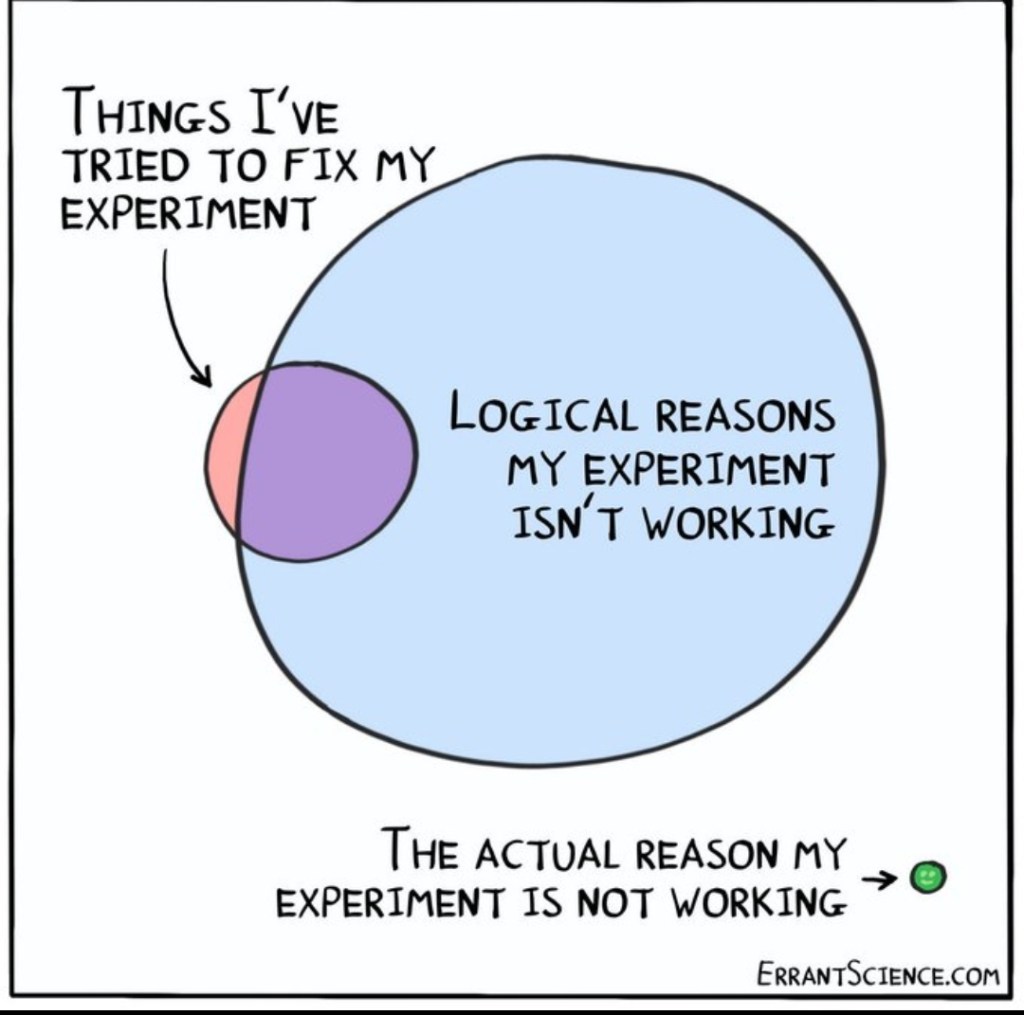
On a Trust scale research enables funding to support infrastructure or translation of new diagnostics/services that might just not be possible with normal budget constraints. I was recently the co-applicant on a grant which brought in over £500,000.00 of infrastructure funding, for both staff and equipment. This means that the initial financial burden of translating over something new is not placed on the NHS and the data to then support business cases for introduction can be collected with minimal financial impact. On a national scale this kind of funding also supports multi site projects which would be difficult to manage in any other way in order to support large scale changes within the healthcare system, meaning that the potential impact can be huge and provide wide scale change.

There are also so many benefits for you as an individual. My career and life changed the day I got my NIHR Doctoral Fellowship. It opened both my eyes and doors to paths that I could never have imagined. I wouldn’t be a Lead Healthcare Scientist now if it wasn’t for the NIHR. I’m not sure I would be a Consultant. I have travelled the world, given lectures to thousands of people, developed future CAs and been able to develop as a scientist and a leader thanks to the funding that was provided. Along the way I hope that I’ve also made a difference for patients both through being involved in national guidance and local change.

What does a day in the life of a clinical academic look like?

As with so many aspects of Healthcare Science no two CAs seems to be the same. The National School of Healthcare Science have a number of different profiles on their webpage which describe some of the different options.

For me my weeks are really varied, obviously for the last 2 years my clinical work has been a priority and so the academic side of my role has been less prominent. I’ve already talked about teaching but for instance this is what I will be doing this month:

  • Organising a specialist conference on Environmental Infection Prevention and Control
  • Reviewing papers for numerous journals
  • Reviewing a grant
  • Reviewing abstract submissions for a conference
  • Meeting with my PhD students
  • Editing a paper for submission
  • Meeting to review SOPs for a country wide clinical trial
  • Meeting to review data for an ongoing COVID-19 study
  • Meeting with the molecular team to talk about how we move our Gram negative typing forward
  • Carrying out an MSc viva
  • Attending 2 exam boards as an external examiner

As my clinical work is currently still pretty hard core a lot of this I’ll pick up for the moment in my own time. Also, none of it takes me as long as when I first started out and so it looks more overwhelming than it actually is – I hope you can see the variety however.
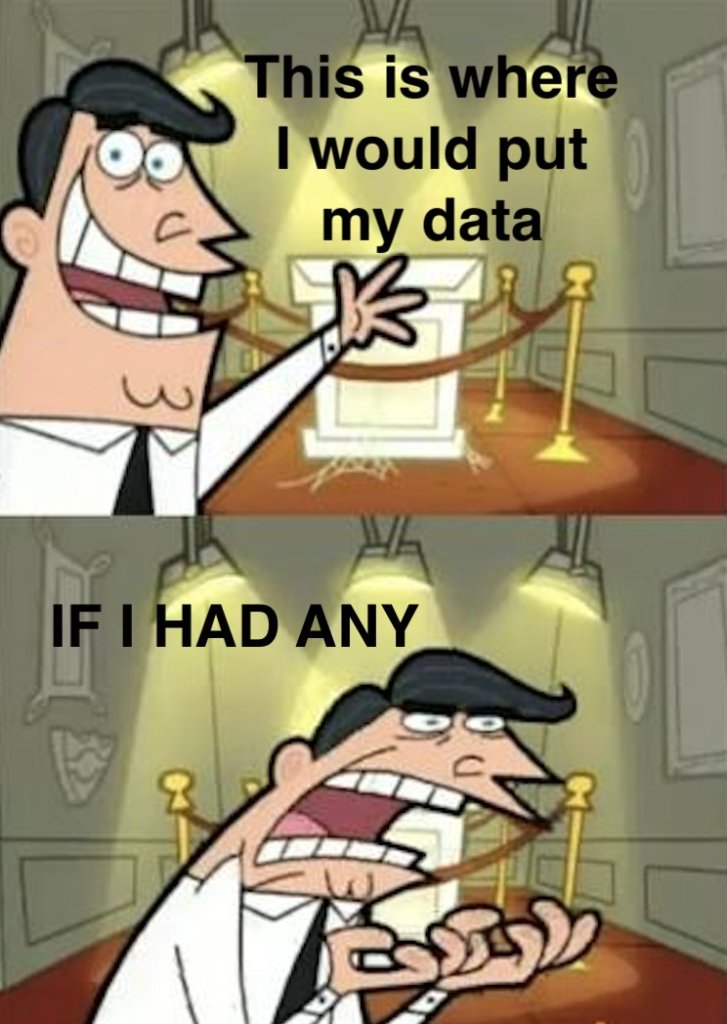
Photo credit – Rabit Hole Photography

There is no getting around the fact that being a CA is not a 9 – 5 post however, managing grant and other deadlines on top of clinical work often requires some significant juggling skills, and in my case a very supportive husband. It’s not something I would advise that people strive for if they don’t love research, if they don’t have so many ideas that they just need to do something with them, it is not a tick box career. You also have to grow to be comfortable with failure, only ~20% of grants are successful, paper reviewer comments can be harsh and your confidence will take repeated knocks. Every time this happens though I get better at what I do, I find the learning and try to make sure I do it better next time #lifeislearning.

Despite it’s challenges being a CA brings me untold joy, it provides me with an outlet for creative thought and means that even though I spend most of my days in an office not a lab, I still feel like a scientist. I get to collaborate with the most amazing people who are at the forefront of their fields to make improvements for patients that would either not be possible or would take years any other way. For me it’s been something that has more than repaid my investment in time, energy and creativity. It’s taken me to places I would never have imagined, introduced me to people that my life is better for having met and provided me with experiences that I didn’t think would ever happen to someone as normal as me. So if you love learning new things, making life better for patients and are happy to spend your weekends in front of a laptop then a Clinical Academic career may be the career for you!
All opinions on this blog are my own

Conference Season Is Upon Us: Top tips for anyone who struggles with networking

Firstly apologies, this post was supposed to go up before ECCMID as I was hoping it would help others attending. Work was just too full on and I didn’t have the headspace to get it written. As there are still a lot of events yet to come I’m hoping it will still prove useful however.
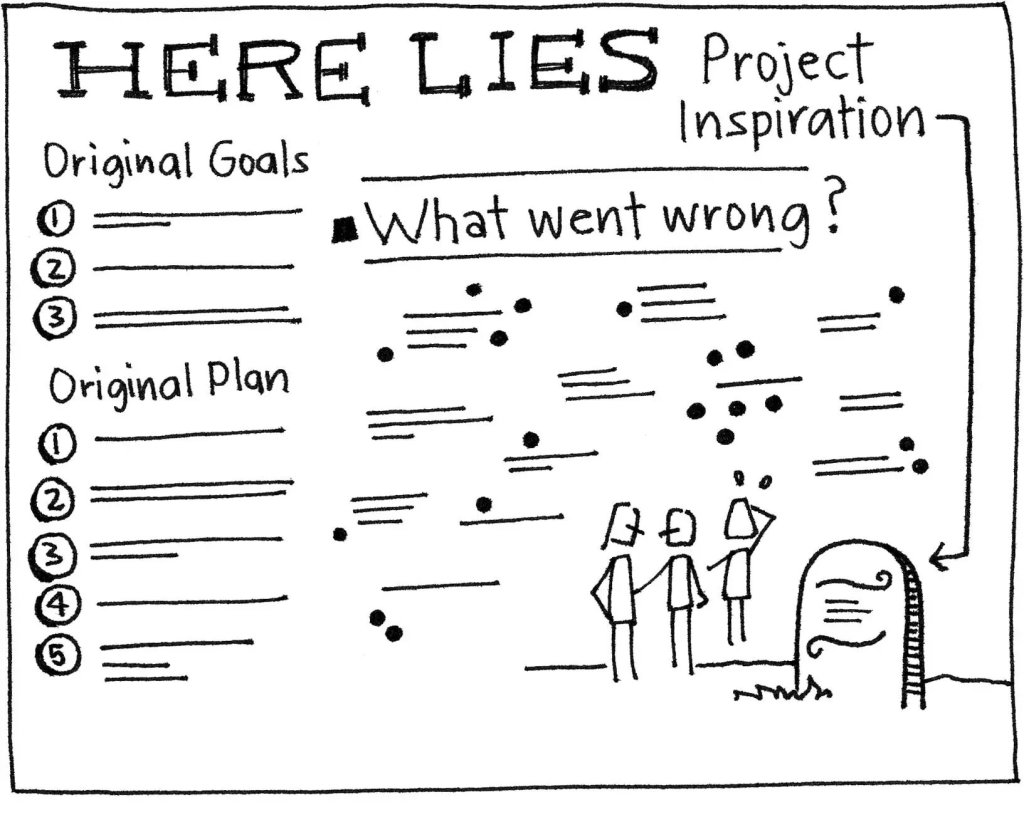
We all know how very important networking is, especially at conferences. So much of a career that makes a difference in science is based on who you know and who you collaborate with. The problem is making those connections and getting to know people, especially in the early part of your career, often requires taking the plunge and being the one to open a conversion with someone you’ve never met.

I have an amazing friend called Diane who is a wonder to behold in these setting. She happily goes up to talk to people who she’s never met and just starts talking to them with great enthusiasm. Shes fearless and draws the best out of those she engages with. If you are a Diane you probably need read no further. For me however, there is little worse than that moment when you enter a room at a meeting/event, get your cup of tea and survey the 100s of people before you. In this moment you know that really now is the time, you HAVE to find someone to talk to. How do you choose who? What on earth do you say that means you don’t come across as an idiot? The very thought of it gives me palpitations. So here are some things I’ve learnt that take some of the stress out of networking at conferences.

Find an in

There are some moments and set ups at conferences when it is easier to start a conversation than others. There is always the chance that the person next to you in an interesting session will strike up a conversation to help them process what they’ve heard but in general they will be doing the same as you, ducking into and out of sessions that trigger their fancy, meaning they will be you focused on what comes next not starting a chat.

I find however there are two key moments when people are available for the cold start up conversation.

The first is at food breaks/receptions. During these moments there will be people who are there solo and also looking to develop their networks. I find the best thing to do in these situations is to get there early. There are always a limited number of tables where people can put down drinks, if you can find one and hold a place then people will effectively come to you. If this fails and there are no tables, just being close to the source of the refreshments often does the same job. Food and drink are great removers of hierarchy and being somewhere visible means that those in a similar position to you will be able to see you and hopefully will head your way. Worst case you make some small talk to the group that comes to your table and you can politely extricate yourself if it all feels too weird by saying you’re popping to get another drink.

The other place where people will be desperate to speak to you is during poster sessions. So many people will be waiting at their posters for an hour in the desperate hope that someone will come and show an interest. This is often a great time to make connections/exchange contact details (see NB below) If you scope out the listing you will know you are speaking to people who are interested in the same kind of work as you. This can shortcut some of the small talk you might otherwise need to make. It also enables you to know whether you are making a connection with a peer or whether you are connecting with a potential mentor/future employer.

The other thing to think about prior to these conversations is what you can offer, what is your unique selling point?

  • Knowledge (technique, setting or organism)
  • Access (organism, patients, research equipment)
  • Support (mentorship, peer-peer)
  • Collaboration (shared goals, shared research, shared implementation)

NB one of my biggest tips for all of these situations is to make sure you have some business cards printed – even if you print them yourself – this means that you can have something easy to hand out or pin to posters if you want authors to get in touch

Find your tribe

Anyone who reads this blog regularly will know that I’m a bit of a twitterholic (@girlymicro if we haven’t met). One of the many reasons that I’ve stuck with twitter since I initially signed up is that it has transformed my networking experiences. Twitter has offered me a way to circumvent the cold start up conversation by allowing me to find my tribe.

These days every conference/meeting has a hashtag. By following this hashtag you can find people who are interested in the same things as you, people who are in the same sessions or who even have shared connections. In many ways its an improved version of doing the poster walk.  Not only does this give you a conversational in but also by tweeting yourself linked to the thread before you ever meet in person it allows you to have a low stakes initial introduction.

One of the things I also love about twitter is it enables me to find and arrange to meet up with people who I primarily know online in order to strengthen my networks by getting to know each other better. It also gives me the chance to arrange collaboration events, like podcast recordings, when we just happen to be in the same place for a limited time.  Both of these can obviously be done by email but can be much easier to arrange when at an event when you suddenly have half an hour free. Especially at big conferences you could wander the halls for 4 days and not meet anyone you know, this way you can make the most of every second.

Take a study buddy

I absorb my learning best when I have someone to talk through my thoughts with. I have a couple of trusted study buddies that I will by preference attend events with. These guys help me get the most out of any event by:

  • Encouraging me to be braver – ask those questions I might talk myself out of, talk to that person that I should really try to connect with
  • Providing me with a sounding board for ideas when I’m in the moment
  • Enabling us to divide and conquer – there are often multiple sessions I want to be in at the same time, this way we can split up and meet at whichever session is actually proving most appropriate
  • Knowing me well enough to give me space when I need down time to re-energise
  • Crucially for me they are also there so I can feel safe from a health perspective if I have issues. They’ve helped me manage severe reactions, broken limbs etc and I trust them to get me where I need to be and give healthcare workers the right info if I need care

Mel and Lena have been my colleagues for years and they can not only get me out of a shame spiral if I do something stupid but also, by having them available to have conversations all together with new collaborators, we can make much more rapid progress on projects from the very start.
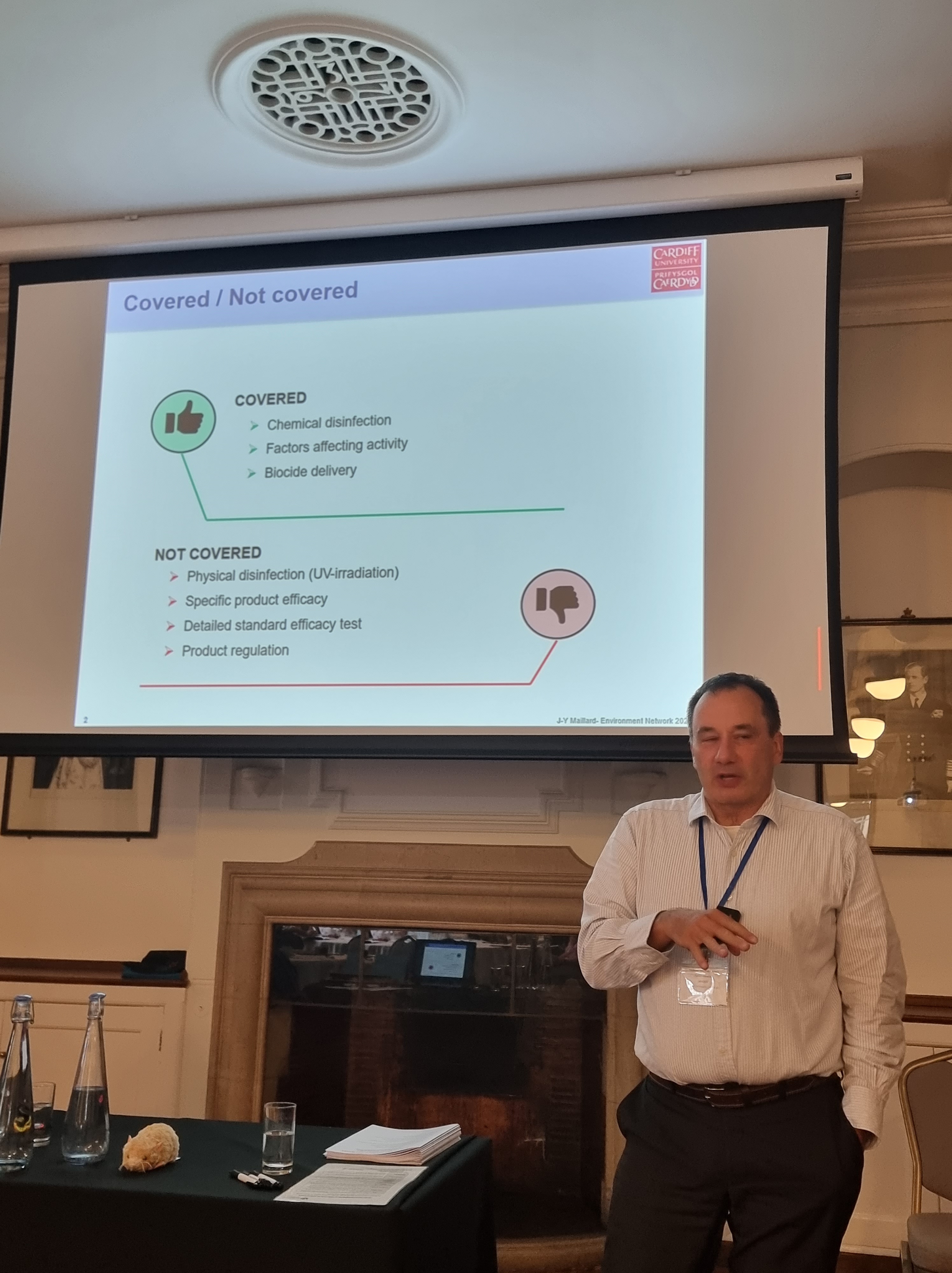
One of the other great things about going with a great study buddy is that you can also achieve other goals whilst at the conference. You can start to get papers drafted, do that research return or catch up about PhD students. If you do have supervision responsibilities whilst you’re away, as you have trainees with you, you can also share the load in terms of ensuring you have downtime. A lot of my most creative breakthroughs have happened with these guys whilst we’ve been away, surrounded both by new science and the time to reflect on how we could encorporate new thinking into our work.

Do some pre-work

I can get really insecure when going to high stakes meetings, like some of the ones I’ve been to at the House of Commons. I never really feel like I fit in and I have been known to hide in the bathrooms there until 5 minutes prior to an event start so I don’t have to face the ‘meet a stranger’ chit chat. In recent years I’ve learnt the value of doing some pre-work ahead of these meetings. This has taken different forms:

  • Reaching out on social media to see if any of my connections are attending
  • Approaching a professional body, especially if I’m on their guestlist, to find out who else they are sending so I can pre-arrange meeting at the session
  • Researching the event to look at speakers and attendance list (if available) so I can pre plan who I might want to speak to and what I could start a conversation with

In these events part of the value is in expanding your network and so really thinking about why you are going and what you hope to achieve is really worth it. Then you can match your elevator pitch (who you are, what you do and what you can offer) to your goals to help you achieve them.

Become the person others come to speak to

One of the things that has become lovely in recent years is that I’ve realised if you are presenting/organising/chairing people come to speak to you. This removes a whole lot of the stress of networking. As I mentioned above, people will often come to you even when you are presenting posters. Its always worth submitting work therefore to events you are attending, not only to get feedback on get science, but also to support you in developing your networks.

Even if you are not in a position to submit work then you should think about offering to support the organisation of events. Meetings are frequently looking for individuals who are happy to support the event organisation, both ahead of time and to do things like man the desks during the event itself. This will mean that you get to know other people who are supporting event delivery with you and give you an opportunity to network with delegates and speakers in a supported way. These connections can be transformative in terms of giving you further opportunities down the line.

Know your self and your limits

Most people assume I’m an extrovert when they meet me and I definitely have a lot of those traits. The things is, I can only manage networking for a fixed period of time. I’m good for a couple of meetings but then I need to retreat back into my bathroom office and answer some emails, otherwise I just feel progressively drained. The older I get the more I need my own space. This is usually fine but presents a real problem at places like conferences where I may need to be in full on extrovert mode for 16 hours a day. I find it exhausting.
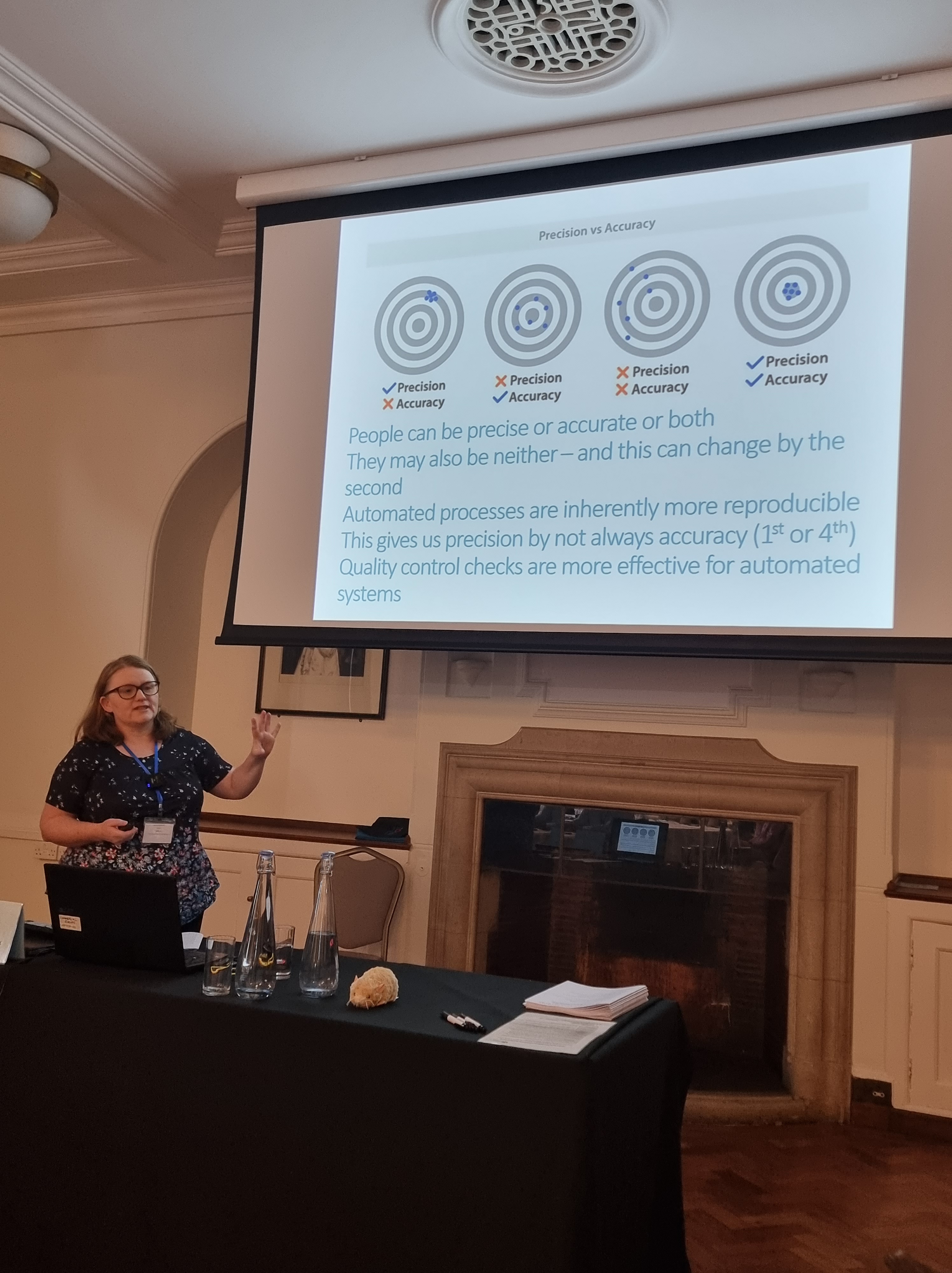
One of the things that I’ve discovered about networking is that I therefore have to schedule it in a way that works for me. I can’t agree to go to lots of dinners on top of full day events, either from a health or a social resource point of view. I therefore pick the moments that work best for me and don’t over commit. This does mean I sometimes worry about missing out and not making the most of every opportunity but it also means that I put myself and my wellbeing first. It means that I don’t leave a conference unable to engage with work when I get back as I’ve already used up all my resources. Therefore my top piece of advice is to understand that networking is key but find a way to do it that works for you. Pick your key moments and do them well, rather than trying to be all things to all people.

All opinions on this blog are my own

If you would like more tips and advice linked to your PhD journey then the first every Girlymicrobiologist book is here to help!

This book goes beyond the typical academic handbook, acknowledging the unique challenges and triumphs faced by PhD students and offering relatable, real-world advice to help you:

  • Master the art of effective research and time management to stay organized and on track.
  • Build a supportive network of peers, mentors, and supervisors to overcome challenges and foster collaboration.
  • Maintain a healthy work-life balance by prioritizing self-care and avoiding burnout.
  • Embrace the unexpected and view setbacks as opportunities for growth and innovation.
  • Navigate the complexities of academia with confidence and build a strong professional network

This book starts at the very beginning, with why you might want to do a PhD, how you might decide what route to PhD is right for you, and what a successful application might look like.

It then takes you through your PhD journey, year by year, with tips about how to approach and succeed during significant moments, such as attending your first conference, or writing your first academic paper.

Finally, you will discover what other skills you need to develop during your PhD to give you the best route to success after your viva. All of this supported by links to activities on The Girlymicrobiologist blog, to help you with practical exercises in order to apply what you have learned.

Take a look on Amazon to find out more