Book Review: What I Love About the Science in the Newsflesh Series by Mira Grant

I’ve been having trouble sitting down to read actual paper books for a while now. The pandemic has my mind kind of worn out and, although I always used to have 4 or 5 paper books on the go at one time, right now I don’t have a single one. That’s not to say I’m not still getting my fiction/non-fiction fix. It’s just that right now it’s happening via audiobooks as I can just close by eyes and be transported.

This brings me onto a slightly new thing I’m going to try out: reviewing and giving some love to books that have science within them to aid that escape rather than making me irritated. I read the whole of the Newsflesh series by Mira Grant a few years ago at the suggestion of the wonderful Dr Claire Walker. As part of my insomnia strategy, I’ve rediscovered it and my love for the science within it.

The Newsflesh series consists of three main novels: Feed, Deadline and Blackout, as well as some short fiction.

Mira Grant describes the premise of the novels as:

“The zombie apocalypse happened more than twenty years ago. Contrary to popular belief, we didn’t all die out, largely because we’d had years of horror movies to tell us how to behave when the dead start walking. We fought back, and we won…sort of. The dead still walk; loved ones still try to eat you if you’re not careful; the virus that caused the problem in the first place is still incurable. But at least we lived, right?”

Nothing is impossible to kill. It’s just that sometimes after you kill something you have to keep shooting it until it stops moving

Mira GrantFeed (Newsflesh Trilogy, #1)

Most zombie fiction is either set during the rising itself, that moment when the dead rise, or during a post-apocalyptic future where the worst of humanity is on display. Within the Newsflesh series, and especially Feed, this isn’t the case. It’s set 26 years after the rising in a world that lives with the ever present nature of having the undead on your doorstep. This is partly because of the way the rising occurred.

The Virus

As in most zombie fiction, the rising was caused by science that went wrong. In this case a modified virus known as Marburg-Amberlee (Marburg EX19), invented by Daniel Wells, was designed to cure leukaemia. It was first tested on Amanda Amberlee, a young leukaemia patient in Colorado, and it succeeded in curing her, after which it remained dormant in her cells and those of others given the cure. A second genetically modified virus was also being developed, known as the  ‘Kellis cure’/’Kellis flu’. The aim of the Kellis cure was to provide a universal cure for the common cold. It contained a mix of coronavirus and rhinovirus proteins, with a fifth man-made protein that was designed to increase the virus’s ability to invade. When the Kellis cure is stolen from the research lab, where it is being developed by a group of activists who believe that this universal cure is being ‘held’ from the world and should be freely available, disaster occurs. The activists believe that the virus should be freely available to aerosolise the virus. The two RNA viruses underwent a combination event in those humans who had been treated with Marburg-Amberlee initiating a new infection, a virus now know as Kellis-Amberlee.

Now every mammal on the planet over 40lbs can convert into a zombie on reactivation of the latent virus in their cells. This can happen as a result of trauma, death or, like many latent viruses, due to failure of the immune system.

The World

This is the truth: We are a nation accustomed to being afraid. If I’m being honest, not just with you but with myself, it’s not just the nation, and it’s not just something we’ve grown used to. It’s the world, and it’s an addiction. People crave fear. Fear justifies everything. Fear makes it okay to have surrendered freedom after freedom, until our every move is tracked and recorded in a dozen databases the average person will never have access to. Fear creates, defines, and shapes our world, and without it, most of us would have no idea what to do with ourselves. Our ancestors dreamed of a world without boundaries, while we dream new boundaries to put around our homes, our children, and ourselves. We limit our potential day after day in the name of a safety that we refuse to ever achieve. We took a world that was huge with possibility, and we made it as small as we could.

Mira GrantFeed (Newsflesh Trilogy, #1)

I think we’re all living in small worlds right now, as I write this on the sofa during yet another lockdown. The think I loved when I first read the novels, and actually love even more re-discovering them in a lockdown world, is how society has adapted to answer the challenges of infection.

All areas of the country (it’s set in the States) are split into hazard categories. If you want to live in an outside space, where mammals could roam and it’s harder to control the movements of the walking dead, you have to accept higher levels of Infection Prevention and Control. Every car door has an antigen test that makes sure you are not in active viral replication before it will open so that you don’t risk fellow passengers. Every door into a home has the same risk. The world is split into those who have completely locked down and live for all intents and purposes an entirely virtual life. Whilst others, determined to have the right to maintain their freedom to keep animals such as horses, or other life styles choices, put their lives at risk to do so and also potentially risk others. Entire areas of the country have been declared ‘lost’, as the movements of the undead cannot be controlled. If you go into high-risk zones, all your clothes must be destroyed or, in less restrictive zones, sanitised whenever you leave the house. Every time you go outside you must be washed with dilute bleach on return. The rules are the law and following them is not supposed to be optional, although, as we are currently seeing, there are always those who will fall into the extremes of the two camps.

The Truth

The other thing that really resonates right now is the distrust of the media. During The Rising, the news is felt to have let down the public by being too much controlled by governments and institutions. The books themselves follow the Mason siblings, reporters Georgia and Shaun, as well as their news crew covering how a presidential election is run in this new world.

News is done differently in this new world because of the reaction to the number of deaths that were caused by the slow response of traditional media to covering the rapidly changing situation. Information is delivered by:

  • Newsies (of which Georgia is one), who aim to deliver neutral fact-based coverage of the news via blogs and websites.
  • Irwins (like Shaun Mason which are named after Steve Irwin), who seek to educate and entertain by going into areas that are off limits to non-reporters in order to give a true view of the world.
  • Stewarts, who aim to collate and curate the reports of newsies, pretty much a ‘one site for all things’.
  • Aunties, who share personal stories, recipes, and other content to keep people happy and relaxed.
  • Fictionals (like  Georgette “Buffy” Meissonier), who write poetry and fiction in order to explore everything that has happened to humanity since the rising.

One of the things that I currently worry about is how we will rebuild the trust and faith in science that may have been damaged by science becoming so politicised during the current pandemic. Although, in many ways, we’ve also seen the damage that going to individual blogs and echo chambers can do to the concept of evidence-based science. Re-engaging with the series right now does make you think about how difficult it is to communicate widely, and how important scientists having conversations across boundaries is.

In (not so, this post is longer than it should be) short, if you haven’t read Feed then you should. Read it because the virology is sound, and the Infection Prevention and Control makes me super happy. Mostly though, read it because it may give you a different lens through which to see our current situation, as well as being super entertaining.

All opinions in this blog are my own
Dreams in the Time of COVID-19: Science Meets Art

For those of you that know me only as Dr Cloutman-Green, you probably won’t know that, in my life outside of the hospital, most of my friends call me Dream. I’ve been called this since I was a teenager. I’d like to say there was a super cool reason for this, but the real reasons are twofold:

  • I have always had very vivid dreams and I have them pretty frequently.
  • Even now, but especially as a young child, I am/was so caught up in thought that I will/would tend to wander into things whilst walking: like lamp posts!

I got my PhD. Then a shy, retiring drunk from Birmingham – in a rare moment of sobriety – designed the Dr Dream logo as a gift and it’s kind of stuck.

During the last year I have not slept well and my dreams have been especially intense. I dream a lot when I’m solving problems and will often perform experiments or clinical scenarios in my sleep. In many ways these have helped me as they often lead to what I call my 3am ‘moments of clarity’: those moments when I wake up and I’ve finally worked out the solution to a problem or a new approach so I can see it from a different angle. The problem this year has been that those 3am moments are no longer ‘moments of clarity’, as the problems we’re facing cannot be solved by just me. They are too big. They are now 3am ‘moments of panic’ or ‘moments of frustration’.

In April I posted about a particularly strange dream I’d had and, via the magic of twitter, I was put in touch with Professor Mark Blagrove, Dr Julia Lockheart and the DreamsID team. The team are interested in how COVID-19 is impacting on dreaming. They have an amazing process, where Julia uses her creative skills to combine art and science in order to produce imagery of the dream onto pages from the first English translation of The Interpretation of Dreams.

The Process

The discussion of a dream follows the dream-appreciation method devised for dream discussion groups by psychiatrist and psychoanalyst Montague Ullman. Further information about Montague Ullman can be seen on the website https://siivola.org/monte/. The method is described in his 1996 book Appreciating dreams: A group approach (Thousand Oaks, CA: Sage). The method comprises the following stages:
•The dreamer reads aloud their dream.
•The group asks questions about the dream so that it is described as fully as possible.
•The group members, except the dreamer, briefly describe how they would relate the dream to their own lives, as if the dream were their own.
•The dreamer responds to what the other group members have said.
•The dreamer describes their own life circumstances, with emphasis on recent waking life concerns and recent emotional or important events.
•The dream is read back to the dreamer in the second person.
•The group and dreamer make or suggest connections between the dream and what the dreamer has said about events and concerns in their recent waking life.

My Dream

The Setting

My office is a converted bathroom.  It’s pretty small and still has a sign saying ‘bathroom’ on the door (in purple).  It’s pretty small: it has room for one desk chair and an L-shaped desk across from the door and running down the right hand side of the space. It’s a totally white space with no natural light or ventilation. It has quite bright white lighting: an LED lamp on the L intersection that lights my main workspace where I work with my back to the door.

The Dream

In my dream, I am working at my normal workspace (the desk part opposite the door) in my desk chair, which is’ a ‘Bond villain’ desk, large and black mesh.  Unusually, I also have the purple furry blanket that normally lives on my sofa across my knees. It’s trailing onto the floor, so I’m slightly trapped where I am.  My desk is clear apart from the lamp of the normal bits and pieces, although there are still my post-it notes under the shelves above my head, which remind me of what I need to be doing, and my shoe a day calendar that sits in front of me on the shelving.  Behind the lamp, however, the hatch that is normally solid and leads to the electrical space has a transparent door with a handle and looks like the pass hatch into a medical safety cabinet.  On the left of me where my in-tray normally sits is now a scientific water bath, white outside, full and bubbling, with a box of blue nitrile gloves sitting next to it.  Floating within the water bath in the floatation tray, instead of the normal reagents, is a set of a dozen quail eggs.  The back of my desk is covered with electronic timers.  At the start of dream, I’m wearing a pair of gloves and I have a set of eggs in front of me (in what looks like a standard Waitrose quail egg box). I’m trying to peel the eggs, wearing gloves (I don’t remember having anywhere to discard the shells so don’t know if they are all around me?). I’m finding it really difficult to get enough grip on the eggs; I’m rolling them gently to try and make some cracks appear but I just can’t manage to get a grip on the cracks in the shell in order to get them off cleanly.  I’m getting there, but it is taking me ages. 

The timer starts going off and I’m trying to get the eggs out of the water bath whilst still having the previous batch on the go.  Then the phone rings.  I didn’t know who it was. I know there was a discussion about needing them to treat a patient and being asked a bunch of questions that I thought I knew the answers to but not being sure that these eggs were going to do what was needed, despite how important they were.  I shove the first lot of eggs into the clear door of the hatch, aware that they need more, and so get on with trying to do the ones that have just come out of the water bath.  I’m also looking around as I know I need to get the next batch on. I can’t see any and there’s no time to  get any.  I change my gloves and start trying to peel the next batch, but they’re still warm and they are hurting my fingers.  Not only that, but because they are still hot they are too soft and some of them start to implode as I’m trying to peel.  I’ve got yolk all over my gloves and I need to save as many as I can.  Then the phone starts ringing and I can’t answer it as I’m covered in yolk and bits of shell.  I sit there crying, at my desk, trying to peel the rest, pushing my glasses up with my wrist so I don’t get yolk on my lenses.

The wonderful thing about this process, for me, was that I didn’t see the art being produced. I was on the phone talking to Mark but very specifically not seeing what Julia was producing. I only got to see that at the end and when watching the YouTube video later. I got to be an active part of the creation of a piece of art and that was a wonderful thing. They’ve even now sent me that final piece of art work, which is now going to hang in the on-call bathroom and will be something really concrete for me that has come out of 2020.

It’s a reminder to both take opportunities as they come, and to think about how we can communicate our work in creative and inspiring ways, to reach new audiences, and to work across boundaries.

So, I wanted to take a moment to say a massive thank you to the DreamsID team for including me in this work, and for including me in their article, as this is the one and only time anything linked to me is ever likely to feature in New Scientist! My family finally think I’m a rock star as that’s a science publication they’ve heard of!

Read more: https://www.newscientist.com/article/2242379-how-coronavirus-is-affecting-your-dreams-and-what-to-do-about-it/#ixzz6i63ukNsa

All opinions in this blog are my own

If you would like more tips and advice linked to your PhD journey then the first every Girlymicrobiologist book is here to help!

This book goes beyond the typical academic handbook, acknowledging the unique challenges and triumphs faced by PhD students and offering relatable, real-world advice to help you:

  • Master the art of effective research and time management to stay organized and on track.
  • Build a supportive network of peers, mentors, and supervisors to overcome challenges and foster collaboration.
  • Maintain a healthy work-life balance by prioritizing self-care and avoiding burnout.
  • Embrace the unexpected and view setbacks as opportunities for growth and innovation.
  • Navigate the complexities of academia with confidence and build a strong professional network

This book starts at the very beginning, with why you might want to do a PhD, how you might decide what route to PhD is right for you, and what a successful application might look like.

It then takes you through your PhD journey, year by year, with tips about how to approach and succeed during significant moments, such as attending your first conference, or writing your first academic paper.

Finally, you will discover what other skills you need to develop during your PhD to give you the best route to success after your viva. All of this supported by links to activities on The Girlymicrobiologist blog, to help you with practical exercises in order to apply what you have learned.

Take a look on Amazon to find out more

My Sunday Afternoon Rage – The Mask Goes Over the Nose, People!

You may or may not know this about me, but I’m a pretty big sports fan. Not the kind that remembers statistics or can quote drivers/players, but a screaming-at-the-TV-or radio in-support-of-my-team kind of fan. When I lived at home in Birmingham, I had a season ticket for the Holte End at Villa Park to see my boys (Aston Villa); now the main live sport I get time to see close up are the London Games when the NFL comes to town (I’m a Green Bay Packers fan and they’ll never visit). Sport is a massive release for me: Watching Sunday night NFL football and F1 is something that my hubby and I really enjoy doing together as these are our shared passions (N.B. in our household, I’m the big general sports fan rather than him).

So imagine what my Sundays in 2020 have become. Imagine that at the end of every race you sat and watched images of Max Verstappen engaging in face-touching whilst wearing a mask that is barely positioned to cover his nose.

The content of the interview is not important, but he rubs the edge of his mask, then moves his finger to his eye, then messes with the vent, then re-positions it by touching the front. All in a video that lasts less than 55 seconds.

The NFL is even worse. At least in F1 drivers are – for the most part – wearing masks, even if they appear to not know how to control their face-touching impulses. Within the NFL, the numbers of coaches not wearing masks at all has led to fines for individuals and for clubs. The NFL is big money in the US. A number of teams have been shut down for SARS CoV2 outbreaks, and yet the behaviour has continued.

So, Why I am Writing this Post?

Every week I get on tube trains to travel to work. During the first lockdown there was ~90% compliance with appropriate mask wearing. In recent weeks, compliance was less than 50% and I’ve seen all the variations in the image below and more. All this whilst I’m having to live with increasing numbers of clinical cases and receiving daily reports of the same elsewhere. I’m writing this as, although some of it is because of a decision to be non-compliant, I think a lot of it is about the fact that we are not really getting the message out about why appropriate mask wearing is important: not just box-ticking to have one near your face. I don’t think we’ve taught people about which bits of masks are contaminated and that touching those areas is where a big portion of the risk lies. This is why I was pretty much against selective mask use when it was introduced. Universal mask use is much more scientifically valid, but it’s not a panacea and actually increases personal risk if not done appropriately.

I’ve seen all of these variations and more

Why Does it Matter That I Wear My Mask Like a Necklace?

We know respiratory pathogens on the outer surface of masks may result in self-contamination. In my PhD thesis back in 2015, I discussed this as a potential route for hand/face contamination. However, in the context of a respiratory pandemic, and mass mask-wearing without training, the implications are much more significant.

The T-zone includes the mucous membranes within the eyes, nose and mouth.  It has been noted that, even within a healthcare setting, members of staff engage in frequent face-touching, with one study noting that healthcare workers touched the T-zones a mean number of 19 times over a two-hour period, which may place healthcare workers at risk of organism acquisition/transfer.  Additionally, organisms could survive on the skin for minutes to hours and thus present a source of hand contamination when touched in the future, with a possible spread to patients and surfaces.(Journal of the American Board of Family Medicine. 2014;27(3):339-46)

My thesis (2015)
BMC Infectious Diseases volume 19, Article number: 491 (2019) 

Fabric masks can protect by filtering up to 50% of particles, reducing exposure. The risk from inhalation is not the only one, however: viruses can survive on skin, paper and fabric, for hours in the case of SARS CoV2. The virus can also infect by self-inoculation into the eyes and contact with other mucous membranes, for instance people rubbing their nose after removing the mask. The above paper used fluorescent particles to demonstrate how contamination of the external of a mask works, and to help visualise the risk of moving that contamination around the mask and skin. If masks are not put on and taken off appropriately, if they are not worn the right way, and if we don’t wash our hands and think about how we touch our faces, we put ourselves at risk. We make the problem worse.

Back to Sport

Role modelling is so important in raising awareness. Teams and individuals have a massive platform to get this message out. People will say that sportsmen and women are not medically trained, so why should they take responsibility to get this message out? I would say that sports like F1 and NFL have huge levels of access to the worlds best clinicians; they have huge levels of medical investment and there is no doubt that these individuals will have been trained and taught. So they need to lead by example and enable me to get back to using Sunday afternoon sport as an escape, rather than a lesson in IPC failures.

Top tips for safe mask wearing:

  • Wash your hands or use a minimum 70% alcohol gel before putting on (donning) and removing (doffing) a mask.
  • If using a fabric mask, ensure that you are washing between each use.
  • If you remove a disposable mask, throw it away: both sides will be contaminated and if you store it you just move that contamination around.
  • Make sure your mask covers your nose and mouth.
  • Be aware of face-touching and use hand hygiene if you accidently contaminate.
  • Know that the outside of your mask is NOT CLEAN!

All views on this blog are my own

What Is Antimicrobial Resistance and What Might It Mean for Me?

I’ve been talking to quite a lot of people about antimicrobial resistance lately. Partly because I’m involved in a big clinical trial called LAKANA, but also because I’ve been recording some content for the Department of Education and school teachers linked to Infection Prevention and Control. What has struck me is that something that has such a massive day to day impact on my working life hasn’t really made its way into the public consciousness just yet.

As last week was antimicrobial awareness week, I thought I should take the opportunity to talk about antimicrobial resistance and why I think we should be working hard to talk about it more: in the pub with our friends, with our families over Christmas, and with our patients and students.

Photo courtesy of Anthony De Souza

What Is Antimicrobial Resistance?

When I go into classrooms and speak to members of the public they sometimes think that antimicrobial resistance is when our bodies become ‘immune’ to antibiotics. This isn’t the case. When we talk about antimicrobial resistance or, for the rest of this blog post, antibiotic resistance (as I’m talking about bacteria) is when the individual bacteria are not affected by the antibiotic or it works less well (see my introduction to antibiotics post for a bit of background).

Antibiotics work in two main ways. They are either:

  • Bacteriostatic = inhibits the growth of bacteria.
  • Bactericidal = kills bacteria.

The way the antibiotic works against the bacteria can be linked to the way that the bacteria become resistant to the antibiotic. I’m going to do another blog post with some of the technical details of how this works and how we detect it, so bear with me for a couple of weeks. For this post, the main thing is to know that it is the bacteria that become resistant, not us, and that there are a number of different ways that this can happen:

  • Intrinsic resistance = the antibiotic will never work against that particular bacterial species because of the characteristics that species has. This includes things like Vancomycin not working against Gram negative bacteria as the molecule is so large.
  • Selective resistance = where a mixed population of resistant and sensitive bacteria are impacted by antibiotic use and the resistant ones survive and therefore become dominant.
  • Acquired resistance = where previously sensitive bacteria acquire the ability to resist the effect of an antibiotic, often through acquiring genes, which allow them to change the way they function or replicate.

What has antibiotic resistance got to do with me?

The Review of Antimicrobial Resistance (2016)

Levels of antibiotic resistant bacteria are being detected in increasing numbers in food (linked to farming), in the environment, and within humans: both in hospitals and in the community. It’s for these reasons (and others) that it has been modelled that more people will die linked to antimicrobial resistance than cancer by 2050. If, as a population, we have more resistant bacteria onboard as part of our normal flora, it is increasingly more difficult to treat us when we need it. It will also become increasingly more difficult to do ‘standard’ surgeries such as hip replacements, tonsillectomies etc. as these require us to give prophylactic antibiotics when you’re in surgery in order to reduce infection risk. This means we may have to live with long-term conditions that currently we would surgically correct.

Most of us think about antibiotics as being something that we either give to really sick people in hospitals or a fairly harmless way to get back to our every day lives when we’re feeling unwell at home. In many ways that is true. Most of us will have had multiple courses of antibiotics during our life and have never given it much thought. Some women may have had the odd bout of thrush when they’ve taken antibiotics for a urinary tract infection and that is the closest they’ve seen to side effects. The case of a woman getting a fungal infection (thrush) because they’ve taken antibiotics that have wiped out the non-harmful colonising bacteria in their vagina is a pretty good example of exactly what can happen in less obvious sites when we take antibiotics. For example, there’s plenty of data that the use of antibiotics can impact on the bacteria in your gut, providing selective pressure and changing what the population of bacteria looks like. Usually this returns to normal over time. However, in a world where the bacteria we encounter are increasingly resistant, that return to normal could take longer; if they got out of the gut to another location due to surgery during that time they could be more difficult to treat.

Colonisation vs Infection

Most of the time if we have resistant bacteria onboard we would never know. They are colonising us, just like our normal bacteria, and not causing us any harm. There’s good data to show now that when we travel abroad to countries with a high prevalence of antibiotic resistant bacteria in food or the environment, that we may exchange some of our sensitive bacteria for resistant ones. You’d never know, especially as when we get home they will usually be replaced again with sensitive versions. However, if you happen to get an infection whilst you have them onboard because you’ve had an accident on holiday, or you’ve travelled for medical care overseas, then the infection may be more difficult to treat.

It’s not just the antibiotics we use in humans that can make this situation worse. Antibiotics are used as growth promoters in farming. We use antibiotics to treat our pets. Because of how expensive and difficult antibiotics are to develop, we are not really developing new ones and so the pool of available antibiotics is getting smaller.

Because antibiotics are used in so many different ways in solving the issue of how to impact levels of antibiotics, resistance is complicated. It requires us to be able to diagnose and detect resistance faster, to work with drug companies in order to tackle the drug development pipeline, and to take a ‘One Health’ approach, looking at farming and veterinary approaches as well human.

So, what can I do?

  • Be aware that not all mild respiratory and other conditions require antibiotics. Many are viral and will improve with rest and hydration. Therefore, consider waiting before requesting a prescription for antibiotics.
  • If given a prescription, make sure you complete the course. Do not just stop because you start to feel better. Stopping early might mean that you have not completely treated the infection and the remaining bacteria can grow back and sometimes develop resistance.
  • Do not buy antibiotics when you are abroad in a country that permits an over-the-counter purchase.
  • Do not store antibiotics and use them at a later date. Neither should you use antibiotics that were prescribed for a family member or (and I know people have done this) a pet.
  • Think carefully about whether travelling abroad for healthcare is the right choice; make a risk assessment about where you are planning to travel.

If we want to continue to experience healthcare in it’s pre-COVID-19 form, we all need to work together to change the way we use antibiotics so that the modelling predictions do not come true

All opinions on this blog are my own
The Nosocomial Project

In 2018, Nicola Baldwin and I met when I gate-crashed a public engagement event on Antimicrobial Resistance as a member of the public. Nicola was helping facilitate the session. I was immediately inspired by how she enabled conversations to happen between different people of very different backgrounds in the room.

We agreed to meet up for coffee and a lab tour, as Nicola was just as interested in the science as I was in using drama and stories to communicate our message. In that moment, the Nosocomial Project was born.

Why am I writing about this today? Well, for three reasons:

  • Firstly, I don’t think we talk enough about the power of stories to support change: change in behaviour, change in communication and change in the kind of science and research we might undertake.
  • Secondly, it’s the Antibiotic Guardian awards tomorrow and we’ve been fortunate enough to be shortlisted in the Public Engagement category.
  • Finally, it’s the last day of antimicrobial awareness week and so it felt very timely.

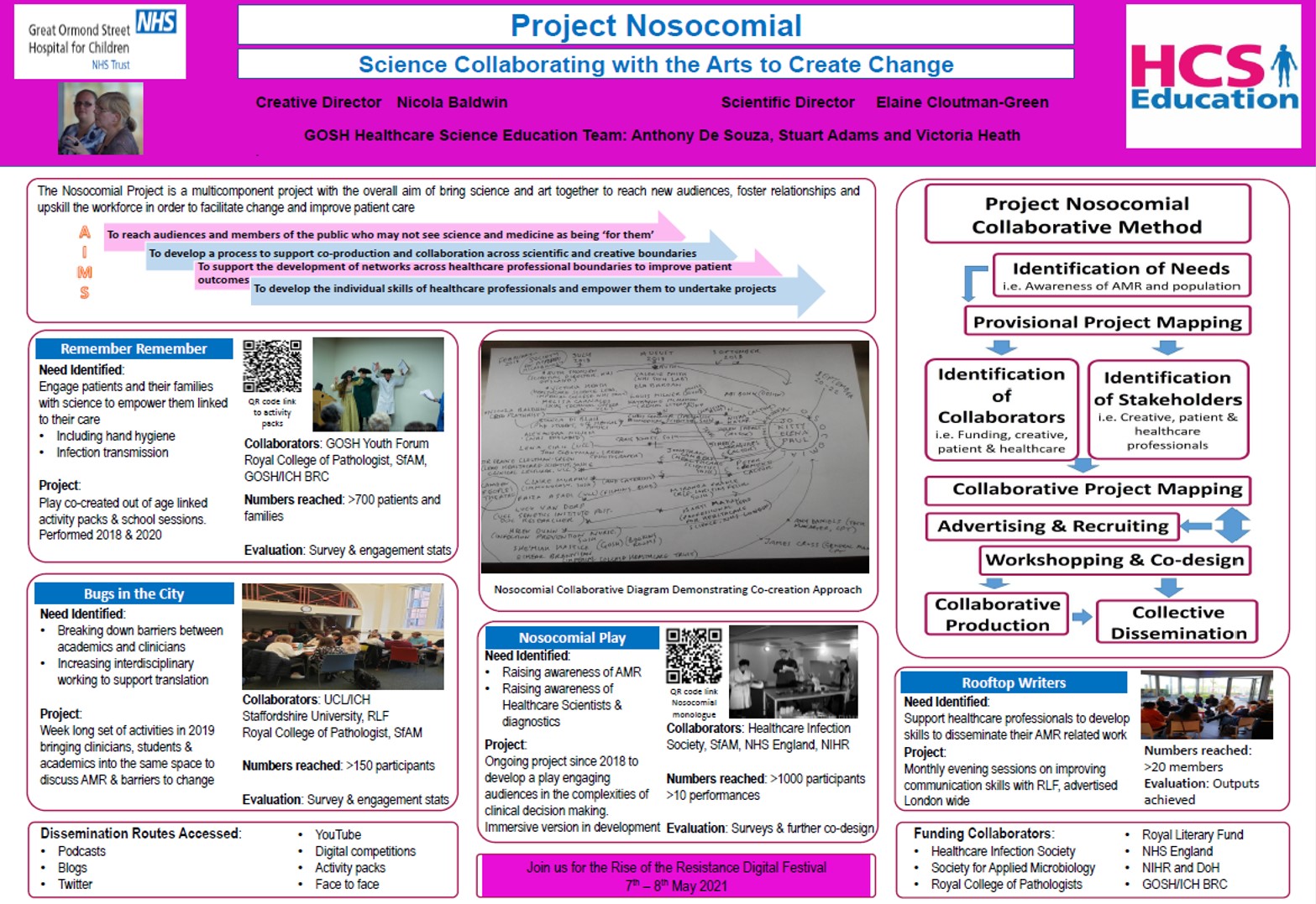
The project has included a lot of different events and subprojects and has reached over 2000 people over the last couple of years. Although the projects all have slightly different target audiences, and are delivered in different ways, the main thing is how they develop.

The process is about collaboration and co-production. It’s about trying to give everyone a voice and finding innovative ways to reach out and find new stories, along with new participants. The team is about providing funding and stakeholders to support bringing people into a room (virtual or digital), as the collective leads to more than could be produced by any individual.

The core team work with creatives, scientists, health professionals and members of the public, with >50 collaborators so far. With the Rise of the Resistance Festival, scheduled for May 7th and 8th 2021, we are hoping to grow that number even more. So, if you want to join us in using drama to create impact and change, tweet us @girlymicro @NosocomialThe

Saturday Morning Zombies: how infection is portrayed in the genre

It’s Saturday morning and I’m spending my day watching zombie movies. There is a reason that I watch in the morning… I’m a complete scaredy-cat and so I don’t want to watch these before I go to sleep. Also, I don’t really like horror movies. Correction: I only like horror movies with plot, i.e. Get Out.

So, why am I spending Saturday exploring the world of zombie horror?

Three reasons:

  • Despite not liking horror movies as such, I’m intellectually obsessed with how infection is portrayed in them and debating whether the infectious cause would result in different types of zombies.
  • Nicola Baldwin and I, because of our shared obsession with the genre (albeit for different reasons), are going to create a new piece of work on zombies and infection for the Rise of the Resistance Festival (online 7th and 8th May 2021). I therefore need to do some homework.
  • My husband really really likes zombie movies: he is super-stoked that this is my weekend homework, rather than writing papers or analysing data

My friends and I talk about this so much as part of our ‘pub conversations’ that we honestly do have a zombie survival plan. So much so that one of my best friends included saving her husband ‘during the zombie apocalypse’ as part of her wedding vows. This may sound silly and, believe me, it is; But there is some interesting and philosophical stuff in here:

  • Where is the best place to run to (cities vs country)?
  • What would you do in the 1st 24 hours, 1st week, 1st month?
  • Who would you get to join your party? Why? What skills do you need?
  • Do you take people along for the ride because you like them, or does everyone have to have purpose?
  • What rules of society might you abandon for the sake of saving the human race, i.e. monogamy, patriarchy?
  • How much aid would you offer to strangers ‘Good of the Many’?
  • Would you opt to die as you or turn if infected? ‘Survival at any cost and in any form?’
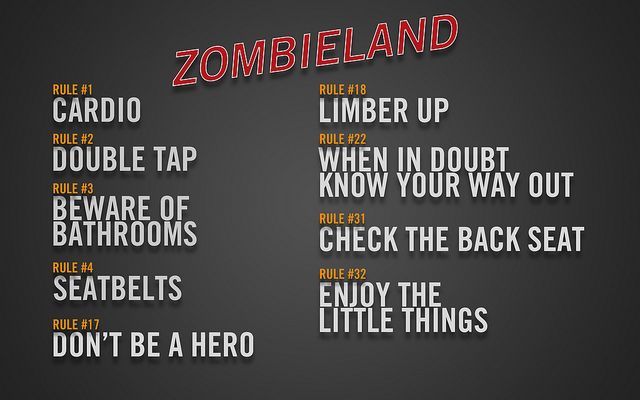
  • What would your ‘rules’ be?

These questions are all about how we, as humans, would react to a zombie outbreak. However, the thing that really fascinates me is how the zombie might change based on the cause of the zombie infection.

There are real life instances where infection can result in behaviour change. As part of my interest in this, I created the activity at the bottom of the page called ‘Zombie Island’. It was one of the first public engagement activities I designed and ended up being turned into a live action takeover event in the city centre of Toronto, where visitors had to solve different clues and challenges in order to cure themselves before they became zombies. The activity in Toronto was called Zombie Rendezvous and the link to the booklet is below:


Zombie Island – How Will You Save your Tropical Island Home?

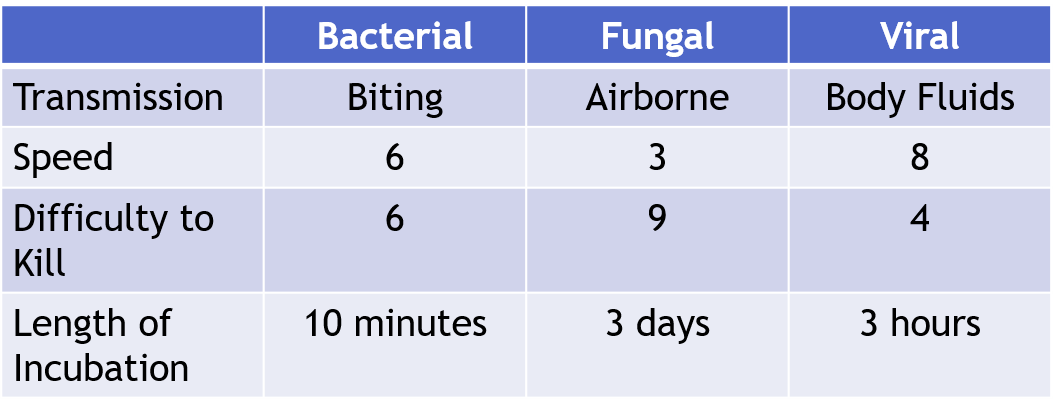
The first thing you need to do is design your zombie. Will it be due to:

  • A virus?
  • A bacteria
  • A fungus?

This decision will affect not only how your zombie transmits infection, but also how fast and easy/hard to kill it is.

How do infectious causes affect zombie characteristics?

Slide taken from Design You Zombie Activity (see downloads below)

Once you have your zombies designed you can then play the scenario. Each different type of zombie requires different infection control and public health decisions/prioritisation. Make the wrong choices and the zombies will reach the port or airport and get off your island to infect the outside world. They can also infect your food supply, take down your military, or cause mass point-source outbreaks if you fail to shut down public events. All decisions aren’t equal, so make your choice…+

More on all of this later when I’ve watched some movies. Remember – aim for the head!

All opinions on this blog are my own.

Celebrating National Pathology Week: What is a clinical microbiologist?

To celebrate this week being National Pathology Week , I thought I should take some time to post about what a clinical microbiologist is. I do this because, when I was at university, I really didn’t know that this career path existed. So here is a shout out to all those students who are trying to decide their next steps. You too will find your way.

When I googled microbiologist this is the first item that comes up

Microbiologists study microorganisms (microbes) in order to understand how they affect our lives and how we can exploit them

Prospects.ac.uk

This seems like a pretty good cover-all description. It goes on to discuss that there are microbiologists in many different areas:

  • medicine.
  • healthcare (I’m not sure how they differentiate this from medicine or visa versa).
  • research.
  • agriculture and food safety.
  • environment and climate change.

I must admit that when I was at university most of the options I encountered were linked to the food and drink industry or pure research. I think that their list missed things like Pharmaceuticals (although they may count that as medicine) and other forms of production, i.e. cosmetics.

At university I only did one module of microbiology (I was reading Zoology) and that module was about environmental bacteria and plating out bacteria onto agar plates to see what grew.

How did I go from Zoology to Microbiology?

I really wanted to work in an area of science where I could work to make a difference. I wanted to work somewhere that I could see that difference being made. Working in research felt too abstract to me. When I discovered, through a friend, that I could become a scientist in healthcare I knew it was what I wanted to be.

The National Careers service says you need to have two to three A-levels to become a microbiologist, plus a post-graduate degree. That is mostly true. However, in a world of apprenticeships and T-Levels, that is no longer the only route.

When I became a Healthcare Scientist I became a Clinical Microbiology trainee. So, what was the difference between that and what I’d done at University? The main difference with clinical microbiology is that I focus on organisms that cause infection: parasites, viruses, fungi and bacteria.

I also discovered that there was so much more to microbiology than agar plates. Although – don’t get me wrong – agar plates are still a mainstay of life within the bacteriology laboratory.

One of the techniques I learnt to love was polymerase chain reaction (PCR), which enables us to look for the DNA or RNA of a microorganism instead of growing it. Viruses and parasites don’t grow on agar plates and bacteria and fungi may not grow well if exposed to antibiotics or if present in low levels. PCR allows us to diagnose patients with infections that would not be diagnosed otherwise, or to speed up the process so patients get put on the right treatment faster.

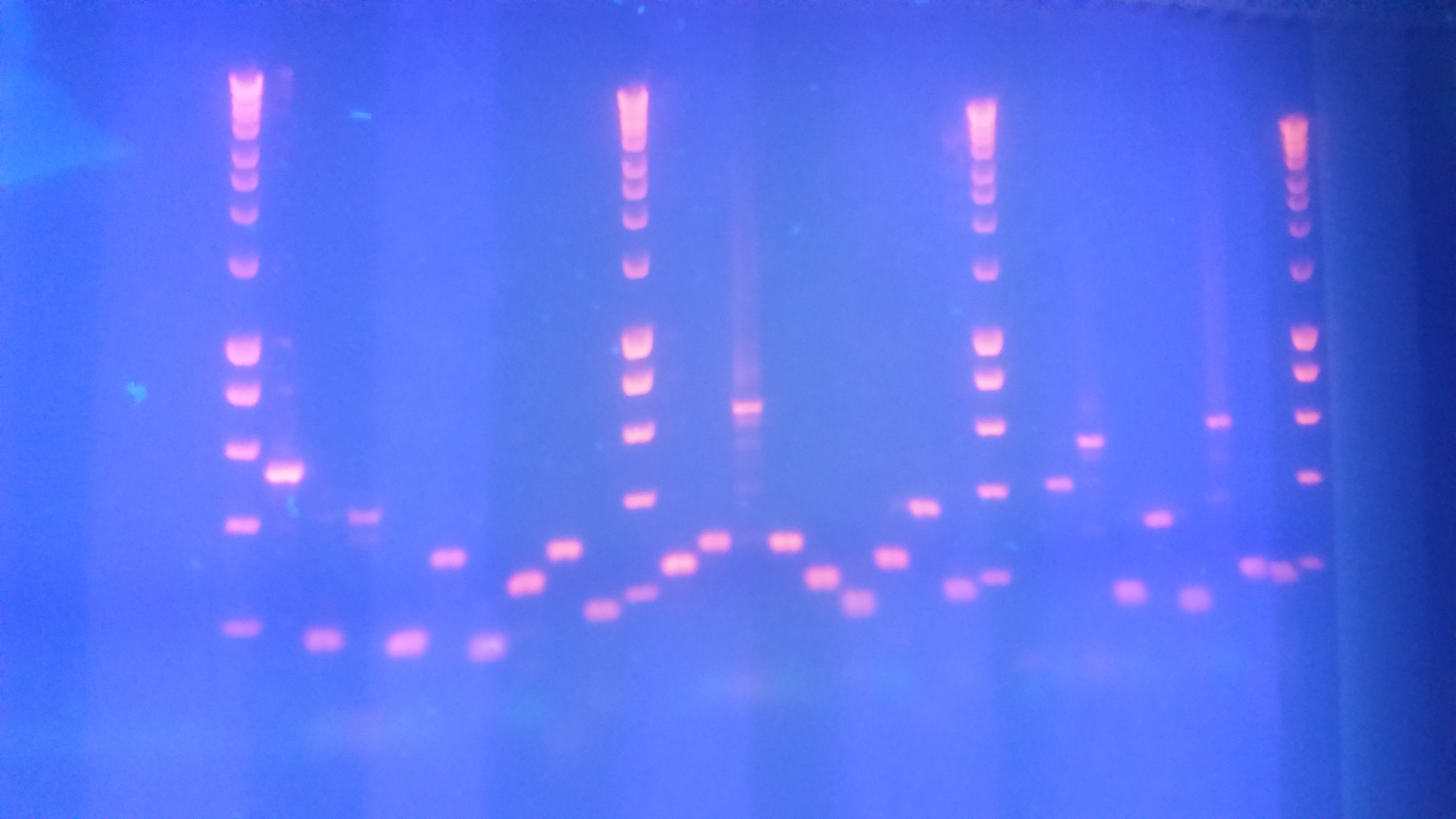
Variable number tandem repeat typing of Klebsiella pneumoniae

PCR also enables us to do things that are harder to do using traditional bacterial techniques such as culture. The picture is of patterns that are like bacterial fingerprints so that they can be clustered into similar groups. This enables me, as a clinical microbiologist, to tell whether bacteria within the same species are the same or not. This is important when deciding whether a bacteria has spread from one patient to another. It helps in acting like a hospital detective, which is a lot of my work in Infection Prevention and Control.

As a trainee I spent four years rotating within laboratory settings. I spent one year in a molecular laboratory, diagnosing patients using PCR. I then spent six months rotating between benches (each sample type has its own laboratory bench) in bacteriology: wounds, respiratory samples, faecal samples, blood cultures, urines, fluids (cerebral spinal fluid etc.) and the primary bench where samples were put onto agar plates. Six months in virology, a year in research and time in food and water, parasitology and mycology (fungal) labs.

The diagnostic process is pretty similar in principle between the specialisms:

  • collect specimen from possible site of infection.
  • select the most appropriate test to detect any organisms (agar plate for bacteria, PCR primers for viruses, etc.)
  • evaluate whether the result (positive or negative) is accurate and whether there are other tests that should be done, i.e. further characterisation of positives such as antimicrobial sensitivity.
  • decide on treatment or management of the infectious cause, i.e. antimicrobials or non-antibiotic management such as surgery.
  • advise on infection control if actions are needed to investigate where the infection came from or to protect others from risk.

During my first four years I spent most of my time in the laboratory doing the first three bullet points.

Time goes on. I’ve been in the NHS for 16 years. Most of my time is spent at my desk in the on-call bathroom. Not so much at the moment, due to the pandemic, because I’m working from home more.

Since 2010, most of my time has been spent either in Infection Prevention and Control undertaking the final bullet point or increasing my skills by gaining Fellowship of the Royal College of Pathologists to do bullet point four.

I still support the lab and, occasionally, get my lab coat on – but not as much as I’d like. It is, therefore, possible to be a clinical microbiologist and be anywhere on the spectrum. You can go as far as you’d like and do the type of work that makes you happy. It’s why being a clinical microbiologist is a great career!

Modernising Scientific Careers Framework

Remember, Remember! See the play, read the script and do the activities here!

See the original blog post about Remember, Remember here

Join Us to Help Celebrate National Pathology Week 2020!

Remember, remember the fifth of November

Gunpowder, treason and plot

We see no reason

Why gunpowder treason

Should ever be forgot……

What can you do to help our scientists who’ve been sucked back in time to 1605 to find the gunpowder plotters and help Princess Elizabeth?

Complete the activity packs below and watch the play or order to help them

Watch the play whilst completing the activity packs


In Chapter One our scientists find a strange message from the past, but what does it mean?

In Chapter Two our scientists find a Princess in need of assistance!

In Chapter Three our scientists get access to the scene of the crime, but what will they discover?

In Chapter Four our scientists try to persuade Princess Elizabeth that science is useful

In Chapter Five our scientists teach a Princess about infection and hand hygiene, as well as finding time to save the day

Thank you to our amazing cast:

Tara Kearney (PRINCESS ELIZABETH)   

Jonny Wright (FRANK & GUY FAWKS) @xymyorkrapper

Jennifer Daley (LILY & SIR JASPER) @jennifer_daley

Becky Simon (ROSA & GUARD) is @beckybsimon

Credits
Written by playwright Nicola Baldwin with Dr Elaine Cloutman-Green, Lead Healthcare Scientist at Great Ormond Street Hospital. Created for patients, families and staff at Great Ormond Street Hospital. First performed at GOSH for Pathology Week, November 2018. Director, Hannah Jones. Our project was funded by SfAM; the performance at GOSH was also supported by the Royal College of Pathologists. Thanks to: Abi Bown, Melisa Canales, NT Costumes, Rachel McInery, She’miah Hastick, Miranda France, Polly Cheeseman, Anthony Manuel DeSouza (EDUCATION RESOURCES), Fionnuala Wilkins (GOSH SCHOOL), Amy Sutton (GOSH YOUTH FORUM), Laura Walsh (GOSH PLAYTEAM), Andrew Roast (GOSH DIGITAL), Royal Literary Fund. Photography by Rabbit Hole Photography.

This play is for performing at home

All opinions on this blog are my own

Remember, Remember! Step back in time to save the King

Join Us to Help Celebrate National Pathology Week 2020!

Remember, Remember!

Remember, remember the fifth of November.

Gunpowder, treason and plot.

We see no reason

Why gunpowder treason

Should ever be forgot……

What can you do to help our scientists who’ve been sucked back in time to 1605 to find the gunpowder plotters and help Princess Elizabeth?

Full play on YouTube, scripts and activity packs are available here

Join in our digital competition, watch the play and complete the activity packs to help the Healthcare Science Education Team celebrate the work of Healthcare Scientists and the work they do for patients and families!

2018 Cast Rehearsal Photos by Rabbit Hole Photography

Watch the great play by Nicola Baldwin (2018) Remember, Remember! on our YouTube Channel (available Friday 30th October)

See how your hard work can help our scientists by completing the activity packs that accompany the show (download links below)

Also

Take photos, record a video or create other content (blog, tik tok, artwork etc) linked to your completed activities OR answers one of the following questions for a chance to win a £50 Amazon voucher!

–           What do I think of when I hear the words microbiology / bug?

–           What does antimicrobial resistance mean to me?

–           What will antimicrobial resistance mean for my family?

–           Are bugs good or bad?

–           What do I think scientists do in hospitals?

Email: we transfer your entries to hcs.education@gosh.nhs.uk by Sunday 8th November

Lily, Rosa and Frank are Healthcare Scientists working in the laboratories. They work to help patients understand what is making them unwell, or to help with making them better.

It’s November and there is fog hanging in the air. The leaves have begun to fall and the street lights have started to come on by the time they leave work.

Scientists often work late into the night and Lily is waiting for Rosa and Frank to finish for the day.

Whilst waiting for them she decides to run one more test using her favourite piece of lab equipment, a MALDI-ToF she’s called Bonnie.  Bonnie is a pretty cool piece of equipment: it has a laser and can get a result for Lily in less than 5 minutes for something she used to have to wait 2 days for.

Just as she presses the big red button, Rosa and Frank walk through the door to the laboratory.  Suddenly a message appears on the screen, where no message should be saying ‘HELPE…’

Then the message changes and gives an address at the top of Lamb’s Conduit Street and what looks like a map.

Lily is so surprised she jumps back and tries to turn Bonnie off, but the machine doesn’t respond and the message just stays on the screen.

Not knowing what to do Lily, Rosa and Frank decide to leave the lab and find somewhere to sit and chat to work out what might have happened;, After all this is a piece of scientific equipment not a computer game.

As they leave the lab, they are suddenly surrounded by the fog they had seen outside the window until they can barely see what’s in front of them.

As they walk towards where they believe the tube to be, they suddenly realise they are on Lamb’s Conduit Street and the fog begins to clear.

A child is waiting. She has a Scottish accent and demands they call her Princess Elizabeth! They must all bow to her!

She tells them there is a plot to get rid of her father by blowing up the Houses of Parliament. The scientists are amazed – do you mean the Gunpowder Plot of 1605?

She says she will tell them later how she managed that.

Even then, they don’t believe she is a princess….

But she is 

Remember, Remember! by Nicola Baldwin 2018

The scientists must find a way to help Princess Elizabeth find the Gunpowder Plotters. Then maybe they’ll be able to find out how to get back to 2020!

The scientists have asked you to complete a number of activities in order to help them find the plotters.  You are the detectives, guiding the scientists so that they can get home.

Complete the following activities and we’ll find a way to get the results back in time to the scientists in 1605.

Science Communication: Reflections from an Ivory Tower

This week I was going to post about Antimicrobial Resistance (AMR) as, in many ways, it has been quite a momentous week in my professional life and it all ties into AMR. I may still… but I wanted to raise something that has been playing on my mind this week in light of the social media reactions I’ve seen to the new COVID-19 (don’t call it a lockdown) tiers.

Let me say now that this isn’t a political post, purely one linked to reflections that have been triggered for me that are linked to some of the pitfalls of traditional communication, medicine and dissemination.

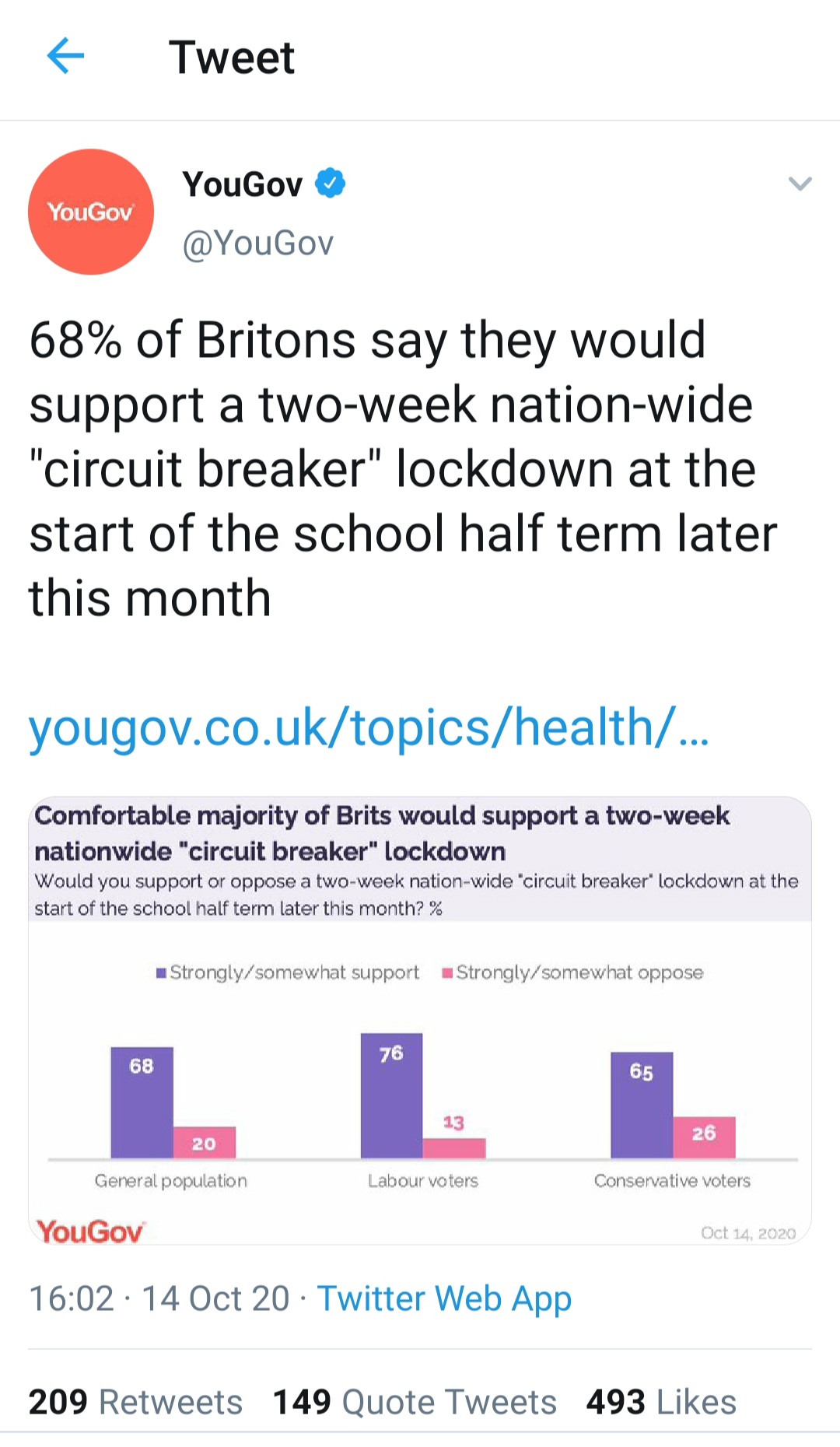
On Wednesday, I saw this tweet. The scientist in me responded with, ‘well of course’ and ‘surely people understand the ramifications for everyone if we don’t find working containment measures’.

Twitter post related to the new YouGov poll

When I see posts like this, I usually scroll through the comments. I think it’s important to read what people are posting and see what the challenge is like, as it’s all too easy to see the world through the eyes of those in your bubble. Those people in similar situations to us, with similar views to us, who then use stats like this to reinforce the positions we already hold.

Then, as part of the comments, I saw this:

My first reaction to this post was to blow out my cheeks and sigh. “The needs of the many outweigh the needs of the few” and all that. That’s an economic problem that should be addressed, not an infection issue: think of the number of people who will die etc.

Then I stopped and realised there is truth to this

I do live in an Ivory Tower

Now that’s not to say that I am rich, and it’s not to say that my response to the the poll is wrong. It is to say that we must reflect and admit the truth to ourselves. I can pay my mortgage. My job is not at risk (although my husband’s may well be). I can buy food and cover my bills. That gives me a privileged position where I can engage with and make decisions about how I feel about the science, the justification, and the way they are implemented. I don’t have to react from a place of worry and fear. That privilege means that I can digest information from a place of logic and not emotion. That privilege also means that I can lose perspective about how others may receive the same information and I certainly have to be aware of that privilege when it comes to judgement.

However the key word in the above paragraph is “receive”. This is where I come to the real point of my post. One of the problems with the current situation is the feeling of disempowerment of being the recipient of information and not the co-creator of response. This has been a problem in the health setting for pretty much as long as it’s existed, but its only in recent years that it’s been recognised as such.

Too many times in medicine we implement from a position of expertise and authority without engaging the lived experience and knowledge of others. I’m a passionate believer in the power of true co-production, where we work in partnership to create something that neither group could deliver on their own. I work in a hospital where we see patients who may be one of only 20 in the world with their condition. It is naïve and arrogant of me to believe that I will understand more about their experience of living with their disease. I can input, support and advise on the basis of biology and my experience. It will never be truly effective without considering theirs.

So my thought on this Friday evening is actually more of a plea. We all have our Ivory Tower, our bubble, our version of the truth. If you work in healthcare it’s important to give yourself time to reflect on what that means for your practice. Are you doing everything you can to move from being the authority in the room to being the person who is prepared to truly listen and co-create the best possible outcome for the patient in front of you?

Are we ready to enter a new period in healthcare where it is much more about the patient in front of us than it is about our years of training and education?

Photo by Adrianna Calvo on Pexels.com

All opinions most definitely my own

Adventures in Science Communication – Stand-up comedy edition

I’m not funny. Well, I’m not “laugh out loud” funny. I’ve never been the kind of person who has told jokes and, unlike many in an American genre TV programme, I would never have won the ‘Class Clown’ award. So how on earth did I end up spending three hours this week in a stand-up comedy training session?

There’s obviously the answer that a lot of the 11 people on the call would give: i.e. we need continuous professional development (CPD) points and, as Healthcare Scientists in the time of COVID-19, that’s not as easy. For anyone that doesn’t work in our profession, we have to show that we engage in a set number of hours of active learning and updating our practice. This helps us stay safe but also encourages a growth mindset where we learn new skills.

Secondly, the funding for the sessions is from a public engagement grant that my brilliant deputy was awarded by the Society for Applied Microbiology (SfAM). My deputy is super brave and was invited to do a show last year, having never done any stand-up comedy. As part of my role as leader, I felt it was incredibly important to actively participate in something that she had put energy into and believed would make us better communicators. Also, I’m a Trustee for SfAM and they do great work in supporting scientists in stepping out of their boxes and trying something new to communicate differently. I really buy into this and so, despite being slightly terrified, it was the right thing to do.

Step out of your box and give it a go

The session was delivered by Dr Steve Cross who is a consultant in public engagement and education. He started off the session by saying that he enjoys teaching nerds to be funny. Well, as a self confessed mega-nerd, this was a good start from where I was sitting. The session was a real mix of scientific backgrounds: from social science, infection specialists, pathologists, physiologists, through to medical physicists. This is one of the great things about sessions like these: networking is a great and often unexpected benefit and you get to spend hours with scientists you would never encounter otherwise and learn about their worlds.

Never underestimate the power of stories

We started out by discussing what we thought was funny. I had failed to do my homework and so hadn’t brought a clip with me (I know, an automatic F!) But the better prepared participants showed YouTube clips that made them laugh and discussed why. In an attempt to raise my grade from an F to a D, the clip below (belatedly) is something that makes me chuckle.

From watching the different clips I began to reflect on the power of stories. One of the reasons that Nicola Baldwin (the playwright I work with) and I utilise drama is because we believe in the power of drama to communicate, break down barriers and alter behaviour. It was fascinating to think about how comedy can be used to:

  • See things from a new direction
  • Explore differing opinions in a confrontation-free way
  • To confront and explore upsetting/worrying topics avoiding direct triggers
  • Enable the voicing of secret thoughts that are very common but we fear discussing openly
  • Talk about common experiences as if they are new in order to gain fresh insight
  • Subvert expectations
  • Inspire or start conversations

A lot of these points can be extrapolated to the reason Nicola and I use drama. The power of comedy is the portability and equal access nature of it. It doesn’t require huge amounts of resources to prepare a set, it doesn’t require a lot of resources to deliver a set, and it can be delivered flexibly across zoom or in person.

Steve ran us through a bunch of very easy to access and non terrifying exercises. Many of these involved us taking a story or event and reflecting on it in order to delve deeper into emotions connected with it. We then discussed how these stories and linked emotions could be used to make people laugh. Obviously there’s way more to it, but Steve is the king and we are running more of these sessions if you’d like to give it a go and participate yourself.

My main reflections from the session were:

  • Undertaking this kind of training can enable you to see situations differently and explore ways of seeing them from another’s point of view
  • Learning to break situations down and actively think about how to communicate them is a transferrable skill which is really useful in your professional practice
  • Understanding how stories can be used to create empathy and engage audiences isn’t just important for comedy. This technique can be used to support you bringing your whole self to work and break down communication barriers

All opinions in this blog are my own