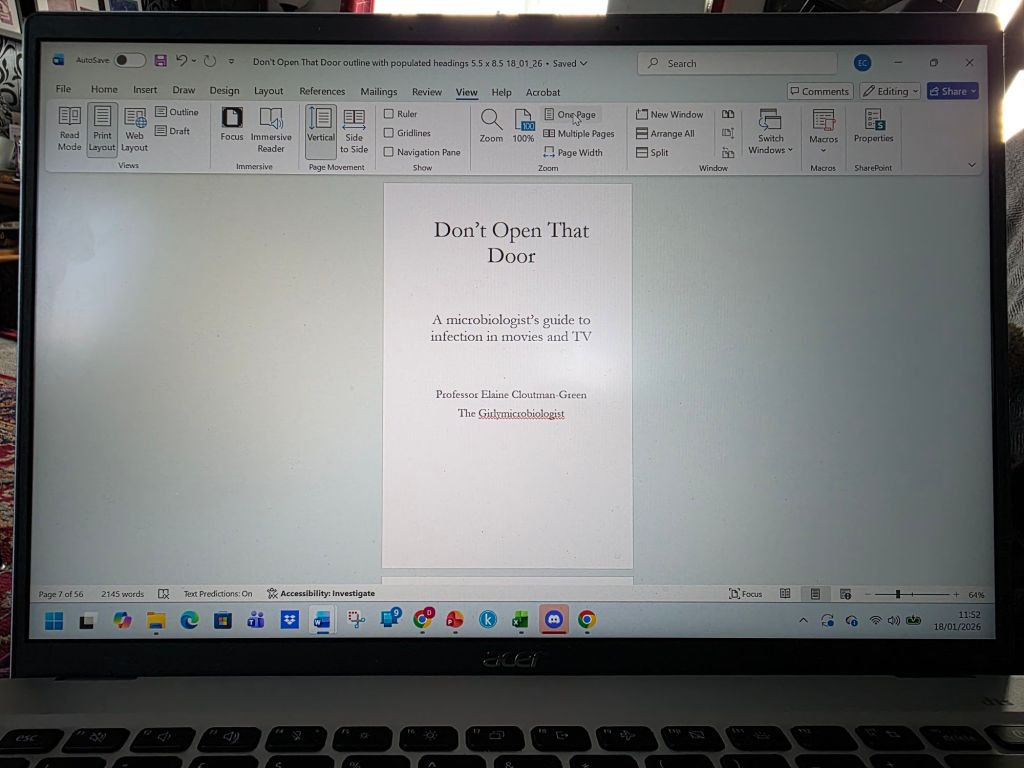
You may have noticed that I’ve been a little poor at keeping up with the Girlymicrobiologist site admin, and missing the odd weekly blog post. This isn’t because I’ve been slacking, honest, it’s more because I may have become a little distracted by a new project. I promise to get back on top of things soon, but in the meantime I thought I owed you an update.
Many of you have been kind enough to support last years project, which was a book aimed at supporting people to engage with research and research degrees, and I couldn’t be more grateful for your cheer leading. This new project, however, in the words of Monty Python could be described as ‘and now for something completely different’. It couldn’t be further from a book about academic study. This one is all about something else I love passionately, movies and TV.
I finished and launched the last book last October, and to be honest it hadn’t occurred to me, prior to letting it go into the wild, that I would write anything else till my retirement – when I’m planning to write some pathology based murder mysteries. It was never the plan to do something again, at least so soon. Frankly though, my brain tends to disrupt all my best laid plans, and ideas come meaning I just can’t help myself but get swept up. I’m blaming Ian McKellen inspiring me to ‘practice any art’.
Despite having no plans to do more, I have to say that I really enjoyed writing the first book, and I found the process of being able to write in a different way very fulfilling. I love writing this blog, and the first book is based on a lot of the pieces I have written for here, but it was nice to see them come together and take on a new and different life of their own. I also enjoyed mixing up the writing of something on a single theme with writing blogs on different topics for here, although I did rely a lot on Dr Claire Walker bringing together many guest blogs to allow me some writing time. It was lovely to see what those guest blogs brought to the site, and I really enjoyed seeing how including those voices really makes this feel even more like a community space. Without realising it, I think I caught ‘the bug’. Now, I’ve always enjoyed writing, this is my happy space, but I had never seen myself as an author, having held a book I’d written in my hands though, I can see how it could become a little addictive.
As I was sitting watching horror movies as part of my post release recovery, and researching for my 2025 Halloween post, I suddenly realised what I’d like to do next. I really wanted to write about some duel loves of mine, movies and TV plus infection.
Without any expectation of writing another book, all of a sudden I had a structure in my mind, and Don’t Open That Door had began…
You all know how much I am a movie and TV buff, everything from guilty pleasure reality TV, like The Secret Lives of Mormon Wives, to documentaries, and all genre of film (with the exception of torture porn horror movies, I’m a Blumhouse girlie). Whilst enjoying some down time with Mr Girlymicro, I realised how widely infection is featured in all kinds of different genera settings, some of it was actually pretty good, whilst some of it was really poor. So the first step was to do a whole bunch of research about what kind of examples were out there, by hitting up a bunch of different lists that have been collated by others, internet searches, and sourcing opinions from my movie loving friends. All of which led to the creation of a list of 138 options that needed a review to see if if they were actually linked to infection, and if they were infection based….was the infection content any good.
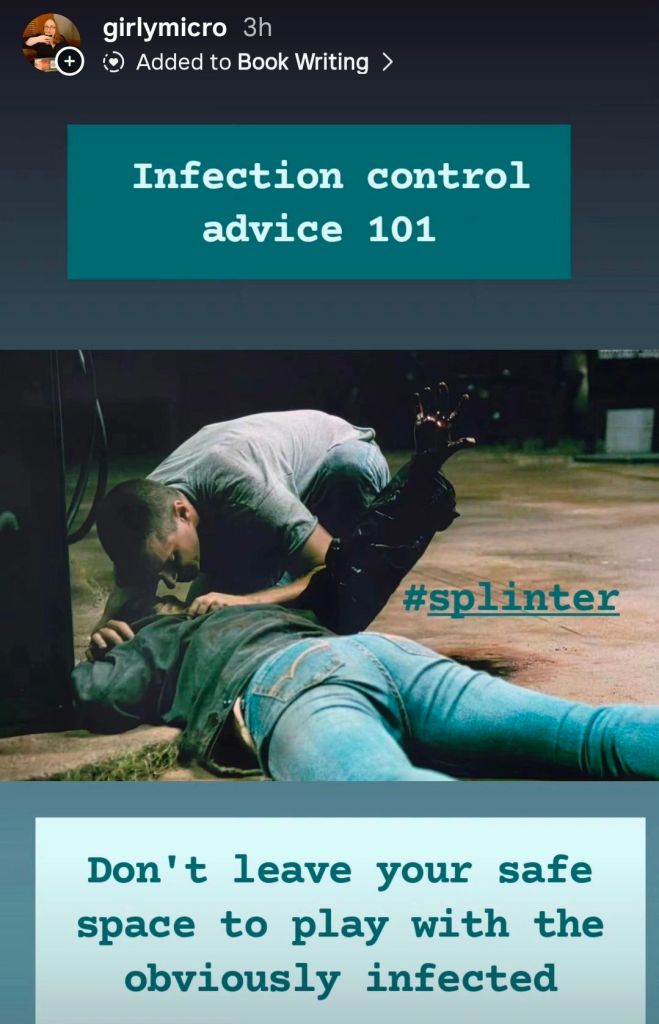
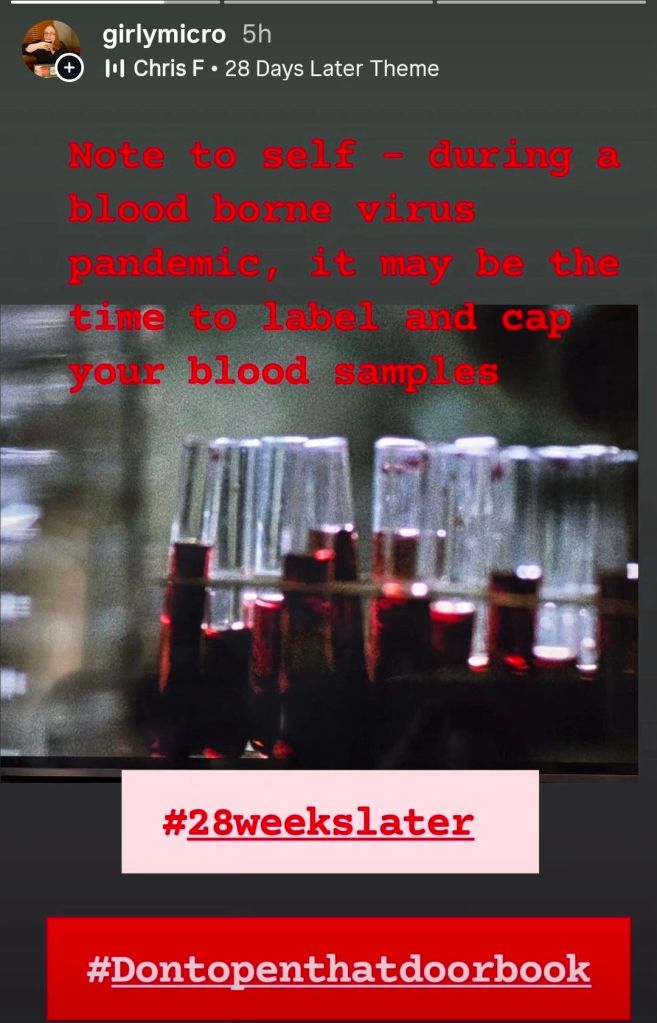
If you follow me (Girlymicro) on Instagram, you will have probably seen a number of stories that I’ve posted recently linked to movies I’ve been watching with some Infection Prevention and Control/micro commentary:
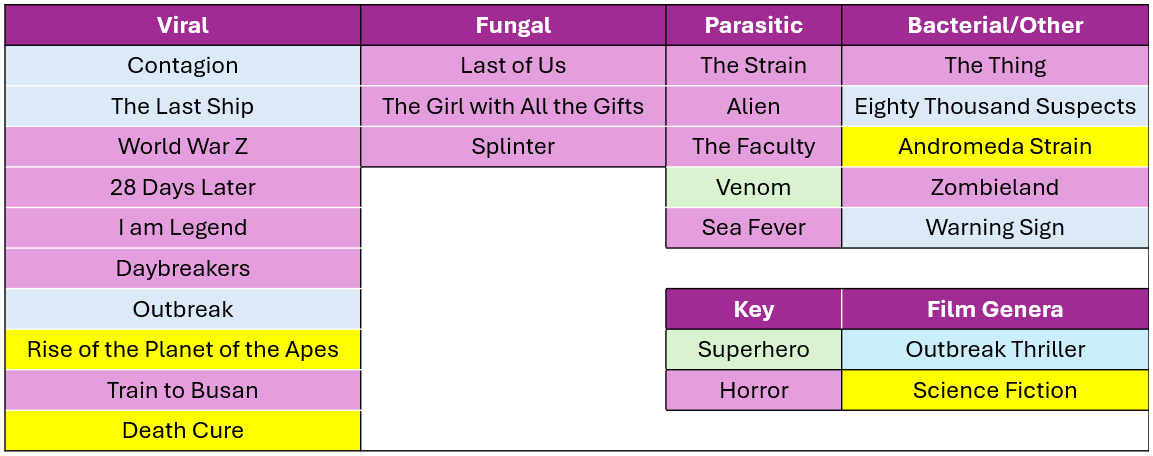
These have come about whilst I’ve been watching the 138 films/series with Mr Girlymicro to decide which ones make the cut to be included. I’ve watched some awesome films, some like Sinners, weren’t based on infection so couldn’t be included. I have also watched some truly bad movies, I even gave Resident Evil another go, and have spared you all by making sure that it is not included on the list. One of the considerations was that, even if the science wasn’t dreadful, I haven’t included anything that I or Rotten Tomatoes include as being truly horrible. I’m not just saving you on this, but also myself, as I’m having to watch included examples many times as part of the writing. I also felt it was really important to cover infections linked to viral, fungal, parasitic, and bacterial causes, just because they behave so differently and the interventions needed are so different. So the final list for inclusion involves movies and TV series that sit across infectious agents, although viruses are more represented than any other cause.
There are plenty of horror movies on the list, purely because they represent A LOT of the infection genera, but I was surprised at how many options there were outside of horror movies. I also tried to mix up certifications where I could, so that there are some options that everyone might enjoy.
Not everything could be included however, and there were also some exclusion criteria that impacted what I could include. Exclusion criteria included factors such as availability – no point including things that people can’t access, language options – I sadly only speak English so it needed at least English subtitles, and most importantly not based on real life events – this is about fiction.
For inclusion examples also needed to have infection as a central theme. This meant that health dramas could not be included as they only feature infection in some episodes, but at some point I do really want to write something that compares different medical dramas (House, New Amsterdam, Holby City etc) and maybe do a ranking scale….let me know if you think that would be a fun blog post.
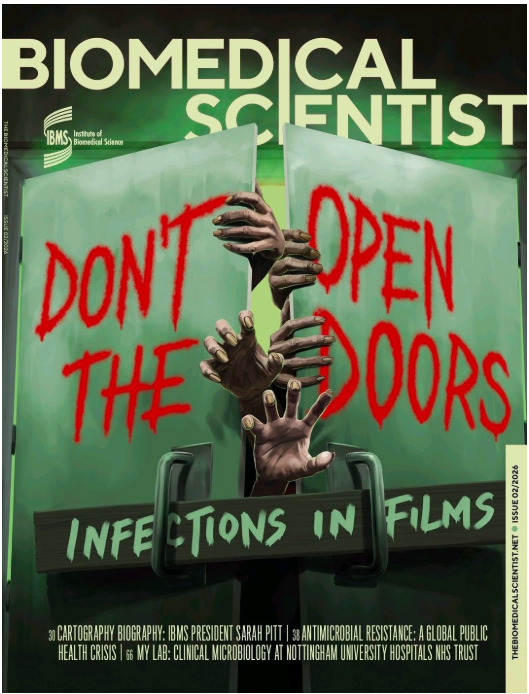
Image credit The Red Dress
The reason it felt timely to talk about this today, is that the Biomedical Scientist magazine has been kind enough to do a whole feature on what the new book will look like, with a bit more detail, and some examples of what chapters will look like. It dropped on the 27th March and you can check it out the link here: https://thebiomedicalscientist.net/2026/03/24/infections-films. Also, how awesome is the art work they’ve done, can’t say enough how awesome The Red Dress are.
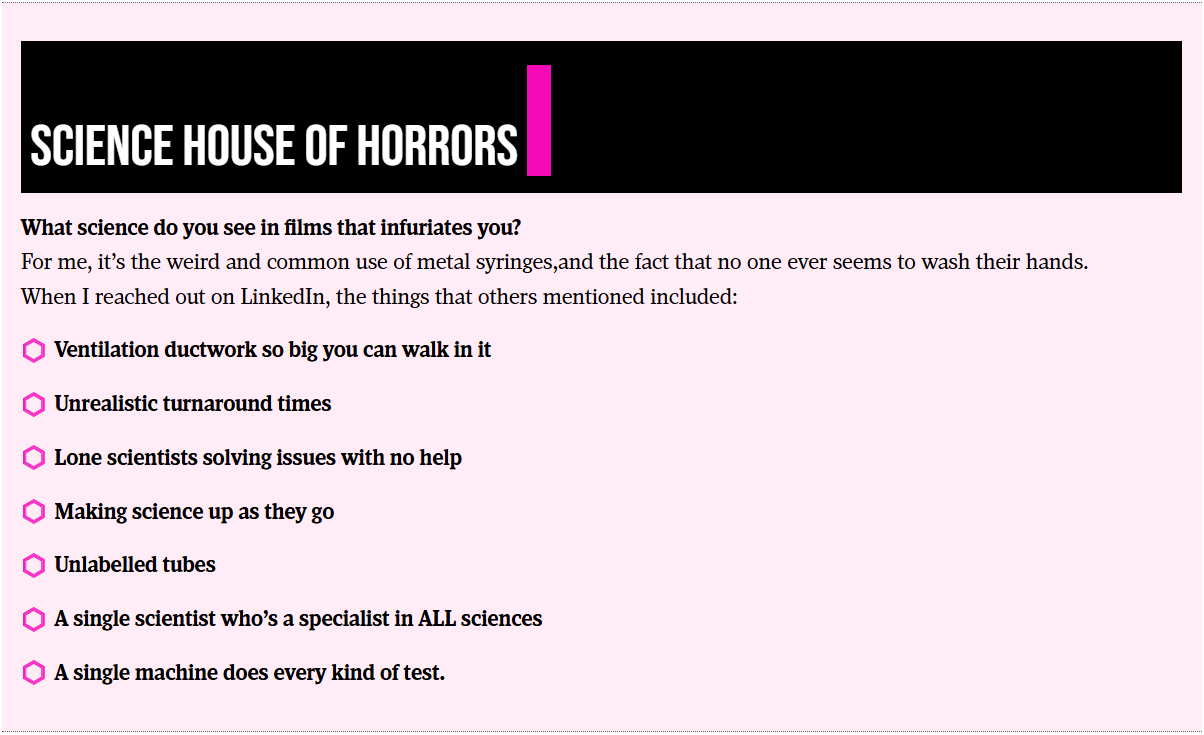
Whilst writing the article for the Biomedical Scientist and watching the example movies, I couldn’t happen but note how many weird and wonderful things are included as part of the science representation. Things that in my scientific career I rarely if ever encounter, but seem to crop up time and time again in Hollywood depictions of scientific life. I’m collating these for one of the final chapters in the book called ‘Science House of Horrors’ as I find them a bit fascinating. I’ve included some of the ones in the Biomedical Scientist article that I noticed, as well as those sent through as responses from social media, but I’d love to know if you have any others that I should include.
There are other opportunities to get involved though, I have 23 films and series examples, but there is room in the book to cover 25. I’m really keen to get other examples that include fungi, but if there is just something brilliant I haven’t included please let me know. There will also be a chapter called ‘Hall of Fame’ that covers both amazing movies that just don’t have enough infection in them to be included, or ones that were great but not quite as good an example of an infection characteristic as the ones already included. There is also the ‘Hall of Shame’ for examples, such as the TV series The Rain and Resident Evil, where the science is so bad that it is note worthy in itself.
Anyone who drops me an email to elaine@girlymicrobiologist.com and inputs into the House of Horrors, volunteers film examples I’ve missed, or suggests contenders for the ‘Hall of Fame’ or ‘Hall of Shame’, will get their name included in the list of contributors at the back of the book. Science takes a village, so does pulling together a book, and I’m really keen that this feels like it comes from our community. I hope you enjoy the article and I can’t wait to hear from you about your suggestions.
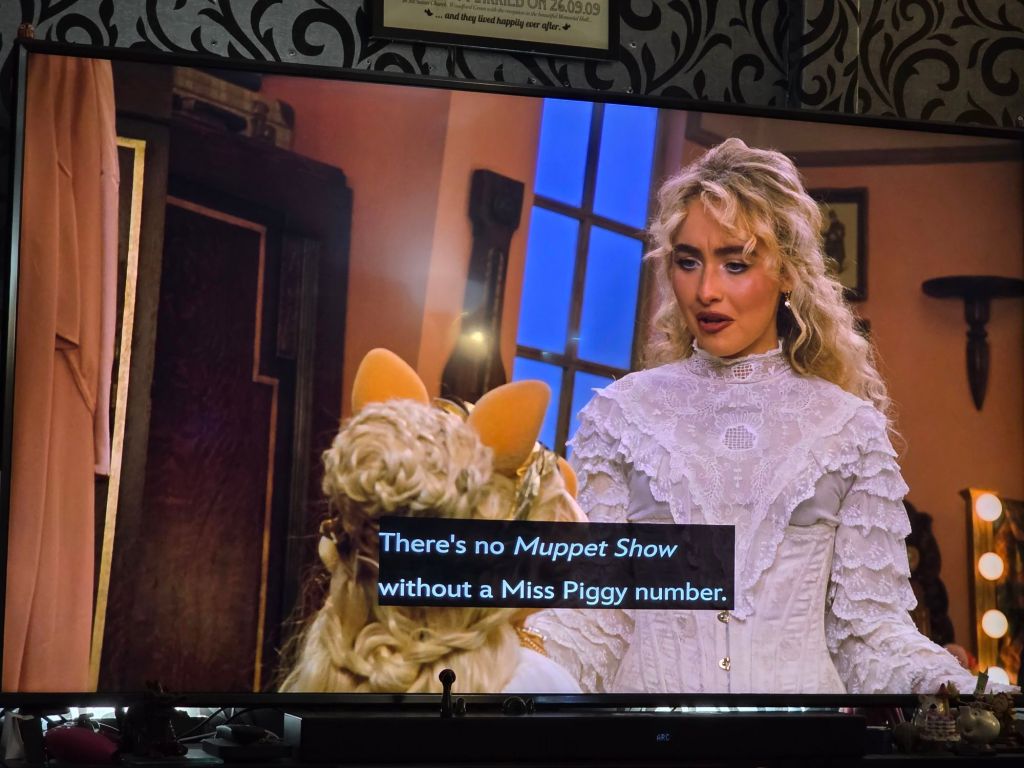
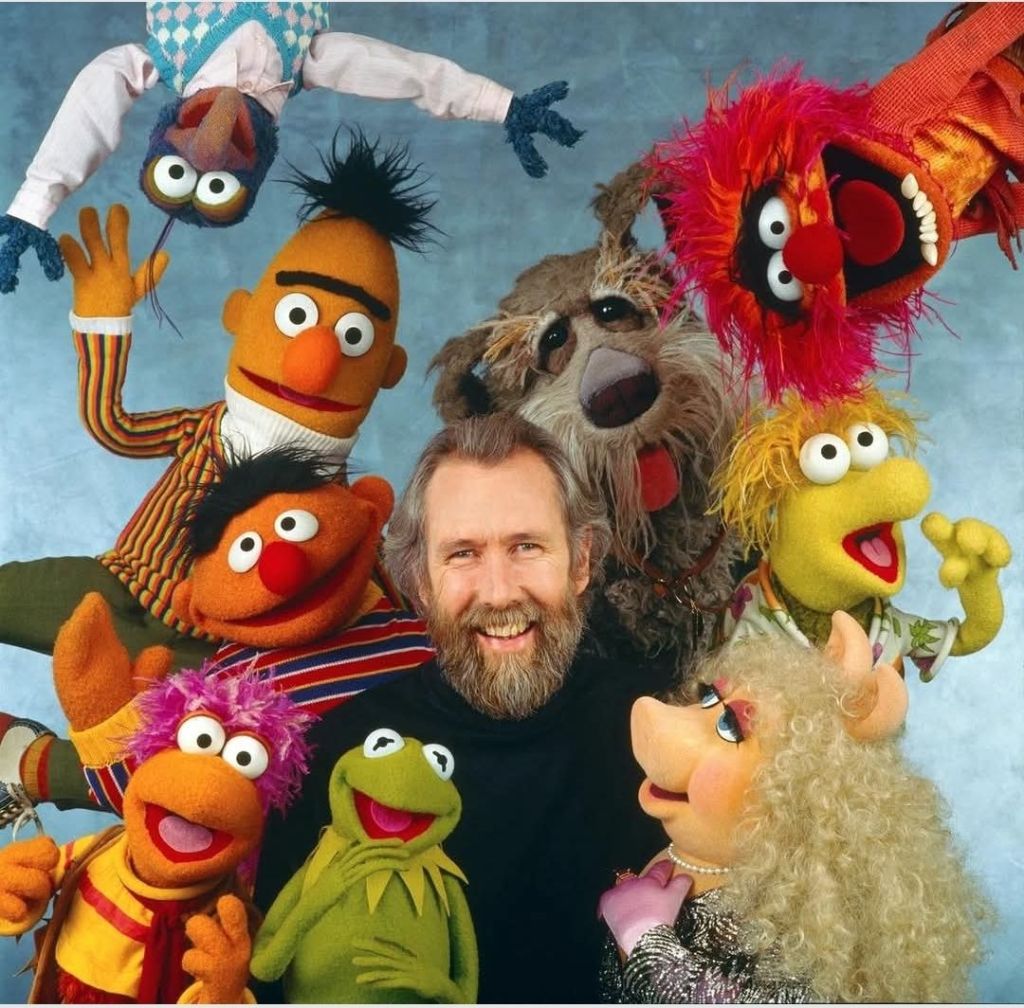
I’ve always been a massive Muppets fan, from their original films through to one of my favourite films of all time, The Muppet Christmas Carol. It’s a family tradition and you all know how much I love Christmas. Picture my joy then when the news was released that this week there would be a new, original, episode of The Muppet Show released on Disney+.
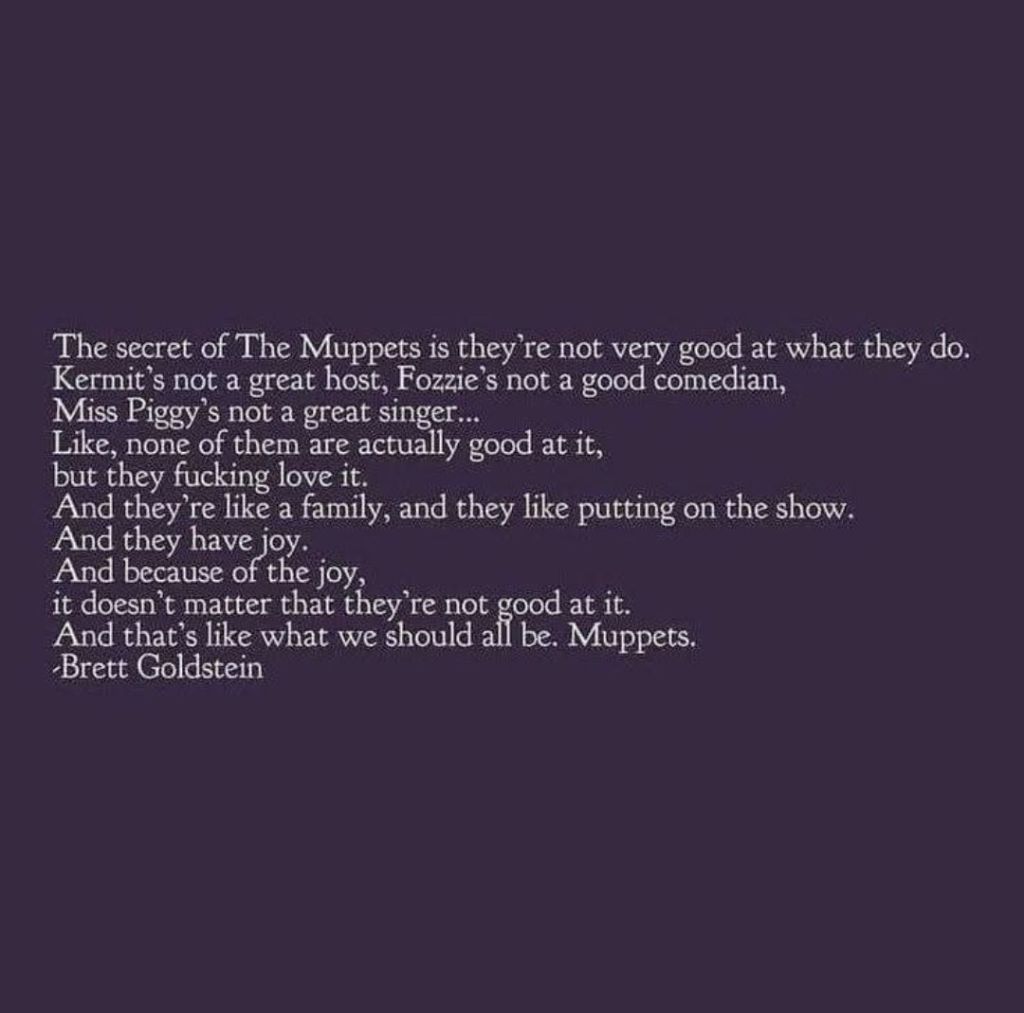
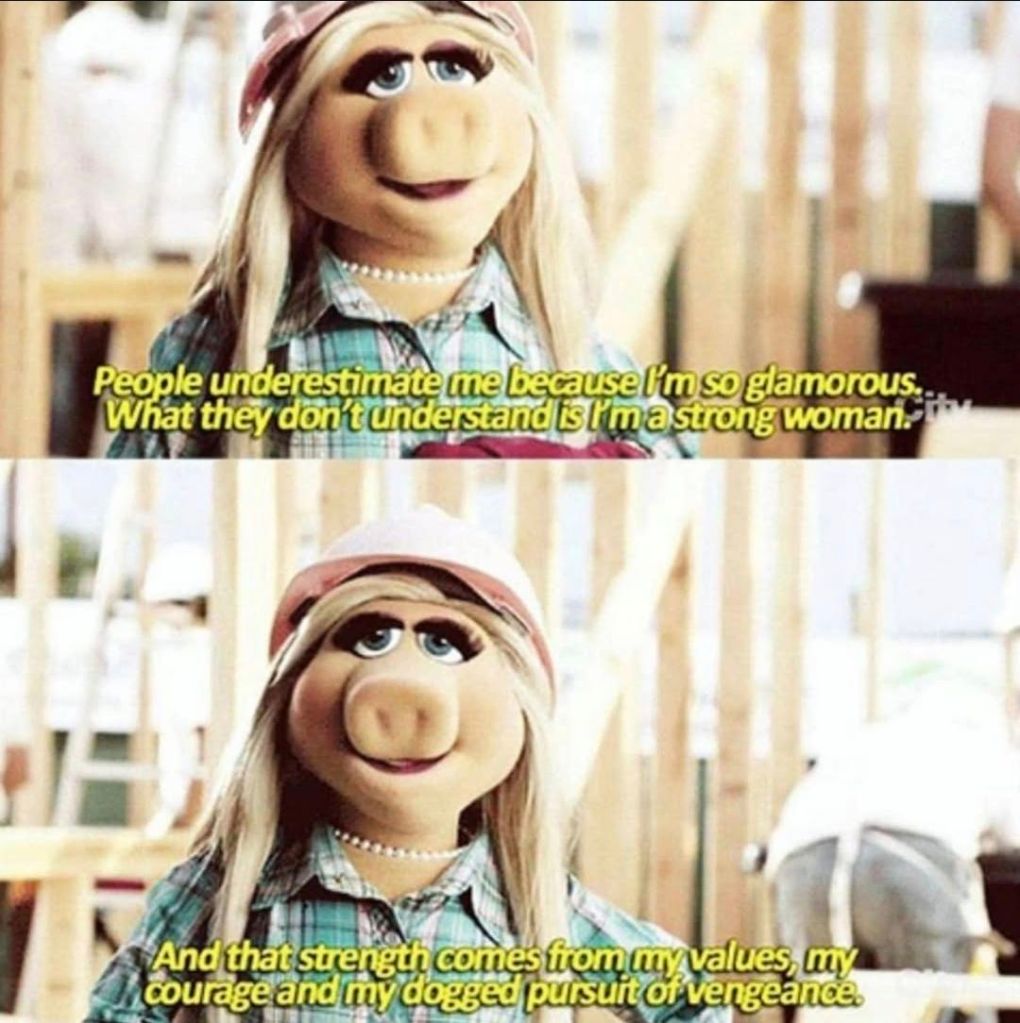
Watching it gave me such joy. Miss Piggy is, after all my hero, but I started to try to think why? Why do The Muppets bring me such joy? What is it about them and their interactions that really speaks to me? Especially as I’ve been writing about the role of women in the work place recently, what is it about how Miss Piggy functions that I admire and wish I could channel more? Then I found this quote below and it felt so genuine to me.
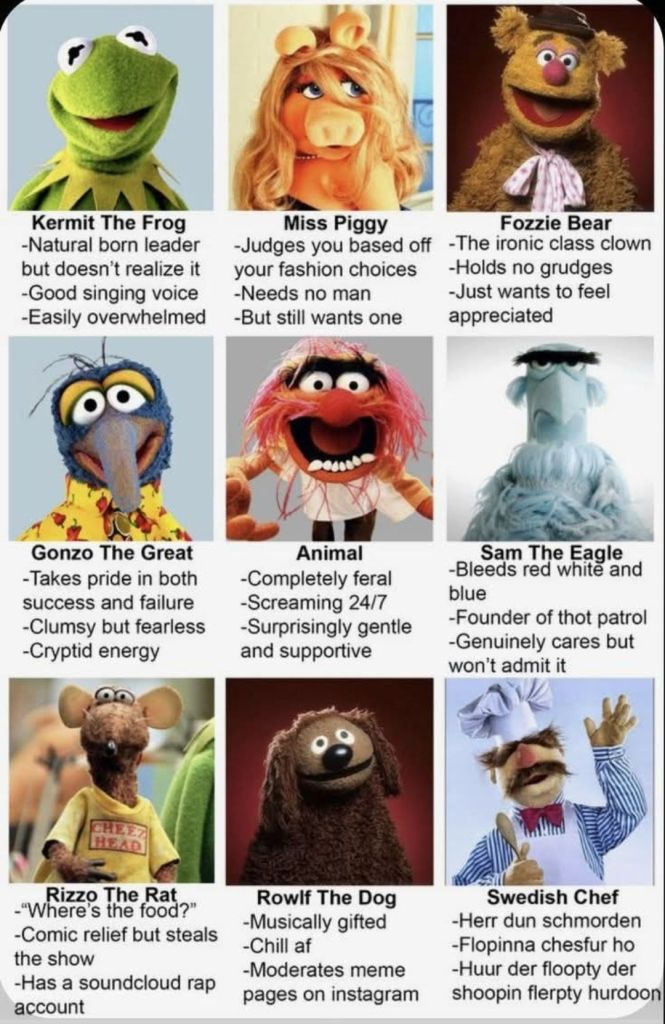
When thinking about their traits more, I couldn’t help but come up with a fairly substantial list that made me want to be ‘more Muppet’ and I thought that in honour of their new moment in the sun I would share the list with you in case you want to join me on a Muppet adventure.
Self advocacy
I don’t care what you think of me unless you think I’m awesome. In which case, you are right
As a female scientist there have been more times than I can count when I wish I’d had the courage to speak up, be seen, and be heard. In fact this is one of my themes and aspirations to be braver about in 2026. Miss Piggy is never afraid to stand up and be counted. She knows her value, and she knows what she brings to the table. More than that she’s not afraid to let others know it and to hold them to account when they under value or under estimate her.
We are often trained that it isn’t a good look to be too confident, or come across as too challenging. That it is better to fit in then to stand out, and that standing out will only cause us trouble. Miss Piggy stands out proudly and isn’t afraid of the consequences of making her presence known. I wish that I too could hold my space without being worried about how others see me for doing so, and I too should maybe care a little less what others think of me.
Boundaries
One of my favourite parts of The Muppet Christmas Carol is when Kermit negotiates for Christmas Day off work:
Mr Cratchit (Kermit): Mr Scrooge it appears to be closing time.
Mr Scrooge: Very well. I’ll see you at 8.00 tomorrow morning.
Kermit: Tomorrow’s Christmas.
Mr Scrooge: 8.30 then.
Kermit: If you please Sir. Half an hour off hardly seems customary for Christmas Day.
Mr Scrooge: How much time off is customary Mr Cratchit?
Kermit: Uh. Why. Um. The whole day.
Mr Scrooge: The whole day! – The entire day?
Kermit: If you please Mr Scrooge, why open the office tomorrow? Other businesses will be closed. You’ll have no one to do business with. It’ll waste a lot of expensive coal for the fire.
Mr Scrooge: It’s a poor excuse for picking a man’s pocket every December the 25th. But as I seem to be the only person around who knows that… Take the day off.
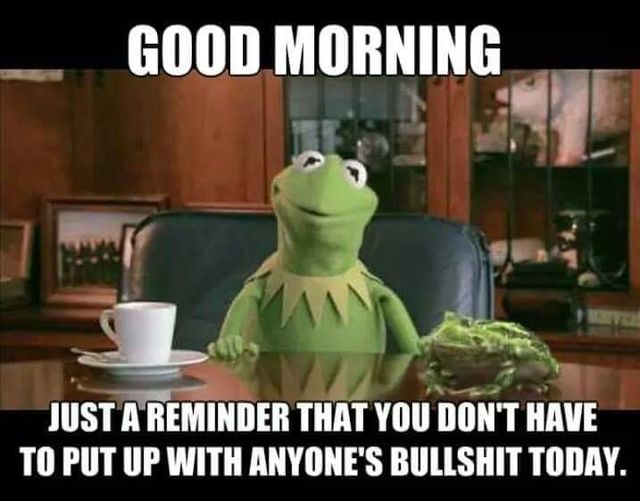
There are moments like this time and time again in The Muppets, be they in the movies or on the small screen. Moments where they gently but firmly set boundaries. Boundaries on good behavior. Boundaries for each other. Boundaries linked to kindness, both to themselves and others. Kermit holds a quiet confidence that permits him to set boundaries that protects both himself and others, without making drama or conflict out of the act. As someone who struggles to say no, and protect her well being on occasion I admire this so much.
Loyalty
The Muppets are a family. They have disagreements. They consist of very different personalities. Yet they love each other unconditionally, and always turn up for each other when it matters. Their love and loyalty isn’t transactional. It’s not performative. It’s the kind of loyalty I look for in those people who are my ride or dies. The ones who would take a call from you at 3 in the morning, just because you need to make it.
They have the kind of loyalty to each other in a work space that allows them to disagree, to argue about the order of the set list, but also lets them arrive at a moment where they all pull together for the absolute best they can achieve as a group, which is always better than any of them could achieve alone. I count myself so lucky to have an IPC team where I feel like we are always there for the finale together.
Respect without hierarchy
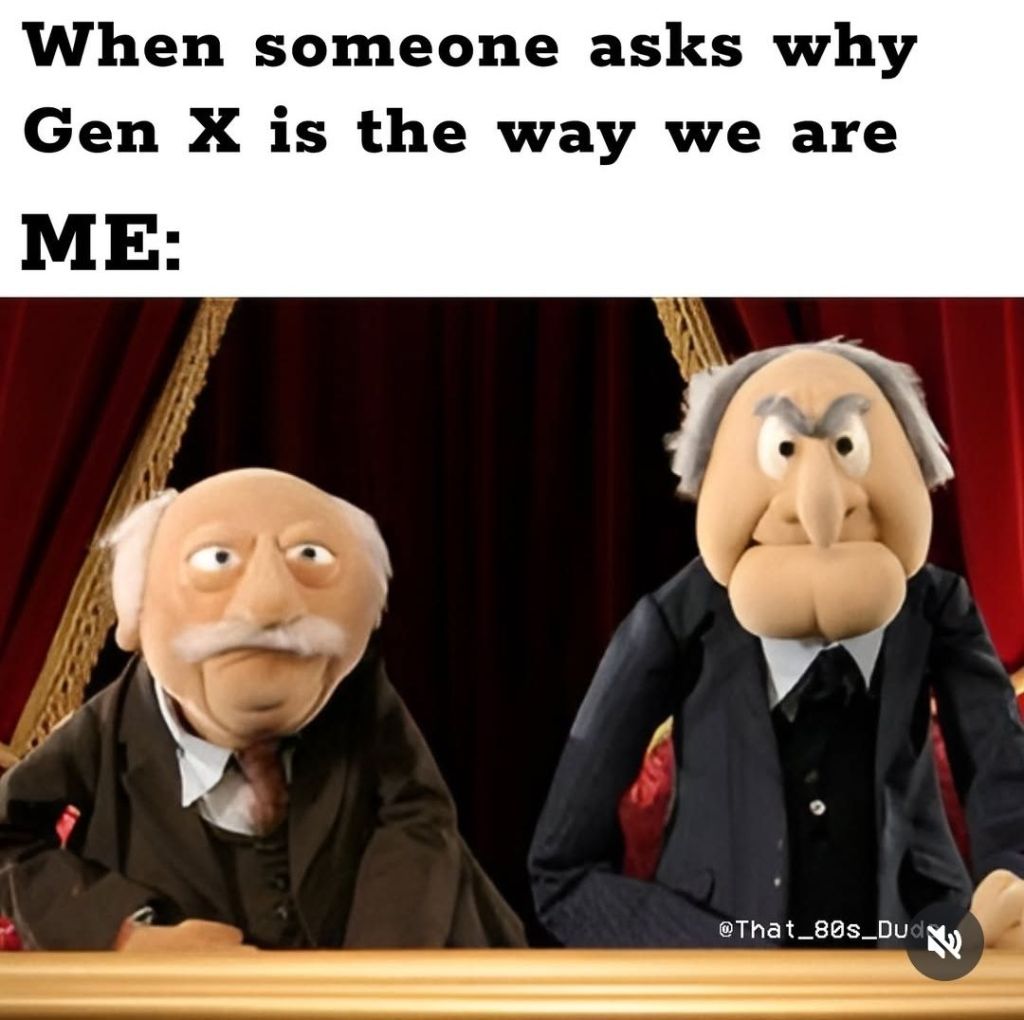
I don’t do hierarchy, I don’t do respect just for the sake of it. For The Muppets, Statler and Waldorf are the epitome of that approach, they are there to remind people that there is always a reason to laugh at ourselves, and not to get too caught up in position or reputation.
Waldorf: Well, you gotta give them credit Statler: Why’s that? Waldorf: Well, they’re gonna keep on doing it till they get it right
Although The Muppets have big personalities, and a leader in Kermit, that leadership is quiet and is not based on titles. It’s based on respect for how he handles situations and the relationship capital he has built. Miss Piggy may run wild, but always pulls back just in time because of her respect and love for him. Mr Girlymicro is very much a Kermit like personality, and it’s one of the many reasons why being married to him makes me a better person. He knows when to call me on my shit, and I respect him enough to hear it.
Living in the moment
I’m a planner. I have a ten year plan. I have a plan for the next 10 minutes. All of that planning can mean that I lose sight of the now. I can struggle to ever truly be in the moment. I love the fact that no matter the chaos that features in a Muppet episode, they can come together in the moment to experience the true joy of achieving a goal or being in each others company. They are aware of the challenges that the future holds, but are able to still live in the moment and enjoy the now. Be that for a musical number, or to cheer each other on. It is so easy to let the now pass whilst aiming for a better future, when really there is a lot to be said for enjoying the moment that you are in.
Appreciation of the good things
Living in the moment brings me onto appreciating the good things. One of my very early experiences as the UK Ambassador for the Society of Healthcare Epidemiology of America was to attend a conference held in, of all places, the Contemporary Hotel at Disney World in Florida. I’d never been to Disney before. In fact I’d never considered going, but I was paid to go and that meant I could also take Mr Girlymicro, and Mel (my science work wife).
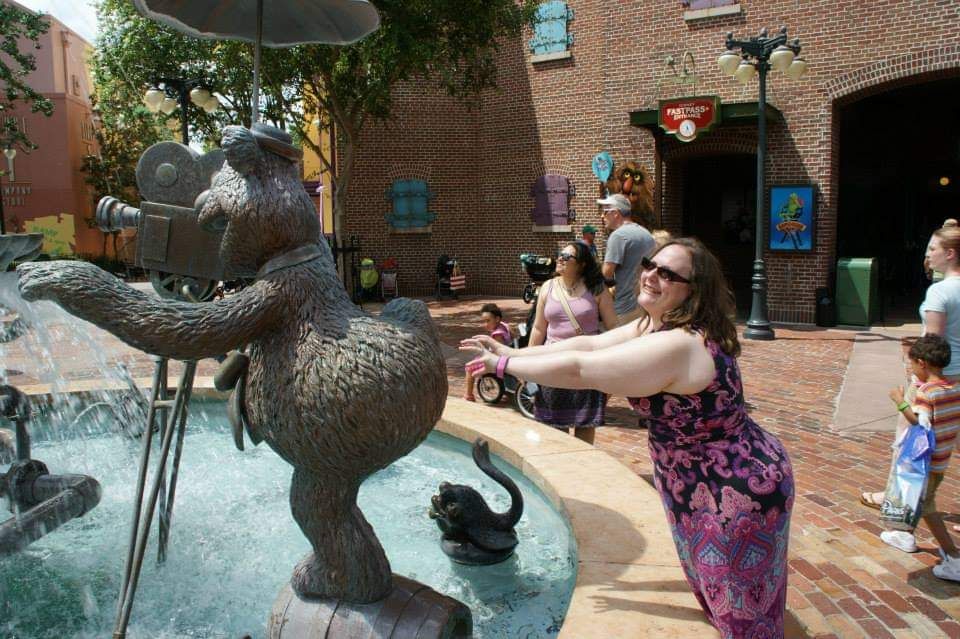
It happened to be Star Wars weekend, and I had a whole day where I could explore and make memories with people who mean a lot to me. In those days a mock up of The Muppet Theatre was there, along with The Muppet courtyard. The three of us made some wonderful memories, and had so much fun. That ride is no longer there, and there has not been another conference held there. If I hadn’t decided to try something I’d never done before I would never have become the Disney fan I am today. If I hadn’t been on that ride and to that place, I would never have had the opportunity, as I’ve not been back to Florida and The Muppet Theatre closed last year. The Muppets embrace all there is in life, and sometimes I have to remind myself to do the same.
Give permission to feel
One of the other things that I love about The Muppets is that they express all of the emotions. Miss Piggy expresses both love and rage. Kermit exhibits leadership and frustration. Fozzy expresses bravery and self doubt. None of them are perfect, nor do they try to be. They have songs about joy, but they also have songs about heartbreak and sorrow, and don’t try to hide from either. They travel the gamut of human emotions and don’t try to claim that one is more valuable than another. I think sometimes it is important to be reminded that it is OK to not be OK. We can’t have it together all the time. Occasionally it is alright to sit on your lily pad in a state of ennui, as long as you also know that at some point you have to get up, dust yourself off, and get back in the fight.
Born out of that acceptance that all emotions matter, or maybe because of it, is the fact that The Muppets accept and demonstrate complexity. Miss Piggy is a strong independent pig who still loves a frog with all of her heart. Kermit has a quiet confidence that emanates, but is still easily overwhelmed and loses that central calm. They show that none of us is just one thing, nor should we aim to be.
I may be the person who has published >40 scientific papers, but I’m also the person who got locked in her own bedroom recently as she couldn’t get the door nob to turn. Competence in one area does not equal competence in another. I can be someone who loves reading about the history of the Silk Road, and also someone who enjoys watching Below Decks or Love is Blind. No person is all good, or all bad, and this is especially important to remember in a leadership context. There may be people that we don’t understand how they think, or their processes, but that doesn’t make them bad it people, it just makes them different, and we should embrace that difference as variety makes the whole better.
Fearless in response to challenge
Every Muppet episode or film is always centred around challenge, there would probably not be much plot otherwise. The challenge is often insurmountable, or at least incredibly intimidating. There’s a reason they will all need to come together to overcome it. The amazing thing, to me, is that they never waste a lot of time bemoaning the challenge, they just get on with it. They don’t ever really consider what will happen if they don’t succeed. They don’t waste energy on fear or overwhelm. As someone who wastes a LOT of energy in catastrophising, and in fearing failure, I really do think this is an area where I need to be more Muppet. They have such faith in each other to carry them through, even when they lose faith in themselves. Being a little more task rather than ‘what if’ focused would certainly help me.
Refuse to be defined by others
One of the reasons The Muppets weather any storm is that they know who they are and don’t let others define them. It is so easy to be a passive passenger in our own lives. Humanity works based on silo’s and putting each other in boxes, and it is sometimes easy to go along with those definitions that used by others for us. One of the things this blog has gifted me, is that I feel much more comfortable defining myself and my own narrative than I did for the first decade of my career. Finding your voice may not be the easiest process, but it one that is worth investing in as early as you can. Define yourself so that others have a harder time doing so on your behalf.
Defy convention
When we let others define us, we also let them limit us. The Muppets defy convention. They say that you can be anything you want to be. The Muppet Babies encourages you to dream. The Muppet Christmas Carol encourages you to be kind and to value things outside of the conventional, and a Muppet Treasure Island tells you it’s OK to be a pirate. All joking aside, Miss Piggy shows that ambition is not a dirty word. Why not dream of being a pop star? Why not aim to win an Academy Award? Why not dream bigger than we’ve been told we are allowed, rather than believing being told to think small. Aspirations are not a bad thing. Miss Piggy works hard towards her dreams, even if they never fully happen. It shows us that it is the journey rather than the gateway or the destination that is most important. Judging ourselves on what we learn rather than attaining tick boxes is something that we could all benefit from embracing.
Anyone can be a scientist
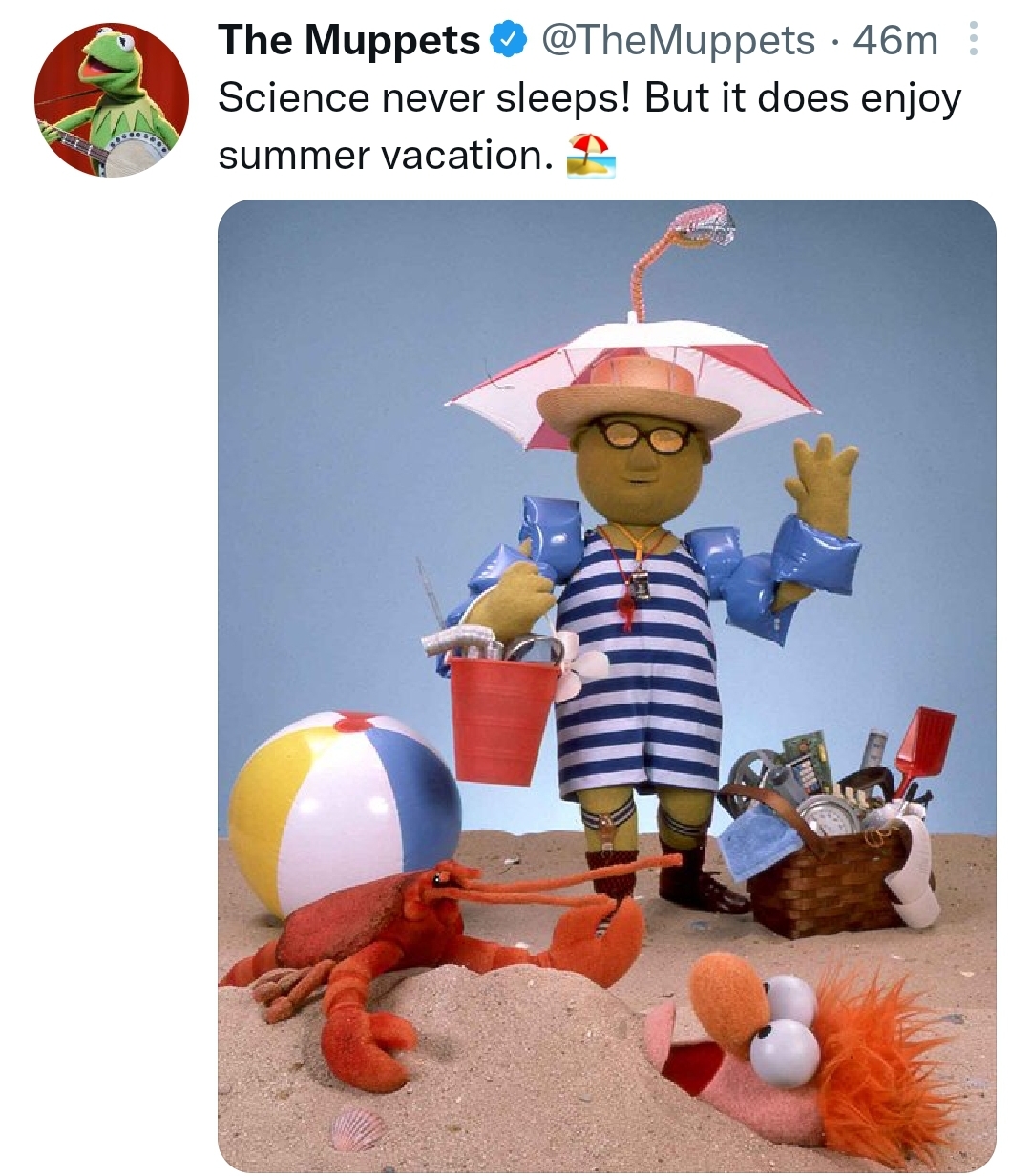
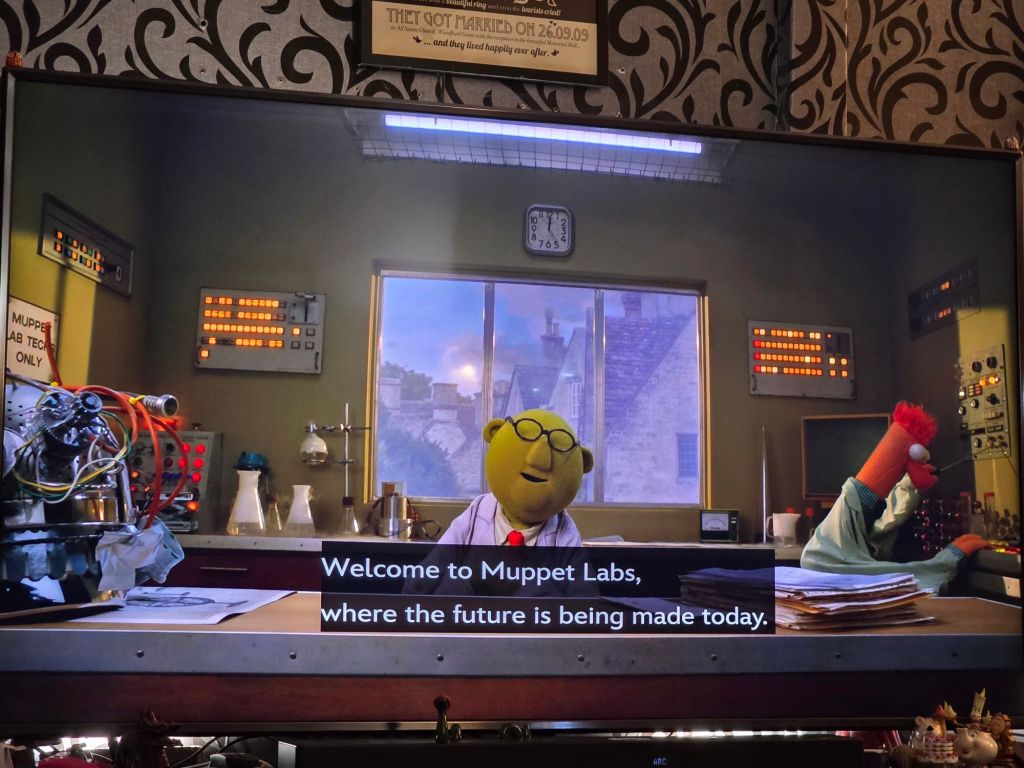
Finally, I wouldn’t be me if I didn’t mention how much joy Bunsen and Beaker bring me. No, I don’t ever want to work in their lab. No, I’m not sure they comply with any health and safety guidance ever written. They do however completely change how people normally see scientists. They are not distant. They are not ‘other’, other than being puppets. They have joy in their work. Things go wrong, regularly, and yet they are always there the next week trying something new. They embody the joy of exploration, well at least Bunsen does, I think Beaker probably needs some time off to recover. In a world where science is either vilified or portrayed as being undertaken by people so intellectual we can’t envisage knowing them, The Muppets still being me joy by offering a grounded view of the joyful chaos that being a scientist can bring.
The truth of it all, even if we learn nothing else from them, is that The Muppets tell us that if you are doing what you love everything will find a way to being OK.
As for Miss Piggy, I salute you! Let me know how I can be as stylish as you!
It’s the 8th March, and we all know what that means…..It’s International Women’s Day!
This year, International Women’s Day is timed pretty wonderfully for me, as it happen to also be just as Healthcare Science Week is about to kick off. As both a woman and a Healthcare Scientist, I thought this was a great opportunity to combine the topics and talk about how these two things have impacted how my science career came about, and why I think a lack of recognition of both has incredibly important impacts on society as a whole. That said, this is also a post about how far we’ve come and the role that female scientific representation in the media has, and can have, on how we feel seen as women in science.
In what feels like a different life, where I was younger and had better hair, I was selected by the Royal Society of Biology to do some filming linked to raising the awareness of women in science. The session is short but was really interesting for me to do as it centered on who inspired me to become a scientist and how it happened. Now, many of you who read this blog will know all about that tale, but for context, I’ve linked to the video below:
The thing is, I suspect that there are still many people out there who might love to do science, and yet they’ve never had the chance to meet a scientist or really learn about the brilliant variability of a career in STEM (science, technology, engineering and maths). So what’s my point? Getting to actually meet and chat with a real scientist still feels like it’s a thing for the privileged few, not something that is available for mass consumption. You know what is available for mass consumption? TV and movies. This blog reaches 20 odd thousand people a year, a single episode of a TV programme, like Holby City, makes those numbers look so small they are not even worth considering. So it matters that the roles of female scientists within movies and on TV have not always been the most representative of either the careers available or the type of people that choose to engage with scientific careers. The reach and expectation setting that the media can have dwarfs any of the best efforts I can make across my entire career. Therefore, in order to celebrate International Women’s Day this year, I thought I would take the opportunity to talk through where we started with some of this representation in TV and the movies, and then celebrate quite how far we have come.
Why is it important to have women in science?
I kind of don’t believe I’m writing this section. This one should be a no brainer and yet I think it’s probably important to take a paragraph, especially with all the current commentary about equality, diversity and inclusion (EDI), to talk about why EDI matters.
The data supports the fact that we are far from a scenario where female representation in the workforce mirrors the distribution of women in the population. Worse than that even, is the fact that even if women make it into STEM careers they are doing less well than their male counterparts, including lack of representation in senior roles and general reduced access to research funding. There will be another post at some point about the source of some of these discrepancies but hint – it’s not because the women are worse at their jobs, that blog is still a little way away however.
One of the reasons for the lack of of women in STEM careers is that, according to work undertaken by Steinke et al in 2007, children are exposed to gender stereotypes and images of scientists through movies, TV shows and books where there is a lack of good representation of female scientists. They undertook work with primary school children where they asked them to draw a scientist, very few children drew female scientists and most listed media as the source of their inspiration. A similar study in Korea, in secondary school children, showed that only 16% of them drew female depictions of scientists. This kind of data backs up why media representation is so important, as you really can’t be what you can’t see. So many children do not realise that a scientific career is even a pathway that is open to them, if they are not fortunate enough to know one. If children can’t access what that career might look like through the information sources they access all the time then they don’t even consider it as an option for them when making their life choices.
But why should we care that we have less women working in science? What kind of difference do they make that we should try to move the dial on this?
Women make up just over 50% of many populations but much of the data produced by scientists, including clinical trial data, is biased towards male datasets. This leads to the outcome data for females often being less good. Some of this is likely due to a lack of female voice in the room when studies were being planned
There is often a research bias, where issues that purely impact women tend be under researched compared to issues that purely impact men
Inclusion of women in tech pipelines has been demonstrated to improved productivity and boost economic outputs
Science should be for everyone and therefore needs to include everyone. Science is best when it is seen through different lenses and priorities which different individuals bring to the table. Variable opinions drive improved change and innovation, so being inclusive is a win win
By increasing female representation in STEM we can switch up our focus from working to increase diversity and spending energy on being visible and role modelling, jobs that are overwhelmingly undertaken by women in STEM fields in addition to their day jobs, and allow women to compete better with their male colleagues by freeing up their time to focus on their science
What kind of representation did I see in the media when I younger?
Having talked about how important exposure to role models in the media are to encouraging women in STEM, I wanted to kick off by talking about the kind of representation I was aware of when younger and making decisions about my career choices. Now, a key disclaimer here, it appears that my teenage years were some horrific length of time ago, even though I’m blatantly still young, spry and filled with youth. Women, especially those in technical roles, often weren’t featured or were there to act as passive objects for men to respond to or act around. They were all too frequently there to be a foil for the men who were the focus of the storytelling. There wasn’t an abundance of female science representation in any of the media that I do remember, but what was present used to focus on 6 key stereotypes:
The Old Maid – the female scientist who is only interested in her work (and therefore not showing that you can be both a scientist and a person) who, as the film/show proceeds, has her female and emotional side brought out by the main male protagonist
The Male Woman – a female scientist who works in an all male environment. She is not as sexual a character as other women in the setting may be, but she is also not on the same level as the men she works with. She is often presented as having unhealthy habits, such as drinking issues, in order to show (it feels to me) that it’s unhealthy to try to be a woman in a mans world
The Naïve Expert – often a character in a film that is critical but does not contribute to any of the science solutions or really advance the story in any way. These often feel like box ticking roles or to aid the exposition of other characters
The Evil Plotter – usually a young and beautiful character who is there to trick the men within the film. They are set up to be hated by the both the other characters and the audience as they use their scientific knowledge and looks for evil. This one again strikes me as a way of demonising women who bring anything other than their knowledge of science and dare to be people with other needs as well
The Daughter/Assistant – this one is the typical smart and capable woman who is there as a subservient to a smarter, more well known, or more significant male character who will be the one to advance and resolve the plot whilst the female is there as a foil to show how smart and capable the male protagonist is
The Lonely Heroine – a woman who is depicted as intelligent and independent, and allowed to also be sexual, but somehow is not able to compete with her male colleagues. Usually, during the course of the story, she is gradually able to be seen and have an impact but only when she develops a relationship with a man who allows her to be acknowledged by others
Now, don’t get me wrong, all media and story telling is based on stereotypes and tropes, almost everything can be fit into a silo. That said, if the stereotype is only there to serve the male protagonists of the tale, that is a problem and it very much felt that way in films and programmes I watched growing up.
Scully effect
So what changed? I remember so clearly my first encounter with the The X-Files. It came out in 1993 (1994 in the UK) and I kind of missed it, but my sister and brother would not shut up about how great it was, so it took a while for this geeky 15 year old to discover Dana Scully and all of the science joy she would bring to me.
For those of you who don’t know anything about The X-Files (and you really should) according to Wikipedia ‘The series revolves around Federal Bureau of Investigation (FBI) Special AgentsFox Mulder (David Duchovny) and Dana Scully (Gillian Anderson), who investigate the eponymous “X-Files“: marginalized, unsolved cases involving paranormal phenomena. Mulder is a skilled criminal profiler, an ardent supernaturalist, and a conspiracy theorist who believes in the existence of the paranormal, whereas Scully is a medical doctor and skeptic who has been assigned to scientifically analyze Mulder’s case files.’ The reason that this series made such a difference for me, was because it was the first time that I saw a fully rounded female STEM character who was a person, with interests outside of her job, who was also an equal player in the story and able to challenge and lead within the series framework. She was more than just a foil, or a tool for exposition, and the number of times she was the one that did the saving became somewhat of a running joke.
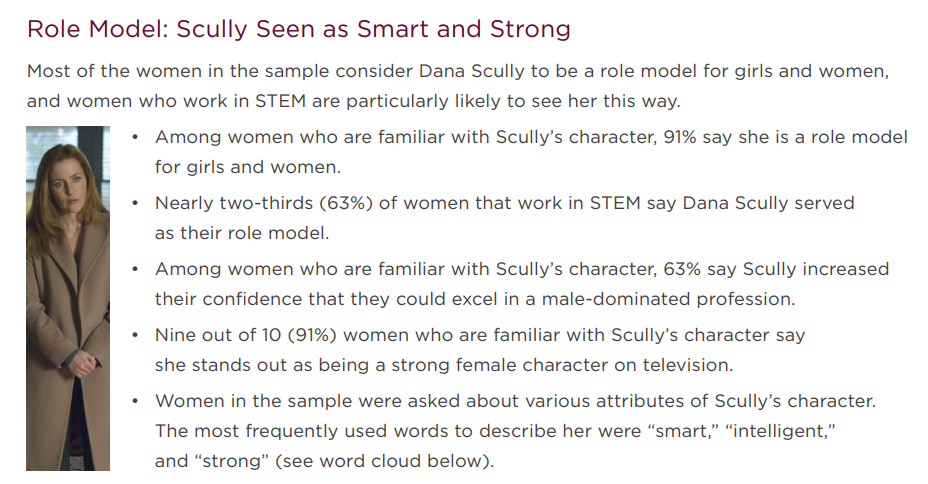
It wasn’t just me that the character of Dana Scully had an impact on, her character led to what has been described as the Scully Effect. The Scully Effect refers to the phenomenon where women were inspired to pursue careers in STEM after watching The X-Files. This was the first time I think I really became aware of the power of the media to impact in more than a superficial way. The impression of this effect has been upheld by a recent study to try and capture some of the way that the Scully Effect impacted on those who watched the show, so you don’t just have to take my word for it.
There is no doubt that the role of Scully in The X-Files felt like a watershed moment for featuring women in STEM careers. Having just talked about the difference that Special Agent (Dr) Dana Scully made in terms of female representation in science I’m now going to excluding medics from the rest of this discussion as a) they are featured much more frequently in all forms of media and b) the lack of female scientific representation is one of the reasons that students see medicine as the only route open to them, rather than seeing the world of opportunities available within the world of science careers. (I still love you Dana, you’re still my girl)
So where did the change in TV go from there? Now, there are a few honorable mentions I’d like to give a shout out to, these are obviously based on my person taste, but I do think they are examples where things have continued to change for the better:
Bones is a police procedural linked to investigations of human remains undertaken by Professor Temperance “Bones” Brennan (Emily Deschanel), who is a forensic anthropologist, supported by FBI Special Agent Seeley Booth (David Boreanaz). Now, in many ways Bones fulfills many of the Old Maid stereotypes, but there are many key differences. For one, her intelligence is always held up as a positive and with high regard, and she is considered to be so valuable that her challenges with more emotional interactions are considered to be over whelmed by the value her intellect brings, which is quite a different take. Secondly, her emotional journey is mostly chaperoned by another female character in the show, Angela Montenegro, rather than relying on a male character for their character development (yes, yes, I know her and Booth get together but I’ll die on the hill that it’s secondary to Angela). Finally, and maybe most importantly, the character of Bones is very clearly signposted as being based on a real person, Kathy Reichs, who was also involved in making the show. As I said, representation is important and the fact that this clearly shows that you can be a successful scientist, and perhaps even close the circle and be inspiring enough to have a TV series based on you to inspire more young people, is a massive step forward.
Kathy Reichs
Two other TV science representations I love come from other police procedural or fantasy series, both are lab guys, all of which probably tells you a lot about who I am. These guys both speak to my heart as they are fully formed characters, not just single dimension caricatures of female scientists. They have flaws, they have passions, they are authentic, and most of all they love the science that is their calling. (this isn’t to say that science has to be your calling for it to be your job, I just love that there are representations of scientists on TV who love science the way I love science)
First, I’m kicking off with Abby Sciuto from NCIS. She’s a forensic scientist, who in that TV way has a world of completely different science skills rolled into one, but I still love that about her as she exhibits so much scientific curiosity. As an ex goth myself, one of the other things I love about her is her sense of self expression and not being limited or making herself smaller on the basis of what others think about her. She the opposite of those female scientific characters who rely on others to enable them to be people rather than lab coats. I fully respect and am so happy to see this kind of female science representation.
Second, is Ella Lopez from the TV series Lucifer, a TV series based on a comic where Lucifer, as the devil, abandons Hell to run a nightclub in Los Angeles. He then (for plot reasons) becomes a consultant to the LAPD and hi-jinks ensue. She’s also a forensic scientist who works for the LAPD, are you sensing a theme? I don’t know whether this is because of the kind of series I like, or whether the writers of these kind of series just feel like they have more time and scope to devout to full character representation. The reason I love Ella is that she is the complete opposite of the Old Maid/Male Woman stereotype. She is the emotional heart of most scenes, and is accepted for bring her full emotional quirky self to the table. As someone who often feels judged for wearing her heart on her sleeve, I love this is represented as a strength in this characterisation of a female scientist.
Let’s talk movies?
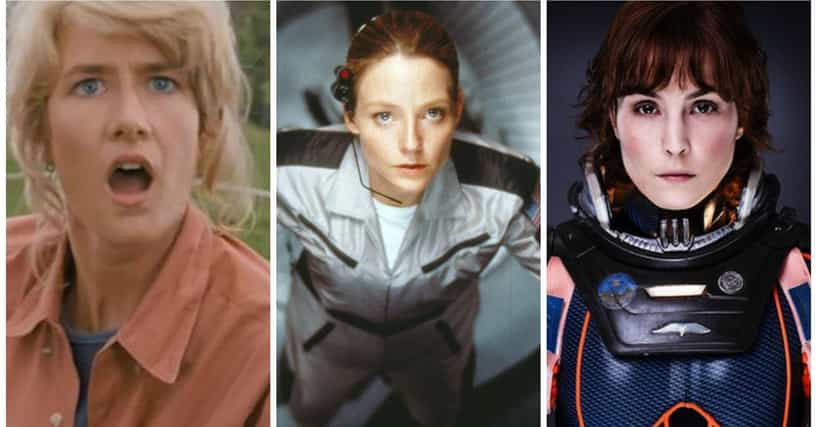
So what about the movies? In some ways female scientific representation is always slightly more challenging in films. Slightly due to the nature of the medium, there is often less opportunity for character development (as you have a few hours vs multiple episodes) and so they still tend to fall very much into some of the stereotypes already discussed. There is still a strong tendency for strong female characters, when present, to still fulfill the Evil Plotter stereotype, and the film industry in general struggles to have female roles that are not reliant on male roles for context. That doesn’t mean there are not plenty of films despite this that have female characters I enjoy (Jurassic Park and Contact being just 2 on the left of the image below).
In terms of movies I want to discuss though, let’s start with the one on the right, Dr Elizabeth Shaw from Prometheus (2012). Those of you who read my Halloween blog on how the Alien movies reflect the world of Infection Prevention and Control, will already know how much I like this film series. One of the reasons the series appeals to me in general is that it doesn’t shy away from strong female lead characters, it started with Ripley after all. The female lone survivor trope is strong with this series, but I also like it when characters like Elizabeth are the ones that survive because they don’t shy away from their intellect and aren’t scared to be the smartest person in the room. Too often we hide away from owning our space as women, and I love a film where the characters are given license to own their space.
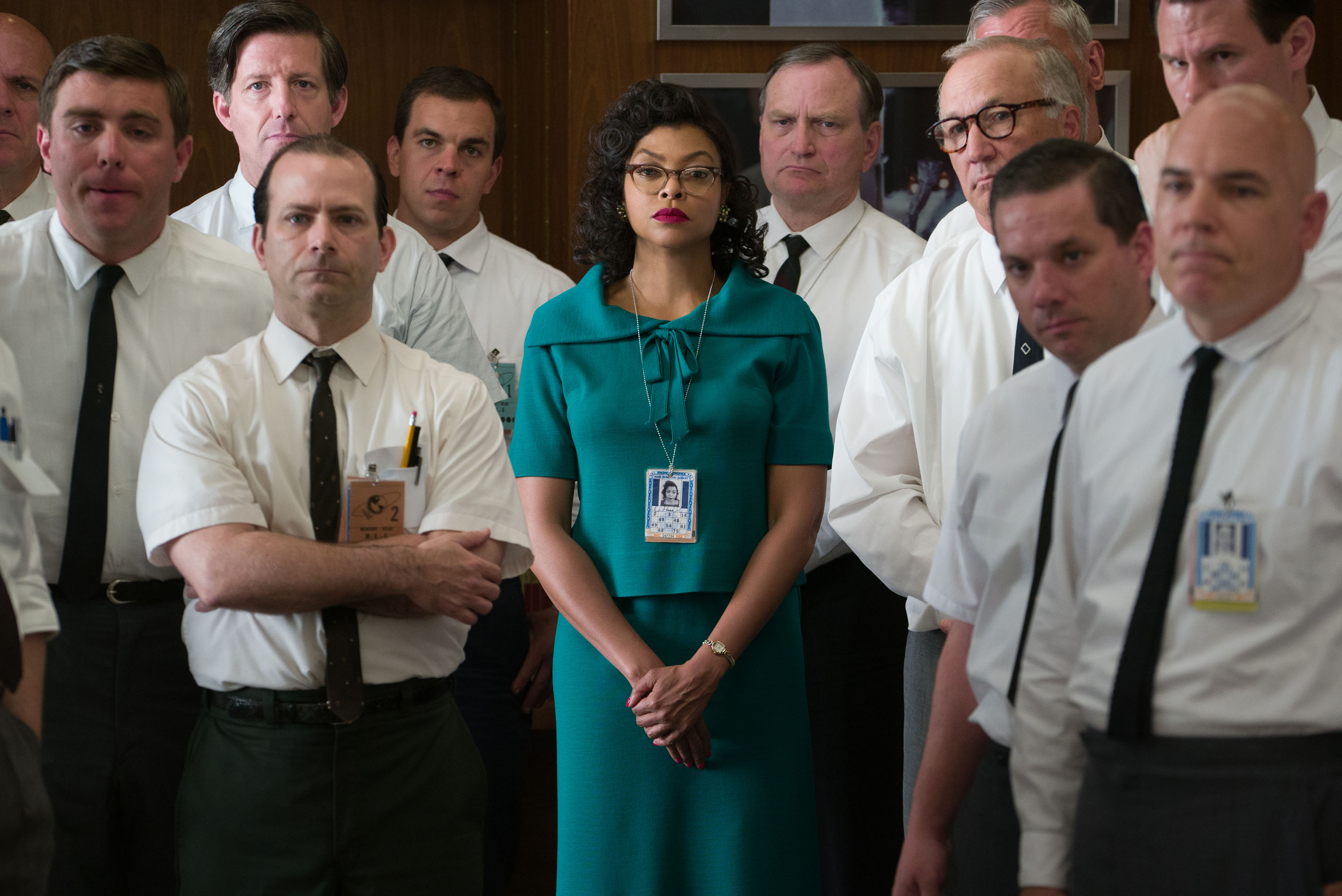
Talking about films where women are given permission to own their space, this next one is based on historical figures. My favourite female scientist movie of all time is hands down Hidden Figures, which came out in 2016. This film is loosely based on the non-fiction book by Margot Lee Shetterly and is about three female African-American mathematicians: Katherine Goble Johnson (Taraji P. Henson), Dorothy Vaughan (Octavia Spencer), and Mary Jackson (Janelle Monáe), who worked at NASA during the Space Race. If you haven’t seen this film I cannot recommend it enough. When I have bad weeks this film reminds me of the fights that others have fought just so I can occupy the space that I’m in, and the continued need to be that fight for the generation that will follow me. It’s about so much more than female representation, some of the challenges that these women faced due to the colour of their skin is mind blowing to someone growing up in the UK, not to say that there are not ongoing diversity and inclusion issues here. This film to me is everything that science representation on the big screen should be, and it’s just a pity that there aren’t as many examples as can be found on the small screen.
All hail Marvel
All this brings me to the one place that I feel consistently hits it out the park for me in terms of both female character representation and in showing scientists as real three dimensional people, Marvel (both Marvel Cinematic Universe and Marvel Studios). Personal opinion, but I feel like Marvel have done more for showing women who are scientists and characters in their own right than most other genre series, an irony I am aware of for a series based on comic book characters. This is probably made possible because they can draw on character development from so many decades of story lines in order to make it work.
My all time favourite is Dr Jemma Simmons from the Agents of SHIELD series, but that could be because you are able to get to know the character over 7 seasons. Film wise, I really love Dr Jane Foster from the Thor series. Previously my all time favourite film science character was Shuri from the first Black Panther series, I’m pretty conflicted about this now however due to some of the anti science opinions held by the actress.
There are frequently great scientific characters embedded across all parts of the Marvel universe ,however, and so I encourage you to find your own favourites. To help I’ve listed some of the big hitters, in terms of main characters, below.
Thor film series with Dr Jane Foster
Agents of S.H.I.E.L.D. TV series with Dr Jane Simmons
Ant-Man (and the Wasp) film series Dr Hope van Dyne (and Janet van Dyne)
Doctor Strange film series Ms Christine Palmer
Spider-Man film series (not actual scientists as too young to have careers but….) Mary Jane Watson
Black Panther film series Shuri
Captain Marvel film Dr Wendy Lawson
Eternals film, possibly all of the film characters as they are after all eternal
Another thing that I appreciate about the Marvel films is that even when a character is not present, due to them being part of another story stream, they often reference the absent character, and not just in a way that talks about their positioning linked just to a romantic other. One of my favourite examples of this is below, from Age of Ultron, and is part of a conversation about why Pepper Potts and Jane Foster are not at a party. The dialogue goes like this:
Avengers: Age of Ultron (2015)
If you are looking for something you can watch with your family, that will hopefully inspire the next generation of scientists, and help ensure that the next time a child is asked to draw a picture of one they may choose to draw a woman instead, this is a great place to start.
I feel we’ve come such a long way in terms of female scientific representation in the media, but there is so much more that needs to happen. We can all work to drive this by being aware of the films we choose to watch and where we decide to spend our money. Those of us working in science can also do a lot to make sure that we take opportunities presented to us that mean we will be seen, and hopefully inspire those who will follow us. Let’s embrace the moment, step out from the shadows, and truly show why having women in the scientific space is crucial for the best science to occur.
Thank you for taking some time out of your day to share International Women’s Day with me!
It has not been a great week for science, with many of us being concerned about how the presence of a vaccine denier on the successful ticket to the white house will impact public health initiatives and the quality of science communication in general. I’ve been thinking a lot about how we got here and how, even more than previously, embedding good science into mediums that are routinely accessed by the majority, will be crucial in ensuring the reach of accurate science communication when some of the more standard public health routes are bound to suffer in the coming years.
I think it will be a surprise to none of you that I am a bit of a lover of TV and movies, we’ve also covered a number of book reviews linked to this blog, and I like nothing better than snuggling down with a good book and a cup of Darjeeling. What does any of this have to do with anything? Infection, infection control, and science in general is a huge chunk of my every day, but this isn’t the case for everyone, or even most people. Many people are passive absorbers, meaning that they may not search out information but take on board when they encounter it when going about their lives. This means that the quality of what they encounter may be hugely variable, depending on how and where this happens. I’ve previously talked about the quality of the science in some of the books I enjoy, including the News Flesh series, as well as posting last week about how infection control is represented the Alien movies for Halloween. These are fun posts to do, but it made me think of the most popular movies that are linked to infection out there. How good is the science they represent? and by doing this better, could we support science literacy in general?
IMDB list of Top 25 Virus/Pandemic/Epidemic/Infection Movies
In order to think about this more detail I hit the Internet Movie Database (IMDB) which contains all kinds of lists, including a top 25 of Virus/Pandemic/Epidemic/Infection Movies (https://www.imdb.com/list/ls094715071/)
A Quiet Place (2018) (Girlymicro comment – I don’t know that this should count as it’s an alien invasion film)
Bird Box (2018) (Girlymicro comment – I don’t know that this should count as it’s an unknown enemy film that does not appear to be linked to infection)
Now, I have only seen 16/25 of these, Mr Girlymicro has seen 22/25, so between us we have most of these, so hopefully I’ll be to comment from a position of knowledge on a fair few of these. Before we even start however, as you can see from my commentary on this list, the poor science starts early during the classification of some of these as infection movies, even before we start to talk about the science content of the movie/show itself. Firstly, let’s look at the name of the list = Top 25 Virus/Pandemic/Epidemic/Infection Movies and how it related to the actual definition.
An increase, often sudden, in the number of cases of a disease above what is normally expected in a specific population and area.
An outbreak, which carries the same definition as an epidemic, but is often used for a more limited geographic area.
The CDC suggests epidemics occur when an agent and susceptible hosts are present in adequate numbers, and the agent can be effectively conveyed from a source to the susceptible hosts. Whereas a pandemic refers to an epidemic that has spread over several countries or continents, usually affecting a large number of people. The starting epidemic is usually due to a combination of factors including:
A recent increase in amount or virulence of the agent,
The recent introduction of the agent into a setting where it has not been before,
An enhanced mode of transmission so that more susceptible persons are exposed,
A change in the susceptibility of the host response to the agent, and/or
Factors that increase host exposure or involve introduction through new portals of entry
So you can see from the above that a number of movies on this list don’t actually count under the terms linked with to the title. Some of them are alien invasion, some of them are climate change related, and one is even on the topic of bioremediation. Yet there they are on the list.
For some of the others, I’ve already covered their concept during my Zombie post, so I’m not going to go through these in this blog, but focus instead on the ones that fulfill the epidemic based criteria. That said, give me a shout if you’d like a more in-depth zombie comparison post as Train to Busan is an awesome movie, and I’ll accept any excuse to re-watch it.
Let’s start at the very beginning
The first film on the list is Outbreak, a film that came out in 1995, with a description of ‘A team of Army doctors struggle to find a cure for the deadly Motaba virus that was transported from Africa to North America by a white-headed Capuchin monkey and is now spreading quickly throughout a small California town.’
This movie has an amazing cast, but I have to say I don’t want any of them in my team if it came to trying to lock down a high risk infection from an unknown source (vector). In terms of the escape monkey component. You’d think that it is far fetched, and if you’d asked me yesterday I would have said just that, but just today on BBC News there was a story on 43 escaped monkeys from a research lab in the US. So far fetched it may be, but not unheard of, in the case of vector escape.
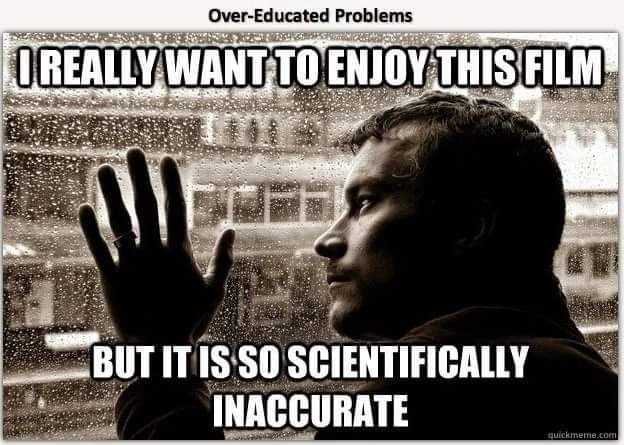
Even if the vector component may not be quite as unlikely as I’d previously thought, I’d like to say that the rest of the practice in this is highly suspect at times. That said, I do have to admit, that I once went to a talk by a scientist who was looking for viral transmission sources of haemorrhagic fevers in Africa. They showed pictures of the table where they performed autopsies on found deceased animals in the jungle, under the same canopy as the table where they then sat down for dinner. So, as much as the way that high consequence infectious diseases (Ebola etc) are not portrayed as accurately as I’d like, maybe this is a movie of its time, as was that lecture. I really want to enjoy this movie, as it so defined how many of us had our first introduction to outbreaks and what they could mean, but almost 30 years on I don’t think I could recommend the scientific accuracy it portrays. The fact that this is still the top rated movie does not bode well for our scientific literacy hopes.
What a difference a decade makes
Almost 15 years after Outbreak, Contagion was released in 2011. This was the first of the infection movies on this list that I saw after I’d started working within Infection Prevention and Control. Contagion is described as ‘Healthcare professionals, government officials and everyday people find themselves in the midst of a pandemic as the CDC works to find a cure.’ I remember going to see this with a scientist friend and whooping out loud at the explanation of an R0, it gave me so much joy I was shushed by someone else in the cinema, to my ongoing shame.
The CDC defines an R0 as ‘The basic reproduction number (R 0), also called the basic reproduction ratio or rate or the basic reproductive rate, is an epidemiological metric used to describe the contagiousness or transmissibility of infectious agents.’ So, see if you share my joy at how the movie explains what this is, in a way that is so much more approachable than the CDC definition:
This film is not perfect, I clearly remember losing my mind about the glove use at one point, and SPOILER ALERT, it was that poor glove use that meant I was OK with one of the characters dying, but the underlying science is well explained and some of the approaches to containment and vaccination are definitely well routed in evidence. The differences in the quality of embedded science between Outbreak and Contagion are highly noticeable. Part of me wonders if some of the drivers for this heightened quality is linked to awareness of the topic due to the 2009 Swine Flu pandemic, or whether this was part of a wider shift towards improved factual grounding in these kinds of movies.
When talking to Mr Girlymicro about this movie, whilst writing this post, he has pointed out that despite my enjoyment he found it an act of ultimate depression which he will not be watching again, and that was when he watched it before the pandemic. It may therefore be, something that triggered my science joy may, in fact, be too depressing or triggering for other reasons to equate to true enjoyment for the general public. This may be an example of something that could risk being dis-engaging by being too close to the truth, despite being second on the IMDB list. Especially in a post pandemic world, this is a line that may prove difficult to walk and prove to be a barrier to movies and TV on this topic being commissioned in the short to medium term.
A completely different movie about primates
Still on viruses and re-visiting our primate theme from Outbreak comes Rise of the Planet of the Apes , which was also a 2011 release. It came out the same year as Contagion, and in the same discussion as Mr Girlymicro stated he would not re-watch that movie, for all the accuracy of it’s science, he would watch Rise repeatedly, and I can testify that in fact he has. Rise has the following description ‘A substance designed to help the brain repair itself gives advanced intelligence to a chimpanzee who leads an ape uprising.’ This is a really interesting addition to the category, as the pandemic aspects of it are mainly actually addressed in the closing credits which demonstrate how a pandemic can spread across the globe, with the film very much focused on the human (and primate) story behind the build up.
This film utilises a viral vector to try to address and revert brain abnormalities linked to Alzheimer’s, with a scientist desperately trying to find a cure for his father, whilst undertaking clinical trials on primates. Now, the clinical trial aspects of this film could not be further from the reality, and any scientist caught undertaking clinical trials and then sneaking the medication to treat their father would at best be fired and at worst been imprisoned. Somehow, because of the focus on the relationships rather than the science, the bad science in this movie bothers me significantly less than that represented in Outbreak, possibly because it feels deliberately portrayed as more like science fiction than science fact. There are some aspects of science to this one that I find interesting and like. The idea of a vaccine or medication behaving differently across species barriers is something that is interesting and could be deeply seated in evidence based plot-lines. I am aware, in this age of post truth and vaccine denial, having a film that focuses on how a vaccine or treatment could end life as we know it may not play into the goals I’m wishing to achieve using popular culture.
Let’s not forget about fungi
In recent years there’s been a rise in the quality of TV and the amount of choice has exploded, especially on streaming and other services. The switch to being able to film big budget TV over shorter film equivalents has provided storytellers with the capacity to really explore bigger and more complex tales that may not have been possible in under 3 hours.
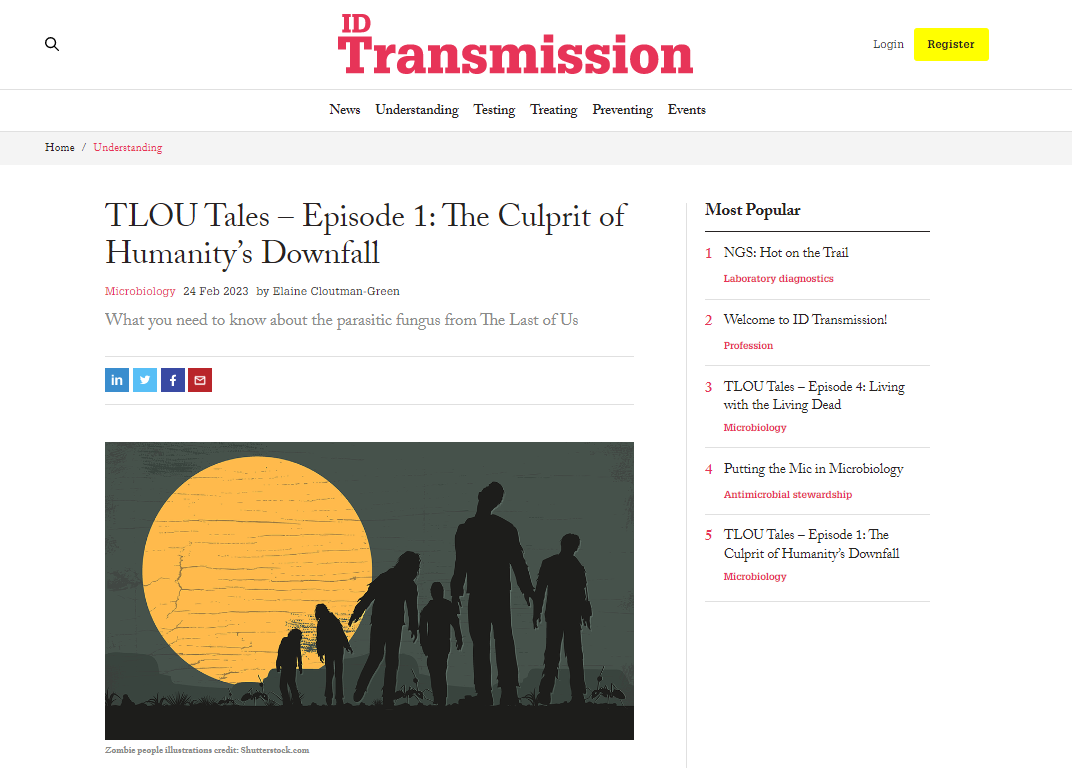
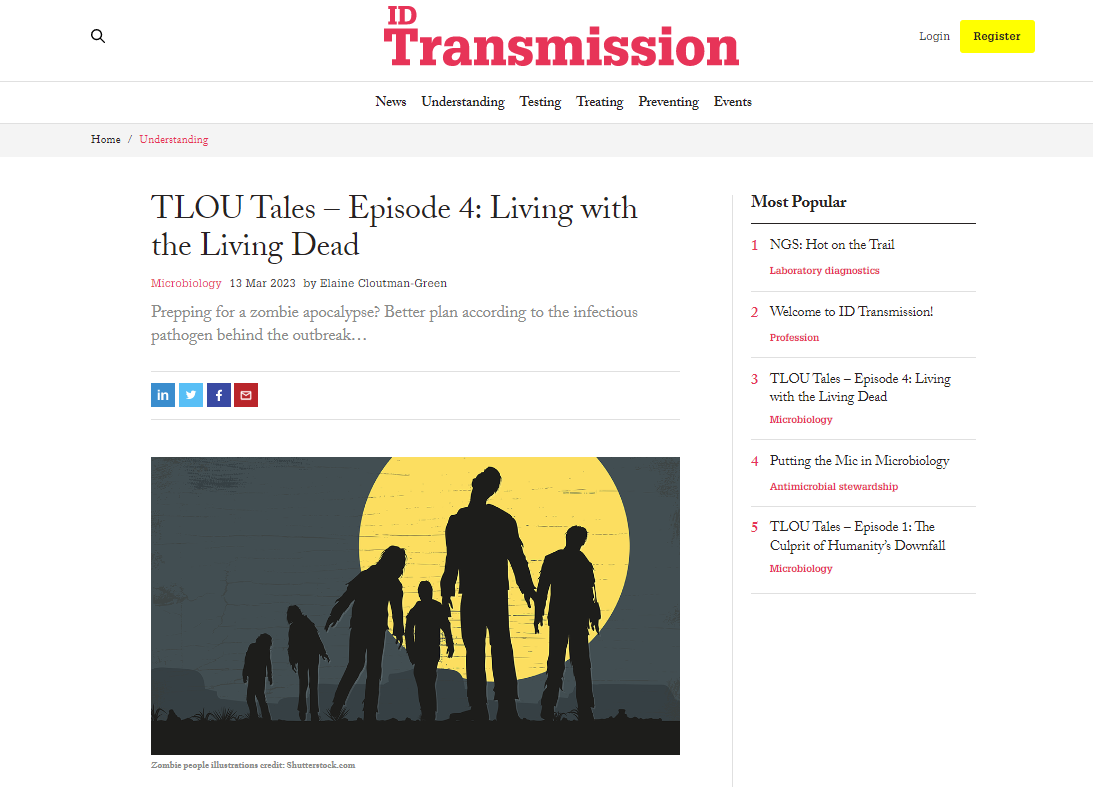
This is last and most recent entry onto the IMDB list and is also the only TV entrant. It is our first step away from the world of viruses, into the world of mycology and all things fungal. The Last of Us came out in 2023, although it’s based on a computer game that was released in 2013. The series is set ‘after a global pandemic destroys civilization, a hardened survivor takes charge of a 14-year-old girl who may be humanity’s last hope.’ This is therefore a great combination of the way different mediums impact popular culture. The plot asks big questions about how far you would go to get a cure for the world, how much is one persons life versus the possible saving of mankind. It’s a real homage to the power that vaccination could hold to impact the world, and how when one isn’t available how desperately people might act in the search for a cure. This is the only entry on the list that came about post pandemic, and I think it is because of that (despite being a parallel to the game) that really resonates on where that desperation comes from, and despite the current vaccine back lash, shows how different outcomes could be.
The very first scenes of the series are a flashback interview from before the pandemic where a scientist talks about what they think the next bit pandemic will be, and I have to say the whole scene brings me unacceptable levels of science joy.
Anyway, this one played so much into my particular ball park that I worked with Liv Gaskill at ID Transmission on a series of articles that talked about the science behind both the Last of Us computer game and the resulting TV series, which pretty closely followed the same plot. This four part series was a real joy to be involved with and so I’m hoping that you might enjoy them too:
I wonder if fungi will be increasingly represented in this genre a) due to the success of The Last of Us and b) as viruses feel a little too close to home these days and so the fungal world might feel like a safer sand box to play around in. This could provide a safe way to have accurate science portrayal, alongside entertainment, as the real prospect of a fungal pandemic is thankfully pretty small.
A shocking oversight
We’ve reached the end of the list, but not the end of the blog post as I want to address an appalling over sight on the IMDB list, and that is the omission of The Strain on the list. This is also a TV series, where season 1 was released in 2014, covered a series of 3 books, and ran for 4 seasons. The series is described as ‘A mysterious viral outbreak with hallmarks of an ancient and evil strain of vampirism ravages the city of New York.’
The strain – episode one, season one
There are many reasons why I love this series (and at some point I should do a vampirism and infection blog to include things like Ultraviolet) is that some of the main characters are epidemiologists linked to the CDC and so some of the science exposition as part of the job based discussions is very pleasing. The other reason I like this series is there is a definite bait and switch, in terms of the causative agent, with all the initial dialogue being linked to your standard viral outbreak, with a gradual reveal that the culprit is actually a parasite. This adds a layer of interest as the approaches to dealing with transmission really start to reflect this, and provide an interesting change as the characters are also forced to pivot and discuss the differences. So, the use of a non-viral infection is not as unique as some of the coverage of The Last of Us may imply. That said, the general science outside of the epidemiology in this definitely becomes more to serve the horror plot than feasibility as time progresses.
Where are the bacteria?
You’ve survived ~3000 words of outbreak talk, covering viruses, fungi and even parasites. You may however be struck by the lack of bacterial cause in any of these listings. I’ve been thinking about this whilst I’ve been writing this blog and I’ve come up with a few thoughts as to why this might be the case:
Too close to home – many people have experienced bacterial infections themselves in their loved ones, sometimes with tragic consequences. It may be hard to therefore suspend belief enough to enjoy the offering. I wonder if this will be true to an extent for viruses now, or whether popular culture will be a safe way to explore collective trauma linked to the pandemic
Too slow – one of the features of many of the scenarios in these movies and shows is that the impact to fast and significant. This an important aspect of making events have real risk and in raising tensions. If accurately portrayed bacterial infections may be too slow in their impact OR the deterioration is so quick there is insufficient time for viewer engagement
Not dramatic enough – bacterial transmission (as described by R0) are not going to be as dramatic as their viral counterparts, so if you subscribe to ‘go big or go home’ this transmission route is probably not the one to drive a sprawling plot-line forward
Too commonly encountered – there are 101 medical shows which have bacterial infections and their consequences featured and so they may be too close to a different genre
The science is pretty hard to get right – as people are more familiar with the topic the less story flexibility there is and the greater the need to not be too jarring for those you are trying to engage. At least in the UK, many people will have been taught about Typhoid Mary and the John Snow Cholera outbreak, and so may have some familiarity. It may also be that these also make people think of the past, and this is not the feel many of these properties are trying to evoke.
So maybe bacteria are a harder sell, although I’d be intrigued to throw a little antibiotic resistance into the mix, or some bacterial toxin related drama and then see what cool things could be done as a result. Maybe that might be my future project 🙂 Let me know if you think that there is a bacterial based film/series that I’ve missed.














 Girlymicro