
This blog post is delayed as I’ve been away stuffing my face with seafood, staring at the ocean, and taking a much needed break. I’m back now though and I have an event tomorrow (Monday, so probably today when you see this), that I’m both excited about and super nervous for. I’m giving a talk for Pint of Knowledge linked to research I’m doing for my new book on infections in movies and TV. Now, I give lots of talks, on average a couple a month, but this one is different. For one, people are paying to see it (I’m not getting paid or anything, I’m assuming it covers venue costs), which means there is an extra obligation that it is both entertaining and worth the entrance fee. It is also a public talk, anyone can buy a ticket, which means that the audience is hard to guess and it is difficult to predict what their expectations are, or if I will be able to meet them. All of which mean I’ve managed to get myself into a bit of a tizz about the whole thing.
Whilst I’ve been having my existential crisis of confidence however, Mr Girlymicro has, as always, been an absolute rock. He’s let me talk through ideas for presentation structure for hours on our holiday, supported me taking my laptop away so I could practice my slides on him, and provided me confidence and reassurance when my courage to try something new took its own holiday and left town. I’ve been thinking a lot, therefore, about the roles those close to us play in the success and outcomes of our lives. Mr Girlymicro, for instance, has both given up a lot of quality time to support my goals, but also carried a lot of emotional burden to get me through tough times. The same is true for Mummy Girlymicro, and my key close friends. Success may appear to be a solo effort, but in reality it’s always a team sport. What I hadn’t realised until recently is how much this is recognised and that there is even a term that really encapsulates this reality, it is known as the Pymalion Effect.

What is Pygmalion?
Pygmalion was originally a figure from Greek mythology who fell in love with an ivory statue that he sculpted of his ideal woman, who was then brought to life by Aphrodite. My knowledge, however, comes from my A-level drama days and my love of George Bernard Shaw as a playwright, who wrote a play called Pygmalion in 1912, which was first performed in 1913. The plot centers around a phonetics professor, Henry Higgins, who places a bet that he can transform a flower girl, Eliza Doolittle, into a refined lady, that no one will be able to guess the origins of, within a matter of months. After a period of intense training, Eliza succeeds in high society but as a consequence of her development journey asserts her independence, leaving the inconsiderate Higgins at the end of the play to establish her own life based on her new self-worth.

The play was then turned into a musical, My Fair Lady, by Lerner and Loewe in 1956, and then captured as a film staring Rex Harrison and Julie Andrews in 1964, which went on to win the Academy Award for Best Picture.

What is the Pygmalion Effect?
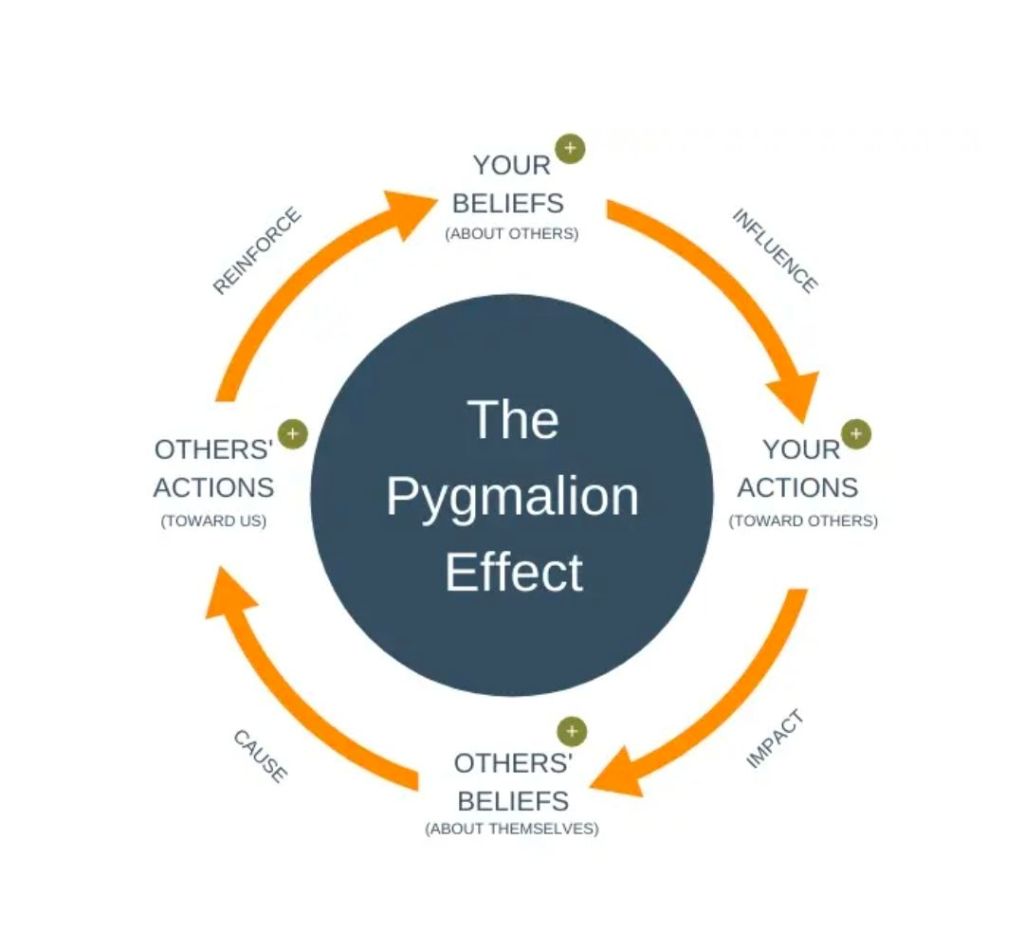
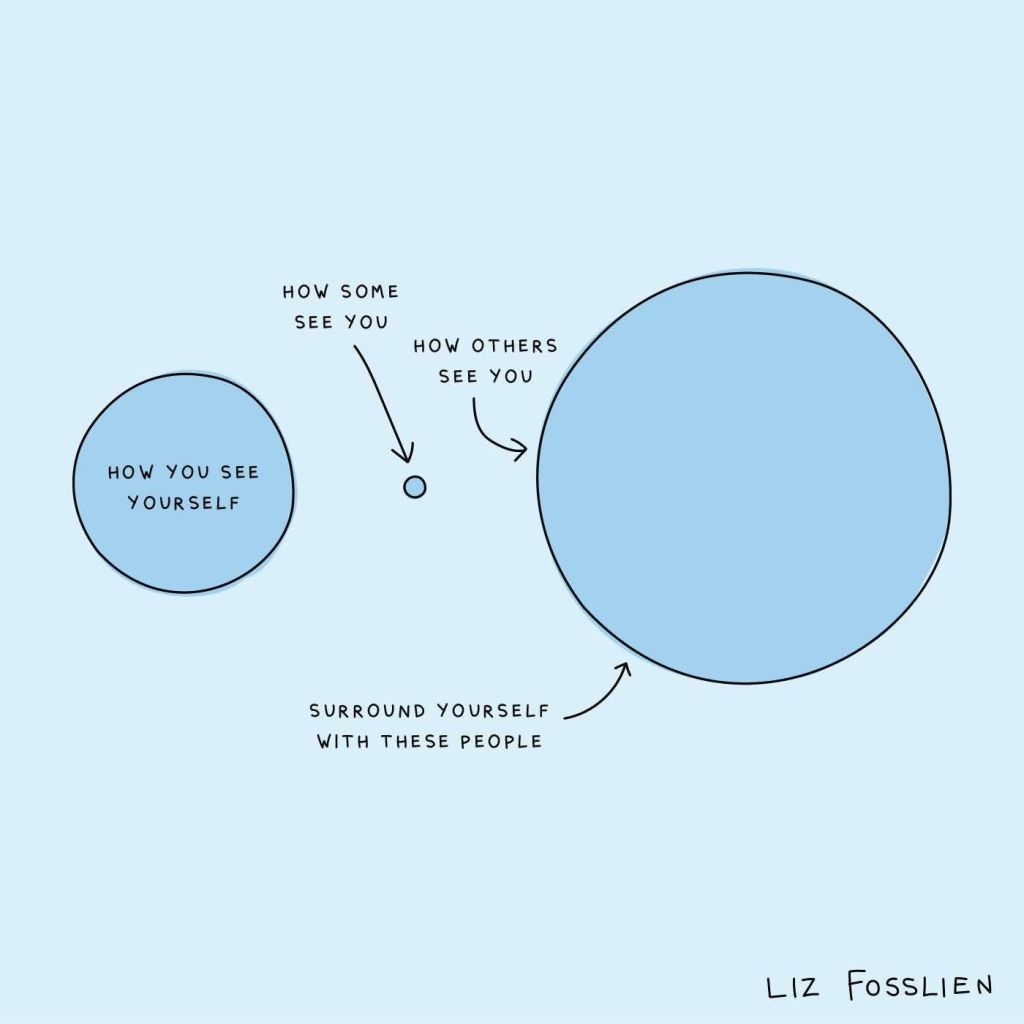
The Pygmalion Effect is a psychological phenomenon where high expectations lead to improved performance. This is born from the fact that the expectations of Higgins for Eliza drives her to change and develop (although it must be said he is not kind), because he holds a belief in what she can become. The idea behind the Pygmalion effect, therefore, is that surrounding ourselves with people (and leaders) who have increased expectations of our capacity for success (whatever that means for us) will result in better outcomes.
The effect was first described in 1968 by researchers Robert Rosenthal and Lenore Jacobson who shared it within their book ‘Pygmalion in the Classroom’. The book described an experiment in schools showing that teachers’ positive expectations of “bloomer” students led to higher IQ scores, although it is worth noting that subsequent experiments have not always replicated the original data described. That said, the concept holds a certain amount of internal logic. If you are the target of positive comments and supportive behaviour, you are likely to internalise those comments and respond to that behaviour. It is known that those with internalised positive labels succeed accordingly, this is something that also links to privilege. A similar process works in the opposite direction in the case of low expectations, where low expectations can lead to worse performance and the inclusion of negative external commentary into sense of self.
What does it mean for us as individuals?
What this means for us as individuals is that the people we choose to keep closest in our lives matter, as do the leaders we choose to follow, as their voices will impact how we see ourselves for good or for ill. They can either enhance our resilience, and enable us to be braver and take appropriate risks, or they can be the voices that enforce our pre-existing self doubt causing us to fall into a fixed rather than growth mindset. It’s not just about support and reinforcement, it is also about the ‘why don’t you just give it a go’ and ‘of course you should’, the push to take steps and constructive risk that you would not have considered or been brave enough to voice otherwise.
Getting distracted by the noise
There’s so much noise in our day to day lives. There is so much distraction. If you look at LinkedIn or social media, it is easy to become overwhelmed and to question whether we are enough. When you are on a clinical career pathway which lasts years, it can be challenging to maintain your motivation, and to manage the challenges involved, in a set of career steps that require focus over more than a decade.
For me, I needed to take a lot of risks and steps into the unknown if I was to achieve the career I envisaged. I knew, for instance, that I wanted to become an Infection Control Doctor but there were no other scientists in that role. I knew I wanted to maintain an interest in education, when I didn’t know anyone who held an education qualification, and include that within my Healthcare Scientist role. I knew that I wanted to have equivalent qualifications to my medical colleagues to help establish my professional credibility, but didn’t know anyone who had succeeded at FRCPath whilst working solely within a specialist setting. There is no bench mark for knowing whether you can succeed in goals where there is no established pathway, or whether you are ready to take the next step. At key decision points, therefore, those that surround you can be a key influence into whether you saddle up and ride out, or hunker down and wait.

Using those close to us to find the signal
Sometimes, what we need is to have someone who helps us cut through all that noise. Someone who can be a sounding board for processing our thoughts. To aid us in deciding whether the goal we are considering is the one that we really want to follow, or is it just the one that is most visible, most accessible, or most acceptable to those around us. To think about whether it is something we want, or something we are doing for others. To help ask us ‘what is it that you want?’ ‘what is the end game?’ ‘what could your next steps be?’. They can also help us respond to the doubters, the critics, and those who ask ‘why would you want to do that?’. To help us ensure that we listen to the right voices in our lives, rather than the ones that might just be the loudest. Not everyone will see your vision, but having the right people in your life means that there will be people who can validate your vision, even when they can’t quite picture it with you just yet, because they have trust in you, your ability, and your decision making.
Actively choose who you pay attention to
This only works, however, if you listen to the right people, and spend time with the people that ask you the right questions. The people who ask ‘what will your next step be?’ rather than ‘why would you want that?’. This means that you need to choose who you surround yourself with and pay attention to the signals that the way they speak to you send. The people who, when you say ‘I need to skip tonight and revise’, say ‘sure, shall we lock something in the diary to help you celebrate when it’s done’ rather than pushing the ‘one night won’t hurt’ commentary.
NB there are definitely times when pushing someone who is going too hard into a night off to recover is the right move, here I’m talking about the repeat pushes that mean the focus never happens
Many of us drift through relationships in our lives, and I’m not just talking romantic encounters. As I’ve gotten older, especially since the pandemic, I think I’ve realised the importance, and joy, of being more selective in those who I keep really close and those voices that I listen to most. Not all conversations hold the same weight, not all opinions have the same value, and I am now just more conscious of the ones that I let engage with my own self talk.
Find people who will push you to do the hard stuff
When I was having a wobble, and seriously questioning whether I had it in me to face my fear of failure and sit an exam, I once called my sister and said ‘I need you to motivate me’ and she replied with ‘do you want fries with that?’. She didn’t mean that being in the service industry was bad, nor was she making commentary on career choice. She was making commentary on my ability to choose what my aspiration was. I could choose a route by which I knew I could succeed. One of no risk, with no need to confront my fears. Or I could choose to roll the dice on myself, put in the work, live within my fear, and aim for the thing that I did not know if I could achieve, and decide that the aspiration was worth the risk.
My privilege is that I have had multiple people in my life who pushed me to do the thing I didn’t know I could achieve. Who pointed out that failure is learning, and that to have it within my life was not a source of shame but a source of strength. I am very aware of how fortunate that makes me. I also had a mentor in my career who told me it was OK to try, who had my back when I wanted to be the first at trying something that was not traditional for a scientist. I have even been fortunate enough that support has been demonstrated in concrete ways, such as when Dr Walker undertook organising so many guest blogs for me last year to enable me to focus on getting my first book out (It Shouldn’t Happen to a PhD Student). Things that don’t just change your internalised view but also help you to achieve in practical ways.
Keep people in your life who have faith in you when you don’t have faith in yourself
The people I keep close now are all ones who whose opinions I trust. The ones that will tell me the hard stuff as well as the good, and because of that I hear and take onboard when they tell me the positive in a way I wouldn’t if they didn’t also call me out when I’m being a less good version of myself. Mr and Mummy Girlymicro will often be the voice of reason when I’m lighting myself on fire with self imposed deadlines. They are also the ones who will push me to be braver, and as Mr Girlymicro say ‘JFDI’ or ‘just f*****g do it’ when I’m prevaricating and letting fear make my decisions, rather than knuckling down to the job in front of me.
To have trust, you need to know that they will do what is needed in the moment. If they tell me this may be a stretch, but even if I fail I will get through it, I believe them because they acknowledged the level of challenge I am facing. Sometimes, you need a cheerleader in the room. Sometimes, you need the honest truth. Be aware of your needs in the moment and go to the right people to address what is actually required. You will likely have more people that can act as your cheer squad, than the number who will sit with you in the truth of the challenge that you face. One may sometimes look like the other, but they are actually entirely different roles.
Beware your Dunbar number
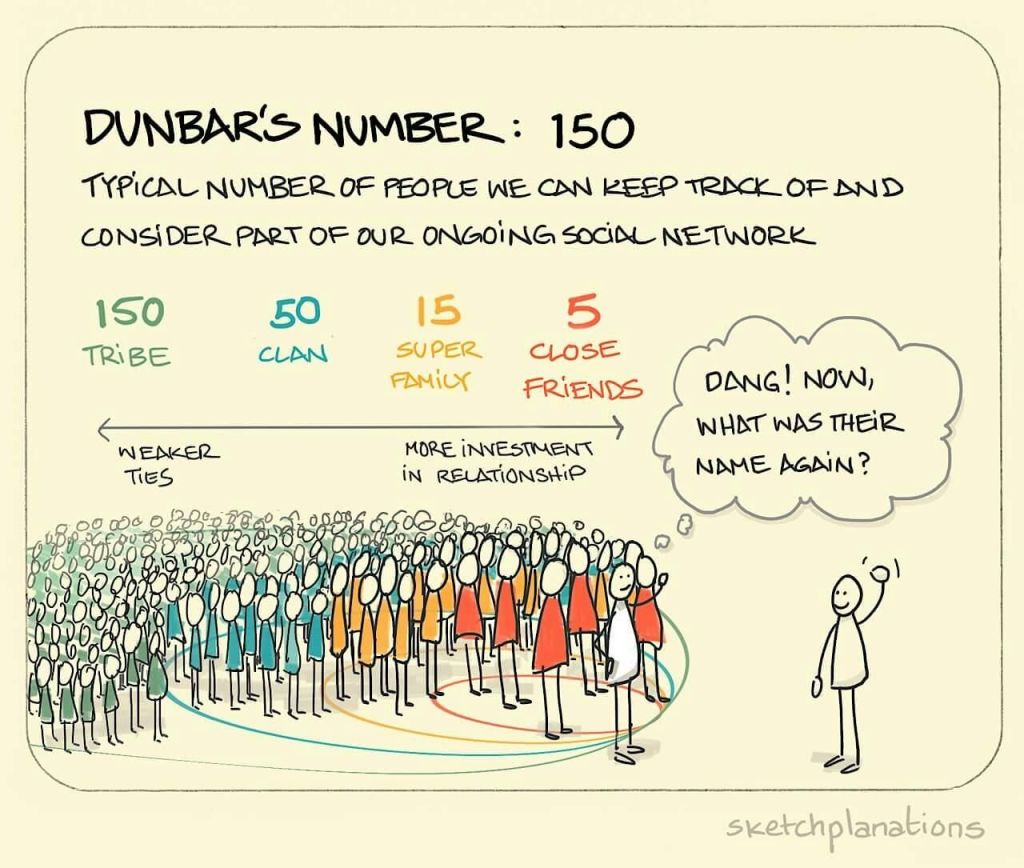
The reason why awareness of the roles you need playing, and who can play them in your life, is valuable is that we are only able to maintain relationships at specific levels with set numbers of people. If you choose to have those closest to you as the ones that magnify your self doubt, rather than pushing you to be greater, then you are using up a finite resource without maybe recognising it as such.
I’ve talked about the Dunbar Number before, but it’s the concept that, because maintaining relationships requires input and resource, you can only maintain a limited number of close relationships at any one time. The number of people closest to you, often your direct family, is usually limited to about 5. Beyond this you have your super family, that slightly wider circle of close friends but not necessarily the people you would call at 3am, which is still limited to about 15 people. The choice of the people we include in these small, but highly impactful groups, can therefore have exponential impacts on us individuals, especially for an area of our lives where we may not undertake conscious review of its influence. Choosing who sits within those categories wisely can literally be a life changer.
Celebrate those who you choose to keep close
Now, I’ve talked a lot about how other impact us, but relationships and leadership roles are bi-directional. You are not just on the receiving end of positive or negative reinforcement, you will also be the instrument of delivery. It is crucial, therefore, to consider who we want to be on the other side of this equation. To think about our word choice, motivations, and actions towards others. To consider our opportunity for impact, not just for our close family and friends, but those team mates and mentees who are within our sphere of influence. Small actions and word choice can really impact, without our conscious awareness, especially if they are undertaken over a period of time.
So my final thought is that we should not just choose who we want in our close circle with purpose, but be aware of and choose which inner voices we want to support in others, the one that makes them doubt and fear, or the one that enables them to take their next steps bravely and grow into spaces they never believed had room for them. Everything is a choice, whether made conscious or not, let’s choose to raise others not amplify their fears.
All opinions in this blog are my own

