
I am currently in the middle of secret project, which I hope to announce more about in late August/early September. I’m really excited about it but it’s taking a bunch of my time. I’m hoping that you will be just as excited when I can share more details. The wonderful Dr Claire Walker is helping me deliver my passion project by curating the Girlymicrobiologist blog for a few weeks. This means that I hope you all enjoy getting some great guest blogs from a range of topics. Girlymicrobiologist is a community, and all of the wonderful authors stepping up, sharing their thoughts and projects, to support me in mine means the world. I hope you enjoy this guest blog series. Drop me a line if you too would be interested in joining this community by writing a guest blog.

Previous mycology posts have covered how fungal mycotoxins can cause us harm, and how the new yeast on the block, C. auris, is causing problems in healthcare, but the next two posts will talk about how beneficial fungi can be in our every day lives.
The blog posts will look at how certain yeasts can be used in something that brings me a lot of joy, bread. Many of you will know I’m dairy free, and although I know I should cut down on carbs, you can take my bread from my cold dead hands. It’s one of the few things I can eat without fear and makes me happy. In celebration of this oft overlooked area of microbiology we shall be talking all things baking over the next two weeks.
The first of these posts is written by Dr Walker who is a paid up member of the Dream Team since 2013, token immunologist and occasional defector from the Immunology Mafia. Registered Clinical Scientist in Immunology with a background in genetics (PhD), microbiology and immunology (MSc), biological sciences (mBiolSci), education (PgCert) and indecisiveness (everything else). Now a Senior Lecturer in Immunology at University of Lincoln. She has previously written many great guest blogs for the Girlymicrobiologist, including Exome Sequencing and the Hunt for New Genetic Diseases.
Before I hand over to Claire though, I thought I would talk a little about baking and fermentation. About 50% of all the PhD students I speak to have dreamt at some point of throwing their research out the window, running away and starting a bakery. This may be because baking has a surprising amount of science within it when compared to some other forms of cooking, hence the need to closely align to a recipe. A lot of this is actually because you are working with yeast, a living organism, hence the fact that we are talking about this on the Girlymicro blog, as micro is just cool in so many ways

Fermentation is an anaerobic (occurs without the presence of oxygen) process where microorganisms, like bacteria and yeast, convert sugars into energy and various byproducts, like acids, gases, or alcohol. In baking, it causes yeast and bacteria to convert sugars into carbon dioxide, among other things. This is what causes the dough to rise, as well as adding flavour, and is therefore essential to all things yummy and bread related. The most commonly used yeast is Saccharomyces cerevisiae, and this is one of the reason baking can behave so variably on times of the day or seasons, as both temperature and pH can impact on how well the fermentation process works. It can also mean, if you are impatient like me, you add water at far too high a temperature and effectively kill off your yeast so it doesn’t work at all. Fermentation, and its use in food production, is one of the many examples of how microbiology and microbes impact our every day lives, and of how much poorer our lives would be without them. So I hope you’ll enjoy the next couple of blogs about how baking has both microbiological and immunological links.
Blog by Dr Claire Walker

As I’ve confessed on this blog before,I am, what I like to call, a ‘failed microbiologist’. Many moons ago I completed a master’s qualification in environmental microbiology and dreamed of a career tracking pathogens through our water systems guaranteeing safe water for all. However, I graduated during a recession and started applying for any job that would have me. As luck would have it, I ended up on the immunology clinical scientist training scheme (the story of that fateful application I will save for a later date), and the rest is history. However, I’ve always loved a bit of microbiology and my fascination with all things fermented has taken me on many adventures. Including baking afternoon tea for a GirlyMicro special event!

My treat for finishing my marking this year was a fermentation course at the Welbeck School of Artisanal food learning all about the transformation of food by microorganisms. The word fermentation comes from the Latin fervere meaning ‘to boil’ after Romans watched the bubbles forming when they fermented grapes into wine. Name a scientist who doesn’t love a bit of Latin? There are several biological processes occurring when we ferment foods like grapes, but essentially it is a process by which large chains of molecules are broken down by enzymes into their smaller, tastier, more nutritious, and more easily digestible parts.

The area of fermentation about which I am really passionate is sourdough. Yes, I lived in East London for many years, and yes, I owned a banneton before it was cool. Sourdough doesn’t just indulge my microbiology side project; it became unexpectedly personal. After picking up a particularly unpleasant microbe while travelling in India, I developed amoebic dysentery, and my gut never fully bounced back. I couldn’t tolerate shop-bought bread or much of anything, really. It wasn’t until I began incorporating fermented foods, especially sourdough, into my diet that I noticed slow but steady improvement. (Though let me be clear: this is my experience, not medical advice – if you’re unwell, definitely speak to your clinician!)
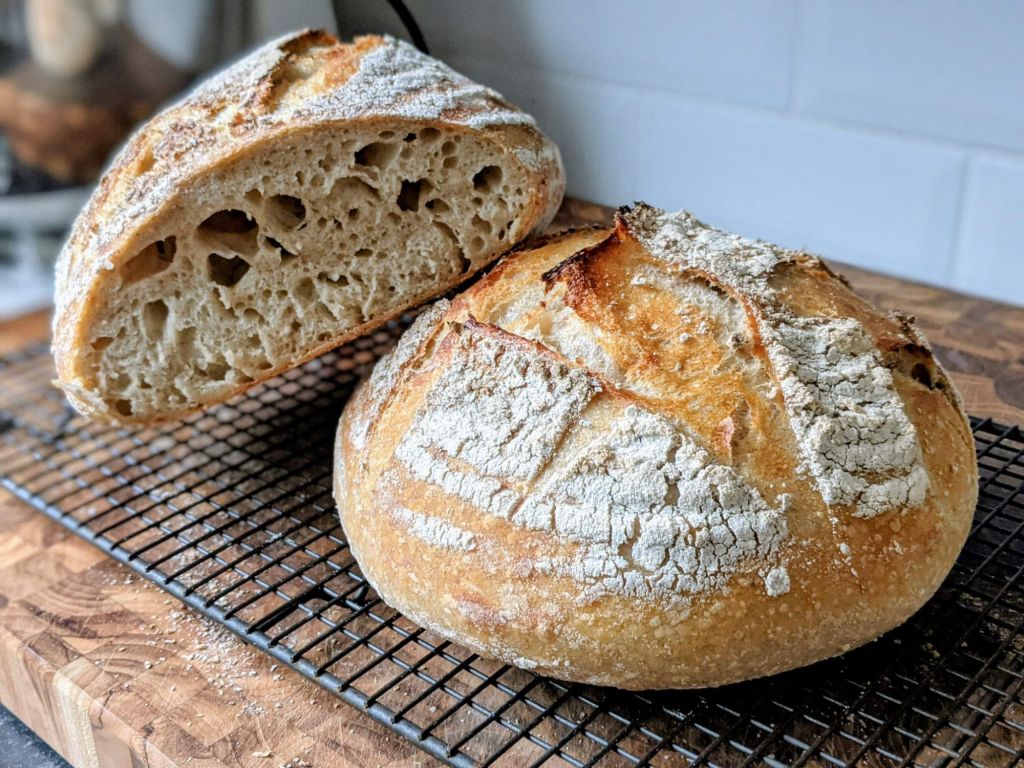
For the uninitiated, a sourdough mother, or starter, is a living culture of wild yeast and lactic acid bacteria that needs regular feeding with flour and water to stay active. As a failed microbiologist, I found something oddly fulfilling about sustaining a microbial ecosystem especially one that produces bread with real health benefits. What’s not to love about a culture that feeds you back?
Of course, I’m a dyed in the wool clinical immunologist so I can’t finish up this post without waxing lyrical about the immunology of sourdough. What makes sourdough really special, from an immunologists perspective, is how it supports our gut, which is home to about 70% of our immune cells. By encouraging a healthy mix of gut bacteria, sourdough helps produce bioactive compounds that keep our immune system balanced, strengthening our defenses without overreacting. This means it can help protect us from infections while calming down low-grade chronic inflammation that might otherwise cause problems. So, sourdough isn’t just tasty, it’s a simple, natural way to support a well-regulated immune response. Of course, sourdough isn’t for everyone, especially not for coeliacs. After all, even the most dedicated immunologist moonlighting as a microbiologist hasn’t yet figured out how to turn gluten into something completely safe. Guess some mysteries are still off the menu!
All opinions in this blog are my own
 Girlymicro