
I’ve been thinking a lot about goals lately as I have two awesome PhD students who are currently in the thesis writing mines, and having taken a few years away, I’m preparing to re-enter the grant writing labyrinth. This thinking has led me to actively spend some time considering what can make a goal helpful, but also what can make it a millstone around your neck and something that actually makes life tougher.
As you’d probably expect, I spend a lot of my working life talking to people about goals, be they personal or organisational. I’ve also spent the last 20 or so years setting good goals and also setting some truly dreadful ones, either because they were unachievable or developed in a way that just wasn’t helpful. So I thought this might be a good moment to share what I think a good goal should look like in case it helps.
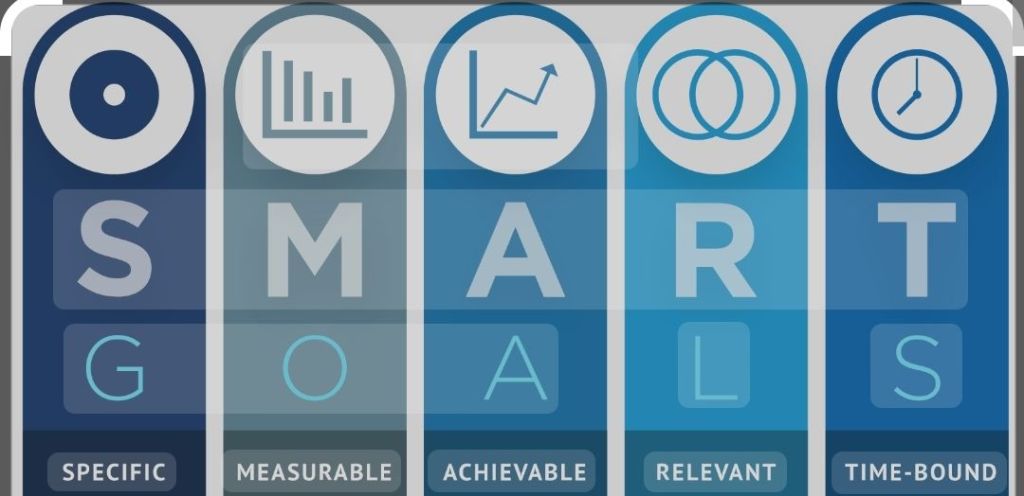
Goals should be S.M.A.R.T.
You will hear an awful lot about how goals should be S.M.A.R.T. These criteria were proposed by George T. Doran (1981) and stated that goals should be:
- Specific: Targeting a particular area for improvement.
- Measurable: Quantifying, or at least suggesting, an indicator of progress.
- Assignable: Defining responsibility clearly.
- Realistic: Outlining attainable results with available resources.
- Time-related: Including a timeline for expected results
These principles can make goal setting sound really complex, and like their development will take a whole bunch of time. That can definitely be true if you are setting things up for a big piece of work or a project. The principles can however also be applied to more modest goals that aren’t about big things. For instance, if I manage to do a 20 minute block of writing right now, I will reward myself with a pot of the pink earl grey tea I currently love so much. Therefore getting into a habit of thinking what is achievable and embedding specificity, even into the little things, is a good routine to get into.
The right goal can get you over hump day
One of the reasons I find goal setting so useful is it can get me away from big picture thinking. Sometimes, seeing the big picture is what you need. They are other times, however, when seeing that big picture can feel overwhelming or dis-empowering, and what I need is to be able to break my task/goal into small enough chunks that I think I will be able to take the steps forward that I need.
In all honesty, sometimes those chunks have to be pretty damn small if I’m struggling. Sometimes, they can be larger. Sometimes, they can aim at controlling the next 5 minutes of my life, and sometimes, they can focus on a whole day. A key piece of learning for me has been to understand what I need to have in order to service the need, whilst acknowledging that I’m not a robot, and so some days I will need to accept that my productivity looks different.
If I’m setting up a big set of goals for a project, I therefore need to be flexible enough in my approach to allow variation in how any blocks of sub goals written can be brought together or modified based on the needs of the day. Motivating enough to get me over the hump, not so formidable that I’d rather do nothing than look them in the eye.
No goal stage should take longer than you can attain in one sitting
This is a big one, for me at least, no individual goal should take you longer than one sitting. That one sitting could be a day, on some days that one sitting could be 20 minutes, but one sitting is my time boundary for an individual sub goal.
There are a few reasons for this:
- Different sub goals can get combined based on how I’m feeling and my capacity to be challenged on any specific day
- Keeping them time limited means that they are easier to monitor, tick off and see progress, even when it feels like a slog
- I find it easier to plan my total work that needs to be achieved/go into something if I have a workable unit of input that is going to be required
- It means that I only ever have to do one achievable thing in order to feel like I’ve done something. Otherwise, failing to complete my goal because I’ve set myself too much to do, can leave me feeling like I’ve failed rather than I’ve failed to plan appropriately
A lot of this, for me, is about learning how to trick my brain so I can move forward even on those days when I just don’t really want to but it has wider benefits in terms of tracking and flexibility in terms of thinking outside of delivery alone.

Goals can be multistage
All of this doesn’t mean that you can’t use goal setting to work towards a big plan, a big vision, or a big task. If you are working towards your 5 year plan, your thesis, your fellowship, you absolutely need to have a plan and goals that encompasses everything. The plan cannot however be ‘write a thesis’ or even ‘write a thesis by the end of 2024’. Those types of goals are the ones that become millstones as they include all the expectation aspects of a goal with none of the pathway that would enable you to achieve what’s needed.
Multistage goals require you to look at your big picture and then turn it into a 1000 piece jigsaw, where most of the time you are trying to find a home for a single piece, but you keep the lid of the box with the picture to hand in order to guide you along the way. Getting to a point where you are able to break the whole down requires you to do 2 things. One, do your research so you know about the project/larger goal in detail. This enables you to sensibly decide where you can segment it. Two, spend some time getting to know yourself, what motivates you and your rhythms, so that you can be sure you are breaking down the whole in a way that facilitates rather than hinders the way that you work. There is no point in being deluded and pretending you are or work like someone else. At this point, realism, no matter how much you like or dislike the truth, is key.

Goals should have details
I will say this once more with feeling (still one of my favourite Buffy episodes). Your goals must never be things like: ‘write a chapter’, ‘write a paper’, ‘write a thesis’. Not unless you have a constant level of superhuman motivation. Your goals need to be much more specific and achievable.
There’s an example of a high level goal written below, but I tell you that I would find that unachievable if that is all I had. I would need sub goals below it per week and per day. I say this as someone who used to run half marathons. I would need a ‘on week one of training I will run so many miles’ and ‘on day one of week one I will do X’. Otherwise, I would get to the end of week one supposedly needing to run 30 miles that week having run none, and facing up to the fact that I would have failed at the first hurdle as there was no way I was running 30 miles on a single weekend. This kind of failure can really get into your head and change how you feel about the next stage, and ensuring you don’t make life harder for yourself is a key life lesson.

Goals should aid focus
You will not feel world beating every day. What good looks like will change on different days. It is foolish, therefore, to pretend otherwise when you are planning your sub goals. Again, you need to be planning for reality, not idealism. It is not only sensible but essential therefore to include flexibility in your goal setting that takes this into account.
One of the best ways I’ve found to do this is to make sure that I have a mix of different styles and types of goals. I include tasks for those days where I don’t have the focus for sustained deep activities, where all I can face is picking around the edges, as well as ones for those days when I can tackle the big thinking and can really dig deep. A good example of this is making sure you have a list of the essential, time consuming but slightly mindless work that always needs to be done for any paper or thesis. Things like figure checking, formatting wrinkles and cross referencing. Don’t waste your days when you have energy and focus on these, keep a list to one side so that even on days you don’t feel ‘on it’ you are able to still feel like you are moving things forwards. Be cogniscent of your state of mind and use that to make the best use of your time.

Goals should support your process not become an additional stressor
My husband has probably lost count of the number of times he’s found me crying on the sofa, and when he’s asked what’s wrong, I’ve said the world is going to end because I’m going to miss deadline X or Y. When he’s then followed up with a question linked to who has set the deadline, invariably he finds that it’s self imposed. He then looks at me with compassion and gently (or forcibly depending on my need) reminds me that if I set the deadline I could also, you know, change the deadline…..
These moments always remind me that the purpose of a goal is that it should enable you to cut out the noise and focus on the now, not become a distraction or thing to be overcome. A good goal should enable you to be motivated even when you don’t feel like it. A good goal should give you an objective way to capture progress, even when you feel you aren’t making any. The best kind of goal should mean that you don’t end up in a crying heap on the sofa as they stop you reaching that point. So develop good habits about goal setting, and your future self will thank you.

Ensure you have a way to monitor progress
I’ve said a good goal should be measurable. There a couple of reasons for this. First, at a very basic level you need to be able to tell when it’s been completed. Setting a goal like ‘improve my piano skills’ sounds fine, but how do you classify that? When will enough improvement be reached? Is sitting for 5 minutes and running scales enough, or are you wanting to be able to play more than Chopsticks?
Second, if you are involved in something that is big or multi goal, you will need to be able to see progress being made. Part of this, if you think like me, is that I need to be able to visualise that I’m moving forward in order to maintain my motivation, and being a scientist I like quantitative data to show that I’m not just lying to myself. The other component of this is about learning for future activities. By setting measurable goals that have time scales attached, in order to can capture trends, supports you to be able to set better goals in the future . For instance, I know that I always under allocate time and have learnt the hard way that I need to add 1/4 additional time to things vs. the time I originally planned. I have also learnt that I will take an age on the initial phases of any piece of work, way way longer than I had allocated. This means, however, that my writing phases tend to be much shorter than allocated, as if I’ve done my planning/thinking, I can get 5000 words down a day.
If I don’t have goals that are not only measurable but monitored, I can only get part of the benefit of undertaking the work linked to setting the goal in the first place. So do future you a favour and make sure that you have mechanisms for doing both as part of your day to day to maximise both your outputs and your learning.

Goals should be regularly reviewed
You will only get the learning potential out of goals if you see those goals as live items. Pieces of a puzzle that should be regularly reviewed by holding them up against the box lid, which has the wider picture. Goals that are no longer helping should be reviewed, and the whole plan should remain flexible enough to change so that it can better fulfil the purpose. If you find out that you have allocated time scales that don’t work, missed out crucial stages, or just made individual goals too big and need to break them up, this is much easier to fix if you embed reflection throughout. Otherwise, you can end up crying on the sofa as you have been too inflexible or focused on the finish line to flex the details along the way.
I would advocate setting reflection points at regular time intervals, but also at the start and end of a new stage, in order to think what went well and not so well. For instance, if you are writing the first data chapter of your thesis, were your time allocations correct? How did your list of mop up activities work? Was there anything you missed out or had present that you didn’t need? Then, use this learning to adjust everything moving forward. It’s also worth having a wider review stage at the end so that you can roll any higher level themes into your learning for next time. You may not write another thesis, but you will write other large documents, so maximise the learning opportunities where ever possible.

At the end of the day, you rather than the goal, are the one who needs to be in control
The purpose of all of this thinking and preparation is not, in the end, to make extra work for yourself. The purpose of this is to give yourself a framework to support thought and mean you don’t waste time or lose direction later on. A goal is a tool to help, not a noose to choke self confidence or creativity.
The other thing to bear in mind is that a goal is not a deadline, and we should stop treating them as such. A goal is a way of helping you deliver to deadlines, but it is not an end in itself. You will have goals for things that don’t have formal deadlines, and you may even have deadlines for things that don’t require goals. Knowing the difference and seeing goal setting as just another tool in your toolkit that is there to help you achieve and reach your aspirations can really help change your relationship with goals and goal setting. If your goal does take control and end up becoming a deadline in itself, lay back and enjoy the feeling that comes with the sound of it whooshing past in order to re-set your relationship and put yourself back in the driving seat. You are the one in control after all.

All opinions in this blog are my own
If you would like more tips and advice linked to your PhD journey then the first every Girlymicrobiologist book is here to help!
This book goes beyond the typical academic handbook, acknowledging the unique challenges and triumphs faced by PhD students and offering relatable, real-world advice to help you:
- Master the art of effective research and time management to stay organized and on track.
- Build a supportive network of peers, mentors, and supervisors to overcome challenges and foster collaboration.
- Maintain a healthy work-life balance by prioritizing self-care and avoiding burnout.
- Embrace the unexpected and view setbacks as opportunities for growth and innovation.
- Navigate the complexities of academia with confidence and build a strong professional network
This book starts at the very beginning, with why you might want to do a PhD, how you might decide what route to PhD is right for you, and what a successful application might look like.
It then takes you through your PhD journey, year by year, with tips about how to approach and succeed during significant moments, such as attending your first conference, or writing your first academic paper.
Finally, you will discover what other skills you need to develop during your PhD to give you the best route to success after your viva. All of this supported by links to activities on The Girlymicrobiologist blog, to help you with practical exercises in order to apply what you have learned.
Take a look on Amazon to find out more
 Girlymicro