Hold on Tight Its Going to Be a Bumpy Ride: The truth about my journey from trainee to consultant

Firstly, lets start with an apology. I’ve haven’t posted for a month as I’ve been struggling health wise and not really been able to get to a laptop to be able to write. Although annoying, it has given me plenty of time to think about what I might want to write next, so hopefully you’ll forgive me.

Now, onto the present. I’ve been in post for 20 years this month, and have also just spent some time recording a couple of webinars that covered bits about the journey to consultant. It felt timely, therefore, to put something out there talking about my experience of the consultant journey. Word of warning, though, this is only my experience, and everyone’s journey is different. I hope my sharing this it will help others, both in validating the aspiration but also in supporting expectation setting by talking about what it was really like to go through. Frankly, I want to be clear that it is never as linear as it appears from the outside and that that is perfectly OK.
So, let’s start at the very beginning. On my first day in post (all the way back in 2004) I was told that I was on an 11 year programme from trainee to consultant, and boy did I drink that cool aid and believe that would be the truth, after all these people were my bosses, supervisors and mentors. Sadly, it transpired that although they were being inspiring they were also far from being completely honest in terms of disclosing how straight forward, or not, the programme and progression actually were. I am now a Consultant Healthcare Scientist, although it took me 16 years rather than 11. Now I’ve reached the promise land I want to be clear that it was no where near the linear journey that I was sold on recruitment and there was a lot of struggle at every single stage. That being said however, now I’ve crossed the line, I wouldn’t have had it any other way. It was dealing with those barriers and obstacles that made me really decide who I was and what I wanted. It was also where most of the learning was truly at. So I wanted to write a blog post that doesn’t sell the ideal but discusses the realities of what some of those barriers looked like and to make those facing them a) feel less isolated and b) know they can be overcome.
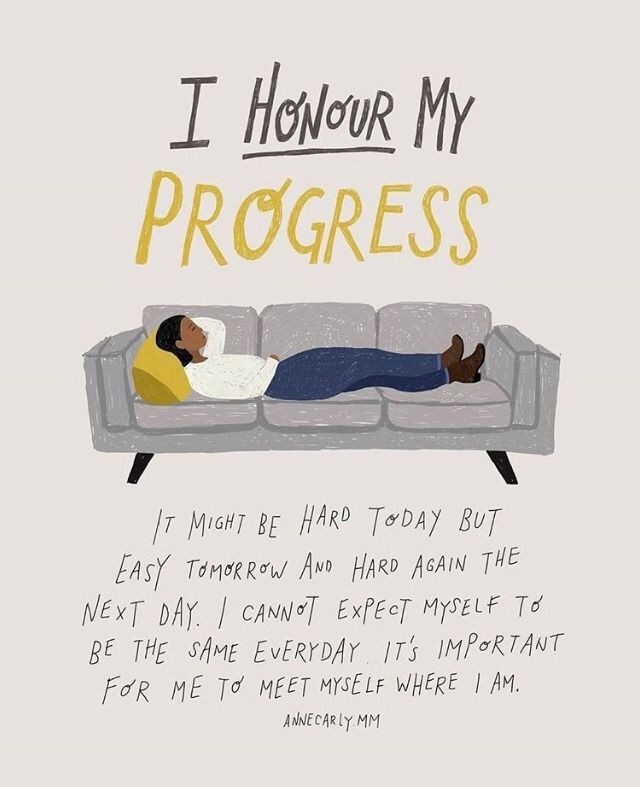
You have to be doing the job to get the job

This one took me a long time to fully comprehend, as it can feel counter intuitive, but you have to already be doing most of the role in order to be able to get the role permanently. It is easy, in moments of frustration, to turn around and say ‘that’s not what I’m paid to do’ or ‘if they want me to do that job they need to pay me for it’. There are definitely times when you need to dig your heels in about workload and boundaries, but this generally needs to be the nuclear option. For the most part, you need to be prepared to roll your sleeves up and jump in to get the experience so that you are well placed to advocate for a post to be created, if that’s your aspiration, or to enable you to apply elsewhere with confidence. For me, I learnt huge amounts when I provided maternity cover for a year as a trainee. It built trust and showed willing to my clinical lead as well as providing me with experiences I would not have had in any other circumstance, enabled me to springboard into my next post, and meant my clinical lead wanted me stay enough they found money at the end of my training. Maintaining an openness to opportunities and an awareness of the fact that stepping up, although not always recognised financially or otherwise, does come with benefits on all sides and is an important part of playing the long game.

There is no single way to get from A to B

When I started, I thought the journey would be straight forward. I’d finish training, I’d get my 4th year funded, I’d get a Clinical Scientist post. Then I would work towards FRCPath and a PhD, hopefully moving into a Principle Clinical Scientist post. Once I’d achieved my tick boxes, my loyalty and hard work would be rewarded and a Consultant post would be forth coming. That’s just not the way work places and budgets work however. On this one patience is THE virtue, and the sooner you can acknowledge that A doesn’t immediately lead to B, the better for your mental well being. That said, the training pathway now available for Healthcare Scientists does make, at least the early stages, more straight forward.

Counter intuitively I’m going to say that, looking back, not having access to the straight forward route has been the most beneficial thing that could have happened to me. I would never have ended up with a clinical academic career if I hadn’t needed to acquire further salary funding and a PhD. I would never have ended up in Infection Prevention and Control if my training programme had been funded for the full four years. So many of the things I value the most only came about because I had to find ways around barriers and due to glorious happenstance. Despite being challenging in the moment, I’m grateful for every detour taken.

When it comes down to it, the person responsible for your progression is you

This one may feel harsh to hear, but no one is as invested in your career as you are. I’ve had a fair few people over years who’ve come to me and said that they deserve to be given X or Y. No matter how true this may be, this isn’t how it works in reality. If you want something to happen, you have to be the driving force to make it so. You are the star of your own movie.

I think a good example, for me, of this was my training programme.  I was really fortunate that no one would block anything I wanted to do. The flip side of that coin was that no one sorted anything out on my behalf. It was my responsibility. I could go to any clinic, shadow anyone I wanted to shadow, but I had to reach out to find the contacts and arrange it. I had to have a vision of where I wanted to be and put together the pieces to enable me to get there. This is, in turn, enormously freeing and terrifying. It taught me early to be the master of my own destiny, and this is an important lesson for anyone on this pathway,  irrespective of how supportive your surroundings at some point you will have to make it on your own.

You will hear a lot of no

One of the reasons to learn early to be your own driving force is that you will hear a lot of no as you under take this journey, whether that be linked to funding, exams, or posts. If you haven’t set your own direction then it can be hard to keep driving, as you may not be sure what you keep pushing for. As the old adage says, if you don’t have faith in yourself, no one else is likely to.

A lot of the no you hear will not be personal, a lot of it will be nothing to do with you or your skills. That doesn’t stop it from being hard to hear or from it feeling personal when it is not. A key skill that isn’t much talked about is learning how to respond to these challenges. You need to move to a place where you are able to process and move on without carrying that rejection with you. To learn from the moment and then let it go, so you always emerge a stronger, better person for the experience.

You have to know what matters

Something that can really help when facing the barriers and challenges along the way is being really clear what matters and why you are pursuing the choices you’ve made. Why does this route align with your own personal values and beliefs? If you understand your ‘why’ then you can weather the delays. It makes it so much easier to get back up when you’ve taken a knock.

The other side of this, which we don’t talk about anywhere near as much, is the importance of knowing what doesn’t matter. You can’t fight a battle on all fronts, and there will be positions you get into when you discover that you are fighting for something out of habit or without thinking about it. This is a waste of energy that you could be focusing on something that actually matters to you. Developing the self reflection to know when this is the case and using it to remove yourself from the arena is one of the most freeing and valuable skills you can invest in. I learnt this late, and I really wish I’d realised it earlier.

It is not an even playing field

I started this journey as pretty naive. I think I genuinely thought everyone would have a similar set of challenges and barriers to overcome. This just isn’t true. I know people who’ve become Consultants over a weekend with no external advert or interview. I know of trainees who’ve gone from point A directly to point B because their faces fit and everything aligned for them, not many but some. The challenging reality is that sometimes the playing field just isn’t even. Some disciplines are more set up for straight forward progression than others. Some disciplines have a bigger medical leadership who may not understand the role of Healthcare Scientists. In all honesty, being a woman in science is also not always straightforward. The gender issues are not always as obvious, but they are definitely still there, and that’s before we even start talking about other diversity issues.

When confronted with moments where this imbalance becomes apparent, we always have 2 choices, you can quit, or you can continue to fight. One of my core values has always been about parity of access, and one of the reasons I became a Lead Healthcare Scientist was to be in a position where I had the capacity to influence in this area. So when you come across inequality on your journey, whether it’s something you face or become aware of as an ally, I would always encourage you to be the change you want to see and to remember these moments when you are in a position to make life different for those that follow you.

Know that it’s OK to change your mind

So far, I’ve talked a lot about making Consultant, but I think it’s important to talk about the fact that it’s OK to also not want to end up as one. Life is about far more than work, and even in work we all find different sources of joy. The job role as a Consultant is not the same as a qualified Clinical Scientist. You won’t get lab time. There’s an expectation that it’s not a 9 – 5 role, and you will sacrifice a lot to get there, both financially and in your home life. It’s not the right choice for everyone, irrespective of your capability to do the role if you chose. I just wanted to take a moment out to write something that is supportive of starting along this route and then deciding it isn’t for you, for all kinds of different reasons.

Sometimes, I think people feel pressured to continue as ‘I’ve started so I must finish’. I love where I’ve ended up, and it was always my passion. If that wasn’t the case, then I would always support ending up where your passion does lie. That could be in the lab, in education, in quality or leadership. We are so lucky to have so many different options.  I’m also aware that I talk about ending up working where your passion lies, and that is also not right for everyone. For many people, that passion doesn’t lie at work at all but with other aspects of their lives, and work is just what enables those things to happen. In my clunky way, I suppose what I’m trying to say is you do you boo and don’t let the pressure of expectation or external influences lead you down a pathway that isn’t right for you.

Bring yourself to every interaction

This all brings me onto something that also took me a long time to embrace. You can’t spend a career spanning decades pretending to be somebody else. For about my first 5 years in post, I didn’t really talk about the things that interested me. I didn’t talk about being a gamer and a geek because I was just really concerned about any judgement and how that might impact my career progression. It took me a while to accept that putting on a front is both really tiring and limits the amount of genuine relationship building you can do.

That said, I acknowledge that it can also be really hard to turn up as your whole self. I know there are some leaders out there who say we don’t owe our full selves to work, but I don’t think I know how to do it any other way. If I want those I lead to share something of themselves so we can build true connections, then I don’t think I can do differently.  I’m not saying that everyone has to share every aspect of their lives, but I think I have to lead by example. For me, this means embracing the fact that I am not perfect and that I will have bad days as well as good, and make it OK to talk about those things. For me, that opens up dialogue on coping strategies and deeper dialogue versus pretending that everything is perfect. Everyone brings something different and we should honour that difference by embracing it rather than hiding who we are.

Sometimes, it’s just a case of continuing to show up

I’ve talked a bunch about some of the reasons that making Consultant may involve surmounting or finding a way around barriers. I think one of the things we talk less about is the fact that the thing that often makes the most different is continuous effort. At its heart it’s about continuing to show up, on good days and on bad. It’s about demonstrating commitment and being in it for the long haul.

Now, when I say continuous, no one expects every day to be the same, but there is a consistency linked to intention. If you are clear where your ambition lies and stick to it, it is easier for those around you to also factor that into their thinking. If you are changing the goal and ambition regularly, then can be harder for those trying to support you. It’s not that you can’t change your mind, but you should try not to scatter gun your approach. Making Consultant, to me, like getting a PhD, mostly seems to be about a tenacity of purpose that means you keep showing up, combined with the patience to know it will happen eventually.

Always remember why you started the journey

I think many of you will know that patience is not my greatest asset and so I found the journey so frustrating at times, as I had such a clear vision that was not always shared by others. For this reason, you really need to know that the pursuit of this is right for you, right for you when start, but also stays right for you along the way. It’s that clarity of purpose that can re-centre you when things are tough or when you are facing those no’s. Without it you could easily falter and it may be that it really isn’t the right option for you.

The other reason to have that clarity of purpose is that it is not like reaching the destination transports you to a land of rainbows and bunnies. Consultant roles have their own challenges, and in many ways just having the title doesn’t really change anything. The job is still the job. Therefore, if you aren’t sure along the way, you may just be signing up for more of something that may not be what you want it to be. The flip side of that coin is that if you are sure, and know what you are working for, you are likely to end up in the job you’ve dreamed of and aspired towards for over a decade, and that feels pretty damned good.

The people make the journey worthwhile

I just wanted to finish with something that has struck me more and more as I moved along the stages to becoming a Consultant. Although all the professional stages feel significant, it’s the people I’ve met along the way that I am most grateful for. It’s these people who will stick with you long after the nerves and stresses of an exam are just a distant memory. They will be the ones that guide and pick you up when you hear the no and face the obstacles. They are the ones that, when they celebrate with you, make the celebrations really worthy of the name. So don’t be so focused on putting one foot in front of the other that you forget to look up and find time to develop the relationships that will last a life time.

All opinions in this blog are my own

How Do You Become a Scientist and Other Career Day Questions: Some info to help in your scientific career journey

Last week I was part of a careers day for Queen Mary University of London, where I did my second Masters degree and where I currently act as an external examiner for the same Masters 15+ years later. I used to do these kinds of events all the time pre-pandemic but it’s been the first one I’ve done for some time. I know that many of the people who read this blog are already working scientists, but there are definitely some of you who are just starting out on your journey and so I thought I would share some thoughts in relation to some of the questions I was asked.

What is a day in the life of Clinical Scientist like?

I’ve blogged before about what a Clinical Scientist job is like as a Clinical Microbiologist. I think the main defining characterisation of Clinical Scientist jobs is that they are all quite different from each other. If you look at the NHS website it gives the following fairly generic description:

Clinical scientists research and develop techniques and equipment to help prevent, diagnose and treat illness.

Clinical scientists are healthcare and medical experts who support clinical staff in their work with patients. Their work is very wide ranging and can include laboratory work and testing, basic and applied research, management and teaching.

https://nshcs.hee.nhs.uk/healthcare-science/careers-in-healthcare-science/roles/clinical-scientist/

There are 4 main areas of Healthcare Science, each of which will have sub disciplines:

The day is a life for each is therefore pretty different. I work as a Consultant Clinical Scientist, and my training was within Microbiology. My Consultant post is even more specialised however, as my main area of practice is within Infection Prevention and Control. I love this as it means that I still maintain my practice within virology, mycology and bacteriology, whereas otherwise I would have had to choose a specific route.

These days I don’t get to spend so much time in the lab. My day to day involves supporting clinical decision making, managing outbreaks and infection risks, as well as supporting PhD students and research activity. I basically act as a hospital detective, trying to work out what is going on and solving cases of infection. I also sit on a number of national and international committees to try and translate some of the learning I experience and research into clinical practice. One of the things I love is that I run something called the Environment Network, that came out of my PhD.

What was my pathway into Healthcare Science?

My pathway into Healthcare Science was probably not that similar to most of you applying today, mostly because it wasn’t really something that was discussed when I was at uni and there were really quite restricted ways into the profession – things like T-Levels and apprenticeships just didn’t exist back then. My undergraduate degree was in Zoology, and although I loved it there were no real jobs in it. When I was an undergraduate I knew I didn’t really want to be your typical academic, where I thought you would spend your whole career looking at a single pathway in a lab, and that it wouldn’t really impact on the ‘real world’. I always knew I wanted to do something that changed things, that made life better for people, I just didn’t know how to do it.

When I graduated doing a master wasn’t really an option. I wasn’t in a position to pay for ongoing education – I needed to work. I then lucked out and was approached because the uni where I did my degree was looking for biologists to start on a new trial MRes that was focused on developing an interdisciplinary approach. They were developing a course called the Physics of Biological Interactions at Surfaces, and they wanted biologists to take it in conjunction with physicists, not only that but they were paying £10,000 tax free to anyone who would do it. I jumped at the chance, who wouldn’t.

During this MRes I discovered clinical research, research that was aimed at change and at making life better for patients. All of a sudden a new world opened up to me, I knew this was the kind of science I wanted to do. My best friend, who was a microbiologist, handed me an advert for a trainee Clinical Scientist job in London in Microbiology. Now, my project had included micro during my MRes, and I’d done one module of micro during my undergrad, but I was far from being a microbiologist. Despite that I took a leap of faith and applied for the job. There 240 applicants and 4 posts. I cried when I left the interview as I really wanted the job and I felt the interview was a disaster. Next day they called and offered me the job. I was shocked, so shocked I asked them why. The interview had been a bunch of scenarios, they replied that that they could teach me facts but they couldn’t teach someone how to think, and they liked the way my mind worked. That has stuck with me, and I bear it in mind as I interview to this day. The rest, as they say, is history.

What are the common routes available to people trying to enter into Healthcare Science today?

There are multiple points into Healthcare Science careers, which is great because no matter what stage of your career you discover them there is a route that will be appropriate for you!

College level entry

Discovering Healthcare Science careers early is great as it maximises your ability to choose your path forward and the amount of time that you can spend developing in this particular careers path. The main way to enter at this point is via T-Levels (I’ve written a separate blog post on these), as they enable you to build a good base and explore the different specialisms to help you make an informed choice.

Degree level entry

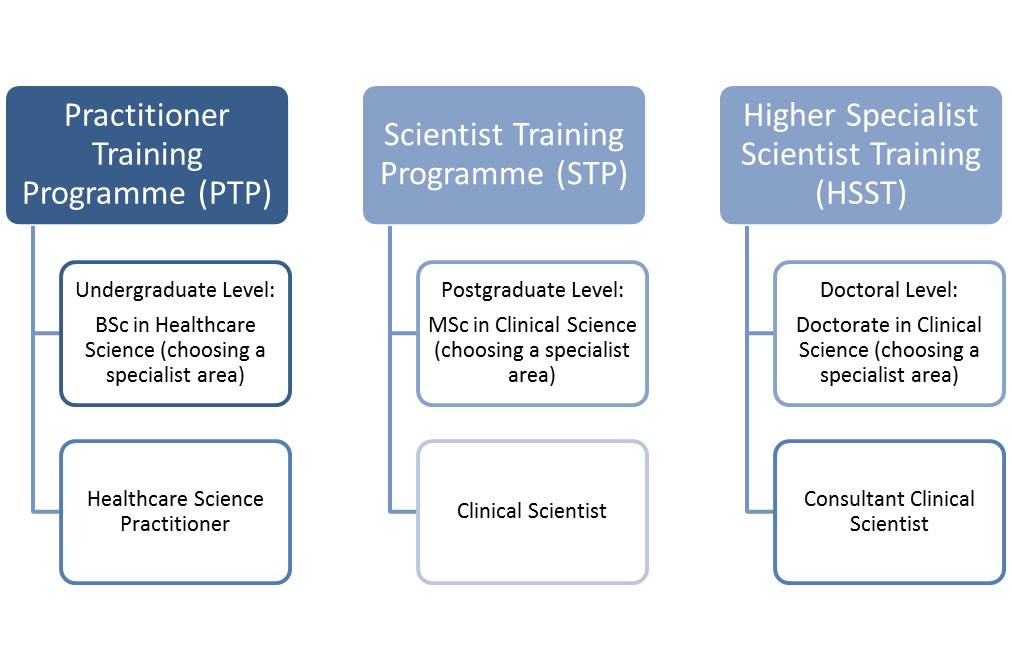
Degree level entry can look different depending on whether you are looking at going down the physiological sciences or life sciences route. For physiological science there are accredited degrees that enable you to access the Practitioner Training Programme, or PTP. This enables you to get work experience and training during your degree. There are also two different types of programme that in life sciences will support entry into the field as a Biomedical Scientist (BMS). Both of these include selecting Institute of Biomedical Science (IBMS) accredited degrees, but one includes choosing a degree that has a placement year so that you come out ready for registration, whereas the other will require you to do a registration year as part of work when you graduate (see post graduate entry).

Post graduate level entry

Once you have a life science (or other acceptable degree depending on specialism) the there are multiple routes into Healthcare Science:

Direct entry training posts – these include trainee BMS posts for those who have undertaken an accredited degree but still need the year in post to complete their portfolio.

Centrally recruited training post – these posts are traditionally either Scientific Training posts (STP), or Higher Specialist Scientific Training posts (HSST). STP posts involve training over three years to be a Clinical Scientists, and HSST posts involve training for 5 years (once already registered as a Clinical Scientist) to become a Consultant Clinical Scientist. STP posts involve further academic training to get an MSc, whereas HSST posts require working towards clinical exams and a taught doctorate.

In-post development and training, there are frequently opportunities to develop via informal routes when you are in post. If you have taken an accredited degree some posts will support you in completing your portfolio to get state registration whilst working as an associate practitioner (AP), or if your degree was not accredited, your employer may support you in taking top up modules that would then enable you to move onto the next stage of portfolio completion.

Finally, there are routes in via something known as equivalence or route 2 registration, especially for Clinical and Biomedical Science routes. These routes mean that you might do something like apply for a post when you have gained an appropriate PhD and over a period of years gain enough clinical experience to be able to complete a portfolio that demonstrates a similar level of knowledge and experience to someone whose gone through a formal training route. This is what I need for my HSST registration, as I already had a PhD and several years of clinical and academic experience.

Apprenticeships

I’ve put apprenticeships separately here as these are applicable to every level, although the Clinical Scientist one is not yet formalised. This means there are routes where you can be training and earning qualifications that support your career progress, as well as gaining valuable experience. These change periodically and different Trusts will support different ones, so I’m not going to list them in detail but I would encourage you to look at the .Gov website I’ve listed below so you can find the latest information and entry requirements:

  1. Healthcare science assistant (level 2) Carrying out routine technical and scientific procedures and support within hospitals, doctor surgeries and other healthcare settings for a wide range of people. Apprenticeship category: Health and science
  2. Healthcare science associate (level 4) Working in hospitals, primary care and other healthcare settings, carrying out routine technical and scientific procedures. Supporting healthcare science (HCS) practitioners and clinical scientists. Apprenticeship category: Health and science
  3. Healthcare science practitioner (integrated degree) (level 6) Supporting the prevention, diagnosis and treatment of medical conditions. Apprenticeship category: Health and science

What other types of science careers are there?

Healthcare Science is obviously not the only way to become as a scientist as a career, there are a world of different types of way to work in science. Starting in one does not mean that you cannot transfer to another, and different career options may be appropriate at different stages of your life. What I’m really saying is don’t worry too much about feeling like you are committing to a certain pathway if you get offered an entry level job in one area when your idea may be in another. Gain learning and experience and don’t be afraid to move between if that’s the decision that is right for you. Here are a few I can think of off the top of my head:

  • Industry – pharmaceutical, manufacturing, medical writing and so so many others
  • Academia – university based, but there are plenty of different pathways within, including specialising in teaching or research
  • Public sector – this can include jobs such as Healthcare Science, but could also include other routes such as public health, food science, environmental science, and options such as science policy
  • Clinical – there are other routes that enable you to work with a clinical aspect to your role, such as clinical trails, without entering into Healthcare Science
  • Charity sector – there are numerous charities, such as cancer research, Wellcome etc, that employ scientists and really value scientific input, whether that’s in their grant structure, policy development or science governance
  • Communication – science communication and public engagement is a really important area, from writing for news papers to developing content for employers such as the BBC, there are a lot of options in this area

What are my top tips for science applications?

I’ve previously written about this is more detail in 2 blog posts, application tips and interview tips, which I hope will be useful. Below are some more general tips that might help:

  • Don’t be afraid to use non-science examples. Have you worked in retail and dealt with money or conflicts? Have you been a guide or a school council member, both of which show leadership potential? You don’t have to have spent a year in a lab to be able to complete the form
  • Be prepared to talk about your why? Why science? Why this job? Why this place?
  • Know how to complete the application form. If you are applying for an NHS job you will need to explicitly state how you match each point with examples. Do avoid recruitment bias it’s all done on a point based system. You can’t get points if you aren’t writing against the JD, so don’t waste word count on items that are unlinked
  • Make sure you tailor your application to the job. Generic CVs won’t get you very far and a generic NHS application form will not get you the points you need. It takes time but it will pay dividends
  • If you get an interview make sure you visit before hand. It will give you pointers as to what they are looking for and ensure that it also feels like the kind of place you want to work
  • Practice common interview question answers ahead of time
  • If you are interested in them supporting further development, like supporting portfolio completion, use your opportunity at the end of the interview to raise it. An interview is as much you interviewing them as them interviewing you. If something is important to you make sure that you raise it, then you can make a fully informed decision about whether the role is right for you

What are my top tips for career planning?

I’ve blogged before about the fact that I’ve not had the smoothest academic pathway and that I really believe that academic success does not have to define who you are. I really believe there are so many many ways to end up in a place and a career that is right for you. There is not one way to do something, but here are some principles that I hope might help:

  • Don’t think you have to have it all figured out – follow what inspires you and supports your passions and everything will work out
  • You don’t have to be the smartest person in the room – being tenacious gets you far further than being talented alone, just keep going
  • Do your research – if you want something invest the time to learn about it, if there is a specific job reach out and speak to the people advertising it to get to know them, the workplace and more about the job
  • It’s OK to try a number of different ways to get into the field, don’t focus too much on it being on the ‘right’ pathway, as long as it enables you to be gaining experience, and in an ideal world training, you are still moving forward even if you need to move horizontally later
  • Keep an open mind about training routes in, don’t rule out apprenticeships and vocational routes, even if you consider yourself to be more academic, they will let you gain experience at the same time as earning money and studying
  • Be open to the fact that you are likely to have to invest your own time. Working in science has enormous opportunities, but if you sign up to a Healthcare Science pathway you are also signing up to continuous professional development, some of which will likely need to happen in your own time if you want the best possible outcomes
  • Maintain a growth mindset – no matter what the stage of your career be open to still developing, be open to opportunities and next steps, and be prepared to keep driving yourself to be better
  • Take a chance on yourself – sometimes we are our own biggest barriers and the most important thing is to get out of our own way. Don’t talk yourself out of taking chances, don’t tell yourself you can’t or that things won’t work out so you won’t try. Be brave, take your chances and leap!

How can I get work experience?

Work experience in Healthcare Science can be difficult to acquire, don’t be disheartened though there are still plenty of ways forward:

  • See if you can gain experience within industry or academia as these both tend to have specific work experience programmes that you can tap into
  • Some professional bodies, such as Applied Microbiology International, Microbiology Society and the Royal Society of Biology all have studentship and placement grants. I’m sure there are many others. Consider becoming a student member if you can afford it, or reach out to someone you would like to have a placement with and see whether they could apply or support you to do so. These mean that you can have some living allowance, if like me you couldn’t do it without, and bring some money with you to do a short project. They also look good on your CV as demonstrate both commitment and application/grant writing skills
  • Ask one of your current lecturers if they have any project opportunities with them
  • Gain an entry level post and use that to gain the experience you need to support your next steps
  • Consider apprenticeships to gain some exposure alongside your qualifications
  • Consider volunteering in adjacent roles, most hospitals and care facilities have volunteer programmes where you can gain experience, but also give back

Remember, you don’t need extensive experience to support your application for an entry level role, even a cup of tea with someone who does the job will enable you have a better understanding of the role. A couple of days to a couple of weeks is an advantage but not essential.

Useful places to find more information

Below are some links that might be helpful in getting some further information and reading up about possible next steps. These are great jumping off points, but you should also reach out to mentors and people doing the different types of jobs you are interested in to get deeper information not listed on the websites. There will be an option that works for you, but not every option works for everyone, so the more research you do the better fit you are likely to find.

Apprenticeships

NHS Healthcare Science careers

Equivalence

Institute of Biomedical Science for Biomedical Science careers

Association of Laboratory Medicine for life science Clinical Scientist careers

STP information

HSST information

PTP information

Healthcare Science T-Levels

International and PhD routes to registration via Association of Clinical Scientists

PhD finder

All opinions in this blog are my own