
I’ve been thinking a lot about social contracts lately, the unwritten rules by which groups, systems, and even cultures run. The things that often no one explicitly says, but that end up in your brain as frameworks by which you function. One of the dangers of these social contracts, is that because they are unwritten, individuals can have different understandings of what they mean, and there can be drift across groups and generations, leading to upset or unease without it being easy to pin down.
One of the ones that sticks out to me a lot at the moment is around recognition and promotion. There is a real imbalance that I keep encountering about whether reaching the next step on the career ladder is about achievement or loyalty linked to time served. What is the best way to be recognised enough to receive the crown of acknowledgement? That moment when you receive recognition and the reward for all you’ve done. Is is given more readily to the people who work hard, go out of their way, and tick all the boxes to thus get the promotion? Is it, or should it be, about recognition of spending time in role and thus demonstrating loyalty to a particular organisation or system? The disconnect between these two approaches is something I observe causing a lot of distress, especially with trainees and those early in their career journeys who are trying to make decisions in order to further their careers.
The truth, I am realising, is that success probably isn’t about either of those things, or at least neither of those things alone. The social contract linked to recognition probably isn’t, and never has been, about time vs input. What never gets discussed, and the thing that strikes me as making the biggest difference, is advocation, either for yourself or someone on your behalf, and this is probably not linked to social contracts at all. This is about group behaviour and how we are seen, not even necessarily about the reality of what we achieve in role. For today’s post, therefore, I thought I would explain why my thinking has changed, and how we might be able to do more to help and empower ourselves once we are more aware of the game we actually playing.
Before I go on however, just because I want a pick me up this Friday (miss you sis), I thought I would share my favourite ever tiara based scene. Whenever I hear the term Tiara Syndrome, this is the visual that comes to my mind, and I’m not sad about that.
The meritocracy suggestion
I was always taught that if I worked hard enough I could achieve anything. If I put in the hours and experienced the grind, then my reward would be in the recognition I received as a result. I spent years putting in the extra hours, missing key life events and prioritising work, believing I was fulfilling my side of a social contract. Work hard, be seen, be recognised. I was fortunate enough that in many ways the social contract was delivered for me, but it was not for the reasons that I thought. There was a key piece that I didn’t recognise. I had a wonderful boss who was the one who both pushed and saw me. He believed in what I was trying to achieve, and when he had the opportunity he provided what recognition he could. My work hard ethos aligned with his and I was therefore both seen and rewarded. Since his retirement, I’ve been able to understand how much of a difference that positioning made. I’ve also come to recognise that some of that ‘be seen, be rewarded’ was because of the alignment in our ethos, and that others who aligned differently did not get seen in the same way. In many ways this is human nature, but it also means that you can’t rely on A leading to B, in reality it is much more complex than that.
When I first saw the video below from Barack Obama, it spoke to me, it aligned with what I had always been taught. It’s not true though. It’s only true in certain circumstances, for certain people, and that means it relies on privilege. If you are in the wrong place, if alignments don’t fit, if you have people who don’t want to see you, then you can solve all the problems you want and A will not lead to B, you won’t be ‘seen’, you will work hard and things will improve for the system as a result, but that doesn’t always equate to your aspirations being met as a result.
The truth about the meritocracy myth
The reason that point A doesn’t always lead to point B, is because what counts as ‘merit’, not only counts as different things to different people (loyalty vs going above and beyond for instance), but also the benchmarks for achieving those merits varies. Some people are running a flat race, whilst others are running the hurdles. Loyalty in role could be 2 years to some people and 20 to others. Going above and beyond could be being willing to stay an extra 30 minutes to one boss, and being prepared to work every weekend to another. The Obama idea of being the person who turns up with solutions, or fixes problems that are not seen by others, requires you to have a boss who doesn’t just take that fix and present it to a room without mentioning where it originated. If a problem is fixed that isn’t seen by others, is the solution going to be as valued, can you be too efficient to be ‘seen’?
Having the space and capacity to be the ‘fixer’ also has privilege associated. Many studies have shown that, in places like academia, women take on a lot of the ‘soft’ skill work, mentorship, outreach, committee membership etc, which means they have less time to tackle the ‘reward’ associated tasks, such as publishing, funding applications etc. Not only do you have to go above and beyond, but you have to go above and beyond in the right tasks, that are valued by the right people. This is before you even get onto whether going above and beyond is the right marker. For instance, if someone can’t go above and beyond by extending hours because they have caring commitments, but they are excellent in the contracted time available, why should they be disadvantaged? All of which is a long way of saying, that the system doesn’t reward ‘merit’, as it is often unclear what ‘merit’ is. Even if ‘merit’ is made clear the system often doesn’t reward ‘merit’ in all cases for all people, much of it is circumstance dependent. If you are lucky like I was to have a boss that aligned and saw me, great, but can success really be so dependent on luck or can we make our own?
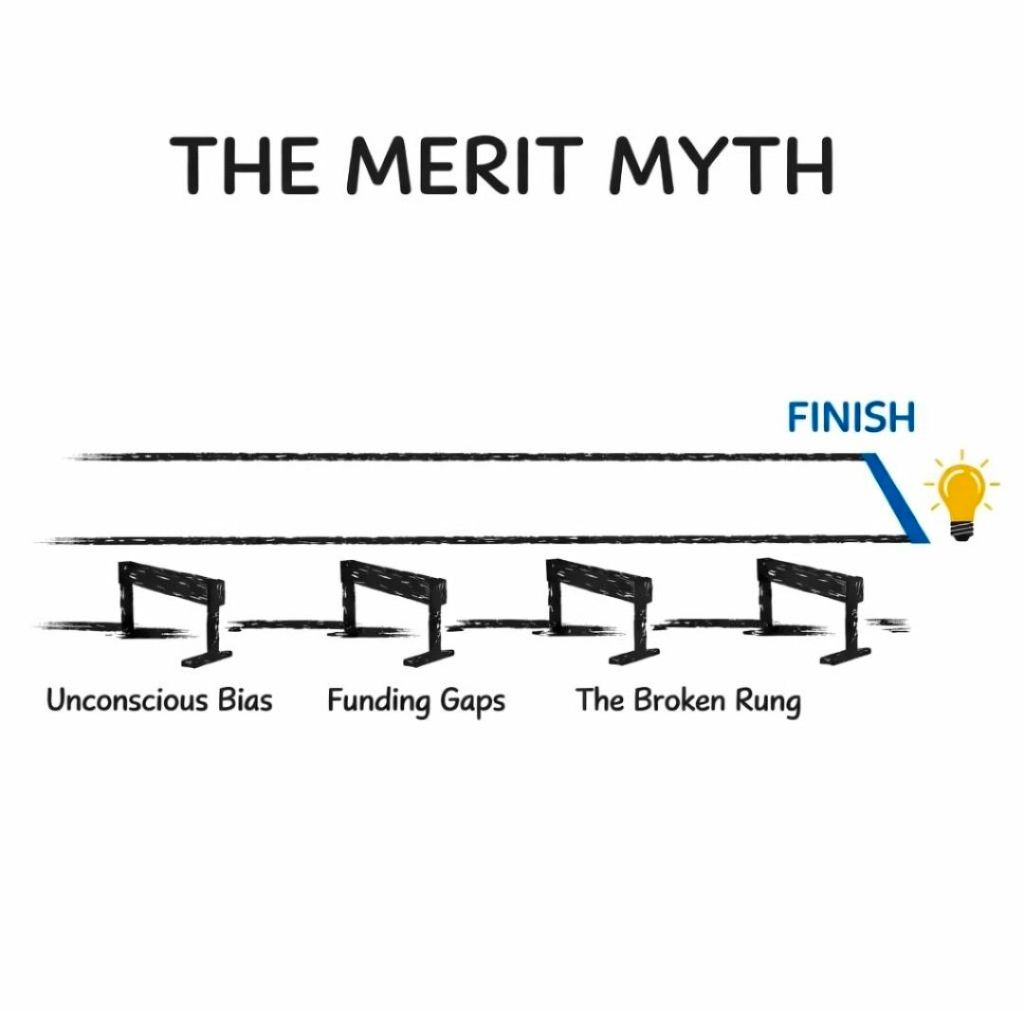
What constitutes ‘merit’ isn’t universal
Even if the gateways were the same, along with the resources, there would still be differences and challenges linked to performance in the work place, often based on misinterpretation or a lack of strategic understanding of the unwritten rules of the system, and it is by enhancing our understanding of these rules that we can make our own ‘luck’.
In 2013, Sheryl Sandberg published “Lean In”
Women, she wrote, apologize constantly—for things that don’t warrant apology, to people who didn’t request one, in situations where men would never dream of saying sorry.
They face what researchers call the “likability penalty” When men are successful, they’re liked more. When women are successful, they’re liked less. Success and likability are positively correlated for men, negatively correlated for women.
This means women face an impossible choice: be liked but not respected, or respected but not liked. Men often don’t face this trade-off.
The gap isn’t in competence. It’s in permission.
Men are frequently given implicit permission to take up space, to speak with certainty, to disagree openly, to advocate for themselves. Women must constantly negotiate that permission—softening, qualifying, apologizing, making themselves smaller to avoid backlash.
That’s not a personal failing. That’s adaptation to a rigged game.
That brings us to Tiara Syndrome
Tiara Syndrome describes the professional tendency, often seen in women, where they wait to be noticed and rewarded rather than actively advocating for themselves. The belief that if they undertake diligent, excellent work, it will automatically be noticed and rewarded with promotions or raises, like a fairytale princess receiving a crown. They see the process of recognition as passive, linked to how impactful they are in role, rather than requiring active self-promoting or negotiation for advancement. Coined by Carol Frohlinger and Deborah Kolb, it highlights how quiet competence can lead to being overlooked in favour of more vocal colleagues. All of this means that if you have something you want, you can’t be a passenger in how you get it. It is the very epitome of ‘if you don’t ask, you don’t get’. The skill, therefore, is in learning how and when to ask.
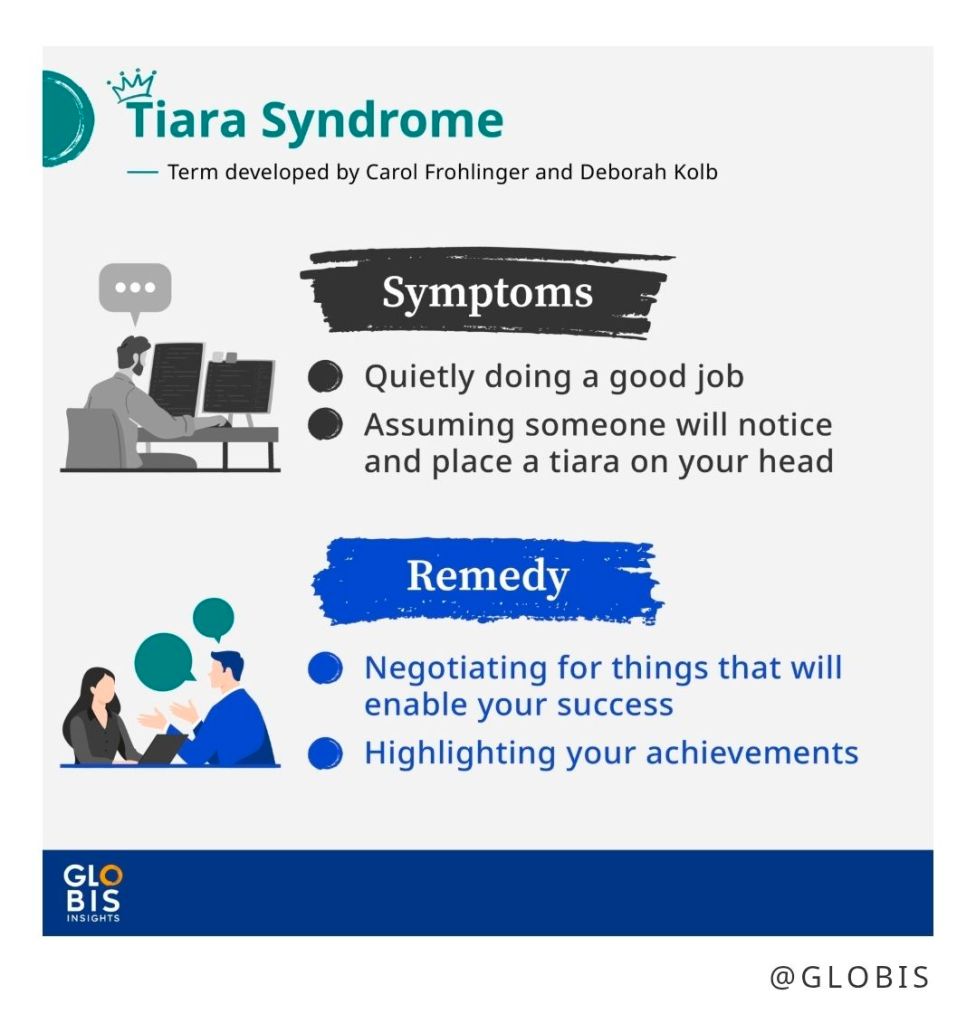
How can this play out in the work place?
Apart from the impacts on career progression, one further issue with Tiara Syndrome is that, due a lack of self advocation, we can fall into an even worse trap, that of performance punishment. If you are the one who always stays late, or steps in to fix the small mess before it becomes something big that will impact others, that is the standard that gets set. Stay late on a Friday night frequently enough when dealing with Friday dramas, it will become assumed that whenever a Friday drama occurs you will be the one who stays late. It stops being a request and becomes an assumption. This leads to the benchmarks moving, and suddenly you need to do even more to be seen as going over and above. Therefore you are even less recognised than before. Completely the opposite to what you were trying to achieve. You work harder hoping to have that work recognised, but what happens is that your hard work gradually leads to decreased recognition and makes the situation worse. The solution is not to work harder, the solution is to advocate better.
So what can we do about it?
Part of the observations made by Sheryl Sandberg in Lean In, was that she noted that women often attribute success to external factors (luck, help from others, timing) while men attribute it to their own skills and efforts. This means that women can frame their career progression differently and feel less empowered to make changes that lead to different outcomes. If we think that our career progression is down to luck, then it makes sense that you are less likely to make active changes, but it is these active changes that truly make the difference.
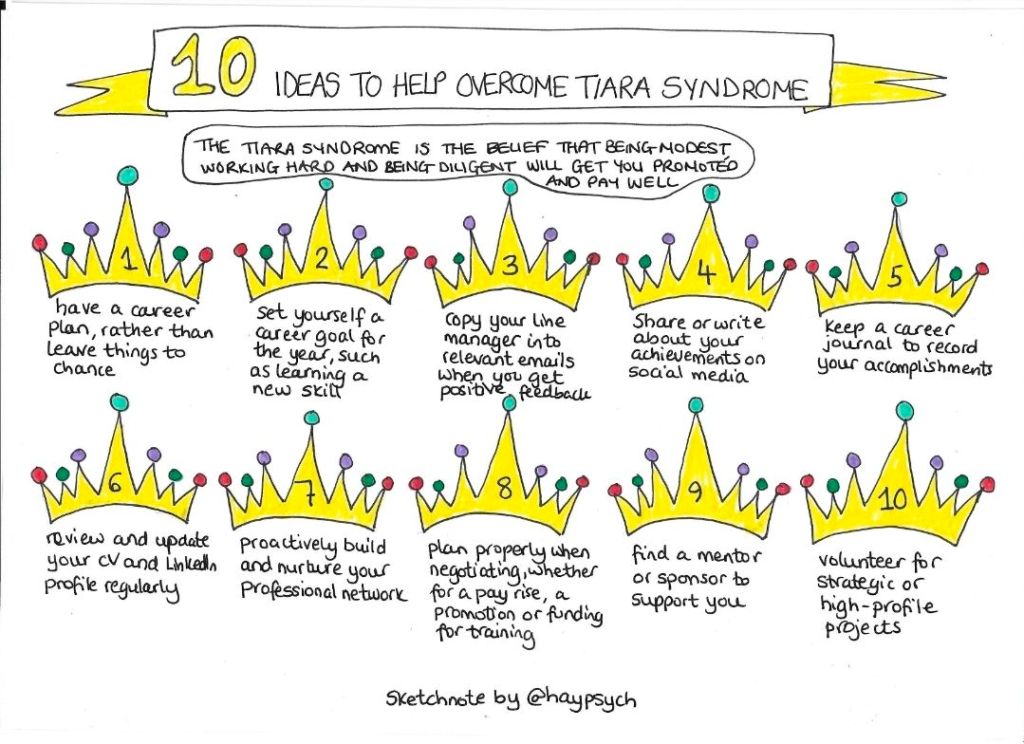
So what can we do, irrespective of gender, to take control of our route to coronation? The first thing I would advocate for is having a plan. Reflect enough to know where your aspirations lie. You don’t need to know every step of the way, but you need to know where you are aiming for, what you next step is, and a rough road map in-between. Then develop some solid actions against it. Draw up a plan, and some way of measuring, like success criteria, to help you know how far you’ve come.
Instead of going with the flow, take some time to reframe and record your activity in light of your aspirations. Think about the skill and knowledge gaps you need to fill, develop evidence as you complete them by thinking broadly and including things like testimonials so you can provide external assurance. Whilst you are doing all of this, make a conscious decision to change your language. Think about using words that empower, rather than disempower, when you are talking about your work. Recognise the input and aid of others without dismissing your own contribution. Know when to use the term ‘we’ and when it would be more impactful (and honest) to use the word ‘I’. You can advocate for yourself whilst still being a team player and acknowledging the contribution of others. Step out of your comfort zone and practice how to take ownership of your successes. I mean this literally, as I found it was a skill I needed to actively practice, otherwise in the moment I would (and sometimes still do) default to how lucky I am. Now, don’t get me wrong, I am lucky, but it isn’t luck that got me to where I am, that was a lot of hard work, late nights, and too numerous a list of sacrifices to count.
Another thing I learnt is the importance of expending my energy wisely. There will be people who will never see you, or acknowledge your worth/work, no matter how much you advocate for yourself or put the evidence in front of them. These are battles that are not worth fighting. Invest your energy in those discussions and encounters where you can influence or change the conversation. If you can’t find the right people straight away, build your networks until you can. Find your people, find the person who can mentor and advocate for you in order to lighten the load. This doesn’t remove the responsibility and need to do it for yourself, but means that you will feel less alone whilst doing so. Use those people you find to practice the discussions you’ll need to have with people who may not be so aligned. Use them, and the safe space they provide, so that you can be more effective when you have to step into more uncertain territory.
Know that it’s OK to change and set boundaries
One of the key things that I’ve learnt, rather late in life, is the need to set boundaries, both for myself and others. This is something that I’m still working on, but has made a huge difference to how I see both myself and the world. One of the dangers of being a people pleaser is that you take on the agenda of others as if it is your own. You take on the extra work, and the extra projects, in the mistaken belief that this will be recognised, ease your pathway to success, but also make others happy. The reality is that it can just distract you from the things that you want to achieve, and often, it is neither noticed or rewarded. Transitioning away from this ‘of course’ behaviour can be both challenging and unsettling. It can really impact your identity, how you see yourself, and how you fear others may see you.
Living in that fear does not make the behaviour itself either healthy or meaningful, however. It just provides a comfortable delusion that in the long term doesn’t pay off. I’m not saying that you should suddenly say no to everything. Nor am I saying you shouldn’t be a team player. What I am saying is that you need to face the role you are playing in the scenario and be prepared to live in the discomfort in order to change things for the better in the long run. Say yes to things but in a strategic way. Look at your skill and knowledge analysis, and say yes to things that help address the gaps. Say yes to things that bring you joy. Otherwise, if you say yes to everything you end up, by default, saying no to others unintentionally. By taking a pause to think before you say yes, it means that the yes you say is about moving forward not just filling time or making others happy.

Find a team that crowns you
Finally, I talked about finding your people, and I have to say this is the thing that has made the biggest impact on both my life and my career. My team last year made me a swab tiara, and crowned me ‘The Swab Queen’. All of which is to say, if you find the right people and the right place, you won’t have to find a way to be crowned, your people will do it for you. A word of warning to finish on, however, make sure that once you have your regalia you take the time to make sure you find those who you can pass it onto. Crowns are about legacy after all, no one keeps the same crown forever.

All opinions in this blog are my own
 Girlymicro