
It’s a real privilege for me to share a guest blog today in continued celebration of Pride month and acknowledging the work that is left for us to do to address the ongoing impacts of discrimination and bias on the everyday lives of so many. Ant was the previous Chair of the GOSH Pride network, and in his role as Head of Healthcare Science Education, has also undertaken substantial work on tackling health inequalities through awareness of, and contribution to, the differential attainment toolkit.

We celebrate Pride month every June highlighting the need for visibility, acceptance and equality. This is marked by peaceful protest, a show of diversity in all its forms rising in unity providing a sense of belonging for those that belong to the LGBTQIA+ community as well as those who vibe with the same value set.
The feeling of belonging that is cultivated during pride, where flags are flying, culture and history is more visible etc can be eroded away by subtle moments throughout the day. Typically they arise in the form of everyday comments, assumptions or questions, often unintentional but always land uncomfortably. While these are called microaggressions, they can feel macro-aggressive.
What is a microaggression?
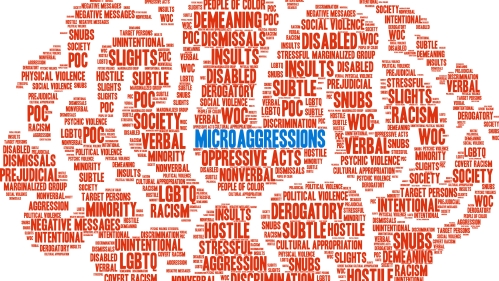
Microaggression as a term describes a form of discrimination that can be communicated through verbal, nonverbal and environmental messages often unintentionally. These in isolation can be relatively small, they hurt, kinda like a papercut which isn’t a huge deal. It stings, you heal, you move on. Having 10 or more papercuts over the day from the moment you wake up to the moment you go to sleep cuts a little deeper causing more distress. To an outsider your reaction to the tenth microaggression of the day may appear disproportionate but they won’t know what you’ve experienced thus far.
Here are some examples of microaggressions, this is not an exhaustive list:
- ‘So…. who’s the man in the relationship?’
- ‘I do not see colour’
- ‘We are all a bit autistic’
- ‘Do you not want any children?’
- ‘You are bisexual! Does that not make your partner feel insecure?’
- ‘You are too pretty to be a lesbian’
- ‘Your name is hard to pronounce. Can I call you Kerry’
- ‘You are not like other Muslim people’
- ‘You do so well for a disabled person’
- ‘You are so pretty. People have a hard time taking you seriously’
- ‘You do not look trans’
- ‘When was the last time you went ‘home’?
- ‘Given what your husband does, do you really need to work?’
In 2007 the term microaggression was subcategorised into types (microassaults, microinsults, and microinvalidations). The definition was also expanded to include any marginalised identity.

This past month I’ve experienced an increase in microaggressions or outright racism often in environments where it is hard to get away or confront without some sort of collateral damage to myself or others e.g. Intoxicated individuals/groups on trains. If I have had a challenging week at work or am dealing with a personal issue, I find my cognitive load is high making me feel more vulnerable to microaggressions and compounding their impact.
I, like others find it difficult to deal with microagressions as they are often not just directed at one aspect of myself, for instance my sexuality, and often we can experience these acts which relate to multiple parts of ourselves.

Growing up with brown skin and gay I’ve always felt different. This gets compounded when you or those that you relate to are treated adversely. This has really affected my feeling of belonging even into my adult years where my sense of self and place in society is constantly questioned especially when those in power use ‘otherness’ as a political tool legitimising people’s inappropriate behaviour. This can be further damaging when community spaces which should be safe for you are not, further leading to isolation.
So how can we deal with microaggressions?
Know your boundaries
- Depending on the situation it may be more appropriate for you to respond in the moment, later on, directly, indirectly or not at all.
- Addressing every microaggression can be exhausting and it may do you more harm to address them all.
Highlight what is under the surface
- You can try ‘You’ll have to explain that one to me’
- ‘Can you explain what you meant by that?’
- This may help the individual recognise and self correct.
Disarm and dismantle
- Interrupt the individual before they get to finish, especially if it’s an inappropriate joke.
- ‘That is not an appropriate conversation’
- Redirect the conversation
- Express your discomfort – ‘Id rather not discuss that’
Educate the perpetrator
- ‘It may not be your intention, but this is how I perceive what you said, and this is how it makes me feel’
- I used to say that or had that thought but then I learnt this.
- ‘I think you are trying to support me but when you say things like that it feels invalidating’
- Focus on the impact not the intent – they may not have intended offense, but it is important to address its impact on you.
- Use clear and direct language to explain how you felt but don’t use personal attacks in your response.
As a witness you can also
- Validate their experience and highlight that you also witnessed and heard.
- Ask if they need to vent or need any advice. Or simply ask what they need.
- Ask if they’d like you to follow up with the person in question.
- Even making eye contact helps
- Physically positioning yourself next to the individual for a show of support
- Intervening using some of the phrasing in the other sections.
Seek help
- If you are in the work place you can get advice from HR, trainee networks or forums, freedom to speak up guardian.
- Share your experiences with a friend over a coffee or a slice of pizza.
Going forward
I think it’s important to say whilst one can experience microaggressions we can all be perpetrators and need to be self-reflective in our verbal & physical language and our actions.

We can create a supportive environment building a culture of respect and inclusivity, we can speak up when we witness microaggressions even if directed at others, educate ourselves by learning about how microaggressions affect different people, try and understand and recognise your own internal bias.
If you found this helpful, below is a link to last weeks post on allyship, that may also be of interest:
All opinions in this blog are my own
 Girlymicro