Guest Blog from Francis Yongblah, Kip Heath and Anthony De Souza: Healthcare Scientists Celebrating Pride Month and why Visibility is still so Important!

It’s the end of Pride Month 2021, but that doesn’t mean that the fight for equality has ended. Healthcare scientists that are part of the LGBT+ community talk about why representation is important to them.

Francis Yongblah, Microbiology Laboratory Manager and HSST Trainee.

As a Gay, Asian Healthcare Scientist, representation of the LGBTQ+ community in Healthcare science is crucial to me. I have been a Healthcare Scientist for just over 12 years and in that time I have experienced and been exposed to homophobia and prejudice in the laboratory workplace. Although these incidents were very early in my career, these scenarios have always stayed in my mind and something that I have never forgotten. Early on in my career, I felt that I had to hide who I was as an individual and could not actually be me for fear of being judged or treated unfairly. These scenarios made me worry that, because of my characteristics of being a gay man, my professional development and career would have been hindered. No healthcare scientist should feel like this, and it’s important for everyone to recognise the attributes and contribution that a diverse workforce can bring to a service, team and the positive impact it can have on patient outcomes.

I have worked hard as an LGBTQ+ Scientist in order to ensure that my career has been able to develop and I can go as far as I am able to and not to be held back by my sexuality. I feel it key to have representation for the healthcare scientist workforce in order to be able to recognise how key it is to have a diverse workforce, as well as recognising that there are LGBTQ+ Healthcare Scientists within the workforce. We’ve now come a long way from when my career had just started out and I feel proud to have my organisation and the NHS represent and support LGBTQ+ Healthcare Scientists. There has also recently been a lot of support from the Institute of Biomedical Sciences (IBMS) to promote the LGBTQ+ Healthcare Scientists in our workforce.,

Kip Heath, Healthcare Scientist and Science Communicator

For me, it’s essential that we foster a workplace environment (and, indeed, a society) in which people are accepted regardless of their gender or sexuality. I’m a queer woman married to a cis heterosexual man. He’s a wonderful and supportive individual and the only person I could imagine taking on the world with. But, to that outside world, we are a standard heterosexual couple. On the one hand, that can be an advantage as I can hide my sexuality fairly easily. However, there have been workplaces that I’ve not felt comfortable or accepted as myself. But I have found that my identity can be easily erased, even by other members of the LGBT+ community.

Now I work in leadership positions where I need to provide support across the healthcare science workforce. My boss talks about the importance of bringing your authentic self to work and leading by example. Our workforce is hugely diverse and it’s important that we demonstrate that. I want to make sure that LGBT+ healthcare scientists in our Trust never feel like they need to hide themselves at work and that there are people that they can open up to if they have any issues. In my role as a science communicator, I raise awareness of healthcare science careers to students and show them that the profession is open to LGBT+ scientists, and that their sexuality is not a barrier to progression.

Anthony De Souza, Practice educator for HCS, HEI lecturer & LGBT+ Forum co-chair

Representation is important to me because, when I grew up, there was no one in my life or on TV that was like me. This added to a feeling of invisibility and isolation, making me feel like I didn’t matter and that there was no place for me in society. I’ve been lucky enough to feel safe enough at work to be myself these days, but everyone’s situation within an organisation will differ.

We know that diversity equates to strength but what are we doing to create an inclusive space for scientists? Science is a diverse and ever changing space where a variety of perspectives yields better conversations, we need an environment that actively supports that. We also need to recognise that much of the discrimination individuals may face happens before they’ve even accepted a job offer, this could be binary choices on demographic questions or uniformity of interview panels.

To be our best at work we have to commit our energy and focus for the good of patients’. We can only do this if we don’t have to constantly edit how we act to fit a pre-defined notion of ‘normal’, react in real time to how we’re perceived or routinely have to deflect micro-aggressions. 

Shining a light on excellence throughout the workforce of scientists from different gender identities, sexual orientation, disability, age or race is important for visibility. We need role models that we can relate to and learn from. This also challenges the wider communities’ pre conceived notions of what a professional usually looks, sounds and acts like.

Today you are you, that is truer than true.

There is no one alive, who is youer than you

– Dr Seuss

All opinions on this blog are my own

Guest Blog by Dr Claire Walker: My top three reasons for picking Immunology

Whilst Girlymicro is away, trying to desperately find some of this work life balance people keep talking about, the charming and wonderful Claire has stepped into the breach to keep you informed and amused. Isn’t she lovely!?

Blog By Dr Claire Walker

Paid-up member of the Dream Team since 2013 (as discussed in a previous post, in her personal life most people call Girlymicro Dream), token immunologist and occasional defector from the Immunology Mafia. Registered Clinical Scientist in Immunology with a background in genetics (PhD), microbiology and immunology (MSc), biological sciences (mBiolSci) and indecisiveness (everything else). Now a Senior Lecturer in Immunology at University of Lincoln.

Followers of this blog will have seen the wonderful Dream and Kip performing stand-up comedy and encountered the light-hearted hashtag #immunologysucks, typical microbiologist thinking! As the Dream Team’s token immunologist, I feel there has to be some defence of my chosen specialism. So here I weigh in on why I chose immunology, and why you might like to consider it too.

My Top Three Reasons for picking Immunology – the King of Science

  1. It’s New, New things are Cool.

Immunology is the new kid on the block of pathology disciplines. Throughout my career, I’ve been able to collaborate with all sorts of people. From geneticists and genetic counsellors during my PhD looking for new immunological diseases, to major clinical cancer trials companies and gene therapy scientists during my sojourn at a major children’s hospital, and even with the occasional microbiologist who wants some obscure cytokine readout for a study (I’m looking at you Dream!). Everyone loves collaborating with immunologists because we get the really good machines, and we aren’t afraid to use them.

2. It’s an Adventure, Adventures are Exciting.

If you’re interested in reading a science blog, you’ll have a fairly clear idea that the immune system are the cells of the body that protect us from disease. Immunologists develop our knowledge of how this works. But think about it for a moment. It is a hugely complex system that needs to understand what to kill, and when, and when to turn itself off. Humans need to be able to eat food without attacking it, and leave friendly bacteria and our own cells well alone. When the immune system falls out of balance the immunologist needs to understand how, why and what we can do to treat people. As the wonderful Dr Daniel Davis describes it, building our understanding of the immune system as ‘a painstaking, game changing scientific adventure’.

3. We’re the Future, and the Future is Awesome.

Antibiotics are in trouble. Cancer isn’t always treatable. Viral disease can shut down the whole of society. Scientists are turning to clinical immunologists for the answer. We can create artificial antibodies to treat previously untreatable diseases, we can re-program the immune system to attack and kill cancerous cells and vaccines can be rapidly produced to save millions of lives. Manipulating the immune system to treat and prevent disease not only saves lives of patients today, but has revolutionised how we approach problems in medicine.

The Bottom Line

There are so many fascinating specialisms within the world of pathology that making a decision early in your career can feel overwhelming. Immunology has just got so much to offer – who wouldn’t want a piece of that action?

TLDR. #Immunologyrocks

All opinions in this blog are my own

Guest Blog by Dr Claire Walker: Did you hear the one about the Consultant Microbiologist who Hosted a Digital Festival?

Whilst Girlymicro is away trying to find some of this work life balance people keep talking about, the charming and wonderful Claire has stepped into the breach to keep you informed and amused. Isn’t she lovely!?

Blog By Dr Claire Walker

Paid-up member of the Dream Team since 2013 (as discussed in a previous post, in her personal life most people call Girlymicro Dream), token immunologist and occasional defector from the Immunology Mafia. Registered Clinical Scientist in Immunology with a background in genetics (PhD), microbiology and immunology (MSc), biological sciences (mBiolSci) and indecisiveness (everything else). Now a Senior Lecturer in Immunology at University of Lincoln.

Did you hear the one about the Consultant Microbiologist who Hosted a Digital Festival

of Science collaborating with Artists, Musicians and even Comedians?

She was a Woman of Many Cultures

That’s right! I am, of course, talking about The Rise of the Resistance festival, the greatest scientific communications event since Jonathon Van Tam’s daily Covid briefing. Someone please buy that man a clicker (JVT, if you’re reading this, hit me up I have a spare for you).

More seriously, if the constant stream of scientific content in the media over the last 15 months has taught me anything it is that scientists are not always the best communicators. We have to ask ourselves why this essential skill is being overlooked by our profession.  Is it because our subject matter is so complex? Or is it because we’ve never taken the time to learn, practice and apply these skills?

I’ve spent more than a decade developing a detailed understanding of how clinical testing works but only shared my findings with other healthcare professionals, and rarely outside my own discipline. The importance of clinical testing is now taking centre stage and, because of the pandemic, I am finding myself butting heads with every armchair expert who believes they know more about my specialty than me. I’ve been frustrated by this, but now I think it’s my own fault. I’ve spent too much time hiding in the lab and not enough time shouting from the rooftops about just how vital, influential and downright amazing our healthcare scientists are. It’s time for me to put down the pipette and pick up a microphone.

Pathologists as Comedians – are we Having A Laugh?

I decided to jump on the first opportunity to come my way. And that was the offer to participate in Stand-up for Science, a live comedy gig as the closing act of the Rise of the Resistance festival. My first thought was that stand-up comedy is about a million miles from my comfort zone. However, I was fortunate to receive the excellent training of professional scientific comedian Dr Steve X Cross. With this new knowledge and the support of my fellow scientific comedians, Dr Cloutman-Green and Kip Heath, I wrote my set.

The training taught me that worlds of science and comedy are not so far removed as you might think. My job as both a scientist and an educator is to find the best method of communicating complex ideas to a varied audience, and I spend much of my time giving presentations to large, mostly awake, crowds. 

Fortunately, the gig itself was all delivered from the comfort of my home office. For those of you who didn’t manage to watch live (including my lovely husband who was juggling the children) I’ve attached the link here. I felt that the gig itself was brilliant, a wonderful experience to meet funny and passionate individuals from across the pathology disciplines. We covered everything; from classic urologist finger up the bum humour, to carefully constructed gags about our doctorates, to fishing samples out of a bin at the Brit Awards.

There are a lot of great stories for healthcare scientists to tell, and rarely have I had a day in the clinical lab without finding something to laugh about. Much like learning how to design an experiment, or program the flow cytometer, communication is an essential skill for healthcare scientists. And why should it be dry and boring? Why not throw in a joke or two? We aren’t going to win friends or influence people by mansplaining our work or dismissing it as too complex for the lay person to understand.

Now, more than ever, we have a responsibility as scientists to get out of the lab and make ourselves heard. Getting the right test for the right person at the right time, the mantra of the clinical scientist, is essential. Spreading understanding of clinical testing and of vaccination will save lives. Today.

TLDR: Scientists, even microbiologists, are people too. And some of us are downright hilarious.

All opinions on this blog are my own

Guest Blog by Dr Steve Cross: The Science of Space

By Steve Cross www.clevermakefunny.com

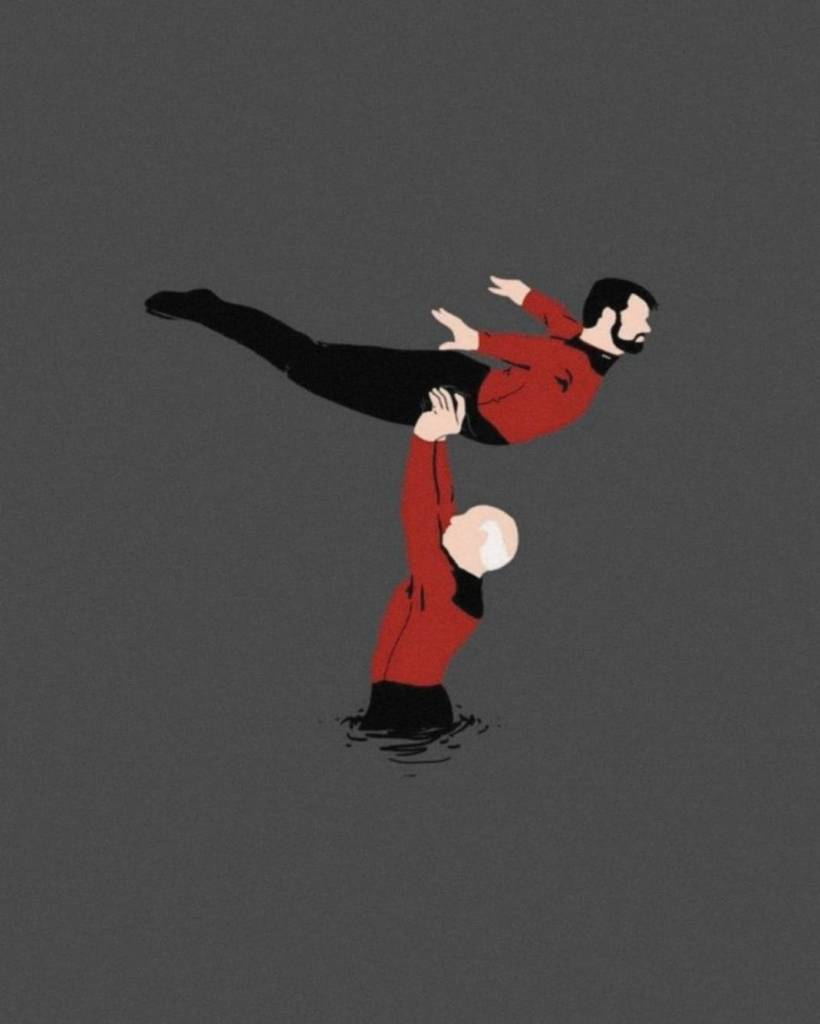
Do you know what everyone in space is scared of? It’s not lasers (we’ve got shields) or fire (we’ll just get a droid to put it out) or even fifth-dimensional beings (they can be defeated by being witty or saying their name backwards). No. It’s torpedoes. Well, in Star Wars and Star Trek it is. I don’t know about Battlestar Galactus or Paddington 5 or Expansys or whatever it is that you like. I only know the classics.

Photo by Craig Adderley on Pexels.com

Torpedoes come in two types. Star Wars has proton torpedoes (if you fire one into a sewer it ignites all the old poop and makes it destroy the whole base) and Star Trek has photon torpedoes (these are often fired as a “full spread” which implies there are roasties, Yorkshire puddings and possibly pigs in blankets on the side).

But how scary are they?

Science can tell us.

A proton, as anyone who listened for 5 seconds in GCSE science knows, is a hydrogen ion. Basic boring old hydrogen is a single proton with a single electron floating around it. Take the electron away and you’ve got protons. Do you know what’s really rich in protons? Acid. Even a really weak acid has trillions* of spare protons in it.

Canonically we don’t know whether Star Wars torpedoes have a warhead of lemon juice, vinegar or possibly even Viakal. Sadly there are no scenes of brave flight technicians precisely measuring teaspoonfuls of Diet Coke into primed torpedoes. What we do know is that the torpedoes would definitely get the limescale off their targets with their rich proton loads. Star Destroyers probably shine like chrome after a good old space battle.

We can only speculate about how the first Death Star was destroyed. Did it have a core made of millions of tons of sodium, just waiting to recreate the most exciting moment of A-Level chemistry but at grand scale? Only Darth Vader knows. And he can’t tell us because he isn’t real.

Over in the Star Trek universe we’re all wearing our uniforms that are apparently solely designed to make cosplaying unsexy, and we’ve tried shooting the enemies with phasers (the first time I used the guitar pedal of the same name I was sorely disappointed). It didn’t work. It usually doesn’t. Phasers only exist to provide a moment of tension by not working. So it’s time to up the stakes. We will unleash the fearsome photon torpedoes!

In tedious-science-explanation land, a photon is the smallest possible unit of electromagnetic energy. It is the basic unit of light. Photons move pretty fast, in fact they move at the speed of light. That’s why it’s called that. Physicists are pretty literal. That’s how they came up with units like “Light-year (ly)f” and “Earth mass (M⊕)”.

It’s easy to blast your enemy with literally trillions* of photons; Just point a torch at them. Is this the payload of the fearsome photon torpedo? We know they’re big enough to fit a dead Vulcan in, ears and all (from the second movie) so they could hold some serious lighting. “Priming photon torpedoes” presumably means turning on all of the torches in each one by hand. Although, if all those torches had poorly-made lithium batteries and it got a bit warm, the photon torpedo might make a perfect incendiary bomb.

Is anyone else not scared? I’m not scared.

*It might be more. I refuse to do the maths.

APPENDIX

A dismissal of the other forms of Star Trek torpedo, most of which only appear in one episode of Voyager when the writers were desperate because, against all the odds, Deep Space Nine was eating their lunch. It turns out we just wanted to see someone drink silently at a bar while Worf seduced every female character on a space station. Who knew?

fusion torpedo – This is what is known in normal human history as a thermonuclear or H Bomb. This is scary shit. It was also invented in the 1950s which suggests other cultures should have come up with a way of blocking it by now.

photonic torpedo – A more-sciencey-sounding version of a photon torpedo, presumably.

plasma torpedo – I’m assuming this is full of ionised superheated gas, not human blood with the cells removed. I’m not sure how scary that would be to anyone except a vegetarian. Less threatening than a fusion torpedo either way.

quantum torpedo – the smallest possible unit of torpedo

spatial torpedo – a torpedo that is used in outer space? Or that occupies some physical space? It doesn’t seem that scary. Or well named.

transphasic torpedo – I’m not sure why anyone would want to add phasers (which don’t work, ever) to a torpedo?

gravimetric torpedo – Uh oh look out this torpedo has mass!

NB from Girlymicro. If you’d like to submit a guest book review or guest blog drop me a line on the links on the right of the page

All opinions on this blog are my own

Guest Blog by Dr Claire Walker: A clinical immunologist’s thoughts on lateral flow antibody testing for SARS CoV2

By Dr Claire Walker

Paid-up member of the Dream Team since 2013 (as discussed in a previous post, in her personal life most people call her Girlymicro Dream), token immunologist and occasional defector from the Immunology Mafia. Registered Clinical Scientist in Immunology with a background in genetics (PhD), microbiology and immunology (MSc), biological sciences (mBiolSci) and indecisiveness (everything else). Now a Senior Lecturer in Immunology at University of Lincoln.

A clinical immunologist’s thoughts on lateral flow antibody testing – this post follows on from Dr Dream’s awesome post on testing for the virus – concerns my thoughts on COVID-19 antibody testing by lateral flow technologies.

‘The LEDs on the top of the box turned on, one red, one green, beginning to flash in an alternating patter. The flashing slowed and finally stopped as the red light went out, leaving the green. Still clean.’

‘Feed’ by Mira Grant 2010 (see Newsflesh book review for some more on the series)

Whilst some days it might feel like the end of the world during the COVID19 Pandemic, we aren’t quite living through the zombie dystopian vision of the future described in Mira Grant’s Feedback trilogy. However, much like in the world envisioned in Feed, point of care testing has become part of many people’s lives. A friend recently received a lateral flow anti-SARS CoV-2 antibody test and sent me his result saying, “turns out I never had it, 80-90% confident”. It sounds like quite good odds, doesn’t it? If you happen to like gambling, and someone told you to bet on a horse with an 80-90% chance of winning, it’d be tempting to have a flutter. But when it comes to clinical testing, a 1 in 5 chance that that result is inaccurate is far less appealing.

What are the tests?

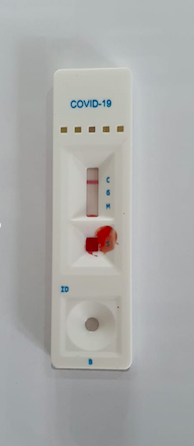
Antibody tests, unlike testing for the virus itself, detect the antibodies produced by our immune systems in response to infection. To envisage a lateral flow test, think about a pregnancy test. Instead of urine, a few drops of blood from a finger prick are mixed with a solution and applied to the device.

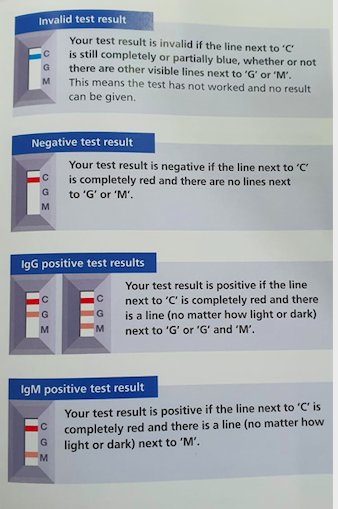
You then wait 10-15 minutes and the results can be read in the result window (image 2). There are many different versions of these tests out there, but the underlying principle is much the same. If you have the antibodies in your blood sample, they bind to viral proteins attached to gold particles. This forms an antibody-antigen-gold-particle complex which can be seen as the positive test line.

How good are the tests?

‘Confident’ isn’t a term we like to use in clinical science: we like the terms ‘sensitive’ and ‘specific’. We also like to use statistics to describe the sensitivity and specificity of a test. In the case of COVID-19, the sensitivity of the test is the proportion of people with COVID-19 that have a positive blood test. A test which is 100% sensitive means that all individuals with COVID-19 are correctly identified as having the disease. Conversely, specificity is the proportion of individuals without COVID that have a negative blood test. A test that is 100% specific means that all healthy individuals are correctly identified as not having COVID-19. It’s pretty hard for any clinical test to be this wonderful, but we are trying to get as close to this ideal as possible. The MHRA recommends these tests have a sensitivity of >98% and specificity of >98% (1). To date, none of the lateral flow assays to detect antibodies have met these criteria.

What are we using them for?

Testing for antibodies isn’t the same as testing for virus. A positive result means you were likely infected with COVID-19 in the past. This result should not be used to diagnose a current COVID-19 infection because it can take 1-3 weeks after infection for your body to make antibodies. We aren’t sure how long these antibodies are going to stick around either. Some viruses are very memorable to the immune system. Unfortunately, coronaviruses are pretty forgettable, and the ‘immunological memory’ – the antibodies against the SARS CoV-2 virus – may disappear in a matter of months. In the case of my friend, who took his antibody test in October to find out if he had COVID-19 in February, that negative result doesn’t mean very much.

This test only tells you that you’ve made antibodies to the virus, not how many are there and if they can stop reinfection. We don’t know if these antibodies are protective or if that makes you immune to the virus. You can also test positive for the virus and positive for antibodies at the same time, meaning you are still infectious. Best not to use the result to decide whether or not to visit Grandma.

The Bottom Line

Whilst I don’t love these tests for individual use, they are useful. By monitoring the prevalence of antibodies against SARS CoV-2 at a population level, we get a snapshot of what is happening in the country in the moment the test is taken. It tells us something about the antibody status of a community of individuals, helping to monitor the COVID-19 pandemic at a population level and more data will hopefully help immunologists better understand what on earth is going on with the immune response to this virus.

TLDR. Lateral flow tests for antibodies are best left for community studies and aren’t going to let you know if you had COVID-19 in January. You’ll just have to keep wondering.

Reference

  1. MHRA. Target product profile antibody tests to help determine if people have immunity to SARS-CoV-2, 2020. Available: https://assets.publishing.service.gov.uk/government/uploads/system/uploads/attachment_data/file/883897/Target_Product_Profile_antibody_tests_to_help_determine_if_people_have_immunity_to_SARS-CoV-2_Version_2.pdf

NB from Girlymicro. If you’d like to submit a guest book review or guest blog, drop me a line on the links on the right of the page

All opinions on this blog are my own