
I often worry about writing posts like this one, not because I’m worried about how needed they are, but because I’m not an expert. As a scientist I usually post in areas that I feel I have expertise in, and as Girlymicro I frequently post about my own lived experience. This post is different, as I’m in no way claiming any expertise on this, just a wish to do more and do it better.
The thing that led me to post is that I’ve been thinking about how many of us who are in influential positions, and placed to be better allies to make a difference to others, do not always feel like we know enough about how to be effective in that role. I tell myself that I will lead with intention in this area, and will just always try to do my best in every encounter and situation. Aiming for that rather than perfection. The problem with that entire sentence is that there are far too many I’s in it, however, and I feel like I’m missing the point. It should never be about me, but about the people I serve and those that I am in a position to support.
So, in that spirit, and after listening to a talk this month where BAME interviewees described that they felt they were not able to bring their 100% authentic selves to work, and in support of Pride month, I thought it’s time to stop making this about my uncertainty, stand up and post what I can about how we can be better allies.
Create safe spaces
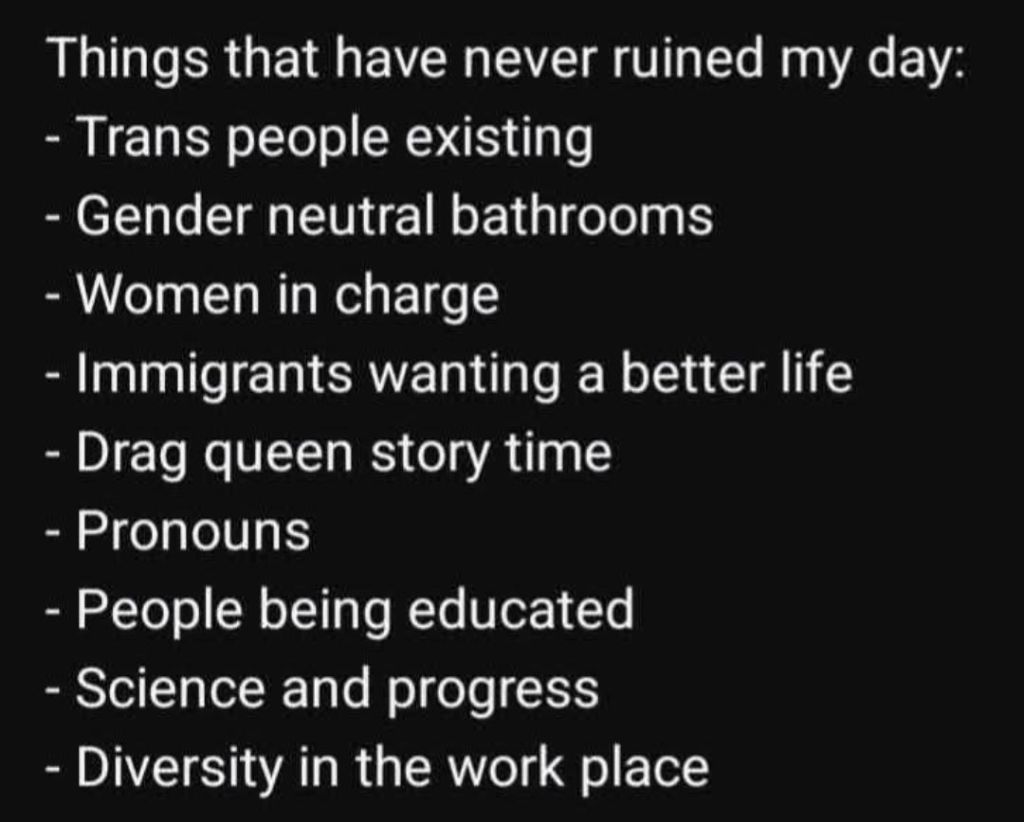
I have a saying at work that what happens in the bathroom stays in the bathroom. Now, if you don’t read this blog regularly that sentence may make no sense at all. My office at work is a converted bathroom cubicle, and it still says on-call bathroom on the door. I wrote last week how I didn’t feel like I had a safe space to cry or express how I was feeling when I was a trainee. I hope that the bathroom is now that space. Anyone can come into the bathroom for a chat, and what happens during that chat stays within those 4 walls. Sometimes people need to vent. Sometimes people need a safe space to be upset. Sometimes people need a safe space to check in and see whether something that has happened is OK or not. To raise concerns or talk something through. I’m also happy to be booted out of it at any time so someone has a safe space to process and have some time alone as needed.
Safe spaces aren’t just physical however, they are more often what you can provide to someone else as part of your interactions. A place where anyone can bring what they need for discussion, but also a space where they can be fully themselves without fear of judgement. A safe harbour so that, even if it’s for a few minutes each day, they don’t have to wear a mask. A place where they will feel heard and validated. This can be 1:1, but also ensuring you have networks and other peer spaces that can provide support. It is also about making spaces for others, in terms of creating space for opportunities and progression, that feel open and inclusive to anyone who wants to take them up.
Call out in the moment
It’s all very well trying to create safe spaces, but how do people know about them or that you can help and support. This one is about walking the walk. Not just talking about action, but being the action. It’s about being the person in the room who is fortunate enough to have a voice and being able to challenge in the moment when behaviour happens. Challenging when someone makes a homophobic joke, or reaches out to touch the hair of a colleague without their consent. To challenge the person who refuses to use someone’s chosen pronouns, makes inappropriate comments about someone else’s appearance, or calling out microaggressions to make their behaviour visible. Challenging in the moment, rather than making excuses for the behaviour, or letting it go ‘as it was just a one off’.
For me, this one is about being prepared to experience one tiny component of the level of discomfort of the person being targeted, in order to challenge the behaviour and demonstrate both allyship and, hopefully, lead to behaviour change from the instigator. Having sat and been the target in moments like this and been so shocked that I couldn’t respond. Having felt voiceless to protect myself. I’m so aware of the importance of someone else stepping up in that moment and how it can completely change how you then feel about having to continue to exist in that dynamic after the moment has happened. We have the capacity to be the person that steps in and with one sentence shuts down the scenario, and then follow on by offering support to the person impacted. All of which is much more powerful if you do it as it happens rather than at a later date.
Challenge the status quote
Culture is a difficult thing to change. I’ve worked in environments like warehouses and pubs, during my student days, where certain ways of speaking to people or joking were common place, but I found them very uncomfortable. I’ve been there and not had the courage to speak out. Now that I am older, hopefully more confident, and certainly a little braver, I see it as my job to try to raise awareness and tackle some of those cultural norms, as and when I find them. Trying to remind others, and challenge in a consistent way to address the culture as a whole, in an attempt to help with making that culture feel welcoming to everyone.
Another part of trying to influence and impact cultural change is awareness about how I offer opportunities. I used to think that just asking for volunteers and being open about the fact that the opportunity existed was enough. I’m now very aware now that that isn’t enough, as if someone feels marginalised, or invisible, they are unlikely to step forward. This is a work in progress for me as I’m aware that tapping people on the shoulder for opportunities is also not fair and transparent. So I’m currently trying to support individuals and boost confidence to throw their name into the hat, whilst still retaining the openness of opportunities. I’m sure over time I’ll find better ways, but I think as a starting point we should be aware of the complexities and not assume we’ve ‘fixed’ the disparity by taking a single straight forward approach. It’s also about being very open to feedback and input into how to do this better.
Demonstrate curiosity
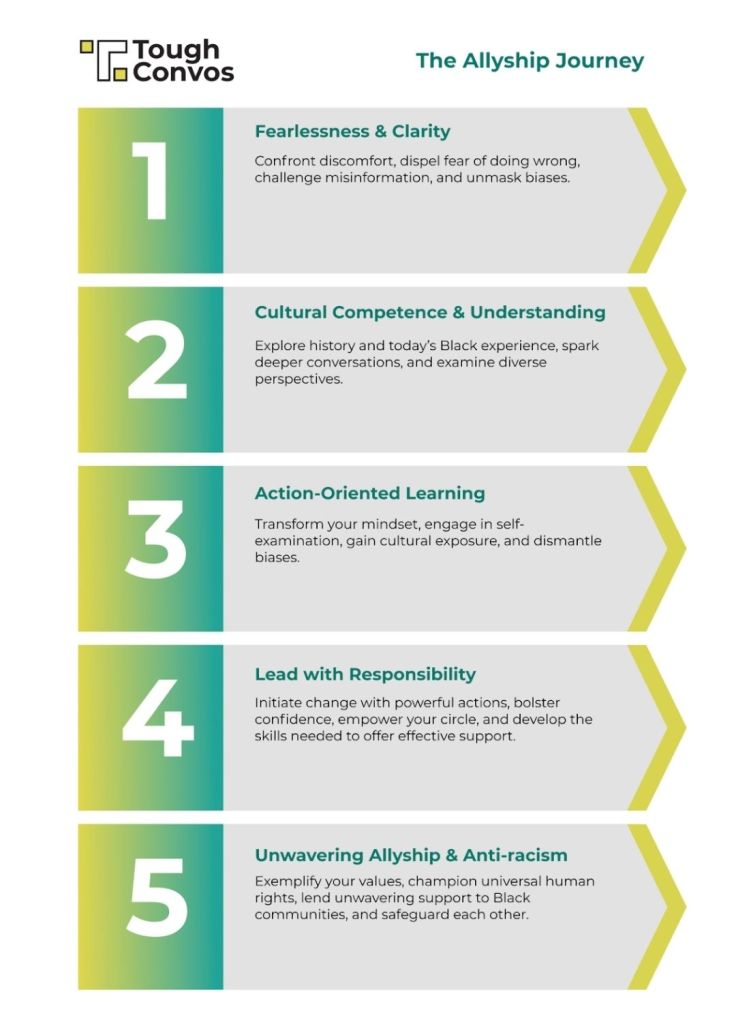
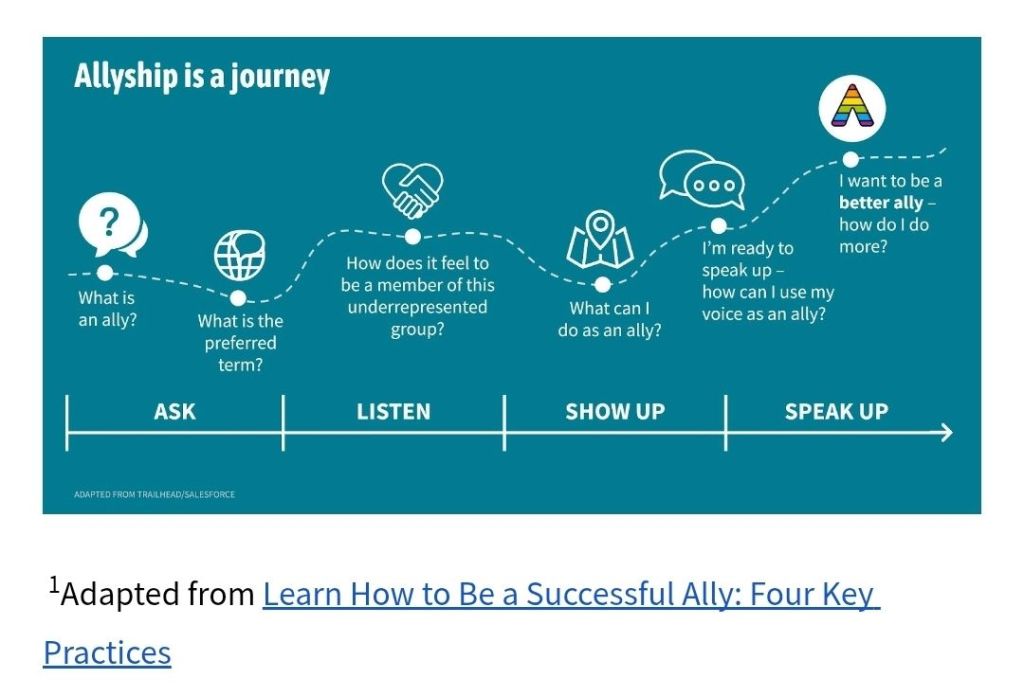
As part of the acknowledgement that I need to do better, I’ve been thinking a lot about and trying to engage with, how I can be better at tackling inequity in all the areas I’m involved with, and how to be a better ally. For me, at least, the first step is to always seating any change in openness and genuine curiosity. Curiosity and a wish to learn about different identities, biases, and how systemic issues impact the very people that the system should be set up to support.
Too often, as part of that wish to learn, we want to take the easy route and ask those most impacted to invest their time and energy to educate us, to tell us the answers, to validate that we are doing OK. This places a burden onto those who are already having to deal with the consequences of discrimination and bias, for the benefit of the very group that may be enacting the behaviour. If I want to know more about MRSA, I don’t ask the organism, and my starting place isn’t talking to others with the expectation that they will give me all their baseline knowledge. My starting place is to do my research, to read and access resources in order to give me the foundation to learn more. Being a better ally is no different. There are some great books out there. There is a trove of internet and other resources. More than that though, so much of this is about using that starting point to then undertake the self-reflection and self-work to start this journey. The more I think and explore, the more complex I realise this subject is, how much it depends on individuals and circumstances, and so being open to constant learning and development is key.

See with your eyes wide open
It is easy to be so focussed on your life, your lens, in the moment that you don’t pay enough attention to how others are acting and what they may be saying through actions other than words, that you aren’t present enough to be the ally that you want to be. You can fail to pay attention to the experiences of others, and fail to read their reactions, and thus fail to provide the support that is needed.
It is crucial that we challenge our own internal bias. There is so much from my position of white privilege that I need to recognise, that I need to actively be aware of and self monitor, as well as being aware of in others. It can be uncomfortable to turn that reflection onto ourselves, but to me that is a symbol of the very privilege we need to be aware of. Those from marginalised groups don’t have the option to choose to be uncomfortable or not, and so we need to be prepared to experience discomfort and face up to the fact that we will all have bias. There is often also a tendency to excuse or forgive behaviour that is linked to that privilege, and to impose standards or acceptance criteria on others based on that very biased starting point. We need to enter situations with our eyes wide open, prepared to fully see ourselves as well as others.

Own your own privilege
I come from a white middle class background. I am a female with a chronic health condition, but I would in no way consider myself to be disabled. I apply all of these labels to myself and I’m pretty certain that these and other labels are applied to me by others. I have experienced challenge because of those labels, but I am also aware of how much some of those labels protect me from the injustice, discrimination and physical risk felt by others. I’m aware of how much my privilege protects me and how much it has permitted me to have a voice that is not available to others.
No matter how much self reflection you do, it can be challenging to recognise your own bias, it’s referred to as hidden bias for a reason. You can reach out to peers, and those who know you well, but those responses often come with their own bias, and will be through a lens that probably takes into account your intent, rather than truly neutral. There are some good resources out there that you can use to recognise your own bias, and then include that awareness as part of your improvement journey. One of the big ones was developed by Harvard University, although there are plenty of other options out there:
- Implicit Association Test (IAT): This is a widely recognised test developed by Harvard University that helps individuals assess their own hidden biases.
These tests are based on speed of decision making and can be really enlightening as to underlying levels of bias across all kinds of different characteristics.

Address the systematic issues
There is bias and discrimination in all settings. Some of it is embedded in the very systems that should be there to protect from and remove it. Some settings are definitely worse than others, and some characteristics are definitely more targeted than others. It is everywhere though, and we should all acknowledge that and actively look for it in order to tackle it, rather than sitting in our comfortable space as we are less impacted.
The start of this for me is to own the responsibility and look at policies and structure with fresh eyes to determine whether our systems actually are fit for purpose. Whether they are merely ticking boxes, or are actually set up in a way that excludes people, and then work to be the change and influence it to make those systems better. This can be everything from basic things, like are meetings routinely organised at 8am or 6pm, thus excluding people with caring commitments, or the lack of provision of prayer space, to the need to look at recruitment processes to remove the influence of intrinsic bias. There is so much that can be done, and we all have a responsibility to start somewhere and drive for continuous improvement.

Connect with other leaders
One key way to make sure that we make enough impact is to ensure that we are including these discussions in all the leadership spaces that we occupy. Making sure that it is including on evaluation and review criteria, as well as on agendas to support reflection and action. Collective leadership is much more likely to lead to sustained change, and so it is crucial to build the networks that will allow this change to happen. A word of warning on this one, if you look at the make up of equality, diversity and inclusion committees, they are often made up more of the individuals with characteristics that face the challenges than the allies that have power in places that would support improvements. As leaders, we need to be prepared to invest our time and energy, even in the spaces that may not benefit us as individuals, in fact, even more so if we are not the ones that will benefit. We also need to share the learning and data we get, so that the same lesson doesn’t have to be learned multiple times, but that a single experience leads to positive change for everyone.
Embrace advocacy
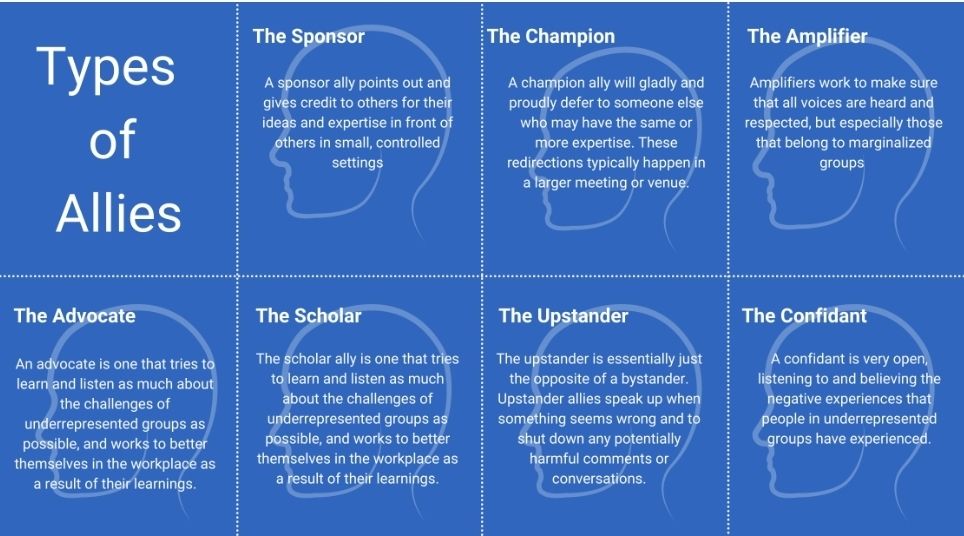
There are all kinds of ways to be an ally, but the most important thing is that you are consistent in your behaviour, and that you lead the way in behaving as you would want others to behave. Sometimes, the most appropriate kind of ally role will depend upon the situation and circumstance you find yourself in. Most types of behaviours, however, are ones that we should embed in all of our interactions. It is just good practice to acknowledge the work of others and give recognition of work done, so that it is recognised by everyone in the room. All of us should defer to individuals who have greater knowledge than ourselves, and hold spaces, so that the person with the most amount of expertise is able to fulfil that role. These behaviours are beneficial as a leader irrespective of scenario, but are especially important to ensure that those who are often overlooked, or silenced, are heard.
Consciously signal support
Finally, part of the power of leadership is the impact that conscious signalling of support can have, not just for individuals, but on changing culture. These can be small steps, like the inclusion of pronouns on your email signature, meaning that you are open to others sharing theirs with you in return. It can be something like wearing an inclusive lanyard or badge, that signals you are open and supportive. One of the big things for me is being clear that I am open to challenge and willing to learn and grow from my mistakes. I will, on occasion, mess up someone’s pronouns or name pronunciation, never on purpose. I will always try and clarify and act on the information received, but I am far from perfect. I want to accept criticism and correction, to hear it constructively and become better as a result. It is no good knowing you wish to be a safe space if you don’t let others know. People won’t give you constructive feedback if you don’t signal that you are open to the learning. Let’s make sure that we the only part of this conversation that is about us is on how we can do it better, in order to be better leaders, followers, and members of our communities.

All opinions in this blog are my own
 Girlymicro
[…] The World Needs More Allies: How can we support each other better to feel comfortable to be our… […]
LikeLike